
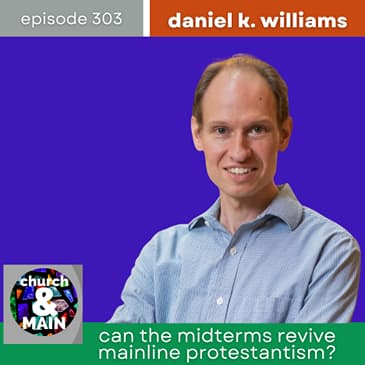
Four white mainline Protestant pastors are running for Congress this year. A generation ago, that would have been hard to imagine. Could it spark a revival for a tradition many have written off?
In this episode of Church and Main, Dennis Sanders talks with Daniel K. Williams, a historian of American religion and politics at Ashland University in Ohio.
The conversation stems from Williams’ Substack article, where he argues that the midterms could be “an important first step in rehabilitating the cultural image of mainline Protestantism for a younger generation of progressives.” Dennis and Williams look at why white mainline pastors have mostly stayed out of electoral politics, why that may be changing now, and what it could mean for the pews.
In This Episode:
- [10:03] Why religious traditions rarely disappear and instead reinvent themselves, and why mainline decline isn’t a straight line to collapse
- [16:48] Why pastors stayed out of office: congregations that are politically divided, and a “prophetic voice” tradition wary of getting cozy with power
- [21:26] What changed: the Trump era, the denominational splits of the 2010s, and a Democratic Party more open to faith
- [28:17] Whether denominations will sort politically the way the parties have, and the challenge of attracting younger members
- [33:10] Adam Hamilton and the surprising idea of a progressive mainline megachurch
- [36:04] Which Pew political groups the mainline might be uniquely poised to welcome, from loyal liberals to Republicans uneasy with the party’s direction
- [40:08] How prominent candidates change the public image of a tradition, with Jimmy Carter and J.D. Vance as examples, and the possible return of a vocal religious left
- [45:38] What white mainline pastors can learn from the Black church about preaching prophetically while doing the work of governing, including Raphael Warnock and John Lewis
Links
- Daniel K. Williams’ Substack article on the midterms and the mainline
- Faith leaders on the ballot: 12 races to watch from Religion News Service
-
Facebook (https://www.facebook.com/churchandmain) | Instagram (https://www.instagram.com/churchandmainpod/) | Threads (https://www.threads.net/@churchandmainpod) | Website (https://churchandmain.org/) | YouTube (https://www.youtube.com/@churchmainpodcast) | Substack (https://churchandmain.substack.com/)
Enjoyed this episode? Subscribe to Church and Main on your favorite podcast app, leave a review, and visit churchandmain.org or churchandmain.substack.com to read more and support the show. Send an email to dennis@churchandmain.org.
00:00:27 --> 00:00:32 Hey, everyone. Welcome to Church and Main, a podcast for people interested
00:00:32 --> 00:00:37 in the intersection of faith, politics, and culture. I'm Dennis Sanders, your host.
00:00:38 --> 00:00:40 I hope that your October is going well.
00:00:42 --> 00:00:45 So, I want to share some names here.
00:00:46 --> 00:00:52 James Tallarico, Adam Hamilton, Lindsay James, Sarah Trone Garrett,
00:00:53 --> 00:00:59 What do these names all have in common? Well, most of you by now know of James
00:00:59 --> 00:01:03 Tallarico, and a number of you might know of Adam Hamilton.
00:01:04 --> 00:01:09 The common denominator for all four of these people is that they are all white
00:01:09 --> 00:01:10 mainline Protestant pastors.
00:01:11 --> 00:01:16 Hamilton is the lead pastor of Church of the Resurrection in suburban Kansas City.
00:01:17 --> 00:01:21 He is the leader of one of the largest congregations in the United Methodist Church.
00:01:22 --> 00:01:26 Lindsay James is a minister in the Presbyterian Church USA.
00:01:27 --> 00:01:31 Sarah Terrone Garrett is a minister in the Evangelical Lutheran Church in America.
00:01:32 --> 00:01:39 And James Tallarico is currently in seminary to become a pastor in the Presbyterian Church USA.
00:01:40 --> 00:01:44 But that's not the only thing that they have in common. The other thing is that
00:01:44 --> 00:01:47 they're all running for Congress in this year's midterms.
00:01:48 --> 00:01:51 Tallarico and Hamilton are running for Senate and they're running for Congress.
00:01:51 --> 00:01:56 In Texas and Kansas, respectively, while James and Garrett are running for the
00:01:56 --> 00:01:59 house in various districts in Iowa.
00:02:00 --> 00:02:06 Now, the fact that all of this is happening is kind of unusual because for quite
00:02:06 --> 00:02:12 some time, white mainline Protestant pastors basically sat out of running for office.
00:02:13 --> 00:02:19 Now, it's not unusual to see evangelical and black church pastors.
00:02:22 --> 00:02:26 Run for office and win and serve in Congress. So for example,
00:02:27 --> 00:02:33 Georgia Senator Raphael Warnock is the pastor of the historic Ebenezer Baptist Church in Atlanta.
00:02:34 --> 00:02:40 But for a lot of white mainline pastors, it made more sense to be activists
00:02:40 --> 00:02:46 than it was to be running in order to be as the song in the musical Hamilton
00:02:46 --> 00:02:48 goes in the room where it happens.
00:02:49 --> 00:02:54 So is this all happenstance, and what does it mean for mainline Protestantism?
00:02:55 --> 00:03:00 Now, the religious historian Daniel K. Williams thinks that these four candidates,
00:03:01 --> 00:03:07 if they can pull it off, it could create a spark that could revitalize mainline Protestantism.
00:03:08 --> 00:03:11 In a recent Substack article, Williams wrote the following, quote,
00:03:12 --> 00:03:16 I suspect that if James Tallarico's Senate campaign is successful, and,
00:03:17 --> 00:03:23 that if he is joined in Congress by a few other mainline Protestant clergy who are Democrats,
00:03:24 --> 00:03:28 this will likely be an important first step in rehabilitating the cultural image
00:03:28 --> 00:03:33 of mainline Protestantism for a younger generation of progressives.
00:03:34 --> 00:03:40 So today, I'm talking with Daniel K. Williams about how the midterms could revitalize
00:03:40 --> 00:03:41 mainline Protestantism.
00:03:43 --> 00:03:47 Before we go into that conversation a little bit about Daniel,
00:03:48 --> 00:03:54 he is a historian of American Religion and Politics, teaching at Ashland University in Ashland, Ohio.
00:03:55 --> 00:03:59 He holds a PhD from Brown University and taught for 18 years at the University
00:03:59 --> 00:04:02 of West Georgia before moving to Ashland.
00:04:03 --> 00:04:07 He's the author of five books, and that includes God's Own Party,
00:04:07 --> 00:04:13 The Making of the Christian Right, Defenders of the Unborn, The Pro-Life Movement Before Roe v.
00:04:13 --> 00:04:17 Wade, The Election of the Evangelical, Jimmy Carter, Gerald Ford,
00:04:17 --> 00:04:22 and the Presidential Contest of 1976, and The Politics of the Cross,
00:04:22 --> 00:04:24 A Christian Alternative to Partisanship.
00:04:26 --> 00:04:32 As we are a little over 10 days out at the time of this recording from the midterm
00:04:32 --> 00:04:36 elections, I think this is an important conversation to have.
00:04:36 --> 00:04:42 So, here is my discussion with Daniel K. Williams on Pastors,
00:04:43 --> 00:04:46 Congress, and the Revitalization of Mainline Protestantism.
00:05:06 --> 00:05:10 Well, thank you for joining me here today. I kind of wanted to start out to
00:05:10 --> 00:05:16 know a little bit about who you are and your spiritual faith background. Sure.
00:05:17 --> 00:05:23 Well, I'm a Christian, and I have been at different points on the Christian
00:05:23 --> 00:05:24 spectrum during my life.
00:05:25 --> 00:05:30 So I grew up in a very conservative Protestant tradition,
00:05:31 --> 00:05:34 the Churches of Christ, known, if people know them at all, they probably know
00:05:34 --> 00:05:42 them as non-instrumental wings of the larger Restorationist movement that produced
00:05:42 --> 00:05:44 the Disciples of Christ and the Christian Church.
00:05:44 --> 00:05:49 But Churches of Christ are the more conservative wing of that.
00:05:49 --> 00:05:54 And I grew up in a pretty theologically and politically conservative home.
00:05:55 --> 00:06:01 And then after college, went to graduate school at Brown University and studied,
00:06:02 --> 00:06:09 American history, but I was drawn to the history of American Christianity and American politics.
00:06:09 --> 00:06:15 I did a lot of reading for my preliminary exams on African American history,
00:06:15 --> 00:06:16 the history of the Black Church.
00:06:16 --> 00:06:22 That challenged my assumptions, and I decided that I wanted to investigate the
00:06:22 --> 00:06:29 larger political context in which the evangelical tradition.
00:06:31 --> 00:06:35 In the United States became allied with the Republican Party in the late 20th
00:06:35 --> 00:06:41 century. So that became my dissertation and my first book, God's Own Party,
00:06:41 --> 00:06:42 The Making of the Christian Right.
00:06:43 --> 00:06:48 And I stayed with Churches of Christ for quite some time.
00:06:49 --> 00:06:57 I went through a faith crisis in the early part of my academic career after graduate school.
00:06:57 --> 00:07:04 That prompted me to eventually find my way into a mainline Presbyterian congregation.
00:07:04 --> 00:07:07 I was with that group for a while. I ended up,
00:07:10 --> 00:07:16 Becoming more convinced, I think, of the truth of an evangelical form of Reformed
00:07:16 --> 00:07:19 theology. So I appreciated some things that I found in the main line,
00:07:19 --> 00:07:22 but also disagreed with other things.
00:07:23 --> 00:07:29 For about seven years, my wife and I were part of a congregation affiliated
00:07:29 --> 00:07:31 with the Presbyterian Church in America.
00:07:32 --> 00:07:37 And right now, we're part of an evangelical free church where I do some Sunday
00:07:37 --> 00:07:38 school teaching and I'm serving.
00:07:40 --> 00:07:44 As an elder. So I view myself as someone who is.
00:07:46 --> 00:07:53 Situated within evangelical Protestantism, certainly very interested in other
00:07:53 --> 00:07:59 traditions, open to learning from other traditions and writing about other traditions.
00:07:59 --> 00:08:07 I certainly, in my own scholarship, try to treat each group fairly trying to
00:08:07 --> 00:08:12 recognize their perspective so about a year ago I published the book Abortion
00:08:12 --> 00:08:14 in America's Churches which looks at.
00:08:15 --> 00:08:22 How various theological traditions in modern America, mainline Protestantism,
00:08:22 --> 00:08:25 Catholicism, evangelical Protestantism, the black church,
00:08:26 --> 00:08:32 have changed in their perspective on abortion over time or have engaged with
00:08:32 --> 00:08:33 abortion in different ways or have
00:08:33 --> 00:08:36 debated that topic and have arrived at different points on the spectrum.
00:08:37 --> 00:08:44 And I hope if I've been successful that I'm trying to treat each tradition fairly,
00:08:44 --> 00:08:50 recognizing change over time as well as continuities in that tradition.
00:08:51 --> 00:08:55 So there are times where i will write uh,
00:08:56 --> 00:09:00 from a perspective of the theological convictions of evangelicalism there are
00:09:00 --> 00:09:04 times where i will write from the perspective of of critiquing certain aspects
00:09:04 --> 00:09:06 of the evangelical tradition that i find,
00:09:07 --> 00:09:12 problematic especially when it comes to some of its political choices and there
00:09:12 --> 00:09:14 are times maybe most often where i try to write,
00:09:15 --> 00:09:21 as a historian who is interested in understanding people on their own terms and analyzing.
00:09:23 --> 00:09:28 How those perspectives have shaped American democracy as well as the church.
00:09:29 --> 00:09:33 Yeah. And just so you know, I'm actually an ordained minister in the Disciples
00:09:33 --> 00:09:38 of Christ. Okay. So, yeah. So, you are familiar with this larger tradition.
00:09:38 --> 00:09:40 Yeah. Wonderful. Wonderful.
00:09:41 --> 00:09:45 So I wanted to talk to you about the article that you wrote in your substack,
00:09:45 --> 00:09:48 which is called The Politics at the Cross.
00:09:48 --> 00:09:53 And the article was about how you thought that this year's midterm elections
00:09:53 --> 00:09:55 could revitalize the main line.
00:09:56 --> 00:10:02 Could you kind of give a synopsis of what you were trying to get at in that article? Sure.
00:10:03 --> 00:10:10 One of the things that I have always taken issue with is the assumption that
00:10:10 --> 00:10:13 so many people outside of mainline Protestantism,
00:10:13 --> 00:10:19 and especially in evangelicalism, which, as I said, is a tradition that I would
00:10:19 --> 00:10:24 identify with and am very conversant with, but don't always agree with.
00:10:24 --> 00:10:30 And one of the issues that I have with a claim that some people in that tradition
00:10:30 --> 00:10:36 have made that mainline Protestantism is on its way out the door,
00:10:36 --> 00:10:39 so to speak, that it's rapidly declining and will soon disappear,
00:10:40 --> 00:10:45 is that religious traditions in this country very rarely completely disappear.
00:10:45 --> 00:10:48 It's more common that they will reinvent themselves. And of course,
00:10:48 --> 00:10:55 mainline Protestantism has evolved and reinvented itself at several points along the way.
00:10:56 --> 00:11:01 And so, disciples of Christ today are not exactly like the disciples.
00:11:02 --> 00:11:06 Mainline or liberal wing of disciples of Christ were in the early 20th century.
00:11:06 --> 00:11:09 There are some continuities, but there are also some changes,
00:11:09 --> 00:11:11 some cultural influences.
00:11:11 --> 00:11:18 And I think it's probably reasonable to expect that we're going to see some
00:11:18 --> 00:11:22 sort of evolution in mainline Protestantism rather than to see,
00:11:23 --> 00:11:28 a complete eroding of that tradition, as some people have suggested uh it is
00:11:28 --> 00:11:32 true i think it's no secret to anyone that we have seen,
00:11:33 --> 00:11:37 membership declines in mainline protestant denominations over the last 50 years
00:11:37 --> 00:11:40 and especially over the last 10 to 20 years and,
00:11:41 --> 00:11:50 yet i think it would be a mistake to simply draw out those uh graphs and expect
00:11:50 --> 00:11:54 the trend lines to continue unabated until 20 or 30 years from now we see,
00:11:54 --> 00:11:57 uh a complete collapse of the mainline.
00:11:57 --> 00:12:03 So the question is, if mainline Protestantism is likely to evolve,
00:12:03 --> 00:12:06 is likely to continue changing to meet.
00:12:08 --> 00:12:13 Contemporary needs, what is it going to become? It's highly unlikely to ever
00:12:13 --> 00:12:15 again become what it was in the 1950s,
00:12:15 --> 00:12:25 a default option for most uh americans and and maybe the default uh cultural
00:12:25 --> 00:12:29 influencer that it once was but nevertheless the question is what are what are
00:12:29 --> 00:12:30 these churches going to become and so,
00:12:31 --> 00:12:35 when i began to see political changes this year that,
00:12:36 --> 00:12:40 were directly related to the mainline i realized that what i might be seeing,
00:12:40 --> 00:12:47 is a sign of how the mainline is evolving uh in certain ways uh,
00:12:48 --> 00:12:52 On my political radar, at least, this started with James Tallarico in the spring.
00:12:52 --> 00:12:58 There was a lot of press coverage of James Tallarico as a Democratic candidate
00:12:58 --> 00:13:03 for the U.S. Senate in Texas. And I remember in the primary races,
00:13:04 --> 00:13:06 observing his campaign, I even wrote a little bit about it.
00:13:07 --> 00:13:15 I noted that he was a fascinating candidate because here he was in a Bible Belt state,
00:13:16 --> 00:13:24 but not coming from a Southern Baptist church or an explicitly evangelical background,
00:13:24 --> 00:13:30 rather coming from a mainline Protestant seminary and a mainline Protestant denomination.
00:13:31 --> 00:13:35 Allowing his particular social justice commitments and faith commitments that
00:13:35 --> 00:13:40 have been shaped by those experiences to influence his politics.
00:13:40 --> 00:13:46 But at the time, I viewed this as very interesting, but maybe interesting because
00:13:46 --> 00:13:50 it was unusual, and I wasn't necessarily expecting to see more of that in the campaign.
00:13:50 --> 00:13:55 Of course, Tallarico won the nomination. Now he's considered an extremely competitive
00:13:55 --> 00:14:01 candidate for this position. He may even win, becoming the first Democratic,
00:14:01 --> 00:14:04 senator from Texas in a couple of decades. And.
00:14:05 --> 00:14:11 But not only that, but there are other mainline Protestants who take their faith
00:14:11 --> 00:14:15 seriously, and not just active lay members or even seminarians,
00:14:15 --> 00:14:17 but ordained ministers.
00:14:17 --> 00:14:24 So we have Adam Hamilton, for example, running for a U.S.
00:14:24 --> 00:14:31 Senate seat in Kansas. We have a couple of pastors, mainline Protestant pastors in Iowa,
00:14:31 --> 00:14:37 women who are running for House seats and polls show that some of these people
00:14:37 --> 00:14:40 may well win their races.
00:14:40 --> 00:14:43 This is projected, at least according to contemporary polls,
00:14:44 --> 00:14:49 to be a good year for Democrats and therefore maybe a good year for some of
00:14:49 --> 00:14:54 these candidates who are in ordinarily red states. They might be able to flip them.
00:14:54 --> 00:14:58 If that happens, and of course, that's still unknown, but if that happens,
00:14:58 --> 00:15:03 I think it's going to change not only American politics, but the image of the
00:15:03 --> 00:15:06 predominantly white Protestant mainline.
00:15:06 --> 00:15:11 African American pastors have been active in politics for a very long time,
00:15:11 --> 00:15:14 going back to the mid-20th century, if not before.
00:15:15 --> 00:15:20 But white mainline Protestant pastors have not been very active in recent years.
00:15:21 --> 00:15:24 They've been very active in speaking out on political questions,
00:15:24 --> 00:15:27 in lobbying, in writing, in.
00:15:29 --> 00:15:37 Making their sermons applicable to contemporary social justice issues and therefore political questions.
00:15:38 --> 00:15:39 But in terms of running for office...
00:15:40 --> 00:15:46 At least in recent years, in the last 20 or 30 years, mainline Protestant pastors
00:15:46 --> 00:15:52 have been less likely than ordained evangelical white ministers or certainly,
00:15:52 --> 00:15:54 ordained African American ministers,
00:15:55 --> 00:15:57 to run for office. But that may be changing.
00:15:58 --> 00:16:05 And if it is changing, I think it may signal to a younger generation of progressives
00:16:05 --> 00:16:12 that at least one wing of Christianity is very comfortable with progressive politics.
00:16:12 --> 00:16:17 And that the phenomenon that we have generally seen over the last 50 years,
00:16:17 --> 00:16:20 at least 40 years, I guess, of seeing,
00:16:21 --> 00:16:28 a divergence between the church-going habits of white progressives and white
00:16:28 --> 00:16:31 conservatives, where white conservatives are much more likely to go to church,
00:16:31 --> 00:16:32 than white progressives.
00:16:33 --> 00:16:38 While that's probably not going to change overnight at least this would be an
00:16:38 --> 00:16:45 opening signal that maybe that cultural stereotype doesn't have to hold true.
00:16:48 --> 00:16:53 Why do you think that this is happening now? I think you mentioned in the article,
00:16:53 --> 00:16:56 and I do know this also just because I follow politics,
00:16:57 --> 00:17:02 that the last really mainline, white mainline Protestant pastor that was in,
00:17:04 --> 00:17:07 this elected was John Danforth.
00:17:08 --> 00:17:13 He's an Episcopal priest, and he left office 30 years ago.
00:17:14 --> 00:17:20 So, why has there kind of been a dearth of politicians that have,
00:17:20 --> 00:17:22 I mean, I know that there have been some that have run for office,
00:17:22 --> 00:17:26 but that have not had that kind of,
00:17:26 --> 00:17:29 that it's a possibility that they could win.
00:17:30 --> 00:17:37 Right i think that there are several things going into this so the question i guess,
00:17:38 --> 00:17:43 the first question would be why why was there this this lack of political involvement
00:17:43 --> 00:17:46 and by lack of political involvement of course i don't mean that,
00:17:46 --> 00:17:49 mainline protestants weren't talking about politics but in terms of actually
00:17:49 --> 00:17:54 running for office as ordained ministers there was there was that gap?
00:17:56 --> 00:18:01 Why was there that retreat, so to speak? And then the second part of the question
00:18:01 --> 00:18:05 would be, well, why now? Why is there this sudden interest in that?
00:18:06 --> 00:18:09 The first part of the question I would say is that.
00:18:12 --> 00:18:19 I think that mainline Protestant pastors have been conflicted about partisan
00:18:19 --> 00:18:25 politics to a degree that may surprise those who are outside the tradition.
00:18:25 --> 00:18:31 So, polls have shown, going all the way back to the late 1980s,
00:18:31 --> 00:18:35 or the earliest polls on this that I know of, but going all the way back to
00:18:35 --> 00:18:38 the late 1980s, and I suspect this was true before the 1980s.
00:18:40 --> 00:18:45 White mainline Protestant pastors have, in general, leaned toward the liberal
00:18:45 --> 00:18:47 side of the political spectrum.
00:18:47 --> 00:18:50 More have identified as political liberals than as political conservatives.
00:18:51 --> 00:18:55 In recent years, as we've seen the sorting of the parties along ideological
00:18:55 --> 00:18:59 lines, far more register as Democrats than register as Republicans.
00:19:00 --> 00:19:07 And I think that's only become more pronounced as seminaries over the last decade
00:19:07 --> 00:19:11 or so have been giving increased attention to social justice issues.
00:19:12 --> 00:19:20 However, However, most white mainline Protestant pastors also serve congregations that,
00:19:21 --> 00:19:25 at best, are politically divided, and in many cases actually lean politically
00:19:25 --> 00:19:32 conservative, because polls have also shown that mainline Protestants in general
00:19:32 --> 00:19:36 who are white, and church-going mainline Protestants in particular,
00:19:37 --> 00:19:40 tend to lean more toward the Republican side than the Democratic side.
00:19:40 --> 00:19:47 And that's not a recent phenomenon, but it also seems to be becoming even more
00:19:47 --> 00:19:48 pronounced in recent elections.
00:19:48 --> 00:19:54 And so a lot of mainline Protestant pastors have been peacemakers within their
00:19:54 --> 00:19:57 own churches. They have spoken out on certain political questions,
00:19:58 --> 00:20:01 but I think there's a sense that.
00:20:03 --> 00:20:09 Their ministry would be in some way incompatible with a direct partisan stance,
00:20:09 --> 00:20:13 which of course running for elected office does require one to,
00:20:15 --> 00:20:19 embrace a partisan label and everything that goes with that.
00:20:21 --> 00:20:26 I think there's also been a sense among the more progressive mainline Protestant
00:20:26 --> 00:20:30 pastors that the church should have a prophetic voice.
00:20:31 --> 00:20:37 And part of that is maybe a suspicion of running for office.
00:20:37 --> 00:20:45 So in the late 1960s, mainline Protestantism in general shifted from being very comfortable with.
00:20:47 --> 00:20:51 The corridors of power, so to speak, a fairly close relationship with the Eisenhower
00:20:51 --> 00:20:56 administration and the Johnson administration and the Great Society toward becoming
00:20:56 --> 00:20:59 more skeptical about Washington politicians.
00:20:59 --> 00:21:04 The idea of speaking truth to power means critiquing liberal Democrats as well
00:21:04 --> 00:21:07 as Republicans, of saying that,
00:21:07 --> 00:21:11 maybe they could support Johnson's great society, but were very critical of
00:21:11 --> 00:21:16 his stance in the Vietnam War, or saying they appreciated the Civil Rights Act
00:21:16 --> 00:21:20 of 1964 and the Voting Rights Act of 1965, but wanted to pressure the administration,
00:21:21 --> 00:21:24 to not retreat from civil rights in the late 1960s.
00:21:26 --> 00:21:28 And that idea that that.
00:21:29 --> 00:21:36 We need to speak truth even to progressive politicians to push them further
00:21:36 --> 00:21:39 and maybe not get too cozy to the corridors of power,
00:21:40 --> 00:21:45 that also would tend to mitigate against running for office, at least for some.
00:21:45 --> 00:21:49 And so with those who are serving more conservative congregations feeling conflicted,
00:21:49 --> 00:21:54 and those who are maybe more progressive feeling like they would compromise
00:21:54 --> 00:21:56 something of their prophetic witness if they ran for office.
00:21:57 --> 00:22:01 It was easier just not to run for office. But I think we're in a changed moment.
00:22:01 --> 00:22:06 And I would say that the changes in that moment have been, one,
00:22:07 --> 00:22:13 the election of Donald Trump twice, and everything that goes with that.
00:22:13 --> 00:22:16 And I think for those who are.
00:22:18 --> 00:22:24 More progressive or more liberal and who view the Trump administration as a
00:22:24 --> 00:22:30 threat to American democracy in a way that maybe no previous presidential administration has equaled,
00:22:31 --> 00:22:37 that that can lead people to take stances that they wouldn't otherwise have taken.
00:22:37 --> 00:22:41 So just as during the revolution, even some Quakers took up arms,
00:22:41 --> 00:22:47 and during the Civil War, some pacifist abolitionists decided to embrace the
00:22:47 --> 00:22:51 Union cause, there can be something about the urgency of a particular moment,
00:22:51 --> 00:22:55 where people reevaluate previous stances and say, well,
00:22:56 --> 00:22:57 what is this current moment calling me to?
00:22:57 --> 00:23:02 And probably the most famous example of that in global mainline Protestantism
00:23:02 --> 00:23:06 would be Dietrich Bonhoeffer and his decision to do things that he ordinarily
00:23:06 --> 00:23:10 would not have done in opposing Hitler because of the magnitude of the evil.
00:23:10 --> 00:23:15 So I don't think that the refusal to run for office was.
00:23:16 --> 00:23:23 On the level of a strong Christian conviction that would equal the Quakers'
00:23:23 --> 00:23:30 pacifism or Dietrich Bonhoeffer's previous convictions about what a Christian should or should not do.
00:23:30 --> 00:23:33 But I would say, if we make this analogy from the greater to the lesser,
00:23:33 --> 00:23:36 if in these moments of crisis,
00:23:36 --> 00:23:40 Christians who thought they were pacifists or who thought they needed to take
00:23:40 --> 00:23:45 a particular stand in one direction, rethought that because of the urgency of the moment.
00:23:45 --> 00:23:50 It's not too surprising that a political
00:23:50 --> 00:23:56 crisis would produce that sort of rethinking on the part of some.
00:23:57 --> 00:24:00 But there are at least a couple other things that have also contributed to this.
00:24:00 --> 00:24:08 One, I think, is that the mainland Protestant tradition went through a pretty
00:24:08 --> 00:24:14 profound fracturing in the 2010s in several different traditions.
00:24:14 --> 00:24:20 So the United Methodist Church would be the largest of these groups that splintered.
00:24:21 --> 00:24:27 Uh smaller groups that splintered would be uh the episcopal church um to a lesser extent,
00:24:28 --> 00:24:31 uh the uh the e the elca and and the,
00:24:31 --> 00:24:36 the pc usa has divided several times but it divided once again over the last
00:24:36 --> 00:24:40 15 years all over the same issue really uh which would be the issue of sexuality
00:24:40 --> 00:24:46 but behind that would be um a constellation of other factors that that.
00:24:47 --> 00:24:53 Meant that a sizable minority of theological and, to a certain degree,
00:24:53 --> 00:24:59 political conservatives moved out of each of those denominations.
00:24:59 --> 00:25:06 And so the mainline has become more politically, socially,
00:25:07 --> 00:25:16 and theologically progressive over the last 10 or 15 years than it was in the very early 2000s.
00:25:16 --> 00:25:24 In the 1990s, most mainline Protestant denominations had a sizable conservative wing that would,
00:25:25 --> 00:25:32 prevent those denominations from moving too far left of center on a lot of questions,
00:25:32 --> 00:25:36 like questions about the Israel-Palestinian question or questions of abortion
00:25:36 --> 00:25:38 or especially questions of sexuality.
00:25:39 --> 00:25:43 But once those splits took place,
00:25:44 --> 00:25:53 those smaller mainline Protestant denominations became more uniformly progressive,
00:25:53 --> 00:25:54 at least at the pastoral level.
00:25:55 --> 00:26:02 And that in turn, I think, would create a culture in which even if the congregations
00:26:02 --> 00:26:09 didn't always move as far to the progressive side as maybe the overall denomination did.
00:26:11 --> 00:26:18 There was a new political culture that would encourage a certain type of partisan engagement.
00:26:19 --> 00:26:26 But then finally, I think we're at a moment where the Democratic Party is welcoming religion and,
00:26:27 --> 00:26:31 to an extent that maybe wasn't fully evident just a few years ago.
00:26:31 --> 00:26:37 And this has happened in several waves. So there was a moment in 2006 when something
00:26:37 --> 00:26:46 similar happened where in the aftermath of John Kerry's defeat in his presidential campaign in 2004,
00:26:46 --> 00:26:52 the headlines were that social conservatives in Ohio really pushed the vote to George W.
00:26:52 --> 00:26:57 Bush and that maybe the Democratic party had lost touch with religion.
00:26:57 --> 00:27:00 And so in 2006, there was an effort to try to rediscover that there was more
00:27:00 --> 00:27:06 excitement over, uh, Barack Obama, uh, reaching out with his own faith testimony,
00:27:06 --> 00:27:09 reaching out to, uh, voters of faith.
00:27:10 --> 00:27:16 And I, I think these, these moments occur in waves, but certainly there has
00:27:16 --> 00:27:22 been an interest on the part of some, not all Democrats. I think the democratic party is certainly, um.
00:27:25 --> 00:27:29 Certainly multifaceted and maybe even quite divided in some respects.
00:27:29 --> 00:27:33 But there are some who have said we really need to find a way,
00:27:33 --> 00:27:42 especially in conservative red states or purple states, to speak to voters of faith.
00:27:43 --> 00:27:49 And I think that has given rise to an excitement over campaigns like Tallarico,
00:27:49 --> 00:27:52 where people are saying maybe Tallarico,
00:27:53 --> 00:27:58 would not be the right candidate for Vermont, but maybe he is the right candidate for Texas.
00:27:59 --> 00:28:01 And I think,
00:28:03 --> 00:28:08 if he can win or if others like him can win, then I think that would solidify,
00:28:09 --> 00:28:15 that point of view within the Democratic Party in a way that maybe we haven't seen recently.
00:28:17 --> 00:28:21 One of the things that you say in the article, and we just talked about here
00:28:21 --> 00:28:28 earlier, is that while pastors in mainline denominations have become more progressive
00:28:28 --> 00:28:32 over time, their congregants haven't.
00:28:34 --> 00:28:42 And you have said that this time could be an opportunity to speak to more progressive
00:28:42 --> 00:28:44 voters who don't go to church.
00:28:46 --> 00:28:49 Which brings up the question of kind of what does that mean for,
00:28:51 --> 00:28:54 you know, for lack of a better term, purple congregations.
00:28:55 --> 00:29:00 Does that mean that denominations become more sorted.
00:29:02 --> 00:29:08 Kind of in a way that the political parties are, that that drives out more moderate
00:29:08 --> 00:29:13 and maybe more conservative people who make up those congregations?
00:29:15 --> 00:29:25 I think it's possible. Right now, white evangelicalism is very closely identified
00:29:25 --> 00:29:27 with political conservatism. There are,
00:29:30 --> 00:29:34 more politically progressive evangelicals, but it's a pretty small minority.
00:29:34 --> 00:29:38 It's probably no more than 20% according to polls.
00:29:39 --> 00:29:47 And so, in that sense, predominantly white evangelical denominations are already politically sorted.
00:29:48 --> 00:29:55 The mainline Protestant churches have generally prided themselves on being a
00:29:55 --> 00:29:56 welcoming place for everyone.
00:29:56 --> 00:30:00 Republicans, Democrats, people with conservative social views,
00:30:00 --> 00:30:03 people with more liberal or progressive social views.
00:30:04 --> 00:30:11 And what they have largely become in many areas is,
00:30:13 --> 00:30:20 a small group of people of predominantly older generations.
00:30:20 --> 00:30:25 So obviously there are exceptions in the mainline, but just statistically,
00:30:25 --> 00:30:29 if we look at it, of the different groups of American Christians,
00:30:29 --> 00:30:30 evangelicals, Catholics,
00:30:32 --> 00:30:41 mainline Protestants, mainline Protestants are the oldest of those groups with average ages.
00:30:43 --> 00:30:49 Of approximately 60 or so. And in some denominations, even older than that,
00:30:50 --> 00:30:55 the PCUSA tends to skew very much toward the older side, for example.
00:30:55 --> 00:31:01 And the question that those denominations have wrestled with and are continuing
00:31:01 --> 00:31:05 to wrestle with is how do you attract younger people?
00:31:05 --> 00:31:12 And the problem that they face is that for younger conservatives, they're drawn...
00:31:14 --> 00:31:20 Very disproportionately to evangelical churches. And for younger progressives,
00:31:20 --> 00:31:23 they're often just not that interested in church at all.
00:31:24 --> 00:31:29 And so if there's a change in makeup of a change in public image that would
00:31:29 --> 00:31:33 attract younger progressives, I can imagine that,
00:31:34 --> 00:31:35 the mainline Protestant churches
00:31:35 --> 00:31:42 will start to skew a little bit more politically democratic or liberal.
00:31:43 --> 00:31:47 However because of the current makeup it's not going to be an overnight change,
00:31:48 --> 00:31:55 and i think for most mainline protestant denominations any sort of growth and any sort of uh,
00:31:56 --> 00:32:02 inroads that they can make among younger people would be welcome even if it
00:32:02 --> 00:32:07 does create a little bit of a change in in the politics of the denomination.
00:32:08 --> 00:32:13 How exactly that will occur, I'm not sure. I know with evangelical churches,
00:32:14 --> 00:32:17 much of it has taken place through church planting.
00:32:19 --> 00:32:23 I think with the main line, there's been far less church planting than there
00:32:23 --> 00:32:25 has been among evangelicals.
00:32:26 --> 00:32:31 The main line in general, in most towns, has relied on attracting people to,
00:32:32 --> 00:32:38 the same buildings that were there in some cases literally a hundred years ago or more,
00:32:39 --> 00:32:45 uh and those buildings are usually filled with congregants who who in many cases
00:32:45 --> 00:32:50 were the same congregants who were there 20 or 30 years ago and i think.
00:32:51 --> 00:32:57 It's possible that you could get new people coming into those older buildings
00:32:57 --> 00:33:00 and older settings, or it's also possible that,
00:33:01 --> 00:33:08 some younger seminarians sensing the moment may realize that it's possible to have a new.
00:33:10 --> 00:33:17 UMC or Disciples or Episcopal Church plant and attract new people.
00:33:18 --> 00:33:23 I think Adam Hamilton's example in Kansas may be inspiring to many people.
00:33:23 --> 00:33:29 A lot of people are not used to hearing the term mainline Protestant and megachurch
00:33:29 --> 00:33:35 in the same sentence, but Adam Hamilton's church, Methodist church, is a megachurch, is,
00:33:36 --> 00:33:39 a progressive church, though welcoming to,
00:33:40 --> 00:33:45 a diversity of people and a diversity of perspectives, but led by a pastor who's
00:33:45 --> 00:33:49 very comfortable now running as a Democrat.
00:33:49 --> 00:33:53 So I think that may become a model for more people.
00:33:54 --> 00:34:03 And if nothing else, what this election season has done is publicize that sort of activity,
00:34:04 --> 00:34:10 where perhaps people who only thought of the mainline Protestant tradition as associated with,
00:34:12 --> 00:34:20 older, wealthier, retired white people will begin to think of it as something
00:34:20 --> 00:34:22 that is a little bit more diverse than that.
00:34:24 --> 00:34:27 Yeah, I think one of the things that I find interesting, and I have visited.
00:34:29 --> 00:34:33 Church of the Resurrection in Leawood, Kansas, Adam Hamilton's church.
00:34:34 --> 00:34:41 It is, I mean, and it is weird to say that it is a mainline Protestant megachurch because it's huge.
00:34:42 --> 00:34:48 Um what's interesting about hamilton is his and i think that there is a clip
00:34:48 --> 00:34:49 that has been going viral,
00:34:51 --> 00:34:58 about how he talks and and that it's it's a far more inviting and i think this
00:34:58 --> 00:35:01 also stems from the fact that he is someone who planted a church,
00:35:03 --> 00:35:07 to people from differing backgrounds whether they're liberal or or conservative
00:35:08 --> 00:35:11 um and he even says that his church is made up of both.
00:35:13 --> 00:35:17 That might make a difference because it's a much more,
00:35:19 --> 00:35:22 It's not hard-edged, I think, is what I'm trying to get at.
00:35:23 --> 00:35:29 There's something about it that I think could make a difference and make people
00:35:29 --> 00:35:34 more interested in a way that we,
00:35:36 --> 00:35:36 haven't seen in a while. Yeah.
00:36:04 --> 00:36:11 And as I look at those groups, I see that mainline Protestantism could be uniquely
00:36:11 --> 00:36:17 poised, probably not to appeal equally to all nine groups, but to appeal to,
00:36:19 --> 00:36:25 maybe a couple groups on the left of center and at least one group on the right of center.
00:36:25 --> 00:36:32 So the groups that I'm thinking about would be, I see most mainline Protestant
00:36:32 --> 00:36:37 pastors or a very large number of mainline Protestant pastors being most comfortable with.
00:36:40 --> 00:36:45 The group that's not furthest left, but that would be kind of in the center
00:36:45 --> 00:36:49 of the Democratic Party that Pew calls the loyal liberals.
00:36:49 --> 00:36:53 Those are people who believe in institutions. They're people who were very comfortable
00:36:54 --> 00:36:56 with Kamala Harris, for example, running a campaign that...
00:36:58 --> 00:37:04 Drew on on aspects of of the Obama administration, the Biden administration
00:37:04 --> 00:37:08 and and said, let's let's continue this path.
00:37:09 --> 00:37:15 Let's not just completely cut off funding from Israel and let's not go in a,
00:37:16 --> 00:37:17 direction that we would label socialist.
00:37:17 --> 00:37:24 But also, let's preserve this progressive tradition in American politics that
00:37:24 --> 00:37:28 gave rise to Obama, that gave rise to Hillary Clinton, that Joe Biden was trying to continue.
00:37:29 --> 00:37:35 Um and to maybe just uh just to the right of this but still within the democratic coalition would be,
00:37:36 --> 00:37:39 a coalition of people who are um,
00:37:40 --> 00:37:44 disproportionately made up of of the working class and especially hispanics
00:37:44 --> 00:37:46 and african-americans people who are,
00:37:46 --> 00:37:52 are pretty uh liberal on the economic questions but but also tend to be um,
00:37:53 --> 00:37:57 more socially conservative particularly on questions of gender and sexuality,
00:37:58 --> 00:38:02 And then to the right of that would be people who I think,
00:38:03 --> 00:38:06 would be aligned with, say.
00:38:07 --> 00:38:12 David Brooks or others that have traditionally been Republican and yet are really
00:38:12 --> 00:38:15 bothered by the direction of the Republican Party under President Trump.
00:38:15 --> 00:38:18 And I see those three groups as being...
00:38:19 --> 00:38:24 Natural parts of a mainline Protestant coalition. And so if your church is made
00:38:24 --> 00:38:28 up of those three groups, you're going to have some people who have long identified
00:38:28 --> 00:38:32 as Republican, you're going to have some people who have long identified as Democratic.
00:38:32 --> 00:38:36 You're going to have a diversity of perspective on questions like,
00:38:38 --> 00:38:44 you know, who should be allowed to play on a high school girls sports team.
00:38:44 --> 00:38:52 But nevertheless, there are certain commitments to American democracy and certain beliefs about,
00:38:54 --> 00:39:00 the importance of democratic institutions that I think will unite people from
00:39:00 --> 00:39:01 all three of those groups.
00:39:01 --> 00:39:05 And so you're not going to have the people who are on the far right,
00:39:06 --> 00:39:11 who are firm MAGA Republicans wanting to own the libs as they would see it,
00:39:12 --> 00:39:20 you may find it difficult to appeal to as many people on the furthest left of the spectrum.
00:39:21 --> 00:39:29 But I see a future for mainline Protestants in the political sphere in kind
00:39:29 --> 00:39:34 of preserving that brand of ecumonicity and.
00:39:36 --> 00:39:39 Small L liberalism in sort of the best sense of the word.
00:39:41 --> 00:39:48 So basically it's saying it's not as much sorting, but it's creating kind of
00:39:48 --> 00:39:54 a different spectrum of people, which I would agree.
00:39:54 --> 00:39:59 And I think I remember taking that Pew quiz back in the summer.
00:40:00 --> 00:40:06 I'm not the loyal liberal. I'm probably the next over. But yeah, I can see that.
00:40:08 --> 00:40:14 Where do you think that this is, you know, let's say in November,
00:40:15 --> 00:40:19 some of these races turn out and people win.
00:40:20 --> 00:40:27 And we have several people who are from either pastors or soon to be pastors in Congress.
00:40:28 --> 00:40:33 How do you think that that could change mainline Protestant churches?
00:40:33 --> 00:40:38 Because you talk about how this could all revitalize mainline Protestantism.
00:40:39 --> 00:40:41 So how do you see that playing out?
00:40:44 --> 00:40:49 I think that the public image would attract new people to,
00:40:50 --> 00:40:54 some of these churches, at least as visitors, just curiosity seekers,
00:40:54 --> 00:41:00 people who say, well, I really didn't think church had much for me,
00:41:00 --> 00:41:03 or I didn't think I could find a church that aligned with my perspective,
00:41:03 --> 00:41:05 but maybe I'll give this a try.
00:41:05 --> 00:41:09 Or at least I'll visit and find out what it's like.
00:41:09 --> 00:41:15 So I think we tend to see that with.
00:41:18 --> 00:41:22 Every prominent political candidate who represents a tradition that maybe was
00:41:22 --> 00:41:24 previously less well-covered.
00:41:24 --> 00:41:28 Suddenly everyone is talking about that or people in the news media are talking
00:41:28 --> 00:41:32 about this and that prompts people to start thinking about this tradition in a new way.
00:41:32 --> 00:41:38 So, you know, a few prominent examples would be Jimmy Carter ran for president in 1976.
00:41:38 --> 00:41:43 A lot of news media pundits didn't really use the term born again.
00:41:43 --> 00:41:46 But by the end of the campaign, everybody was talking about what does it mean
00:41:46 --> 00:41:48 to be a born again Christian? And.
00:41:51 --> 00:41:53 Similarly, I think.
00:41:54 --> 00:41:59 The phenomenon of people who were attracted to political conservatism,
00:41:59 --> 00:42:02 especially young white men attracted to political conservatism,
00:42:03 --> 00:42:08 finding their way into a conservative form of Catholicism had started before
00:42:08 --> 00:42:09 J.D. Vance's conversion.
00:42:09 --> 00:42:15 But when J.D. Vance was picked to be Trump's running mate, and there was a lot
00:42:15 --> 00:42:18 of attention given to the fact that he was a fairly recent Catholic convert,
00:42:18 --> 00:42:21 suddenly this was in the news a lot.
00:42:21 --> 00:42:27 And there were a lot of news articles about young conservative men becoming
00:42:27 --> 00:42:28 Catholic on college campuses.
00:42:28 --> 00:42:33 And it's hard to say which came first, the chicken or the egg,
00:42:33 --> 00:42:38 but I think it's a snowball effect where a phenomenon was starting and then
00:42:39 --> 00:42:42 you see more news media coverage of it and then you have more people,
00:42:44 --> 00:42:47 therefore aware of the phenomenon and experiencing the phenomenon. And so.
00:42:50 --> 00:42:58 In each of these cases, I see religious trends affected by these larger prominent developments.
00:42:58 --> 00:43:07 And so while Tallarico and Hamilton and others are not quite as prominent as,
00:43:07 --> 00:43:10 say, Jimmy Carter was running for president in 1976 because they're not running
00:43:10 --> 00:43:12 presidential campaigns at this moment,
00:43:12 --> 00:43:17 nevertheless, there's been enough news media coverage of these Senate races
00:43:17 --> 00:43:21 that i think people who are paying attention to the news and who,
00:43:22 --> 00:43:28 maybe didn't think that there was a form of christianity that matched their
00:43:28 --> 00:43:36 own uh cultural or political leanings now have reason to think otherwise and,
00:43:37 --> 00:43:39 we'll see how much traction.
00:43:40 --> 00:43:47 That gets. But I think, at the very least, it adds something to the conversation.
00:43:48 --> 00:43:52 I suspect if there are several successful races this time around,
00:43:52 --> 00:43:57 that in 2028 and beyond, we'll see other mainline pastors who maybe had been
00:43:57 --> 00:44:01 on the fence about whether to run or not, thinking that they could run as well.
00:44:02 --> 00:44:09 And depending on how long this trend continues, we could well see the re-emergence,
00:44:09 --> 00:44:13 of a vocal religious left in Congress.
00:44:13 --> 00:44:18 That during the late 1960s and for some time beyond that, into the 1980s,
00:44:18 --> 00:44:20 there was what people called a religious left.
00:44:21 --> 00:44:23 It wasn't far left. It was more like.
00:44:25 --> 00:44:31 Centrist liberals. But that voice of the National Council of Churches,
00:44:32 --> 00:44:37 to a large extent at least on certain issues, like immigration uh the catholic
00:44:37 --> 00:44:43 bishops of the united states as well joining in and certainly uh voices from the black church,
00:44:43 --> 00:44:48 uh speaking out on particular questions like speaking out against president
00:44:48 --> 00:44:52 ronald reagan's nuclear arms build-up saying this is this is contrary to,
00:44:52 --> 00:44:56 to christian principles and and those organizations still exist but they just
00:44:56 --> 00:44:59 haven't gotten as much press but if you started to have,
00:45:00 --> 00:45:07 members of congress who could say yes this is this is my tradition i i am invoking uh,
00:45:08 --> 00:45:12 the moral authority of the understanding of my faith here uh in speaking out
00:45:12 --> 00:45:18 on these political questions i i think that it could give rise potentially to the,
00:45:19 --> 00:45:24 a new idea that it's not really a new idea but a new idea in the context of
00:45:24 --> 00:45:31 the 21st century which is that that there is a a vocal faith-based uh,
00:45:32 --> 00:45:35 political lobbying tradition that's not allied with political conservatism.
00:45:38 --> 00:45:42 One final question that I have is, and you mentioned this in the article,
00:45:42 --> 00:45:46 is that for a long time, and having come from the Black church,
00:45:47 --> 00:45:52 it is not unusual to see Black ministers in office.
00:45:52 --> 00:45:55 We currently have Raphael Warnock, the senator from Georgia,
00:45:55 --> 00:45:57 who is a Black Baptist minister.
00:45:57 --> 00:46:02 But historically, whether it's been John Lewis or Adam Clayton Powell,
00:46:02 --> 00:46:07 and we could even go back into the 19th century to find that.
00:46:08 --> 00:46:16 What could white mainline Protestants learn from the black church when it comes
00:46:16 --> 00:46:20 from ministers running for office? Yeah.
00:46:21 --> 00:46:28 Well, I think they can certainly take the idea that it can be done.
00:46:30 --> 00:46:37 I think they can realize that there is a way to preserve your ability to speak
00:46:37 --> 00:46:40 prophetically while still engaging in,
00:46:41 --> 00:46:46 partisan negotiating i think john lewis for example it was someone who maintained
00:46:46 --> 00:46:49 his moral authority and his integrity even while,
00:46:50 --> 00:46:56 having to go about the daily business of Congress, which sometimes is not morally inspiring, but it's,
00:46:57 --> 00:47:01 in other words, someone can be a negotiator and at the same time be a prophetic
00:47:01 --> 00:47:06 voice, can stand for their convictions while also learning to work with colleagues
00:47:06 --> 00:47:08 on a congressional committee.
00:47:08 --> 00:47:11 So I think that would be something they could learn.
00:47:12 --> 00:47:17 I think there are differences between predominantly white mainline Protestantism,
00:47:18 --> 00:47:19 and the black church, and.
00:47:21 --> 00:47:24 White mainline Protestants, or those who are from historically white,
00:47:24 --> 00:47:28 predominantly white mainline Protestant denominations, are going to have to figure out,
00:47:30 --> 00:47:39 how to navigate this, because the black church has been very comfortable making their theology.
00:47:41 --> 00:47:45 Politically applicable and even partisan.
00:47:45 --> 00:47:52 So the Black church has historically and to this day has been comfortable inviting
00:47:52 --> 00:47:56 political candidates in while they're running for office and speaking as political
00:47:56 --> 00:47:59 candidates and encouraging people to vote,
00:48:00 --> 00:48:02 as a matter of faith.
00:48:02 --> 00:48:08 They've been able to see the Exodus story, for example, as a story about contemporary
00:48:08 --> 00:48:11 liberation and as a political mandate.
00:48:11 --> 00:48:16 And while the white mainline church has been inspired by that at times,
00:48:17 --> 00:48:21 they've generally been hesitant to go too far down that road.
00:48:22 --> 00:48:26 Some have, but a lot of the churches as a whole, I would say the denominations
00:48:27 --> 00:48:32 as a whole, have been hesitant to fully embrace that tradition.
00:48:32 --> 00:48:38 And so that is something that they're going to have to think about and try to navigate as a And.
00:48:40 --> 00:48:44 One of the interesting things about Raphael Warnock is he wanted to remain senior
00:48:44 --> 00:48:48 pastor of Ebenezer Baptist Church while he was serving in Congress.
00:48:49 --> 00:48:56 And I think from the black church tradition, that's not as odd as it might be for a white church.
00:48:56 --> 00:49:00 I think for a lot of white churches, they would say, well, just like with the
00:49:00 --> 00:49:07 Catholic tradition where ultimately Father Robert Drinan was ordered,
00:49:07 --> 00:49:10 you can't continue to be a priest and a member of Congress. You're going to have to choose.
00:49:10 --> 00:49:15 And so I think in the white Christian tradition more broadly,
00:49:16 --> 00:49:21 there's been this tension that people have felt between politics and faith in
00:49:21 --> 00:49:24 a way that maybe a lot of black Christians don't feel.
00:49:25 --> 00:49:29 And I think that will have to be a source of conversation. And I'm not sure
00:49:29 --> 00:49:33 how everyone will actually sort that out. But that is something to keep in mind
00:49:33 --> 00:49:37 as people try to grapple with what all of this means.
00:49:39 --> 00:49:45 Okay. Well, if people want to learn more and you have a really great sub stack, where should they go?
00:49:48 --> 00:49:52 Well, I am happy for you to promote my sub stack. So thank you for that.
00:49:54 --> 00:49:58 You know, I think there are probably a lot of different places where people
00:49:58 --> 00:50:03 can go to find thoughtful voices on American religion. So there are blogs out
00:50:03 --> 00:50:05 there like Religion Unplugged. There are.
00:50:09 --> 00:50:13 Various publications. I think the Christian Century, of course,
00:50:13 --> 00:50:15 is a great place to learn about,
00:50:16 --> 00:50:22 mainline Protestantism, both from a news perspective, but also just from a variety
00:50:22 --> 00:50:26 of voices contributing to this conversation as people grapple with theology.
00:50:27 --> 00:50:33 I think, similarly, if people want to broaden their knowledge and look beyond,
00:50:35 --> 00:50:40 just the mainline Protestant tradition, I think if people looked at some other
00:50:40 --> 00:50:44 periodicals, maybe from other wings of contemporary American Christianity,
00:50:44 --> 00:50:48 like Christianity Today for Evangelicalism, I think that's good,
00:50:49 --> 00:50:51 to get this perspective to hear from people,
00:50:51 --> 00:50:54 in their own voices.
00:50:54 --> 00:51:02 Um i think there's a lot of good scholarship uh on the uh on american christianity
00:51:03 --> 00:51:05 um for the for mainline protestantism um,
00:51:06 --> 00:51:12 in particular i i think the book it's a it's an academic book so it's maybe not uh.
00:51:14 --> 00:51:17 You have to be ready to read an academic monograph to read it but the book before
00:51:17 --> 00:51:23 the religious right i think is a really good book about um the origins of,
00:51:24 --> 00:51:29 mainline protestant thinking on politics in the 1940s and then i think for,
00:51:30 --> 00:51:34 a this is this book has been around for a long time but but still a good read
00:51:34 --> 00:51:39 just to get people a perspective on how different christian groups can look
00:51:39 --> 00:51:41 at the same thing and come to completely different,
00:51:41 --> 00:51:45 conclusions i really like and you're probably very familiar with it charles
00:51:45 --> 00:51:50 marsh's book god's long summer um that's a book that i've assigned in classes
00:51:50 --> 00:51:56 i think is accessible to a lot of people and it looks at the moment of the civil rights,
00:51:57 --> 00:52:02 era in Mississippi and looks at groups from the radical right to,
00:52:03 --> 00:52:07 the progressive civil rights advocacy and looks at how each of these groups,
00:52:08 --> 00:52:10 grappled with the Bible, grappled
00:52:10 --> 00:52:15 with their own theological tradition in very different ways. Okay.
00:52:17 --> 00:52:21 Well, Daniel Williams, thank you so much for this And I may actually have you
00:52:21 --> 00:52:25 back after the election to kind of talk about how this all turned out and where
00:52:25 --> 00:52:27 we go from here. But thank you for taking the time.
00:52:28 --> 00:52:30 That would be great. Thank you. All right.
00:52:59 --> 00:53:05 So, I will put a link in the show notes for the article from Daniel K. Williams.
00:53:06 --> 00:53:10 As usual, I'm always curious to know what your thoughts are on this episode.
00:53:10 --> 00:53:13 What did you think about it? Did you agree with his assessment?
00:53:14 --> 00:53:16 Did you have any questions, any comments?
00:53:17 --> 00:53:19 If so, I would love to hear from you.
00:53:20 --> 00:53:25 You can send me an email at dennis at churchinmaine.org.
00:53:26 --> 00:53:29 And I'd love to hear from your comments.
00:53:30 --> 00:53:35 Again, as usual, if you want to learn more about this podcast and listen to,
00:53:36 --> 00:53:41 past episodes or donate, check me out, churchinmain.org.
00:53:42 --> 00:53:47 And you can also go to churchinmain.subsec.com to read related articles.
00:53:47 --> 00:53:54 I do post these episodes usually about a week or so after it appears on the main feed.
00:53:55 --> 00:54:00 And also, if you want to donate, you can do that. You can do that on the Substack.
00:54:00 --> 00:54:05 It is $5 a month, $60 a year, if you would like to do so.
00:54:08 --> 00:54:12 I always like to ask to please consider rating or reviewing this episode on
00:54:12 --> 00:54:13 your favorite podcast app.
00:54:13 --> 00:54:17 I hope that you will consider subscribing on your favorite podcast app,
00:54:17 --> 00:54:19 so make sure that you get this episode.
00:54:21 --> 00:54:25 So that is it for this episode of Church in Maine. As I always like to say thank
00:54:25 --> 00:54:26 you so much for listening.
00:54:27 --> 00:54:31 Take care, everyone. Godspeed, and I will see you very soon.