
We tend to think of democracy in terms of institutions and procedures — voting, the Supreme Court, Congress. But what if it actually depends on something less visible: the everyday virtues that make shared life with people we didn't choose possible at all?
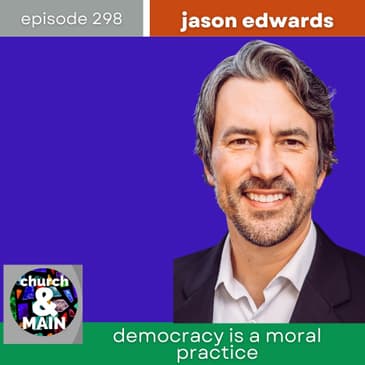
Dennis talks with Jason Edwards, senior pastor of Second Baptist Church in Liberty, Missouri, about his Baptist News Global essay on democracy as a moral practice, sparked by a well-known 2008 moment when Senator John McCain corrected a supporter's false claim about Barack Obama. The conversation moves from there into how churches form — or fail to form — people capable of living alongside those they disagree with, including a candid look at emotional health as part of discipleship.
They also touch on Jason's forthcoming book, At Home with God: How the Cross Transforms Us, built around the image of a house with many windows — each theory of the atonement offering a true but partial glimpse of something too vast to fully see.
In this episode:
- Why Jason calls democracy "a moral practice" rather than just a system
- The McCain moment that shaped his thinking
- How churches can cultivate — or undermine — emotional maturity
- A preview of At Home with God and its "house with many windows" approach to atonement
Links:
- Jason's essay, "Democracy as a moral practice, not just a system" (Baptist News Global)
- Jason G. Edwards on Substack
- At Home with God: How the Cross Transforms Us (IVP, November 2026)
Facebook (https://www.facebook.com/churchandmain) | Instagram (https://www.instagram.com/churchandmainpod/) | Threads (https://www.threads.net/@churchandmainpod) | Website (https://churchandmain.org/) | YouTube (https://www.youtube.com/@churchmainpodcast) | Substack (https://churchandmain.substack.com/)
Enjoyed this episode? Subscribe to Church and Main on your favorite podcast app, leave a review, and visit churchandmain.org or churchandmain.substack.com to read more and support the show. Send an email to dennis@churchandmain.org.
00:00:26 --> 00:00:30 Hello, and welcome to Church in Maine, a podcast for people interested in the
00:00:30 --> 00:00:33 intersection of faith, politics, and culture.
00:00:33 --> 00:00:36 I'm Dennis Sanders, your host.
00:00:37 --> 00:00:44 So, these days, when we think of democracy, we like to think about procedures, like voting.
00:00:45 --> 00:00:48 Or maybe we think about constitutional rights, like the freedom of speech or
00:00:48 --> 00:00:50 the freedom of religion.
00:00:50 --> 00:00:54 Or maybe we think about the institutions, the Supreme Court,
00:00:54 --> 00:00:56 Congress, the presidency.
00:00:58 --> 00:01:04 So, when we think about democracy, we're thinking about institutions and procedures.
00:01:06 --> 00:01:11 But might we be missing something here? Are there certain values and practices
00:01:11 --> 00:01:13 that actually make all of this possible?
00:01:15 --> 00:01:20 Writing for Baptist News Global, Jason Edwards wrote in an essay this past summer,
00:01:20 --> 00:01:26 that democracy is as much about values, values such as pluralism and prudence
00:01:26 --> 00:01:29 and learning to live with people that you don't choose.
00:01:30 --> 00:01:36 Here is a piece of that essay, a quote from that essay of this past summer.
00:01:36 --> 00:01:42 He writes, a democracy carries that same strain into public life,
00:01:42 --> 00:01:46 joining us with neighbors we didn't choose and won't always understand.
00:01:47 --> 00:01:52 Laws, institutions, and procedures are important, but they cannot do the whole work.
00:01:53 --> 00:02:00 Virtues like patience, honesty, and restraint are learned over time in ways no law can require.
00:02:00 --> 00:02:06 What earlier Christians called prudence, which is the capacity to see clearly
00:02:06 --> 00:02:09 what a situation requires and to act well
00:02:09 --> 00:02:14 when no general principle can fully account for it, is exactly what democratic
00:02:14 --> 00:02:16 life asks of ordinary people.
00:02:17 --> 00:02:22 In the end, a common life depends on whether we've learned how to live with
00:02:22 --> 00:02:28 those we didn't choose without needing them to become something else, unquote.
00:02:30 --> 00:02:38 So, in this episode, we're going to look at democracy as a moral practice with Jason Edwards.
00:02:39 --> 00:02:42 And along the way, we're actually going to be taking a little bit of a side
00:02:42 --> 00:02:47 trip to talk about atonement and his new book, which focuses on atonement.
00:02:48 --> 00:02:52 But before we do all of that, a little bit more about who Jason is.
00:02:53 --> 00:02:59 He's been the senior pastor of Second Baptist Church in Liberty, Missouri, since 2009.
00:02:59 --> 00:03:04 He holds degrees from East Baptist University, Baylor University's Truett Seminary,
00:03:04 --> 00:03:06 and Fuller Theological Seminary.
00:03:07 --> 00:03:11 His writing has appeared in Christian Century, Plow, Good Faith Media,
00:03:11 --> 00:03:16 Baptist News Global, and the Kansas City Star, and he also has his own substack.
00:03:17 --> 00:03:21 His forthcoming book is At Home with God, How the Cross Transforms Us,
00:03:22 --> 00:03:24 and that will be published by University Press.
00:03:25 --> 00:03:31 Jason and his wife, Christy, a pediatric hospital chaplain, live in liberty
00:03:31 --> 00:03:33 with their three children.
00:03:33 --> 00:03:39 So with all of that, let us enter into this discussion on the moral practice
00:03:39 --> 00:03:41 of democracy with Jason Edwards.
00:04:00 --> 00:04:04 Well, Jason, welcome to the podcast, and I wanted to start out by knowing a
00:04:04 --> 00:04:08 little bit about you and your faith background.
00:04:10 --> 00:04:17 Yeah, I'm originally from Northeast Texas, and I grew up in Southern Baptist
00:04:17 --> 00:04:19 and United Methodist churches.
00:04:20 --> 00:04:24 So that's really, those are really the kinds of churches that formed me.
00:04:25 --> 00:04:32 Um i you know grew up in those churches when i was 17 years old i sensed a call
00:04:32 --> 00:04:37 to ministry and so that turned me toward theological education in college,
00:04:38 --> 00:04:42 and went through that i've been a pastor here for a little over 17 years,
00:04:44 --> 00:04:52 um what else do you want to know what and you are a pastor is just outside of Kansas City, correct?
00:04:53 --> 00:04:58 That's right. I'm in Liberty, Missouri, and I'm at Second Baptist Church in Liberty, Missouri.
00:04:59 --> 00:05:02 It's a church connected with the Cooperative Baptist Fellowship.
00:05:03 --> 00:05:09 It was for the majority of its history until around 2000, a Southern Baptist
00:05:09 --> 00:05:13 congregation that is connected with the Cooperative Baptist Fellowship.
00:05:13 --> 00:05:15 And then I've been here since 2009.
00:05:18 --> 00:05:22 Well, one of the reasons, I mean, I wanted to talk to you is the article that
00:05:22 --> 00:05:30 you wrote for Baptist News Global on democracy as a moral practice and not just a system.
00:05:31 --> 00:05:35 And so we've had some discussions about that and kind of that you were asked
00:05:35 --> 00:05:42 to write about this basically in conjunction with the semi-quincentennial of the United States.
00:05:44 --> 00:05:48 Kind of tell me how did this article come about,
00:05:50 --> 00:05:59 and what led you to write it well I maybe wrote it under duress I don't know,
00:06:00 --> 00:06:06 my friend Carol McIntyre who is responsible for the series and she's the pastor
00:06:06 --> 00:06:09 of First Baptist in Greenville, South Carolina.
00:06:10 --> 00:06:15 She and I and two other pastors have been meeting via Zoom monthly since the
00:06:15 --> 00:06:16 opening of the pandemic.
00:06:17 --> 00:06:26 And she reached out about this because she wanted a group of pastors to develop
00:06:27 --> 00:06:29 what could be turned into curriculum for churches.
00:06:31 --> 00:06:36 And they already had the titles of the articles, the topics.
00:06:36 --> 00:06:39 She sent me a thing and just said, sign up for what you want.
00:06:40 --> 00:06:46 And just quite honestly, I said, Carol, I love you.
00:06:47 --> 00:06:52 But InterVarsity Press told me I'm supposed to start promoting my book the month
00:06:52 --> 00:06:57 you're telling me you want this article that is politically adjacent to come
00:06:57 --> 00:06:58 out. I'm not sure that's a good idea.
00:06:59 --> 00:07:06 And uh but you you see who won so um so i chose this one and um gave it my best
00:07:06 --> 00:07:09 shot and they included it in the series.
00:07:12 --> 00:07:16 And what made you wasn't burning inside of me.
00:07:18 --> 00:07:24 But I mean, I guess what's interesting is what made you decide to talk about it as a moral practice?
00:07:24 --> 00:07:30 I think when we talk about democracy and it kind of in the title,
00:07:30 --> 00:07:35 we think of a system, we think of voting, we think of of representatives.
00:07:36 --> 00:07:40 We think of all of the things basically of government.
00:07:41 --> 00:07:46 But you were the the way that you wrote the essay was that there was something
00:07:46 --> 00:07:52 more going on here that there was a moral stake and dimension to democracy um,
00:07:53 --> 00:07:57 and i think the best way the example that you write is something that happened,
00:07:58 --> 00:08:04 not too far from me i'm i'm um in minnesota in Minneapolis.
00:08:04 --> 00:08:12 And so you share the story about the late Senator John McCain at a rally that
00:08:12 --> 00:08:18 took place in suburban Minneapolis and how a participant,
00:08:19 --> 00:08:22 kind of said something about Obama,
00:08:23 --> 00:08:30 who was then a candidate for president, that was very demeaning, and how he basically.
00:08:31 --> 00:08:40 Stuck up for his opponent, which I will add is something that now seems very rare.
00:08:41 --> 00:08:46 But that seems to be kind of a basis of what you were getting at. Yeah. Yeah.
00:08:47 --> 00:08:53 Yeah. I, I think in that sense, we're just after a sense of decency,
00:08:54 --> 00:08:58 um, people having a moral center, uh, conviction.
00:08:59 --> 00:09:04 And part of what the article, the way I chose to approach it was, um,
00:09:04 --> 00:09:12 that for anything really, but democracy to work in the way that we ideally want
00:09:12 --> 00:09:18 it to work, uh, character formation and the way that we grow and live together within that,
00:09:19 --> 00:09:22 system and community is important,
00:09:24 --> 00:09:30 and so so that that's really the that's really the way that I approached it
00:09:30 --> 00:09:35 in that particular moment struck me when it happened and then looking back at it later just because.
00:09:39 --> 00:09:43 It doesn't seem like it's something that McCain had to do. He could have just let it slide.
00:09:46 --> 00:09:56 But almost instinctively, he corrected the claim and then moved on, but corrected it,
00:09:57 --> 00:10:05 said a word of affirmation about Obama, and then also kind of framed it as,
00:10:05 --> 00:10:10 we just happen to be two people who disagree on fundamental issues.
00:10:10 --> 00:10:12 And that's what we're talking about.
00:10:13 --> 00:10:19 And I thought there was something that in that moment that captured the best.
00:10:21 --> 00:10:26 Of who we strive to be and how we want our democracy to work.
00:10:28 --> 00:10:36 Um, you, you mentioned in our exchange that I, I did name that, um,
00:10:37 --> 00:10:42 you know, the, the call in the moment was, was that someone was claiming that
00:10:42 --> 00:10:44 they couldn't trust Obama because he was an Arab.
00:10:46 --> 00:10:50 And, uh, and so it's important in naming the good of that moment to say,
00:10:51 --> 00:10:57 you can't equate being an Arab with being not good.
00:10:57 --> 00:11:01 Uh, and so that was one, that was something that I wanted to name in there.
00:11:01 --> 00:11:07 Um, and then the editor also wanted to make sure that I named that McCain didn't,
00:11:08 --> 00:11:12 uh, also didn't clarify that Obama is not an Arab.
00:11:13 --> 00:11:18 And so that's why that extra measure got put in, uh, just to make sure that was, yeah.
00:11:20 --> 00:11:23 So part of that was me and part of that was the editor. Okay.
00:11:24 --> 00:11:28 But I think, you know, the interesting thing about that with McCain,
00:11:28 --> 00:11:31 and you talk about this in your article,
00:11:32 --> 00:11:35 that, and you even say that democracy is more than its documents,
00:11:35 --> 00:11:40 that it's really about the habits that people carry in ordinary life.
00:11:40 --> 00:11:45 And that that is really what holds everything together. And if you don't have
00:11:45 --> 00:11:47 it, everything falls apart.
00:11:47 --> 00:11:53 Um, and I think from that experience with, with McCain is that obviously there
00:11:53 --> 00:12:01 was a habit there, um, of how you treat others and how, um, you disagree with others.
00:12:02 --> 00:12:07 Um, that there, it seems like there are embedded rules of engagement. Exactly.
00:12:08 --> 00:12:13 Exactly. And McCain had a sense in that moment of the embedded rules of engagement,
00:12:14 --> 00:12:17 that were rooted in a certain kind of decency and character.
00:12:18 --> 00:12:22 And that he not only had that for himself,
00:12:23 --> 00:12:28 but went the extra step in the leadership position of calling the crowd to those
00:12:28 --> 00:12:34 same boundaries, those same rules of engagement to say it was almost really
00:12:34 --> 00:12:36 the only one who could say it.
00:12:36 --> 00:12:40 Nope, we're not like you would do with a child. We're not going to talk like that.
00:12:42 --> 00:12:47 That's not how we talk to one another. And then moving on, you know.
00:12:50 --> 00:12:54 Why do you think that we've lost that? Because that's obviously,
00:12:56 --> 00:13:03 I remember seeing that moment in 2008 and thought it was, that was important,
00:13:04 --> 00:13:08 when he died 10 years later.
00:13:08 --> 00:13:14 That was something, that was the first thing in writing about it that I, it came to mind.
00:13:15 --> 00:13:19 But that almost seems like that happened a century ago.
00:13:20 --> 00:13:24 And we don't seem to have that same argument.
00:13:24 --> 00:13:30 Does that mean that we are losing the habits that kind of can foster democracy?
00:13:31 --> 00:13:35 Well, there are certainly some bad habits that have been normalized.
00:13:36 --> 00:13:41 But here's a question I have for you related to this, because it's something
00:13:41 --> 00:13:44 that I've wrestled with when I've thought about that moment.
00:13:45 --> 00:13:52 Do you think there would have been any negative consequences for McCain in the
00:13:52 --> 00:13:59 press if he had not chosen to clarify that?
00:13:59 --> 00:14:05 In other words, I wondered, you know, it does seem like a moment of character to me,
00:14:06 --> 00:14:12 but I wondered at the time if he had just let that comment stand and kept going,
00:14:13 --> 00:14:15 as if he was also assuming it was true,
00:14:16 --> 00:14:24 would there have been any negative blowback after the fact in the press because
00:14:24 --> 00:14:25 he didn't correct the comments?
00:14:27 --> 00:14:32 I think there would have been, because I think at that time, there are already a lot,
00:14:35 --> 00:14:40 of charges or concerns, not the right word, but charges.
00:14:42 --> 00:14:49 Against then-Senator Obama. There were people who had problems with his middle name.
00:14:49 --> 00:14:56 They were, again, obviously worried about whatever kind of radicalism or,
00:14:56 --> 00:14:58 and to be honest, just about his race.
00:14:59 --> 00:15:02 So I think that that was already in the air.
00:15:03 --> 00:15:09 And so had he not said something, I think the press would have picked that up. It would have been...
00:15:11 --> 00:15:14 He could not have escaped that. They would not have let that slide.
00:15:15 --> 00:15:20 And part of that, so part of me asking that question is, how much of the action
00:15:21 --> 00:15:24 in the moment, because it was very instinctive. I mean, there was a,
00:15:25 --> 00:15:29 you know, he had to respond that way in the moment.
00:15:30 --> 00:15:35 And so how much of that instinct is rooted in his own character?
00:15:37 --> 00:15:43 And how much of that instinct is rooted maybe in the sense that,
00:15:43 --> 00:15:46 oh, I need to correct this or I'm going to get in trouble.
00:15:47 --> 00:15:49 Like, I can't just let that slide.
00:15:49 --> 00:15:54 There might be consequences if I just let that slide. So, you know,
00:15:54 --> 00:15:57 you just wonder, it's sort of like, why do we do good things?
00:15:58 --> 00:16:02 Do we do them for ourselves or do we do them for others? And often it's both.
00:16:03 --> 00:16:10 And so, was there something in the atmosphere at that time of American politics,
00:16:11 --> 00:16:13 where not only do you have an instinct that, no,
00:16:14 --> 00:16:18 I've got to correct that, but also, I might get in trouble if I don't correct that?
00:16:19 --> 00:16:27 I think it's a little bit of both. I think it was part of McCain's character in how he worked.
00:16:27 --> 00:16:32 And I think because he was someone that always, I think, worked across party
00:16:32 --> 00:16:36 lines, he got to know people.
00:16:36 --> 00:16:41 And maybe the influence of being in the Navy, being in the military,
00:16:41 --> 00:16:45 there are certain ways of how you are formed in the military.
00:16:46 --> 00:16:52 But I also know he was a politician, and politicians are also worried about how they react.
00:16:54 --> 00:17:00 So I think it's both. I think it's a little bit more on the character part than the politician part.
00:17:02 --> 00:17:08 But I don't think that the politician part is not zero and probably is more than 10.
00:17:08 --> 00:17:12 It's a little bit of both. I think it leans more towards the character,
00:17:14 --> 00:17:19 because of how he responded. It wasn't calculated. It was very instinctual.
00:17:20 --> 00:17:26 But, yeah, you are always going to be worried about how things are going to be perceived as well.
00:17:27 --> 00:17:34 Yeah. And so it's hard to measure this, but you wonder if the exact same conversation
00:17:34 --> 00:17:39 were happening between the exact same two people in the public square now in this atmosphere.
00:17:42 --> 00:17:46 Would there be any hesitation? Would there be anything different?
00:17:46 --> 00:17:49 And we can't say that or not, but,
00:17:52 --> 00:17:53 I do wonder about that.
00:17:55 --> 00:18:00 And also then, how is this environment that we're in shaping character?
00:18:03 --> 00:18:09 I think it shapes it a lot I think there is,
00:18:11 --> 00:18:22 I believe now it's almost inverse that had he said anything to defend an opponent he might have been,
00:18:23 --> 00:18:29 pilloried especially on one side of the aisle uh,
00:18:31 --> 00:18:37 And it would just be more difficult, I think. Or it would be much more calculating
00:18:37 --> 00:18:40 because you're worried about how are people going to perceive this?
00:18:40 --> 00:18:45 Will you get any blowback from it? So it would be very different today because
00:18:45 --> 00:18:49 of the environment that we're in and because of how people are being formed.
00:18:49 --> 00:18:55 Yeah. And I don't mean that as a comment on how McCain would or wouldn't respond
00:18:55 --> 00:18:59 now. I mean, I would imagine he would be pretty consistent.
00:18:59 --> 00:19:05 I think so. But it is, but it is significant, I think, to look at what's going
00:19:05 --> 00:19:12 on now and, and how people treat one another and, um,
00:19:14 --> 00:19:17 and wonder about how much that is affecting our own,
00:19:19 --> 00:19:24 our own formation. And what I wonder about, and maybe part of the conversation,
00:19:24 --> 00:19:28 because I was thinking about this in advance of it, is how much...
00:19:30 --> 00:19:32 The community of the church,
00:19:35 --> 00:19:43 could or should be a part of the formation of people in a way that would cause
00:19:43 --> 00:19:47 them to interact in the public square differently,
00:19:47 --> 00:19:50 because we're obviously in a smaller community here.
00:19:50 --> 00:19:56 But one thing that I was puzzling over is the more our churches become,
00:19:57 --> 00:20:01 I don't know if this is the right way to say it, but tribalized.
00:20:01 --> 00:20:03 No, I think that is the right word.
00:20:04 --> 00:20:08 The more our churches are an echo chamber,
00:20:11 --> 00:20:17 the less they form us in that way, which is a sense of how to be in healthy,
00:20:18 --> 00:20:21 challenging, growing, vibrant community,
00:20:21 --> 00:20:26 with people that we didn't choose and who are different than we are and who hold,
00:20:27 --> 00:20:29 varying convictions about things.
00:20:31 --> 00:20:38 I yeah because i think the the question about the church the church should be
00:20:38 --> 00:20:43 the place where character is formed at least one of the places and um.
00:20:46 --> 00:20:49 But the way especially in our in a democracy um,
00:20:51 --> 00:20:54 and especially one that is as diverse and pluralistic as ours,
00:20:55 --> 00:21:01 it also means that you have to have institutions, churches, that can handle
00:21:01 --> 00:21:04 diversity in all of its forms.
00:21:06 --> 00:21:12 And I think the thing that has worried me and concerns me is that,
00:21:12 --> 00:21:17 and you're seeing this regardless of where you are on the political spectrum,
00:21:18 --> 00:21:23 is churches becoming more of one political stripe or another.
00:21:23 --> 00:21:29 And so they become almost infinity, not infinity, affinity groups,
00:21:30 --> 00:21:34 which is very different from the vision of the church that we see,
00:21:34 --> 00:21:36 especially like in the Book of Acts,
00:21:38 --> 00:21:40 that is so diverse.
00:21:40 --> 00:21:42 And of course, there are issues with that.
00:21:42 --> 00:21:46 But they have to kind of work things out.
00:21:47 --> 00:21:54 You know, I have long told a story when I was younger and living, I lived in D.C.
00:21:54 --> 00:21:59 And was attending a Baptist church there in town. And it was a church that was
00:22:00 --> 00:22:05 fairly diverse from people who would be more on the mainline side and others
00:22:05 --> 00:22:07 who were very evangelical.
00:22:08 --> 00:22:13 And they were getting ready to hire a pastor, an associate.
00:22:15 --> 00:22:20 Who at the time, you know, back then, people, denominations were still kind
00:22:20 --> 00:22:26 of talking on the issue about LGBTQ issues and she was very much more affirming.
00:22:26 --> 00:22:31 And some people, that was a concern for them.
00:22:32 --> 00:22:37 And so this other woman got up who was considered an evangelical And she talked
00:22:37 --> 00:22:41 about the fact that she knew the pastor.
00:22:42 --> 00:22:46 They were friends, and they did not agree on this issue.
00:22:48 --> 00:22:51 But she was going to support her to become pastor.
00:22:53 --> 00:22:58 And the reason that could be is because they knew each other. They were friends.
00:22:58 --> 00:23:05 They had a relationship. And we don't, our churches don't have that as much anymore.
00:23:05 --> 00:23:12 And I think that's concerning because then how can you form people to respect
00:23:12 --> 00:23:18 someone who may not vote the same way you do or has very different views on a lot of issues?
00:23:19 --> 00:23:23 And, you know, I always have, I do believe that, as you said,
00:23:23 --> 00:23:33 that a church is about people who you may not, you don't choose to be in community with, but you are.
00:23:34 --> 00:23:39 And, but what happens when they do become self-sorting communities? Yeah.
00:23:41 --> 00:23:46 Yeah, I think to a degree, no matter what church we choose, there are going
00:23:46 --> 00:23:49 to be people there we're in relationship with that we would not have chosen.
00:23:50 --> 00:23:53 But we also are choosing our churches.
00:23:54 --> 00:23:59 And to an extent, you just have to say it is what it is.
00:23:59 --> 00:24:03 I mean, we, we can all have our ideals about everything, but,
00:24:03 --> 00:24:08 but, um, idealistically we would be, you know, reflections of revelation seven,
00:24:09 --> 00:24:14 and, uh, every, every tribe and tongue and nation and perspective.
00:24:14 --> 00:24:20 Um, but that's not going to happen. And so, so I do, I do wonder,
00:24:20 --> 00:24:23 and I have wondered and tried to, um.
00:24:26 --> 00:24:31 Tried to embody this in some way over the past few years.
00:24:32 --> 00:24:37 If even in no matter how diverse or homogenized our congregation is,
00:24:40 --> 00:24:47 if the real hard work of discipleship right now isn't at least trying to help
00:24:47 --> 00:24:51 people think about how they live with and have conversations with,
00:24:53 --> 00:24:59 the person in their life who they fundamentally disagree with about things.
00:25:02 --> 00:25:06 And in that, maybe even, and this is something that I've been passionate about
00:25:06 --> 00:25:13 for a while, that we realize that emotional intelligence and cultivating that
00:25:13 --> 00:25:15 has to be a part of discipleship.
00:25:20 --> 00:25:25 That's interesting because I don't think we think about that in terms of discipleship.
00:25:27 --> 00:25:32 It's, you know, kind of, you know, we talk about things like civility and it's
00:25:32 --> 00:25:37 nice to have and everything, but we don't think about it as following Jesus.
00:25:37 --> 00:25:42 But if you think about it, even within Jesus' own disciples,
00:25:42 --> 00:25:49 you had a lot of diversity and people who did not necessarily go together,
00:25:50 --> 00:25:53 and yet they were all part of that community.
00:25:55 --> 00:25:59 Yeah, I think that's, and I also think when we're having difficult conversations,
00:25:59 --> 00:26:02 we have to recognize the emotional realities that are in the room.
00:26:03 --> 00:26:05 And so, you know, in a more recent.
00:26:09 --> 00:26:15 Conversation we were navigating as a church that we knew was going to be difficult,
00:26:15 --> 00:26:19 one of the things we talked about in the planning was, I think we should begin
00:26:19 --> 00:26:23 this conversation with, we should begin every meeting with contemplative prayer.
00:26:25 --> 00:26:30 And one of the reasons we do that is because it's prayer and because we open
00:26:30 --> 00:26:36 ourselves up to god's spirit and those kinds of things that are very important,
00:26:37 --> 00:26:42 um another reason we do that is because we know that contemplative prayer turns
00:26:42 --> 00:26:45 down the dial on our anxiety,
00:26:47 --> 00:26:55 and if we're starting at a at a less trigger trigger happy place If we're starting
00:26:55 --> 00:26:59 at a less anxious place, then maybe we're able to hear one another better.
00:27:02 --> 00:27:05 And so I just, I think we, several years ago,
00:27:06 --> 00:27:12 I love the way it's Peter, Peter Scazzaro, who is out of New York City,
00:27:13 --> 00:27:18 and he writes, he does the Emotionally Healthy Spirituality Curriculum.
00:27:18 --> 00:27:25 And it's always stuck with me, the phrase that they use, we believe you cannot
00:27:25 --> 00:27:30 be spiritually healthy and emotionally unhealthy.
00:27:33 --> 00:27:38 It's not possible to be both spiritually healthy and emotionally unhealthy.
00:27:39 --> 00:27:46 And so what they do in their discipleship approach is they're taking a path
00:27:46 --> 00:27:51 that combines contemplative Christian spirituality and.
00:27:53 --> 00:27:57 Bowen systems thinking, family systems theory,
00:27:58 --> 00:28:09 to help folks grow in a way where the emotional health and the spiritual health is intertwined.
00:28:11 --> 00:28:17 And to me, that's a part of what we're talking about because it's about how
00:28:17 --> 00:28:19 we engage life with one another.
00:28:21 --> 00:28:24 It's about how we manage our own anxiety.
00:28:30 --> 00:28:34 That then leads me to a question of how then has the church failed on that?
00:28:37 --> 00:28:41 It seems like we have not done a good job of helping to form people and helping
00:28:41 --> 00:28:46 to form for them to be both spiritually healthy and emotionally healthy. Yeah.
00:28:47 --> 00:28:51 I don't, how would you answer that question? Because it's hard for me to make,
00:28:52 --> 00:28:55 I probably have made several of them since we've been on together,
00:28:55 --> 00:28:59 but it's hard for me to just stand beside blanket statements.
00:29:00 --> 00:29:04 Uh, so every human is different. Every church is different.
00:29:04 --> 00:29:08 Every community is its own mingling of different kinds of diversity.
00:29:09 --> 00:29:11 And, and so I.
00:29:14 --> 00:29:20 I don't know. There's, there's certainly a lot of unhealth in churches because
00:29:20 --> 00:29:22 there are a lot of human beings in churches.
00:29:24 --> 00:29:24 Um,
00:29:27 --> 00:29:28 so I guess I'm, And,
00:29:31 --> 00:29:35 I'm interested in that conversation, but I think even more the conversation
00:29:35 --> 00:29:41 of what are the things that we can be doing here and there to encourage and
00:29:41 --> 00:29:44 cultivate emotional maturity in our congregations?
00:29:46 --> 00:29:51 Well, I think part of it might be, we don't think that, it's kind of what you
00:29:51 --> 00:29:56 said earlier, we don't think that emotional health is tied to spiritual health.
00:29:56 --> 00:29:58 So we can have people who know.
00:30:01 --> 00:30:05 The Bible up and down, but,
00:30:08 --> 00:30:14 don't have a way of how to apply it and aren't really formed in a way.
00:30:14 --> 00:30:19 So they can know a lot about the spiritual side, but be terrible people.
00:30:22 --> 00:30:25 And, you know, I think a lot about, you know, a few days ago,
00:30:25 --> 00:30:32 I think during a morning prayer, one of the passages was Jesus doing all the
00:30:32 --> 00:30:36 woe to you, to the Pharisees and the scribes.
00:30:37 --> 00:30:41 And, you know, these were people who knew the law up and down.
00:30:41 --> 00:30:43 They knew everything about that.
00:30:44 --> 00:30:50 But what Jesus was getting at with them was they were kind of terrible people
00:30:50 --> 00:30:54 because they would do things, they weren't treating people right.
00:30:54 --> 00:30:59 And so there wasn't a way to connect those things.
00:31:00 --> 00:31:07 And I think that's kind of how, as churches, we have to try to find a way of
00:31:07 --> 00:31:14 helping to connect those two, that it's important to know the faith. That's important.
00:31:14 --> 00:31:16 But then how do we live that faith out?
00:31:17 --> 00:31:23 Because if we have a lot of people who know it, but then are still acting terrible,
00:31:24 --> 00:31:26 then it's not really sinking in.
00:31:29 --> 00:31:36 Yeah, I mean, I agree. I think there has to be a holistic approach to formation.
00:31:36 --> 00:31:44 And I think that we have to understand that really, I mean, at least one of
00:31:44 --> 00:31:47 the goals of Scripture is to form people.
00:31:49 --> 00:31:57 Certain kinds of people, certain kinds of community, the cultivation of wisdom and integrity.
00:31:59 --> 00:32:05 And integrity, of course, is not just about whether I lie or not.
00:32:05 --> 00:32:08 It's about being an integrated person.
00:32:09 --> 00:32:14 It's about alignment, that who you are on the inside, who you are,
00:32:14 --> 00:32:20 how you live on the outside are in alignment and we're constantly working, working at that.
00:32:21 --> 00:32:27 It is, I think it's, I think it's really hard to do. I, I believe that in churches and in every system,
00:32:28 --> 00:32:35 um, because I have been so affected by Bowen thinking that the health of the
00:32:35 --> 00:32:42 leadership over time has a profound effect on the health of the community.
00:32:45 --> 00:32:53 If there is a leader or a small leadership group, how healthy those folks are,
00:32:53 --> 00:32:57 and how they engage with one another and the community,
00:32:58 --> 00:33:04 slowly emanates out and really infects the rest of the community over time.
00:33:04 --> 00:33:07 So it begins to reflect the health of the leader.
00:33:08 --> 00:33:16 And so one of the things that I think that we can do is really get committed to saying,
00:33:18 --> 00:33:21 and we talk about this with our staff, is I'll say to them, you know,
00:33:21 --> 00:33:28 I think our church members have a right to expect that their pastors are certain kinds of people.
00:33:30 --> 00:33:34 And so you need to understand that the cultivation of being a certain kind of
00:33:34 --> 00:33:40 person in terms of our prayer life, in terms of,
00:33:42 --> 00:33:47 our integrity, in terms of the things that we're working on on a regular basis,
00:33:48 --> 00:33:52 and how we embody our humanity in the world.
00:33:53 --> 00:33:57 They should, I mean, I think you could reasonably, you can write that into your
00:33:57 --> 00:34:00 calendar on a daily basis.
00:34:01 --> 00:34:06 That's a job expectation, that you are becoming the kind of person that the
00:34:06 --> 00:34:10 people who come to our church deserve to have as pastors.
00:34:12 --> 00:34:17 So I think that's one of the things. And so for me, I mean, part of that is
00:34:17 --> 00:34:21 I have a spiritual director who is also a therapist.
00:34:23 --> 00:34:28 There are, there are things like that, that I do in my own life to try to cultivate that.
00:34:29 --> 00:34:34 Um, I also sort of got into the, the habit of saying, you know,
00:34:34 --> 00:34:37 at least once a year, I need to be integrating something into my,
00:34:37 --> 00:34:43 uh, sermon plan that helps cultivate,
00:34:44 --> 00:34:47 you know, this intertwined spiritual and emotional health.
00:34:48 --> 00:34:51 And I was talking with somebody the other day, I think one of the most powerful
00:34:51 --> 00:34:56 sermon series I ever did, and we did it as a book study as well,
00:34:57 --> 00:35:02 was based on Richard Rohr's book, Breathing Underwater.
00:35:05 --> 00:35:10 Which is spirituality that is rooted in the 12 steps. Hmm.
00:35:11 --> 00:35:16 And the assumption within it is that we are all, every single one of us, addicts.
00:35:19 --> 00:35:25 And so it then takes you through these 12 steps.
00:35:25 --> 00:35:30 And it's so powerful because it is, I really think, you know,
00:35:30 --> 00:35:36 Rohr says he thinks that the 12 steps are Western spirituality's greatest contribution,
00:35:39 --> 00:35:43 to the spirituality of the world. uh, or something like that.
00:35:44 --> 00:35:48 And, and I found a couple of things. I found that it helped people realize,
00:35:48 --> 00:35:51 oh yeah, I've got these tendencies in me too.
00:35:51 --> 00:35:54 And here are some ways I can work on this.
00:35:54 --> 00:35:58 But also the other incredible thing that happened, I've never had anything like
00:35:58 --> 00:36:05 this, any response to like this and anything else I've done is, um, I had.
00:36:08 --> 00:36:14 Folks who were in recovery and their family members in the congregation coming
00:36:14 --> 00:36:16 out of the woodworks to talk with me,
00:36:18 --> 00:36:22 and share with me that having that conversation in the church,
00:36:22 --> 00:36:28 like maybe they'd been in recovery for some addiction and their family had known that for 30 years,
00:36:29 --> 00:36:33 and nobody in their family had ever felt permission to talk to them about it.
00:36:35 --> 00:36:39 And they said, just the fact that I was talking about it on Sunday morning in
00:36:39 --> 00:36:43 worship, in that way, all of a sudden their family members started coming to
00:36:43 --> 00:36:45 them and saying, hey, tell me more about this.
00:36:47 --> 00:36:53 And so what they came to me, the thank you to me was, thanks for giving my family
00:36:53 --> 00:36:56 permission to have these conversations with me.
00:36:57 --> 00:37:01 But the permission was just that we're going to do a series about this.
00:37:01 --> 00:37:03 We're going to name these things.
00:37:05 --> 00:37:08 We're going to talk about our own brokenness in these kinds of ways.
00:37:12 --> 00:37:16 I don't know if that if that's helpful but that that's one that's practically
00:37:16 --> 00:37:21 the kinds of things that we try to do just just have those conversations.
00:37:25 --> 00:37:30 And how i think one of the things i'm kind of curious and and you kind of talk
00:37:30 --> 00:37:31 about this in the article that,
00:37:32 --> 00:37:40 and you bring up the the quote by bonhoeffer about um the people who kind of say they love community,
00:37:41 --> 00:37:49 um kind of me not really and they actually end up destroying community um which
00:37:49 --> 00:37:54 is kind of a long way of saying that it's community is is difficult,
00:37:56 --> 00:37:59 and that if you have this people are talking about this idealized community
00:37:59 --> 00:38:01 you need to watch out because,
00:38:02 --> 00:38:04 you know, bad things will happen.
00:38:06 --> 00:38:12 And so in kind of having these, these conversations, how do we,
00:38:14 --> 00:38:21 how does the church kind of help to foster that? And what ways can they foster that?
00:38:22 --> 00:38:28 Because it seems like as Christians, the way that we should be able to foster
00:38:28 --> 00:38:35 that is to see that the other person that we may disagree with is loved and created by God.
00:38:37 --> 00:38:39 Which is something I think we forget these days.
00:38:43 --> 00:38:48 But it seems like that has to be the basis of the argument.
00:38:48 --> 00:38:52 Even though, again, even saying that doesn't mean that it's going to be easy.
00:38:53 --> 00:38:59 Yeah, because we say that, that doesn't mean it's like, I guess the question is then, so what?
00:39:02 --> 00:39:05 And in understanding what the so what is,
00:39:08 --> 00:39:15 But for me, it's even, I mean, the how for me, all I really at this point in my life know is.
00:39:18 --> 00:39:23 We have to try to figure out how to embody it. Mm-hmm.
00:39:23 --> 00:39:28 Um, in that same vein, you know, thinking about the things that I was mentioning,
00:39:28 --> 00:39:31 uh, Patrick Lencioni, uh,
00:39:31 --> 00:39:36 who talks a lot about leadership and with businesses and organizations wrote
00:39:36 --> 00:39:39 a book several years ago that had an impact on me called the advantage,
00:39:40 --> 00:39:45 in the, the whole premise of the book or the question of the book was in these
00:39:45 --> 00:39:50 organizations that really live up to these certain principles and succeed in
00:39:50 --> 00:39:53 these ways, um, What was the advantage? What was the difference?
00:39:55 --> 00:39:59 And what they found was that the difference was emotion, was health.
00:40:02 --> 00:40:06 And they, and the way they described that is it really is emotional health.
00:40:08 --> 00:40:12 And so they'll talk about the health. How do you cultivate that?
00:40:12 --> 00:40:16 And it starts with maybe the health of the CEO, then the health of the seven
00:40:16 --> 00:40:17 person leadership group.
00:40:18 --> 00:40:21 And then it emanates out into everything else.
00:40:23 --> 00:40:24 And so...
00:40:26 --> 00:40:30 Again, part of it for me is understanding that, trying to give other people
00:40:30 --> 00:40:36 opportunities to learn about that and practice that, like, I could name some
00:40:36 --> 00:40:40 other things, but then how do I embody that?
00:40:41 --> 00:40:48 And so part of it for me is when I'm going into conversations with staff and with church members,
00:40:49 --> 00:40:54 if you know that it may be difficult, thinking about, I know that one of the
00:40:54 --> 00:40:58 most important things in creating healthy organizations and healthy communities
00:40:58 --> 00:41:00 is how we handle conflict.
00:41:02 --> 00:41:03 And it is not avoiding it.
00:41:05 --> 00:41:09 It really is being clear and calm,
00:41:11 --> 00:41:17 and i guess courteous in the midst of it and so,
00:41:18 --> 00:41:23 there's something about being able to sit down and establish our humanity through,
00:41:24 --> 00:41:31 through humor and you know mutual affection and affirmation and then being able to say,
00:41:33 --> 00:41:34 here's what I,
00:41:35 --> 00:41:37 here's what I think about this.
00:41:39 --> 00:41:43 And I think this is actually what you would call differentiation.
00:41:44 --> 00:41:55 Uh, here, here's where I am and I cannot, I can't, you know, do otherwise than this.
00:41:56 --> 00:42:02 I am not going to lead, no matter how much we disagree with one another,
00:42:03 --> 00:42:06 I'm not going to turn that into an attack on you or your character.
00:42:09 --> 00:42:18 I will show you the dignity of being curious and asking you questions and trying
00:42:18 --> 00:42:19 to understand where you're coming from.
00:42:24 --> 00:42:30 And maybe somehow modeling, even in our conversation, how I would like for you to receive me,
00:42:32 --> 00:42:37 and not making your action, my actions contingent on your actions.
00:42:40 --> 00:42:46 Um, I don't know if that makes sense, but I, I think, I think we all,
00:42:46 --> 00:42:50 we kind of have to get to the point where we go, I can't control what someone else thinks.
00:42:52 --> 00:42:57 I can't control how someone else behaves, but I can decide,
00:43:00 --> 00:43:05 you know, how I'm going to respond and how I'm going to embody these principles.
00:43:08 --> 00:43:15 It seems like a lot of this is for people to learn how to be emotionally healthy,
00:43:16 --> 00:43:23 um, in order to be, to, well, actually to navigate in our culture.
00:43:24 --> 00:43:32 Yeah. And, but also in our own emotional health, having grace for where other people are. Mm-hmm. Um.
00:43:38 --> 00:43:42 I think that's true, actually, in our ideas, in our theology, in everything.
00:43:47 --> 00:43:52 It takes us a while to come to a theological conclusion.
00:43:53 --> 00:43:59 It takes us a while to come to changing our mind about something.
00:43:59 --> 00:44:04 It takes us a while to develop the maturity we currently have,
00:44:04 --> 00:44:05 which is not perfect maturity.
00:44:07 --> 00:44:17 And once we get to that idea or that place of maturity we have little tolerance
00:44:17 --> 00:44:19 for people who aren't where we are,
00:44:21 --> 00:44:30 and we make less space for people who are at the same theological place emotional
00:44:30 --> 00:44:35 place whatever that we were five years ago mm-hmm.
00:44:41 --> 00:44:46 Yeah, I mean, I do see that a lot, especially in the church, unfortunately,
00:44:48 --> 00:44:53 on different issues where people are at some point and how they respond to other
00:44:53 --> 00:44:56 people is sometimes can be condescending.
00:44:57 --> 00:45:02 And there isn't a whole lot of grace. And it's like, you're not really helping
00:45:02 --> 00:45:06 your argument if you are acting this way.
00:45:06 --> 00:45:14 Um, it, it, it's, it turns out to be bad witness because the person who is on
00:45:14 --> 00:45:16 the other side is like, well, I don't want to be like that.
00:45:17 --> 00:45:20 And so then nothing advances.
00:45:22 --> 00:45:26 Yeah. And then we think, we think our behavior is about us not being able to
00:45:26 --> 00:45:30 tolerate other people, but it's actually about us not being able to tolerate ourselves.
00:45:32 --> 00:45:39 Hmm. Um, and, and that's the hardest thing of all that we have emotional maturity,
00:45:40 --> 00:45:45 is in many ways about learning to tolerate my own emotions,
00:45:46 --> 00:45:59 and how your perspective makes me feel how uncomfortable I am with this conversation,
00:46:01 --> 00:46:07 with this decision, with this perspective, and how, you know,
00:46:07 --> 00:46:09 it makes me shake inside.
00:46:11 --> 00:46:17 And most of our relationships come down to that. In our marriages,
00:46:18 --> 00:46:20 in our friendships, in our communities,
00:46:21 --> 00:46:33 it's how much can I tolerate the feelings that I have when you are here doing this or saying that?
00:46:35 --> 00:46:43 And if I can get to a point where I can truly be at ease,
00:46:44 --> 00:46:51 in the space where someone thinks, talks, believes, acts differently than I do,
00:46:53 --> 00:46:56 man, that can be world-changing.
00:46:58 --> 00:47:01 In more ways than one. Yeah.
00:47:04 --> 00:47:10 I wanted to give some time left in our talk to talk a little bit about your
00:47:10 --> 00:47:12 upcoming book, At Home with God.
00:47:13 --> 00:47:17 And I think that these, actually, these issues are related in a way.
00:47:20 --> 00:47:21 In that,
00:47:23 --> 00:47:29 the book is about the views, different views of atonement and what happened
00:47:29 --> 00:47:34 when Jesus was, what is the significance of Jesus being on the cross?
00:47:34 --> 00:47:41 And that can be a, has been sometimes a fraught issue for people for a lot of different reasons.
00:47:43 --> 00:47:46 Can you talk a little bit about, and I'll have to probably have you back to
00:47:46 --> 00:47:49 talk a little bit more, but what led you to write the book?
00:47:50 --> 00:47:54 And kind of, what is the book about and what led you to write it?
00:47:56 --> 00:47:59 Well, what led me to write it is, I mean, this may sound cliche,
00:47:59 --> 00:48:05 but it is just a combination of my own desire to know God more,
00:48:07 --> 00:48:16 and also a love for theology. and trying to understand perhaps.
00:48:19 --> 00:48:25 The most significant thing in all of our faith as Christians.
00:48:26 --> 00:48:28 And what we would say is the most significant thing in the world,
00:48:29 --> 00:48:31 in creation, existence.
00:48:33 --> 00:48:37 And honestly, coming to the place, I think some of my own writing,
00:48:37 --> 00:48:42 the way that it's happening now is, I'm finally becoming more comfortable with
00:48:42 --> 00:48:46 being honest about where I am,
00:48:47 --> 00:48:50 which is that I tend to just.
00:48:53 --> 00:48:59 I don't naturally pit ideas against each other. It's more, I am more naturally
00:48:59 --> 00:49:01 interested in hearing, oh,
00:49:02 --> 00:49:07 you know, like I, maybe I think so on this issue, maybe I think something about
00:49:07 --> 00:49:11 this and you say, but I think this and I think, oh, that's an interesting point.
00:49:12 --> 00:49:18 Well, that's really interesting. But I also don't necessarily think that our
00:49:18 --> 00:49:22 differing views are opposed to each other.
00:49:23 --> 00:49:31 That sometimes what they do is they help us see a bigger picture of the thing
00:49:31 --> 00:49:33 that you and I both want to understand.
00:49:35 --> 00:49:39 This is true in politics. I mean, most of the time, the truth,
00:49:39 --> 00:49:44 the real truth, whatever it is that we can't put our fingers on is not here or there.
00:49:45 --> 00:49:49 It's somewhere across The whole spectrum of things.
00:49:49 --> 00:49:54 And so, so for me, um, I, I,
00:49:56 --> 00:50:03 I find so much value in understanding all of the things that people have thought
00:50:03 --> 00:50:05 and wrestled with about the atonement.
00:50:06 --> 00:50:10 And so the way that I chose to approach it in the original sermon series where
00:50:10 --> 00:50:15 the idea was developed, we actually built a house on the stage at the church.
00:50:17 --> 00:50:23 And the idea was a house with many windows. And every window was a theory.
00:50:25 --> 00:50:31 And the idea at the beginning was if you come upon a house and you look through
00:50:31 --> 00:50:34 a window, you see part of the house, but not all of the house.
00:50:35 --> 00:50:36 And if you go and look through another
00:50:36 --> 00:50:39 window, you see another part of the house, but not all of the house.
00:50:40 --> 00:50:42 And if you look through another window, you see another part of the house,
00:50:42 --> 00:50:46 but not all of the house. And they're all true visions of the house.
00:50:46 --> 00:50:51 And if you uncover every window in that house and look through every single window,
00:50:52 --> 00:50:56 you see more of the house and you get a more complete picture of what's inside
00:50:56 --> 00:51:01 the house, but you don't, you still don't see the whole house because there
00:51:01 --> 00:51:06 are parts of the house that even if you look through every window, you still can't see.
00:51:08 --> 00:51:11 And so the metaphor of the book is the great house of atonement.
00:51:13 --> 00:51:20 And that each one of these angles, um, I, in the book, I talk about them as rooms.
00:51:22 --> 00:51:25 But not all rooms. Some are aspects of the house. Like there's a front door.
00:51:26 --> 00:51:28 One of the chapters is the front door.
00:51:28 --> 00:51:34 And another chapter is the stained glass window. And so there are things that
00:51:34 --> 00:51:39 aren't just a room, but it's sort of like all these things are part of the house.
00:51:41 --> 00:51:45 And even talking with people in the development of the book,
00:51:46 --> 00:51:51 there was still, with some important conversation partners, there were still some.
00:51:52 --> 00:51:58 Is it this or is it this? And I said, no, no, you're, you're not understanding the point.
00:52:00 --> 00:52:08 It's, we're taking a tour here of the mystery and trying to catch glimpses.
00:52:09 --> 00:52:15 And the real point is, is whatever you think the atonement is or did, it's bigger than that.
00:52:19 --> 00:52:24 And I hope that somehow if you, if, as you walk, wonder through all of these
00:52:24 --> 00:52:28 rooms, it becomes bigger than you thought it was, and that you will also have
00:52:28 --> 00:52:32 a greater sense that it's still bigger than you think it is.
00:52:35 --> 00:52:41 And so that's kind of the idea. Well, I think that's interesting that you bring out,
00:52:43 --> 00:52:48 the word and concept of mystery, because I think the way that we talk about
00:52:48 --> 00:52:54 atonement is that there has to be one answer or an answer.
00:52:55 --> 00:52:59 Either it has to be this way or it's nothing.
00:53:00 --> 00:53:06 And I think what you're trying to say is that it's kind of a lot of things and more.
00:53:07 --> 00:53:11 And also that there's a little bit of a humility there because the thing of
00:53:11 --> 00:53:14 God is that we don't understand everything of God.
00:53:15 --> 00:53:19 And we never will. We only understand a little bit more. And.
00:53:22 --> 00:53:26 The knowledge is also entering into mystery that we won't get it all.
00:53:27 --> 00:53:34 And that's okay. And I'm laughing when you say mystery because the promotional
00:53:34 --> 00:53:38 people at IVP later were kind of talking about different ways to promote the book.
00:53:38 --> 00:53:43 And they said, for instance, if there's a chapter that you had that got cut,
00:53:43 --> 00:53:44 you could share that with people.
00:53:45 --> 00:53:49 And I said, well, there was a chapter that got cut. It was my favorite chapter.
00:53:50 --> 00:53:57 And every chapter has a different room title. There's a dining room and there's
00:53:57 --> 00:54:02 a hearth. And there's a war room, you know, and there were a lot of conversations about that.
00:54:03 --> 00:54:06 But the chapter that got cut was The Attic.
00:54:08 --> 00:54:13 And The Attic, the subtitle was Mystery and Unknowing.
00:54:15 --> 00:54:20 And it was really a place that you could go to realize what you don't know.
00:54:22 --> 00:54:27 So I got a little nod to the attic in the last chapter, but I had to cut the attic.
00:54:28 --> 00:54:34 I actually love attics. So because because someone said to me,
00:54:34 --> 00:54:38 I mean, I get the importance of mystery, but what does that have to do with atonement?
00:54:39 --> 00:54:40 And I was like, well,
00:54:43 --> 00:54:47 well, uh, in, so there's more to say about that.
00:54:47 --> 00:54:53 Um, it, it, it really is the difficulty of helping someone understand where
00:54:53 --> 00:54:56 you're coming from that thinks that they know where you're coming from.
00:54:57 --> 00:55:03 And, um, and there were other chapters that were talked about being cut cause
00:55:03 --> 00:55:06 it was like, yeah, but this isn't, but, but this doesn't cover.
00:55:06 --> 00:55:12 And I was like, yeah, it doesn't cover everything, but it is a part of it, you know?
00:55:13 --> 00:55:15 So, well, what, but what does this have to do with this? So we're like,
00:55:15 --> 00:55:20 well, it's a part of the whole thing, you know? So.
00:55:22 --> 00:55:28 Well, I mean, it's interesting because I think our, we want it to all make sense and.
00:55:30 --> 00:55:34 Doesn't it i don't know if it was supposed to make sense,
00:55:36 --> 00:55:45 i mean the whole faith doesn't always make sense so right and in some ways the book though is a big yes,
00:55:46 --> 00:55:51 it's it's like it's not in it's not kind of it doesn't make sense so we can't
00:55:51 --> 00:55:56 know anything it's more it's more like what means that too,
00:55:56 --> 00:56:02 that that too yes does this negate that no no now there are some things in there
00:56:02 --> 00:56:10 that when you read you'll i do say it isn't it's not that um and in particular i felt,
00:56:10 --> 00:56:15 that i needed to do that with um the front door which is the chapter on substitution,
00:56:17 --> 00:56:22 so we needed to talk a little bit about um actually some of this is relevant
00:56:22 --> 00:56:24 to the politics conversation.
00:56:24 --> 00:56:33 It's that we, we in some ways become formed in the image of the God that we worship.
00:56:34 --> 00:56:43 And so what we believe about God's rationale activity in atonement and whether or not.
00:56:44 --> 00:56:47 Um, it's about being, um.
00:56:50 --> 00:56:54 You know, our view of wrath and what we kind of think of those.
00:56:54 --> 00:56:58 So it, it, it then shapes the kind of people we become.
00:56:59 --> 00:57:07 And actually, I think that kind of gets into the politics question as well is, is what is yours?
00:57:07 --> 00:57:14 What, what is the way that you engage age democracy say about who your God is?
00:57:17 --> 00:57:22 And I'll just say for another conversation, what I'm really interested in is
00:57:22 --> 00:57:26 my very limited Baptist understanding of the word catechism,
00:57:28 --> 00:57:35 and how I believe that we've reached a point where,
00:57:36 --> 00:57:45 politics and our partisanship inhabits the place in our soul that religion and God used to inhabit.
00:57:46 --> 00:57:54 Oh, most definitely. And so therefore, we protect that if somebody attacks that
00:57:54 --> 00:57:58 in the way that we would if they were attacking our God.
00:58:02 --> 00:58:11 And the catechism aspect of it is that 24-hour news is our Sunday school.
00:58:12 --> 00:58:17 Hmm. and our political rallies are our worship services.
00:58:19 --> 00:58:21 And if you think about the amount
00:58:21 --> 00:58:28 of time any of us spends in any kind of religious spiritual formation,
00:58:29 --> 00:58:35 that is dwarfed for a child, for instance, by the amount of time they spend
00:58:35 --> 00:58:42 in school, which is also formation and that is dwarfed by the amount of time
00:58:42 --> 00:58:44 they spend in front of any screen,
00:58:46 --> 00:58:50 and that's that's measurable and then when you think about that in our own lives
00:58:50 --> 00:58:53 and you think when we spend time in front of screens,
00:58:56 --> 00:58:57 in what ways are we being formed,
00:59:00 --> 00:59:06 you know how is the news channel forming us how is the algorithm forming us,
00:59:08 --> 00:59:18 you know how is the the platform forming us and it just it's what our brains
00:59:18 --> 00:59:19 are being immersed in yeah,
00:59:22 --> 00:59:26 Yeah, I mean, and it does get back to that kind of sense of formation.
00:59:31 --> 00:59:35 Because we are being formed one way or the other. And I think the big challenge
00:59:35 --> 00:59:44 for churches these days is that we only get them maybe one or two hours a week.
00:59:44 --> 00:59:47 The rest of the week they're being formed by something else.
00:59:48 --> 00:59:51 And they have to make decisions about what they're being formed by.
00:59:53 --> 00:59:54 In those spaces.
00:59:57 --> 00:59:59 And maybe we somehow figure out how to help them with that.
01:00:05 --> 01:00:13 What are your hopes for this book that people will, churches and Christians will get from it?
01:00:16 --> 01:00:18 Well, in some ways,
01:00:20 --> 01:00:25 the approach itself, the hope is in some ways that people are more generous with one another.
01:00:26 --> 01:00:32 I mean, I don't think that's going to come across as I wrote this book because in there.
01:00:32 --> 01:00:35 But it is how my brain works.
01:00:38 --> 01:00:46 That perhaps we can get into conversations and enjoy the energy that comes from
01:00:46 --> 01:00:52 ideas, especially when they're about God. um,
01:00:54 --> 01:01:01 and and and i also hope i i think if you see the way that it's written um the
01:01:01 --> 01:01:07 uh the intent was to convey high theology and devotional language um,
01:01:09 --> 01:01:16 so one of the hopes is is that it will feel really accessible.
01:01:18 --> 01:01:24 But that you'll have every day from everyday people every day you know to to
01:01:24 --> 01:01:28 people with theological education coming across going oh i understand this a little bit better,
01:01:30 --> 01:01:36 um and i hope that's i hope that's the case my friend kathy maxwell who is the
01:01:36 --> 01:01:41 vice president of central seminary was one of the reviewers and um,
01:01:42 --> 01:01:45 she, she texted me after she read it.
01:01:45 --> 01:01:50 And she said, I've never read a book on the atonement like this. And,
01:01:52 --> 01:01:58 um, and then she said, uh, well, I, I want to be careful about how I say this,
01:01:58 --> 01:02:04 but she said it's, and I think it's a, it's a occupational hazard that we kind
01:02:04 --> 01:02:07 of get tired of the things we spend our time reading about.
01:02:08 --> 01:02:13 And she said, you've something to the effect of you've made this reluctant theologian think she might.
01:02:17 --> 01:02:18 Love,
01:02:20 --> 01:02:24 you know, love the atonement again. And I think, I think by that she wasn't
01:02:24 --> 01:02:31 meaning that she didn't love Christ's atonement, but, but the exploration of the ideas with it. Um,
01:02:34 --> 01:02:39 and that, I mean, that's, that's what it is. I guess I, in some ways I hope it generates worship,
01:02:41 --> 01:02:46 that, that you, that you might, that people might look at it and have that sense,
01:02:46 --> 01:02:47 oh this is bigger than I thought it was,
01:02:50 --> 01:02:53 and that that might prompt some sort of awe.
01:02:58 --> 01:02:59 But I don't know,
01:03:01 --> 01:03:04 I really don't know what honestly don't know what to expect,
01:03:06 --> 01:03:11 well here's hoping that it will be as what you talked about that it will bring
01:03:11 --> 01:03:18 a sense of worship for people and a sense of kind of falling on kind of in love
01:03:18 --> 01:03:19 with some of these ideas.
01:03:21 --> 01:03:23 Well, Dennis, I think what will probably really happen is people will hate it
01:03:23 --> 01:03:24 and they'll tell me about it.
01:03:27 --> 01:03:29 Well, in this day and age, that will probably happen too. Yeah.
01:03:31 --> 01:03:34 I think that's, that's the, that's the, you know, you put your,
01:03:34 --> 01:03:38 you're just putting yourself out there and, uh, you don't know how,
01:03:38 --> 01:03:42 even this podcast, I've never done one of these before.
01:03:42 --> 01:03:45 Okay. And so I, I've been thinking in the run up to this, like,
01:03:46 --> 01:03:51 what, what am I going to get comfortable enough to say that's going to get me in trouble later?
01:03:54 --> 01:03:59 Because it's going to be in this video record, you know, so.
01:04:01 --> 01:04:06 Well, if people want to know a little bit more, read some of your articles, where should they go?
01:04:08 --> 01:04:10 Well, I am on Substack.
01:04:14 --> 01:04:18 And some of that was actually my own decision. There was a point in time a couple
01:04:18 --> 01:04:24 of years ago where I thought I either need to get completely off social media.
01:04:25 --> 01:04:29 Or if I'm going to stay on social media at all, I need to start sharing things
01:04:29 --> 01:04:33 that might be a helpful and healthy distraction.
01:04:34 --> 01:04:40 And so the substack is kind of the second shot. I've started with another website,
01:04:40 --> 01:04:46 but I'm just trying to put something out there weekly for my congregation and others.
01:04:48 --> 01:04:53 That people might find helpful. Okay. Well, I would definitely put the link
01:04:53 --> 01:04:56 in the show notes for people.
01:04:56 --> 01:05:00 So, well, Jason, thank you so much. This was a very good conversation,
01:05:00 --> 01:05:05 both on the article you wrote and on your upcoming book.
01:05:05 --> 01:05:11 And I really do hope that this book does make a difference for people.
01:05:13 --> 01:05:18 I appreciate your curiosity. Thank you. You're welcome. Good to meet you. All right.
01:05:47 --> 01:05:51 As usual, feel free to share your thoughts about this episode by sending an
01:05:51 --> 01:05:54 email to churchandmain.substack.com.
01:05:54 --> 01:06:00 I will include links to Jason's book and to his substack, as well as a link to the essay.
01:06:01 --> 01:06:04 If you want to learn more about the podcast, listen to past episodes,
01:06:04 --> 01:06:07 or donate, check me out at churchandmain.org.
01:06:08 --> 01:06:13 You can also go to churchinmaine.substack.com to read related articles.
01:06:13 --> 01:06:18 I do post these episodes about a few days later on the Substack page.
01:06:19 --> 01:06:24 You can also make a donation on Substack.
01:06:24 --> 01:06:31 I do not paywall my articles, but you can make a donation of $5 a month or $60 for a year.
01:06:31 --> 01:06:35 I hope that you will consider subscribing for this podcast in your favorite podcast app.
01:06:35 --> 01:06:40 And please consider leaving a rating or review because that helps others find the podcast.
01:06:41 --> 01:06:45 So, that's it for this episode of Church in Maine. I'm Dennis Sanders, your host.
01:06:46 --> 01:06:49 Thank you so much for listening. Take care, everyone. Godspeed,
01:06:49 --> 01:06:51 and I will see you very soon.