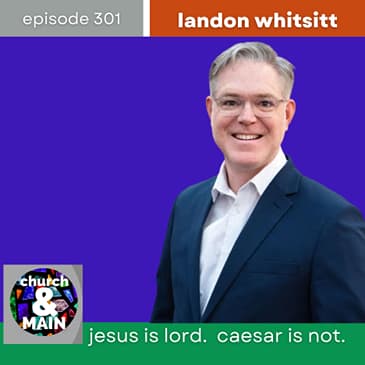

Saying “Jesus is Lord” can sound like a harmless phrase, but in the Roman Empire, where Caesar was Lord, it was a radical claim. Today, the claim still has rivals, and political and cultural tribes all want our allegiance.
Dennis talks with Presbyterian pastor Landon Whitsitt about his book Divided Allegiance. Landon is the pastor of Westminster Presbyterian Church in Oklahoma City and a former vice moderator of the 219th General Assembly of the PC(USA). He is also the author of Make-Believe, Zombie Jesus, The Descending God, Afraid of Everything, Open Source Church, and Theology of Art.
The conversation looks at why we keep dividing our loyalty between God and other powers, and what faithfulness looks like when every side wants to claim Jesus. Landon pairs the prophet Micah with the Barmen Declaration, the confession written against the Nazi regime. His point is that this struggle is not new to our moment. It is what the people of God have always faced.
In this episode:
- The biblical context of Micah and its relevance today
- The significance of the Barman Declaration in Christian ethics
- The challenge of divided loyalties in contemporary faith
- The role of confession and repentance in spiritual integrity
- The influence of Reformed theology on understanding God's sovereignty
- The church's prophetic role in social justice and injustice
- The impact of Christian nationalism on faith and allegiance
- Practical steps for pastors and congregations to remain faithful
Resources:
- Landon’s Substack: landonwhitsitt.substack.com/
- Landon’s website: LandonWhitsitt.com
- Westminster Presbyterian Church, Oklahoma City (sermons): wpcokc.org
- Divided Allegiance by Landon Whitsitt
Facebook (https://www.facebook.com/churchandmain) | Instagram (https://www.instagram.com/churchandmainpod/) | Threads (https://www.threads.net/@churchandmainpod) | Website (https://churchandmain.org/) | YouTube (https://www.youtube.com/@churchmainpodcast) | Substack (https://churchandmain.substack.com/)
Enjoyed this episode? Subscribe to Church and Main on your favorite podcast app, leave a review, and visit churchandmain.org or churchandmain.substack.com to read more and support the show. Send an email to dennis@churchandmain.org.
00:00:24 --> 00:00:28 Hello, and welcome to Church in Maine, a podcast for people interested in the
00:00:28 --> 00:00:32 intersection of faith, politics, and culture. I'm Dennis Sanders, your host.
00:00:33 --> 00:00:39 So, the phrase, Jesus is Lord, might seem like an innocuous phrase to many of us.
00:00:40 --> 00:00:43 It's something, at least, I heard a lot of growing up.
00:00:43 --> 00:00:48 But, in reality, it's actually a quite radical statement.
00:00:49 --> 00:00:53 If we went back to the beginnings of the church when it began,
00:00:53 --> 00:00:58 just after Pentecost, and where it took place in the Roman Empire,
00:00:59 --> 00:01:01 Caesar was considered Lord.
00:01:02 --> 00:01:10 So, claiming that some itinerant Jewish rabbi in a backwater of the empire is
00:01:10 --> 00:01:13 Lord kind of challenges earthly authority.
00:01:15 --> 00:01:22 Now, I remember, and have always had this in my mind, that Bob Dylan once sang
00:01:22 --> 00:01:23 a song about you gotta serve somebody.
00:01:23 --> 00:01:32 And that's kind of the case, that the whole concept of Jesus is Lord is that we want to serve God.
00:01:36 --> 00:01:40 But the thing is, as much as we say that we want to serve God,
00:01:40 --> 00:01:48 and we even want to say that Jesus is Lord, we're always tempted to serve more than one Lord.
00:01:49 --> 00:01:54 We kind of want, to put it rather bluntly, an open relationship.
00:01:55 --> 00:02:01 But that doesn't lead to a good end. Never has.
00:02:02 --> 00:02:08 Today, I'm speaking with Presbyterian Pastor Landon Whitsitt about his very
00:02:08 --> 00:02:10 timely book, Divided Allegiance.
00:02:11 --> 00:02:17 And what we'll discuss is the importance of faithfulness to Jesus in a world
00:02:17 --> 00:02:23 that is filled with political and cultural divisions, all of them wanting our allegiance.
00:02:24 --> 00:02:30 And more often than not, we fall for those and fall for those allegiances.
00:02:32 --> 00:02:36 Landon is the pastor of Westminster Presbyterian Church in Oklahoma City.
00:02:37 --> 00:02:43 He's also the former vice moderator of the 219th General Assembly of the Presbyterian Church USA.
00:02:44 --> 00:02:52 That is a very long title, which basically means that he helped represent the
00:02:52 --> 00:02:53 denomination for a time.
00:02:54 --> 00:02:58 Landon writes about faith, the church, and what happens when you take the Bible
00:02:58 --> 00:03:01 seriously enough to let surprise you.
00:03:01 --> 00:03:07 He's written other books besides Divided Allegiance, and those include Make-Believe,
00:03:07 --> 00:03:15 Zombie Jesus, The Descending God, Afraid of Everything, Open Source Church, and Theology of Art.
00:03:16 --> 00:03:22 So, now let's hear more from Landon about our Divided Allegiances.
00:03:41 --> 00:03:45 Melinda, I'd like to start off by getting to know a little bit about people
00:03:45 --> 00:03:49 and just to know about your background, your faith background,
00:03:50 --> 00:03:53 and also where you serve right now.
00:03:54 --> 00:03:59 Yeah, Dennis, thanks for having me on the podcast. What an honor.
00:03:59 --> 00:04:04 I am currently serving as the senior pastor and head of staff at Westminster
00:04:04 --> 00:04:06 Presbyterian Church in Oklahoma City.
00:04:06 --> 00:04:11 It is not a place that I thought I would end up. Um, I was actually born in
00:04:11 --> 00:04:16 Oklahoma, uh, but I consider myself a Kansan. I used to say Oklahoman by birth
00:04:16 --> 00:04:18 and Kansan by the grace of God.
00:04:18 --> 00:04:24 Um, you can see I've got my, my Kansas city hat on today. Ted Lasso came out
00:04:24 --> 00:04:28 last night. So all of us Kansas city people, we're, we're, we're pretty happy right now.
00:04:29 --> 00:04:38 Um, so grew up mostly in Kansas city detour over to, uh, to Louisville for, for seminary.
00:04:38 --> 00:04:43 Um, but most of my life has been spent in the Kansas city, Kansas city area.
00:04:44 --> 00:04:50 I was actually born to a family of what I like to call charismatic fundagelicals.
00:04:51 --> 00:04:56 Um, we were, we are, uh, we're, we're, we're the holy roller type,
00:04:57 --> 00:05:00 uh, the lift your hands and dance in church kind of, kind of folk.
00:05:00 --> 00:05:05 Um, and so that's what a lot of my upbringing, uh, was like.
00:05:06 --> 00:05:09 Then we went to a Baptist church, a Southern Baptist church,
00:05:09 --> 00:05:13 when I was in middle school and was there through high school.
00:05:15 --> 00:05:19 And that was, I mean, that was a formative experience. I like to say that I
00:05:19 --> 00:05:24 learned a lot about personal piety there. I would not trade that for the world.
00:05:25 --> 00:05:28 I don't see the world the same way as I did when I was a Southern Baptist,
00:05:28 --> 00:05:34 but the devotional life that I was taught has been valuable to me,
00:05:34 --> 00:05:36 and I'm really grateful for it.
00:05:37 --> 00:05:41 But then I went to a Presbyterian school in the middle of Kansas and became
00:05:41 --> 00:05:42 Presbyterian by default.
00:05:43 --> 00:05:48 And then I met and married a Presbyterian girl. So I like to say I was Presbyterian by marriage.
00:05:48 --> 00:05:51 And then I joined a Presbyterian church and became a pastor.
00:05:51 --> 00:05:53 So now I'm a born-again Presbyterian.
00:05:53 --> 00:05:59 And like all born-again people, I'm a zealot.
00:06:00 --> 00:06:03 I love the Reformed tradition. I think it is.
00:06:06 --> 00:06:10 Something that more of the world needs to understand. And I think that,
00:06:10 --> 00:06:15 you know, Reformed theology has gotten a bad rap because of the theology bros over the last 20 years.
00:06:15 --> 00:06:22 But Reformed theology is actually a very beautiful, loving, and hopeful thing.
00:06:22 --> 00:06:27 And so it has formed me in ways that I never would have expected,
00:06:27 --> 00:06:33 up to and including what we're going to talk about today, the writing of Divided
00:06:33 --> 00:06:36 Allegiance, which is based around one of our confessions.
00:06:37 --> 00:06:41 Presbyterian Church is a confessional church. We don't think we're smart enough
00:06:41 --> 00:06:42 to read the Bible on our own.
00:06:42 --> 00:06:47 And so we use the words of faithful people from thousands of years over the
00:06:47 --> 00:06:51 course of thousands of years and help us to understand what's going on.
00:06:51 --> 00:06:57 And one of our confessions has really shaped the way that I understand public
00:06:57 --> 00:07:03 life and what it means to live, particularly in America right now.
00:07:04 --> 00:07:10 But that's kind of my story. I'm a one-man ecumenical movement, and I love it.
00:07:10 --> 00:07:16 Well, that sounds familiar, because I grew up Baptist and evangelical,
00:07:16 --> 00:07:18 and then there's the Black Church in there, and too,
00:07:19 --> 00:07:25 and Disciples of Christ, and then living in Minnesota as a land of Lutherans,
00:07:25 --> 00:07:26 and my husband's Lutheran.
00:07:26 --> 00:07:29 So, yeah, I get that.
00:07:29 --> 00:07:34 And I think Disciples of Christ coming, that we came out of Presbyterianism,
00:07:34 --> 00:07:38 I always like to see it's Reformed adjacent. And…,
00:07:39 --> 00:07:43 And I think you're correct. I think reform theology gets a bad rap,
00:07:43 --> 00:07:48 and I think that there's a lot more to it than what we see.
00:07:50 --> 00:07:55 And I think it's kind of sad it doesn't get that respect sometimes,
00:07:55 --> 00:07:58 because there's just a lot of good stuff in it.
00:07:59 --> 00:08:01 Right, right. Yeah, I mean.
00:08:04 --> 00:08:09 In our constitutional documents, we talk about that the big theme,
00:08:09 --> 00:08:12 the main theme, the primary theme of the Reformed tradition,
00:08:13 --> 00:08:20 is that God redeems, sustains, rules, and transforms all things and all people,
00:08:21 --> 00:08:23 through sovereign righteousness and love.
00:08:23 --> 00:08:30 And so this idea that our God is a God of love, uncoerced, that's who our God is.
00:08:30 --> 00:08:36 I mean, I just, it pains my heart to watch the way that people talk about reformed
00:08:36 --> 00:08:41 people, because the sovereignty of God is a loving sovereignty.
00:08:41 --> 00:08:47 If God's sovereignty is not loving, then it's not God's sovereignty. Yeah. Yeah. Yeah.
00:08:48 --> 00:08:52 So this actually does kind of flow into your book, Divided Allegiance.
00:08:53 --> 00:08:59 And I think the subtitle also tells a lot about what the book is about.
00:08:59 --> 00:09:02 And it's what happens when the church forgets who it serves.
00:09:03 --> 00:09:08 And so my first question to you is, what led you to write the book?
00:09:09 --> 00:09:15 It sounds like this kind of came out of some sermon planning in 2023,
00:09:16 --> 00:09:20 but also the 2024 presidential elections.
00:09:21 --> 00:09:27 So kind of what about that planning for the book of, because you were planning
00:09:27 --> 00:09:33 on preaching from the book of Micah and also the presidential election made
00:09:33 --> 00:09:34 you want to write the book?
00:09:37 --> 00:09:43 So every year in our congregation, we have four big words that we use,
00:09:44 --> 00:09:46 grace, peace, love, and justice.
00:09:46 --> 00:09:54 And I try to arrange the preaching around one of those words loosely every single year.
00:09:54 --> 00:10:01 And we knew that 2024 was going to be a contentious year politically.
00:10:02 --> 00:10:08 And so we wanted to make sure that we were doing our work well.
00:10:09 --> 00:10:14 And that year's work was justice. And so I wanted to use that as an opportunity
00:10:14 --> 00:10:18 to introduce our congregation to the prophetic literature.
00:10:18 --> 00:10:21 A lot of folks don't know the prophetic literature.
00:10:21 --> 00:10:28 You and I do as we grew up, right? The prophetic literature was big in our upbringing.
00:10:29 --> 00:10:32 But for a lot of folks, they don't know it. And so I decided to start with Micah
00:10:32 --> 00:10:36 as kind of the introductory take.
00:10:36 --> 00:10:41 And so we spent about five weeks in January and February of that year preaching
00:10:41 --> 00:10:46 through that. And I wanted to also mirror it with one of our confessions to
00:10:46 --> 00:10:47 teach folks about our confessions.
00:10:48 --> 00:10:52 And so as I started reading through Micah that previous fall,
00:10:52 --> 00:10:58 the Barman Declaration just started ringing in my ears because Micah was really
00:10:58 --> 00:11:00 all about who are you serving.
00:11:01 --> 00:11:05 Who are you serving? What kind of deals are you cutting? Do you think you're
00:11:05 --> 00:11:08 more important than God? I mean, Micah's very name, who is like the Lord?
00:11:09 --> 00:11:10 And the answer obviously is no one.
00:11:11 --> 00:11:15 And so the Barman Declaration, I felt like I had a really good opportunity.
00:11:15 --> 00:11:18 And plus, just given the way my brain works, it felt like a fun challenge to
00:11:18 --> 00:11:24 see if I could make the Barman Declaration and Micah harmonize a little bit.
00:11:25 --> 00:11:29 Just from a craft perspective as a preacher, I wanted to see if I could do that.
00:11:30 --> 00:11:34 I don't know how well I did it. I think I did it well. I hope I did it well.
00:11:35 --> 00:11:40 But it really gave a lot of folks in our congregation language for some things
00:11:40 --> 00:11:42 that they had been worried about.
00:11:43 --> 00:11:48 I serve a pretty, I will say, a pretty affluent congregation in Oklahoma City.
00:11:49 --> 00:11:53 And the thing that I love about our congregation is they care deeply.
00:11:54 --> 00:11:58 Their identity is really rooted in wanting to be good disciples of Jesus Christ.
00:11:58 --> 00:12:01 And they put their money where their mouth is. They put their time where their
00:12:01 --> 00:12:04 mouth is. This is a glorious congregation to serve.
00:12:04 --> 00:12:12 And to have them respond so strongly to this notion of Jesus being our primary
00:12:12 --> 00:12:14 allegiance was really, really powerful.
00:12:15 --> 00:12:18 After the sermon series was over, somebody said, boy, you need to turn that
00:12:18 --> 00:12:21 into a book. I said, yeah, I mean, I got a lot of stuff to do. Maybe I will.
00:12:24 --> 00:12:28 And then a year later, I was preaching through Colossians and I was preaching
00:12:28 --> 00:12:30 the primacy of Christ and someone.
00:12:30 --> 00:12:35 So this is after the after the election, after the 2024 election,
00:12:35 --> 00:12:37 I was preaching the primacy of Christ.
00:12:37 --> 00:12:41 And someone wrote me an email accusing me of being political and being,
00:12:41 --> 00:12:45 you know, I don't know if they use the word dirty liberal, but it was that kind
00:12:45 --> 00:12:46 of that kind of sentiment.
00:12:46 --> 00:12:51 And I thought, what kind of world do we live in if you can hear a preacher talk
00:12:51 --> 00:12:57 about the primacy of Christ, read Colossians 1, and think I'm saying partisan words?
00:13:00 --> 00:13:06 That is beyond what I think should be common. And then I realized, you know what?
00:13:07 --> 00:13:10 I may have thought, somebody needs to do something about this.
00:13:11 --> 00:13:15 And I remember the old Jerry Garcia quote, right? Somebody's got to do something,
00:13:15 --> 00:13:18 and it's just incredibly depressing that it's got to be us, right?
00:13:18 --> 00:13:21 So I was like, somebody's got to say something about this.
00:13:22 --> 00:13:27 Well, I mean, I have literally been trained to teach people theology and to teach the Bible.
00:13:27 --> 00:13:34 I should stop waiting. And so I began work on taking those sermons and transforming
00:13:34 --> 00:13:37 them into the book that eventually became Divided Allegiance.
00:13:39 --> 00:13:46 How long was that sermon series in 2023, 2024? I believe it was five weeks. Okay.
00:13:48 --> 00:13:50 Okay. Just enough to whet the whistle.
00:13:52 --> 00:13:57 And I think one of the things that's been your, what you do in that book is fascinating.
00:13:57 --> 00:14:03 And you kind of started off by saying that this book will make people uncomfortable.
00:14:06 --> 00:14:11 And that it will make everyone, regardless of their political persuasion, uncomfortable.
00:14:12 --> 00:14:16 What made you want to write that in the book? Because I think that that's important
00:14:16 --> 00:14:18 to write, to include that in the book.
00:14:21 --> 00:14:27 I thought it was important to include because, well, one, at least in the Presbyterian
00:14:27 --> 00:14:29 Church, I'm kind of a known commodity.
00:14:30 --> 00:14:35 People know that I have pretty progressive and or liberal views,
00:14:35 --> 00:14:37 both theologically and politically.
00:14:37 --> 00:14:44 And so I felt like it was important for me to say, this is not going to be a partisan attack.
00:14:45 --> 00:14:50 Because as i've um as i've come back to the congregation i served for,
00:14:50 --> 00:14:54 almost a decade as a mid-level bureaucrat in the presbyterian church and as
00:14:54 --> 00:14:58 i've come back to the congregation over the last several years,
00:14:58 --> 00:15:05 one of the things that i have uh really come to realize about myself is that
00:15:05 --> 00:15:07 i made a lot of assumptions myself,
00:15:08 --> 00:15:10 about what i thought,
00:15:11 --> 00:15:14 the bible the way that the bible and politics lined up.
00:15:14 --> 00:15:19 And, um, I think it would not be too strong to say that in many ways,
00:15:19 --> 00:15:24 I was ashamed of the assumption that I, that I carried.
00:15:25 --> 00:15:29 Um, and, and it's, and it's hard. I mean, I believe in, uh, the equality of
00:15:29 --> 00:15:33 people. I believe that God is a God of justice. I believe that God,
00:15:33 --> 00:15:39 as one of our other confessions says, stands against injustice and on the side of the wronged.
00:15:39 --> 00:15:45 And those tip of those policy translating those into policy positions tend to
00:15:46 --> 00:15:53 lean one way on a political spectrum and often not on another but i had dennis i had i had assumed.
00:15:55 --> 00:16:00 The um the the syncopation of.
00:16:01 --> 00:16:08 Moral progress and the Bible. And those are not necessarily the same thing.
00:16:08 --> 00:16:11 I had baptized the idea of moral progress.
00:16:11 --> 00:16:18 Um, and that was, that was humbling for me to realize that I had done the thing that I've always been,
00:16:19 --> 00:16:24 really grumpy about my more, my more conservative or right leaning friends,
00:16:24 --> 00:16:28 uh, the way that they have assumed Christianity reflects their,
00:16:28 --> 00:16:31 their ideological or political point of view.
00:16:31 --> 00:16:36 And I had to, I was very convicted and I had to repent of that.
00:16:36 --> 00:16:40 I mean, to use a good old Baptist word, I had to repent of that,
00:16:40 --> 00:16:43 um, and acknowledge that that's the way that it was.
00:16:43 --> 00:16:47 And I've really come to a place where I have, where I've understood and I,
00:16:47 --> 00:16:51 and my, God bless my children who get frustrated with me.
00:16:51 --> 00:16:57 I've had to tell them, I, I actually no longer, I no longer think about myself in political ways.
00:16:58 --> 00:17:03 I don't identify as a, I mean, I'm registered, but I don't identify as a Democrat
00:17:03 --> 00:17:05 or a Republican or an independent.
00:17:05 --> 00:17:08 I think about myself as a Christian and a disciple of Jesus Christ.
00:17:08 --> 00:17:14 And I have had to admit that that comes into conflict with a lot of ways that
00:17:14 --> 00:17:17 I had thought and a lot of things that I have said over the years.
00:17:17 --> 00:17:23 Um so that's that's why for me it was it was important to say um and i think
00:17:23 --> 00:17:27 more importantly it was for those folks quote unquote in the middle this is
00:17:27 --> 00:17:29 going to make you uncomfortable too.
00:17:31 --> 00:17:35 Um yeah fence sitters in the kingdom of god there there are no fence sitters
00:17:35 --> 00:17:40 in the kingdom of god uh as my youth pastor used to say so i wanted to make
00:17:40 --> 00:17:43 sure that everybody understood that they may be uncomfortable.
00:17:44 --> 00:17:47 I might touch a nerve. And if I didn't, fantastic. Great. You're more mature
00:17:47 --> 00:17:50 than I am. But I assumed that I would.
00:17:52 --> 00:17:52 And I think,
00:17:53 --> 00:17:58 One of the things that's fascinating about that is I think that that's even,
00:17:58 --> 00:18:02 it seems like that can even be more difficult in this day and age,
00:18:03 --> 00:18:08 where it seems that politics has kind of taken the place of religion,
00:18:10 --> 00:18:13 and where we kind of make that number one.
00:18:14 --> 00:18:19 And so it's that they become fused. And of course, you do talk about that in the book.
00:18:20 --> 00:18:26 And so it's really hard to try to think of yourself as a Christian first and
00:18:26 --> 00:18:33 not, you know, either one or the other, even in the middle, because we're, I think we just kind of,
00:18:34 --> 00:18:40 everything is kind of collapsed into our political viewpoints.
00:18:41 --> 00:18:48 Right right yeah it's it's it's it's entirely difficult um i i try to be really
00:18:48 --> 00:18:52 strict about my news diet um i'm,
00:18:53 --> 00:18:59 i don't i don't take in a lot of news um because the news that i need to know is,
00:18:59 --> 00:19:03 will get to me i read a book a few years ago called stop reading the news and
00:19:03 --> 00:19:08 it was it was pretty convicting and also as somebody uh who's neurodivergent
00:19:08 --> 00:19:11 you know with adhd i need to I need to reduce my inputs anyway.
00:19:14 --> 00:19:17 I get it. Yeah. I get it.
00:19:18 --> 00:19:23 So you start off by talking about that context because you based this on Micah.
00:19:25 --> 00:19:34 Can you guys say a little bit about what was Micah's context and what does that say about us today?
00:19:35 --> 00:19:37 Because his context was fascinating. Yeah.
00:19:38 --> 00:19:43 Wasn't it? Yeah. Holy cow. So Micah was a pre-exile prophet.
00:19:45 --> 00:19:51 And he and all the people, he lived in Judah, which was the southern kingdom.
00:19:51 --> 00:19:55 So for folks who have forgotten their biblical history, at one point,
00:19:56 --> 00:20:03 the United Kingdom of Israel split into two. There was a northern kingdom and a southern kingdom.
00:20:04 --> 00:20:10 And Assyria demolished the northern kingdom. And the southern kingdom of Judah
00:20:10 --> 00:20:12 knew that things were coming.
00:20:13 --> 00:20:19 And so the ruling elite did all sorts of things to try to respond to this.
00:20:21 --> 00:20:26 They tried to pay off those who were going to come. They tried to.
00:20:28 --> 00:20:33 Uh, form alliances, uh, with folks. They formed an alliance with Egypt in particular.
00:20:33 --> 00:20:37 Um, and Micah was encouraging them to rely on the Lord.
00:20:38 --> 00:20:43 Micah's name, as I've said, Micah's name, Mikiyahu means who is like the Lord.
00:20:44 --> 00:20:48 So every time his name was said, he was, he was proclaiming.
00:20:48 --> 00:20:51 And that's, that's the theme of, of the book.
00:20:51 --> 00:20:56 One of the things that's amazing about the prophetic literature is that most
00:20:56 --> 00:21:00 of these folks are, I like to call them performance artists.
00:21:01 --> 00:21:07 I think a lot of the political satire we have in the world right now,
00:21:07 --> 00:21:12 those folks would probably be considered prophets in that same kind of ilk.
00:21:14 --> 00:21:17 I think about all the folks I like to watch on The Daily Show,
00:21:18 --> 00:21:21 Trevor Noah, John Stewart, Roddy Chang.
00:21:22 --> 00:21:24 You know, I mean, that's what these folks do.
00:21:25 --> 00:21:29 They are performance artists and they help us to see things.
00:21:29 --> 00:21:32 That's what the prophets did. And prophets famously did this.
00:21:33 --> 00:21:38 You know, they would strip down and walk around naked to demonstrate something.
00:21:38 --> 00:21:42 They would marry certain people in order to demonstrate something.
00:21:42 --> 00:21:45 They would go without food in order to demonstrate someone.
00:21:45 --> 00:21:50 I think Jeremiah, it was Jeremiah or Isaiah, laid on his side for a number of
00:21:50 --> 00:21:52 days in order to demonstrate something.
00:21:52 --> 00:21:57 So what Micah was trying to do was to demonstrate you, the people,
00:21:57 --> 00:22:00 the ruling elite, are...
00:22:02 --> 00:22:06 You are giving your allegiance to someone other than the Lord.
00:22:06 --> 00:22:14 You're stripping the holy places and sending those precious metals as tribute.
00:22:15 --> 00:22:22 You are setting up worship of other gods to appease your enemies or your allies.
00:22:23 --> 00:22:28 And Micah wanted to make a very clear statement that no, as the people of God,
00:22:28 --> 00:22:31 our allegiance is to God and God alone.
00:22:32 --> 00:22:36 Um, that's doesn't mean it's always going to be easy. That doesn't mean it's always going to be fun.
00:22:36 --> 00:22:40 It doesn't mean that it's always going to be successful in terms of a human
00:22:40 --> 00:22:43 calculation, but it doesn't matter. Our job is to be faithful.
00:22:43 --> 00:22:47 So that was Micah's big message. I want you to be faithful.
00:22:47 --> 00:22:51 God wants you to be faithful. And I'm here to call you back to it because that's
00:22:51 --> 00:22:54 what the Torah says, because that's what prophets did. Prophets used the Torah
00:22:54 --> 00:22:57 to remind people of what the Torah said.
00:22:57 --> 00:23:00 This is what God wants. You shall have no other gods before me.
00:23:01 --> 00:23:05 And you're right, it's a very interesting context for today.
00:23:06 --> 00:23:09 Especially the folks that I would probably be more prone to disagree with,
00:23:10 --> 00:23:13 claim Christianity, claim Jesus.
00:23:13 --> 00:23:17 And I think that's one of the things that inside of me prompted me to write the book,
00:23:18 --> 00:23:22 prompted me to do the sermon series, because the God that they were proclaiming
00:23:22 --> 00:23:28 did not resemble the God that I understood Micah to be talking about,
00:23:28 --> 00:23:32 Jesus to be talking about, the whole of Christian scripture to be talking about.
00:23:34 --> 00:23:39 They were serving someone. See, the problem is, is not that they were serving
00:23:39 --> 00:23:42 someone instead of Jesus.
00:23:44 --> 00:23:51 They were serving someone else and saying it was the same as serving the Lord.
00:23:52 --> 00:23:56 And that to me is more insidious and more problematic.
00:23:58 --> 00:24:01 Than anything else. And we've seen it before. I mean,
00:24:01 --> 00:24:04 that's what happened to the church in Nazi Germany, which is why we brought
00:24:04 --> 00:24:08 in, which is why I decided to use the Barman Declaration because it was written
00:24:08 --> 00:24:13 particularly in response to that theological timeframe.
00:24:15 --> 00:24:19 What led you to use the Barman Declaration? You talked about that earlier as,
00:24:20 --> 00:24:23 it is part of the confessions for the Presbyterians.
00:24:25 --> 00:24:29 What made you try to connect the Barman Declaration with Micah?
00:24:30 --> 00:24:36 Because the Barman Declaration's entire point was to say,
00:24:36 --> 00:24:42 and it says it right in its very first article, Jesus Christ,
00:24:42 --> 00:24:45 as he attested to us in the Holy Scriptures,
00:24:46 --> 00:24:50 is the one word of God which we have to hear and which we have to trust and
00:24:50 --> 00:24:53 obey in our life and death. So the Barman Declaration is very clear.
00:24:53 --> 00:24:55 We don't follow anybody but Jesus.
00:24:56 --> 00:24:59 And so the Barman Declaration was written.
00:25:01 --> 00:25:07 Against the Nazi regime and against what the churches were doing by assuming
00:25:07 --> 00:25:14 Nazism and serving that it was it was a it was a confusion in their minds.
00:25:15 --> 00:25:18 These German Christians, they thought that God had a special relationship with
00:25:18 --> 00:25:22 Germany. God wanted to see God wanted to make Germany great again.
00:25:22 --> 00:25:24 I mean, to use the to use the common phrasing.
00:25:25 --> 00:25:30 And these theologians understood, no, no, no, this is a problem that we have
00:25:30 --> 00:25:33 had for thousands of years, all the way back to Micah.
00:25:34 --> 00:25:38 This is what churches have always done. And so Barman.
00:25:41 --> 00:25:45 Was the very right confession, the very right word for us in this day and age.
00:25:46 --> 00:25:51 Folks that I run around with and folks that I talk to, we've been talking about
00:25:51 --> 00:25:58 the Barman Declaration as applicable to our common life for well over a decade,
00:25:59 --> 00:26:03 probably since the early 2010s, seeing the rise of the Christian nationalist,
00:26:04 --> 00:26:08 way of speaking and the invocation of Jesus.
00:26:09 --> 00:26:13 And I want to be clear, it doesn't matter, political party. I remember,
00:26:14 --> 00:26:22 there was once when President Biden strongly invoked biblical scripture in support
00:26:22 --> 00:26:25 of something that his administration did, and I was incensed.
00:26:26 --> 00:26:29 He's a faithful man, I have no doubt, but you don't get to do that.
00:26:29 --> 00:26:32 Jesus doesn't love America more than everybody else.
00:26:33 --> 00:26:38 So that's why the Barman Declaration came in, because it's the purest analog.
00:26:39 --> 00:26:45 And it was also a tricky one, because people get tired, and rightfully so,
00:26:45 --> 00:26:48 of certain people comparing other people to Nazis and Hitler.
00:26:48 --> 00:26:53 I mean, it's a tried, it's a worn out comparison.
00:26:54 --> 00:26:58 It just is. And so one of the things that I felt like I needed to do was show,
00:26:58 --> 00:27:03 this is a very specific flashpoint in Christian history, just like I think we're at a flashpoint now.
00:27:04 --> 00:27:08 But this is not unique to now. This is not unique to the 1930s.
00:27:08 --> 00:27:11 This is what the people of God have always tried to deal with.
00:27:11 --> 00:27:16 So I tried to do a historical sweep and say, this is the problem of Christian
00:27:16 --> 00:27:18 people, of Judeo-Christian people.
00:27:19 --> 00:27:23 We serve one God and we always forget about it and it never works out well for us.
00:27:25 --> 00:27:29 One of the things that, in reading the book, and I think I talked before we
00:27:29 --> 00:27:33 started recording, how this relates to Andy Root's latest book,
00:27:33 --> 00:27:34 Battle of the Gods of Moor.
00:27:35 --> 00:27:40 And this, bear with me for a moment, makes me think of a Star Trek The Next Generation episode.
00:27:41 --> 00:27:43 And there is an episode where.
00:27:45 --> 00:27:51 Someone in the crew, it's not a well-known, not a regular person, but a person dies.
00:27:51 --> 00:27:56 And this person has a son. The mother dies, they have a son.
00:27:57 --> 00:28:01 It's a being that has killed the person, but then feels remorse.
00:28:01 --> 00:28:06 So they create a version of the mother.
00:28:07 --> 00:28:12 And so this kid is just now thinking, well, wow, this is mom and everything.
00:28:12 --> 00:28:16 And I remember what was interesting about it is that the doctor,
00:28:16 --> 00:28:22 Dr. Crusher, brings up this thing about, you know, this being can offer this
00:28:22 --> 00:28:25 kid comfort and wonder and all of this stuff.
00:28:26 --> 00:28:28 All we can give him is loss.
00:28:29 --> 00:28:36 And I thought about that when I thought about how the Israelites at this moment
00:28:36 --> 00:28:39 in time, they're dealing with Assyria.
00:28:39 --> 00:28:44 Assyria is this power that has already taken the northern kingdom,
00:28:44 --> 00:28:48 dispersed them, and basically just eliminated them.
00:28:49 --> 00:28:55 And they're scared. And they're willing to do whatever it can.
00:28:55 --> 00:28:58 And then you have Micah saying, well, you need to trust in God. And they're like.
00:29:01 --> 00:29:05 Do you not see the other people up there and what they can do?
00:29:05 --> 00:29:11 And so it's, I think what I keep thinking about is that how challenging it is
00:29:11 --> 00:29:14 to follow God and God alone.
00:29:14 --> 00:29:18 And it's, that's not just an issue of the Israelites, that's an issue of you
00:29:18 --> 00:29:21 and I now. I mean, it's just, it's hard.
00:29:24 --> 00:29:29 Right. That's so right. I mean,
00:29:30 --> 00:29:36 in your retelling of the Northern Kingdom, looking at Assyria and the Southern
00:29:36 --> 00:29:40 Kingdom, seeing them coming, one of the things that I took great pains to do,
00:29:40 --> 00:29:43 and I hope I did it well because I truly believe it,
00:29:44 --> 00:29:48 is that people are trying to do the right thing.
00:29:48 --> 00:29:52 That's the thing that I think is important to remember.
00:29:53 --> 00:30:00 We don't divide our allegiance because we're necessarily arrogant people,
00:30:00 --> 00:30:00 although there are some.
00:30:01 --> 00:30:06 But by and large, the vast, vast, vast majority of Christian people,
00:30:06 --> 00:30:10 our allegiance is divided because we're trying to do the right thing.
00:30:10 --> 00:30:12 We're trying to use the brains that God gave us.
00:30:13 --> 00:30:17 We're trying to be smart. We're trying to be strategic. We're trying to do all of those things.
00:30:18 --> 00:30:22 And so at a certain point, like we got to cut ourselves some slack here.
00:30:24 --> 00:30:29 And again, back to a discussion about Reformed theology. That's the thing that
00:30:29 --> 00:30:34 I love about Reformed theology. The way we say it in our church is all people
00:30:34 --> 00:30:36 are always already loved by God.
00:30:36 --> 00:30:40 So that's assumed. That's the baseline. We don't have to earn God's love.
00:30:41 --> 00:30:43 We can't lose God's love.
00:30:44 --> 00:30:50 And so it's not a matter of punishing someone when they get it wrong,
00:30:51 --> 00:30:55 but more importantly it's a it's a matter of making sure that people understand
00:30:55 --> 00:31:01 that god loves and care and is caring for you and therefore you can give your
00:31:01 --> 00:31:05 entire allegiance to god um,
00:31:06 --> 00:31:12 even when you may not think that it is the smarter strategic thing to do, which God bless you.
00:31:12 --> 00:31:16 You're not God and God is. So that's fun. Have fun with that choice.
00:31:17 --> 00:31:24 But you don't have to worry about it because, in a sense, God is in control.
00:31:24 --> 00:31:29 There's the sovereignty of God means that God is running the show.
00:31:31 --> 00:31:35 And that's why one of the sections, I took great pains to talk about people
00:31:35 --> 00:31:39 who failed by all earthly measure. There are people who have failed.
00:31:41 --> 00:31:46 Who came up short, but their faithfulness was the point, not the winning.
00:31:46 --> 00:31:48 See, that's the thing that we always have to remember.
00:31:48 --> 00:31:51 These good folks who divide their allegiance and they are good,
00:31:51 --> 00:31:53 they're worried about outcomes.
00:31:53 --> 00:31:57 And what Micah is saying, I think what Barman is saying, what Christian theology
00:31:58 --> 00:32:01 and preaching has always said is you need to worry about the inputs.
00:32:01 --> 00:32:03 Are you being faithful to God?
00:32:04 --> 00:32:08 You know, you've got tons of folks. I mean, one of my favorite stories in the
00:32:08 --> 00:32:10 book is, you know, is Fannie Lou Hamer, right?
00:32:10 --> 00:32:16 I mean, she fought and fought and fought and by every measure did not achieve her objectives.
00:32:17 --> 00:32:22 Very small incremental change and progress, but that was not her point.
00:32:23 --> 00:32:29 Her point was to be faithful to God and do what she understood faithfulness to God looked like.
00:32:29 --> 00:32:34 And I think that's what the writers of the Barman Declaration wanted to do.
00:32:35 --> 00:32:39 Even though they were silent on the quote-unquote jewish question they were
00:32:39 --> 00:32:44 silent on on a lot of those things they didn't really want to get terribly,
00:32:44 --> 00:32:51 uh political they were making a theological statement um so they were fallible people uh as well,
00:32:51 --> 00:32:56 but that's that's entirely the point god is sovereign god is ruling us we are
00:32:56 --> 00:33:02 fallible people so therefore logically our our trust should be placed entirely in God's hands.
00:33:04 --> 00:33:08 And I think that there is something to be said that it's not important.
00:33:10 --> 00:33:16 We're always, I think, as humans looking for the heroic and that people are
00:33:16 --> 00:33:21 human and they fall short even when they are trying to do the right thing.
00:33:23 --> 00:33:27 Whether it's the people behind the Barman Declaration, even the prophets.
00:33:27 --> 00:33:30 I mean, none of us are perfect.
00:33:31 --> 00:33:36 And I think that that's where kind of grace comes in, the grace of God comes in.
00:33:38 --> 00:33:44 Yeah, absolutely. Absolutely. yeah the the heroic is i mean i'm grateful for
00:33:44 --> 00:33:47 the heroes i'm grateful for the saints of the church they give us something to look at,
00:33:48 --> 00:33:56 but at the end of the day it's it's the the quiet faithful persistent siblings
00:33:56 --> 00:34:02 in christ that show me the way that life actually moves forward and actually and actually lives.
00:34:06 --> 00:34:10 What do you hope people can kind of get out of the book?
00:34:12 --> 00:34:18 And maybe I should back up and say, how, one, how was the sermon series when
00:34:18 --> 00:34:21 it was just the sermon series received initially?
00:34:21 --> 00:34:25 And then now that it is kind of in an expanded in book form,
00:34:25 --> 00:34:30 what are you hoping people can get out of this book, especially in our current context?
00:34:32 --> 00:34:36 In its original form, the sermon series, from what I remember was received well.
00:34:37 --> 00:34:39 If people were angry with me, nobody said anything.
00:34:42 --> 00:34:48 Our congregation is pretty good. I find, and I find this to be true about most
00:34:48 --> 00:34:51 congregations. I'm sure you find this to be true about your congregation as well.
00:34:52 --> 00:34:56 If you treat people with respect, both intellectually and emotionally,
00:34:56 --> 00:34:59 they'll go with you to places that they otherwise wouldn't go.
00:34:59 --> 00:35:03 So I strive to do that. And I hope that I succeeded with the sermon series.
00:35:05 --> 00:35:13 Um, the, the way that I hope it is received now is I hope that it shines a light
00:35:13 --> 00:35:16 on something that Christians,
00:35:18 --> 00:35:21 something that Christian people just don't realize that they're doing.
00:35:21 --> 00:35:25 Um, that's, that's my, that's, I feel like that's my job.
00:35:25 --> 00:35:29 Um, the book is just an extension of my pastoral ministry. Just like,
00:35:29 --> 00:35:32 you know, you see this podcast as an extension of your pastoral ministry.
00:35:34 --> 00:35:36 That's what the book is my job is to teach you something um,
00:35:37 --> 00:35:43 and to help you see something um and even though it might be uncomfortable because
00:35:43 --> 00:35:47 learning is always uncomfortable i don't want to i don't want to wag my finger
00:35:47 --> 00:35:50 at you but i want to invite you to see,
00:35:51 --> 00:35:55 i want to invite you to see something that you may not have seen before and to consider,
00:35:56 --> 00:35:58 if that is a piece of your life that needs to change um,
00:35:59 --> 00:36:02 i hope it gives people language to.
00:36:04 --> 00:36:08 Uh, to combat the rise of Christian nationalism.
00:36:09 --> 00:36:15 Um, I know there are a lot of people that I don't think think about it in the most effective way.
00:36:16 --> 00:36:20 And so I'm hoping that this gives people an effective way to think about it.
00:36:22 --> 00:36:27 Um, and I also hope, you know, part of the reason why I wrote the ending of
00:36:27 --> 00:36:33 the book, the way that I did about hope and about, um, about the fact that there
00:36:33 --> 00:36:36 were a lot of people who failed in all of these movements.
00:36:36 --> 00:36:41 I'm hoping to give people who are starting to crack and think,
00:36:42 --> 00:36:44 is this really the way to be talking about Jesus?
00:36:45 --> 00:36:51 I hope that I give them some permission and a safe place to land. I was really struck.
00:36:54 --> 00:36:59 When I relearned, because I had forgotten about this, when I had relearned about Martin Niemöller.
00:37:01 --> 00:37:05 And for those who are listening, Martin Niemöller is the man who wrote a version
00:37:06 --> 00:37:11 of the, uh, and then they came for me poem, you know, they came for the Jews
00:37:11 --> 00:37:14 and I didn't speak up because I wasn't a Jew. And then they came for me and
00:37:14 --> 00:37:16 there was nobody left to speak for me.
00:37:16 --> 00:37:21 He was a, he was a Hitler supporter. He was, he was excited about national socialism,
00:37:22 --> 00:37:24 and he came to regret that deeply.
00:37:24 --> 00:37:30 Um, if there is, If there is hope for somebody like that to change their mind,
00:37:30 --> 00:37:35 I want to, I want to offer one piece of the puzzle that will allow folks to
00:37:35 --> 00:37:39 change their mind and say, oh, I need to not divide my allegiance.
00:37:40 --> 00:37:45 I need to, I need to make sure that my allegiance is where, where it properly needs to be.
00:37:47 --> 00:37:52 Yeah, because I think sometimes, especially with when people talk about Christian
00:37:52 --> 00:37:59 nationalism, the danger is that we tend to demonize people and to say,
00:37:59 --> 00:38:00 well, you're bad people.
00:38:02 --> 00:38:07 And then there's no and then we don't there doesn't seem to be in some sometimes
00:38:07 --> 00:38:11 in the argument, no room for repentance. No, there's no way of of grace.
00:38:11 --> 00:38:13 It's just you're bad, you're condemned.
00:38:14 --> 00:38:19 And that's to me, that doesn't help. but I actually can, can actually make things worse.
00:38:21 --> 00:38:28 Um, 100%, 100%. And it's the problem that we all have. We all divide our allegiance.
00:38:28 --> 00:38:31 Some of us divide it one way. Some of us divide it another way.
00:38:31 --> 00:38:35 We are all doing this all the time, every single day.
00:38:35 --> 00:38:39 Um, I'm, I'm having a conversation with a church member right now,
00:38:39 --> 00:38:41 just about economic justice.
00:38:41 --> 00:38:46 And one of the things that we have agreed is like we are, we,
00:38:46 --> 00:38:51 we, we have resources that would absolutely help.
00:38:52 --> 00:38:54 Do we need to, as, as Jesus told
00:38:54 --> 00:38:58 the rich young ruler, sell everything we have and give it to the poor?
00:38:58 --> 00:39:02 Do we need to do that? Right. And that is a question about where our allegiance
00:39:02 --> 00:39:05 lies and what, what skin we're willing to put into the game.
00:39:05 --> 00:39:07 And that's just a, that's just a basic, easy one.
00:39:08 --> 00:39:11 But, well, that's not easy. It's a basic one. But, you know,
00:39:11 --> 00:39:13 I mean, up to and including.
00:39:14 --> 00:39:18 What kind of media do you watch? What kind of conversations do you have?
00:39:18 --> 00:39:24 I mean, that's one of the things that I love about the Barman Declaration is,
00:39:25 --> 00:39:26 it makes clear. What does it say?
00:39:27 --> 00:39:33 The second thing is that Jesus Christ is God's mighty claim on our entire life.
00:39:33 --> 00:39:37 So that means that my economic life, Jesus, has primacy. Right.
00:39:38 --> 00:39:45 On my relational life, on my media life, on my political life,
00:39:45 --> 00:39:48 every part of my life, Jesus doesn't just get a say.
00:39:49 --> 00:39:54 Jesus is the one who dictates what I do. And that is, gosh, Dennis,
00:39:54 --> 00:39:57 I mean, that's scary, right? Because I am failing.
00:39:59 --> 00:40:02 Yeah well you know i always say that if if,
00:40:03 --> 00:40:07 we want to take christ's discipleship seriously we're never going to be a good
00:40:08 --> 00:40:14 republican or democrat it's that that kind of lordship is always going to rub up against us whether,
00:40:15 --> 00:40:16 we like it or not,
00:40:17 --> 00:40:20 it's just going to yeah it's just going to,
00:40:23 --> 00:40:26 So when it kind of comes to this whole sense of divided allegiance,
00:40:27 --> 00:40:29 where do you think, I mean, you've
00:40:29 --> 00:40:33 talked about repentance. Where does confession fit into all of this?
00:40:35 --> 00:40:42 It has to be a part of it. I mean, that's a really, that's a fantastic question. It has to be a part of it.
00:40:48 --> 00:40:51 That is what our South African friends taught us with apartheid,
00:40:51 --> 00:40:56 right? um that without truth there is no reconciliation um.
00:40:59 --> 00:41:06 So how, how that is done. And I think, you know, as, as pastors,
00:41:06 --> 00:41:10 you and I have opinions about how we do that sort of thing, but on a policy level,
00:41:11 --> 00:41:15 um, how that is done takes a lot of care.
00:41:16 --> 00:41:20 Um, takes a lot of care. Cause exactly what you were saying just a moment ago,
00:41:21 --> 00:41:25 if you come at this confrontationally, you're getting, you will get nowhere.
00:41:26 --> 00:41:29 So how do we, how do we do that? How do we offer that? The only,
00:41:29 --> 00:41:33 the only thing that I can think to offer into that, um,
00:41:34 --> 00:41:42 into that is to remind us at least about the way that Presbyterians do our order of worship.
00:41:43 --> 00:41:46 When we offer our call to the confession, the prayer of confession,
00:41:46 --> 00:41:55 which we do very quickly in the worship service, we always say beforehand, we are not perfect.
00:41:55 --> 00:41:59 I said some version of this, right? We are not perfect. We hide from ourselves.
00:42:00 --> 00:42:05 We hide from what we've done. We take pride in what we do. We're arrogant and God loves us.
00:42:06 --> 00:42:10 Nothing about us, nothing about what we're going to say is going to take away
00:42:10 --> 00:42:12 the fact that we are always already loved.
00:42:13 --> 00:42:19 So it is within that confidence of God's love that we can confess what we've
00:42:19 --> 00:42:22 done, what we've left undone, what we've said and left unsaid.
00:42:22 --> 00:42:26 I think that when it comes to the confession of people.
00:42:27 --> 00:42:33 Um, I think they, if they don't understand that, that on the other side of this,
00:42:34 --> 00:42:36 is restoration, then they won't do it.
00:42:37 --> 00:42:42 And I don't need everybody to do a South African truth and reconciliation commission
00:42:42 --> 00:42:45 level, you know, confess it to the whole world and have it on,
00:42:46 --> 00:42:50 you know, on video and audio and in the national archive. I don't need that.
00:42:50 --> 00:42:57 But, you know, I think it's required that we confess it to one other person,
00:42:57 --> 00:43:01 at least to say to somebody, you know,
00:43:02 --> 00:43:06 I mean, we'll just think about, you know, my household or your household, right?
00:43:06 --> 00:43:10 It is, I think there are times when it would be sufficient for you to just confess
00:43:10 --> 00:43:14 that to your husband and have that be enough, because then it is,
00:43:14 --> 00:43:18 you are acknowledging to another human being, this is who I am.
00:43:19 --> 00:43:24 And in a lot of ways, that is an act of undivided allegiance to God,
00:43:25 --> 00:43:30 because what God says is, the truth will set us free, and naming the truth,
00:43:30 --> 00:43:33 and being honest about who we are, and you've done that, right?
00:43:34 --> 00:43:38 So I think that at a certain level, that might be the case. You don't need to
00:43:38 --> 00:43:41 post on Facebook that you're re-registering with the other party,
00:43:41 --> 00:43:43 if that's what it comes to, or whatever.
00:43:44 --> 00:43:49 But, I mean, I guess if you've hurt people, you know, Alcoholics Anonymous,
00:43:49 --> 00:43:54 they do it right, right? Yeah, yeah. Insofar as you are able, go and make amends.
00:43:54 --> 00:43:56 Insofar as you are able, and it won't cause additional harm.
00:44:00 --> 00:44:04 I think the other thing to remember, and you talked about,
00:44:05 --> 00:44:08 as we talked about earlier, the situation with the Israelites,
00:44:09 --> 00:44:14 but I think you also do a really good job of talking about the situation in
00:44:14 --> 00:44:18 Germany leading up to when Hitler comes to power.
00:44:20 --> 00:44:25 And I remember this from my own history in high school. It was bad in Germany.
00:44:26 --> 00:44:32 Um and so it wasn't as if people just decided okay well just become evil and
00:44:32 --> 00:44:35 you know just just to start you know doing that,
00:44:36 --> 00:44:44 it was a really dire situation for them and they felt this all of this and i
00:44:44 --> 00:44:48 think what it puts it in is obviously it doesn't excuse what happens but it
00:44:48 --> 00:44:51 puts it in a very human term.
00:44:52 --> 00:44:56 And I think what it reminds me, it makes me think of is that whole,
00:44:58 --> 00:45:05 From the hymn, Come Thou Fond of Every Blessing, the title Prone to Wander, that we all do that.
00:45:05 --> 00:45:10 You know, I'm not any better than a German in 1932.
00:45:12 --> 00:45:20 We are all prone to wander. And that's just, we all have those divided allegiances.
00:45:20 --> 00:45:22 Yes, yes.
00:45:23 --> 00:45:30 Oh, I think that, I think that was John Calvin's favorite hymn. Hmm. Okay.
00:45:31 --> 00:45:35 Cause his idea is, I mean, I, a lot of times during my prayer time,
00:45:35 --> 00:45:37 that's something that I will quote.
00:45:39 --> 00:45:42 Prone to wander, Lord, I feel it. Prone to leave the God I love.
00:45:42 --> 00:45:45 Here's my heart, Lord, take and seal it.
00:45:45 --> 00:45:50 And John Calvin, that was his, his symbol is a hand with a heart in it, offering it to God.
00:45:51 --> 00:45:54 Yeah, bind me like a fetter.
00:45:54 --> 00:46:00 Ooh, we don't use good words like fetter anymore. Nope. Yeah, I mean, you're right.
00:46:01 --> 00:46:05 We have to be compassionate to one another about these things.
00:46:07 --> 00:46:13 I've got a friend, I think he's retired now. He used to write a column for the
00:46:13 --> 00:46:15 Presbyterian Outlook or Presbyterians Today.
00:46:16 --> 00:46:21 James Ayers, folks will remember James. James was a pastor in Kansas.
00:46:21 --> 00:46:24 Love James. One of those good old boys.
00:46:25 --> 00:46:29 He was, I say good old boy, but he was from Boston. And he liked to say,
00:46:29 --> 00:46:32 nobody wakes up one day and says, I'm going to be wicked bad.
00:46:32 --> 00:46:35 Right? Nobody does that. Nobody does that.
00:46:36 --> 00:46:39 It's these small little choices and these small little steps.
00:46:39 --> 00:46:42 And in fact, I think that that's why, you know, back to your question,
00:46:42 --> 00:46:43 why did you write the book?
00:46:44 --> 00:46:50 Because in the Presbyterian context, we believe that those of us who are trained in ministry, we are,
00:46:51 --> 00:46:55 and those of us who lead in ministry, so our elders and our deacons as well,
00:46:55 --> 00:47:00 we are gifts from God to the church to help the church be the church.
00:47:00 --> 00:47:05 And so one of the things that we have to do is teach people to see when we're
00:47:05 --> 00:47:10 taking those small steps, making those little choices that might eventually
00:47:10 --> 00:47:13 lead to being wicked bad.
00:47:13 --> 00:47:18 That is part of our job. And so I really hope that,
00:47:19 --> 00:47:23 I'm tracking back to an earlier question, but I really hope that one thing this book helps is,
00:47:23 --> 00:47:30 my fellow pastors to have language and a confidence to rely on not only biblical
00:47:30 --> 00:47:36 witness, historical witness, theological witness to say, no, this is not who we are.
00:47:37 --> 00:47:40 We are people who should give our only allegiance to God.
00:47:42 --> 00:47:49 Which kind of does kind of lead me to kind of what does this book say to congregations
00:47:49 --> 00:47:55 to pastors right now and and and how they can kind of,
00:47:56 --> 00:47:58 be a faithful people in this time,
00:48:00 --> 00:48:05 i think what it says is you have to look at this um,
00:48:08 --> 00:48:11 We know the words Christian nationalism right now. We know those words.
00:48:11 --> 00:48:15 In the last year-ish, those words have become important words.
00:48:15 --> 00:48:19 In fact, people are saying, yes, I am proud to be both a Christian and a nationalist,
00:48:19 --> 00:48:20 and that just blows my mind.
00:48:22 --> 00:48:25 I think what it says to the church is you have to examine this.
00:48:26 --> 00:48:30 I mean, I've had folks in my own congregation who were gracious enough to read
00:48:30 --> 00:48:36 early drafts of this, and some of them said things like, you presented some
00:48:36 --> 00:48:38 things that I had never thought of before.
00:48:40 --> 00:48:43 And so I'm grateful, not only that they were the kind of people who could receive
00:48:43 --> 00:48:47 something like that, but I'm grateful that it connected and that they were able
00:48:47 --> 00:48:49 to examine some parts of their life.
00:48:50 --> 00:48:54 Because I think that's a big part of what it is to be a disciple, right?
00:48:54 --> 00:48:57 Daily conversion, going back to your question about confession,
00:48:57 --> 00:49:00 daily conversion is a big part of being a disciple.
00:49:00 --> 00:49:02 And if we're not willing to take a look at it and ask the questions.
00:49:04 --> 00:49:11 I don't see how we can even think we're the kind of disciples God has called and created us to be.
00:49:12 --> 00:49:16 Because it seems like, I mean, one of the things that it feels like in a lot
00:49:16 --> 00:49:20 of this book is that it boils down to discipleship.
00:49:21 --> 00:49:26 And what does it mean to be a follower of Jesus? Totally. Totally.
00:49:27 --> 00:49:32 I mean, I'm sure you've discovered this in your ministry. Like this stuff that
00:49:32 --> 00:49:35 we do, it's actually pretty simple. We're just teaching you how to love Jesus
00:49:35 --> 00:49:38 and love other people. It's all about discipleship.
00:49:38 --> 00:49:42 I mean, I did a baptism on Sunday. That's the Great Commission.
00:49:42 --> 00:49:44 Go and make a disciple. Yeah.
00:49:45 --> 00:49:50 Yeah, I'm grateful that you popped that word into the conversation because that's
00:49:50 --> 00:49:52 exactly right. I hadn't even thought of it in those terms, though.
00:49:53 --> 00:50:02 Well, and, you know, I think it is, it's reminiscent of what Jesus was trying
00:50:02 --> 00:50:05 to do with the disciples, is helping them to learn.
00:50:06 --> 00:50:11 And the thing that's important about the disciples is, of course, they always fell short.
00:50:11 --> 00:50:14 I mean, you know, it's right there in black and white. They,
00:50:15 --> 00:50:19 you know, when Jesus was being arrested, they were gone.
00:50:20 --> 00:50:26 And, you know, it's, this is, I think what it kind of boils down to is,
00:50:27 --> 00:50:30 is discipleship. Who do we follow? Who do we listen to?
00:50:32 --> 00:50:38 And, but the thing is, is that the discipleship can get, I think, garbled.
00:50:40 --> 00:50:46 And mixed up. You know, it's not necessarily that you're choosing Jesus or Baal.
00:50:46 --> 00:50:51 It's that you choose both. And that's kind of the danger.
00:50:52 --> 00:50:53 Yep. Yep. Yeah.
00:50:55 --> 00:50:56 Yeah. Yeah.
00:50:59 --> 00:51:05 So where do you think the church where we are now,
00:51:07 --> 00:51:13 can be in a few years when it comes to trying to follow Christ in this,
00:51:14 --> 00:51:16 in a very politically divided time?
00:51:17 --> 00:51:23 You know, where do you see the church being a witness or do you see that happening?
00:51:23 --> 00:51:28 Can it happen? Have you seen examples where it's, you know, it's not trying
00:51:28 --> 00:51:35 to pick a side, you know, red or blue, but trying to to be the church in a time
00:51:35 --> 00:51:37 that's still so politically fraught?
00:51:39 --> 00:51:42 I think so. I think a couple of things.
00:51:49 --> 00:51:55 There are, there are ordinary moments and then there are acute moments.
00:51:55 --> 00:51:59 So you've got acute moments where I think, uh,
00:52:02 --> 00:52:07 where I think the church has to be present. Um, I mean, I, I,
00:52:07 --> 00:52:09 this immediately comes to mind.
00:52:10 --> 00:52:12 You live in the twin cities. I'm thinking about, uh, you know,
00:52:12 --> 00:52:18 what happened, uh, over the course of this past year in the twin cities with ice.
00:52:19 --> 00:52:26 Yes. Um, the, the, the church was very present, very present through all of that.
00:52:27 --> 00:52:32 Um, and it wasn't, it was not political necessarily.
00:52:32 --> 00:52:38 It was, we are, as one of our confessions says, the confession of Belhar,
00:52:38 --> 00:52:42 which came out of South Africa, confession of Belhar says, we are required to
00:52:42 --> 00:52:46 stand where God stands against injustice and with the wronged.
00:52:46 --> 00:52:49 I saw the church standing with the wronged.
00:52:52 --> 00:52:56 So there is, there is that, um, that is, that is a thing that the church needs
00:52:56 --> 00:53:02 to be willing to do to stand literally physically stand with the wronged and against injustice.
00:53:04 --> 00:53:07 Those are acute times though. Thanks be to God.
00:53:07 --> 00:53:11 Those are hopefully more and more few and far between.
00:53:11 --> 00:53:17 We know they will never go away, but the ordinary times, I recall something that.
00:53:18 --> 00:53:21 Uh, A friend of both of ours, online friend of both of ours,
00:53:21 --> 00:53:26 a former moderator of the Presbyterian Church, Bruce Reyes Chow, told me one time.
00:53:27 --> 00:53:34 He said he was talking, you know, as he says, he was raising a ruckus in San Francisco.
00:53:34 --> 00:53:37 And somebody said, well, what's your policy proposal? He goes,
00:53:37 --> 00:53:39 oh, no, no, no. That's not my job.
00:53:39 --> 00:53:42 My job is not policy proposals. That's your job.
00:53:42 --> 00:53:47 My job is the prophetic call to say we're not doing it right.
00:53:47 --> 00:53:49 Or we're not doing it well.
00:53:49 --> 00:53:52 We don't have to come up with a solution. That's why, I mean,
00:53:53 --> 00:53:58 in Reformed theology, we have this understanding that God not only calls religious
00:53:58 --> 00:54:02 kinds of people to do religious kinds of work, God calls all people to do all kinds of work.
00:54:02 --> 00:54:07 And so, our elected officials are, we believe, called by God to do that kind
00:54:07 --> 00:54:10 of work, and thanks be to God for them. I wouldn't be good at that work.
00:54:12 --> 00:54:16 That's their job. Our job is to say, again, we are the teachers,
00:54:16 --> 00:54:21 we are the proclaimers, we are the ones who say, this is where the Lord is standing.
00:54:21 --> 00:54:23 Now align your policies likewise.
00:54:25 --> 00:54:29 Your policies are harming people. No, right?
00:54:30 --> 00:54:34 That's our job. So I think that's the work of the church. The work of the church,
00:54:34 --> 00:54:38 we have to be willing to say, we're getting it wrong, and here's how we're getting
00:54:38 --> 00:54:41 it wrong, and here's the goal we should be reaching.
00:54:43 --> 00:54:47 And be okay when people say, you're just poking holes. Yeah,
00:54:47 --> 00:54:50 we are. Absolutely. Absolutely.
00:54:50 --> 00:54:52 Because your job is to find the
00:54:52 --> 00:54:56 solution that will honor people in the way that they need to be honored.
00:54:59 --> 00:55:01 That's my hip reaction, I think.
00:55:04 --> 00:55:07 Yeah, I think so. How does that sound to you, Dennis? You buy that?
00:55:09 --> 00:55:13 Well, I mean, I don't think that necessarily we're called to be policy folk.
00:55:13 --> 00:55:19 I mean, that's, I did not get a degree in public policy or the law.
00:55:21 --> 00:55:21 So, yeah,
00:55:23 --> 00:55:30 I think also, and within that, it's not saying that there is a specific prescription to something.
00:55:31 --> 00:55:39 It's simply saying, this is where you're wrong, and here is what God is asking of us.
00:55:40 --> 00:55:42 How you get that done, that's up to you.
00:55:43 --> 00:55:49 The problem the thing is it has to get done that's that's the issue that's real
00:55:49 --> 00:55:54 yeah i like that that's so wise yeah there are tons of ways to get it done but
00:55:54 --> 00:55:57 freaking get it done like come on,
00:55:59 --> 00:56:06 we know the problems of the world let's get it done yep it's i mean that's It
00:56:06 --> 00:56:08 also makes it a lot easier because, like I said,
00:56:09 --> 00:56:14 I did not get a degree in public policy. They didn't teach that in seminary.
00:56:14 --> 00:56:17 I'm kind of glad they didn't teach that in seminary either.
00:56:23 --> 00:56:28 Oh, yeah. I mean, one of the things back to the whole confession idea,
00:56:28 --> 00:56:30 Presbyterian being a confessional church.
00:56:30 --> 00:56:34 One of the things that we say about our confessions is that confessions proclaim
00:56:34 --> 00:56:39 to us as well as the world who we are and what we resolve to do.
00:56:39 --> 00:56:44 And so there is a role that the church as an institution plays.
00:56:45 --> 00:56:47 This is what God wants to see in the world.
00:56:50 --> 00:56:54 Where it gets, I think, tricky and sticky is, well, no, tricky and sticky is
00:56:54 --> 00:56:56 not wrong. That's not right.
00:56:56 --> 00:57:03 Where it gets interesting, where it gets not as clear cut, is we also believe
00:57:03 --> 00:57:06 that each individual member of the church is the church in the world.
00:57:06 --> 00:57:09 And so some of those people are the policy people.
00:57:09 --> 00:57:14 I think the church's job is to help those people do their work well. Mm-hmm.
00:57:15 --> 00:57:19 I've got several friends who are theological ethicists. I've got one friend
00:57:19 --> 00:57:23 who was the theological ethicist for a hospital group back in.
00:57:24 --> 00:57:25 Right back during COVID.
00:57:25 --> 00:57:31 And her job was to help think through who's going to get the vaccine first.
00:57:31 --> 00:57:35 I am so grateful that she was in place. Her name's Carrie Allen.
00:57:35 --> 00:57:37 She'd be a great person for you to have on the show.
00:57:38 --> 00:57:42 I'm so grateful that she was in place to help people think about that.
00:57:42 --> 00:57:49 Using her religious degree, using her theological acumen to help people think
00:57:49 --> 00:57:54 through what it means to save lives with a vaccine.
00:57:54 --> 00:57:57 Who should get it first? Lord, I'm glad I didn't have to answer that question.
00:57:58 --> 00:58:01 Gosh, I'm glad I didn't have to answer the question. I mean,
00:58:01 --> 00:58:04 I'm glad that I'm not making policy because I think I would be a poor person
00:58:04 --> 00:58:09 to make policy around all of that. I want everybody to be able to do anything that they want.
00:58:10 --> 00:58:13 Um, but my job is just to love people as they walk in the door.
00:58:13 --> 00:58:21 Thank God for our, our siblings who are working, uh, who are working in those and many other areas.
00:58:22 --> 00:58:28 Uh, you know, voting rights, uh, just equality rights across the board. Thank God for people.
00:58:29 --> 00:58:31 I read a book and I tell people Bible stories.
00:58:32 --> 00:58:34 You don't want me making policy.
00:58:35 --> 00:58:43 Nope no no that we would be in big prop big trouble if you put me in charge so.
00:58:45 --> 00:58:49 You and i can sound real smart with a limited number of things and then we are
00:58:49 --> 00:58:55 way out of our depth yep well and the the wonderful thing is to know that when
00:58:55 --> 00:58:58 you are out of your depth and unfortunately,
00:58:59 --> 00:59:04 too there are lots of people that don't know that so oh my gosh I don't know
00:59:04 --> 00:59:09 that more often than I am comfortable admitting on a recorded podcast. I will say that.
00:59:14 --> 00:59:16 My children have stories. They can tell you many stories.
00:59:19 --> 00:59:24 So, if people want to know more about you, where should they go?
00:59:24 --> 00:59:27 I know that you have a Substack out there.
00:59:27 --> 00:59:36 I do. I do. Yeah, you can find me on Substack. It's just LandonWitsit.substack.
00:59:40 --> 00:59:45 And the congregation that I serve, if you are interested in the sermons that I preach,
00:59:48 --> 00:59:52 wpcokc.org. We put up our weekly sermons there. This summer,
00:59:52 --> 00:59:54 we're preaching through the Apocrypha.
00:59:54 --> 00:59:56 That's a lot of fun. Yeah.
00:59:56 --> 01:00:00 We bought new pew Bibles and the only ones we could find, because we got the
01:00:00 --> 01:00:03 NRSV updated edition, the only ones we could find had the Apocrypha.
01:00:03 --> 01:00:08 And I'm like, well, let's read through these books. That's a hoot, let me tell you.
01:00:09 --> 01:00:12 I don't know when the last time you read the story of, or if you've ever read
01:00:12 --> 01:00:16 the story of Judith, um, it's been a while.
01:00:16 --> 01:00:21 Yeah. So for those who don't know, uh, Judith went and, you know,
01:00:21 --> 01:00:25 cut off a general's head and they said greater, you know, most blessed are you
01:00:25 --> 01:00:28 among women, which is the same thing they told Mary.
01:00:29 --> 01:00:35 So, oh my gosh, it's just very fun. Very fun time. Yeah. But most sub stack's probably the best.
01:00:36 --> 01:00:39 I have a Facebook and an Instagram account, but I'm barely on it,
01:00:40 --> 01:00:42 much to the chagrin of all my friends.
01:00:42 --> 01:00:49 I don't read Instagram or Facebook very often. So, Substack's probably the easiest way to get to me.
01:00:49 --> 01:00:51 Or my website, LandonWitsitt.com.
01:00:52 --> 01:00:55 All right. Well, Landon, thank you for taking the time. This was a really good
01:00:55 --> 01:01:00 conversation, and I hope that people will read the book.
01:01:00 --> 01:01:06 It's been a good read so far and um definitely looking forward to to reading
01:01:06 --> 01:01:11 it all the way through i appreciate it dennis what a what a what a joy to get
01:01:11 --> 01:01:15 to talk face to face all right take care all righty.
01:01:45 --> 01:01:54 So, my husband is a composer, and one of the songs that Daniel has written is a song,
01:01:56 --> 01:02:01 called Choose This Day, or I should say, actually, We Would Serve the Lord.
01:02:01 --> 01:02:06 And the song begins, Choose This Day Whom You Will Serve.
01:02:07 --> 01:02:13 And I've been thinking about that, as we're putting together this episode,
01:02:13 --> 01:02:20 that we are constantly forced to choose who are we going to serve.
01:02:22 --> 01:02:27 Too often we want to kind of have it both ways, but that's not how God works.
01:02:28 --> 01:02:32 I hope that you enjoyed the episode and would love to hear your thoughts about it.
01:02:34 --> 01:02:39 If you have questions or comments, feel free to send me an email at,
01:02:41 --> 01:02:45 and you can send that to dennis at churchandmaine.org.
01:02:46 --> 01:02:50 As you notice, that is a new email. So dennis at churchandmaine.org.
01:02:51 --> 01:02:58 I will include links to Landon's substack, his website, and then also his book.
01:02:58 --> 01:03:02 And so I hope but you will consider taking a look at it.
01:03:04 --> 01:03:08 Now to get to some of the business of the website, if you want to learn more
01:03:08 --> 01:03:13 about the podcast, if you want to check out past episodes or donate,
01:03:14 --> 01:03:16 go to churchandmain.org.
01:03:17 --> 01:03:23 Now you can also go to churchandmain.subsec.com to read related articles.
01:03:24 --> 01:03:30 I also try to put those episodes up, usually a few days later.
01:03:33 --> 01:03:40 So always be on the lookout for them. You can also make a donation on Substack.
01:03:41 --> 01:03:46 I don't paywall anything. It's $5 a month, 60 bucks a year.
01:03:47 --> 01:03:50 I am actually working on a few articles that should be coming up soon.
01:03:51 --> 01:03:57 One of them has to do with a comic book character and death.
01:03:57 --> 01:04:01 So just to put that out there in case you are interested.
01:04:04 --> 01:04:10 But again, if you want to go and find out those articles, go to churchinmaine.substack.com.
01:04:11 --> 01:04:15 I also hope that you'll consider subscribing to the podcast on your favorite podcast app.
01:04:16 --> 01:04:21 And please consider leaving a review or a rating.
01:04:21 --> 01:04:24 When you do that, that actually helps others find the podcast.
01:04:24 --> 01:04:28 And I would be totally grateful if you did that.
01:04:29 --> 01:04:33 So that is it for this episode of Church in Maine. I'm Dennis Sanders,
01:04:33 --> 01:04:35 your host. Thank you so much for listening.
01:04:36 --> 01:04:40 Take care, everyone. Godspeed, and I will see you very soon.