
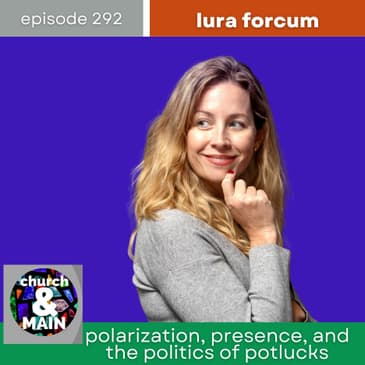

America isn't breaking apart because people are more extreme. We're breaking apart because our civic relationships are. That's the line from writer and researcher Lura Forcum that sparked this conversation on political polarization, tribalism, and what faith communities can do about it.
Dennis Sanders sits down with Lura Forcum, psychologist by training, writer of the newsletter How to Human, and co-host of the We Made This Political podcast, for a wide-ranging conversation on why Americans are sorting into hostile camps and what it would take to find our way back to each other.
Lura draws on her background in social psychology to explain how tribalism works beneath our conscious awareness, why dehumanization is the first step toward justifying harm, and how her Christian faith, particularly the conviction that all people are made in the image of God, shapes her understanding of political conflict. The conversation moves through some of the year's hardest moments, including the death of Senator Lindsey Graham and the shooting of Charlie Kirk, and asks what it looks like to hold complexity about people we disagree with rather than reducing them to caricature.
Along the way, Dennis and Lura talk about the segregated hour of American church life, the discomfort of crossing racial and denominational lines to worship, and why sharing a meal, whether at a neighborhood potluck or the communion table, might be one of the most powerful tools we have for rebuilding trust.
Shownotes:
How to Human (Substack newsletter) - https://h2h.substack.com/ We Made This Political (Podcast) - https://wemadethispolitical.substack.com/podcast
Join the Church and Main Email List
Facebook (https://www.facebook.com/churchandmain) | Instagram (https://www.instagram.com/churchandmainpod/) | Threads (https://www.threads.net/@churchandmainpod) | Website (https://churchandmain.org/) | YouTube (https://www.youtube.com/@churchmainpodcast) | Substack (https://churchandmain.substack.com/)
00:00:26 --> 00:00:31 Hello, everyone, and welcome to Church and Main, a podcast for people interested,
00:00:32 --> 00:00:38 in the intersection of faith, politics, and culture. I'm Dennis Sanders, your host.
00:00:39 --> 00:00:44 So today we're going to talk about political polarization from a faith perspective,
00:00:44 --> 00:00:49 which might sound like this is nothing new, because if you've heard me on this
00:00:49 --> 00:00:52 podcast, you know that this is something that I am concerned about.
00:00:53 --> 00:00:59 I've talked about it with several people over the years, and the reason it is
00:00:59 --> 00:01:04 something that is kind of at the heart of what I'm about is because it's really
00:01:04 --> 00:01:08 affecting every aspect of American society,
00:01:08 --> 00:01:10 and that includes the church.
00:01:12 --> 00:01:14 One of the persons that is also
00:01:14 --> 00:01:20 looking at this and that is also concerned about this is Laura Forkham.
00:01:21 --> 00:01:29 She is a psychologist, writer, and co-host of the We Made This political podcast.
00:01:30 --> 00:01:34 And she wrote something in her own substack, which is called How to Human,
00:01:34 --> 00:01:36 that I found interesting. This is what she said.
00:01:37 --> 00:01:41 America isn't breaking apart because people are more extreme.
00:01:41 --> 00:01:44 We're breaking apart because our civic relationships are.
00:01:47 --> 00:01:54 I wanted to say that one more time america isn't breaking apart because people
00:01:54 --> 00:01:58 are more extreme we're breaking apart because our civic relationships are,
00:01:59 --> 00:02:04 i found that a very interesting uh quote and,
00:02:05 --> 00:02:09 i wanted to talk to laura i've been wanting to talk to her for a while so that's
00:02:09 --> 00:02:14 who is our guest today as we talk about our fraying social fabric and what role
00:02:14 --> 00:02:17 faith can play in weaving it back together.
00:02:18 --> 00:02:23 A little bit more about Laura, she is also president of the Independence Center,
00:02:23 --> 00:02:27 and a mom of three kids living in Pendleton, South Carolina.
00:02:28 --> 00:02:33 So with all that, let us get into this conversation on political polarization,
00:02:34 --> 00:02:40 faith, and maybe how potlucks can be part of the answer with Laura Forkham.
00:02:59 --> 00:03:04 Well, thank you so much for being on today. I wanted to start out by knowing
00:03:04 --> 00:03:07 a little bit about who you are, kind of your background.
00:03:07 --> 00:03:10 And I know we're going to go more into your faith background,
00:03:10 --> 00:03:14 but kind of a little cursory of your faith background as well.
00:03:15 --> 00:03:20 Okay. Well, my name is Laura Forkham. I am a writer and researcher.
00:03:21 --> 00:03:27 I write a newsletter called How to Human, and I podcast with Lauren Hall,
00:03:27 --> 00:03:29 a podcast that's called We Made This Political.
00:03:31 --> 00:03:35 And all of my work is around the question of like, how do humans,
00:03:36 --> 00:03:39 What do humans do? How do they work together?
00:03:40 --> 00:03:45 And what do we look like when we're at our best? And what are the things that
00:03:45 --> 00:03:50 we know make us behave in ways that are not healthy?
00:03:50 --> 00:03:54 So lately, a lot of that work has been political in the sense,
00:03:55 --> 00:03:56 or civic maybe is a better word.
00:03:57 --> 00:04:04 I'm really interested in how we get back to having a healthier set of civic relationships because,
00:04:05 --> 00:04:13 the big through line in my work has always been public policy and public policy conversations.
00:04:15 --> 00:04:21 And the polarization and division that we have right now in our country are
00:04:21 --> 00:04:25 in the way of making good public policy, and it impacts all of us.
00:04:25 --> 00:04:27 It impacts our daily lives.
00:04:27 --> 00:04:33 So a lot of my writing and podcasting and work, the big overarching driver for
00:04:33 --> 00:04:37 it is how can we get back to being able to govern ourselves well.
00:04:39 --> 00:04:43 So that people feel heard, they can thrive, you know,
00:04:44 --> 00:04:49 we can have abundance and richness in our lives in the way that we're meant to.
00:04:50 --> 00:04:55 So I have a little bit of an unusual background in that I spent seven years
00:04:55 --> 00:04:57 as a consumer psychology professor.
00:04:58 --> 00:05:02 So a lot of my work is grounded in social psychology.
00:05:03 --> 00:05:08 And when I went to study psychology, I thought that what I was understanding
00:05:08 --> 00:05:14 was how you can persuade people to hear different ideas and to be open to different
00:05:14 --> 00:05:16 ideas, especially around public policy.
00:05:18 --> 00:05:23 But I kind of inadvertently ended up studying tribalism without really intending
00:05:23 --> 00:05:28 to, and learned a lot about how we behave as members of groups.
00:05:28 --> 00:05:34 And obviously, the group that is top of mind for so many people right now is a political group.
00:05:34 --> 00:05:38 So that was unintentional, but it's been really...
00:05:39 --> 00:05:44 Important. And it's kind of wrapped in with.
00:05:46 --> 00:05:50 My religious upbringing and training in some unexpected ways.
00:05:51 --> 00:05:57 So I grew up in the Presbyterian church at a time when I don't ever remember
00:05:57 --> 00:06:01 anybody saying PCA versus PCUSA.
00:06:01 --> 00:06:05 So that was, I'm pre-division, I guess.
00:06:06 --> 00:06:08 I had a wonderful church family growing up.
00:06:11 --> 00:06:16 I still talk about it all the time because it was so wonderful to be known by
00:06:16 --> 00:06:21 people besides my family and kind of understood as my own person separate from
00:06:21 --> 00:06:24 my family and appreciated for who,
00:06:24 --> 00:06:29 I was and my strengths and also guided away from my weaknesses.
00:06:29 --> 00:06:31 So I feel so fortunate in that regard.
00:06:33 --> 00:06:40 And more recently, since I settled here in Clemson, I started attending an Episcopal church.
00:06:40 --> 00:06:46 So Episcopalians are not super precious about whether you're in or not.
00:06:48 --> 00:06:51 Presbyterians, I remember from when I was growing up, you had to have a letter
00:06:51 --> 00:06:56 of transfer from your church, or you had to have a profession of faith that was very formal.
00:06:56 --> 00:07:00 And my priest was just kind of like, no, if you want to be Episcopalian, come on.
00:07:01 --> 00:07:05 So I know you can be confirmed. I'm not confirmed in the Episcopal church,
00:07:05 --> 00:07:10 but I am a very happy member of.
00:07:12 --> 00:07:16 Holy Trinity Episcopal Church here in Clemson, South Carolina.
00:07:17 --> 00:07:22 And also down the street from where I live is a very old church that we take
00:07:22 --> 00:07:25 care of and use called St. Paul's.
00:07:26 --> 00:07:31 It's a historical church. So that's also part of my faith life,
00:07:31 --> 00:07:34 although it doesn't have a separate congregation. Okay.
00:07:35 --> 00:07:41 There is something interesting about I'm a minister in the Christian Church
00:07:41 --> 00:07:46 Disciples of Christ, and our history actually comes out of Presbyterianism.
00:07:47 --> 00:07:52 And it was at a time, I think, one of the founders who came out of that was
00:07:52 --> 00:07:59 that Presbyterians were pretty sectarian and formal.
00:07:59 --> 00:08:02 So when you kind of talked about the whole having, you know,
00:08:03 --> 00:08:09 the formality of things, it's like, yeah, that reminds me of the history of
00:08:09 --> 00:08:11 why we came out of that tradition.
00:08:11 --> 00:08:15 And it's nothing against Presbyterians. I think there is a, I've worked with
00:08:15 --> 00:08:22 a lot of them and everything, but it was just an interesting fact about that tradition. Yeah.
00:08:24 --> 00:08:31 Yes. So, one of the things that I wanted to talk about is how has your faith
00:08:31 --> 00:08:37 really influenced your work, especially on things like tribalism?
00:08:38 --> 00:08:43 That is a topic that I am interested in and concerned about,
00:08:43 --> 00:08:45 especially in the life of our country.
00:08:47 --> 00:08:51 Just because i feel i don't know it was when i was growing up,
00:08:53 --> 00:08:57 you know there was always disagreement about things and and of course that's
00:08:57 --> 00:09:05 part of i think living in a democracy but it feels like these days our disagreements.
00:09:07 --> 00:09:11 Well, I would use the word again, more sectarian and more tribal.
00:09:12 --> 00:09:19 And there's very little space for compromise or for even listening to another side.
00:09:21 --> 00:09:26 And I know that that is very much important to your work.
00:09:26 --> 00:09:30 And I'm just always curious, how does your faith inform that?
00:09:31 --> 00:09:36 Yeah. I mean, for me, one of the biggest, most...
00:09:39 --> 00:09:46 Fundamental, I guess, themes is that tribalism asks us to dehumanize other people.
00:09:47 --> 00:09:51 And if you believe that other people were made in the image of God,
00:09:51 --> 00:09:54 then that should be incredibly concerning to you.
00:09:54 --> 00:09:58 Anytime we are trying to strip away the humanity of other people,
00:09:59 --> 00:10:03 I think that we are engaging in just a grave, grave error.
00:10:05 --> 00:10:13 And one of the main reasons that it should concern us, just separate from being,
00:10:14 --> 00:10:19 a violation of our beliefs as Christians, but it should also concern us because
00:10:19 --> 00:10:21 it is the basis for violence.
00:10:23 --> 00:10:31 When we are in close community and within our in-groups, We are incredibly pro-social as human beings.
00:10:32 --> 00:10:37 We tend to take care of each other. We tend to understand each other.
00:10:39 --> 00:10:43 And sort of like do for each other without concern about what we will get back,
00:10:43 --> 00:10:47 right? Like that's us at our best selves within our close groups.
00:10:48 --> 00:10:54 You can't both be people who are loving and caring and understanding of each
00:10:54 --> 00:10:56 other and murder each other.
00:10:57 --> 00:11:01 And the way our brains solve this problem is by saying, don't worry,
00:11:01 --> 00:11:03 that's not actually a person.
00:11:04 --> 00:11:09 They don't mind. It doesn't bother them. And so when you hear somebody being dehumanized,
00:11:10 --> 00:11:15 or even kind of weaker versions of dehumanization, like infrahumanization,
00:11:15 --> 00:11:19 when you hear this kind of subtle implication that it's okay to harm them,
00:11:19 --> 00:11:22 that they're not bothered by that harm, um,
00:11:23 --> 00:11:31 That is leading down a path that is meant to take and to harm and to maim and
00:11:31 --> 00:11:35 just to defeat and conquer.
00:11:35 --> 00:11:43 So we have kind of non-conscious tendencies to dehumanize people when it's convenient for us.
00:11:43 --> 00:11:47 And a lot of my work is about helping people to recognize, like,
00:11:48 --> 00:11:52 when am I doing that? What circumstances are inviting me to do that?
00:11:52 --> 00:11:54 And what could I do instead?
00:11:55 --> 00:12:01 But it is very much, to me, grounded in this understanding that all humans are
00:12:01 --> 00:12:03 made in the image of Christ often.
00:12:07 --> 00:12:11 In the Episcopal Church, we call them image bearers. I know some other churches
00:12:11 --> 00:12:12 have that same tradition.
00:12:13 --> 00:12:19 And we also talk about our siblings in baptism, our siblings in Christ.
00:12:19 --> 00:12:21 And I think all of that language is really helpful.
00:12:22 --> 00:12:28 And it's important, and it's most important for the people that we are least
00:12:28 --> 00:12:29 inclined to extend it to.
00:12:29 --> 00:12:34 You know, it's very easy to not dehumanize the people who are close to us and
00:12:34 --> 00:12:39 that we agree with where we need to remind ourselves is for people that we would
00:12:39 --> 00:12:41 rather not see as fully human.
00:12:43 --> 00:12:48 So that is that's a huge part of the work that I do and the motivation for it.
00:12:50 --> 00:12:50 And.
00:12:53 --> 00:12:58 I think that if you are sort of rooting your politics in a belief that,
00:12:59 --> 00:13:06 it's not about the opposite political party, it's about what we owe to other
00:13:06 --> 00:13:09 people who are also made in the image of God,
00:13:10 --> 00:13:12 then how do we navigate difference?
00:13:12 --> 00:13:15 And it's not to say that we have to agree at all.
00:13:16 --> 00:13:22 I'm not at all saying that we must agree in order to fully recognize their humanity.
00:13:22 --> 00:13:30 I'm just saying that we can deal with them and understand them in a slightly different way.
00:13:32 --> 00:13:37 What do you think has led us down that road of dehumanization?
00:13:38 --> 00:13:44 Because I see this, you know, it's funny that the way that we live these days,
00:13:44 --> 00:13:51 because I feel like we live so siloed, we like to think that the other side is very dehumanizing.
00:13:53 --> 00:13:59 But we don't think that our side is dehumanizing. and what's interesting from
00:13:59 --> 00:14:06 what I've observed is that I hear that dehumanizing language on both sides of our political divide,
00:14:08 --> 00:14:13 what has led to that what what has led to this point that we can no longer just,
00:14:14 --> 00:14:18 we can can hold together even when we disagree.
00:14:20 --> 00:14:24 That we have to believe that if someone disagrees that they are evil,
00:14:26 --> 00:14:33 You know, I think this is a human tendency that, you know, has been a constant
00:14:34 --> 00:14:36 over the course of our history. And I think…,
00:14:37 --> 00:14:42 Maybe for a time, Americans especially have been able to convince themselves
00:14:42 --> 00:14:45 that they were exceptional in some way, right?
00:14:45 --> 00:14:51 That they didn't do the same tribal behavior, maybe like provincial is another
00:14:51 --> 00:14:57 word people would use, that we were past that and we were beyond that.
00:14:58 --> 00:15:04 And clearly, like, that's not true, because we have a really well-trod history
00:15:04 --> 00:15:08 of dehumanizing people on the basis of race.
00:15:08 --> 00:15:12 But I do think that there have been periods in American history where we've
00:15:12 --> 00:15:17 sort of been able to say to ourselves, we're here to make money together.
00:15:17 --> 00:15:21 We're here to prosper together. And because of that, we're not going to worry
00:15:21 --> 00:15:25 about the, you know, who's in our tribe and who's not.
00:15:26 --> 00:15:31 But but for so much of human history you would have been able to pass somebody
00:15:31 --> 00:15:37 on the street and know whether they were from you or from your kin group from your,
00:15:38 --> 00:15:44 tribe or band or whatever it is or not right and and americans are unique i
00:15:44 --> 00:15:49 think this is one of the reasons why it it can be so beneficial to spend time in other countries
00:15:50 --> 00:15:56 because you can start to see like oh this is a place where there is conflict
00:15:56 --> 00:15:58 or strife between this country and the,
00:15:59 --> 00:16:01 neighboring country, right?
00:16:01 --> 00:16:04 Or this region and a neighboring region.
00:16:05 --> 00:16:10 And you see how people relate to each other in that manner and that they don't
00:16:10 --> 00:16:11 see themselves as equal.
00:16:12 --> 00:16:14 They see themselves as quite different.
00:16:15 --> 00:16:22 I think we at times have kind of lost the ability as Americans to see that distinction.
00:16:22 --> 00:16:25 Like we don't walk by somebody on the street and say, oh, that's the person
00:16:25 --> 00:16:30 from the neighboring town or that's the person from a different state. Yeah.
00:16:31 --> 00:16:34 But we are starting to look at them and say, oh, they're probably MAGA.
00:16:35 --> 00:16:41 That's probably a Democrat or a communist, whatever we're calling Democrats these days.
00:16:43 --> 00:16:48 And so, you know, it's such an old tendency.
00:16:48 --> 00:16:55 And I think we are at our best when we're able to deal with other people on
00:16:55 --> 00:17:02 the basis of some degree of trust, warranted trust, earned trust, right?
00:17:02 --> 00:17:07 But find structures that allow us to get along with each other and live with each other.
00:17:07 --> 00:17:14 And, you know, I think that political parties and political figures have realized
00:17:14 --> 00:17:19 inadvertently that tribalism is sort of this old hardware that's in our brains
00:17:20 --> 00:17:22 that they can make use of for profit.
00:17:23 --> 00:17:29 It's incredibly motivating, right? And if your job is to raise money or get
00:17:29 --> 00:17:36 people to go vote, then having a motivating idea is really important to you.
00:17:37 --> 00:17:40 And group membership is a really important motivation.
00:17:41 --> 00:17:45 It's just something that, you know, I don't think it's a new thing.
00:17:45 --> 00:17:49 I don't think it's a new technology. I just think it's being harnessed in a new way.
00:17:49 --> 00:17:55 And it's interesting because Lauren, my podcast co-host, and I were talking
00:17:55 --> 00:17:59 about the fact that, you know, 100 years ago, 150 years ago,
00:17:59 --> 00:18:03 maybe, the argument people would have been having...
00:18:04 --> 00:18:08 Maybe longer than 150. I'm bad at history. Maybe 200, right?
00:18:08 --> 00:18:12 Think about the Reformation, right? Like the argument wouldn't have been political
00:18:12 --> 00:18:18 at all. It would have been around the rules of faith and the Protestant Reformation, right?
00:18:19 --> 00:18:24 So like we seem to be very good at finding something over which to argue.
00:18:25 --> 00:18:31 I want people to know, and I kind of write about this, it seems like the reason
00:18:31 --> 00:18:36 for our division is related to ideology, but that's not the reason.
00:18:37 --> 00:18:44 The reason is that somebody's in the other group. And then we provide supporting evidence afterwards.
00:18:45 --> 00:18:51 But, you know, we if you actually look at the views and values of Republicans
00:18:51 --> 00:18:58 and Democrats when you survey them, they are so close together on so many policy issues.
00:18:59 --> 00:19:04 It's like even more troubling to me because I think like you're willing to dehumanize
00:19:04 --> 00:19:08 people on the basis of not even policy disagreement.
00:19:09 --> 00:19:14 It's really, in a lot of cases, it's matters of taste and education.
00:19:15 --> 00:19:18 And I'm not saying that the parties have identical platforms,
00:19:18 --> 00:19:20 because that's not true. That's not my claim.
00:19:21 --> 00:19:28 But on the whole, there's so much more similarity for individual people's values
00:19:28 --> 00:19:30 than there is difference.
00:19:31 --> 00:19:34 And so that, but that ability to make us...
00:19:34 --> 00:19:39 Despise each other is something that's just old hardware that we have.
00:19:39 --> 00:19:44 There are these really interesting experiments in psychology around what's called
00:19:44 --> 00:19:48 the minimal group paradigm by a researcher named Tiefel.
00:19:49 --> 00:19:55 And what he showed was that he could assign people to groups randomly who had
00:19:55 --> 00:19:59 never met each other before just by giving them like a sticker of a certain color.
00:20:00 --> 00:20:04 So there were reds and orange and blue, I think maybe in the original experiment.
00:20:04 --> 00:20:10 And they would give out resources differently based on group membership,
00:20:10 --> 00:20:13 even though they had just met these people and they didn't have any reason to
00:20:13 --> 00:20:16 think they would interact with each other in the future.
00:20:17 --> 00:20:22 So we know like that group tendency, that in-group behavior is really strong.
00:20:22 --> 00:20:27 It's really easy to elicit. And right now it just happens to be done around politics.
00:20:31 --> 00:20:36 And I think the thing that also is happening, or at least what I've noticed
00:20:36 --> 00:20:39 with politics especially, is,
00:20:40 --> 00:20:43 well, it's interesting because I think the American system of government,
00:20:44 --> 00:20:47 and maybe most systems, but especially the United States,
00:20:49 --> 00:20:52 is built around compromise.
00:20:52 --> 00:20:58 It's kind of, people would probably say it's kind of clunky in the way that it works.
00:20:59 --> 00:21:08 But the whole point of it is to bring people with disparate interest together to sort out a solution,
00:21:10 --> 00:21:18 and that takes time and I think one of the things that I've noticed especially is that there is not a.
00:21:21 --> 00:21:26 There's a lot I think you've even said this people tend to profit off of disagreement,
00:21:27 --> 00:21:32 so that Even solutions that are possible to issues,
00:21:32 --> 00:21:37 people would rather have the argument over the issue,
00:21:38 --> 00:21:47 over trying to solve it, because there's money to be made, or there's attention to be made.
00:21:48 --> 00:21:52 And, you know, the issue that comes to mind is immigration.
00:21:55 --> 00:22:00 A lot of what we're dealing with could be solved if we're willing to hash it out and,
00:22:02 --> 00:22:06 put up a compromise. And not everyone's going to be happy about it,
00:22:07 --> 00:22:12 but it would solve a lot of what is the issue or problems.
00:22:12 --> 00:22:15 But I think that there are people there that rather have the issue,
00:22:16 --> 00:22:21 which gets people upset, gets people angry, says the other side is.
00:22:22 --> 00:22:26 Destroying the country or bringing authoritarianism, whatever it is,
00:22:26 --> 00:22:28 instead of how do we solve this?
00:22:29 --> 00:22:37 Yes. I think immigration is a great example where it's harming actual people's lives. Exactly.
00:22:37 --> 00:22:42 Right? Not just potential immigrants, but people here in this country as well.
00:22:42 --> 00:22:52 And the fact that there are lots of policy proposals floating around that would
00:22:52 --> 00:22:55 solve these problems for the better, right?
00:22:55 --> 00:23:01 Because if we had a guest worker program, we could let people into the country
00:23:01 --> 00:23:06 to work and know where they are and collect taxes from their earnings.
00:23:06 --> 00:23:13 They would be safer because they would be here legally and be able to seek police
00:23:13 --> 00:23:16 assistance or medical assistance when they needed it, right?
00:23:16 --> 00:23:24 They're quite marginalized by being, you know, illicit residents of this country in many cases.
00:23:24 --> 00:23:30 So there's so many people who are being harmed by our inability to solve this problem.
00:23:30 --> 00:23:36 And as you said, to leave it unsolved because doing so means you can continue
00:23:36 --> 00:23:39 to fundraise on this problem, right?
00:23:39 --> 00:23:44 And so what that looks like is saying, we need your votes. We need your money
00:23:44 --> 00:23:49 because we have to stop the other side from doing whatever, right?
00:23:49 --> 00:23:53 Or they passed the bill, but we can reverse it.
00:23:53 --> 00:24:00 Now give us money to take it to court, right? Like, so it's a path to influence and power.
00:24:01 --> 00:24:07 As long as it's unsolved. And, you know, some of these issues,
00:24:07 --> 00:24:13 I think immigration is an example of one where nobody is happy with how things
00:24:13 --> 00:24:15 are being done right now, right?
00:24:15 --> 00:24:24 Like, we don't, allowing people to enter the country and then having armed troops go intercept them,
00:24:25 --> 00:24:30 or ask Americans for proof of their citizenship, right?
00:24:30 --> 00:24:35 Like that's not a set of circumstances I think anybody wants to live with.
00:24:35 --> 00:24:41 And we're spending really incredible amounts of money on that type of,
00:24:42 --> 00:24:47 immigration enforcement that would be far better spent, that would actually
00:24:47 --> 00:24:52 create value if we apply them to solving the immigration system.
00:24:53 --> 00:25:00 I think in a lot of cases, people have the idea that it's quite easy to legally
00:25:00 --> 00:25:04 enter this country as an immigrant, and that anybody could do it if they wanted to.
00:25:05 --> 00:25:08 And I think more people need to understand that it's actually quite difficult
00:25:08 --> 00:25:11 to enter this country with permission to work.
00:25:12 --> 00:25:16 I'm hearing a lot of examples from people trying to enter the country,
00:25:16 --> 00:25:21 even on a student visa or tourist visa from countries like Mexico,
00:25:21 --> 00:25:23 that they just can't get a visa.
00:25:25 --> 00:25:29 And so, you know, that has implications for all kinds of people.
00:25:30 --> 00:25:35 And that kind of gets me to one of my other sort of like faith groundings in
00:25:35 --> 00:25:43 the work that I do, which is that it's really hard to understand the impact of a policy,
00:25:44 --> 00:25:47 from outside, right?
00:25:47 --> 00:25:54 I kind of wish everybody could try to enter this country as a non-American so
00:25:54 --> 00:25:56 you could see what it's like.
00:25:57 --> 00:26:03 I've written before, I think more people should spend time in jails and prisons.
00:26:03 --> 00:26:07 I think you should see what it's like to be on the receiving end of governmental
00:26:07 --> 00:26:13 power because it's frightening and you feel powerless, right?
00:26:14 --> 00:26:24 And so I say that to say that we all need to spend more time with these like
00:26:24 --> 00:26:28 situations and with the people impacted by them.
00:26:28 --> 00:26:33 And the people who have that experience of kind of like presence or...
00:26:35 --> 00:26:40 Yeah, just like being with the impacted people, I think they tend to have a
00:26:40 --> 00:26:46 much more complex understanding of what the problem is and what solutions might look like.
00:26:46 --> 00:26:51 And, you know, so many times in the Bible, I think that the example that we
00:26:51 --> 00:26:56 see from Jesus is that he is present with people. And.
00:26:58 --> 00:27:03 The example for us is not to go and be present and do nothing more,
00:27:03 --> 00:27:05 but it starts with presence.
00:27:06 --> 00:27:09 Right and like there's just there's so many places it's um,
00:27:10 --> 00:27:14 uh you know a source of like comfort so in so many places in the bible
00:27:14 --> 00:27:19 where where jesus is saying i'm with you and i think this this sense of like
00:27:19 --> 00:27:25 well what if what if we looked at politics and policy and started with being
00:27:25 --> 00:27:27 with the people who are affected um,
00:27:28 --> 00:27:33 and i think it's so important not just for policymakers at like,
00:27:33 --> 00:27:37 at the federal level, right, to answer questions about immigration.
00:27:38 --> 00:27:40 But it's also really important in our communities, too.
00:27:41 --> 00:27:47 And I just think all the time about, like, we're actually told to go visit prisons.
00:27:47 --> 00:27:51 I guess, hey, maybe that's the basis for my spend more time in prison,
00:27:52 --> 00:27:55 right? But, like, we're commanded to spend time with people who are sick,
00:27:55 --> 00:27:59 with people who are in prison, with people who are widowed and alone.
00:27:59 --> 00:28:01 And, like.
00:28:02 --> 00:28:08 We're not told, go solve all their problems. And I think it's so tempting to
00:28:08 --> 00:28:11 say, like, oh, we can fix this. We can solve this. We know the answer.
00:28:12 --> 00:28:15 And so in the work I do around policy, a lot of the time, the question I'm asking
00:28:15 --> 00:28:19 is, like, well, have you actually talked to the people who are affected?
00:28:19 --> 00:28:23 Because a lot of times their understanding of the problem is not what you think
00:28:23 --> 00:28:26 it is from looking at the outside.
00:28:27 --> 00:28:31 So, yeah, the presence piece to me is, like, it's such a big part.
00:28:32 --> 00:28:41 And I have to say, you talked earlier about how not solving this issue has led to harming people.
00:28:42 --> 00:28:50 I am, you know, I live in Minneapolis, so I know what that means.
00:28:51 --> 00:28:54 And obviously, we've just also seen it this past week.
00:28:55 --> 00:29:01 And, you know, the cost of not solving this issue does mean harming people.
00:29:05 --> 00:29:11 But I think the other thing that is hard is that I worry that there are people
00:29:11 --> 00:29:18 out there that kind of are okay with harming people, that don't have a problem with that.
00:29:20 --> 00:29:32 So that's also an issue about our polarization, that there seems to be a desire to harm people,
00:29:32 --> 00:29:37 which then leads me to think of where this is heading.
00:29:37 --> 00:29:45 You know, how does this dehumanization that occurs on both the left and the
00:29:45 --> 00:29:49 right, where do you think that this can head in our culture?
00:29:52 --> 00:29:57 I am more and more concerned that we will see political violence, honestly.
00:29:58 --> 00:30:05 I mean, I think we're already seeing the waters tested around what will people
00:30:05 --> 00:30:09 tolerate in terms of violence towards,
00:30:09 --> 00:30:14 citizens, towards residents, towards immigrants.
00:30:15 --> 00:30:25 Um and so kind of right like one step is harming out group members and seeing if anyone cares,
00:30:26 --> 00:30:33 another step is denying rights to out group members to see if anyone cares and
00:30:33 --> 00:30:39 i see a lot of that even in the conversation around um the alex pretty,
00:30:39 --> 00:30:41 shooting for example right like,
00:30:42 --> 00:30:44 it was remarkable how quickly,
00:30:44 --> 00:30:47 the people who have also said,
00:30:48 --> 00:30:52 you know, you have a Second Amendment right to carry a weapon,
00:30:54 --> 00:30:59 and that you should be able to do so at a protest, kind of retracted that position,
00:31:00 --> 00:31:03 when it was somebody from the other political side.
00:31:04 --> 00:31:07 So if rights are only for your side.
00:31:11 --> 00:31:15 To me, this is starting down the path that supports political violence.
00:31:15 --> 00:31:19 Because what it's saying is those people are not as human as we are.
00:31:19 --> 00:31:20 That's why they don't get the rights.
00:31:21 --> 00:31:28 The reason they're not as human is because we need to justify harming them.
00:31:29 --> 00:31:34 And we need to protect ourselves from them, right? The justification for harming
00:31:34 --> 00:31:37 them is the belief that they would harm us first.
00:31:37 --> 00:31:42 Like, this is incredibly formulaic. It's not specific to Democrats and Republicans
00:31:42 --> 00:31:46 in the United States in the year 2026.
00:31:46 --> 00:31:50 Yeah, you could bring up Northern Ireland. You could bring up Rwanda.
00:31:51 --> 00:31:54 That's probably an extreme example, but it is an example.
00:31:54 --> 00:32:00 Mm-hmm. So, I mean, I certainly would love to be wrong about this prediction, but.
00:32:02 --> 00:32:08 We've seen this type of civil violence in so many settings that,
00:32:10 --> 00:32:12 you know, it has the same ingredients.
00:32:12 --> 00:32:19 And, you know, I certainly hope and pray that we are not going to pick up arms
00:32:19 --> 00:32:21 against our fellow citizens.
00:32:22 --> 00:32:28 But, you know, I have to say, like, as somebody growing up in the United States
00:32:28 --> 00:32:30 hearing about the Civil War,
00:32:30 --> 00:32:38 it was always a mystery to me why people – I understood why people fighting
00:32:38 --> 00:32:44 for the Union would have picked up arms and said, you know, I believe in the Union.
00:32:44 --> 00:32:46 I'm going to take up arms to defend it.
00:32:46 --> 00:32:53 What I didn't understand is why would people who are not slave owners pick up
00:32:53 --> 00:32:55 arms to defend the Confederacy?
00:32:55 --> 00:32:58 And I think I understand that now better than I ever have.
00:33:00 --> 00:33:05 They were defending things as they were. And.
00:33:07 --> 00:33:12 We have a strong desire to keep things as they are, a status quo bias.
00:33:12 --> 00:33:16 And so my worry is that,
00:33:18 --> 00:33:23 Perhaps we will not see actual open conflict. I hope I'm wrong about that.
00:33:23 --> 00:33:29 But I can imagine kind of political violence, election-related violence that is,
00:33:30 --> 00:33:35 sporadic and more limited in nature around political issues,
00:33:35 --> 00:33:39 which, you know, would be a tragedy for this country.
00:33:42 --> 00:33:49 So then that leads me to the question of what can be done? How do we, can we turn around?
00:33:49 --> 00:33:55 Or is this, are we just headed down this road and have to let it work itself
00:33:55 --> 00:34:00 out, which is also somewhat of a scary prospect?
00:34:02 --> 00:34:05 I think that we can do something. I mean,
00:34:05 --> 00:34:10 one of the reasons that I do the writing and podcasting I do is because I think
00:34:10 --> 00:34:17 so much of what we're doing in a tribal sense is happening outside our awareness.
00:34:18 --> 00:34:23 And we tend to talk about political conflict, like if we could just talk nicely
00:34:23 --> 00:34:27 to each other or find areas of agreement, everything would be okay.
00:34:27 --> 00:34:32 Um but i think that's that's kind of like focused on the tip of the iceberg
00:34:33 --> 00:34:37 and actually there's a lot of stuff underneath it that we're gonna have to address
00:34:37 --> 00:34:40 and a lot of that stuff we're doing without realizing it
00:34:40 --> 00:34:47 you know we are policing the views and the language of other people
00:34:47 --> 00:34:50 to to be able to say oh you're not one of us,
00:34:50 --> 00:34:55 like let me let me scoot you to the edge let me get you outside of the group.
00:34:56 --> 00:35:00 And I want people to understand that the reason we are concerned about who is
00:35:00 --> 00:35:04 in and out of our group, who belongs in and who doesn't belong,
00:35:04 --> 00:35:08 is because groups are the basis for getting resources.
00:35:09 --> 00:35:13 So we don't want people in who don't belong because we don't want them to get resources.
00:35:14 --> 00:35:17 But all of this is happening below conscious awareness.
00:35:17 --> 00:35:22 So it's sort of like you're working for the tribe, but you don't realize it.
00:35:23 --> 00:35:28 So I think one piece of it has to be starting to understand just how much of
00:35:28 --> 00:35:31 these processes are outside of conscious awareness.
00:35:31 --> 00:35:36 And then doing something about it, to me, gets back to presence.
00:35:37 --> 00:35:42 We have to sit together with people that we disagree with, that we don't like.
00:35:43 --> 00:35:47 It certainly helps in faith communities to be able to say, well,
00:35:47 --> 00:35:51 you know, no matter how much I dislike them, God loves them.
00:35:51 --> 00:35:55 They are made in the image of God. They are infinitely valuable.
00:35:55 --> 00:35:59 And, you know, through nothing that they have earned, they just are,
00:35:59 --> 00:36:01 they were born that way, they were made that way.
00:36:02 --> 00:36:07 Right. So that can be a really important basis, but you need some reason to
00:36:07 --> 00:36:12 be able to go sit with people and, and just say, well, you know,
00:36:12 --> 00:36:15 I didn't, I, I'd never thought about it like that. Could you tell me more?
00:36:16 --> 00:36:18 Why does that mean that to you?
00:36:19 --> 00:36:24 And I think actually doing it in your community is a really wonderful way to start.
00:36:26 --> 00:36:32 Unfortunately, we are quite sorted according to a political party because it
00:36:32 --> 00:36:36 flows out of education and class and income level.
00:36:36 --> 00:36:42 So it can be hard to find people who are different from you depending on where you live.
00:36:43 --> 00:36:48 But I think, you know, being engaged in your community, being connected to your
00:36:48 --> 00:36:50 neighbors is at least one way,
00:36:50 --> 00:36:57 of starting to understand that there is no prototypical Republican who holds
00:36:57 --> 00:36:59 all of the views that you've attributed to them.
00:36:59 --> 00:37:06 There's no typical prototypical Democrat, right, who is the platonic ideal of
00:37:06 --> 00:37:08 a Democrat in all the regards, right?
00:37:08 --> 00:37:11 Like, they're just people who
00:37:11 --> 00:37:15 have some beliefs and honestly probably have beliefs that surprise you.
00:37:16 --> 00:37:21 That's one of the things that I think is really wonderful about being in connection
00:37:21 --> 00:37:24 with people that aren't your, they're not your family, right?
00:37:24 --> 00:37:28 They're not your chosen friends. They are the people that you find yourself
00:37:28 --> 00:37:33 among and you talk to them and you learn things that are incredible about them.
00:37:33 --> 00:37:38 You know, they have incredible life stories. They have really improbable combinations
00:37:38 --> 00:37:41 of beliefs, right? They are incredible.
00:37:41 --> 00:37:43 Pro-immigration.
00:37:45 --> 00:37:50 And they also are, you know, whatever, gun proponents, right?
00:37:50 --> 00:37:54 Or they are hunters, but they're in favor of strict gun control,
00:37:54 --> 00:37:58 right? Like, you meet these people all the time, and you don't know their stories
00:37:58 --> 00:38:02 unless you are there with them, and you can ask them and learn something about them.
00:38:05 --> 00:38:13 So I guess my advice is, like, Go encounter somebody who isn't like you and,
00:38:15 --> 00:38:19 kind of see where your assumptions are wrong.
00:38:20 --> 00:38:27 Well, that is something I've always enjoyed doing is trying to find out what
00:38:27 --> 00:38:29 makes people, as I've said to
00:38:29 --> 00:38:33 another person interviewing, what makes them odd? What makes them not fit?
00:38:35 --> 00:38:38 Because that is interesting.
00:38:38 --> 00:38:44 And it's also, you're also then focusing on that person.
00:38:47 --> 00:38:52 You're not focusing on whatever the label is that has been given to them.
00:38:53 --> 00:38:58 And I think that that is so important these days because too often everyone
00:38:58 --> 00:39:05 just looks at a label or looks at what letter R or D is behind their name.
00:39:05 --> 00:39:06 Are they red or are they blue?
00:39:07 --> 00:39:10 And not who that person is.
00:39:12 --> 00:39:15 And I think the thing, as you said earlier, about being created in the image
00:39:15 --> 00:39:23 of God is that God creates us as a unique people, as a unique creations.
00:39:24 --> 00:39:29 And so there needs to be more of a curiosity of how are these people unique creations?
00:39:31 --> 00:39:32 Hmm, yeah.
00:39:34 --> 00:39:38 So, you know, one of the things that I wanted to talk to you about is,
00:39:38 --> 00:39:45 because you live in South Carolina, was the passing of Senator Lindsey Graham.
00:39:46 --> 00:39:51 And I wanted to get your opinions on this because it's, I noticed something
00:39:51 --> 00:39:54 fascinating about how people were talking about him.
00:39:55 --> 00:39:58 And there were two different discussions.
00:39:59 --> 00:40:04 Um there were journalists and politicians,
00:40:05 --> 00:40:09 who would always remember things about what they knew about him,
00:40:10 --> 00:40:14 and how he worked on certain issues or how he,
00:40:16 --> 00:40:20 they traveled with him to ukraine or things to that extent um,
00:40:22 --> 00:40:27 and what was interesting is that they actually knew him and who he was,
00:40:27 --> 00:40:30 all of the idiosyncrasies, all of everything.
00:40:30 --> 00:40:35 And then there were people who didn't really know him as well,
00:40:35 --> 00:40:37 who were maybe more pundits or things.
00:40:38 --> 00:40:46 And their opinions were not as charitable. It was just a fascinating thing to
00:40:46 --> 00:40:49 see those two different ways of looking at him.
00:40:50 --> 00:40:55 And that's not to say that there wasn't disagreement with his views or even
00:40:55 --> 00:41:00 some of his choices. I mean, I have had disagreement with some of his choices.
00:41:01 --> 00:41:07 But there was a one side I think focused on him as a human being with all of
00:41:07 --> 00:41:14 the kind of idiosyncrasies and weirdness and then the other one it was more of a caricature,
00:41:16 --> 00:41:21 of who he was and so I just wanted to get your views on that and your views
00:41:21 --> 00:41:26 on who he was as a politician and especially in your talk about.
00:41:28 --> 00:41:31 Polarization and all Yeah.
00:41:32 --> 00:41:38 So it's funny, actually, Lindsey Graham is from – he was born in the neighboring
00:41:38 --> 00:41:42 county to where I live. I'm here in Pendleton, South Carolina.
00:41:42 --> 00:41:48 And I guess kind of ironically, this is a tiny town of like 3 people.
00:41:48 --> 00:41:52 Um, the square is just a few, a block away from me.
00:41:52 --> 00:41:58 And he had his constituent office on the town square, his local upstate constituent office.
00:41:58 --> 00:42:04 So like he was around, um, I saw him once or twice at trivia night,
00:42:04 --> 00:42:06 um, across the street from me.
00:42:06 --> 00:42:11 And when he was here in town, he, he stayed down the street at a home of some
00:42:11 --> 00:42:14 folks who, um, who were personal friends of his.
00:42:14 --> 00:42:23 Um, so I, I don't know him. Um, and you know, I, I was not a supporter of his,
00:42:24 --> 00:42:30 um, in any sense, but you know, he is a public servant and a human being.
00:42:30 --> 00:42:35 And so I, you know, I think anytime people are celebrating the death of a human
00:42:35 --> 00:42:39 being, another human being, um, we are...
00:42:40 --> 00:42:48 We're in danger, you know, and just in the orientation of our own heart, right?
00:42:48 --> 00:42:52 We should not be celebrating the deaths of other people. It's always a tragedy,
00:42:52 --> 00:42:55 though, in almost any circumstance.
00:42:57 --> 00:43:04 And so it's, of course, a tragedy that he should die for his friends and family and constituents.
00:43:05 --> 00:43:12 And it can both be true that it is tragic for someone to die and be true that
00:43:12 --> 00:43:14 you disagree with their policy preferences.
00:43:16 --> 00:43:22 And so I think you're exactly right that there's this kind of problem of like distance, right?
00:43:22 --> 00:43:29 Because distance is what allows you to tell a really simplistic story that says he is nothing but,
00:43:30 --> 00:43:38 a caricature of his sexuality and Republican voting preferences and hypocrisy on that matter, right?
00:43:39 --> 00:43:44 But if you actually know him, then you know there's far more to him than that.
00:43:45 --> 00:43:52 And anybody could tell a story about any one of us that is caricatured and extreme and misleading.
00:43:54 --> 00:43:58 But we're also more complex than that caricature.
00:43:59 --> 00:44:03 And I think the other thing is, you know, there's –.
00:44:05 --> 00:44:14 A big influence on me spiritually is the writer Madeline Lingle and some of,
00:44:18 --> 00:44:24 the theologian Richard Rohr because they talk so much about uncertainty in faith.
00:44:24 --> 00:44:29 And like, do we really know what we think we know? Are we sure?
00:44:30 --> 00:44:35 The people in the Bible who are sure usually are not being shown in a great light.
00:44:36 --> 00:44:38 Their certainty is usually a problem.
00:44:39 --> 00:44:46 And so I think like some humility would tell any of us that we have our intentions,
00:44:47 --> 00:44:51 and we're doing what we think is right in most cases, but we're probably wrong.
00:44:52 --> 00:44:56 We probably get it wrong and we do things we don't intend and the things we
00:44:56 --> 00:44:58 do intend we do for the wrong reasons.
00:44:59 --> 00:45:02 Because we're fallen and just, you know,
00:45:04 --> 00:45:09 It is our nature. And so I think the thing that you should say or think about
00:45:09 --> 00:45:15 any public servant is they had their reasons for what they did. And.
00:45:19 --> 00:45:25 They may have been wrong and we may be wrong. But that kind of willingness to
00:45:25 --> 00:45:29 take uncertainty and faith and say, well,
00:45:30 --> 00:45:33 this is what I think, but I'm open to the possibility that I'm wrong or that
00:45:33 --> 00:45:35 there are other ways of looking at this.
00:45:37 --> 00:45:40 Just having humility, I think, is incredibly important.
00:45:40 --> 00:45:47 And it should color how we think about elected officials too. They're not angels.
00:45:47 --> 00:45:53 They are, even if they're on our side, right? And the unfortunate thing about
00:45:53 --> 00:45:59 tribalism is that it tells us to treat our side like we're all,
00:46:01 --> 00:46:08 infallible, right? Like the elected officials of our side are moral pillars
00:46:08 --> 00:46:11 and exemplars, and very few of them are.
00:46:12 --> 00:46:20 And so we need to be able to have serious conversations about whether somebody
00:46:20 --> 00:46:25 is upholding the principles that they've espoused, right?
00:46:25 --> 00:46:30 And so it's just It's just unhelpful, I think, to have these all or nothing
00:46:30 --> 00:46:33 sort of like Lindsey Graham was the worst person in the world.
00:46:33 --> 00:46:38 Lindsey Graham was a saint among men, right? It's just we're all complicated
00:46:38 --> 00:46:41 and messy in this way. We could do with a lot less certainty.
00:46:44 --> 00:46:51 Where do you think that the church can play a role in trying to help people,
00:46:52 --> 00:46:58 see each other, and especially see people who they disagree with as fellow humans?
00:47:00 --> 00:47:03 And the reason I ask this also is because sometimes the church hasn't always
00:47:03 --> 00:47:09 played that role and isn't playing that role today. But how can it do that?
00:47:11 --> 00:47:15 Oh, that's, I mean, that's such a wonderful question.
00:47:16 --> 00:47:20 You know, our, I feel very fortunate our church, um,
00:47:22 --> 00:47:33 does a lot of it. We raise food in the garden to donate to the food pantry in our area.
00:47:35 --> 00:47:42 There's a big emphasis on charitable support. And I think it's really admirable.
00:47:44 --> 00:47:48 I, you know, I think about this a lot because I'm also actually like around
00:47:48 --> 00:47:53 the corner from an AME church. It's like on my street.
00:47:53 --> 00:47:59 And, you know, and I've been there once. We did an event in Juneteenth week
00:47:59 --> 00:48:06 where we talked about race and I moderated the conversation that it was at this church.
00:48:06 --> 00:48:11 And I think a lot about like, it would be nice to visit, but I feel,
00:48:11 --> 00:48:15 I don't quite feel like I belong there.
00:48:15 --> 00:48:20 And so I have this kind of – I don't know how we get out of these bubbles because
00:48:20 --> 00:48:27 I have this one feeling that's like, I appreciate what my church does to support,
00:48:27 --> 00:48:32 right, to live out its mission of being the hands of Christ in the world, right?
00:48:33 --> 00:48:38 But also, it's happening from a distance. And so I think about, well,
00:48:39 --> 00:48:43 what would we need to do differently to like actually feel like,
00:48:44 --> 00:48:50 I can go visit the AME church and like they would feel welcome in our church which is very white um,
00:48:51 --> 00:48:56 like yeah and so I don't think and I think it's challenging because it's not
00:48:56 --> 00:49:00 like it's the preference of of any one person in that church building,
00:49:00 --> 00:49:05 it's just kind of us and our groups feeling like I don't I don't know am I am
00:49:05 --> 00:49:11 I welcome there will people think that it's odd if I turn up for a Sunday service um.
00:49:13 --> 00:49:18 Yeah, so I don't know. I'm curious what you think the answer to that question is.
00:49:20 --> 00:49:27 Martin Luther King said that the church hour was the most segregated hour in American life.
00:49:28 --> 00:49:33 How do we make different choices? Or, I don't know, set things up differently?
00:49:34 --> 00:49:43 I think it's knowing that you are there to, you know, that you're a fellow traveler and to just,
00:49:45 --> 00:49:49 trust and believe that you are welcomed and belong there and to know that.
00:49:52 --> 00:49:57 I think I do that, I think about that from the reversed, you know,
00:49:58 --> 00:50:04 as someone who's black that goes into, and I do go into a lot of predominantly white churches.
00:50:06 --> 00:50:09 And of course, you know, the question that always comes up is,
00:50:09 --> 00:50:11 how will I be received? Mm-hmm.
00:50:13 --> 00:50:16 And I think you also just have to kind of trust that you will be.
00:50:16 --> 00:50:22 And, you know, if you're not, well, that was a bad experience and chalk that
00:50:22 --> 00:50:24 up and don't do that again.
00:50:26 --> 00:50:29 But to know that you'll be, to trust that there are people there.
00:50:29 --> 00:50:33 And I think especially in our world, there are a lot more people out there that
00:50:33 --> 00:50:38 I think are more willing to welcome people than not.
00:50:38 --> 00:50:43 And just to know that and to trust in that.
00:50:44 --> 00:50:48 That's kind of how I would go with it. Yeah. Yeah.
00:50:49 --> 00:50:52 You know, I think when the other thing is when we have a problem to solve,
00:50:52 --> 00:50:59 I think it's so much easier to get together to actually, if we have a reason for gathering.
00:51:00 --> 00:51:04 I think we're so much better when we have a reason. And so I,
00:51:05 --> 00:51:12 one of the reasons I was just really like, humbled and delighted by the Juneteenth
00:51:12 --> 00:51:14 conversation we had was because,
00:51:15 --> 00:51:21 it was really a mix of black and white people who came together to sit and listen
00:51:21 --> 00:51:24 to some ideas that were messy.
00:51:25 --> 00:51:28 And we didn't like tie a bow on it at the end.
00:51:30 --> 00:51:34 And we just kind of sat there in the mess. And I think that's the example of
00:51:34 --> 00:51:38 Jesus in so many cases. And like that is the thing that we can do as Christians,
00:51:38 --> 00:51:41 too, is just sort of say, well, you know what? I'm here with you.
00:51:42 --> 00:51:45 We can figure out what you need, but for right now, I'll be here.
00:51:48 --> 00:51:53 And I would love to do more of that. And I think that that's important.
00:51:53 --> 00:52:00 I think part of our culture fears the messiness, because we think that it has
00:52:00 --> 00:52:02 to be all neat and tied up in a bowl. And it's like.
00:52:04 --> 00:52:10 I think inclusion or diversity is always going to be messy.
00:52:11 --> 00:52:17 You know, we're a nation of 340 million people and a very diverse nation.
00:52:19 --> 00:52:24 And it's just going to be messy. It's just, it's not going to be neat.
00:52:24 --> 00:52:30 It's going to be kind of us working together and it's not necessarily all going
00:52:30 --> 00:52:34 to be immediately Kumbaya, but it's, it's,
00:52:35 --> 00:52:40 Working towards that, and I think that's what's the thing that matters,
00:52:41 --> 00:52:43 is that trying to work together.
00:52:45 --> 00:52:51 I don't think that when Martin Luther King talked about the beloved community that it was all perfect.
00:52:53 --> 00:52:58 Communities are not perfect. There's going to be disagreement,
00:52:58 --> 00:52:59 there's going to be hard times.
00:53:01 --> 00:53:07 But the important part of that is, That it's a community, that people are together,
00:53:07 --> 00:53:11 and that it is beloved, and it's beloved by God.
00:53:12 --> 00:53:13 That's what matters.
00:53:15 --> 00:53:20 Yeah, exactly. That it doesn't have to be, we don't have to all be in agreement.
00:53:20 --> 00:53:25 We don't have to be the same in order to be in community with each other.
00:53:26 --> 00:53:30 And I think that can be one of the things that's really beautiful about something
00:53:30 --> 00:53:35 with sort of like closed edges, the way churches are and the way communities
00:53:35 --> 00:53:37 can be sometimes is because like,
00:53:38 --> 00:53:41 one of the things you get from that is like, well, you know,
00:53:41 --> 00:53:43 I'm not crazy about her, but like.
00:53:44 --> 00:53:45 She's one of us.
00:53:45 --> 00:53:47 Right. Like we're stuck with her.
00:53:48 --> 00:53:53 And so how do we live together when we when we don't our first inclination or
00:53:53 --> 00:53:58 our first option is not to like leave so that we can find a better place.
00:53:58 --> 00:54:03 Right. That it is that you can look at somebody who's who's not your favorite
00:54:03 --> 00:54:07 person and say, well, yeah, that's just who that person is.
00:54:07 --> 00:54:12 Um, you know, like there's this, this kind of, uh, I would hope our,
00:54:12 --> 00:54:18 our goal in creating the beloved community is to be able to be who we really
00:54:18 --> 00:54:20 are and be accepted for it.
00:54:21 --> 00:54:26 Even if it's not, um, even if it's not everybody's first choice and we sometimes
00:54:26 --> 00:54:30 rub people the wrong way a little bit, um, you know?
00:54:31 --> 00:54:38 Yeah, I, I think that is what is needed. I think too much of our culture,
00:54:38 --> 00:54:44 and I think this kind of gets back to the polarization, is that we want everything to be neat and tidy.
00:54:46 --> 00:54:51 That leads to bad places. I mean, it just does.
00:54:52 --> 00:54:57 And history has told us that, showed us that, that when you want everything
00:54:57 --> 00:55:02 neat and tidy, when you don't, when you're afraid of disagreement,
00:55:03 --> 00:55:07 that way lies madness. And it's just, it's bad.
00:55:08 --> 00:55:12 Yeah. And the disagreement is still there. It's just not allowed to be expressed,
00:55:12 --> 00:55:16 right? So it's all below the surface and it bubbles up eventually.
00:55:17 --> 00:55:19 In ways that are really counterproductive.
00:55:21 --> 00:55:28 So, yeah, I think the messiness is just who we are as humans.
00:55:28 --> 00:55:36 And I don't know why we've sort of in recent years become so concerned with,
00:55:37 --> 00:55:43 it's interesting, it's almost like we feel safer online because we can,
00:55:43 --> 00:55:48 with that distance, we can make all the attributions that we'd like to about
00:55:48 --> 00:55:49 what somebody is actually like.
00:55:50 --> 00:55:55 But in real life, you're confronted with the fact that there are good things
00:55:55 --> 00:55:58 about this person and less good things. They're more complicated.
00:55:58 --> 00:56:04 You can't assume that you know all of their views because they're more complicated than you thought.
00:56:05 --> 00:56:10 Yeah. And that sort of like certainty again, right? That like,
00:56:10 --> 00:56:14 oh, I know who this person is. I know if they're good or bad.
00:56:15 --> 00:56:21 That is a really unhealthy sort of need. I guess that's a universal human need.
00:56:21 --> 00:56:26 But it stops us from being in community with each other when we need a ruling
00:56:26 --> 00:56:29 on everybody as opposed to just saying, oh, no, we're just going to be here together.
00:56:32 --> 00:56:41 Where do you think, you know, if we were looking five years into the future, where do you find,
00:56:43 --> 00:56:48 where do you think that we are, we'll be as a nation in the near future?
00:56:49 --> 00:56:55 Do you think that there are signs of hope or do you think it's a more darker future?
00:56:57 --> 00:56:58 I'm hopeful.
00:57:00 --> 00:57:04 I try not to be Pollyannish, but I am hopeful.
00:57:05 --> 00:57:09 I think there are a lot of people doing a lot of work around the question of
00:57:09 --> 00:57:11 how do we make communities healthier?
00:57:12 --> 00:57:22 Because I think what they've realized is that spending all of our time online is not good for us.
00:57:23 --> 00:57:28 It's a lot of what's driving this tribalism, right, is just being fed the same
00:57:28 --> 00:57:33 stream of information that supports your beliefs and doesn't challenge any of
00:57:33 --> 00:57:35 them, doesn't confront you with messiness.
00:57:35 --> 00:57:42 And so the antidote to that is getting people to turn away from the online life
00:57:42 --> 00:57:45 and reinvest in the people around them.
00:57:45 --> 00:57:50 And that also means turning away from this attention on what is happening with
00:57:50 --> 00:57:55 the federal government and turning to something you can influence,
00:57:55 --> 00:57:56 which is your local community.
00:57:57 --> 00:58:04 You can't influence anything happening in Congress or the White House unless
00:58:04 --> 00:58:08 you have millions of dollars at your disposal.
00:58:08 --> 00:58:13 So what you can influence is your town council and your school board.
00:58:13 --> 00:58:18 You can go to committee hearings. You can have dinner with your neighbors and
00:58:18 --> 00:58:21 call on them when you need help and help them when they need help.
00:58:22 --> 00:58:27 And so I think there are a lot of people trying to figure out how you build these communities.
00:58:27 --> 00:58:33 There's just some really incredible projects happening all across the country.
00:58:34 --> 00:58:40 And that gives me a lot of hope, not just because I think that a lot of what
00:58:40 --> 00:58:45 we're seeing now is unhealthy and people are tired of it, but also because it is,
00:58:46 --> 00:58:51 it's, you know, I feel incredibly fortunate and just like this incredible sense of-
00:58:52 --> 00:59:01 Um, I, I feel lucky and I, I can't, I pinch myself sometimes that I have the community that I have.
00:59:01 --> 00:59:07 And, um, you know, I have a potluck every other month and people bring food
00:59:07 --> 00:59:12 and it's crowded and we run out of plates and it's like the most wonderful thing.
00:59:12 --> 00:59:17 So I'm also happy in the sense that like, I want more people to have that and
00:59:17 --> 00:59:20 to say like, Hey, if I, if I need something, I can call this neighbor.
00:59:22 --> 00:59:26 You know, if I have a question, if I have a problem, somebody will come help
00:59:26 --> 00:59:29 me. And, you know, we live in our bodies.
00:59:30 --> 00:59:35 We need to spend time physically in proximity with other people.
00:59:36 --> 00:59:40 I especially think we need to eat meals with other people. I think we evolved to do that.
00:59:40 --> 00:59:50 And that is like so much of our human existence has been nourishing ourselves together.
00:59:51 --> 00:59:57 So I'm hopeful that more people are seeking that out and holding it up as an example.
00:59:58 --> 01:00:03 Well, there is, you know, it's interesting you think about that because then
01:00:03 --> 01:00:11 that also then centers on the other meal, which is communion, and how that.
01:00:13 --> 01:00:14 Can bring people together.
01:00:15 --> 01:00:21 And, you know, I think that there's a tie between the fact that Jesus in his
01:00:21 --> 01:00:28 ministry focused a lot of things around table and how that brought people together.
01:00:28 --> 01:00:34 And how he welcomed people who wouldn't normally be at a table,
01:00:34 --> 01:00:37 or at least people didn't want them to be at a table.
01:00:38 --> 01:00:41 He welcomed them. I think of Zacchaeus, the tax collector.
01:00:43 --> 01:00:49 And I think that that is important. That's good to hear that there are more
01:00:49 --> 01:00:51 attempts of bringing people together
01:00:51 --> 01:00:56 to a table, because that makes people know what we have in common.
01:00:58 --> 01:00:59 Yes.
01:01:01 --> 01:01:05 I was attending the Episcopal Church in Bloomington, Indiana,
01:01:05 --> 01:01:11 a long time ago, and the priest said, this is not my table, this is God's table,
01:01:12 --> 01:01:13 everyone is welcome here,
01:01:14 --> 01:01:18 which I think is not officially the position of the Episcopal Church.
01:01:18 --> 01:01:23 It says you have to be, it says you have to have been baptized to receive communion.
01:01:23 --> 01:01:26 But, you know, that wasn't his point.
01:01:27 --> 01:01:32 But I love that idea. I know that different churches have different practices
01:01:32 --> 01:01:38 around who may receive communion, and I respect their right to make those determinations.
01:01:38 --> 01:01:45 But I do think that inviting somebody into your home to share a meal is something
01:01:45 --> 01:01:49 that has just communicated trust and inclusion.
01:01:50 --> 01:01:53 And I think, you know, to your point about Zacchaeus, right,
01:01:53 --> 01:01:58 like part of why that matters is not just inclusion for the benefit of Zacchaeus,
01:01:58 --> 01:02:04 but it was also Jesus saying, like, this person is okay with me, right?
01:02:04 --> 01:02:09 And that is important for all of us to see because we are all Zacchaeus,
01:02:09 --> 01:02:13 even though we imagine that we are somebody else.
01:02:16 --> 01:02:22 It's funny how we have this human tendency to sort of say, don't worry,
01:02:22 --> 01:02:25 there's plenty of grace for you and you need it.
01:02:25 --> 01:02:29 And you can have a mind. But I'm okay. I am actually. Yeah, exactly.
01:02:29 --> 01:02:33 It's like, no, you're not. You're not okay. No, we're not. You're not okay.
01:02:34 --> 01:02:40 We're not okay, but we're not okay and we're not inviting people to the table
01:02:40 --> 01:02:45 because we're okay. We're inviting them to come share a meal with us so we can
01:02:45 --> 01:02:47 be messy, broken humans together.
01:02:49 --> 01:02:54 Yeah, I will have to remember that, that we are actually all Zacchaeus,
01:02:54 --> 01:03:00 because I think we like to think, well, I'm not Zacchaeus. And like, yeah, yeah, yeah, yeah.
01:03:04 --> 01:03:11 Well, if people want to know more about you, I know you have a really good podcast.
01:03:13 --> 01:03:19 Where should they go? um how to human is my sub stack um,
01:03:19 --> 01:03:25 newsletter which is free um so is the how uh we made this political podcast
01:03:25 --> 01:03:28 um if you are not a sub stack user um,
01:03:29 --> 01:03:35 my my newsletter is also on linkedin and so you can find me there and sign up
01:03:35 --> 01:03:41 there um it's also free but if you don't want one more social media platform to track,
01:03:42 --> 01:03:43 you can find me there as well.
01:03:44 --> 01:03:50 All right. Well, Laura, thank you so much for joining me in a conversation that
01:03:50 --> 01:03:55 I think really explains kind of the stakes that we're in, but also maybe the
01:03:55 --> 01:03:57 hope that we can find as well.
01:03:57 --> 01:04:00 So thank you so much. Thank you, Dinesh.
01:04:29 --> 01:04:33 As always has been the case, I'd love to hear what your thoughts are on the episode.
01:04:34 --> 01:04:37 You can always send me an email at churchinmain at substack.com.
01:04:38 --> 01:04:45 I will include links to the We Made This Political podcast, to Laura's own Substack, How to Human,
01:04:49 --> 01:04:52 for your information and for your perusal.
01:04:54 --> 01:05:02 Also, if you want to learn more about this podcast, listen to past episodes or donate as usual.
01:05:02 --> 01:05:04 Check us out, churchinmain.org.
01:05:05 --> 01:05:10 You can also visit churchinmain.substack.com to read related articles.
01:05:11 --> 01:05:19 Also, these episodes do appear about a week after they appear on the main website on Substack.
01:05:20 --> 01:05:25 Not all of them, but a good chunk of them. Uh, so you can check that out there.
01:05:25 --> 01:05:30 You can, um, become a paid subscriber on Substack. There's nothing beyond the
01:05:30 --> 01:05:32 paywall, uh, behind a paywall.
01:05:33 --> 01:05:37 So if you subscribe, it's, it's kind of a, I treat it as a donation,
01:05:37 --> 01:05:41 but it is $5 a month, $60 a year. If you are interested.
01:05:43 --> 01:05:47 Um, I would also hope that you would consider subscribing to the podcast and
01:05:47 --> 01:05:48 your favorite podcast app.
01:05:52 --> 01:05:57 Also, consider leaving a rating or a review that helps others find this podcast.
01:05:57 --> 01:06:05 You can also check us out on YouTube. We do have short videos that are on there,
01:06:05 --> 01:06:12 shorts as they call them on YouTube, and some videos that are a little bit longer
01:06:12 --> 01:06:16 clips from the interviews that I've had.
01:06:16 --> 01:06:22 And you can go to youtube.com backslash churchinmainpodcast to learn more.
01:06:24 --> 01:06:27 That is it for this episode of Church in Maine.
01:06:28 --> 01:06:33 A reminder that during the month of August, there will be no new episodes.
01:06:33 --> 01:06:40 That will be my annual August break, but we will be back with new episodes come September.
01:06:40 --> 01:06:46 So, again, that is it for this episode of Church in Maine. I'm Dennis Sanders, your host.
01:06:46 --> 01:06:50 Thank you so much for listening. Take care, everyone. Godspeed,
01:06:50 --> 01:06:52 and I will see you very soon.