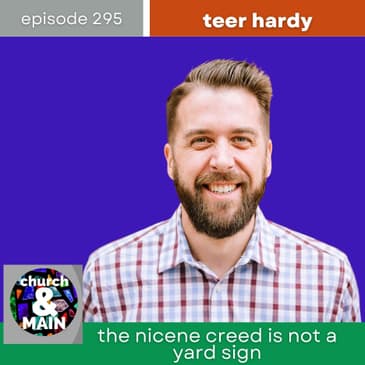

When JD Vance accused "in this house we believe" yard signs of butchering the Nicene Creed, Methodist pastor Teer Hardy started wondering what creeds are actually for. That question turned into an essay — and this conversation.
Teer Hardy, pastor of Trinity United Methodist Church in Alexandria, Virginia, and co-host of the Crackers and Grape Juice podcast, returns to discuss his piece "Creeds Are Not Yard Signs."
Shownotes:
The Body of Christ in a Polarized Culture with Teer Hardy | Episode 222
Join the Church and Main Email List
Facebook (https://www.facebook.com/churchandmain) | Instagram (https://www.instagram.com/churchandmainpod/) | Threads (https://www.threads.net/@churchandmainpod) | Website (https://churchandmain.org/) | YouTube (https://www.youtube.com/@churchmainpodcast) | Substack (https://churchandmain.substack.com/)
00:00:26 --> 00:00:30 Hello, and welcome to Church and Main, a podcast for people interested in the
00:00:30 --> 00:00:32 intersection of faith, politics, and culture.
00:00:33 --> 00:00:35 I'm Dennis Sanders, your host, and happy August.
00:00:37 --> 00:00:41 The tradition that I'm part of, which is the Christian Church Disciples of Christ,
00:00:41 --> 00:00:42 is a non-credal tradition.
00:00:42 --> 00:00:47 Now, we aren't against creeds. They are just not commonly used.
00:00:48 --> 00:00:55 The reason? Well, it came out of the fact that my tradition came out of the Presbyterian Church.
00:00:56 --> 00:01:03 And two centuries ago, the Presbyterians were using creeds to kind of determine
00:01:03 --> 00:01:04 who belonged and who didn't, and,
00:01:05 --> 00:01:10 they would continuously basically divide and divide basically upon who,
00:01:10 --> 00:01:14 how they interpreted, especially the Westminster Confession of Faith.
00:01:15 --> 00:01:20 Because we believed in Christian unity, or at least wanted to,
00:01:21 --> 00:01:23 we kind of got rid of creeds.
00:01:23 --> 00:01:28 And that's kind of a shame because I think that creeds do have a place in the
00:01:28 --> 00:01:31 life of the church, just not as the role of the bouncer.
00:01:33 --> 00:01:36 For me, I think that they can be beautiful hymns to God.
00:01:36 --> 00:01:42 I love saying the Apostles' Creed, and it's kind of been a thing for me almost
00:01:42 --> 00:01:48 every year on Easter to have the congregation use the Apostles' Creed.
00:01:49 --> 00:01:54 And I'm drawn especially to modern creeds, like the Barman Declaration.
00:01:54 --> 00:02:00 That one was written at the dawn of the Nazis in Germany, and a group of Christians
00:02:00 --> 00:02:05 basically making their stand against what they saw as a dangerous ideology.
00:02:06 --> 00:02:10 And then there was things like the Belhar Confession. That was created during
00:02:10 --> 00:02:13 the time of the apartheid struggle in South Africa.
00:02:13 --> 00:02:21 And that was definitely a witness to the racism, state-sponsored racism that
00:02:21 --> 00:02:24 was taking place in that country.
00:02:24 --> 00:02:29 Both of these were a witness to Christ against totalitarian regimes.
00:02:31 --> 00:02:36 Creeds can tell the world what the church believes, and they can also form people,
00:02:36 --> 00:02:41 and that's especially important against the world's competing ideologies.
00:02:43 --> 00:02:48 In many ways, I think these days, we need creeds now more than ever.
00:02:48 --> 00:02:54 Now, these days, especially in this election season, but sometimes just all
00:02:54 --> 00:02:59 the time, we've become a culture of yard signs. Yard signs, in many ways,
00:02:59 --> 00:03:01 tell people what we believe.
00:03:03 --> 00:03:08 They just don't tell you who we're going to vote for, but they tell you who
00:03:08 --> 00:03:13 we like and who we don't like, what we believe and what we don't believe.
00:03:13 --> 00:03:15 And that's all there for the world to see.
00:03:16 --> 00:03:24 In many ways, the yard signs can be counter-creeds. They tell people what party,
00:03:24 --> 00:03:27 what people, what beliefs we're loyal to.
00:03:29 --> 00:03:36 So what do those historic creeds have to say in our time? Do the creeds still matter?
00:03:38 --> 00:03:43 Today, I'm going to talk about this with friend and Methodist pastor, Tyr Hardy.
00:03:44 --> 00:03:48 We're going to talk about a recent post he wrote on his substack titled,
00:03:48 --> 00:03:50 Creeds Are Not Yard Signs.
00:03:50 --> 00:03:57 So, in a world where politics is asking what is useful, the creeds ask who God is.
00:03:59 --> 00:04:04 A little bit about Tyr before we go into the interview. He is pastor of Trinity
00:04:04 --> 00:04:07 United Methodist Church in Alexandria Virginia.
00:04:07 --> 00:04:13 He is a native of the Washington, D.C. area and received his MDiv at Masters
00:04:13 --> 00:04:16 of Divinity at Wesley Seminary in D.C.
00:04:16 --> 00:04:23 And is one half of the host of the Crackers and Grape Juice podcast along with Jason Michelli.
00:04:24 --> 00:04:30 So with all that, here's my conversation with Tear Hardy on the importance of
00:04:30 --> 00:04:33 creeds in an era of yard signs.
00:04:51 --> 00:04:56 All right, Tear. I wanted to talk to you today about creeds. Yes.
00:04:58 --> 00:05:08 Because you wrote something interesting about how kind of creeds not being a
00:05:08 --> 00:05:11 slogan and things to that extent and what they are.
00:05:12 --> 00:05:17 And I find that always fascinating because my tradition, the disciples of Christ,
00:05:18 --> 00:05:21 is a non-Creole tradition. It's not that we don't believe in creeds or that
00:05:21 --> 00:05:26 we're anti-creedal, but we aren't centered around creeds.
00:05:27 --> 00:05:33 But things like the Nicene Creed, the Apostle Creed, are important to the history of the church.
00:05:33 --> 00:05:37 And I think that they are very important in this time and place.
00:05:37 --> 00:05:43 So I'm kind of curious what led you to write the article and what are the importance of creeds?
00:05:44 --> 00:05:50 So, I mean, what led me to it was the, um, vice president, um.
00:05:52 --> 00:05:57 Call referred to the signs that people have in their front yards and say like,
00:05:57 --> 00:06:00 you know, in this house, we believe, you know, love is love,
00:06:00 --> 00:06:02 science is science, neighbors are neighbors, all that type of stuff.
00:06:03 --> 00:06:07 Um and vance called that a butchering of the nicene creed um,
00:06:08 --> 00:06:14 and you know i i don't think people put those signs in their yards thinking
00:06:14 --> 00:06:20 about the nicene creed i don't think most people think about the nicene creed in general i just,
00:06:21 --> 00:06:26 um as a pastor i can't remember the last time other than when i wrote this essay
00:06:26 --> 00:06:30 i can't remember the last time the nicene creed was on my mind right it's just
00:06:30 --> 00:06:35 not something that we regularly think about um and then even in,
00:06:36 --> 00:06:38 you know i'm in i'm in the world of methodism,
00:06:40 --> 00:06:49 we we are a creedal denomination but we only recite publicly recite the creeds my experience on easter.
00:06:51 --> 00:06:56 And so, you know, and even then, I'm not sure most people know what they're
00:06:56 --> 00:07:00 saying. I'm confident none of them are thinking about the yard signs.
00:07:01 --> 00:07:04 And so what got me thinking about this was just that, you know,
00:07:06 --> 00:07:13 if the Nicene Creed is our confession, the hour being like the kind of the lower
00:07:13 --> 00:07:18 C Catholic Church's confession of Christ as Lord, as one holy apostolic church.
00:07:21 --> 00:07:27 That doesn't seem too controversial so I wanted to explore that a little bit yeah yeah.
00:07:30 --> 00:07:35 You know, what do you think is the role of creeds today?
00:07:37 --> 00:07:41 And yeah, I know that's a loaded question because there's a difference between
00:07:41 --> 00:07:48 what is the historic nature of the creeds, but how do we use the creeds today?
00:07:49 --> 00:07:53 And, you know, we were just kind of talking beforehand about,
00:07:54 --> 00:07:58 you know, whether we believe everything in the creeds.
00:07:59 --> 00:08:04 So what is it you know what what are the creeds for,
00:08:05 --> 00:08:10 you know i i love that philip carrey wrote um and okay so the last time i thought
00:08:10 --> 00:08:14 about the nicene creed was when i read philip carrey's book titled nicene creed
00:08:14 --> 00:08:16 so that was i know the last time i thought of it,
00:08:17 --> 00:08:22 um but he writes it to confess the faith so our creeds are what,
00:08:23 --> 00:08:29 make it's what takes the things we believe and then begins to shape them into
00:08:29 --> 00:08:32 a shared public and recognizable thought.
00:08:33 --> 00:08:37 It takes what we believe, organizes it in a way that we can then make sense
00:08:37 --> 00:08:44 in conversation with our, it helps us make sense, it helps us have theological
00:08:44 --> 00:08:47 conversations like this because it gives us kind of a starting point for the church.
00:08:49 --> 00:08:58 But then it also puts it into concrete terms so that it's not just,
00:08:58 --> 00:09:02 you know, what I'm feeling today doesn't become.
00:09:04 --> 00:09:09 Orthodox teaching because how I'm feeling about God and what I believe,
00:09:09 --> 00:09:10 it varies from day to day.
00:09:10 --> 00:09:13 It varies on my encounters with the divine,
00:09:14 --> 00:09:19 but it also varies when I encounter other Christians other disciples other people
00:09:19 --> 00:09:21 who are claiming the same faith,
00:09:23 --> 00:09:28 so I think that it gives us a common I love the common language that it gives
00:09:28 --> 00:09:30 us especially in a world where you know,
00:09:32 --> 00:09:36 denominations are, you know, it feels like rather than becoming a unified body,
00:09:36 --> 00:09:41 we just continue to fracture, um, nominationally. We, we just went through this
00:09:41 --> 00:09:46 in the United Methodist church, um, rather than coming, you know.
00:09:48 --> 00:09:51 Rather than being unified, we are becoming more and more divided,
00:09:52 --> 00:09:57 uh, which is very human of us, which I think maybe is a reason why we need these
00:09:57 --> 00:10:01 creeds, why we need the creeds, especially the 19th creed, because it gives
00:10:01 --> 00:10:02 us that starting point of who Christ is.
00:10:03 --> 00:10:04 And once we know who Christ is,
00:10:04 --> 00:10:12 then we can begin to really unpack what it means to be the body of Christ.
00:10:14 --> 00:10:19 I'm going to take a step. Do you think that people, I mean, because I think
00:10:19 --> 00:10:23 it's interesting when you talk about who Christ, that the creeds help us to
00:10:23 --> 00:10:24 understand who Christ is.
00:10:24 --> 00:10:28 And I know kind of the whole history of the Nicene Creed,
00:10:28 --> 00:10:39 the controversies about that and then i kind of think about it today and how we view jesus and,
00:10:41 --> 00:10:49 we either view him as kind of this someone someone who kind of blesses our country
00:10:49 --> 00:10:55 in on one end of the spectrum and another one who is kind of,
00:10:56 --> 00:11:01 this is going to sound terrible but kind of the holy community organizer on the other end.
00:11:03 --> 00:11:09 And it feels like at times we've lost sight of who Christ is.
00:11:10 --> 00:11:12 And so we don't, and it seems like maybe the,
00:11:14 --> 00:11:18 The creeds can be at least, especially like the Nicene Creed,
00:11:18 --> 00:11:24 can be at least be a starting point of understanding, um, of who this person
00:11:24 --> 00:11:26 is that we kind of talk about all the time.
00:11:28 --> 00:11:34 I think maybe, you know, one of the antidotes to Christian nationalism would be the creeds, um,
00:11:37 --> 00:11:43 to declare Christ Lord, to confess him, to be of the same essence as the father. uh,
00:11:46 --> 00:11:49 Not just, you know, the, oh.
00:11:52 --> 00:11:55 How does Jason put it? Like the Secretary of Afterlife Affairs,
00:11:55 --> 00:11:58 right? Like Christ is present with us.
00:11:58 --> 00:12:02 Christ is present with us as we're having this conversation.
00:12:02 --> 00:12:07 Christ is present with us in worship. And I think knowing that Christ is present
00:12:07 --> 00:12:12 with us in all things that we're doing, but then also to know who Jesus is, Because,
00:12:14 --> 00:12:17 I have to believe that if we were to take those things more seriously,
00:12:18 --> 00:12:25 as people who claim this faith, that the way we interact in the world would be different.
00:12:27 --> 00:12:31 The way we interact with one another. And even in, I keep looking out the window
00:12:31 --> 00:12:33 because my church is right here. The way we interact with one another when we're
00:12:33 --> 00:12:36 sitting in that sanctuary would be different.
00:12:36 --> 00:12:44 And we would be more of a foretaste of the kingdom of heaven than we're not.
00:12:44 --> 00:12:48 Now, on the other side of it, I think the creeds can help Christians also prevent
00:12:48 --> 00:12:54 Jesus from becoming, you know, just a 2-year-old community organizer.
00:12:56 --> 00:13:06 I think it helps us to understand Christ's divinity alongside his humanity.
00:13:07 --> 00:13:15 Because if Jesus is not truly God, Jesus is not divine, then God has not come to us in flesh, right?
00:13:16 --> 00:13:22 But also, if Jesus isn't fully human, then God has not been one of us.
00:13:22 --> 00:13:27 And I think that's the beauty of Christ, is that we have divinity,
00:13:27 --> 00:13:30 we have humanity coming together and we're,
00:13:31 --> 00:13:38 being with us um yeah and then creeds help us unpack that you know there's it
00:13:38 --> 00:13:42 breaks my heart that like i studied these things in seminary but haven't you know,
00:13:43 --> 00:13:48 it comes up in you know in a social media post and i'm like oh let me dive back
00:13:48 --> 00:13:52 into this uh but it's you know or we talk about during confirmation right but
00:13:52 --> 00:13:55 we make it just this little tiny lesson and then we move on to something more
00:13:55 --> 00:13:57 exciting like missions or you know,
00:13:59 --> 00:14:02 coming up with your own creed like we don't need to come up with our own creeds
00:14:02 --> 00:14:04 because I've got one. Hmm.
00:14:06 --> 00:14:11 Well, and I think the other thing is, and I think you kind of talk about the
00:14:11 --> 00:14:18 fact of, you know, that the creed isn't this kind of list of do's and don'ts.
00:14:19 --> 00:14:24 Like, you know, not mistreating workers or to feed the poor or things.
00:14:25 --> 00:14:32 But that our understanding of the creed and understanding of the person of Jesus,
00:14:33 --> 00:14:38 does make those things more real, and in some cases,
00:14:39 --> 00:14:41 I think as you write, non-negotiable.
00:14:43 --> 00:14:50 I remember um a mutual friend of ours jason michelle talking about um an encounter
00:14:50 --> 00:14:54 he had after worship alongside stanley howard wass had preached at jason's church and,
00:14:55 --> 00:14:59 you know someone came up to him afterwards came up to stanley afterwards while
00:14:59 --> 00:15:02 jason was standing there and said something like you know i didn't like your sermon,
00:15:02 --> 00:15:06 and stanley's response was i I don't care because it was the word of God.
00:15:07 --> 00:15:13 And I think, and Stanley wasn't being here that I want people there is he wasn't being dismissive.
00:15:13 --> 00:15:17 He was making a theological statement and the same is true of the Cree.
00:15:17 --> 00:15:18 So we don't have to agree with them.
00:15:19 --> 00:15:26 But this is what we, as the lower C Catholic church have decided.
00:15:27 --> 00:15:31 Now it happened a very long time ago. And if there needs to be another nice,
00:15:31 --> 00:15:35 you know, another council to come together. I mean...
00:15:37 --> 00:15:42 I don't know how well that would go over, or how productive it would be at this
00:15:42 --> 00:15:45 point. But it gives us a starting point to say this is who God is.
00:15:45 --> 00:15:50 This is how God has come to us. This is the salvific work God has done through
00:15:50 --> 00:15:52 Christ for all of creation.
00:15:53 --> 00:15:58 And whether you cross your fingers or not on Easter when it's recited,
00:15:58 --> 00:16:04 whether or not you even recite it, this is what the church claims as orthodoxy,
00:16:05 --> 00:16:07 as right belief. And this is our starting point.
00:16:08 --> 00:16:11 And I think if our starting point is the lordship of Christ,
00:16:11 --> 00:16:15 is God's salvific work in Christ, is that, you know,
00:16:16 --> 00:16:20 if our starting point is that, you know, the tomb is still empty,
00:16:21 --> 00:16:23 I think it changes the way we interact with one another.
00:16:23 --> 00:16:27 I think then we can go out and we can we can do all the the things that are
00:16:27 --> 00:16:33 on the in this house posters we can do all the things those people want us to do but it's framed in the,
00:16:33 --> 00:16:40 work of the ongoing work of God and not just the the things we want to do in our lives.
00:16:42 --> 00:16:49 I'm preaching this Sunday on the feeding of the 5, and.
00:16:53 --> 00:16:57 In prepping the sermon, I found an article from the New York Times from the
00:16:57 --> 00:17:03 COVID era, and people were putting refrigerators out in New York City full of food.
00:17:04 --> 00:17:09 But one of the things I realized so I'm juxtaposing that against the feeding
00:17:09 --> 00:17:13 of the 5 and what I realized is those refrigerators, they have to be restocked,
00:17:15 --> 00:17:18 there is going to come a time when someone goes to the little food pantry outside
00:17:18 --> 00:17:26 your church and they're going to open it and it's going to be empty because our work apart from God.
00:17:29 --> 00:17:36 Is finite we have limits on what we're able to do But when you look at what happens in Matthew 14,
00:17:38 --> 00:17:43 where Jesus tells the disciples, say we have nothing, but they actually have
00:17:43 --> 00:17:46 five loaves and two loaves, and Jesus is able to do something with that.
00:17:47 --> 00:17:49 Apart from Christ, yeah, the refrigerator is going to be empty.
00:17:49 --> 00:17:53 So apart from Christ, a lot of the work we do runs up on,
00:17:55 --> 00:17:59 the limits of humanity, of our humanness. but with Christ, um,
00:18:00 --> 00:18:06 as Lord, then, you know, what's, I, I, I coach a lot of baseball and I see on
00:18:06 --> 00:18:09 a lot of baseball gloves, I can do all things through, through Christ who gives me strength.
00:18:10 --> 00:18:15 Um, you know, and I, I believe that to be true, but you know, not often in the way that,
00:18:17 --> 00:18:20 we, we, we make it about self-righteousness or throw it, you know,
00:18:20 --> 00:18:22 hitting a curve ball. Uh, Hmm.
00:18:25 --> 00:18:25 Well.
00:18:28 --> 00:18:34 And it can become a talisman in some ways of a good luck charm.
00:18:35 --> 00:18:41 Yes. Uh-huh. It's a, well, it's also like when you have that on your glove and
00:18:41 --> 00:18:44 then you're cussing out the batter after you strike him out.
00:18:44 --> 00:18:48 You know, they kind of, the two things cancel each other out a little bit.
00:18:52 --> 00:18:55 Well that reminds me back in college i,
00:18:57 --> 00:19:01 had um i was at the library and,
00:19:01 --> 00:19:06 had put my i can't remember if i locked had not locked my bike the whole way
00:19:06 --> 00:19:11 if i should and there was another person who had his bike and it had bible verses
00:19:11 --> 00:19:14 on and i was at first thought wow that's kind of cool and then he,
00:19:15 --> 00:19:16 says something kind of like,
00:19:18 --> 00:19:21 basically without really looking at me that if you,
00:19:23 --> 00:19:27 lock your bike that way that's an easy way of getting stolen but and he didn't
00:19:27 --> 00:19:29 look up or anything and i'm just like,
00:19:30 --> 00:19:35 oh so this these bible verses don't really mean much to you because,
00:19:36 --> 00:19:41 you know you're you know they were just kind of for show to look look how holy
00:19:41 --> 00:19:48 i am when in reality you're kind of a jerk And I think that that can be a way of how people,
00:19:49 --> 00:19:51 use their faith.
00:19:51 --> 00:19:56 It's kind of, it's an adornment, but you're still kind of a jerk.
00:19:59 --> 00:20:02 It's like, you know, uh, you know, you, you, you leave church on Sunday morning.
00:20:03 --> 00:20:05 Right. And, and then you, you know,
00:20:05 --> 00:20:08 people, you get flipped off as you're leaving the church parking lot.
00:20:08 --> 00:20:12 Right. Like by not, not by like a random person from the neighborhood.
00:20:12 --> 00:20:18 Right. But by, you know, the person that, you know, you just confessed and reconciled
00:20:18 --> 00:20:21 alongside, you know, and then went to the table and now, Oh,
00:20:21 --> 00:20:25 you know, we need to, we need to confess again.
00:20:28 --> 00:20:32 But but that shows our i mean that shows why we need jesus it shows why we need
00:20:33 --> 00:20:34 christ to be our lord because,
00:20:35 --> 00:20:39 left to our own devices we do harm to one another i don't think it's always
00:20:39 --> 00:20:43 intent no we do into i think that we do intentionally harm one another that
00:20:43 --> 00:20:45 that is i think that's beyond.
00:20:48 --> 00:20:51 Questioned um but there's we we
00:20:51 --> 00:20:54 do harm to one another all the time and we don't realize we're doing it.
00:20:56 --> 00:21:05 I don't think it's intentional at times. But when we are able to declare Christ to be Lord,
00:21:06 --> 00:21:13 it teaches us how to speak of God and how to speak of our relationship with one another,
00:21:15 --> 00:21:19 in spite of our sin, in spite of the ways we do harm to one another.
00:21:19 --> 00:21:29 It allows us to reframe our relationship, you know, not as a public act of faith,
00:21:31 --> 00:21:37 but just as our DNA of how our relationship is with one another and with creation.
00:21:42 --> 00:21:47 You said something in your article that I thought was interesting,
00:21:47 --> 00:21:53 and it's about how the Methodists, the United Methodists, uses the creeds.
00:21:53 --> 00:21:59 And it's that they don't include it in the doctrinal standards,
00:22:01 --> 00:22:03 and that that's a very Methodist thing.
00:22:04 --> 00:22:09 It's not a substitute for Scripture, but it's a gift.
00:22:10 --> 00:22:15 And here is what I thought was interesting, is that it teaches us how to speak
00:22:15 --> 00:22:17 before it teaches us how to argue.
00:22:18 --> 00:22:21 And maybe that's what we need most right now. Not less conviction,
00:22:21 --> 00:22:27 not less public faith, not a Christianity so vague that it can be reduced to be nice with candles,
00:22:27 --> 00:22:33 but a faith whose public confession is disciplined by the actual Lord we confess.
00:22:33 --> 00:22:36 The creed is not a yard sign. Thank God.
00:22:38 --> 00:22:43 Yeah. And I think that's kind of,
00:22:44 --> 00:22:49 I don't, it's something I didn't think of before that the creed is,
00:22:49 --> 00:22:57 is something that can offer discipline, offer kind of,
00:22:58 --> 00:23:06 in some ways, ground rules of how do we kind of live that I think we definitely
00:23:06 --> 00:23:08 kind of need in our culture today.
00:23:11 --> 00:23:18 I mean, we were talking earlier about how fragmented and splintered the body of Christ is.
00:23:19 --> 00:23:21 That we keep splitting.
00:23:22 --> 00:23:29 My denomination just split last 2024, 2025. We're still dealing with the aftermath of that.
00:23:30 --> 00:23:36 And we don't, I'll be honest, I don't know how, and maybe I should do a better job.
00:23:36 --> 00:23:39 I don't know how to speak to people. I don't know how to have a conversation
00:23:39 --> 00:23:41 right now with people who chose to leave the United Methodist Church.
00:23:42 --> 00:23:43 There's still a lot of hurt there.
00:23:45 --> 00:23:49 A lot of harm has been done. But if I were to sit down and have a conversation
00:23:49 --> 00:23:54 with them, I think I'd be able to do so because I could use this,
00:23:55 --> 00:24:00 I could use the Nicene Creed, use the Apophis Creed, as a framework of a conversation.
00:24:01 --> 00:24:05 We disagree on some very fundamental things.
00:24:08 --> 00:24:15 But also I think this, these provided a starting point for us to have a conversation
00:24:15 --> 00:24:22 with one another in a way that is, that's rooted in Christ and not in our denominational,
00:24:23 --> 00:24:25 dysfunction and polity.
00:24:27 --> 00:24:33 Yeah. I wrote that. That's good. I'm going to reread this. It is good.
00:24:36 --> 00:24:41 I've noticed that sometimes when i've looked back at things and i think wait
00:24:41 --> 00:24:48 i wrote who wrote that i who wrote that that that can't be me that wasn't that was me it's like,
00:24:49 --> 00:24:52 it happens yeah i mean because listen i mean and the thing about the creeds
00:24:52 --> 00:24:55 right like this is the next paragraph that i have this pulled up,
00:24:57 --> 00:25:01 the nicene we've had the nicene creed for generations that yard sign that says
00:25:01 --> 00:25:04 in this house we believe this this this that's going to get knocked over,
00:25:05 --> 00:25:12 every political cycle we see yard signs get stolen vandalized mocked replaced with new ones um.
00:25:15 --> 00:25:20 But the creeds have endured. We don't have to agree with all of them.
00:25:20 --> 00:25:23 That's fine. I can live with that. And if you're from a non-creedal tradition,
00:25:23 --> 00:25:27 I can agree with that too. I guess I'm technically a non-creedal tradition that
00:25:27 --> 00:25:31 uses creeds. You know, I'm okay with all of that.
00:25:32 --> 00:25:35 But they've survived. And I think they offer us something,
00:25:37 --> 00:25:38 right now.
00:25:40 --> 00:25:45 Not right now, but to the whole church across generations. that gives us language,
00:25:45 --> 00:25:47 so that we can speak to one another.
00:25:48 --> 00:25:56 We can speak of one another with love because it's rooted in Christ's unwavering love for us.
00:25:59 --> 00:26:02 Well, I mean, and that was actually the question I was going to ask is,
00:26:04 --> 00:26:11 what do the creeds mean in this moment, in our political moment, in our cultural moment?
00:26:12 --> 00:26:18 Because we are a fairly fragmented society.
00:26:19 --> 00:26:23 There are a lot of issues that are,
00:26:25 --> 00:26:28 taking up our space, and they're important issues.
00:26:30 --> 00:26:31 But,
00:26:33 --> 00:26:39 what do the creeds mean, and how do they help us in talking about,
00:26:41 --> 00:26:43 well, basically just being able to talk to one another?
00:26:48 --> 00:26:52 Well, I think it can put our, if we allow them to.
00:26:54 --> 00:27:01 They can put the creeds can put our current conversations into in like an eschatological
00:27:01 --> 00:27:07 way we can see our current issues through an eschatological lens we can see that,
00:27:09 --> 00:27:15 the people now who are making themselves out to be lords of creation are not,
00:27:15 --> 00:27:22 um we can see that Sin And death,
00:27:23 --> 00:27:27 Do not hold the final words It gives us,
00:27:27 --> 00:27:31 It gives us theology It gives us language to help us understand What's going
00:27:31 --> 00:27:37 on and how to see that This is not permanent The things that are The ways in
00:27:37 --> 00:27:38 which we afflict one another,
00:27:39 --> 00:27:44 And the ways in which we are afflicted Are not Permanent,
00:27:46 --> 00:27:47 That.
00:27:50 --> 00:27:54 In the, Willimon says, you know, in the end, God's going to get what God wants.
00:27:56 --> 00:27:59 Um, I think that's true here as well.
00:28:00 --> 00:28:06 That the, and the creeds are the church finding the language to say that it doesn't make it easy.
00:28:06 --> 00:28:09 I don't think it, I know, I don't want to come off as saying,
00:28:09 --> 00:28:12 well, if you just learn the creeds and recite the creeds that all,
00:28:12 --> 00:28:15 you know, it's going to be so much easier to interact with your neighbor in the world.
00:28:15 --> 00:28:18 That's not, that's not the case. Cause it's, we're dealing with humans.
00:28:18 --> 00:28:21 We're dealing with ourselves. And we know how, I know how hard I am to deal with.
00:28:21 --> 00:28:26 I've been by myself for a week while my family's been away. I know how hard I am to be with myself.
00:28:27 --> 00:28:31 So I know how hard I can be to be other people, uh, to experience me.
00:28:33 --> 00:28:39 I also know I can be really gracious. And I think that's because of Christ at work in me.
00:28:39 --> 00:28:43 It's nothing I've done, you know? Um, yeah.
00:28:48 --> 00:28:56 I think you know one of the things that is interesting about the creeds also
00:28:56 --> 00:28:58 and i think you hint at this,
00:28:59 --> 00:29:05 and i just learn it more and more is that the creeds help us to remind us is that it's not about us,
00:29:06 --> 00:29:17 and that we live in this culture that it really is all about me and how I act and how important I am.
00:29:18 --> 00:29:24 And so much of our faith, and you talked about Will Willimon before,
00:29:25 --> 00:29:28 and I remember him speaking when I was in seminary,
00:29:31 --> 00:29:36 you know about the fact that it's about god coming to us not us going to god,
00:29:37 --> 00:29:41 yes and that the creeds kind of remind us that that that's,
00:29:42 --> 00:29:47 that god is kind of at the center of everything it's not us and um,
00:29:49 --> 00:29:51 And boy, do we kind of need that now.
00:29:54 --> 00:29:59 It's a new framework for the church today, but it's an oldie but a goodie, right?
00:30:01 --> 00:30:07 It reframes our relationships with one another as Christ's body.
00:30:08 --> 00:30:13 And it reminds us of our relationship with Christ and our triune God.
00:30:14 --> 00:30:15 That this is a relationship.
00:30:18 --> 00:30:20 That there is a relationship between the persons of the Trinity.
00:30:21 --> 00:30:24 We are in relationship with each of them and we are in relationship with God.
00:30:27 --> 00:30:32 It gives us language for it. And I really, it's, you know, the creeds aren't a slogan.
00:30:32 --> 00:30:36 They're, they're our declaration of who God is.
00:30:38 --> 00:30:42 You know, and I say that and I understand that some, some traditions are non-creedal.
00:30:45 --> 00:30:50 But I've been around the church long enough to know that even there are parts
00:30:50 --> 00:30:54 of the creed for non-creedal traditions that are like, oh, yeah, absolutely.
00:30:54 --> 00:30:57 This is, you know, Christ is Lord.
00:30:58 --> 00:31:03 We do believe in one holy Catholic church. And because, you know,
00:31:05 --> 00:31:12 because of the splintering of the body, we see the harm that got us from point A to point B on that.
00:31:14 --> 00:31:21 We've read the history. We know how we do harm to one another in the name of
00:31:21 --> 00:31:23 God, which is a whole another.
00:31:26 --> 00:31:33 Conversation of the ways in which we bless the harm we do with religious language.
00:31:34 --> 00:31:39 And yeah, that's an essay and a conversation for maybe another day.
00:31:41 --> 00:31:42 Yeah, I mean, I think.
00:31:46 --> 00:31:51 Obviously, you know, we are all people of the book, and you don't want to.
00:31:54 --> 00:31:58 Dismiss the Bible and all that. That's important.
00:32:00 --> 00:32:03 But it seems like sometimes in my understanding of church history—,
00:32:08 --> 00:32:14 The thing about the creeds is that they kind of, in some ways,
00:32:15 --> 00:32:19 summarize what's important in Scripture.
00:32:20 --> 00:32:25 Sometimes the danger in some traditions when it's just, say,
00:32:25 --> 00:32:34 we're going to focus on the Bible and not on the creeds, is that the Bible can be manipulated.
00:32:35 --> 00:32:36 It can be used.
00:32:39 --> 00:32:46 For a certain end, or it can become kind of just a nice thing, but we don't really mean,
00:32:48 --> 00:32:53 what it says. because, and this is a, I remember reading years, this was in college.
00:32:54 --> 00:32:56 I think it was the autobiography of Frederick Douglass.
00:32:57 --> 00:33:07 And during his time when he was enslaved, he ended up being whipped by his master or someone.
00:33:08 --> 00:33:14 And this person, while he was whipping Frederick Douglass, was spouting Bible verses.
00:33:16 --> 00:33:22 And so those verses were there, but they didn't mean anything at all.
00:33:22 --> 00:33:28 And I think sometimes what the creeds can do is like,
00:33:29 --> 00:33:36 a backstop or a safeguard or a fail-safe that helps us understand what this
00:33:36 --> 00:33:39 really means. Why is this important?
00:33:40 --> 00:33:44 In that when we kind of only focus on scripture,
00:33:44 --> 00:33:52 it's that we can kind of manipulate and also I would say the devil can also
00:33:52 --> 00:33:57 manipulate and all that to selfish ends.
00:33:59 --> 00:34:04 And none of that is to denigrate scripture. That's not what I'm getting at. Yeah. You know.
00:34:05 --> 00:34:08 Two things can be important, right? Like, we, and, you know,
00:34:08 --> 00:34:13 and, yeah, and another aside, like, in saying one thing is important,
00:34:13 --> 00:34:16 we're not saying something else is like,
00:34:18 --> 00:34:22 both things, we, we are smart enough people, I think, in general,
00:34:23 --> 00:34:27 to hold these things, to hold both things and say they are both important.
00:34:27 --> 00:34:30 And then we can't be dismissing one over the, yeah. Uh-huh. Yeah.
00:34:34 --> 00:34:41 Yeah. I mean, I just think that that kind of matters. I think one question that I have is.
00:34:45 --> 00:34:52 What is, how do our kind of, the historic creeds kind of line up with some of
00:34:52 --> 00:34:55 the more modern confessions?
00:34:57 --> 00:35:01 That have come out obviously there are some very important ones that,
00:35:02 --> 00:35:06 in some ways we're speaking to a certain moment um obviously the most well-known
00:35:06 --> 00:35:15 is barman um less known but still important was the belhar confession for in south africa but,
00:35:16 --> 00:35:22 what do these kind of more modern or more recent confessions how do they line
00:35:22 --> 00:35:27 up or how do they connect with some of the more historic creeds I think the
00:35:27 --> 00:35:28 first thing that came to my mind was a framework.
00:35:29 --> 00:35:31 Mm-hmm. It gives us a pattern.
00:35:35 --> 00:35:37 And I think that's important,
00:35:41 --> 00:35:43 so that these confessions are
00:35:44 --> 00:35:51 focused and that they are in line with the broader Christian tradition.
00:35:51 --> 00:35:54 And I know there's a whole host,
00:35:55 --> 00:36:00 of rabbit holes there, but I think it does give us a bit of a framework.
00:36:03 --> 00:36:07 And it helped guide us and give us some common language that we can use.
00:36:09 --> 00:36:09 Yeah.
00:36:14 --> 00:36:18 That's, yeah. I think that's where I would go with that. Remember,
00:36:18 --> 00:36:22 I'm not a scholar on any of this. No.
00:36:24 --> 00:36:27 I took church history and Christian theology in seminary.
00:36:30 --> 00:36:35 And I'm not either but I think there's something important to hear it from someone
00:36:35 --> 00:36:37 that isn't a scholar because,
00:36:40 --> 00:36:47 sometimes the scholar I mean it's not being put into the day to day life of the church,
00:36:50 --> 00:36:55 and so it's important to hear it from a pastor who is doing it in the day to day life.
00:36:58 --> 00:37:03 And, you know, creeds and all these confessions, confessions,
00:37:03 --> 00:37:09 creeds, all these things, they help give us, they help us make our,
00:37:09 --> 00:37:11 they help us share our faith. That's what I'm trying to say.
00:37:11 --> 00:37:17 In public, in recognizable, intangible ways that make, can make sense to other people.
00:37:19 --> 00:37:25 Um they are a means of evangelism um when you know done in a way that's not,
00:37:26 --> 00:37:31 performative or um coercive,
00:37:32 --> 00:37:36 yeah i i think they they serve a they serve a function yeah i mean okay we can
00:37:36 --> 00:37:41 look back on the you know we can look back to constantine's conversion and that
00:37:42 --> 00:37:45 you know there could be some coercive things happen, you know,
00:37:45 --> 00:37:47 cause once the emperor, uh,
00:37:48 --> 00:37:52 um, declares a new religion, like you're going to get on board.
00:37:52 --> 00:37:58 Like that's, you know, so like there are, there are that, there are those things in our history.
00:37:58 --> 00:38:04 Um, but, but, but, but, but I think that, um, having that language,
00:38:05 --> 00:38:09 having a commonality, having words that are recognizable and also parts of it
00:38:09 --> 00:38:11 that make us ask questions.
00:38:14 --> 00:38:20 What does it mean to be an apostolic church? Well, we are a continuation of the 12 apostles. Okay.
00:38:20 --> 00:38:23 What does it mean to, what you're saying, holy Catholic. I thought we were Methodists.
00:38:23 --> 00:38:30 Yep. We're talking about Catholic and it opens up a conversation so that we
00:38:30 --> 00:38:35 can begin to also do discipleship so that we can,
00:38:37 --> 00:38:41 help teach people the faith in the ways we've been taught the faith, um,
00:38:42 --> 00:38:44 from the saints that taught us. Yeah.
00:38:49 --> 00:38:53 Yeah, and I agree. I think, again, coming from my tradition,
00:38:53 --> 00:39:01 there is something to be said of at least understanding those things.
00:39:03 --> 00:39:08 And I think the other thing, and we maybe talked about this before we started
00:39:08 --> 00:39:15 recording, is that it's not centered on, I don't have to, it's not a checklist.
00:39:15 --> 00:39:17 Like, I have to believe all of these things.
00:39:19 --> 00:39:24 And because I think at the end of the day, it kind of doesn't matter what I believe.
00:39:26 --> 00:39:29 It matters about that God is God.
00:39:30 --> 00:39:35 And I think too often we act as if, well, it's all about me.
00:39:35 --> 00:39:38 I have to believe all these things or I don't believe all these things.
00:39:38 --> 00:39:42 So why should it matter? And it's like, yeah, it doesn't matter.
00:39:43 --> 00:39:46 I couldn't agree with you more. right it doesn't matter what you believe it's
00:39:46 --> 00:39:50 like back to what stanley said after that sermon like jesus is lord so it doesn't
00:39:50 --> 00:39:57 matter uh things do i don't want to be dismissed things do matter of course but like um yeah.
00:40:01 --> 00:40:07 Because i think we act as if well i mean and we kind of do in our culture and
00:40:07 --> 00:40:08 especially in our in the church,
00:40:09 --> 00:40:15 kind of act like functional atheists yes and so it's like you And it's like,
00:40:15 --> 00:40:17 yeah, no, it doesn't matter what you think.
00:40:19 --> 00:40:22 God is still God. Yeah, yeah, yeah, yeah. Absolutely.
00:40:24 --> 00:40:28 That's a great starting point. Just God is God. Have that be your starting point.
00:40:30 --> 00:40:32 You know, I think maybe we'd,
00:40:34 --> 00:40:39 probably be moving towards a healthier church, healthier body of Christ.
00:40:40 --> 00:40:46 Well, yeah, I think so, too. And of course, that's also hard because we all
00:40:46 --> 00:40:52 want to, you know, we want to be the star of our own story. And it's like,
00:40:52 --> 00:40:54 yeah, it doesn't work that way.
00:40:55 --> 00:40:57 Doesn't. That's not, that's not the Christian faith.
00:41:00 --> 00:41:02 Um, well, I think the main thing.
00:41:05 --> 00:41:12 Well, if people want to know, uh, more about you and follow you and you have
00:41:12 --> 00:41:15 a really awesome sub stack, where should they follow?
00:41:15 --> 00:41:21 Yeah. Just a tear party on sub stack. um i'm on all the social media things
00:41:21 --> 00:41:26 i will go through fits where i post a lot on social media and then there will
00:41:26 --> 00:41:29 be times where i haven't posted in a couple months and it's just,
00:41:29 --> 00:41:36 i i like i love that cycle um but yeah sub stack is where i live now most of my time um,
00:41:37 --> 00:41:43 it feels like sub sub stack for a while felt like the wild west it feels like
00:41:43 --> 00:41:51 it's getting kind of tightened back up into a great place to share um a lot of written stuff.
00:41:53 --> 00:41:58 And I appreciate that. I do, I try to do one really good essay every week.
00:41:58 --> 00:42:02 I share sermons and quotes and things like that on it. So yeah,
00:42:02 --> 00:42:03 I would love for folks to join me over there.
00:42:05 --> 00:42:10 Yeah, Subsec is kind of interesting in that it's, I think you're right,
00:42:10 --> 00:42:15 it goes through periods where it's like really good and really thoughtful ideas.
00:42:15 --> 00:42:20 And then there are periods where it's not.
00:42:20 --> 00:42:28 And it's a lot of ranting. but I think it's getting a little bit more thoughtful again. So, yeah.
00:42:29 --> 00:42:34 Well, and I mean, there's, I won't say who it is, but a well-known theologian,
00:42:34 --> 00:42:36 Protestant theologian has a substack.
00:42:36 --> 00:42:42 And I think he accidentally recommended my substack to his readers.
00:42:43 --> 00:42:47 And so I've gotten quite a few folks sent my way because of that accidental
00:42:47 --> 00:42:52 click. So I'm happy to have that be the case.
00:42:54 --> 00:42:58 Yeah i mean that that's that's happened to happen to me sometimes it's like
00:42:58 --> 00:43:02 yeah wait some you read that,
00:43:02 --> 00:43:07 you thought that was good yeah okay like this thing you know like like this
00:43:07 --> 00:43:11 thing on the crates i just fired it off as like uh you gotta be you know
00:43:11 --> 00:43:14 you gotta be kidding me one of you know one of those types of things and you
00:43:14 --> 00:43:18 know it creates conversations and i think that's probably uh what we need more of,
00:43:19 --> 00:43:24 so i appreciate it thanks for having me on all right okay take care.
00:43:55 --> 00:44:01 You think about creeds? Do you come from a tradition that uses creeds? Do you not?
00:44:01 --> 00:44:07 How are they used? And how do you think that they can be used in this day and age?
00:44:08 --> 00:44:13 As usual, I am always willing to hear what you are thinking and saying.
00:44:14 --> 00:44:18 Feel free to drop me a line at churchinmain at substack.com with your thoughts.
00:44:19 --> 00:44:26 I will include links to that article that Teer wrote for you that's going to be in the show notes.
00:44:27 --> 00:44:31 As usual, if you want to learn more about the podcast, listen to past episodes,
00:44:31 --> 00:44:35 or donate, check me out, churchandmain, all one word, .org.
00:44:36 --> 00:44:42 And you can also check out churchandmain.subsec.com to read related articles.
00:44:44 --> 00:44:51 I do try to put these podcasts usually about a week or two after they appear on the website.
00:44:52 --> 00:44:56 So if you want to hear them there, you will find them there as well.
00:44:57 --> 00:45:03 If you want to, you can make a donation on the Substack.
00:45:03 --> 00:45:07 I don't put anything behind a paywall for the articles that I write,
00:45:07 --> 00:45:09 but you can make a donation.
00:45:09 --> 00:45:13 It's five bucks a month, $60 a year.
00:45:14 --> 00:45:20 If you want to, if you can, please consider subscribing to the podcast on your
00:45:20 --> 00:45:25 favorite podcast app, and please consider leaving a rating or review,
00:45:25 --> 00:45:28 because when you do that, that actually helps others find the podcast.
00:45:28 --> 00:45:31 And I would love for other people to be able to listen to this podcast.
00:45:33 --> 00:45:38 Also, just to let you know that I'm going to be taking my annual August break.
00:45:38 --> 00:45:41 So this will be the last episode, the only episode in August.
00:45:42 --> 00:45:46 So there will be no episodes on the following Fridays.
00:45:47 --> 00:45:53 We will return with new episodes on Friday, September.
00:45:53 --> 00:45:55 I'm going to hopefully get this right.
00:45:56 --> 00:46:01 September 4th. So that will be when we will have new episodes out.
00:46:01 --> 00:46:05 But I hope in the meantime, if you haven't listened to past episodes,
00:46:06 --> 00:46:10 go to churchinmain.org to listen to those episodes, and I hope that you will
00:46:10 --> 00:46:12 take the time to check those out.
00:46:13 --> 00:46:19 And I do have many interviews coming up that you will be hearing,
00:46:19 --> 00:46:21 especially starting in September.
00:46:22 --> 00:46:28 So just to let you know, those are coming. But I will be taking some time off,
00:46:29 --> 00:46:31 partially just to take time off.
00:46:32 --> 00:46:36 And so, like I said, I will be back in September with new episodes coming out.
00:46:36 --> 00:46:40 So I hope that you are enjoying your summer.
00:46:40 --> 00:46:45 I hope that you can take some time off, whether you work in the church or outside
00:46:45 --> 00:46:52 the church, that you allow for these nice warm days to be a time when you can enjoy yourself.
00:46:53 --> 00:46:58 So that is it for this episode of Church and Maine.
00:46:59 --> 00:47:05 I am Dennis Sanders, your host. Thank you so much for listening, as I always say.
00:47:06 --> 00:47:11 Take care, everyone. Godspeed. I will see you soon.
00:47:12 --> 00:47:15 And as I said, I will see you in September. Take care.