
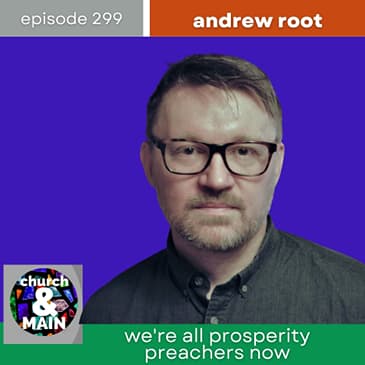

What if the church's obsession with growth is just modern-day Baal worship? Andrew Root returns to the podcast to discuss his new book Baal and the Gods of More: Rescuing Church Growth from Idolatry (Baker Academic). Root — Carrie Olson Baalson Professor of Youth and Family Ministry at Luther Seminary — unpacks how the pressure to grow (whether through innovation or identity affirmation) mirrors ancient Israel's turn to fertility gods, and what it might mean instead to trust a God who meets us in weakness rather than escalation.
In This Episode[0:24] Intro — Facebook-as-salvation in the 2000s, LGBTQ inclusion in mainline churches, and Flint, Michigan as parallel stories of hoping something will bring back “the good old days”
[4:44] What led Root to write the book — a recurring church-growth conversation and an offhand comment about “fertility gods” that became the whole project
[7:15] Baal as a fertility god, and how capital (financial, social, cultural) functions the same way for us today
[9:27] The real question underneath growth anxiety — do we actually trust God?
[9:53] Golden-era memory in mainline Protestantism (and Flint) as a parallel to Israel longing for Solomon’s era
[15:37] The two camps inside every denomination — techno-optimists and identitarians — and why Root thinks both run on the same escalatory, capitalist logic
[23:36] “We’re all prosperity preachers now” — willing to take on poverty now only to cash out later
[31:35] Why Protestants have neglected Mary, and Luther’s reading of her as the true prophet
[34:16] Jezebel reframed — not a sexual temptress but “the great economist” importing growth theory into Israel
[38:12] The Magnificat as confession, not just judgment on others
[41:09] A widower’s story on a Viking cruise — what he was actually grateful for from his church
[45:35] Root’s word to pastors and small congregations dealing with anxiety about decline
[50:21] Where to find Andrew Root’s work — andrewroot.org
Resources
Andrew Root's website: andrewroot.org
Book: Baal and the Gods of More — Rescuing Church Growth from Idolatry (Baker Academic)
Ministry in a Secular Age Podcast: https://www.andrewroot.org/podcast/
Facebook (https://www.facebook.com/churchandmain) | Instagram (https://www.instagram.com/churchandmainpod/) | Threads (https://www.threads.net/@churchandmainpod) | Website (https://churchandmain.org/) | YouTube (https://www.youtube.com/@churchmainpodcast) | Substack (https://churchandmain.substack.com/)
Enjoyed this episode? Subscribe to Church and Main on your favorite podcast app, leave a review, and visit churchandmain.org or churchandmain.substack.com to read more and support the show. Send an email to dennis@churchandmain.org.
00:00:24 --> 00:00:28 Hello, and welcome to Church and Main, a podcast for people interested in the
00:00:28 --> 00:00:33 intersection of faith, politics, and culture. I'm Dennis Sanders, your host.
00:00:34 --> 00:00:40 So, it was about 20 years or so that I sat in a hotel room in Omaha, Nebraska.
00:00:41 --> 00:00:44 I was there for a conference for communicators, and it was there that I learned
00:00:44 --> 00:00:46 about the wonders of Facebook.
00:00:47 --> 00:00:51 It had only become public. It had been created in 2004 just for college students,
00:00:51 --> 00:00:54 and then in, I believe, 2006, it went public.
00:00:55 --> 00:00:56 And it was growing exponentially.
00:00:57 --> 00:01:02 The people at the conference were talking about it in this very excited way.
00:01:03 --> 00:01:08 They saw Facebook and other social media at the time as bringing the church
00:01:08 --> 00:01:09 into this wonderful new era.
00:01:11 --> 00:01:16 And then maybe about 10 years ago, 15 years ago, actually,
00:01:16 --> 00:01:22 you started to see several denominations within mainline Protestantism that
00:01:22 --> 00:01:30 approved gays and lesbians to be married in their churches and also to become ministers.
00:01:31 --> 00:01:35 And people celebrated this advancement. They believed that this was going to
00:01:35 --> 00:01:37 bring the church into a whole new age.
00:01:40 --> 00:01:48 But did they? Social media isn't all bad, but it hasn't been the salvation that
00:01:48 --> 00:01:50 the churches thought it would be.
00:01:50 --> 00:01:54 It definitely has not been the salvation that society thought it would be.
00:01:55 --> 00:02:00 And while greater acceptance of LGBTQ people in the life of the church is a good thing,
00:02:01 --> 00:02:07 and I have to say that it has been personally good for me as a gay man who got
00:02:07 --> 00:02:12 married in a church and is also a minister,
00:02:13 --> 00:02:17 that hasn't necessarily, quote-unquote, saved the church either.
00:02:19 --> 00:02:24 Both of these examples aren't necessarily bad, but they were promised as a way
00:02:24 --> 00:02:29 to bring stability to churches that were experiencing decline.
00:02:30 --> 00:02:35 It's a hope that if we do these things, then the good old days will come back.
00:02:35 --> 00:02:36 The churches will be full.
00:02:38 --> 00:02:43 It reminds me actually a lot of what happened in my hometown of Flint, Michigan.
00:02:45 --> 00:02:49 When General Motors started to shut down plants and let people go,
00:02:50 --> 00:02:53 there was always this hope that something, anything was going to bring back
00:02:53 --> 00:02:59 the good old days and bring it back to the days that there were the city was
00:02:59 --> 00:03:01 bustling and there were jobs aplenty.
00:03:03 --> 00:03:08 Now, I want to talk about all of this with Andrew Root. He comes back to the
00:03:08 --> 00:03:13 podcast, and he's going to talk about his latest book, which is called Baal and the Gods of More.
00:03:14 --> 00:03:19 And in the book, he talks about how churches tend to be fixated on growth.
00:03:20 --> 00:03:25 And they're trying to find ways for congregations and denominations to be stable.
00:03:26 --> 00:03:33 And what they're doing, basically, is what amounts to a modern-day version of a fertility. God.
00:03:34 --> 00:03:40 And of course, when you choose a God over the God, there are costs.
00:03:41 --> 00:03:48 Because instead of choosing the God that is there that calls us children and
00:03:48 --> 00:03:54 holds us, we're choosing one that wants us to produce and make more and make more.
00:03:56 --> 00:04:03 Andrew is the Kerry Olson-Balson Professor of Youth and Family at Luther Seminary,
00:04:03 --> 00:04:06 which is, at least for now, in St. Paul, Minnesota.
00:04:07 --> 00:04:10 He is the author of probably more books than I can shake a stick at,
00:04:11 --> 00:04:16 and also the co-host of the Ministry in a Secular Age podcast.
00:04:17 --> 00:04:23 So, with all that out of the way, here's my conversation with Andrew Root about
00:04:23 --> 00:04:27 how fertility gods are corrupting American Christianity.
00:04:44 --> 00:04:48 All right. Well, Andrew, thank you for coming back on the podcast.
00:04:49 --> 00:04:54 I wanted to, I'm obviously having you on to talk about your latest book,
00:04:54 --> 00:04:56 Bell and the Gods of More.
00:04:56 --> 00:05:01 And I think the first question I have is just to kind of, what were the things
00:05:01 --> 00:05:06 kind of going on, maybe in culture and the church that led you to write this book?
00:05:07 --> 00:05:11 Yeah, well, I think, you know, the first thing is just the pressure everywhere
00:05:11 --> 00:05:16 you go, really across Protestantism, I think mainly in mainline Protestantism.
00:05:16 --> 00:05:19 But even within conservative Protestantism, you'll find everyone's worried about
00:05:19 --> 00:05:25 some kind of sense of decline, whether it's kind of cultural relevance or it's number of people.
00:05:25 --> 00:05:30 And there's just this odd way that people don't want to really fall into church
00:05:30 --> 00:05:34 growth, but nevertheless, there'll be a church growth conversation at every.
00:05:35 --> 00:05:39 Presbytery meeting or church-wide conference or something.
00:05:39 --> 00:05:44 It kind of crops up. And I think I've been accused of being the anti-church
00:05:44 --> 00:05:47 growth guy, which I don't think is fair.
00:05:47 --> 00:05:52 So I was partly trying to just get straight on what I think is important about
00:05:52 --> 00:05:55 growth and what are we actually talking about when we talk about growth.
00:05:55 --> 00:05:59 So, and then I was on a podcast, Dennis, you know, like all my best ideas come
00:05:59 --> 00:06:04 talking to podcasters like you. And I said something about like the church has
00:06:04 --> 00:06:06 become obsessed with fertility gods or something.
00:06:07 --> 00:06:10 And I just kind of, I don't know, the bell went off in my head to think about,
00:06:10 --> 00:06:14 well, what would it be like to think about modern fertility gods?
00:06:14 --> 00:06:17 And are we obsessed with those? And then, you know, what would it be like to
00:06:17 --> 00:06:20 read, you know, 1st and 2nd Kings next to this?
00:06:20 --> 00:06:23 And so the project just kind of evolved from there.
00:06:23 --> 00:06:28 And then I do crazy things like sit in this basement office here and just type
00:06:28 --> 00:06:31 away and then make everyone mad at me, you know.
00:06:31 --> 00:06:35 So that's my spiritual gift is losing friends, which I probably,
00:06:36 --> 00:06:39 through this book, everyone is mad at me in one way or the other.
00:06:40 --> 00:06:43 Well, I think one of the interesting things about this book,
00:06:43 --> 00:06:50 and I mean, I've read the stories in the Kings before and you hear about Baal
00:06:50 --> 00:06:54 and all of this stuff, but I never really thought about the fact that.
00:06:55 --> 00:07:00 Baal was a fertility god. And I never really thought about the fact of what
00:07:00 --> 00:07:03 that meant for the Israelites,
00:07:03 --> 00:07:08 and what it means for us today, even though, you know, we aren't worshiping
00:07:08 --> 00:07:10 Baal, but we are worshiping.
00:07:11 --> 00:07:14 As you say in the book, some type of a fertility god.
00:07:15 --> 00:07:19 Yeah. I mean, if I quote Luther way more than I quote Calvin,
00:07:19 --> 00:07:22 but, you know, it's Calvin who has the great quote that the human heart is a
00:07:22 --> 00:07:24 factory, you know, is an idol factory.
00:07:24 --> 00:07:26 And I think that's really true for us too. You know, we don't,
00:07:27 --> 00:07:30 we don't have cultic systems like you would have in the ancient world where,
00:07:30 --> 00:07:35 you know, we have a ball priests or, you know, the, the, the priests of Artemis, you know,
00:07:36 --> 00:07:40 chanting around looking for fertility and better crop yields and things like that.
00:07:40 --> 00:07:43 In some ways we think we're modern and we've outgrown that kind of stuff.
00:07:43 --> 00:07:48 You know, that's the ancient world stuff, but our relationship with money and
00:07:48 --> 00:07:52 our relationship with capital in general And the way capital becomes more than
00:07:52 --> 00:07:54 just money, but, you know, we think of social capital
00:07:54 --> 00:07:57 and we think of all those kind of different kind of forms of cultural capital.
00:07:57 --> 00:07:59 We think of all those different kind of forms of capital.
00:08:00 --> 00:08:04 There's a certain way that we've kind of pivoted out of the ritualization of fertility.
00:08:05 --> 00:08:10 But we still have this sense that what stabilizes us or makes us long for the
00:08:10 --> 00:08:16 world, our institutions, what will give us a history will be growth in some ways.
00:08:16 --> 00:08:20 And, you know, for our ancient folks, it was growth in the cult of Baal.
00:08:20 --> 00:08:24 Worshiping the fertility god would bring a good future.
00:08:24 --> 00:08:29 It would keep your society going. And I think for us, we don't quite hold on to it that way.
00:08:29 --> 00:08:32 But we do think that if your church isn't growing, it's dying.
00:08:32 --> 00:08:37 You know, if your company isn't growing at a, you know, 10, 15% rate,
00:08:37 --> 00:08:40 it's going to get – it's going to disappear. I mean, we even think our nation
00:08:40 --> 00:08:44 states, you know, our countries, if the economy doesn't grow there –.
00:08:44 --> 00:08:50 Well, revolution or, you know, something's going to occur that will upend it.
00:08:50 --> 00:08:54 You know, that what keeps modern societies growing is this sense of continuing
00:08:54 --> 00:08:59 to grow the economy or to grow reach in some way. And so that's really what
00:08:59 --> 00:09:03 I was trying to explore is, you know, how do we how do we see?
00:09:03 --> 00:09:07 I think what's our God is what we think will keep us existing.
00:09:07 --> 00:09:12 And for us within the church, we like to say, oh, it's a gospel.
00:09:12 --> 00:09:14 Yeah. OK, we believe all that. Yeah. It's a living God. Yeah,
00:09:14 --> 00:09:17 yeah, yeah, we're about that. But where are the people going to come from?
00:09:18 --> 00:09:22 Where's the money going to come from? And, you know, that, I think,
00:09:22 --> 00:09:25 does unveil what we really put our hope in, what we really put our trust in.
00:09:27 --> 00:09:32 And you just even said it in those final words. Does this kind of all boil down
00:09:32 --> 00:09:36 to with this whole wanting to be obsessed with growth?
00:09:36 --> 00:09:43 And I think you talk a little bit about the golden age and wanting that to trust and to trust in God.
00:09:43 --> 00:09:47 Because I think that's, as I was kind of preparing for this,
00:09:47 --> 00:09:52 I kept thinking, this is really all about trust, isn't it? And do we really trust in God?
00:09:53 --> 00:09:57 Yeah, and I think that's absolutely true. I think that's always the demand probably
00:09:57 --> 00:10:03 on every community of faith or every believing community is do you really trust,
00:10:03 --> 00:10:07 you know, for us, we'd say as Protestants, kind of the word of God or the promises
00:10:07 --> 00:10:11 of God, but is do you trust your gods to be able to save you?
00:10:11 --> 00:10:13 I mean, do you actually trust that?
00:10:13 --> 00:10:19 And I think we actually trust capital gains more than we trust God to kind of save us.
00:10:19 --> 00:10:22 But we're in a particularly difficult position, I think, Dennis,
00:10:22 --> 00:10:26 because, and this is where I kind of drew a parallel to 1 and 2 Kings,
00:10:26 --> 00:10:30 is that at least in our kind of larger cultural consciousness within our institutions,
00:10:30 --> 00:10:34 within our institutional memory, we can remember a golden era, you know.
00:10:34 --> 00:10:37 So for mainline Protestantism, you know,
00:10:38 --> 00:10:41 early 1960s. I don't think we should glorify it as a cultural,
00:10:41 --> 00:10:45 you know, there are some struggles culturally, but the church in the main line,
00:10:45 --> 00:10:48 the coffers were full. The congregations were full.
00:10:49 --> 00:10:55 The choirs were, you know, huge. And we still, within our institutions, have memory of that.
00:10:55 --> 00:11:01 And that memory, I think, can make us long for, well, I guess this is Elijah's
00:11:01 --> 00:11:04 point. It can make us long for oddly for the flesh spots of Egypt.
00:11:05 --> 00:11:11 Like we long for those days. And that opens up to a particularly unique temptation.
00:11:11 --> 00:11:15 So I think there's always a question for every community of belief of,
00:11:15 --> 00:11:18 do you trust your gods? You know, do you trust your God?
00:11:20 --> 00:11:23 But I think for us, we're at a kind of unique place. I mean,
00:11:23 --> 00:11:26 there's been many other points in history where this has happened,
00:11:26 --> 00:11:30 but, you know, similar to first and second Kings where the Israelites can remember
00:11:30 --> 00:11:34 the golden era of Solomon. Like they have it in their kind of memory.
00:11:34 --> 00:11:37 And so every king is trying to get back there.
00:11:37 --> 00:11:41 And for us, I think we can remember when our mainline seminaries were,
00:11:41 --> 00:11:46 you know, bulging with people and our pastors didn't even have to think about
00:11:46 --> 00:11:47 growth because it just happened.
00:11:47 --> 00:11:51 You know, it just, the civic religion was just bringing people into Presbyterian
00:11:51 --> 00:11:55 churches, you know, and if you were upwardly mobile and you moved to the suburbs,
00:11:55 --> 00:11:58 you started looking around for a Presbyterian church to go to.
00:11:58 --> 00:12:02 You got educated. You thought you needed to find a Presbyterian church.
00:12:02 --> 00:12:06 And all that has kind of gone away, but it's still in the DNA of our institutions.
00:12:06 --> 00:12:09 And so it makes us long for those golden eras.
00:12:10 --> 00:12:13 And that opens us up, I think, particularly the temptation of fertility gods.
00:12:14 --> 00:12:16 That's kind of the parallel I'm trying to draw.
00:12:17 --> 00:12:22 Yeah. And the thing that made me think about what this made me think about is
00:12:22 --> 00:12:28 where I grew up which my hometown is Flint, Michigan so you know that was,
00:12:29 --> 00:12:32 A town that literally, I mean, GM was founded there.
00:12:33 --> 00:12:39 It is a factory town. Both my parents worked for GM.
00:12:40 --> 00:12:46 And there are many people around that can still remember when Flint was a town
00:12:46 --> 00:12:48 of nearly 200 people,
00:12:48 --> 00:12:56 with 80 people who worked in all of the plants and just kind of how things were at that time.
00:12:56 --> 00:13:02 And, of course, it is not that now. And I think you have people who look to
00:13:02 --> 00:13:09 that past and wish that they could be back to that and want to find.
00:13:09 --> 00:13:17 And I remember, especially over the years, finding some way of trying to get back to that past.
00:13:17 --> 00:13:21 And it's like, and not really coming to terms that it's not coming back.
00:13:21 --> 00:13:27 And, you know, you can even find echoes of that in our larger political conversation.
00:13:28 --> 00:13:33 And that there is this sense of wanting this golden era but it's.
00:13:34 --> 00:13:38 It's hard to get that back for certain reasons. There were certain things of
00:13:38 --> 00:13:44 that time period that made that happen, but can't really be repeated. But we want it.
00:13:45 --> 00:13:52 And that leads us to go off towards easy answers or fertility gods. Yeah, yeah, yeah.
00:13:52 --> 00:13:55 Yeah. And, you know, in this kind of fertility god mode, which,
00:13:55 --> 00:13:58 you know, to make the point of, you know, what you're saying about kind of political
00:13:58 --> 00:14:03 discourse, too, is inside a kind of heavy fertility god worship.
00:14:03 --> 00:14:05 There's always someone to blame.
00:14:05 --> 00:14:10 There's some enemy. There's someone who is we could be at this golden era.
00:14:10 --> 00:14:14 But these these people are keeping us from from getting there.
00:14:14 --> 00:14:17 You know, you can you can hear all that discourse starts to arise. And.
00:14:18 --> 00:14:22 You know, it's an easy analogy to say, like, you know, look at in between the
00:14:22 --> 00:14:26 wars in Germany, all of a sudden the rhetoric is these people are keeping us
00:14:26 --> 00:14:30 from this economic game that would stabilize our society, that would keep us
00:14:30 --> 00:14:33 from this great wound that's occurred.
00:14:33 --> 00:14:37 And so this becomes quite vicious in its own way.
00:14:37 --> 00:14:42 And so if we don't become clear what we really are putting our trust in and
00:14:42 --> 00:14:46 what we think about growth, what we think will make us long for the world,
00:14:47 --> 00:14:51 what will keep us stable, then we do fall into these experiences.
00:14:52 --> 00:14:57 And it becomes quite vicious. And when you feel really like you're sliding way
00:14:57 --> 00:15:01 down and you feel like you're just racing to get back up, it becomes very easy to,
00:15:02 --> 00:15:07 enter into resentment and grievance and calling other people the ones who are, you know,
00:15:08 --> 00:15:10 they're the ones pulling us down this other side.
00:15:10 --> 00:15:14 And yeah, I mean, I worry about that in a significant way.
00:15:14 --> 00:15:21 Yeah, having just a few months ago read a book about Karl Barth and his,
00:15:22 --> 00:15:27 emergency homiletic and kind of learning about the the interwar period it's
00:15:27 --> 00:15:35 like yeah that that doesn't that's going down a really dark road it is yeah yeah so um.
00:15:37 --> 00:15:41 One of the things that you talk about in the book is that there are two,
00:15:41 --> 00:15:47 ways of kind of dealing with this kind of sense of what you call stabilization,
00:15:47 --> 00:15:51 and those are the techno-optimists and the identitarians and this is kind of
00:15:51 --> 00:15:54 where it comes in, where you say you may not have any friends.
00:15:54 --> 00:15:57 That's right. Yeah. So how do you explain those two?
00:15:58 --> 00:16:02 And the other interesting thing I want to talk about is that you also talk about
00:16:02 --> 00:16:06 how one of those groups may not like to think that.
00:16:06 --> 00:16:11 What they're doing is kind of caught in a kind of capitalist way of thinking, but it really is.
00:16:12 --> 00:16:16 And so I'd love to hear about that as well. Yeah, well, I mean, it really picks up.
00:16:16 --> 00:16:20 You know, the backstory to this is something like Flint and is,
00:16:20 --> 00:16:25 you know, the larger Detroit area in some ways in that part of Michigan is an example of this.
00:16:25 --> 00:16:31 Because I draw from this economist named Robert Gordon, who's written this big,
00:16:31 --> 00:16:33 thick book called The Rise and Fall of American Growth.
00:16:33 --> 00:16:37 And he really looks at what he calls the special century. is what he calls it.
00:16:37 --> 00:16:44 And it is from 1870 to 1970. He thinks this was just unprecedented growth in the American economy.
00:16:44 --> 00:16:48 And it really was the outworkings of industrialization. So you have the first
00:16:48 --> 00:16:53 industrialization and it's distributions that start to happen in the 1870s after the Civil War.
00:16:53 --> 00:16:58 And then one kind of goes down, but another one comes up in the second industrial revolution.
00:16:58 --> 00:17:02 And this becomes like the home where Detroit Flint become the center of the
00:17:02 --> 00:17:07 second industrial revolution. You know, the car, the gasoline and electricity
00:17:07 --> 00:17:10 become this huge thing and the factory becomes a huge piece of this.
00:17:10 --> 00:17:12 But then there's supposed to be a third industrial revolution.
00:17:12 --> 00:17:16 And the idea is that it would pick up and it would push us into the 21st century
00:17:16 --> 00:17:19 with this continued kind of amazing standard of living growth.
00:17:20 --> 00:17:25 And it shifts to California and it shifts to Silicon and it shifts to the Silicon Valley.
00:17:26 --> 00:17:29 But it doesn't really bring the same amounts of growth.
00:17:29 --> 00:17:33 I mean, founders of these companies become filthy rich, but the rest of us is
00:17:33 --> 00:17:39 its distributions come into our standard of living and into just even our broader
00:17:39 --> 00:17:42 GDP, which I have to be honest, don't really understand.
00:17:42 --> 00:17:45 I'm a theologian. I don't really understand GDP, but I'm just following Gordon here.
00:17:47 --> 00:17:50 Doesn't really happen. And one of the things that will occur out of that,
00:17:51 --> 00:17:54 Gordon says, is there's always a group of people, he says, that look at his
00:17:54 --> 00:17:58 economic theory and be Like we haven't, you know, we've been in, in decline really,
00:17:58 --> 00:18:02 and not been able to get to the percentage we were at in the 1970s and particularly
00:18:02 --> 00:18:04 in the 1960s, we haven't been there, you know?
00:18:05 --> 00:18:09 We've had some people become filthy rich in the 1980s and beyond,
00:18:09 --> 00:18:14 and others who have really struggled to keep standard of living even similar
00:18:14 --> 00:18:15 to where their parents were.
00:18:16 --> 00:18:20 And you can kind of you can sense that you can see how that gets transposed into church life, too.
00:18:20 --> 00:18:24 Like since the 1980s, we had things called megachurches where you could grow
00:18:24 --> 00:18:30 your church huge, but the rest were just struggling to not decline too quickly.
00:18:30 --> 00:18:34 So you get this very rich, very kind of poor dynamic or this disparity.
00:18:35 --> 00:18:37 But he says that inside of this, there's always a group of people that are like,
00:18:38 --> 00:18:42 we're just one invention away from having this growth come.
00:18:42 --> 00:18:45 And he calls these the techno optimists. Like these are the people who are just
00:18:45 --> 00:18:49 like, hey, AI is going to do it. It's going to happen. Or robotics or something.
00:18:49 --> 00:18:52 Or before this, they said like social media is going to do it.
00:18:52 --> 00:18:56 Streaming is going to do it. Well, it doesn't seem to actually.
00:18:56 --> 00:19:00 I mean, we're all entertained, but our standard of living has not, you know, changed much.
00:19:01 --> 00:19:07 And, you know, the factories in Flint are not reignited by streaming Netflix or anything like that.
00:19:07 --> 00:19:12 So I can see that within the church, too. There's this group of techno optimists
00:19:12 --> 00:19:15 that they, you know, maybe don't think it's an invention, but they kind of do.
00:19:15 --> 00:19:21 Like, it's just one new framework. It's just one new way of doing Sunday school.
00:19:21 --> 00:19:26 It's just one new way of reaching young families. It's just a different kind of youth ministry.
00:19:27 --> 00:19:30 And we'll be back. We'll be back to growth. We'll be back to the golden era.
00:19:30 --> 00:19:34 So those people, I think, are in almost every denomination, the techno-optimists.
00:19:34 --> 00:19:39 It seems that their enemies are what I would call the identitarians.
00:19:39 --> 00:19:44 There's always a group of people who point out that those techno-optimists may be too capitalistic.
00:19:44 --> 00:19:49 They may be too into these kind of maturations of growth. And really,
00:19:49 --> 00:19:52 this becomes about affirmation of identities.
00:19:53 --> 00:19:56 Now, that's interesting. And I have some sympathy, actually, for both sides of it.
00:19:57 --> 00:20:03 But one of the elements, and I'm drawing from the sociologist Emmanuel Castiles,
00:20:03 --> 00:20:04 who wrote this incredible book.
00:20:04 --> 00:20:09 Three volumes in the late 1990s, like looking at what would happen in the third
00:20:09 --> 00:20:13 industrial revolution in the Silicon Digital Industrial Revolution.
00:20:13 --> 00:20:18 One of the things he says will happen here is that identity questions will become huge.
00:20:18 --> 00:20:22 And how we work out identity questions will become really significant.
00:20:22 --> 00:20:25 But what he wants to point out and warn us that we did not follow.
00:20:27 --> 00:20:33 His prophetic warnings is that they will also become interlocked with capital structures.
00:20:33 --> 00:20:39 And on the internet, the movements of growth towards recognition and identity
00:20:39 --> 00:20:43 affirmation will just become exponential.
00:20:43 --> 00:20:46 And what I see within our denominations is you have the identitarians who point
00:20:46 --> 00:20:50 out to the techno-optimists, oh, you're just all about this or that.
00:20:50 --> 00:20:54 But really, there's a certain kind of sense of similar escalatory growth for
00:20:54 --> 00:20:59 them is if our denominations can just affirm and affirm and affirm and affirm
00:20:59 --> 00:21:02 and affirm and affirm, recognize the right identities, recognize,
00:21:02 --> 00:21:04 recognize, broadcast that,
00:21:05 --> 00:21:10 you know, with that, with certain markers that we affirm the right identities,
00:21:10 --> 00:21:14 then that will stabilize the church. So one says some kind of invention.
00:21:14 --> 00:21:18 The other says some kind of, well, you know, again, this is going to make me
00:21:18 --> 00:21:24 no friends, Dennis, but kind of political identification will stabilize the church.
00:21:24 --> 00:21:26 And what I'm trying to point out is for
00:21:26 --> 00:21:31 good or for ill, both are fairly capitalistic. I mean, they both kind of,
00:21:32 --> 00:21:35 are functioning inside of that reality. And there have been people who have
00:21:35 --> 00:21:40 accused me from that identitarian side of like, you know, not caring about identities or something.
00:21:41 --> 00:21:46 Or I got critiqued for being on an Angel Studios conversation about the Bonhoeffer
00:21:46 --> 00:21:48 movie, but they were critiquing me on Facebook.
00:21:49 --> 00:21:54 You know, like you're on a platform that it's just making money after money,
00:21:54 --> 00:22:00 off of this, like, you know, they love it when there's arguments around identitarian
00:22:00 --> 00:22:04 questions about affirmation of identities, because it just leads to either the
00:22:04 --> 00:22:09 outrage or the affirmation is perfect for the likes of escalation.
00:22:09 --> 00:22:13 And so, you know, with the social media, we can just mark, we can look at how
00:22:13 --> 00:22:19 much your assertions for affirmation to certain people or to your own identity.
00:22:19 --> 00:22:24 What's the algorithm? I mean, what's the stats of it?
00:22:24 --> 00:22:27 You're seeing directly how much uptake it's getting. So again,
00:22:27 --> 00:22:31 I have sensitivity towards both those perspectives. I understand some of the
00:22:31 --> 00:22:36 drives towards the techno-optimists and the move towards creativity and innovation.
00:22:36 --> 00:22:37 I don't think that's all bad.
00:22:37 --> 00:22:42 And I think the larger questions of what it means to be a human being and the
00:22:42 --> 00:22:48 deep levels of what it means to embrace one another and hear our experience is essential.
00:22:48 --> 00:22:54 But those easily, when you don't cast out the idol of escalation,
00:22:54 --> 00:22:59 those can become idolatrous in their own rights and they become linked up to fertility gods.
00:23:00 --> 00:23:04 So your side is right on either of those. Because why? Because you have more of something.
00:23:05 --> 00:23:08 You have more recognition or you have
00:23:08 --> 00:23:12 more people coming or you have more relevance in some kind of measure.
00:23:12 --> 00:23:17 And that just seems starkly different than the picture of the cross that we have.
00:23:17 --> 00:23:20 You know, like there's something radically shocking when Paul is like,
00:23:20 --> 00:23:25 this is growth or this is the new world and it's a crucified Christ.
00:23:25 --> 00:23:30 Or we get these pictures of other icons and, you know, looks at the virgin and
00:23:30 --> 00:23:31 the child and like, this is growth.
00:23:32 --> 00:23:35 Very different than our kind of escalatory logic.
00:23:36 --> 00:23:39 And I think there is something, I can't remember if you said this in the book
00:23:39 --> 00:23:44 or maybe it was on a podcast, it probably is also inflammatory to some people
00:23:44 --> 00:23:48 is that you basically say, and you say it out flat out.
00:23:49 --> 00:23:53 In some ways, we're all prosperity preachers now because we have this belief
00:23:53 --> 00:23:54 that wherever it's either,
00:23:55 --> 00:24:00 this technique or technology is going to be the answer and bring prosperity
00:24:00 --> 00:24:05 or it's going to be affirming these identities are going to bring prosperity. It's the same thing.
00:24:06 --> 00:24:10 It's the belief that if we do the right things, success will happen.
00:24:11 --> 00:24:16 Yeah, absolutely. And I hear this everywhere I go. I mean, if you're kind of a historically
00:24:17 --> 00:24:22 a conservative Protestant institution, you're told if you don't go kind of further
00:24:22 --> 00:24:26 towards some kind of capitalist logic of escalation, that you will never be
00:24:26 --> 00:24:28 able to raise another dollar.
00:24:28 --> 00:24:31 If you can't show that you are really after this growth in this way,
00:24:31 --> 00:24:33 you'll never be able to raise another dollar for your school.
00:24:34 --> 00:24:39 But you're told if you're a mainline institution, that if you don't get into
00:24:39 --> 00:24:43 more and more escalation of affirmation of identities, you'll never be able
00:24:43 --> 00:24:43 to recruit another student.
00:24:44 --> 00:24:48 So the idea is, of course, again, your only stabilization is if you can grow
00:24:48 --> 00:24:52 one of those two dynamics. If you can raise money, if you can get more students.
00:24:52 --> 00:24:54 Now, I'm the realist. I understand.
00:24:55 --> 00:25:00 Those are real things. Like those, and the gospel is not the proclamation.
00:25:00 --> 00:25:03 I mean, this is why, you know, the heart of some most Christian expressions
00:25:03 --> 00:25:05 is a sense that poverty is part of the gospel.
00:25:06 --> 00:25:09 Because this is not to say, well, no, this is a reverse logic.
00:25:09 --> 00:25:12 And, you know, like if you deny these things, you'll actually get richer in a different way.
00:25:13 --> 00:25:17 I mean, this is your point. Like, you know, we're all prosperity gospel people in some ways.
00:25:17 --> 00:25:20 We're really willing to take on poverty as long as it means we get rich in the
00:25:20 --> 00:25:24 back end. You know what I mean? Like, I'll be poor here on this end so I can
00:25:24 --> 00:25:28 save my capital and get the escalation with the compound interest on the back end.
00:25:29 --> 00:25:35 But just the call to have to bear the liminality and even the suffering and
00:25:35 --> 00:25:38 pain of poverty is very difficult for us. It's very difficult for me.
00:25:38 --> 00:25:41 I mean, I'll be completely honest. I hate the idea of it.
00:25:42 --> 00:25:47 But there is something when you look upon the cross and you look upon the picture
00:25:47 --> 00:25:51 of the crucified Christ, when you look at the life of Jesus,
00:25:51 --> 00:25:52 that the call to poverty is...
00:25:53 --> 00:25:59 Is there. And at the very least, we have to contemplate that the way God chooses
00:25:59 --> 00:26:05 to grow God's church or what even the gospel means by growth is very different
00:26:05 --> 00:26:08 than the way we've all been formed inside the system.
00:26:08 --> 00:26:12 And again, I'm the sinner among sinners on here.
00:26:12 --> 00:26:17 So I'll have no friends, but I am as pulled into all of these things as anyone else.
00:26:17 --> 00:26:20 I mean, here we are on a podcast that we're hoping people are going to listen
00:26:20 --> 00:26:25 to, you know, and we'll be able to see the numbers on how well it did, you know.
00:26:25 --> 00:26:27 So, in some ways, there's no
00:26:27 --> 00:26:31 way to escape this, which is all the more reason that we have to kind of,
00:26:32 --> 00:26:36 think deeply about what's going on here, because we are, in some sense,
00:26:36 --> 00:26:40 like, you know, in a land where there are no fertility gods,
00:26:40 --> 00:26:43 but where we're trying to proclaim a gospel that goes really,
00:26:43 --> 00:26:47 against the grain of the larger culture milieu.
00:26:48 --> 00:26:53 And maybe that's why, you know, they talk about the whole scandal of the cross
00:26:53 --> 00:26:56 and that it's really hard to,
00:26:58 --> 00:27:01 we have a culture that believes so much in success and in,
00:27:02 --> 00:27:10 prosperity and we're being called to look upon a Christ that's on a cross,
00:27:10 --> 00:27:15 that's being executed probably in, at least in Roman times, the most embarrassing,
00:27:15 --> 00:27:17 most horrible way possible.
00:27:18 --> 00:27:24 That's not very appealing to people. No, it isn't. It is. And it is definitely,
00:27:24 --> 00:27:29 it's a rupture. And, you know, it is apocalyptic when it says this is growth.
00:27:30 --> 00:27:34 This is glory. The crucified Christ is very different.
00:27:34 --> 00:27:38 And the element I'm really trying to hit is, you know, it's always the theology
00:27:38 --> 00:27:40 of the cross is central in my work.
00:27:40 --> 00:27:45 And I'm trying to hit that note. But the other one really is that couples with
00:27:45 --> 00:27:48 it, I think, or else we can just get into the glorification of kind of suffering.
00:27:49 --> 00:27:53 Is that the other side of this is this dynamic of the relational and the relational reality.
00:27:53 --> 00:27:58 And that's why I kind of point at the end of the book towards Mary and the iconography
00:27:58 --> 00:28:01 of the Madonna and the child is to say that there is a growth here.
00:28:01 --> 00:28:07 I mean, there is a beckoning to grow, but it is not a growth that is escalatory.
00:28:07 --> 00:28:09 That's about escalation. It's a growth into.
00:28:10 --> 00:28:12 And so there is something in the Christian life that demands growth,
00:28:12 --> 00:28:15 that you grow into Christ.
00:28:15 --> 00:28:19 And growing into Christ looks very different than the escalation of glory.
00:28:19 --> 00:28:23 Hence, the Heidelberg Disputation, the theologian of the cross calls the thing
00:28:23 --> 00:28:26 what it is, and the theologian of glory calls good evil and evil good.
00:28:26 --> 00:28:29 You know, I mean, you could think, you could put that in the context that the
00:28:29 --> 00:28:34 theologian of glory calls escalatory growth the only good, and the theologian
00:28:34 --> 00:28:36 of the cross looks different.
00:28:36 --> 00:28:42 And this depth of these very small, seemingly weak ways as the most powerful
00:28:42 --> 00:28:47 ones, like the love of a mother to a child, the love of friendship.
00:28:48 --> 00:28:52 The willingness to console one another as they bear their burdens,
00:28:53 --> 00:28:57 to sing lamentations and songs of sorrow.
00:28:57 --> 00:29:03 Like these are what really changes and transforms. And so I am trying to push
00:29:03 --> 00:29:08 us away from, I think, what escalatory growth always does, which is it instrumentalizes us.
00:29:08 --> 00:29:13 And I think that's the kind of irony, even on the identitarian side or the techno-optimist
00:29:13 --> 00:29:17 side, is we're kind of saying, oh, no, we're doing this so people can be together.
00:29:17 --> 00:29:20 But we need to grow the church in a techno-optimist way, because if we don't
00:29:20 --> 00:29:22 have a church, then people can't be together. And the other side is,
00:29:22 --> 00:29:26 we just want to affirm people. We just want people to be accepted.
00:29:26 --> 00:29:30 And we want that. But inside the escalatory growth, it's very easy at some point
00:29:31 --> 00:29:35 for those objectives to become instruments for growth itself.
00:29:35 --> 00:29:40 That growth becomes this kind of monster that eats all of that.
00:29:40 --> 00:29:44 And at the end of the day, you end up needing to have enemies that you point
00:29:44 --> 00:29:49 out that don't affirm so that you can show what it really means to affirm.
00:29:49 --> 00:29:53 Or you have people who don't get it and are backwards leaning and they don't
00:29:53 --> 00:29:56 really want to be creative and they don't really want to be innovative.
00:29:57 --> 00:30:02 And it does lead us to a kind of over and againstness as opposed to a with and forness.
00:30:02 --> 00:30:09 And I'm trying to point out in this very kind of Martin Luther way that God is always pro me.
00:30:09 --> 00:30:16 He's always for you. He's always bearing your burdens with you in this way.
00:30:16 --> 00:30:19 And the only God you can know is the God who was revealed to you in the cross
00:30:19 --> 00:30:25 of Christ, the only revealed to you in the arms in the fragile arms of this teenage girl.
00:30:27 --> 00:30:32 These are not signs of world domination coming and yet,
00:30:33 --> 00:30:37 And yet, what is long for this world, this community of people?
00:30:37 --> 00:30:41 What's not, I mean, our denominations, I have to be quite honest here.
00:30:41 --> 00:30:45 Like, this is not reverse logic to say, well, this will keep our denominations going.
00:30:45 --> 00:30:51 You know, the PCUSA that we're both connected to, Dennis, there's no guarantee
00:30:51 --> 00:30:53 it's here to long for the world.
00:30:53 --> 00:30:58 But a community of people proclaiming Jesus Christ crucified and living,
00:30:58 --> 00:31:01 bearing each other's burdens, that is long for the world.
00:31:01 --> 00:31:06 And God will be faithful in that way. And if our denominational structures go
00:31:06 --> 00:31:09 away, believe me, I'll be the first one to grieve it heavily.
00:31:09 --> 00:31:18 I really like teaching at an ELCA institution and having a job that's a full-time professorship.
00:31:18 --> 00:31:23 That's great. It's utter privilege to have it, but there's no promise I get to keep it.
00:31:24 --> 00:31:28 But there is a promise that there will be a community of human bodies gathered,
00:31:28 --> 00:31:33 proclaiming the resurrected body of Jesus Christ as true God and true Lord.
00:31:35 --> 00:31:39 One of the things that is fascinating in this book is that you do,
00:31:40 --> 00:31:44 and you just kind of talked about it, focus on Mary.
00:31:44 --> 00:31:50 And that is something Protestants have not done a lot, but I was fascinated
00:31:50 --> 00:31:52 by it. One, because I spent,
00:31:54 --> 00:32:00 half of my, you know, pre-college, you know, education in Catholic schools.
00:32:01 --> 00:32:07 And my mother happened to be named Maria, which of course is Mary.
00:32:07 --> 00:32:11 So there's a fascination with that. And so I'm kind of curious,
00:32:11 --> 00:32:17 what is it that Protestants have missed by not focusing on Mary?
00:32:18 --> 00:32:21 Yeah i mean i think there's a there's a lot i mean i i,
00:32:21 --> 00:32:25 there's there for me it is that relationality that's the most central piece
00:32:25 --> 00:32:27 like you just cannot escape,
00:32:27 --> 00:32:34 the relational dynamic that can't be escalated with an infant at at mary's side
00:32:35 --> 00:32:39 but you know i really am you know i i keep my protestant cards here uh.
00:32:40 --> 00:32:44 Dennis because i read end up reading mary ultimately through luther and Luther's
00:32:44 --> 00:32:45 reading of the Magnificat, you know,
00:32:46 --> 00:32:50 so I am trying throughout this book to have my cake and eat it too, you know,
00:32:51 --> 00:32:55 which will, again, I'll have no friends on this.
00:32:55 --> 00:32:58 But Luther really thinks Mary is the true prophet, you know,
00:32:58 --> 00:33:04 in some ways I'm trying to connect Mary and Elijah and saying really Mary is
00:33:04 --> 00:33:05 the fulfillment of Elijah.
00:33:05 --> 00:33:09 She's the true prophet who hears the word and responds.
00:33:10 --> 00:33:13 And, you know, this is the kind of Protestant kind of sensibility is what does
00:33:13 --> 00:33:16 it mean to follow Jesus Christ? What does it mean to grow into?
00:33:16 --> 00:33:19 What we're trying to grow into is hearing the word and responding to the word.
00:33:20 --> 00:33:25 And Mary becomes the true teacher of that. She teaches us what it means to hear
00:33:25 --> 00:33:27 the word and respond to it.
00:33:27 --> 00:33:32 But as Luther points out, as only kind of Luther kin, it's an apocalyptic word.
00:33:32 --> 00:33:37 I mean, the Magnificat is incredibly apocalyptic. Mary's poem is,
00:33:37 --> 00:33:43 you know, if you are high, God is tearing you down. And if you are low, God is bringing you up.
00:33:43 --> 00:33:46 So you think just a radical different disposition of growth.
00:33:46 --> 00:33:50 And in some way, she's saying the Magnificat, if you have taken...
00:33:51 --> 00:33:56 If you put any of your hope in escalatory growth, it's coming down.
00:33:56 --> 00:34:01 And the only way in all that will be left are those that who are lowly.
00:34:01 --> 00:34:07 The poor are going to have a place in this kingdom. They're going to be at the center of it.
00:34:07 --> 00:34:12 Children like Matthew 18 are going to be at the center of this.
00:34:12 --> 00:34:15 So there's something incredibly prophetic about her word too.
00:34:16 --> 00:34:19 And it is a call back to Elijah in the sense where Elijah is saying,
00:34:19 --> 00:34:21 you can't synchronize these things.
00:34:21 --> 00:34:27 Like you can't bring together Yahweh, the one who frees you from Egypt and frees
00:34:27 --> 00:34:29 you from slavery for what? For the sake of what?
00:34:30 --> 00:34:33 Not to be his slaves. It's to be his children.
00:34:33 --> 00:34:39 He makes you his children. And you can't then go and mix this up in a cocktail
00:34:40 --> 00:34:43 with Baalism. Baal does not have children.
00:34:43 --> 00:34:47 Baal has cogs in a machine of growth. And so you can't do this.
00:34:47 --> 00:34:52 And I think it's really interesting because Elijah is basically saying to Ahab,
00:34:52 --> 00:34:56 like, you can't, these things don't mix. This is poison if you mix these things
00:34:56 --> 00:34:59 together. These are logics that don't hold.
00:34:59 --> 00:35:04 But all, you know, to give Ahab the benefit of the doubt, all he's really trying
00:35:04 --> 00:35:06 to do is get back to some growth.
00:35:06 --> 00:35:09 And so, you know, we often say the Jezebel spirit as if, you know,
00:35:09 --> 00:35:12 Jezebel, his wife, is the sexual temptress.
00:35:12 --> 00:35:15 That's not true at all. Jezebel's the great economist. I mean,
00:35:15 --> 00:35:20 she's from she's from Baal's hometown and she's bringing in this Harvard,
00:35:21 --> 00:35:25 you know, economic theory into Israel to try to jumpstart the economy.
00:35:26 --> 00:35:31 But Elijah's point is they don't work. They don't work because Yahweh does not
00:35:31 --> 00:35:32 function on escalation.
00:35:33 --> 00:35:37 He functions. He's a God of the desert. So when you are at your most depleted,
00:35:38 --> 00:35:42 when you are at your most barren, when you're at your most lost,
00:35:42 --> 00:35:44 this God hears your cry and comes near to you.
00:35:44 --> 00:35:47 And what does this God do? Holds you like a child.
00:35:48 --> 00:35:52 That we see in Mary. So Mary becomes the kind of fulfillment of the one who
00:35:53 --> 00:35:57 embraces. And, you know, in the iconography, you can always Mary's eyes.
00:35:57 --> 00:36:00 You often see the infant's eyes are on Mary and Mary's eyes are on you.
00:36:00 --> 00:36:03 And what she's saying to you is come, grow into this.
00:36:04 --> 00:36:09 It's not about this glory. It's about what it means to be found inside this
00:36:09 --> 00:36:15 relationship, what it means to be found, held by this child who I hold now.
00:36:16 --> 00:36:21 And I don't know, I just want the church to be mesmerized by that story and.
00:36:22 --> 00:36:26 That dynamic more than wringing our hands, thinking, you know,
00:36:26 --> 00:36:28 how can we get more growth out of our creativity?
00:36:29 --> 00:36:33 Or how can we become more politically conscious for the sake?
00:36:34 --> 00:36:37 I mean, we need to be politically conscious in some ways, but often it becomes
00:36:37 --> 00:36:39 in the sake that then young adults will come.
00:36:39 --> 00:36:45 I mean, it's amazing how often that both Lutheran, Presbyterian,
00:36:45 --> 00:36:47 and Episcopal churches, people will come up to me and be like,
00:36:48 --> 00:36:50 our church is right next to the university.
00:36:50 --> 00:36:55 We share every political view, every identity view that supposedly every young
00:36:55 --> 00:36:57 adult at that university holds.
00:36:57 --> 00:37:02 And we have the most progressive pastor in our denomination.
00:37:02 --> 00:37:03 And none of these young adults are coming.
00:37:04 --> 00:37:09 Like, why? And the idea is if we have recognized and we've given the affirmation
00:37:09 --> 00:37:14 of the right identities, it should open up and lead more people to come.
00:37:14 --> 00:37:18 And you can see how that is embedded in escalatory logic in and of itself.
00:37:18 --> 00:37:22 Like maybe there's reason to affirm these identities, but it should be something
00:37:22 --> 00:37:26 deeper about shared life and what it means to bear each other's burdens than
00:37:26 --> 00:37:30 just if we're on the right side of these identity issues, then people will recognize
00:37:30 --> 00:37:32 us and they'll show up and they'll.
00:37:33 --> 00:37:38 You know, give us the gold star for, you know, being on the right side of history or something.
00:37:39 --> 00:37:42 We just, we get pulled into those realities so easily, I think.
00:37:43 --> 00:37:49 I think this is the first time I've ever heard of Ball or Jezebel as akin to
00:37:50 --> 00:37:56 McKinsey, the Harvard kind of growth firm. Yeah, yeah, yeah.
00:37:57 --> 00:38:00 Okay, I never saw it that way, but I think there is some truth to that.
00:38:00 --> 00:38:04 See, I can have no friends anywhere, Dennis.
00:38:05 --> 00:38:10 That's why I live in this small little room in my basement. because I, yeah.
00:38:12 --> 00:38:17 And, you know, I think that there's something to be said about the whole Magnificat
00:38:17 --> 00:38:21 because I think the way that we, at least sometimes that I've heard it,
00:38:22 --> 00:38:27 is that when we talk about the mighty being pulled down from their thrones,
00:38:27 --> 00:38:28 we think that that's someone else.
00:38:29 --> 00:38:34 Yeah, yeah. And I think the way that you're explaining it is a lot more confessional.
00:38:34 --> 00:38:38 It's like, ooh, maybe I've been the one that's been, you know,
00:38:39 --> 00:38:42 not relying on God and being placed high up.
00:38:42 --> 00:38:48 And that that's, you know, where I'm at fault. Yeah. I think that's how we have
00:38:48 --> 00:38:51 to read it. You know, unfortunately, I always want to say it's those people
00:38:51 --> 00:38:55 or it's, it's, it's this person who's in the, in the Oval Office right now,
00:38:55 --> 00:38:56 that's going to be pulled down.
00:38:57 --> 00:39:00 And there's something true about that, that we, we can proclaim,
00:39:00 --> 00:39:04 but we have to proclaim it. And what gives that word a kind of profundity is
00:39:04 --> 00:39:07 to say, I know that's going to happen because it's going to happen to me.
00:39:08 --> 00:39:11 Because I have been the one that's turned my back on the poor.
00:39:11 --> 00:39:15 I have been the one that's been too concerned about my escalatory growth and
00:39:16 --> 00:39:18 my own personality capital.
00:39:19 --> 00:39:22 That judgment comes on me. And I do think this is, you know,
00:39:22 --> 00:39:26 the church, maybe one of the reasons we get so obsessed with growth is because
00:39:26 --> 00:39:33 we also are so deeply afraid or have cut out the reality of judgment, you know, uh, and, uh,
00:39:34 --> 00:39:38 There's something incredibly life-giving about judgment.
00:39:38 --> 00:39:44 And, of course, it's dependent on the judge being worthy of making a judgment,
00:39:44 --> 00:39:48 of the judge being filled with mercy and grace, of the judge being a good judge.
00:39:49 --> 00:39:54 Being judged by someone who is not good is awful. That's not good. It's the awful thing.
00:39:54 --> 00:39:58 But when the judge is good, like it's someone who really loves us,
00:39:58 --> 00:40:03 to actually be judged by someone that's your good friend is actually incredibly life-affirming.
00:40:04 --> 00:40:08 It doesn't feel great, but it is actually because they are for you.
00:40:08 --> 00:40:12 They are pro-me again. They are for you. They are on your side.
00:40:12 --> 00:40:19 And so the judgment of the Magnificat is really because it is us first because God is so for us.
00:40:20 --> 00:40:24 And that means that God sometimes judges us. And yeah, I joke about having no
00:40:24 --> 00:40:27 friends in this book, but this book is confessional in the sense that I'm judging
00:40:27 --> 00:40:29 myself, you know, first and foremost.
00:40:30 --> 00:40:32 There's been a lot of times, you know, sitting in this room in prayer,
00:40:33 --> 00:40:36 feeling the temptations of, you know, escalatory growth.
00:40:36 --> 00:40:38 Like, why aren't people reading my books more? Why does that,
00:40:38 --> 00:40:42 you know, a-hole from I don't like and think that's a terrible thinker?
00:40:42 --> 00:40:46 Why is everyone reading their books? You know, this gets in all of us.
00:40:47 --> 00:40:53 It's got really sharp, sharp claws that grab hold of all of us.
00:40:53 --> 00:40:56 So there is a personal confession here as well.
00:40:57 --> 00:41:00 It's kind of like the Taylor Swift song, it's me, hi, I'm the problem, it's me.
00:41:02 --> 00:41:07 Yeah, yeah. Taylor Swift's a great way to quote it. Yeah, absolutely.
00:41:09 --> 00:41:13 I think one of the things that I found fascinating towards the end of the book,
00:41:14 --> 00:41:18 and you always kind of do this with that you kind of weave in stories.
00:41:18 --> 00:41:20 Some of them are true. Some are apocryphal.
00:41:21 --> 00:41:28 But an interesting one that takes place in Europe and with a person who has
00:41:28 --> 00:41:33 lost their wife and that relationship with the congregation.
00:41:34 --> 00:41:40 And you kind of lift that up as an example of really maybe a living example
00:41:40 --> 00:41:44 of what you're seeing with Mary and the child.
00:41:44 --> 00:41:48 Can you kind of explain a little bit more about that without totally giving it all away?
00:41:49 --> 00:41:54 Yeah. I mean, it's just this kind of sense of, of encountering this, this, this person.
00:41:54 --> 00:41:58 And, um, you know, this is a person who's never been part of a church before,
00:41:59 --> 00:42:00 but in the midst of losing, um,
00:42:01 --> 00:42:05 his wife, who was part of a church, um, you know, happens to be in Europe on
00:42:05 --> 00:42:08 a Viking cruise, which, you know, if you are,
00:42:08 --> 00:42:12 at airports this time of year, there's this all sorts of retirement age people
00:42:12 --> 00:42:17 with their Viking, uh, their Viking cruise, uh, bag tags around.
00:42:17 --> 00:42:24 And it just makes this confession to us about how important it was for him that his pastor was there.
00:42:25 --> 00:42:31 You know, it comes up that my wife Cara is a pastor and there's a kind of sense
00:42:31 --> 00:42:33 of him just being grateful for the pastor.
00:42:33 --> 00:42:38 And he's not grateful because, well, our church had 16 people left in it.
00:42:38 --> 00:42:41 This pastor came and now he had 65 and, you know, in three years,
00:42:41 --> 00:42:46 we're going to have 600. And, you know, this pastor saved our church from, uh.
00:42:47 --> 00:42:52 Bleeding out all of its resources, that the real confession is,
00:42:52 --> 00:42:55 the thankfulness that there's someone who could bear my burdens with me,
00:42:55 --> 00:42:58 that there's someone who could be there with me in the midst of this deep,
00:42:58 --> 00:43:05 deep sorrow and create a community where as I face the great goodbyes of life,
00:43:05 --> 00:43:07 I'm not alone in the midst of it.
00:43:07 --> 00:43:10 And someone that can kind of carry my burdens there. So I'm picking up this
00:43:10 --> 00:43:14 theme that I did in the evangelism book too, about the importance of consolation,
00:43:14 --> 00:43:20 you know, and, and, and the confession that makes to the world that it actually
00:43:20 --> 00:43:21 invites in, you know, I, I,
00:43:22 --> 00:43:24 I don't want to, sometimes people push back and be like, well,
00:43:24 --> 00:43:27 you gotta be, we gotta have some growth because we have to invite people in.
00:43:27 --> 00:43:29 Don't we care about people coming to the church? We do.
00:43:29 --> 00:43:33 But what does it mean to minister to people and really minister to their burdens
00:43:33 --> 00:43:36 here? So that, that kind of is a very, I mean, I think it's,
00:43:36 --> 00:43:40 it's, I tried to write it in a way that this is something that's happening in,
00:43:41 --> 00:43:43 all sorts of congregations, all sorts of places.
00:43:44 --> 00:43:47 And in a lot of churches that we think, oh, this church is a bad church or this
00:43:47 --> 00:43:50 church isn't, there's nothing exemplar about this church.
00:43:50 --> 00:43:55 And yet my point is there is. There is a church where people will bear each
00:43:55 --> 00:44:04 other's burdens and people feel pulled into a place to be is incredibly significant.
00:44:04 --> 00:44:09 And that is a growth into something. That's a growth into the very crucified
00:44:09 --> 00:44:10 Christ who proclaims life.
00:44:12 --> 00:44:15 Yeah, I mean, I think you were just kind of talking about the Episcopal Church
00:44:15 --> 00:44:19 being next to the university and having all the right positions.
00:44:19 --> 00:44:24 But I think in that example, it's kind of like, okay, but are you forgetting,
00:44:24 --> 00:44:29 maybe there is a student that feels lonely, is dealing with loneliness or things?
00:44:29 --> 00:44:32 But that seems to be the important thing.
00:44:32 --> 00:44:41 It's not that the identity isn't, but what matters, what really shows Christ
00:44:41 --> 00:44:46 is how you enter into that person's life and into their,
00:44:47 --> 00:44:49 wherever their pain is, wherever their desert is,
00:44:50 --> 00:44:54 to help them and to meet, help them to meet God there.
00:44:55 --> 00:44:59 Yeah. And it actually could be someone that you have a deep impulse to hate.
00:44:59 --> 00:45:03 You know, it could be the very call to find Christ and the one who's wearing
00:45:03 --> 00:45:08 that red hat that you would not ever want to be in your church who now cries
00:45:08 --> 00:45:12 out to you to be with them and be for them,
00:45:13 --> 00:45:16 as a witness, as a very sacrament of a God who is with and for us all.
00:45:19 --> 00:45:26 So as we kind of wrap things up here, one of the things that I wanted to kind
00:45:26 --> 00:45:32 of talk about, and I see this in my own situation, being a pastor of a small congregation, is.
00:45:35 --> 00:45:41 What message you have to churches, especially as we're dealing in a time when
00:45:41 --> 00:45:46 it feels like religion as a whole, especially in American society, feels very brittle.
00:45:47 --> 00:45:51 Yeah. And I think that we are all looking desperately for something.
00:45:53 --> 00:45:58 What kind of word would you give to, especially to pastors, but also to church
00:45:58 --> 00:46:05 leaders, that to help them in this time when there is a lot of anxiety? Yeah.
00:46:06 --> 00:46:10 I mean, I think the first word is one that I always have to hear myself is that,
00:46:12 --> 00:46:14 the future of the church isn't dependent on you.
00:46:14 --> 00:46:19 And you know that that it is it is god's responsibility uh,
00:46:20 --> 00:46:25 to keep the church going and at that level i mean i think a lot of our fears
00:46:25 --> 00:46:30 is that we you know if our little churches closes on close on our watch it's our fault,
00:46:30 --> 00:46:35 you failed uh you should feel ashamed of that and i want to release us from
00:46:35 --> 00:46:36 that reality you know that that.
00:46:38 --> 00:46:43 That's not our burden to bear. That's not the sleepless night we should have,
00:46:44 --> 00:46:47 though we probably need to have some sleepless nights. But those sleepless nights
00:46:47 --> 00:46:49 are really, how do we proclaim the gospel?
00:46:49 --> 00:46:54 How do we bear each other's burdens? How do I help this community see its neighbor
00:46:54 --> 00:46:56 and be called to its neighbor?
00:46:56 --> 00:47:01 How do we hear the word of a living God speak again, especially in a late modern
00:47:01 --> 00:47:07 world where we're so twist and turned and have imaginations framed in so many different ways?
00:47:07 --> 00:47:11 So I think the beauty of this is saying, well, if this is really responding
00:47:11 --> 00:47:15 to the word and giving consolation and bearing each other's burdens,
00:47:15 --> 00:47:19 then it really, there's actually advantage on being small than being big.
00:47:19 --> 00:47:24 You know, like, what does it mean as a community to really be there for one another?
00:47:24 --> 00:47:26 Of course, as a big church, you can do that.
00:47:27 --> 00:47:31 But in some ways, being a small church, you're at an advantage.
00:47:31 --> 00:47:32 You have an advantage in that. You don't have to think about,
00:47:32 --> 00:47:35 okay, we got to get a small group ministry going and we got to get a spreadsheet
00:47:35 --> 00:47:37 to figure that out. That's not how everyone's going.
00:47:37 --> 00:47:41 Small church, you just do it. And so in some ways I want to say to folks in
00:47:41 --> 00:47:45 small churches, and I guess some people could argue my work is just,
00:47:45 --> 00:47:51 an apologetic for a small little Lake Nokomis Presbyterian Church in South Minneapolis
00:47:51 --> 00:47:53 that Cara pastors and I'm part of.
00:47:54 --> 00:47:57 But there's something utterly beautiful in that, of a small church that can
00:47:57 --> 00:48:01 pivot as soon as the confession comes that says –.
00:48:02 --> 00:48:07 I've been diagnosed with stage four cancer and now the community can be with them.
00:48:07 --> 00:48:12 There isn't a whole infrastructure of programming and everyone can kind of turn
00:48:12 --> 00:48:16 and do that. There's something to really embrace there, but it doesn't it doesn't
00:48:16 --> 00:48:20 it doesn't free you from the fact that you're still fragile and you'll always be fragile.
00:48:20 --> 00:48:25 And you may be one big roof leak away from being in big trouble and never be
00:48:25 --> 00:48:27 able to make budget again.
00:48:28 --> 00:48:32 But there's no way around that. And there's something utterly faithful and living
00:48:32 --> 00:48:36 step-by-step in the fragility of that.
00:48:37 --> 00:48:41 You know, the cross is a fragile reality. And to embrace the fragility also
00:48:41 --> 00:48:43 can give us life, you know.
00:48:44 --> 00:48:47 Unless there's a country song. I'm not a country fan, but there's a country
00:48:47 --> 00:48:50 song that's a little sappy that's like, I want to live like,
00:48:51 --> 00:48:52 you know, I only have a few more days.
00:48:52 --> 00:48:55 There's a kind of sense of I want to live in the sense that Paul's given us
00:48:55 --> 00:48:59 that you're already dead, you know. So live life because...
00:49:01 --> 00:49:04 It's all a gift. And I really think we have to look back at that.
00:49:04 --> 00:49:06 It's a gift of God's grace.
00:49:07 --> 00:49:11 I think the song is Live Like You Were Dying. That's it. By Tim McGraw. Thank you, Dennis.
00:49:12 --> 00:49:15 I murdered that. So thank you. I'm sure there's listeners like,
00:49:15 --> 00:49:17 hey, that's not what it is. But yeah. Yeah.
00:49:18 --> 00:49:22 But there's something beautiful about if you can free yourself from bailism
00:49:22 --> 00:49:26 and escalatory logic of capital, you can live like you're dying,
00:49:27 --> 00:49:30 which is, you know, one of the amazing things about the way kind of capitalism
00:49:30 --> 00:49:34 functions is you try to, especially fiscal capitalism, you try to live like
00:49:34 --> 00:49:35 you're never going to die.
00:49:35 --> 00:49:38 You know, so my financial advisor tries to help me live off the,
00:49:39 --> 00:49:42 you know, off the accrued interest of my investments. So I never have to touch
00:49:42 --> 00:49:46 the principles so that I can kind of live indefinitely for the most part.
00:49:47 --> 00:49:53 And, you know, that's a major abstraction. I'm a finite creature who is going
00:49:53 --> 00:49:59 to die as is all of our churches. So what would it mean for us to live like we were going to die?
00:50:00 --> 00:50:05 And I think that that's something that Christ does a lot is remind us of our
00:50:05 --> 00:50:09 own finitude, which we don't like to admit.
00:50:09 --> 00:50:11 No, we hate it. Yeah, yeah.
00:50:13 --> 00:50:19 So if people want to know more, and I know that you have a lot of books out there.
00:50:21 --> 00:50:26 Where should they go? a best place to go is just on my website andrewroot.org
00:50:26 --> 00:50:31 and you know none of us can escape the escalatory giant of Amazon but you can
00:50:31 --> 00:50:34 find that you can pull the book out of the,
00:50:35 --> 00:50:43 the the the jaws of that monster that monopoly monster if you want to do it too so okay,
00:50:44 --> 00:50:48 well Andrew thank you so much for taking the time to chat again and we'll talk
00:50:48 --> 00:50:51 again soon look forward to it thanks Dennis all right.
00:51:21 --> 00:51:23 So I will put a link for,
00:51:25 --> 00:51:30 Andy's podcasts and also the link for the book in the show notes.
00:51:31 --> 00:51:36 As usual, I'm always interested to know about your thoughts on the episode and
00:51:36 --> 00:51:41 what ideas that you are thinking about. What do you think about his thoughts about.
00:51:44 --> 00:51:50 Kind of how we are inadvertently following fertility gods instead of the God?
00:51:52 --> 00:51:57 Feel free to send me a note. And this time you can actually send it to a different
00:51:57 --> 00:52:00 email address. I actually have a new email address.
00:52:00 --> 00:52:05 It is dennis at churchandmain, all one word, dot org.
00:52:06 --> 00:52:12 And if you go there, I will be receiving your comments, questions,
00:52:12 --> 00:52:14 complaints, all of that.
00:52:15 --> 00:52:19 Also, if you want to learn more about this podcast, listen to past episodes
00:52:19 --> 00:52:24 or donate, check me out at churchandmaine.org.
00:52:24 --> 00:52:29 You can also go to churchandmaine.substack.com to read articles there.
00:52:31 --> 00:52:37 I do also accept donations there. I don't put anything behind a paywall.
00:52:38 --> 00:52:45 And you will also see episodes that will show up usually a few days later on the Substack.
00:52:45 --> 00:52:49 If you want to make a donation, it's $5 a month, $60 a year.
00:52:50 --> 00:52:54 Also, feel free to subscribe to this podcast on your favorite podcast app,
00:52:54 --> 00:52:57 and please consider leaving a review, because when you do that,
00:52:57 --> 00:52:59 that actually helps others find the podcast.
00:53:00 --> 00:53:04 So that's it for this episode of Church in Maine. I'm Dennis Sanders, your host.
00:53:05 --> 00:53:08 As I always like to say, thank you so much for listening. Take care,
00:53:08 --> 00:53:12 everyone. Godspeed, and I will see you very soon.