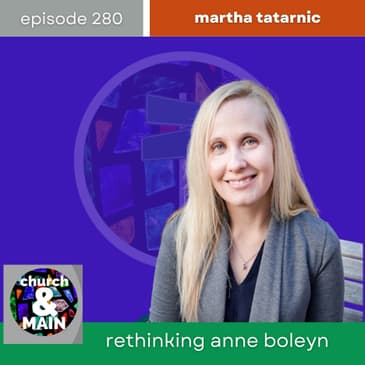

What do you really know about Anne Boleyn? Most of us remember her as Henry VIII's ill-fated second wife — and not much more. But according to Martha Tatarnic, Anglican priest and author of Anne Boleyn: Reputation, Revolution, Religion, and the Queen Who Changed History, we've been missing the bigger picture entirely.
Martha returns to the podcast to explore Anne Boleyn as a serious religious reformer whose influence on the English Reformation — and the Anglican Church — has been vastly underestimated. History painted her as a seductress rather than a scholar. Victim-blaming narratives have shaped her legacy for centuries, and Martha shares what recovering her true story means for the church today.
Shownotes:
Anne Boleyn: Reputation, Revolution, Religion, and the Queen Who Changed History
When IDIC Met the Culture War (Dennis' Article)
Related Episodes:
Talking About Success and Failure in the Church with Martha Tatarnic | Episode 218
Join the Church and Main Email List
00:00:27 --> 00:00:31 Hello, everyone. Welcome to Church and Main, a podcast for people interested
00:00:31 --> 00:00:33 in the intersection of faith, politics, and culture.
00:00:34 --> 00:00:36 I am Dennis Sanders, your host.
00:00:37 --> 00:00:39 And by the way, happy May.
00:00:40 --> 00:00:43 Do you remember learning about Anne Boleyn?
00:00:44 --> 00:00:49 I remember in high school learning that she was one of the many wives of Henry
00:00:49 --> 00:00:54 VIII and actually ended up executed by the king.
00:00:55 --> 00:01:00 But did you know that she was also a reformer? Kind of right up there with Martin Luther.
00:01:01 --> 00:01:07 That's what you'll learn if you read the book by Martha Tartarnik,
00:01:07 --> 00:01:12 an Anglican priest and author of the book called Anne Boleyn,
00:01:12 --> 00:01:14 Reputation, Revolution,
00:01:15 --> 00:01:18 Religion, and The Queen Who Changed History.
00:01:18 --> 00:01:21 This book is actually coming out on May 12th.
00:01:22 --> 00:01:27 Martha has had an interest in Anne since she was a child, and that fascination
00:01:27 --> 00:01:32 with the late queen was also instrumental in helping her become a priest.
00:01:32 --> 00:01:38 So, I wanted to talk to Martha about the book, and I'm welcoming her back on
00:01:38 --> 00:01:45 the podcast to talk about how we can look at Anne Boleyn in a different way
00:01:45 --> 00:01:46 than we have been taught.
00:01:47 --> 00:01:52 Before we go into the discussion a little bit about Martha, she is priest at St.
00:01:53 --> 00:01:56 George's Anglican Church in St. Catharines, Ontario, Canada.
00:01:57 --> 00:02:02 And besides her current book, she is also the author of the books Why Gather,
00:02:03 --> 00:02:07 The Hope and Promise of the Church, and also the book Living Diet,
00:02:08 --> 00:02:09 A Christian Journey to Joyful Eating.
00:02:09 --> 00:02:16 Martha is also the co-host of the Future Christian podcast, along with frequent
00:02:16 --> 00:02:19 guest here, Lauren Richmond, Jr.
00:02:20 --> 00:02:26 So, with all that out of the way, here is my discussion about Anne Boleyn as
00:02:26 --> 00:02:29 a reformer with Martha Tatarnik.
00:02:49 --> 00:02:52 Well, Martha, it is good to have you back on the podcast.
00:02:53 --> 00:02:57 And I wanted to talk about, you have a new book coming out.
00:02:58 --> 00:03:07 And it is a book that I think is fascinating in that it's dealing with a person
00:03:07 --> 00:03:13 from history that I kind of remember when I was in ninth grade,
00:03:13 --> 00:03:16 knowing a little bit about, and that is Anne Boleyn.
00:03:17 --> 00:03:20 And unfortunately, there were only two things I knew about her.
00:03:20 --> 00:03:24 Well, three. One, that she was the second wife of Henry VIII.
00:03:25 --> 00:03:30 Second was supposedly that she had six fingers on one hand.
00:03:30 --> 00:03:33 And then third, that she was executed.
00:03:34 --> 00:03:37 And we didn't talk much more about that.
00:03:38 --> 00:03:46 But there is a lot about her that we don't know. And I think in how you've written
00:03:46 --> 00:03:52 this book, it really has a lot to say about the church and about.
00:03:53 --> 00:03:57 The role of women in the church, but also the role of women in society.
00:03:58 --> 00:03:59 So I think the first thing I
00:03:59 --> 00:04:03 wanted to talk about is what led you to write this book about Anne Boleyn.
00:04:04 --> 00:04:08 All right. Well, first of all, I just want to say thank you for having me back on the podcast.
00:04:08 --> 00:04:14 And thank you for being open to talking about my new book, because I realized
00:04:14 --> 00:04:20 when I reached out to you to see whether you were interested in an advanced copy that it's,
00:04:20 --> 00:04:25 you know, not the typical topics that you have on church in Maine.
00:04:26 --> 00:04:34 But I think that you're absolutely right that what I've tried to do in exploring this, you know,
00:04:34 --> 00:04:39 pretty popular, well-known figure from history is what it does actually have
00:04:39 --> 00:04:43 to say for us today and what it has to say for us in a really.
00:04:44 --> 00:04:46 Critical and important way.
00:04:46 --> 00:04:50 So thanks for getting into it.
00:04:50 --> 00:04:54 Thank you for being open-minded about that.
00:04:55 --> 00:05:00 So, yeah, what led me to write a book about Anne Boleyn?
00:05:00 --> 00:05:04 As you kind of noted, there are lots of things that we think that we know about
00:05:04 --> 00:05:12 Anne Boleyn and lots of things that haven't been really part of the popular narrative in any way.
00:05:12 --> 00:05:19 And I think that needs to be interrogated, really, like the stories that we
00:05:19 --> 00:05:24 have told about her and why it matters that we're a little more clear about
00:05:24 --> 00:05:27 her impact and influence. So I can tell you that,
00:05:28 --> 00:05:35 I have just had a lifelong, pretty much lifelong fascination with Anne Boleyn.
00:05:35 --> 00:05:40 I remember watching Anne of the Thousand Days with my mom when I was quite little
00:05:40 --> 00:05:48 and really being so drawn into her story from that point on.
00:05:49 --> 00:05:57 When I was in seminary in my early 20s studying to become an Anglican priest,
00:05:58 --> 00:06:04 I would find myself—and it really was just gut instinct—I would find myself
00:06:04 --> 00:06:12 gravitating in my free time to the tutor history section of the Trinity College Library.
00:06:12 --> 00:06:18 And in some ways, like that was a natural place to go as someone who was studying
00:06:18 --> 00:06:23 to be a leader in the Anglican Church because Tudor history is so entwined with
00:06:23 --> 00:06:29 the start of the Church of England and therefore of what would become the Anglican Communion.
00:06:29 --> 00:06:35 But I was particularly drawn to books about Anne Boleyn.
00:06:36 --> 00:06:43 And for me, it was really heartening, validating, I would use the word validating,
00:06:43 --> 00:06:46 to discover that this, again, like,
00:06:47 --> 00:06:58 well-known character from popular history had such a formational impact in how
00:06:58 --> 00:06:59 the English language was.
00:06:59 --> 00:07:08 Reformation was shaped, and that her fingerprints are all over the Anglican Church of today.
00:07:09 --> 00:07:12 That was really important for me as a
00:07:12 --> 00:07:18 young woman just beginning to explore a
00:07:18 --> 00:07:29 vocation in leadership in the church to know that it isn't this great big outlier
00:07:29 --> 00:07:34 event to have women serve in leadership in our church.
00:07:34 --> 00:07:41 That actually women have had ways of asserting influence and leadership in our
00:07:41 --> 00:07:46 church all along, even if we haven't been good at telling their story or recognizing their impact.
00:07:47 --> 00:07:51 And so over the years, you know, I've had opportunity to,
00:07:52 --> 00:07:57 teach Anglicanism 101 here and there in my churches.
00:07:57 --> 00:08:01 And I always have a session on the history of the Anglican Church.
00:08:01 --> 00:08:06 And I love telling people, you know, we always say that we think that our church
00:08:06 --> 00:08:09 was started because King Henry VIII wanted a divorce.
00:08:09 --> 00:08:17 But actually, the Anglican Church was started because the woman he was interested in was a reformer.
00:08:17 --> 00:08:24 And she was a smart and influential and principled reformer.
00:08:24 --> 00:08:29 Well, people are just always so surprised by this because that is not how we
00:08:29 --> 00:08:32 have told our church history.
00:08:32 --> 00:08:36 And that's not the narrative that is known about Anne Boleyn.
00:08:37 --> 00:08:41 So I was up on my soapbox one Christmas
00:08:41 --> 00:08:44 vacation going on about
00:08:44 --> 00:08:47 this to my brother of all people who isn't that
00:08:47 --> 00:08:50 interested in church history and doesn't give
00:08:50 --> 00:08:54 me a free pass on any of my ideas like he is not
00:08:54 --> 00:08:59 generally just interested in hearing what I have to say about this that or the
00:08:59 --> 00:09:05 other thing but he was genuinely interested in hearing this and like interested
00:09:05 --> 00:09:11 in realizing that there is a whole um a whole.
00:09:12 --> 00:09:20 Way of looking at both our history and the person of Anne Boleyn that he had never considered.
00:09:20 --> 00:09:23 And that really triggered something for me in thinking, okay,
00:09:23 --> 00:09:29 if my middle-aged accountant brother who isn't interested in my ideas or the
00:09:29 --> 00:09:35 church thinks that this is something that deserves to be talked about,
00:09:35 --> 00:09:38 then I think that there is a book here.
00:09:39 --> 00:09:50 Yeah, I think one of the things that is fascinating is how learned she was,
00:09:50 --> 00:09:53 especially for her time and especially for a woman.
00:09:57 --> 00:10:03 When you talk about her as a reformer, because when we think of all the great
00:10:03 --> 00:10:08 reformers, and you even mentioned this in the book, whether it's Luther or Calvin
00:10:08 --> 00:10:10 or Erasmus, they're all male.
00:10:11 --> 00:10:17 And I think we don't normally think, especially historically,
00:10:17 --> 00:10:26 when we think of Anne Boleyn or any of Henry VIII's wives, we don't really look into them that much.
00:10:28 --> 00:10:35 It's kind of cursory and I think maybe sometimes the way that we look at it
00:10:35 --> 00:10:40 I mean we'll talk about the split and the English Reformation the Church of England.
00:10:42 --> 00:10:47 We will kind of more focus trying to focus on Henry getting a male heir,
00:10:48 --> 00:10:55 but we don't focus on the fact of who these women were and especially with,
00:10:56 --> 00:11:05 and that in many ways she had all of these ideas because of books becoming new.
00:11:05 --> 00:11:09 The printing press had only been around maybe a few decades earlier.
00:11:10 --> 00:11:16 And really, the influence that she had in creating the Church of England,
00:11:16 --> 00:11:21 it wasn't just Henry getting angry and deciding to split it off.
00:11:21 --> 00:11:27 There was actually some thought in all of this. Yeah, a huge amount of thought
00:11:27 --> 00:11:36 and she had a huge amount of influence in how the Reformation was going to shake down in England.
00:11:36 --> 00:11:44 And I think that you're right to point out her level of education and intelligence.
00:11:45 --> 00:11:49 And we think of that being very unique for a woman of her time.
00:11:50 --> 00:11:55 And yet, what I was really surprised to discover in my research was...
00:11:56 --> 00:12:01 Actually, like that she was a product of her time, that she was part of a whole
00:12:01 --> 00:12:07 circle of well-educated women who were asserting leadership and influence in
00:12:07 --> 00:12:13 pretty remarkable ways and who were very invested in church reform,
00:12:13 --> 00:12:20 who they were reading these books and they were accessing the scriptures in their own language.
00:12:20 --> 00:12:25 And they were on fire with what they were reading and discovering.
00:12:26 --> 00:12:33 And these new worlds that were opening up for them as well, they were very invested
00:12:33 --> 00:12:38 in those same eternal questions,
00:12:39 --> 00:12:43 structural questions, philosophical questions, theological questions.
00:12:43 --> 00:12:48 They understood that their eternal souls were on the line as well,
00:12:48 --> 00:13:00 and they were full throttle into investing themselves in the same things that the guys were, right?
00:13:00 --> 00:13:07 Like, it's not that it was just the dudes who thought that this stuff was important.
00:13:07 --> 00:13:10 And I think a big
00:13:10 --> 00:13:18 reason why she was the way that she was is because she was so formed by these
00:13:18 --> 00:13:28 other women who were normalizing the idea of education for women and leadership.
00:13:31 --> 00:13:38 An impact that women could have. You think that this all kind of went hand in
00:13:38 --> 00:13:40 hand with the Reformation in general,
00:13:40 --> 00:13:47 and this was also kind of happening at the same time that humanism kind of was coming to fore?
00:13:48 --> 00:13:55 Do you think that she was very much a product of the time or the changing times?
00:13:55 --> 00:14:03 Yeah, I think that, you know, she's a fascinating character and she comes to
00:14:03 --> 00:14:07 us from this fascinating hinge point in history, right?
00:14:08 --> 00:14:16 Where you can see these pre-modern ways of understanding the world and understanding
00:14:16 --> 00:14:19 society and society's relationship with God.
00:14:19 --> 00:14:23 You can see all of that still in full effect at the same time,
00:14:23 --> 00:14:26 that because of the printing press,
00:14:26 --> 00:14:34 because of access to circulating ideas and reading the scriptures in one's own language,
00:14:34 --> 00:14:41 and how that began to shape people's ideas about more universal access to education
00:14:41 --> 00:14:46 and those humanistic ideals that you note.
00:14:46 --> 00:14:51 Um, all of that is bubbling up at the same time as.
00:14:52 --> 00:14:58 Um, as, you know, we continue to see the old world in full effect and,
00:14:58 --> 00:15:01 and the new world just beginning to be born.
00:15:02 --> 00:15:07 You can see all of those seeds of modernity in Anne Willen's life.
00:15:07 --> 00:15:13 You can see those seeds of that much more individualistic way of thinking about
00:15:13 --> 00:15:19 the world that would come to challenge sort of all of those societal norms of people.
00:15:20 --> 00:15:25 And you can see it in Henry VIII, right? And you mentioned this quest for an
00:15:25 --> 00:15:33 heir being at the heart of what was driving this massive religious question.
00:15:33 --> 00:15:40 Because for Henry, not having a male heir wasn't just a personal problem.
00:15:40 --> 00:15:44 It wasn't just a political problem. It was a religious problem.
00:15:44 --> 00:15:49 And again, he and Anne and Henry.
00:15:50 --> 00:15:57 Basically everyone around him, was fully committed to the idea that the king's
00:15:57 --> 00:16:01 relationship with God impacted everyone.
00:16:01 --> 00:16:08 That this wasn't just about Henry and God, this was about the whole English realm.
00:16:09 --> 00:16:17 And, you know, I'm not saying that the whole English realm supported his madcap,
00:16:17 --> 00:16:23 you know, quest for heirs stampeding through six different wives and, you know,
00:16:23 --> 00:16:27 unleashing all sorts of chaos on the people of England.
00:16:27 --> 00:16:35 But the premise that was kind of driving his pretty erratic, at times,
00:16:35 --> 00:16:39 behavior was a premise that people recognized,
00:16:39 --> 00:16:48 which is that, We are all in this together in terms of the country's relationship
00:16:48 --> 00:16:51 with God being mediated through the king.
00:16:54 --> 00:16:58 There was actually something in the early part of the book that I found interesting.
00:16:58 --> 00:17:01 It was something you were...
00:17:02 --> 00:17:07 Had you received something, it was a school book from a friend of yours in the
00:17:07 --> 00:17:10 UK, and you have a paragraph about it,
00:17:10 --> 00:17:15 and it basically talks about everything about Anne Boleyn, but then it says
00:17:15 --> 00:17:19 at the end that had she known how she was going to end up,
00:17:20 --> 00:17:25 she may have not entered into going into getting married and all of that,
00:17:25 --> 00:17:27 into a relationship with Henry.
00:17:28 --> 00:17:31 And it was interesting reading that. And I will be honest, when I thought about
00:17:31 --> 00:17:34 that at first, I didn't think much about it.
00:17:35 --> 00:17:43 But you kind of talk about how this kind of frames how we kind of look at her
00:17:43 --> 00:17:49 and really kind of bringing in some modern talk about, well, she asked for it.
00:17:50 --> 00:17:56 Or that she's kind of both, is kind of basically ending up to blaming the victim.
00:17:57 --> 00:18:04 And I think what I'm curious about is how has history looked at Anne Boleyn
00:18:04 --> 00:18:06 and how they misjudged her?
00:18:08 --> 00:18:14 Yeah, I mean, that is a real hornet's nest that you have just identified.
00:18:15 --> 00:18:23 And I think that it is right in the thick of the problematic way in which Anne
00:18:23 --> 00:18:26 Boleyn has been talked about and represented.
00:18:26 --> 00:18:31 I've been amazed at the number of times that I have, over the course of writing
00:18:31 --> 00:18:35 this book, just kind of casually told someone, oh, I'm writing a book about Anne Boleyn.
00:18:35 --> 00:18:39 And the number of times that the response has been, oh, well,
00:18:40 --> 00:18:42 like, she tried to land the king.
00:18:42 --> 00:18:48 Oh, well, like, she set herself in Henry's sights.
00:18:48 --> 00:18:52 She was trying to get his attention. and and
00:18:52 --> 00:18:59 then yeah the quote from that lady bird history school book um that you note
00:18:59 --> 00:19:06 in the early part of the book uh and the musical six and um and so many other
00:19:06 --> 00:19:11 popular um representations of ann's life all succumb to that like.
00:19:12 --> 00:19:23 That very subtle, implicit, well, you know, if she, if her husband killed her,
00:19:23 --> 00:19:26 like, she probably asked for it.
00:19:27 --> 00:19:31 Like, she probably, she shouldn't have been so ambitious. She shouldn't have
00:19:31 --> 00:19:35 wanted power so much. She shouldn't have tried to get the king.
00:19:35 --> 00:19:38 She shouldn't have. it's a very and
00:19:38 --> 00:19:42 and then you look at the labels that have been associated with her over the
00:19:42 --> 00:19:48 years that she was a whore that she was a seductress that she was a bad woman
00:19:48 --> 00:19:54 that she was a witch that she was um that sixth finger you know that is part
00:19:54 --> 00:19:58 of the anvil in lore it is has no basis in history,
00:19:58 --> 00:20:05 but it is part of how she has been painted as this evil woman,
00:20:05 --> 00:20:11 as someone who is dealing in nefarious dealings.
00:20:12 --> 00:20:21 And all of that kind of stacks up to this very easy way of telling her story
00:20:21 --> 00:20:26 as someone who, yeah, like had a tragic end,
00:20:26 --> 00:20:29 but kind of set herself up for failure.
00:20:29 --> 00:20:36 When you get into the actual history and what the evidence really tells us,
00:20:36 --> 00:20:42 it's amazing to discover that even that most basic narrative about Anne Boleyn,
00:20:42 --> 00:20:46 that she, you know, refused the king's.
00:20:48 --> 00:20:56 Offer to become his mistress. And so he upped the ante and decided to marry her instead.
00:20:56 --> 00:21:02 That even that most basic idea is not really borne out in the evidence.
00:21:03 --> 00:21:09 But really, probably what we know about Henry and what the evidence tells us
00:21:09 --> 00:21:12 is that he was in the market for a wife.
00:21:12 --> 00:21:20 And he decided pretty quickly, he went from noticing her to deciding that she
00:21:20 --> 00:21:23 was going to be that wife.
00:21:25 --> 00:21:31 There's actually not a lot to suggest that she was the one...
00:21:34 --> 00:21:40 Kind of keeping him on the back foot or playing this master class of deferred gratification.
00:21:41 --> 00:21:49 They were in lockstep together. Once she kind of realized that resistance was futile,
00:21:49 --> 00:21:55 they were in lockstep together with this grand religious agenda,
00:21:55 --> 00:22:04 which was to secure a marriage that would secure legitimate heirs and that would
00:22:04 --> 00:22:12 signal that the king and England's relationship was right with God.
00:22:13 --> 00:22:16 That's a very different way of looking at the story.
00:22:17 --> 00:22:25 And you know what, even if she was somebody who somehow was able to keep the
00:22:25 --> 00:22:29 king on notice for six years until he married her,
00:22:30 --> 00:22:34 that doesn't mean she deserves to die.
00:22:34 --> 00:22:42 It doesn't mean that she deserves to be killed by her husband.
00:22:42 --> 00:22:48 So I think we have to be super careful about how we tell these stories.
00:22:48 --> 00:22:53 And, you know, that really did become, as much as I have enjoyed getting into
00:22:53 --> 00:22:59 the history of Anne Boleyn, I really tried to keep my eye on that prize in terms
00:22:59 --> 00:23:01 of, like, why does this matter?
00:23:01 --> 00:23:05 Why does it matter how we talk about this particular woman?
00:23:06 --> 00:23:14 And what does our language and our narratives about her tell us about patterns
00:23:14 --> 00:23:18 about how we talk about women? And why does this matter for us?
00:23:19 --> 00:23:22 And I think that, you know,
00:23:22 --> 00:23:25 you don't have to get too far in
00:23:25 --> 00:23:33 the weeds before you realize that that kind of victim blaming and that kind
00:23:33 --> 00:23:43 of those kind of stories can support a lot of systemic violence and injustice.
00:23:46 --> 00:23:53 In your study of Anne Boleyn, I mean, how do you think that this is also related to this?
00:23:53 --> 00:23:59 How is it talked about how we look at women historically in general and throughout history?
00:24:00 --> 00:24:07 I mean, I'm going to be certain that there have probably been other cases where we've kind of.
00:24:09 --> 00:24:18 Blamed a victim or judged women in different ways that you kind of learned through this journey.
00:24:19 --> 00:24:27 Yeah, I think that there are some real patterns that we can identify in Anne
00:24:27 --> 00:24:30 Boleyn's life and the way that it has been discussed.
00:24:31 --> 00:24:35 And the victim blaming isn't the end of the story.
00:24:35 --> 00:24:45 I mean, if you look at the tendency across history to take strong,
00:24:46 --> 00:24:55 assertive women and to label them as sexually problematic, that's another pattern.
00:24:55 --> 00:25:05 And, you know, I would point your listeners to Mary Magdalene as like a parallel figure, right?
00:25:05 --> 00:25:19 Like here is a woman who was clearly a leader in the Jesus movement at the forefront of the disciples.
00:25:19 --> 00:25:23 And how has she been known across history? She's been known as a prostitute.
00:25:25 --> 00:25:31 There's no biblical evidence for that. And that has been the label that has been affixed to her.
00:25:32 --> 00:25:41 I think that we could point to any number of examples of where strong women
00:25:41 --> 00:25:46 who maybe don't behave in the way that we think that they should,
00:25:46 --> 00:25:48 who kind of stick out,
00:25:49 --> 00:25:54 get slapped with labels of sexual deviancy.
00:25:54 --> 00:25:57 So that's another pattern that I would identify.
00:25:58 --> 00:26:01 I think that just a pattern in general,
00:26:02 --> 00:26:07 and I really tried to pull at this in a variety of ways through the book,
00:26:08 --> 00:26:18 is that we've had such a narrow focus on telling the stories of who shaped the
00:26:18 --> 00:26:19 world that we have today.
00:26:19 --> 00:26:25 And primarily, we have told those stories through the lens of white men.
00:26:27 --> 00:26:36 And the reality is that although white men in the Western world have more often
00:26:36 --> 00:26:40 than not been the ones in the power positions...
00:26:42 --> 00:26:45 We can certainly, with just a little digging,
00:26:46 --> 00:26:53 find all kinds of evidence for the ways in which other sorts of people were
00:26:53 --> 00:26:57 shaping the history that we have and shaping the world that we have today.
00:26:58 --> 00:27:04 And again, you know, my focus was really on Anne Boleyn, but I came across one
00:27:04 --> 00:27:09 scholar who was absolutely fascinating in terms of, her name is Sharon Jansen,
00:27:09 --> 00:27:17 and just the ways in which she was able to articulate how women of all different
00:27:17 --> 00:27:20 classes, not even just like educated elite women,
00:27:20 --> 00:27:26 women of all different classes were part of political agitation and religious
00:27:26 --> 00:27:34 reform and speaking up and getting their voices heard and making it clear what
00:27:34 --> 00:27:38 they believed and being willing to stand behind that.
00:27:38 --> 00:27:43 But again, we haven't told those stories.
00:27:43 --> 00:27:51 So that invisibility is a pattern in how we have talked about who shapes the world.
00:27:51 --> 00:27:58 And it's a fiction. It's a fiction to suggest that it has just been white guys
00:27:58 --> 00:28:00 who have made the world that we have today.
00:28:03 --> 00:28:07 I have thought about
00:28:07 --> 00:28:13 the history especially of um the black church here in the united states and
00:28:13 --> 00:28:21 a lot of that story is usually going to be focused on the pastors and of course
00:28:21 --> 00:28:25 especially years ago they were mostly men,
00:28:27 --> 00:28:33 But the church wouldn't be the church if it wasn't for all of the women who were running it.
00:28:35 --> 00:28:43 And they also have some important stories that are, I think,
00:28:43 --> 00:28:48 only now being told, but we don't always, haven't heard about them.
00:28:48 --> 00:28:53 But if you didn't have those women who were really the backbones of the church,
00:28:55 --> 00:29:00 none of this would happen, especially things like the civil rights movement here in the States.
00:29:00 --> 00:29:05 Yeah, I think that is like such a good corollary.
00:29:05 --> 00:29:07 And again, like.
00:29:11 --> 00:29:19 People of all different walks of life have always found their ways of getting
00:29:19 --> 00:29:24 their voices into the mix and getting their fingerprints smudged across, you know,
00:29:25 --> 00:29:27 the whole shaping of history.
00:29:27 --> 00:29:33 There was a whole chapter that I had to cut out. I had to cut out so much because
00:29:33 --> 00:29:35 I really got carried away.
00:29:35 --> 00:29:41 There were so many different aspects that I wanted to highlight,
00:29:41 --> 00:29:48 but there was a chapter that I wrote that made a connection between the telling
00:29:48 --> 00:29:59 of Anne Boleyn's story and Indigenous Canada and the Truth and Reconciliation Movement in Canada.
00:29:59 --> 00:30:09 And I realize there is not an obvious connection between an elite woman of the
00:30:09 --> 00:30:17 16th century who married into royalty and Indigenous peoples of Canada today, except to say,
00:30:18 --> 00:30:24 isn't it interesting that at the heart of the truth and reconciliation movement
00:30:24 --> 00:30:29 in Canada is this insistence that
00:30:29 --> 00:30:33 indigenous people's stories be told as part of our history.
00:30:34 --> 00:30:41 That that is going to be baked into our education systems. It is going to be
00:30:41 --> 00:30:42 part of our history books.
00:30:42 --> 00:30:48 It is going to be what school children start to learn about the history of Canada.
00:30:48 --> 00:30:53 That that is an essential step in any work of truth and reconciliation,
00:30:53 --> 00:31:01 is to make sure that we are telling the stories. and you know like I um.
00:31:03 --> 00:31:10 I think Anne Boleyn is a fascinating character who lived in many ways in a time
00:31:10 --> 00:31:13 of history that can be read almost as a soap opera.
00:31:13 --> 00:31:22 And at the same time, I think that there is something just so incredibly critical
00:31:22 --> 00:31:27 and serious about what I'm trying to say,
00:31:27 --> 00:31:30 which is telling these stories really matter.
00:31:30 --> 00:31:34 Telling better stories matters. Telling more stories matters.
00:31:35 --> 00:31:45 Just any way that we can put to bed the lie that it's just one type of person
00:31:45 --> 00:31:49 who has been important in our history.
00:31:49 --> 00:31:53 And, you know, especially like in our church history, too,
00:31:53 --> 00:32:05 because our church history has been so dominated by the voices of men and Christianity
00:32:05 --> 00:32:12 has walked a pretty intimate path with the patriarchy.
00:32:14 --> 00:32:19 And I don't think that that's representative of Jesus and what he was all about.
00:32:19 --> 00:32:29 But I think that we do Jesus a huge disservice by not better representing how
00:32:29 --> 00:32:33 God actually works in our world and through whom God works.
00:32:36 --> 00:32:44 And that kind of leads me to this question is, what does this book have to say,
00:32:44 --> 00:32:48 especially to the modern church?
00:32:50 --> 00:32:57 Obviously you wrote this being yourself an Anglican priest this is in some ways
00:32:57 --> 00:33:02 a lot about the beginnings of the Anglican church and the Anglican communion but.
00:33:04 --> 00:33:11 What does this, what happened four or five centuries ago have to say about this current moment?
00:33:11 --> 00:33:14 How is this, how is it speaking to our moment?
00:33:15 --> 00:33:19 Yeah, well, a couple of different things. I mean, again, yes,
00:33:19 --> 00:33:25 so much of the book is focused on Anne, her story, the English Reformation.
00:33:25 --> 00:33:36 But I really did try to also just touch on how much women were involved right
00:33:36 --> 00:33:42 across the board in that very cataclysmic time.
00:33:42 --> 00:33:50 So to say that Anne, and I think it is absolutely fair to say this, historians say this,
00:33:50 --> 00:33:54 to say that Anne Boleyn was one of the architects of the English Reformation
00:33:54 --> 00:34:00 is a very fair statement and one that Anglicans should know.
00:34:00 --> 00:34:07 They should know that along with Cranmer and Hooker and Parker and.
00:34:08 --> 00:34:16 You know, all the guys, that Anne Boleyn was one of the key architects of how
00:34:16 --> 00:34:19 the English church would be shaped.
00:34:19 --> 00:34:28 Um, and at the same time, the, the same can be said of, uh, how the reformation
00:34:28 --> 00:34:32 shook down across the board, right?
00:34:32 --> 00:34:40 Like you, she's one of many women who were part of, uh, shaping the history
00:34:40 --> 00:34:45 of the church at that really important time. Um, yeah.
00:34:46 --> 00:34:53 This year, the Anglican Church of Canada will mark its 50th anniversary of the ordination of women.
00:34:54 --> 00:34:58 And just in the last couple of weeks,
00:34:58 --> 00:35:09 the first female Archbishop of Canterbury was installed as the kind of flag
00:35:09 --> 00:35:13 bearer of the Anglican communion.
00:35:14 --> 00:35:24 And there is a tendency to treat this,
00:35:24 --> 00:35:30 the ordination of women and the movement of women into the highest offices of
00:35:30 --> 00:35:33 the church as a new thing. And it is.
00:35:34 --> 00:35:38 I mean, it is a new thing in the grand scheme of things, even though women have
00:35:38 --> 00:35:46 been ordained longer than I have been alive. in my church, it's still a very relatively new thing.
00:35:46 --> 00:35:56 And I have had many experiences of running up against the intractability of
00:35:56 --> 00:35:59 how people view who should be in leadership in the church.
00:36:00 --> 00:36:08 And at the same time, as we're kind of making history and all of this newness is unfolding,
00:36:09 --> 00:36:20 I think it's really important to frame it in the context of a long history of
00:36:20 --> 00:36:23 how women have been leaders in our church,
00:36:23 --> 00:36:27 a long history that you can take all the way back to the disciples of Jesus
00:36:27 --> 00:36:31 and further back into the history of Israel. Yeah.
00:36:32 --> 00:36:41 Maybe there's a new chapter unfolding in terms of women's legitimacy and visibility
00:36:41 --> 00:36:43 in leadership, and I celebrate that.
00:36:43 --> 00:36:48 But let's be honest and
00:36:48 --> 00:37:02 fervent about claiming this as foundational to the people of faith and to the
00:37:02 --> 00:37:04 body of Christ and to the life of the church.
00:37:04 --> 00:37:10 And I think that that's important, not just for women who are trying to,
00:37:10 --> 00:37:15 you know, take on these new chapters.
00:37:15 --> 00:37:23 I think it's important for all of us in terms of how we understand how God is at work.
00:37:25 --> 00:37:28 Yeah, I mean, I definitely agree with that. I think,
00:37:28 --> 00:37:33 I remember years ago saying something,
00:37:34 --> 00:37:39 because I knew, and this is when I was growing up and were in more kind of,
00:37:39 --> 00:37:46 let's say conservative backgrounds where women ministry was very limited.
00:37:47 --> 00:37:50 And maybe this just comes from having a very
00:37:50 --> 00:37:53 strong mother but i just always believe that the spirit
00:37:53 --> 00:37:56 moved in choosing
00:37:56 --> 00:38:05 leaders and if the spirit chose someone who was a woman or or black or gay whatever
00:38:05 --> 00:38:14 then i don't think we have much to argue with because i think that is the Spirit's movement in that.
00:38:15 --> 00:38:19 And I think too often we think that there's this rule on high and it's like,
00:38:19 --> 00:38:21 that's not how I read Scripture.
00:38:22 --> 00:38:27 I mean, that's, you know, God would always raise up people to become leaders.
00:38:27 --> 00:38:32 I mean, there's obviously the story in the Hebrew Scripture of Deborah being
00:38:32 --> 00:38:41 a judge and it was God's movement in all of that. And I think sometimes we don't always….
00:38:42 --> 00:38:46 We don't always understand the workings of the Spirit and how the Spirit moves
00:38:46 --> 00:38:51 and the Spirit calls who the Spirit calls.
00:38:51 --> 00:38:54 Yeah, and always has, you know?
00:38:55 --> 00:39:02 And I think that any time that we can have our arrogance dismantled a little
00:39:02 --> 00:39:09 bit in terms of thinking that we rule the roost in how God operates, we don't.
00:39:10 --> 00:39:12 Yeah, the Spirit moves how the Spirit moves.
00:39:13 --> 00:39:21 Last year, I read the biography of Rose Hudson-Wilkin, who was the first Black
00:39:21 --> 00:39:24 woman bishop of the Church of England,
00:39:24 --> 00:39:31 and I got to interview her on the Future Christian podcast.
00:39:32 --> 00:39:35 And uh she grew up in a
00:39:35 --> 00:39:38 church a part of the anglican communion that
00:39:38 --> 00:39:41 was not ordaining women at that time and then she went
00:39:41 --> 00:39:47 to serve in england she grew up in jamaica went to serve in england um and was
00:39:47 --> 00:39:52 feeling this sense of calling all throughout like from the time that she was
00:39:52 --> 00:39:58 a teenager and she describes like meeting with her bishop when she's a teenager,
00:39:59 --> 00:40:02 and saying, like, I'm feeling this call.
00:40:02 --> 00:40:05 And the bishop saying, well, the church doesn't do that.
00:40:06 --> 00:40:09 Like, you can't be ordained.
00:40:11 --> 00:40:16 And she describes, like, just this inner knowledge of, like,
00:40:17 --> 00:40:19 well, maybe the church doesn't do this.
00:40:19 --> 00:40:23 And maybe you don't do this. But I know God does this.
00:40:23 --> 00:40:26 And, like, this is going to happen.
00:40:26 --> 00:40:29 And uh like to have that inner
00:40:29 --> 00:40:35 conviction and that strength of faith for her to continue to pursue that call
00:40:35 --> 00:40:39 across all of that like no we don't do this no we don't do this no we don't
00:40:39 --> 00:40:47 do this and here she is like a bishop of the church of england like god does do this amazing mm-hmm.
00:40:49 --> 00:40:55 And I think you were talking a little bit earlier about the calling of the first
00:40:55 --> 00:40:58 woman to be the Archbishop of Canterbury.
00:41:00 --> 00:41:08 There was still friction about that, which maybe I shouldn't be surprised,
00:41:08 --> 00:41:15 but I was somewhat surprised because it's not like they just picked her out of a hat.
00:41:15 --> 00:41:19 I mean, there's a lot of discernment through all of that process.
00:41:21 --> 00:41:23 But there was a lot of friction.
00:41:24 --> 00:41:28 Yeah, and there will continue to be, right? Like from the get-go,
00:41:29 --> 00:41:34 as soon as the church started ordaining women, there was a big hue and cry about
00:41:34 --> 00:41:37 how this was going to be the ruin of the church.
00:41:37 --> 00:41:43 And, you know, there's been a hue and cry about any time that the church takes
00:41:43 --> 00:41:51 those steps to recognize the ways in which God calls and works, right?
00:41:52 --> 00:41:55 So that is not surprising.
00:41:56 --> 00:41:59 The friction will continue to be there.
00:41:59 --> 00:42:03 The opposition is real. And again, that has a lot to do, too,
00:42:03 --> 00:42:10 with why I'm so insistent in framing her as,
00:42:11 --> 00:42:14 okay, yeah, it's a new chapter, but it's also not a new chapter.
00:42:16 --> 00:42:23 It's a faithful continuation of what has been taking place all along in our faith.
00:42:23 --> 00:42:29 And, you know, that's really important to me as a person of faith to say that,
00:42:30 --> 00:42:34 but it's also just really important to,
00:42:34 --> 00:42:38 like in much more practical
00:42:38 --> 00:42:44 ways like I talk in the book about Malcolm Gladwell and his work around a tipping
00:42:44 --> 00:42:55 point that you know when a woman is seen as as you know kind of rising into ranks that.
00:42:56 --> 00:43:01 Are brand new, that she's kind of alone in.
00:43:01 --> 00:43:08 And that goes for anybody who's kind of breaking through whatever glass ceilings there are,
00:43:08 --> 00:43:14 anybody who is seen as an outlier in a position of leadership that they previously
00:43:14 --> 00:43:22 have been excluded from, that there is a tendency to exceptionalize that person,
00:43:22 --> 00:43:26 to turn them into a novelty,
00:43:26 --> 00:43:34 or to judge them according to a very different sort of standard than someone
00:43:34 --> 00:43:38 who is seen as more normal in that position would be judged, right?
00:43:38 --> 00:43:42 So, you know, a woman gets into a position of leadership, and she thinks that
00:43:42 --> 00:43:46 she has to represent all women everywhere for all time.
00:43:46 --> 00:43:52 Otherwise, like the whole thing will be judged as a failed experiment, right?
00:43:53 --> 00:43:57 And I've certainly heard Black people talk about a similar dynamic,
00:43:57 --> 00:44:04 that when they are thrust into positions that they have previously been excluded from,
00:44:04 --> 00:44:11 there's a sense of responsibility that I have to represent the whole Black community in this moment.
00:44:11 --> 00:44:17 Malcolm Gladwell talks about a tipping point when representation of a previously
00:44:17 --> 00:44:21 excluded group reaches around one-third and suddenly.
00:44:23 --> 00:44:29 Suddenly it allows people to be judged just according to the standard of how
00:44:29 --> 00:44:34 they're doing the job rather than like the standard of like,
00:44:34 --> 00:44:37 should this kind of person be here?
00:44:37 --> 00:44:44 Um, and, and, you know, I think like for Sarah Mullally,
00:44:44 --> 00:44:50 the first female Archbishop of Canterbury, for women in leadership,
00:44:50 --> 00:44:54 for black people in leadership, for gay people in leadership,
00:44:54 --> 00:45:02 for them to understand that they're part of a team and that they're part of
00:45:02 --> 00:45:04 a long and faithful history.
00:45:05 --> 00:45:14 I think really counteracts some of those very unhelpful dynamics when glass ceilings are broken.
00:45:18 --> 00:45:22 Kind of wrapping things up, I wanted to know what is your hope for this book
00:45:22 --> 00:45:25 when it releases next month?
00:45:27 --> 00:45:37 Well, I have a pretty specific agenda about the book, and I welcome your prayers
00:45:37 --> 00:45:39 for this because it's a bit ambitious.
00:45:40 --> 00:45:51 But I really want to be part of dismantling the fictional idea of a church history
00:45:51 --> 00:45:54 that is just shaped by white dudes.
00:45:54 --> 00:45:58 I want to challenge that.
00:45:58 --> 00:46:02 I want people in our churches.
00:46:02 --> 00:46:06 This book isn't written for a church audience. It's written for a general audience.
00:46:06 --> 00:46:16 I think that Anne Boleyn has a lot to say to people, whether you're a person of faith or not.
00:46:16 --> 00:46:21 But I will say that, like, as a Christian leader myself,
00:46:22 --> 00:46:31 my specific hope is that at least in our churches, people will know something
00:46:31 --> 00:46:34 of how women have shaped our church, too.
00:46:34 --> 00:46:37 And I want it
00:46:37 --> 00:46:40 to become widespread knowledge that
00:46:40 --> 00:46:45 Anne Boleyn was a major
00:46:45 --> 00:46:56 influencer and had a huge impact in how the Reformation in England and therefore
00:46:56 --> 00:47:02 in Europe came to be and took place and what it looked like.
00:47:04 --> 00:47:14 Okay. One final note before we end is that I remember actually in seminary,
00:47:15 --> 00:47:18 And of course, my seminary, I went to Luther Seminary. So, of course,
00:47:19 --> 00:47:20 you learned a lot about Martin Luther.
00:47:21 --> 00:47:27 But they talked a little bit about the importance of his wife, Katie Luther. Yeah.
00:47:27 --> 00:47:34 And we talked about it a little bit, but we kind of forget that she was also
00:47:34 --> 00:47:41 in some ways a partner in his ministry and in his helping to shape the Reformation.
00:47:42 --> 00:47:45 And that doesn't always get I've
00:47:45 --> 00:47:49 seen a few books about her but we don't always acknowledge
00:47:49 --> 00:47:54 that it's something I've thought about again there
00:47:54 --> 00:47:56 were parts of the book that
00:47:56 --> 00:48:00 I had to chop and there were
00:48:00 --> 00:48:05 parts of research that I sort of had to cut off at the pass but I also was quite
00:48:05 --> 00:48:12 intrigued by Luther's wife and again by the number of really prominent female
00:48:12 --> 00:48:17 reformers that were agitating all across Europe in the early 16th century,
00:48:18 --> 00:48:20 how important all of them were.
00:48:22 --> 00:48:26 So if people want to chat with you, especially after they've read the book,
00:48:26 --> 00:48:28 where should they contact you?
00:48:29 --> 00:48:35 Well, I am on Instagram, Facebook, Substack, Medium.
00:48:37 --> 00:48:41 I think those are kind of the main platforms that I'm on.
00:48:41 --> 00:48:49 I'm really easy to find because I'm the only Martha Tatarnik in the whole world that I know of.
00:48:49 --> 00:48:52 It's not a common name and so
00:48:52 --> 00:48:55 if you just put in my name in any
00:48:55 --> 00:49:01 of those platforms i'll be the one that comes up and i really am excited to
00:49:01 --> 00:49:06 talk about this book as widely as possible so i hope that your listeners will
00:49:06 --> 00:49:13 feel free to reach out to me all right i hope that they will and so the The book is Anne Boleyn.
00:49:13 --> 00:49:18 Reputation, Revolution, Religion, and the Queen Who Changed History.
00:49:18 --> 00:49:20 And that comes out on May 5th.
00:49:21 --> 00:49:28 So blessings to you. I really do hope that this gets read widely and that people
00:49:28 --> 00:49:35 will learn a lot about a woman that we may know a little bit, that we think we know,
00:49:35 --> 00:49:39 but I think that we will know a whole new chapter about her.
00:49:39 --> 00:49:45 Yeah well thank you for such a thoughtful conversation and for engaging with
00:49:45 --> 00:49:53 all of the ideas and the the great big agenda from this book thanks Dennis you're welcome.
00:50:23 --> 00:50:27 So, I really hope you enjoyed that discussion with Martha about Anne Boleyn.
00:50:28 --> 00:50:32 I will put a link to the book in the show notes.
00:50:33 --> 00:50:39 Again, that book is coming out on May 12th. And I will put a link so that you
00:50:39 --> 00:50:41 can pre-order that book as well.
00:50:43 --> 00:50:49 And also, I'll probably put a link to her personal website just to know so that
00:50:49 --> 00:50:51 you can all know a little bit more about Martha.
00:50:53 --> 00:50:58 Also, as usual, if you want to learn more about this podcast,
00:50:59 --> 00:51:04 listen to past episodes, you can check me out at churchandmaine.org.
00:51:06 --> 00:51:13 I'd also suggest that you check churchandmaine.substack.com to read articles that I've written.
00:51:14 --> 00:51:23 I also do try to post the podcast there. Usually it's a few days after it has launched on Podbean.
00:51:24 --> 00:51:27 And so you can watch for it there.
00:51:27 --> 00:51:30 If you want to donate to the podcast, you can do that.
00:51:31 --> 00:51:37 There's a link in the show notes. If you're listening to this on Podbean or
00:51:37 --> 00:51:39 on other podcast platforms.
00:51:40 --> 00:51:47 Also, you can make a donation and subscribe on the Substack page.
00:51:47 --> 00:51:50 And there's a button if you go to Substack.
00:51:51 --> 00:51:57 I'd also like for you, the most recent article that I wrote on Substack is...
00:51:59 --> 00:52:02 I'm a big star trek fan a very
00:52:02 --> 00:52:05 big trekkie and one of the interesting things
00:52:05 --> 00:52:08 that has been happening in in uh among uh trek
00:52:08 --> 00:52:12 people these days um about a
00:52:12 --> 00:52:16 month ago it's a recent cancellation of the newest of the of the series and
00:52:16 --> 00:52:22 the franchise starfleet academy um what was interesting about that following
00:52:22 --> 00:52:29 it on social media um like on on youtube and on facebook was that there was
00:52:29 --> 00:52:33 pretty much an active campaign,
00:52:33 --> 00:52:34 maybe.
00:52:34 --> 00:52:39 I don't know if that's the right word, but just really a lot of campaign against the series.
00:52:39 --> 00:52:46 And a lot of it kind of bordered, I want to say, on racism and homophobia.
00:52:49 --> 00:52:53 And I was curious about this. I didn't want to write about it,
00:52:53 --> 00:52:59 and I didn't want it to be kind of a political screed, but to understand what
00:52:59 --> 00:53:03 is behind some of this anger over a TV show.
00:53:04 --> 00:53:13 So that is one of my latest articles on my, sorry, on my Substack.
00:53:14 --> 00:53:16 And I will put a link to that article.
00:53:16 --> 00:53:22 The article's title, which I'm forgetting right now,
00:53:22 --> 00:53:32 but um is uh when itic met the culture war and itic um stands for infinite diversity
00:53:32 --> 00:53:40 and infinite combinations and it's kind of a a philosophy that came out of star trek um,
00:53:41 --> 00:53:44 which probably proves that I am an incredibly big geek.
00:53:45 --> 00:53:49 But I hope that you will consider reading the article. It's an interesting take
00:53:49 --> 00:53:57 on the times that we live in, how a TV show became so divisive and kind of polarizing.
00:53:57 --> 00:54:01 And so please give it a check.
00:54:02 --> 00:54:04 Give it a read when you have the chance.
00:54:06 --> 00:54:11 Also, please consider leaving a review.
00:54:12 --> 00:54:18 Or a rating on your favorite podcast app. When you do that, you can make sure
00:54:18 --> 00:54:19 that other people find this podcast.
00:54:20 --> 00:54:22 And I would love if people could find this podcast.
00:54:24 --> 00:54:28 So that is it for this episode of Church in Maine. I'm Dennis Sanders,
00:54:28 --> 00:54:31 your host. As I always like to say, thank you so much for listening.
00:54:31 --> 00:54:35 Take care, everyone. Godspeed. And I will see you very soon.