
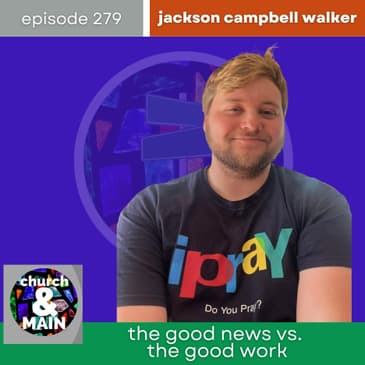

Many progressive and moderate Christians are passionate about justice, inclusion, and showing up for their neighbors. But what if in pursuing all the right causes, we've quietly set aside the message that makes us Christian in the first place?
Jackson Campbell Walker knows this tension firsthand. As a gay pastor who has navigated both conservative evangelical and progressive Baptist spaces, he has watched well-meaning churches slowly replace the grace of God with the works of people.
Jackson and Dennis get honest about what it feels like to be clergy who love both the gospel and justice, and why those two things should never have to compete. They talk about the quiet crisis of trust underneath it all — how, when we stop believing God is at work, we scramble to fill the void with programs, politics, and causes.
This is a conversation for anyone who has ever felt caught between their faith and their convictions — and wondered if they had to choose.
Shownotes:
Trading the Cross for a cause (Jackson's article)
Join the Church and Main Email List
Facebook | Instagram | Threads | Twitter | Website | YouTube
00:00:26 --> 00:00:31 Hey, everyone. Welcome to Church and Maine, a podcast for people interested
00:00:31 --> 00:00:35 in the intersection of faith, politics, and culture.
00:00:36 --> 00:00:38 I'm Dennis Sanders, your host.
00:00:38 --> 00:00:42 So, I want to take you back for a moment to the year 2000.
00:00:43 --> 00:00:52 I was attending an ecumenical gathering of LGBTQ Christians and allies at the
00:00:52 --> 00:00:56 campus of a university. It was about an hour west of Chicago.
00:00:56 --> 00:00:59 And I was in a workshop for something.
00:00:59 --> 00:01:05 And I think someone was asked why churches should be open and affirming.
00:01:06 --> 00:01:10 And so, you know, people gave various answers. And I remarked,
00:01:11 --> 00:01:16 you know, coming from my evangelical background, that it was to fulfill the
00:01:16 --> 00:01:19 Great Commission and to spread the good news, the gospel.
00:01:20 --> 00:01:25 And I remember there was this guy sitting nearby me who actually was from my
00:01:25 --> 00:01:30 home state of Michigan, and he kind of looked, had this puzzled look on his
00:01:30 --> 00:01:34 face, and he mouthed the word great commission.
00:01:34 --> 00:01:37 It was as if he had never heard the phrase before.
00:01:38 --> 00:01:42 Now, maybe this guy was a new Christian.
00:01:43 --> 00:01:48 And he didn't know. Maybe he wasn't even Christian. I don't know.
00:01:48 --> 00:01:53 But though it seems like he had a Christian background or was involved in churches.
00:01:55 --> 00:02:02 But I just always remember that, because not knowing that phrase was something
00:02:02 --> 00:02:06 that was representative of something that I noticed in mainline Protestantism
00:02:06 --> 00:02:09 or in moderate and progressive churches,
00:02:09 --> 00:02:14 that even though there There were churches that were incredibly strong on the issues of justice.
00:02:14 --> 00:02:19 When it came to talking about Jesus, the good news of the gospel,
00:02:20 --> 00:02:22 that's kind of where they were weak.
00:02:24 --> 00:02:30 And, of course, in evangelical churches, sometimes it's the other way around.
00:02:30 --> 00:02:34 There are churches that are very strong on talking about the good news of gospel,
00:02:34 --> 00:02:42 but kind of going back to my story of the guy at that church,
00:02:42 --> 00:02:44 on the university campus,
00:02:45 --> 00:02:50 if you say the words social justice, they might mouth them back and give you
00:02:50 --> 00:02:52 that same quizzical look.
00:02:54 --> 00:02:58 Now, I don't know what it's like in other countries, but it seems like here,
00:02:58 --> 00:03:02 at least in the United States, it feels like Christians have to choose either
00:03:02 --> 00:03:04 your gospel or social justice.
00:03:04 --> 00:03:08 It's not like there's a holistic understanding of this.
00:03:10 --> 00:03:14 And the thing is, is that I'm not the only one that thinks that way.
00:03:15 --> 00:03:21 A pastoral colleague of mine shared an opinion piece that he saw on the site
00:03:21 --> 00:03:26 Baptist News Global, and it's by a young pastor, and the opinion piece has the
00:03:26 --> 00:03:29 title, Trading the Cross for a Cause.
00:03:30 --> 00:03:34 And this is how the essay starts, quote, many moderate and progressive minded
00:03:34 --> 00:03:39 Christians are trying to live our faith in the most actionable way possible.
00:03:39 --> 00:03:44 We want a church that takes suffering seriously, tells the truth about injustice,
00:03:44 --> 00:03:50 shows up for neighbors, and looks like Jesus in public. I want that too.
00:03:50 --> 00:03:55 But here is a subtle trade we can make without noticing. We can let the good
00:03:55 --> 00:03:58 work of the church replace the good news of the church.
00:03:58 --> 00:04:04 We can become people who do good in Jesus' name while drifting from the message
00:04:04 --> 00:04:09 that makes us Christian in the first place, unquote.
00:04:09 --> 00:04:14 So, after reading that article, I wanted to chat with the pastor.
00:04:14 --> 00:04:18 So, my guest today is Jackson Campbell Walker.
00:04:18 --> 00:04:24 He is associate pastor at First Christian Church in Moorhead, Kentucky.
00:04:24 --> 00:04:29 He's a native of Mount Sterling, Kentucky, and a graduate of Transylvania University.
00:04:29 --> 00:04:35 And he has previously served congregations in Louisville and Frankfort,
00:04:35 --> 00:04:37 Kentucky and Little Rock, Arkansas.
00:04:39 --> 00:04:44 Jackson seems to be incredibly passionate about the church, and his passions
00:04:44 --> 00:04:47 are very much in church growth,
00:04:48 --> 00:04:50 next-generation ministry, and
00:04:50 --> 00:04:54 trying to help others deepen their faith in Christ through discipleship.
00:04:55 --> 00:05:01 Jackson and his partner Micah can be found cooking together at home or hanging
00:05:01 --> 00:05:07 out with their two dogs, and I love these names, Earl Alexander and Augustus Gus Fitzgerald.
00:05:08 --> 00:05:13 So, with all of that, let's get into this conversation on Christ and Causes
00:05:13 --> 00:05:15 with Jackson Campbell Walker.
00:05:36 --> 00:05:41 Well, good afternoon, and I wanted to start, Jackson, to learn a little bit
00:05:41 --> 00:05:45 about you and your background and where you're serving.
00:05:47 --> 00:05:53 Yes, absolutely. Well, I grew up in a little town called Mount Sterling, Kentucky.
00:05:53 --> 00:05:55 It's about 30 minutes east of Lexington.
00:05:56 --> 00:05:58 If you don't know Lexington, then Louisville.
00:05:59 --> 00:06:07 But I grew up in a Southern Baptist church plant where a church start, a new church.
00:06:08 --> 00:06:14 And it was on the cutting edge as far as worship style and all of these other
00:06:14 --> 00:06:22 things in the late 90s and early 2000s but was a pretty strong,
00:06:24 --> 00:06:30 conservative theologically and politically conservative congregation and so
00:06:30 --> 00:06:35 a lot of my time was spent in that kind of wing of Christianity,
00:06:37 --> 00:06:44 particularly also in the James Dobson focus on the family kinds of things.
00:06:44 --> 00:06:50 But I've sensed a calling to ministry since I was young, serving in the church.
00:06:51 --> 00:06:58 But later, coming out as gay and having to grapple with what that meant for
00:06:58 --> 00:07:01 me in at least my own tradition.
00:07:04 --> 00:07:10 But I went to college undergrad at Transylvania University in Lexington,
00:07:10 --> 00:07:14 which is a disciple school, as I'm sure you may know,
00:07:15 --> 00:07:24 and decided there that it was a possibility that I could follow my calling to ministry.
00:07:25 --> 00:07:32 And at that same time attending a Baptist church affiliated with both the Cooperative
00:07:32 --> 00:07:38 Baptist Fellowship and Alliance of Baptists in Lexington and really,
00:07:40 --> 00:07:46 discerning my call there, uh, as I live into my own, uh, identity.
00:07:47 --> 00:07:51 Um, from there, I did some internships,
00:07:52 --> 00:07:58 uh, started in seminary in New York city, uh, at a prominent,
00:07:58 --> 00:08:04 uh, seminary there and, uh, ended up coming back home, uh, to Kentucky.
00:08:04 --> 00:08:10 I live in Mount Sterling and I serve as the associate pastor at the First Baptist
00:08:10 --> 00:08:12 Church in Moorhead, Kentucky.
00:08:12 --> 00:08:15 So that's where I am, Dan. Okay.
00:08:15 --> 00:08:21 And kind of a little bit, what is the setting of your church like at First Baptist Moorhead?
00:08:24 --> 00:08:25 Small town.
00:08:27 --> 00:08:31 Yeah, we're a small town with a university.
00:08:31 --> 00:08:37 We're not a university town. I would make that distinction very clear.
00:08:37 --> 00:08:40 We are a small town with a university.
00:08:40 --> 00:08:47 A very unique congregation for being right in the middle of Eastern Kentucky.
00:08:49 --> 00:08:55 Okay. All right. I love that interesting distinction of not a small town with
00:08:55 --> 00:08:58 a university and not a college town.
00:08:58 --> 00:09:02 And I'd be curious to find out what that difference is.
00:09:03 --> 00:09:10 But I think I can guess what that is. We don't have all the trappings of a university town.
00:09:12 --> 00:09:14 It's just kind of plopped into the middle of our rural area.
00:09:16 --> 00:09:18 I get it. I get it.
00:09:20 --> 00:09:27 So, I actually was actually, someone shared with me the article that you wrote
00:09:27 --> 00:09:31 for Baptist News Global that was called Trading the Cross for a Cause.
00:09:32 --> 00:09:39 And I just found it a really fascinating article to read, I think an important
00:09:39 --> 00:09:42 article, probably a timely article.
00:09:43 --> 00:09:46 I was just, I think to start things off, I just kind of wanted to ask,
00:09:47 --> 00:09:51 what led you to write the write this and what was kind of the impetus.
00:09:54 --> 00:09:58 Yeah. Well, something
00:09:58 --> 00:10:01 I was talking with our senior pastor about this morning as I
00:10:01 --> 00:10:05 was speaking about this podcast is that I think something
00:10:05 --> 00:10:13 that is unique about gay or queer clergy is that we're unique in the sense that
00:10:13 --> 00:10:20 we don't always choose the place that we serve because we have to serve in certain
00:10:20 --> 00:10:22 places in order to even be accepted or welcome.
00:10:22 --> 00:10:34 And I think part of that also means serving and working in spaces that are not
00:10:34 --> 00:10:39 necessarily aligned with all of our theological beliefs or preferences.
00:10:39 --> 00:10:50 And so I think moving from a very strong conservative evangelical culture and
00:10:50 --> 00:10:54 going into this very progressive wing of the Baptist tradition,
00:10:54 --> 00:11:00 I saw and heard things that it's like, well, I can get on board with that.
00:11:00 --> 00:11:07 Of course, I have biblical basis for affirming my LGBTQ plus brothers and sisters and siblings,
00:11:07 --> 00:11:19 but it seemed to me like in many ways the gospel was being dropped for the sake of.
00:11:22 --> 00:11:31 Perhaps feeling good in the public square, not being judged in the public square, or being judged,
00:11:32 --> 00:11:39 or perhaps a really emphasized focus on social justice and activism.
00:11:42 --> 00:11:46 And I noticed that those things are important, and I will say right off the
00:11:46 --> 00:11:51 bat that I believe that social justice is an important part of our spirituality and our faith.
00:11:52 --> 00:11:58 It is not the primary goal. It's not the primary movement of our faith.
00:11:58 --> 00:11:59 That would be the grace of God.
00:12:01 --> 00:12:07 Yeah, I mean, I think that is kind of a similar thing that I've noticed,
00:12:08 --> 00:12:11 speaking as another openly gay clergy,
00:12:11 --> 00:12:19 is you kind of feel like sometimes the gospel is kind of, I don't want to say
00:12:19 --> 00:12:22 totally dropped out, but it's like it's almost not emphasized.
00:12:22 --> 00:12:29 And that's always been something that has been kind of great, said me.
00:12:29 --> 00:12:35 It's not, and I think it, like you, it's important to have the social justice aspect.
00:12:37 --> 00:12:41 But, I mean, something that you even read and you put in the article is that
00:12:41 --> 00:12:46 that's kind of almost, that's the fruit of our faith. It's not the essence.
00:12:47 --> 00:12:50 And sometimes I think we, it feels like it gets confused.
00:12:53 --> 00:12:57 And I will say personally it's always kind of nice to hear I'm not taking crazy
00:12:57 --> 00:13:02 pills yes because I feel sometimes,
00:13:04 --> 00:13:10 especially as gay clergy that this is I feel like an odd duck at times,
00:13:11 --> 00:13:18 and I don't think I know I'm not but it feels like sometimes we have to trade
00:13:18 --> 00:13:23 something in order to for whatever reason out there.
00:13:24 --> 00:13:33 And I feel like sometimes we are losing or diminishing the faith, if that makes any sense.
00:13:34 --> 00:13:38 Yes, yes, absolutely. Well, something else that I have found,
00:13:38 --> 00:13:41 and again, this is anecdotal, so I can't say, I'm not Ryan Burge,
00:13:41 --> 00:13:45 I don't have the statistics on it, but I can say at least anecdotally.
00:13:47 --> 00:13:51 Lgbtq plus and black and brown siblings that
00:13:51 --> 00:13:55 come to our church um i think in
00:13:55 --> 00:13:58 my experience have seen that they've gone to
00:13:58 --> 00:14:03 some other affirming churches maybe nearby and they said yeah i
00:14:03 --> 00:14:06 they talked a lot about being affirming and that's great
00:14:06 --> 00:14:09 i'm glad that they are affirming but like we that's not
00:14:09 --> 00:14:12 why we came here you know like to to have that as
00:14:12 --> 00:14:15 the subject uh of what we
00:14:15 --> 00:14:19 do in our in our walk together
00:14:19 --> 00:14:23 in our common life together um and and
00:14:23 --> 00:14:26 people find our church and see okay that there is
00:14:26 --> 00:14:30 actually the possibility that we can make the
00:14:30 --> 00:14:39 gospel central christ and him crucified and also um because of that truth we
00:14:39 --> 00:14:43 can be affirming of our lgbtq plus brothers and sisters And we can believe that
00:14:43 --> 00:14:47 racial reconciliation is of utmost importance.
00:14:48 --> 00:14:55 But again, we often just put it in reverse. We focus on these issues first.
00:14:57 --> 00:15:02 But what's important is we can speak fluently about what Christians should do,
00:15:02 --> 00:15:09 and we forget to say what God has already done in these matters.
00:15:10 --> 00:15:15 You know, why do you think that is? Because it's a subtle word shift in that
00:15:15 --> 00:15:23 we talk about Christians, about people, but we don't really talk about what God has done.
00:15:24 --> 00:15:30 And why do you think sometimes that has been a temptation to kind of focus,
00:15:30 --> 00:15:36 I think as you say in the article, on good deeds instead of the good news? We'll see you next week.
00:15:38 --> 00:15:41 Yeah. Oh, boy, that's tough.
00:15:41 --> 00:15:44 I mean, I think at least in some
00:15:44 --> 00:15:51 of the spaces I've been, it's kind of the intellectual atmosphere almost.
00:15:51 --> 00:15:58 I think I'm actually presently reading a book that you've maybe heard of by Richard Beck.
00:15:58 --> 00:16:00 I think it's Richard Beck called Reviving Old Scratch.
00:16:01 --> 00:16:07 Talking about spiritual warfare and a lot of what he says resonates with this
00:16:07 --> 00:16:14 issue which is that kind of in intellectual more liberal mainline spaces,
00:16:16 --> 00:16:20 people are uncomfortable with some of these subjects like they might not be
00:16:20 --> 00:16:27 exactly palatable in the puppet square and so I think a lot of times and I even
00:16:27 --> 00:16:30 do this too I'm not saying it's those people over there,
00:16:32 --> 00:16:39 that it is more comfortable to cling to what I can do rather than to open my
00:16:39 --> 00:16:43 arms and trust what God can and has already done.
00:16:46 --> 00:16:53 We worry so much, even in our own church, a lot of us are upper middle class,
00:16:54 --> 00:16:59 white liberals who are like, well, we got to make sure that we've virtue signaled
00:16:59 --> 00:17:03 enough, Like that we have our accessibility and we have our inclusion.
00:17:03 --> 00:17:10 And because I think it's tangible for us as people who are pretty intellectual
00:17:10 --> 00:17:16 and stuck in our heads, that's something that we can touch and we can do ourselves to feel good.
00:17:17 --> 00:17:25 And we lack that trust that we should have in what God has already done.
00:17:27 --> 00:17:33 Yeah, I mean, I think what it sounds like, it comes down to almost a matter of faith,
00:17:33 --> 00:17:44 that we have to have these visible things instead of just in our having faith
00:17:44 --> 00:17:47 and trusting in God's promises.
00:17:47 --> 00:17:56 And that that that might be hard especially in our day and age where we want something that is,
00:17:57 --> 00:18:05 palpable or that we can touch it and people can see it whereas trusting is something
00:18:05 --> 00:18:10 we can't see of course that's the whole point of it though,
00:18:12 --> 00:18:15 yes absolutely so.
00:18:17 --> 00:18:26 What would you want to see or how do you help people really have that and grow in that faith?
00:18:28 --> 00:18:32 Because it seems like what this is, is in a way of,
00:18:32 --> 00:18:36 maybe it's too strong to say a crisis of faith,
00:18:36 --> 00:18:43 but it really kind of comes down to that, that we don't trust enough in God's
00:18:43 --> 00:18:49 actions that we feel like we need to do all this stuff instead of trusting it
00:18:49 --> 00:18:53 and out of that trusting comes these actions.
00:18:54 --> 00:18:57 How do we kind of build up that community where people do trust?
00:18:59 --> 00:19:00 Yeah.
00:19:02 --> 00:19:09 Well, our church does a few things that I think, and we're working and growing
00:19:09 --> 00:19:10 just like any other church in these areas.
00:19:10 --> 00:19:18 But I think we do a few things well that it takes a long time for people to
00:19:18 --> 00:19:21 latch on to, but it eventually works in God's timing.
00:19:22 --> 00:19:27 But we are slow and intentional about the way that we do ministry here.
00:19:28 --> 00:19:33 Um we're not a program forward we're not a values and virtues forward kind of
00:19:33 --> 00:19:38 church uh we're primarily a worshiping body and we uh take things slow and intentional,
00:19:39 --> 00:19:42 uh we also uh take things
00:19:42 --> 00:19:45 very organically and allow god to do a lot
00:19:45 --> 00:19:48 of the work and we respond to it um we we
00:19:48 --> 00:19:51 are not super detailed planners when
00:19:51 --> 00:19:58 it comes to the way we do ministry and i think that the way that we behave as
00:19:58 --> 00:20:03 as pastors and as leaders of this church is is catechizing and showing the people
00:20:03 --> 00:20:09 uh that it's important to slow down and listen for the spirit of god,
00:20:09 --> 00:20:18 as we discern our way forward um another thing that we are serious about here
00:20:18 --> 00:20:23 is catechesis And I know that in the Baptist tradition, and perhaps in the disciples tradition,
00:20:23 --> 00:20:29 it's maybe not super emphasized, at least in our tradition.
00:20:29 --> 00:20:32 I'm not sure that most people even know what catechesis is.
00:20:35 --> 00:20:36 But we...
00:20:39 --> 00:20:44 We do a catechesis program with our youth, for example, where we require the
00:20:44 --> 00:20:46 parents to be a part of it as well.
00:20:46 --> 00:20:51 So we kind of bottleneck people into being catechized.
00:20:53 --> 00:21:01 And without that, I'm not sure that we would be able to teach people to follow
00:21:01 --> 00:21:03 in this way of trusting God.
00:21:04 --> 00:21:06 But catechesis is of the most importance for us.
00:21:08 --> 00:21:13 Yeah, that's not a big thing in disciples. You are correct.
00:21:14 --> 00:21:18 I think, at least at our congregation, we try to do that,
00:21:19 --> 00:21:23 kind of especially through our different, you know, we do things like Bible
00:21:23 --> 00:21:29 studies and book studies, but to try to have the focus on how to grow in the
00:21:29 --> 00:21:34 faith and to really helping people to learn through that.
00:21:34 --> 00:21:40 And, you know, that's kind of an ancient practice that really,
00:21:41 --> 00:21:42 really needs to be revised.
00:21:43 --> 00:21:47 I mean, I think, you know, the Catholic Church, I think, still has that,
00:21:47 --> 00:21:49 and I think some different parts of Protestantism.
00:21:50 --> 00:21:54 But in the more kind of lower church, we haven't done a good job.
00:21:56 --> 00:22:02 Yeah yeah well and i think a lot of that is based on the assumption that this
00:22:02 --> 00:22:08 knowledge will carry forward but i i think of the saying of course i don't actually
00:22:08 --> 00:22:11 know the saying so i'm going to try to say it here but like.
00:22:12 --> 00:22:18 Something is created, and then the next generation just inherits it and assumes
00:22:18 --> 00:22:22 that it's normative, and then the next generation squanders it,
00:22:22 --> 00:22:25 and then the cycle begins again.
00:22:25 --> 00:22:29 And I think for a lot of free church traditions, that is an issue that we've
00:22:29 --> 00:22:38 kind of assumed this, I'm sorry, this inherited institutional knowledge of our
00:22:38 --> 00:22:39 faith and of our traditions.
00:22:39 --> 00:22:43 And those things, I think, in many ways are being forgotten.
00:22:44 --> 00:22:52 But before I stop talking and let you talk, I want to also mention something
00:22:52 --> 00:22:58 else that I think has been abused, particularly in the Baptist tradition,
00:22:58 --> 00:23:01 is something we call the four fragile freedoms.
00:23:03 --> 00:23:08 Which is Bible freedom, interpreting scripture, soul freedom,
00:23:08 --> 00:23:13 priesthood of the believers, church freedom, autonomy of the local church,
00:23:13 --> 00:23:15 and religious freedom, separation of church and state.
00:23:17 --> 00:23:23 We tend to take this for gradual freedoms and say, well, we abuse it and we
00:23:23 --> 00:23:26 say, well, that means you can do whatever we want or think whatever we want
00:23:26 --> 00:23:31 or believe whatever we want without putting some guidelines on that.
00:23:32 --> 00:23:39 And I think every tradition has its own set of values or principles or something
00:23:39 --> 00:23:48 that they abuse in order to kind of tear away the gospel and put whatever message in they want to add,
00:23:49 --> 00:23:53 based on the agenda of that local church or denomination. Hmm.
00:23:55 --> 00:24:02 I think that that kind of leads into something that you wrote that I wanted to, um, get at.
00:24:02 --> 00:24:06 And, you know, you, you talk about, um.
00:24:09 --> 00:24:13 When you kind of reverse the order between gospel and action,
00:24:14 --> 00:24:18 that that kind of—there are bad results from that.
00:24:19 --> 00:24:24 And I think we see that, and you were talking about Ryan Berg earlier,
00:24:24 --> 00:24:29 I think you can see that in some of the collapsing of some parts of more especially
00:24:29 --> 00:24:31 mainline Protestantism.
00:24:33 --> 00:24:38 Can you kind of explain a little bit more about that, what that means when we
00:24:38 --> 00:24:43 kind of make action the primary thing instead of the gospel?
00:24:44 --> 00:24:50 And how does that kind of ultimately weaken the church and weaken the faith?
00:24:53 --> 00:25:03 Yeah. I mean, I think it's like running our machine without a battery.
00:25:06 --> 00:25:14 The good news is that God loves us, but collectively and individually,
00:25:14 --> 00:25:20 we've gone our own way through sin, which separates us from God.
00:25:20 --> 00:25:29 And the ultimate truth there that I emphasize so much in our ministry here is
00:25:29 --> 00:25:39 that there is not a single thing that I or we can do to climb the spiritual ladder.
00:25:40 --> 00:25:46 There's nothing we can do. And so by doing actions without first acknowledging
00:25:46 --> 00:25:52 the truth of the grace of Jesus and accepting that,
00:25:53 --> 00:26:02 we have no energy, we have no ability to actually get anything meaningful done in our lives.
00:26:03 --> 00:26:07 No matter what cause it is, no matter how good our intentions are,
00:26:08 --> 00:26:14 that is what we believe in the Christian faith, that we are responding to the grace of God.
00:26:14 --> 00:26:18 And if we don't have God's grace, then we have nothing to respond to.
00:26:19 --> 00:26:22 We don't have the energy or the capacity to actually do good work.
00:26:24 --> 00:26:30 Hmm. And you already kind of answered my other next question was,
00:26:30 --> 00:26:33 where does the role of grace fit into all of this?
00:26:33 --> 00:26:38 Because I think in a lot of this, it seems, and from what I've seen in my own
00:26:38 --> 00:26:40 background as well, is that.
00:26:42 --> 00:26:49 It is kind of as you said that it's it's working almost without a battery and that that grace,
00:26:51 --> 00:26:55 is needed because we're going to fall short we're not
00:26:55 --> 00:26:57 always going to be perfect absolutely um and even
00:26:57 --> 00:27:01 what we try to do is going to fall short um and
00:27:01 --> 00:27:04 that doesn't mean we don't do that but to
00:27:04 --> 00:27:07 understand it's just not
00:27:07 --> 00:27:10 gonna we're not gonna on our own
00:27:10 --> 00:27:13 receive achieve perfection and i think that
00:27:13 --> 00:27:16 that can lead to a lot of burnout well and
00:27:16 --> 00:27:23 that also leads to another point that i emphasize quite often which is um i
00:27:23 --> 00:27:29 adhere to a kind of a more low anthropology um which is not something that most
00:27:29 --> 00:27:33 of my progressive siblings believe in.
00:27:34 --> 00:27:46 In fact, I think a lot of my clergy siblings seem to be naive in the sense that humanity is so great.
00:27:47 --> 00:27:56 And, you know, I've heard, I think it was Nanias Weber said to her friends in
00:27:56 --> 00:27:59 the Unitarian Universalist Church, Have you read the newspaper?
00:28:00 --> 00:28:02 There's a lot of bad going on.
00:28:05 --> 00:28:11 And so I think that's part of it, too, is we can't really get back to accepting
00:28:11 --> 00:28:16 grace if we can't also acknowledge that we need it.
00:28:18 --> 00:28:22 And if we don't acknowledge that we need it, then we're not going to think we
00:28:22 --> 00:28:28 need it. And, you know, we will grasp onto other things like a particular political
00:28:28 --> 00:28:31 thing that can save us. We're going to it's going to save us.
00:28:31 --> 00:28:35 We do this if we get this done, if we achieve this.
00:28:38 --> 00:28:40 But we have to acknowledge that we need that grace.
00:28:43 --> 00:28:47 The interesting thing about low anthropology reminds me of, because there's
00:28:47 --> 00:28:50 also the book by David Zoll about that.
00:28:51 --> 00:28:53 And I would agree with that.
00:28:55 --> 00:28:59 I think that that is a problem, especially with a mainline Protestantism,
00:28:59 --> 00:29:06 that there is a really high anthropology, that everyone can be great.
00:29:06 --> 00:29:10 And it's like, no, no.
00:29:10 --> 00:29:15 Maybe you haven't read. But obviously you aren't reading the newspaper or Pistory or...
00:29:17 --> 00:29:24 Reality, because, wow, we kind of mess up a lot, and even the good ones mess up.
00:29:25 --> 00:29:29 And I think, you know, you even include in your article about the importance
00:29:29 --> 00:29:36 of confession, and I actually grew up Baptist as well, and even within disciples,
00:29:37 --> 00:29:39 sometimes we don't include confession and forgiveness,
00:29:39 --> 00:29:47 but at our church, we do because we need it and I need it.
00:29:47 --> 00:29:55 And I think that that's, especially if you are someone that is engaged in wanting social justice,
00:29:57 --> 00:30:02 you got to be involved in that because I think it seems otherwise,
00:30:02 --> 00:30:08 and you almost kind of become a Pharisee, that you're talking about how great you are,
00:30:08 --> 00:30:13 but then not really dealing with whatever crap that you have.
00:30:14 --> 00:30:22 Absolutely. Well, and I would also say that I think from Fleming, Rutledge describes.
00:30:24 --> 00:30:32 In her book of the Crucifixion how sin is also like, corporately,
00:30:32 --> 00:30:34 it's like an infectious disease.
00:30:35 --> 00:30:38 And so even if
00:30:38 --> 00:30:41 we wanted to say i there's not some personal thing i
00:30:41 --> 00:30:44 did wrong i think a lot of times that's in response to the evangelical
00:30:44 --> 00:30:50 theology that can be really toxic with regard to sin um it is an infectious
00:30:50 --> 00:30:55 disease in the sense that it it's a corporate thing that we deal with systemically
00:30:55 --> 00:31:02 uh and we all ought to confess that we have participated in that and that we are enslaved to that.
00:31:03 --> 00:31:11 And without God's grace, we can't do anything to break the chains from sin.
00:31:14 --> 00:31:19 Do you think that focusing on the cross, because I think there is always a fear
00:31:19 --> 00:31:26 that if you do that, then you're not going to focus on the problems of the world.
00:31:28 --> 00:31:33 And how do you think focusing on the cross does actually focus on the problems?
00:31:33 --> 00:31:34 Because I believe it does.
00:31:35 --> 00:31:43 But how would you say that that actually helps people to see injustice that is happening?
00:31:44 --> 00:31:50 And things that are happening in the world, and what the cross and Christ say about that.
00:31:54 --> 00:32:02 Well, to not give too much detail, I meet weekly with a gentleman who.
00:32:06 --> 00:32:13 Is often highly involved in social causes in our local and regional and sometimes state.
00:32:14 --> 00:32:23 Um, uh, and I think he will often be highly discouraged at the state of the world, um,
00:32:24 --> 00:32:30 because his cause didn't move forward the way that he, uh, wanted it to.
00:32:30 --> 00:32:38 And while I think we all have discouragement with regard to social causes, um.
00:32:42 --> 00:32:49 I'm always coming at it from the sense that I am freed from the bondage of sin through Christ.
00:32:50 --> 00:32:55 And that relieves me from the discouragement of the world, because I know that
00:32:55 --> 00:32:56 that will always exist. I know that that's here.
00:32:57 --> 00:33:04 I know that that is happening and that it always will until God makes all things right.
00:33:05 --> 00:33:08 But in that freedom, I'm able to respond to that with whatever I'm able to do.
00:33:09 --> 00:33:16 I think this gentleman I speak to is not responding to the grace of God and
00:33:16 --> 00:33:19 the freedom that has come at the cross.
00:33:19 --> 00:33:27 He is trying to fix everything. And in that, he will never, ever reach the point
00:33:27 --> 00:33:30 to which he's climbing. He's never going to get there.
00:33:32 --> 00:33:36 So I think that's what's important about the cross is that it is the starting
00:33:36 --> 00:33:45 point. It's able to say, okay, we acknowledge that sin and death has us in bondage on earth.
00:33:47 --> 00:33:53 And without the cross, without Jesus, without the grace that God gives us through
00:33:53 --> 00:33:58 the cross, we're not going to be able to do anything, any of this work,
00:33:58 --> 00:34:02 and get it done with love and grace in our hearts.
00:34:03 --> 00:34:09 One question that comes up to me is, how does this affect as pastors are preaching?
00:34:12 --> 00:34:16 Because I think there is, as you may have heard sometimes in preaching,
00:34:17 --> 00:34:19 what they call lettuce sermons.
00:34:19 --> 00:34:22 So it's kind of, let us do this, let us do that.
00:34:23 --> 00:34:31 How does focusing on grace and on the cross change your preaching?
00:34:34 --> 00:34:37 Actually, I'm not regularly preaching at our church,
00:34:37 --> 00:34:47 but I would say that our senior pastor does preach with grace and mind and the
00:34:47 --> 00:34:49 work of God rather than the work of the people.
00:34:52 --> 00:35:00 I think sometimes that makes people uncomfortable in the sense that we want to be in control.
00:35:03 --> 00:35:06 Um and and of course i think
00:35:06 --> 00:35:09 our church coming from a heritage of kind
00:35:09 --> 00:35:12 of the evangelical culture i think people are like well what's it got to do
00:35:12 --> 00:35:17 with me like where does you know why didn't you give me five things that i need
00:35:17 --> 00:35:21 to do this week as a follower of christ uh you know why didn't you give me a
00:35:21 --> 00:35:28 five-pointer but i think similar to how when you're a kid and you read a novel,
00:35:28 --> 00:35:32 you might not understand it all, but it seeps into your heart as you go.
00:35:33 --> 00:35:41 And I think preaching the grace and truth of Christ and Him crucified is going
00:35:41 --> 00:35:45 to seep into our hearts as the Spirit leads.
00:35:46 --> 00:35:50 And we're not going to always notice that, but again, slowly and intentionally,
00:35:51 --> 00:35:57 that will seep into our hearts and we will respond to that with good works.
00:35:59 --> 00:36:03 Well, as we kind of come to wrapping things up, I wanted to ask,
00:36:03 --> 00:36:07 there are probably a lot of other pastors that are listening to this,
00:36:07 --> 00:36:11 and I think the times that we're living in,
00:36:11 --> 00:36:19 there's always this temptation to look at what's going on and feel like you
00:36:19 --> 00:36:20 always have to speak to that.
00:36:22 --> 00:36:28 And I'm not saying that you never talk about that, but what advice would you
00:36:28 --> 00:36:36 give or what What would you say to pastors to help them to more focus on the cross,
00:36:36 --> 00:36:44 or at least to have more centered on the cross, basically to not give in to
00:36:44 --> 00:36:51 the temptation to always just respond to the news kind of like a reporter or something? Yeah.
00:36:54 --> 00:36:55 Yeah.
00:36:58 --> 00:37:03 Honestly, this may not even be helpful, I'm not sure, but I think at least in
00:37:03 --> 00:37:13 my own personal walk, I have to drench myself in the glory of God.
00:37:14 --> 00:37:18 And I think once I did do that,
00:37:18 --> 00:37:21 I was
00:37:21 --> 00:37:25 able to allow God's Spirit to help me discern
00:37:25 --> 00:37:32 what is important to speak prophetically right now and what am I going to let
00:37:32 --> 00:37:42 God's Spirit do in lieu of me preaching politics constantly.
00:37:43 --> 00:37:47 Right. So if somebody is not feeling that,
00:37:47 --> 00:37:56 I would invite them to slow down and invite the spirit to cover them with this
00:37:56 --> 00:38:01 discernment in ways that I can't give practical advice for, I don't think.
00:38:03 --> 00:38:07 I think you just did i mean it's not practical advice but i think it's a it's
00:38:07 --> 00:38:15 a good it's a good modeling um to really i think to the best word i can come
00:38:15 --> 00:38:16 up with is to trust the spirit,
00:38:17 --> 00:38:26 and where is the spirit and as as nike would say just do it and uh you know
00:38:26 --> 00:38:30 just preach the gospel preach Christ and him crucified,
00:38:30 --> 00:38:35 and you will start to see how that affects your congregation,
00:38:35 --> 00:38:41 how that affects your own heart as a pastor, and how that will also help your
00:38:41 --> 00:38:44 congregation respond to the issues outside of the most of your church.
00:38:46 --> 00:38:55 I've just finished a book I was reading about Karl Barth around the time of the rise of the Nazis.
00:38:55 --> 00:38:57 And he preached a sermon.
00:38:58 --> 00:39:05 I can't exactly remember what it was on, but it was focused on that text.
00:39:07 --> 00:39:11 He didn't say anything about what was going on with the news and what was happening
00:39:11 --> 00:39:16 around him, especially around the Nazis. but as the book read,
00:39:16 --> 00:39:18 everyone knew what he was talking about.
00:39:19 --> 00:39:25 And I think that that's instructive, that sometimes as you focus on the gospel
00:39:25 --> 00:39:29 and trust that God has got this,
00:39:29 --> 00:39:35 people will get it and will respond accordingly.
00:39:35 --> 00:39:42 But as you said earlier, it comes down to trusting it, trusting that God's going
00:39:42 --> 00:39:44 to do the work, that it's not up to us.
00:39:47 --> 00:39:50 It is amazing the things God will do if we will only receive it.
00:39:52 --> 00:39:56 Amen to that. I mean, I think that's the hard thing, because I think,
00:39:58 --> 00:40:00 especially as a pastor, you always feel like it's up to you,
00:40:00 --> 00:40:01 and it's like, no, it's not.
00:40:02 --> 00:40:07 No, your job is to testify, to witness,
00:40:09 --> 00:40:11 and let God do the rest.
00:40:14 --> 00:40:14 Hallelujah.
00:40:17 --> 00:40:22 And I think that that is apropos for word for Easter.
00:40:24 --> 00:40:31 If people want to contact you or follow you, where can they go?
00:40:33 --> 00:40:36 Well, I do have a website, but it's a little in the construction.
00:40:37 --> 00:40:43 But you can certainly find me on our website at fbc-moorhead.org,
00:40:43 --> 00:40:48 which is our church's website and and i'd love to to get in touch with any of
00:40:48 --> 00:40:54 you that might be interested in speaking with me all right well jackson thank
00:40:54 --> 00:40:58 you for taking the time and i hope to have you back again and thank you for
00:40:58 --> 00:41:00 the article it was truly inspiring,
00:41:02 --> 00:41:03 absolutely thank you so much dennis.
00:41:33 --> 00:41:41 I'll put a link in the show notes to Jackson's article, and I would love to
00:41:41 --> 00:41:43 hear what you're thinking about it.
00:41:43 --> 00:41:50 You can drop me an email at churchandmain, all one word, at substack.com.
00:41:51 --> 00:41:55 If you want to learn more about the podcast, check out past episodes,
00:41:56 --> 00:41:59 you can go to churchandmaine.org.
00:42:00 --> 00:42:06 You can also visit churchandmaine.substack.com to read articles that I've written.
00:42:07 --> 00:42:14 I've also started putting some of my episodes on church, on the sub stack as well.
00:42:15 --> 00:42:22 Also, if you want to donate, there is a link in the show in the description.
00:42:24 --> 00:42:35 And if you are listening to this on Substack, you can also subscribe and become a paid subscriber.
00:42:35 --> 00:42:42 And that I believe is for $5 a month and 60 bucks for a year. If you are interested.
00:42:44 --> 00:42:47 I also hope that you will consider subscribing to the podcast on your favorite
00:42:47 --> 00:42:52 podcast app, and to consider leaving a rating or review when you do that,
00:42:52 --> 00:42:54 that actually helps others find the podcast.
00:42:56 --> 00:43:01 That is it for this episode of Church in Maine. I'm Dennis Sanders, your host.
00:43:02 --> 00:43:06 As I always want to say, thank you so much for listening. Take care, everyone.
00:43:07 --> 00:43:10 Godspeed, and I will see you very soon.