
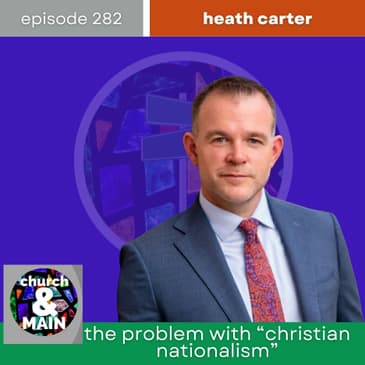

The term "Christian nationalism" is everywhere — but is it actually helping us understand our political moment, or making things worse? Princeton Theological Seminary professor Heath Carter joins host Dennis to make a provocative case: the term has become so broad and loosely applied that it's lost its usefulness, and may be deepening the very polarization it aims to diagnose.
Carter argues that while genuinely dangerous, illiberal movements exist — think theocrats actively working to undermine pluralistic democracy — the label too often gets applied to any Christian who voted for Trump. That kind of broad brush lets mainline Protestants off the hook for their own role in America's political story, while alienating the very voters the left needs to win back.
The conversation ranges from the forgotten history of progressive Christianity and the Social Gospel, to the Democratic Party's complicated relationship with faith, to why curiosity and genuine engagement may matter more than the right terminology. Carter also reflects on what politicians like James Talarico can teach us about speaking the language of faith without surrendering pluralism.
Shownotes:
Americans Should Stop Using the Term "Christian Nationalism" (Heath's article in The Atlantic
Related Episodes:
Is Christian Nationalism Really A Problem? with Ted Peters | Episode 181
Did Mainline Protestants Birth Christian Nationalism with Beau Underwood | Episode 186
Christian Nationalism or Christian Conservatism with Mark Tooley | Episode 195
Join the Church and Main Email List
Facebook | Instagram | Threads | Twitter | Website | YouTube
00:00:26 --> 00:00:31 Greetings, everyone, and welcome to Church and Main, a podcast for people interested
00:00:31 --> 00:00:34 in the intersection of faith, politics, and culture.
00:00:34 --> 00:00:37 I'm Dennis Sanders, your host.
00:00:38 --> 00:00:43 The talk of Christian nationalism is everywhere these days, and my guest today
00:00:43 --> 00:00:46 wonders if we might want to stop using the term.
00:00:47 --> 00:00:53 In March, Princeton professor Heath Carter penned a piece in The Atlantic with
00:00:53 --> 00:00:58 the provocative title, Americans Should Stop Using the Term Christian Nationalism.
00:00:58 --> 00:01:04 And while Christian nationalism is real, in this discussion,
00:01:04 --> 00:01:12 we talk really about the overuse of the term and how to have a discussion across political divides.
00:01:13 --> 00:01:20 Before we go into today's podcast a little bit about Heath, he is an associate
00:01:20 --> 00:01:24 professor at Princeton Theological Seminary, where he teaches and writes about
00:01:24 --> 00:01:26 the intersection of Christianity and public life.
00:01:27 --> 00:01:32 He is the author of Union Made, Working People and the Rise of Social Christianity
00:01:32 --> 00:01:34 in Chicago, which came out in 2015.
00:01:35 --> 00:01:41 It was a runner-up for the American Society of Church History's 2015 Brewer Prize.
00:01:42 --> 00:01:47 He's currently working on a new book, and the title of that book is on earth
00:01:47 --> 00:01:50 as it is in heaven, social Christians, and the fight to end inequality.
00:01:52 --> 00:01:55 And that retells the story of the American social gospel.
00:01:56 --> 00:02:02 And spoiler alert, we kind of do talk a little bit about the social gospel in
00:02:02 --> 00:02:09 this discussion, kind of its connection with the term Christian nationalism.
00:02:10 --> 00:02:16 So if you're curious to see where those connections are, keep listening.
00:02:17 --> 00:02:21 So without further ado, here is my conversation with Heath Carter.
00:02:41 --> 00:02:45 Well, he, thanks for joining me today. I wanted to start to know a little bit
00:02:45 --> 00:02:48 about you, including your faith background.
00:02:49 --> 00:02:53 Sure. I grew up in, it's great to be on, by the way. Thanks so much for having me.
00:02:54 --> 00:03:00 I grew up in the Midwest and then in California in evangelical churches,
00:03:00 --> 00:03:05 I think in the Midwest and in Kansas and kind of smaller Baptist-ish churches.
00:03:05 --> 00:03:11 And then we moved to Southern California and joined a church that was huge by
00:03:11 --> 00:03:15 our Kansas standards at the time, but that was small by its future standards,
00:03:15 --> 00:03:19 which was Rick Warren's Saddleback. That was 1990.
00:03:19 --> 00:03:25 So it was 2 people meeting at a high school at that point.
00:03:26 --> 00:03:32 I went to a Jesuit university and studied theology there, and that really had
00:03:32 --> 00:03:34 a profound impact on my faith.
00:03:34 --> 00:03:37 I grew up in the wilds of American evangelicalism, I like to say,
00:03:37 --> 00:03:43 it wasn't like the intellectual beating heart of like a Wheaton or a Calvin or anything like that.
00:03:43 --> 00:03:47 It was really like kind of the more fundamentalist, more moral majority,
00:03:47 --> 00:03:55 some would say these days, Christian nationalist sorts of evangelical worlds of the 80s and 90s.
00:03:55 --> 00:03:57 The Jesuits really opened up
00:03:57 --> 00:04:01 the kind of wider, deeper worlds of Christian faith and tradition to me.
00:04:02 --> 00:04:06 And I didn't become Catholic, but I've kind of been on a journey ever since.
00:04:07 --> 00:04:12 I worship now at a PCUSA church here in Princeton, where I work. Okay.
00:04:13 --> 00:04:18 Well, you kind of led me into that with the mention of Christian nationalism,
00:04:18 --> 00:04:24 and we wanted to talk a little bit about your article in The Atlantic, which was kind of.
00:04:25 --> 00:04:30 Basically kind of saying that maybe that term has been either a bit overused
00:04:30 --> 00:04:33 and that we should try to use it a little bit less.
00:04:33 --> 00:04:39 And I'm kind of curious just as a basic start, what led you to write that article? Yeah.
00:04:40 --> 00:04:44 Well, I think it's something that I've been thinking about for quite a while.
00:04:44 --> 00:04:49 Obviously, I'm an American religious historian, and this is the conversation
00:04:49 --> 00:04:55 in which my field has probably most broken out into kind of the public square
00:04:55 --> 00:05:01 in the last 10 years is around this term or this theme of Christian nationalism.
00:05:02 --> 00:05:07 I am, you know, as worried as anybody is about the fact that someone like a
00:05:07 --> 00:05:13 Doug Wilson, you know, is a kind of theocrat, you know.
00:05:15 --> 00:05:19 Throwback, reactionary, Calvinist, theocrat. I'm as concerned as anybody that
00:05:19 --> 00:05:23 he's got connections in the Pentagon. So it's not that I think we should be,
00:05:23 --> 00:05:28 of course, alarmed about the dangerous currents in our national life and in
00:05:28 --> 00:05:30 our Christian landscape today.
00:05:31 --> 00:05:34 The challenge, in my view, there's multiple challenges.
00:05:35 --> 00:05:40 I mean, one is, I think, as a historian, I don't know that the current conversation
00:05:40 --> 00:05:47 about Christian nationalism captures the really remarkably deep and multifaceted
00:05:47 --> 00:05:52 ways that Christianity and nationalism have been interwoven in U.S.
00:05:53 --> 00:05:54 History going all the way back
00:05:54 --> 00:05:57 to the founding, really, or at least the generation after the founding.
00:05:59 --> 00:06:04 So I have a whole set of analytical questions about to what extent the term
00:06:04 --> 00:06:06 holds analytical water.
00:06:06 --> 00:06:11 But I also wonder about the ways that the term, you know, sort of the political
00:06:11 --> 00:06:16 strategy, which I think is part of what the conversation is really concerned
00:06:16 --> 00:06:17 with is like kind of the politics of right now.
00:06:18 --> 00:06:22 And I'm not sure that the term is doing the work that people in the worlds that
00:06:22 --> 00:06:27 I live in and that are part of this conversation hope it will.
00:06:27 --> 00:06:30 So it's too, it's, you know, I can talk more about this, but those two different
00:06:30 --> 00:06:33 kinds of concerns that I have about the current conversation.
00:06:34 --> 00:06:38 What do you think is, because you just kind of said that you don't think the
00:06:38 --> 00:06:43 term is doing the work that people people who are using it wanting to do what
00:06:43 --> 00:06:46 is it that they want it to do yeah,
00:06:48 --> 00:06:50 well i think it depends on who you talk to and this is part of the problem with
00:06:50 --> 00:06:56 the term i think um i do think there there are some you know there's this is
00:06:56 --> 00:06:58 a term that has both a scholarly,
00:06:58 --> 00:07:02 there's a scholarly conversation around this term it's especially vibrant i
00:07:02 --> 00:07:03 think in the world of sociology.
00:07:05 --> 00:07:16 I think the folks there really do want to kind of zero in on what they think is a discernible,
00:07:16 --> 00:07:27 distinctive, alarming phenomenon of especially white Christians who are maybe
00:07:27 --> 00:07:32 opposed or at least not committed to a sort of pluralistic democracy.
00:07:32 --> 00:07:37 I think that's what they, you know, at some level are trying to pinpoint in
00:07:37 --> 00:07:41 the popular conversation. So this is, like I said, this is a term that has like
00:07:41 --> 00:07:42 broken out of the academy.
00:07:42 --> 00:07:46 A lot of times we have these academic conversations and nobody ever knows it
00:07:46 --> 00:07:49 because nobody reads the journals that we publish in or whatnot.
00:07:49 --> 00:07:50 But this conversation is broken out.
00:07:51 --> 00:07:54 And so, I mean, if you go on social media any given day and you search Christian
00:07:54 --> 00:07:57 nationalism, you'll see all kinds of non-academics using the term.
00:07:57 --> 00:08:04 And when you look there, I think the term there can mean almost anything.
00:08:04 --> 00:08:07 And I think if you ask 10 different people or 100 different people what the
00:08:07 --> 00:08:10 term means, you'd get a lot of different kinds of answers.
00:08:10 --> 00:08:13 I think for a lot of people, it just means like Christians who voted for Trump.
00:08:14 --> 00:08:21 And, you know, that's a complicated category that is a lot broader than, you know, for example,
00:08:21 --> 00:08:24 you know, Doug Wilson, who genuinely wants, you know,
00:08:24 --> 00:08:31 Christian values to be privileged to the extent that in his hope,
00:08:31 --> 00:08:34 I mean, I listened to an interview with him where he talked about how for him,
00:08:34 --> 00:08:38 basically, God is angry at the United States and will not stop being angry at
00:08:38 --> 00:08:43 this country until we have totally marginalized people of other faiths or people.
00:08:43 --> 00:08:47 People who are not living in accordance with what he deems to be Christian values.
00:08:47 --> 00:08:52 That's a very distinctive, and there are obviously other flavors and varieties
00:08:52 --> 00:09:01 of what you could call theocracy or dominionism or illiberal projects that do not affirm the
00:09:02 --> 00:09:05 uh, pluralistic democracy in any kind of way. And, and I, I think we should
00:09:05 --> 00:09:07 all be concerned about those.
00:09:07 --> 00:09:13 That is a, a smaller stream in, in U S history, I think, than the stream of
00:09:13 --> 00:09:18 like, again, there's this much wider stream in which, you know,
00:09:18 --> 00:09:22 Christianity and nationalism are interwoven in which lots of different kinds
00:09:22 --> 00:09:26 of people have tried to, to work towards something that they thought would be
00:09:26 --> 00:09:27 a more Christian America.
00:09:28 --> 00:09:31 Um, lots of people have been a part of that project.
00:09:31 --> 00:09:37 So for me, if the term was working well, it would mean the first thing.
00:09:37 --> 00:09:43 It would mean the people who are illiberal, who have rejected pluralism,
00:09:43 --> 00:09:49 pluralistic democracy, who are trying to fight for various forms of theocracy
00:09:49 --> 00:09:50 or dominionism or whatnot.
00:09:50 --> 00:09:54 That could be helpful if the term was just talking about those people.
00:09:54 --> 00:09:59 But I think in the popular conversation, it often means it's used synonymously with evangelical.
00:10:00 --> 00:10:03 It's used synonymously with any Christian who voted for Trump,
00:10:03 --> 00:10:06 even if maybe they voted for Biden four years before that.
00:10:06 --> 00:10:10 And maybe they aren't actually, you know, against pluralistic democracy,
00:10:10 --> 00:10:14 but for a variety of complicated reasons, um, pulled the lever for someone that
00:10:14 --> 00:10:17 I, I did not in this, in this most recent election.
00:10:17 --> 00:10:23 So I'm worried about a term that's sort of lost its specificity. And.
00:10:27 --> 00:10:32 That's a concern. That concern is especially about the kind of politics and strategy of the term.
00:10:34 --> 00:10:39 You know, a lot of times I get asked to go to different mainline churches,
00:10:39 --> 00:10:41 you know, ecumenical Protestant churches these days.
00:10:41 --> 00:10:48 I get asked all the time by people in those predominantly white mainline churches
00:10:48 --> 00:10:49 to come and talk to them about Christian nationalism.
00:10:51 --> 00:10:57 Again, so where is the piece coming from? Partly it's coming from my worry that
00:10:57 --> 00:11:01 those invitations reflect a desire for the folks in those churches who are dear folks,
00:11:02 --> 00:11:06 who want to do the right thing, for me to come and tell them about how all the
00:11:06 --> 00:11:08 bad people are out there.
00:11:08 --> 00:11:14 And by implication that in some sense, they're doing it right. Right.
00:11:14 --> 00:11:20 And I think the thing that I worry about, I mean, one thing we know is more
00:11:20 --> 00:11:23 than 50% of white mainliners voted for Donald Trump the last three elections.
00:11:24 --> 00:11:28 More than 50% of white Catholics voted for Donald Trump the last three elections.
00:11:28 --> 00:11:33 And I worry that this conversation, the way that it actually is playing out,
00:11:33 --> 00:11:41 allows folks who should feel on the hook for the current challenges and crises
00:11:41 --> 00:11:44 that we face to be off the hook in the conversation.
00:11:44 --> 00:11:50 That's like at a functional level, at least how I've interpreted some of those invitations.
00:11:51 --> 00:11:53 And so what I've tried to do, and what I tried to do in that piece,
00:11:53 --> 00:11:58 what I've tried to do in my own speaking, I speak at churches all the time,
00:11:58 --> 00:12:02 is not to deny that there are dangerous currents out there, so to speak,
00:12:02 --> 00:12:06 but also to say, this is also part of our story.
00:12:06 --> 00:12:10 We're part of the folks who have gotten us to this place.
00:12:11 --> 00:12:14 And as much as we, um, should be worried about folks out there,
00:12:14 --> 00:12:16 we also need to do introspection.
00:12:16 --> 00:12:21 We need to look in the mirror and, and look at the ways that these ecumenical
00:12:21 --> 00:12:28 Protestant mainline churches, um, have played a part in, in the story of how we get here. Um.
00:12:30 --> 00:12:33 So, yeah. Yeah. And I guess part of the, the, the, the, let me just say one
00:12:33 --> 00:12:38 more thing is just that part of the thrust of the piece is to say that,
00:12:38 --> 00:12:42 you know, in some sense, the world of like the, the white mainline,
00:12:42 --> 00:12:45 predominantly white mainline and never exclusively white, but,
00:12:46 --> 00:12:50 um, you know, it, it wielded tons of power in the middle of the 20th century.
00:12:51 --> 00:12:55 And by my measure, you know, it was not a perfect thing. I'm not nostalgic for it in any way.
00:12:57 --> 00:13:00 But, you know, from the president's cabinet to the Congress to,
00:13:00 --> 00:13:05 you know, state houses across the country, I'm writing a book about that world
00:13:05 --> 00:13:09 and the ways that it fought for a more equal United States of America.
00:13:12 --> 00:13:17 And it's curious to me, given the sort of shape of that project,
00:13:17 --> 00:13:22 which was an ambitious political project, that we don't talk about that world
00:13:22 --> 00:13:25 when we talk about kind of Christian America or Christian nationalism.
00:13:25 --> 00:13:30 Um, you know, given, given the ambitions, given the extent to which folks I
00:13:30 --> 00:13:33 think in that moment, and also today that are left of center,
00:13:33 --> 00:13:35 um, want to legislate their morality.
00:13:36 --> 00:13:40 Uh, you know, I think we can, we can be honest that, you know,
00:13:40 --> 00:13:44 and, and part of what I'm saying in the pieces, then let's not make it about that.
00:13:44 --> 00:13:48 I think a lot of Americans Christian and not want to legislate their most deeply
00:13:48 --> 00:13:54 held values. Um, let's look at the values and let's, let's argue about the values.
00:13:54 --> 00:13:59 Um, I think there's a lot of values in the kind of MAGA Christian world that
00:13:59 --> 00:14:03 I, for one find really deeply problematic and deeply unchristian.
00:14:03 --> 00:14:06 Um, and that's where the action can be at, I think.
00:14:07 --> 00:14:12 Yeah, I mean, you begin that article in The Atlantic with a story of a meeting
00:14:12 --> 00:14:16 with the Federal Council of Churches, which was kind of the predecessor to the
00:14:16 --> 00:14:18 National Council of Churches.
00:14:19 --> 00:14:23 You know, the kind of the body of a lot of mainline Protestantism.
00:14:24 --> 00:14:30 And, you know, what I think about also a lot is how much mainline Protestantism
00:14:30 --> 00:14:36 was involved in even things even before the Federal Council of Churches.
00:14:36 --> 00:14:37 I mean, you could look at abolition.
00:14:38 --> 00:14:43 That was also a place where there was a lot of, I would, you could say,
00:14:43 --> 00:14:47 a version of Christian nationalism in that.
00:14:48 --> 00:14:51 Why do you think that that history has been forgotten?
00:14:52 --> 00:14:58 And is that something that just people have just forgotten? Or is there a purposeful
00:14:58 --> 00:15:00 forgetting, I mean, in that? Yeah.
00:15:01 --> 00:15:04 Well, I think, yeah, there's been a lot of work done in the last,
00:15:04 --> 00:15:10 I mean, so we live in the shadow of a generation that's been deeply formed by the religious right.
00:15:10 --> 00:15:15 And there's no doubt about that. And a lot of the success of the religious right,
00:15:15 --> 00:15:19 which, you know, if you were, I talk about this all the time in my classes.
00:15:19 --> 00:15:25 I mean, if you were alive in 1973, the year that Roe is decided by the Supreme
00:15:25 --> 00:15:29 Court, in the wake of these kind of monumental civil rights breakthroughs in
00:15:29 --> 00:15:31 the 1960s. And if you're a conservative,
00:15:31 --> 00:15:33 you're kind of looking at the landscape, especially if you're.
00:15:35 --> 00:15:38 They didn't give up, however, right?
00:15:39 --> 00:15:44 They, at that point, began, you know, kind of the religious right is able to
00:15:44 --> 00:15:51 effectively kind of out-organize and deploy and build powerful partnerships,
00:15:51 --> 00:15:56 build a coalition with Catholics and evangelicals that had been unimaginable
00:15:56 --> 00:15:57 in earlier generations.
00:15:57 --> 00:16:00 Um and and they
00:16:00 --> 00:16:06 have so deeply shaped the kind of sense of what christianity like public faith
00:16:06 --> 00:16:10 means you know over the last generation that i do think people have just forgotten
00:16:10 --> 00:16:18 they've forgotten that in the generations before uh the religious right you had a really powerful um.
00:16:19 --> 00:16:25 Religious liberalism that that had you know kind of came in my view to its its
00:16:25 --> 00:16:29 most like kind of important moment in the mid-20th century when you get everything
00:16:29 --> 00:16:34 from the New Deal to the breakthroughs of kind of labor and civil rights movements and the Great Society.
00:16:34 --> 00:16:36 That is like the full flourishing.
00:16:37 --> 00:16:41 That sort of full flourishing built on earlier generations. You mentioned the
00:16:41 --> 00:16:43 19th century, kind of the traditions of abolition and whatnot.
00:16:43 --> 00:16:49 These grassroots movements that emerged in response to slavery and industrial capitalism.
00:16:50 --> 00:16:53 Faithful Christians on the ground who said, hey, I think the Bible has something
00:16:53 --> 00:16:56 to say about justice. And I'm, I'm a part of these movements.
00:16:56 --> 00:17:00 Um, and over the course of generations, they built the power to,
00:17:00 --> 00:17:04 again, by the mid 20th century, deeply impact the kind of, uh, shape of the nation.
00:17:06 --> 00:17:08 It's a great question as to why we don't remember it. I mean,
00:17:08 --> 00:17:12 I think it is partly, it speaks to the effectiveness of the religious right
00:17:12 --> 00:17:16 at making a claim that their Christianity,
00:17:16 --> 00:17:19 their view, their version of Christianity is the only version.
00:17:19 --> 00:17:24 And, you know, that's certainly just not right historically,
00:17:24 --> 00:17:29 but it can seem right these days, you know?
00:17:29 --> 00:17:31 And I think for a lot of people, it seems like that's what's on offer in the
00:17:31 --> 00:17:37 public square is this thing. And it's between that and a secular kind of option or something like that.
00:17:39 --> 00:17:47 And, you know, what is the danger in kind of the confusion of how we're looking
00:17:47 --> 00:17:49 at Christian nationalism sometimes these days,
00:17:49 --> 00:17:56 that it could be just someone who voted for Donald Trump and or thinking that
00:17:56 --> 00:17:58 Christian nationalism equals evangelical?
00:17:59 --> 00:18:04 Because it seems that is something that a lot of people, at least what I hear sometimes, are doing.
00:18:06 --> 00:18:08 Is there a danger in that simplification?
00:18:10 --> 00:18:17 For me, and this is my view, right, would be that this is a time where the liberal
00:18:17 --> 00:18:22 left coalition in this country needs to expand its ranks.
00:18:22 --> 00:18:26 And the thing that I worry about, I mean, frankly, with the way that this term,
00:18:27 --> 00:18:31 in some ways for me, like Christian nationalism, it's an interesting study in polarization, right?
00:18:31 --> 00:18:36 Because as I can tell, it seems like it's a term that people left of center
00:18:36 --> 00:18:41 lob at people right of center, who now increasingly take it up as a badge of
00:18:41 --> 00:18:44 honor, as people often do when they're insulted, they take up their insults
00:18:44 --> 00:18:46 as badges of honor, we see that happening.
00:18:48 --> 00:18:53 And, and then other people feel resentful about having this insult lobbed at them.
00:18:53 --> 00:18:56 It's not clear to me, I mean, part of what to say in the piece is that it's
00:18:56 --> 00:19:00 making, it's changing people's minds to be called a Christian nationalist.
00:19:01 --> 00:19:03 And in some ways, I think it just...
00:19:05 --> 00:19:09 You know, I worry that the stories that, you know, I mean, I,
00:19:09 --> 00:19:15 like I said, I grew up in these worlds and I feel like I, I don't have to go
00:19:15 --> 00:19:17 searching for, you know, quote unquote, Christian nationalists.
00:19:17 --> 00:19:20 I mean, I have them in my family, people who I think have all kinds of problematic
00:19:20 --> 00:19:23 views about kind of the intersection of Christianity and public life.
00:19:25 --> 00:19:28 But I also know like, you know, part of my own commitment as,
00:19:28 --> 00:19:32 as somebody who grew up in that space and who's come to a different place in
00:19:32 --> 00:19:33 my life is I try to do what I can.
00:19:34 --> 00:19:37 And I think not everybody needs to do this, but I can do it,
00:19:37 --> 00:19:41 is to stay in touch with those folks and make it harder for them to hold on to those convictions.
00:19:42 --> 00:19:47 And I know that that doesn't start with me calling them names.
00:19:47 --> 00:19:52 It starts with me taking them seriously. And this to me is,
00:19:52 --> 00:19:55 I mean, I guess drives to the heart of my own experience, which is as somebody
00:19:55 --> 00:19:58 who grew up in a world like this, who showed up at a Jesuit university,
00:19:58 --> 00:20:04 a young evangelical Republican, and got paired with a lifelong.
00:20:05 --> 00:20:10 Catholic who was the son of a Democratic congressman was my roommate and you
00:20:10 --> 00:20:16 know we had we argued about everything for all through college and the thing that you know,
00:20:16 --> 00:20:20 I didn't change my mind in like one moment of that conversation,
00:20:20 --> 00:20:25 but I did change my mind over the course of many conversations because he took me seriously.
00:20:26 --> 00:20:31 And I think that's part of what I think for the liberal left coalition,
00:20:31 --> 00:20:35 you know, there are some people that are so far down a rabbit hole that,
00:20:36 --> 00:20:37 you know, you're never going to get them out, right?
00:20:37 --> 00:20:43 But I don't think everybody that voted for Donald Trump in the 2024 election
00:20:43 --> 00:20:44 is so far down a rabbit hole.
00:20:44 --> 00:20:47 In fact, we know some of them are already swinging back in a way.
00:20:48 --> 00:20:54 And my thing is, I think the liberal left side of things needs to welcome those
00:20:54 --> 00:21:00 folks with open arms and build a tent that can take them back in and speak to
00:21:00 --> 00:21:07 them in a way that is curious about maybe why'd you do that thing in the past?
00:21:07 --> 00:21:10 But also is like, hey, let's build a better thing together over here.
00:21:10 --> 00:21:15 And for my purposes, as I look at the way the Christian nationalism conversation
00:21:15 --> 00:21:17 is playing out, I don't see that.
00:21:17 --> 00:21:25 I see it moving people to dig deeper in, and I feel like it nurtures resentment,
00:21:25 --> 00:21:28 and I don't think it kind of promotes the kind of change that we need.
00:21:30 --> 00:21:37 It seems in many ways as you even said it earlier that it's more of a tool for
00:21:37 --> 00:21:40 deeper polarization um than just kind of.
00:21:42 --> 00:21:46 Diagnosing a problem or diagnosing kind of part of our history. Yeah.
00:21:48 --> 00:21:51 To me, that is how it is mainly working. Again,
00:21:51 --> 00:21:56 if it was a really specific term that meant Doug Wilson and people like Doug
00:21:56 --> 00:22:04 Wilson who are actively seeking to overthrow pluralistic democracy, we need a term for that.
00:22:04 --> 00:22:07 And I think Matthew D. Taylor, who's a scholar who works on some of this stuff,
00:22:08 --> 00:22:13 he's written about hardline Christian extremism.
00:22:13 --> 00:22:18 And something like that has real promise in my view, because it's helpful in
00:22:18 --> 00:22:27 delineating a really specific stream of really dangerous faith that,
00:22:27 --> 00:22:31 hey, I don't think we need to be building bridges to that crap, to be honest.
00:22:31 --> 00:22:34 I think we need to be calling it out.
00:22:34 --> 00:22:39 And I think we need to be shining a light on where they have been able to forge
00:22:39 --> 00:22:45 connections to powerful places. I think that's what needs to happen there.
00:22:45 --> 00:22:49 But we got to be able to make distinctions between that crowd and,
00:22:49 --> 00:22:56 you know, run-of-the-mill folks who have been oscillating between the parties
00:22:56 --> 00:22:57 over the last generation.
00:22:58 --> 00:23:01 When, you know, frankly, there really are a lot of people in this country who
00:23:01 --> 00:23:03 have not been doing well under either party.
00:23:03 --> 00:23:07 And I think, you know, they're looking for a way forward.
00:23:07 --> 00:23:14 Trump is a, you know, in my view, not a responsible way to have transformation or change that we need.
00:23:16 --> 00:23:21 But people are frustrated and people's actual conditions on the ground are actually
00:23:21 --> 00:23:22 deteriorating for a lot of people.
00:23:23 --> 00:23:26 And we got to be able to make distinctions between the Doug Wilsons who are
00:23:26 --> 00:23:32 plotting the overthrow of liberal democracy and folks on the ground who are
00:23:32 --> 00:23:34 struggling in their life and who are looking for change.
00:23:34 --> 00:23:38 And I don't think this conversation is doing that effectively right now.
00:23:40 --> 00:23:45 I wonder if, and you may even talk, I think you briefly talk about this in the article,
00:23:47 --> 00:23:51 does part of this have to deal with also kind of the changes that are going
00:23:51 --> 00:24:00 on with, I would say, the Democrats or progressives and how they view religion?
00:24:00 --> 00:24:05 I think you talked about maybe a few – well, there are a few things, a few examples.
00:24:05 --> 00:24:11 One, you talk about some of the rhetoric from Barack Obama about 20 years ago
00:24:11 --> 00:24:15 that when he talks about religion, that just would seem somewhat out of place today.
00:24:15 --> 00:24:23 And I think the second thing that I personally noticed during the 2024 election
00:24:23 --> 00:24:29 is how the outreach was a little bit different.
00:24:29 --> 00:24:37 In the past, maybe even 20 years ago, there was a lot of trying to outreach,
00:24:37 --> 00:24:38 especially to evangelicals.
00:24:38 --> 00:24:44 And in the 2024 election with Kamala Harris.
00:24:45 --> 00:24:51 The person that was in charge of that was someone from a mainline background,
00:24:51 --> 00:24:57 and so there wasn't really as much of that outreach towards evangelicals.
00:24:57 --> 00:25:03 And I'm wondering if part of what we're seeing is also how the left maybe has
00:25:03 --> 00:25:07 started to move away from religion, or at least they're not as comfortable with
00:25:07 --> 00:25:08 religion as they used to be?
00:25:10 --> 00:25:14 I think this is a real struggle for the Dems over the last generation.
00:25:14 --> 00:25:18 I mean, I think Obama had the ability, obviously, that beautiful speech he gave
00:25:18 --> 00:25:24 in Charleston after that heinous murder by Dylann Roof.
00:25:25 --> 00:25:32 He had a facility with kind of the language of faith and whatnot that the Dems
00:25:32 --> 00:25:38 had really struggled to produce before that and have kind of struggled, I think, ever since.
00:25:39 --> 00:25:43 You know, I think, and I sort of referenced this in the piece,
00:25:43 --> 00:25:49 that the fact that the religious right has been so effective in casting itself
00:25:49 --> 00:25:53 as the real Christian witness in the public square,
00:25:54 --> 00:25:59 in some ways, I guess my worry is that the Dems have kind of let them have that
00:25:59 --> 00:26:02 lane and haven't tried to fight for that lane.
00:26:02 --> 00:26:09 And it's partly because I do think the Democratic coalition is religiously plural,
00:26:09 --> 00:26:13 and it obviously involves lots of folks who have no relationship to any kind
00:26:13 --> 00:26:15 of house of worship at all.
00:26:15 --> 00:26:19 And I think they don't want to alienate people, and they don't have the same
00:26:19 --> 00:26:23 sense of our base. But the reality is, and I think this is really critical, right?
00:26:23 --> 00:26:28 There are actually a lot of people in the Democratic coalition for whom faith is really central.
00:26:28 --> 00:26:34 Um, you think about, uh, all of the black Christians who, you know,
00:26:34 --> 00:26:40 are, are critical to the democratic base, the growing numbers of Latino Catholics
00:26:40 --> 00:26:43 and evangelicals and Pentecostals who have got to be a part of the future of
00:26:43 --> 00:26:44 the democratic coalition.
00:26:44 --> 00:26:50 You know, I think I understand maybe not deploying tons of resources to trying
00:26:50 --> 00:26:54 to convince white evangelicals to become Democrats because their level of support
00:26:54 --> 00:27:00 for the Republican party has really been quite resilient, even through these last 10 years. But.
00:27:00 --> 00:27:04 I think, you know, the reality is for the Dems, the future of the party,
00:27:04 --> 00:27:10 I mean, got to find a way to compete in states that we used to be able to compete in and now don't.
00:27:10 --> 00:27:17 And, you know, states that are prairie states and Northwest states where there
00:27:17 --> 00:27:23 are significant numbers of religious voters for whom they feel alienated from the party.
00:27:23 --> 00:27:29 And I think I do genuinely think there are ways to thread the needle here and
00:27:29 --> 00:27:30 to say, hey, for a lot of folks,
00:27:30 --> 00:27:35 they come to our politics through faith and to be able to talk about that in
00:27:35 --> 00:27:39 a way that's not a threat to pluralism or whatnot,
00:27:39 --> 00:27:44 but also that makes clear that the religious right kind of MAGA aligned Christians
00:27:44 --> 00:27:48 don't have the market cornered on faith in the public square.
00:27:49 --> 00:27:52 This has not been a strength of the party. I don't think they figured it out.
00:27:52 --> 00:27:58 We need probably standard bearers who have a kind of familiarity and fluency
00:27:58 --> 00:28:01 with the language of faith, not just at the presidential level,
00:28:01 --> 00:28:03 but kind of across the party.
00:28:03 --> 00:28:07 And again, I think urgently need to find candidates to run for,
00:28:08 --> 00:28:15 especially the Senate, in places, parts of the country where faith remains a force on the ground.
00:28:16 --> 00:28:20 Yeah, I mean, I think living as I do in the upper Midwest,
00:28:21 --> 00:28:26 I think one of the things that, and my husband grew up in North Dakota,
00:28:26 --> 00:28:32 and I think it wasn't that long ago that they had two Democratic senators,
00:28:32 --> 00:28:36 and now they don't. And I think that that's a problem.
00:28:37 --> 00:28:40 It's a huge problem. Yeah. And it's not just North Dakota, right?
00:28:40 --> 00:28:47 It's North Dakota, South Dakota. South Dakota, West Virginia, Montana, Ohio, Iowa.
00:28:47 --> 00:28:50 I mean, you can go down the line. There's so many states where even just 10
00:28:50 --> 00:28:55 or 15 years ago, the Dems had one or two senators and where we can't even run
00:28:55 --> 00:28:58 a competitive race in some of those places right now.
00:28:58 --> 00:29:02 And that is really deeply concerning, given the structure of our federal government,
00:29:02 --> 00:29:07 that there are just huge parts of the geography of the country where now, hopefully.
00:29:07 --> 00:29:11 I mean, And this this fall, I'm hopeful that, you know, we got a competitive
00:29:11 --> 00:29:14 race in Ohio and Alaska, North Carolina, Maine.
00:29:14 --> 00:29:17 Maybe we can pull back in some of these states, but it's got it can't just be
00:29:17 --> 00:29:20 a one off because they've blown it so bad this year.
00:29:21 --> 00:29:24 It's got to be an ongoing ability to compete in places where,
00:29:24 --> 00:29:27 you know, the Democratic Party's
00:29:27 --> 00:29:33 brand has not been able to kind of translate into into those places.
00:29:33 --> 00:29:37 And I think that's a tough assignment, but I also think it's a doable assignment
00:29:37 --> 00:29:38 and urgently needs to be taken up.
00:29:39 --> 00:29:43 And faith has got to be a part of it. I mean, I talked to some folks who were
00:29:43 --> 00:29:46 involved in a Prairie election a few years ago, and they just said,
00:29:46 --> 00:29:49 we're not going to try to talk about faith because we're not comfortable.
00:29:49 --> 00:29:56 And I was like, you guys are just giving up on voters you need and voters you
00:29:56 --> 00:29:57 actually have the ability to talk to.
00:29:57 --> 00:30:01 And Democrats in the past have been able to do this. And some of the party's
00:30:01 --> 00:30:05 most kind of significant breakthroughs in American history have been through
00:30:05 --> 00:30:09 candidates who were able to talk about faith and the ways that democratic politics
00:30:09 --> 00:30:11 connect with a faith tradition.
00:30:13 --> 00:30:17 That actually leads me to James Tallarico,
00:30:18 --> 00:30:25 because he seems to be one of the most visible people out there who is talking
00:30:25 --> 00:30:29 about his faith, who is also a Democrat.
00:30:30 --> 00:30:34 What are your thoughts about him? Yeah.
00:30:35 --> 00:30:39 I mean, I like Tallarico. I mentioned him in that piece that I think he's sometimes
00:30:39 --> 00:30:43 taken to criticizing Christian nationalists for building a political movement,
00:30:43 --> 00:30:45 which I don't think is the right vein of critique of them.
00:30:45 --> 00:30:50 I think we want him to build a political movement. So we're pro political movements.
00:30:51 --> 00:30:56 The critique is that the values that are at the core of that Christian nationalist,
00:30:56 --> 00:30:59 if you call it that, political movement are deeply problematic.
00:30:59 --> 00:31:02 I think Tallarico is a really interesting example.
00:31:03 --> 00:31:06 I mean, there's others like him. I mean, I think Buttigieg has done a decent
00:31:06 --> 00:31:09 job of talking in a faith forward way.
00:31:10 --> 00:31:15 But Tallarico has done it really well. Obviously, Texas is a place where faith really matters.
00:31:15 --> 00:31:25 And I think his ability to sort of effortlessly connect his own faith to a democratic
00:31:25 --> 00:31:28 political outlook is powerful.
00:31:29 --> 00:31:33 We'll see if it's enough. And obviously, it probably depends on how that Republican
00:31:33 --> 00:31:36 primary plays out and who he ends up having to go against. It's going to be a tough race.
00:31:36 --> 00:31:40 And I think the Dems have often, in recent years, put a lot of hope in Texas.
00:31:40 --> 00:31:43 And it's kind of disappointed over and over again.
00:31:43 --> 00:31:50 But Tallarico strikes me as doing something that is doable and that needs to be done more often.
00:31:50 --> 00:31:54 And it doesn't mean that every candidate needs to be like him,
00:31:54 --> 00:31:56 a Presbyterian seminarian or whatever.
00:31:56 --> 00:32:04 But we do need folks like him to have prominent roles in the party such that
00:32:04 --> 00:32:08 there can be a sense that, hey, there are folks right now who are able to connect
00:32:08 --> 00:32:11 their faith to a democratic political platform.
00:32:12 --> 00:32:16 And not all of us are going to do that. But this is a party where that's happening
00:32:16 --> 00:32:19 and where that can be done and where we welcome it and where...
00:32:20 --> 00:32:24 People of deep faith and people of no faith are coming together to fight for,
00:32:25 --> 00:32:29 in the best traditions of pluralistic, you know, democracy.
00:32:29 --> 00:32:33 And I think that's what the party needs. And it hasn't been able to put that
00:32:33 --> 00:32:36 faith forward thing quite out there
00:32:36 --> 00:32:40 as much as one wants. And Tallarico is someone who's doing that well.
00:32:41 --> 00:32:47 Yeah. I mean, I think it's an interesting, like, first effort.
00:32:47 --> 00:32:56 I don't know if he necessarily matches what the average Texas voter and Texas
00:32:56 --> 00:32:57 person of faith is all about,
00:32:57 --> 00:33:04 but it is at least a step forward, which I think in the last few years has not….
00:33:05 --> 00:33:09 The Democrats have not covered themselves in glory on that, and I think that
00:33:09 --> 00:33:12 that's been to their detriment.
00:33:13 --> 00:33:17 Yeah, I'm not persuaded that, like, Tallarico is going to have some breakthrough
00:33:17 --> 00:33:21 victory, look, but I think, you know,
00:33:21 --> 00:33:26 I think to your point earlier about people kind of forgetting that there could
00:33:26 --> 00:33:33 be a way as a person of deep faith to make a case for the kind of politics that Tallarico stands for.
00:33:34 --> 00:33:38 This is part of the remembering, right? And I think he's gained not only an
00:33:38 --> 00:33:43 audience in Texas, but also across the country of folks who are hungry for these
00:33:43 --> 00:33:46 kinds of arguments to be made and made prominently.
00:33:46 --> 00:33:53 And again, to put the sort of religious right back on its heels a little bit
00:33:53 --> 00:33:56 and have to make the case for what they do rather than being able to be the
00:33:56 --> 00:34:01 presumed voices of Christianity in the public square.
00:34:01 --> 00:34:07 And I think the more that folks like Tallarico are, and I think there are other
00:34:07 --> 00:34:10 Democrats who are capable of doing it, but it just hasn't been like our first,
00:34:11 --> 00:34:15 hasn't been at the fore in the ways that I think, you know, if you look at the
00:34:15 --> 00:34:17 Congress, you look at the Democratic delegations in Congress,
00:34:17 --> 00:34:18 if you look at Democratic leaders
00:34:18 --> 00:34:21 across the country, there are a lot of Democrats who are people of faith.
00:34:22 --> 00:34:28 Um but i do think at a at the party level there's maybe been a kind of uh let's kind of keep that,
00:34:29 --> 00:34:31 quiet because we don't want people to think that we're like
00:34:31 --> 00:34:34 them or something like that there's this kind of squeamishness and i
00:34:34 --> 00:34:39 think that's not serving us well um because like i said there are a lot of voters
00:34:39 --> 00:34:44 who um across the democratic coalition for whom faith is absolutely critical
00:34:44 --> 00:34:50 and we got to continue to connect with those people and um i think even if talarico
00:34:50 --> 00:34:52 doesn't win this race, and I hope he will,
00:34:52 --> 00:34:58 but if he doesn't win the race, he may still have done a great good in terms
00:34:58 --> 00:35:04 of reminding Democratic voters and Democratic kind of elite party folks,
00:35:04 --> 00:35:07 like this is an important thing for us to be able to do.
00:35:09 --> 00:35:18 So, how do you think people should be talking about Christian nationalism,
00:35:18 --> 00:35:20 let's say, moving forward?
00:35:20 --> 00:35:26 Yeah. As you have said, probably it's been really painting in some ways with
00:35:26 --> 00:35:29 too wide of a brush on people.
00:35:29 --> 00:35:38 But how do we talk about that to talk about it in a way that maybe includes
00:35:38 --> 00:35:43 a larger sense of who people are and maybe our nation's heritage,
00:35:43 --> 00:35:46 but at the same time also talk about,
00:35:47 --> 00:35:51 Maybe the more dangerous people that are out there like Doug Wilson.
00:35:51 --> 00:35:57 Yeah, I think there's a way to just be, I mean, you know, if you,
00:35:57 --> 00:36:00 if you, a, I mean, one way to go is for people to use the term Christian nationalist
00:36:00 --> 00:36:04 to mean Doug Wilson and him, right.
00:36:04 --> 00:36:12 And to stop using it in this kind of blurry, vague, just those people over there
00:36:12 --> 00:36:16 that I don't like kind of way, which I think is the usage that gives me the
00:36:16 --> 00:36:18 most concern at some level.
00:36:19 --> 00:36:24 I think there are other terms that if it could catch on, something like hardline
00:36:24 --> 00:36:27 Christian extremists, it's not as catchy, maybe.
00:36:27 --> 00:36:30 It doesn't have the same, but it's clearer in my view.
00:36:30 --> 00:36:33 Yeah, I think it sounds a lot clearer. It's a lot clearer, right,
00:36:33 --> 00:36:35 about what it is that we're worried about.
00:36:35 --> 00:36:40 And I think something like that could be really positive.
00:36:41 --> 00:36:47 I mean, I think, again, for me, there's a way to say, hey, there are dangerous,
00:36:48 --> 00:36:54 illiberal currents in the current religious and political landscape that need to be identified.
00:36:54 --> 00:36:56 Light needs to be shown on them, no question.
00:36:56 --> 00:37:00 And then we've got to find a way to kind of continue to make the case.
00:37:00 --> 00:37:03 I mean, there was a great book a few years ago by a guy, I interviewed him,
00:37:04 --> 00:37:06 Anand Girid Haradas, called The Persuaders.
00:37:07 --> 00:37:09 And the whole point of the book, it was a book, he's a guy on the left.
00:37:10 --> 00:37:12 It was written to the left. And the argument of the book was,
00:37:12 --> 00:37:17 friends on the left, we have to be, we have to redouble our commitment to persuasion,
00:37:17 --> 00:37:21 to making the case for our values. We don't have enough votes. We don't have enough.
00:37:21 --> 00:37:25 We need to kind of continue to build capacity behind the movements.
00:37:25 --> 00:37:30 If we want to change the world, the way you got to do that in a society like
00:37:30 --> 00:37:32 ours is you got to continue to make the case.
00:37:33 --> 00:37:38 And he's the one, he says, there are people on both ends of the political spectrum
00:37:38 --> 00:37:39 who are never going to change their minds.
00:37:39 --> 00:37:43 But you'd be surprised about how many people will change their minds.
00:37:43 --> 00:37:45 And especially if you treat folks with...
00:37:46 --> 00:37:50 Dignity, generosity, curiosity. I mean, this is what I think, you know,
00:37:50 --> 00:37:55 it's been interesting to watch someone like Zoran Mamdani in New York who swept
00:37:55 --> 00:37:59 to victory in part by going to all these boroughs and neighborhoods where there
00:37:59 --> 00:38:02 were a lot of Trump voters and he didn't sneer at them.
00:38:02 --> 00:38:05 And he didn't, he went up and talked to him and was like, why'd you vote for that guy?
00:38:06 --> 00:38:09 And, and then was like, let me tell you about what I'm about and,
00:38:09 --> 00:38:14 and, and why I think I've got actually a more beautiful way forward for this city.
00:38:15 --> 00:38:18 That's the work, you know, in my view, I mean, it's, you know,
00:38:18 --> 00:38:21 it's, it's, it's not the only thing we need to be doing, but it's,
00:38:21 --> 00:38:24 it's part of the future is because this is the other thing, right?
00:38:24 --> 00:38:25 I think there are real dangers.
00:38:26 --> 00:38:29 And also, I mean, we're coming up on the 250th anniversary of this country.
00:38:31 --> 00:38:36 And this is, we're, we're, we're participating in a long-term project.
00:38:36 --> 00:38:40 This is a generational project, a democratic society that, you know,
00:38:40 --> 00:38:44 I mean, there was pew data a couple months ago that came out,
00:38:44 --> 00:38:49 if you saw this study that said, you know, they asked people to what extent
00:38:49 --> 00:38:52 they thought their neighbors were morally good or morally bad.
00:38:53 --> 00:38:58 And, you know, in Canada, 7% of Canadians think their neighbors are morally bad.
00:38:59 --> 00:39:03 In the UK, 17% of folks there think their neighbors are morally bad.
00:39:04 --> 00:39:07 In the US, 53% of people think their neighbors are morally bad.
00:39:08 --> 00:39:12 That isn't really encouraging for the future of American democracy.
00:39:12 --> 00:39:19 And for those of us who are invested, you know, for all the many deep flaws,
00:39:19 --> 00:39:23 and we about those for hours, right, of this society past, present,
00:39:23 --> 00:39:26 you know, and even looking ahead,
00:39:27 --> 00:39:31 if you want pluralistic democracy to continue to flourish, like,
00:39:31 --> 00:39:36 we got to find a way to sustain a society with people that we have deep disagreements with.
00:39:37 --> 00:39:40 And we're not doing awesome with that right now.
00:39:40 --> 00:39:46 And I think labels like this that drive up,
00:39:46 --> 00:39:52 I think, a sense of the kind of othering of a huge group of people in,
00:39:52 --> 00:39:55 in, I mean, you know, even by the, the sort of scholarly, you know,
00:39:55 --> 00:39:59 a lot of, a lot of the scholar stuff, they'll say it's 30,
00:39:59 --> 00:40:03 40% that, that kind of score high on Christian nationalism.
00:40:04 --> 00:40:06 Black Christians score really high on Christian nationalism in those studies,
00:40:07 --> 00:40:09 Latino Christians score high on Christian nationalism in those studies.
00:40:10 --> 00:40:14 We're painting with such a broad brush, in my view, that it's really hard to
00:40:14 --> 00:40:18 figure out, like, how are we going to address the fact that 53% of us think
00:40:18 --> 00:40:19 our neighbors are morally bad?
00:40:20 --> 00:40:24 It's not going to come through lobbying terms at them. It's going to come through
00:40:24 --> 00:40:26 engagement, through taking people seriously.
00:40:27 --> 00:40:30 Part of what that doesn't mean for me is like pretending like we don't disagree.
00:40:30 --> 00:40:34 There's a way to have important conversations with people where you treat people
00:40:34 --> 00:40:38 with respect and you take them seriously and you say, you know what?
00:40:39 --> 00:40:42 I love you. I care about you. And I think you're dead wrong about this.
00:40:42 --> 00:40:44 And I'm going to tell you that because I love you. You know what I mean?
00:40:44 --> 00:40:46 And that is possible to do.
00:40:47 --> 00:40:53 We shouldn't give up on that as an important vein of engagement that I worry
00:40:53 --> 00:40:57 sometimes people left of center are giving up on that vein of engagement and
00:40:57 --> 00:41:01 see any kind of engagement with folks who voted for Trump in 2024 as like,
00:41:01 --> 00:41:04 that's just a kind of accommodation or kind of compromise.
00:41:04 --> 00:41:08 And for me, it's like, no, like, let's tell the truth, but let's do it in a
00:41:08 --> 00:41:13 way that just treats people with basic respect and tells the truth and makes
00:41:13 --> 00:41:17 the case for why we think we've got a better road forward, you know?
00:41:17 --> 00:41:19 And I still believe in that.
00:41:20 --> 00:41:25 So, yeah, I mean, I think there is a.
00:41:27 --> 00:41:32 Part of it is also going back to that Pew study, and I talked to someone recently about that.
00:41:33 --> 00:41:42 And I think it's seeing that other person, and we don't really know who they are.
00:41:42 --> 00:41:48 And you talked a little bit about Zoran Mandami, and I think he's kind of a
00:41:48 --> 00:41:50 person that I don't always agree with politically.
00:41:50 --> 00:41:57 But he has that thing that, to use the word from Tim Keller, is winsome.
00:41:59 --> 00:42:03 And so he's able to just reach out to people. I think that's why he was popular
00:42:03 --> 00:42:09 and that's why he's now the mayor, is that there is a certain amount of curiosity
00:42:09 --> 00:42:14 that he had and wanted to reach out to people.
00:42:14 --> 00:42:19 And I think we have to be willing to be curious to people, and especially to
00:42:19 --> 00:42:20 people that we don't agree with.
00:42:21 --> 00:42:26 Why do you believe what you believe? Why did you, what led you to vote the way you do?
00:42:26 --> 00:42:32 Not in an accusatory way, but just to find out more where are you coming from?
00:42:34 --> 00:42:37 Yeah. And I mean, whatever you think about Mondani's politics, like that's what he did.
00:42:37 --> 00:42:41 So I mean, he's, you know, I remember he was out at the polls on the primary
00:42:41 --> 00:42:45 election day, like given Cuomo folks hugs.
00:42:45 --> 00:42:48 And it's like, because for him, it's, it's like,
00:42:48 --> 00:42:55 there's a way to be a human being, even in politics, where you convey a regard
00:42:55 --> 00:43:01 for people that doesn't stop when they vote one, the way they vote one year.
00:43:01 --> 00:43:05 And that imagines, you know, and, and this is, again, this is my own story.
00:43:05 --> 00:43:08 This is so many people's stories, you know, people are on a journey.
00:43:08 --> 00:43:12 And if you think that they're static, you're wrong.
00:43:13 --> 00:43:19 And, and you, the way you engage somebody else who's on a journey is going to impact that journey.
00:43:20 --> 00:43:25 And, you know, the, the, it's, it's tough these days in our social media landscape and all whatnot to,
00:43:25 --> 00:43:28 to really get deep into somebody and, and, and,
00:43:29 --> 00:43:31 and for someone to change their mind i think it's tough but when it happens
00:43:31 --> 00:43:35 it's because someone took them seriously someone that they loved and cared about
00:43:35 --> 00:43:39 saw the things differently and and love them enough to like hang in relationship
00:43:39 --> 00:43:45 with them that's that's powerful there's real power in that and um.
00:43:47 --> 00:43:52 I think again on the left of center side of the aisle like we need to cultivate
00:43:52 --> 00:43:57 the ability to hang in with people even when we think they're wrong recognizing
00:43:57 --> 00:44:00 hey you know what But we're going to be wrong on some things too.
00:44:01 --> 00:44:06 God's not done with me yet. And yeah, got to hold out hope for transformation.
00:44:09 --> 00:44:14 Well, if people want to know a little bit more about you or maybe contact you, how can you do that?
00:44:16 --> 00:44:20 I've got a website, heathwcarter.com, that's got links to a lot of my work and
00:44:20 --> 00:44:25 my email's on there and whatnot. I do a lot of speaking and happy to hear from
00:44:25 --> 00:44:27 folks and happy to continue this conversation.
00:44:29 --> 00:44:33 All right. Well, thank you so much for this conversation. This was, I think, enlightening.
00:44:34 --> 00:44:38 And I do think also hopeful because I think sometimes this whole discussion
00:44:38 --> 00:44:43 on Christian nationalism can be kind of depressing and frustrating.
00:44:44 --> 00:44:48 And I think this is maybe a way out of that bind that we've been in.
00:44:49 --> 00:44:53 Well, thanks for the great questions. Great, great. Really enjoyed talking with you. All right.
00:45:22 --> 00:45:27 So, I know that you probably have thoughts about this, and I'd love to hear them.
00:45:27 --> 00:45:36 If you want, you can share an email to me, send an email to me at churchinmain at substack.com.
00:45:36 --> 00:45:40 I will include a link to Heath's article.
00:45:40 --> 00:45:43 I think it's a really good one. You will want to read it,
00:45:44 --> 00:45:51 kind of for a little bit more talk about the role of Christian nationalism,
00:45:51 --> 00:45:54 And really, kind of an expanded role, because I think, as you could tell in
00:45:54 --> 00:45:58 the discussion and in the article, it continues that, is that…,
00:45:59 --> 00:46:04 What we think of Christian nationalism is actually an expansive view of it.
00:46:04 --> 00:46:06 So, I'd love to hear your views.
00:46:07 --> 00:46:10 Now, if you want to know more about this podcast, if you want to listen to past
00:46:10 --> 00:46:16 episodes or donate, you can go to churchinmain.org.
00:46:17 --> 00:46:22 You can also go to churchinmain.substack.com to read related articles.
00:46:22 --> 00:46:27 I also do post some of these episodes on Substack.
00:46:28 --> 00:46:29 So just be on the lookout for them.
00:46:30 --> 00:46:35 And there you can also subscribe if you'd like.
00:46:36 --> 00:46:41 That is for five bucks a month, $60 a year.
00:46:41 --> 00:46:48 You don't have to, but if you are able to, I would be incredibly thankful for that.
00:46:48 --> 00:46:54 There's also a link in the show notes if you want to make sure to get this podcast in your inbox.
00:46:55 --> 00:47:00 Just click on that link and we'll have that done.
00:47:01 --> 00:47:05 I also hope that you will consider rating or reviewing this podcast.
00:47:05 --> 00:47:08 When you do that, that actually helps others find the podcast.
00:47:09 --> 00:47:16 And if you can, also consider passing this podcast along to a friend who might
00:47:16 --> 00:47:17 want to know more about it.
00:47:18 --> 00:47:24 You can also check us out. We do have a page on Facebook, so check that out.
00:47:24 --> 00:47:27 It should be under Church in Maine Podcast.
00:47:28 --> 00:47:32 So, that is it for this episode of Church in Maine. As I always like to say,
00:47:32 --> 00:47:33 thank you so much for listening.
00:47:33 --> 00:47:38 It really does mean a lot that you guys listen, and God speed,
00:47:38 --> 00:47:41 everyone, and I will see you very soon.