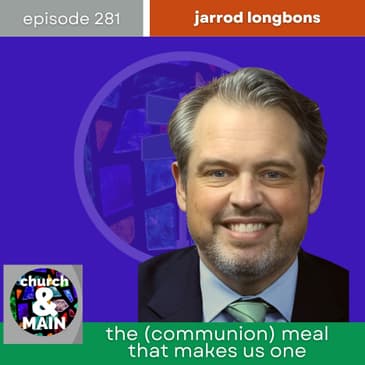
What if communion was more than a ritual squeezed between the offering and the sermon? I sat down with the Reverend Dr. Jarrod Longbons, pastor of Peachtree Christian Church in Atlanta, to explore what it means for the church to be a Eucharistic community. Jarrod makes the case that the Lord's Supper isn't just a worship practice — it's a social imagination that can reshape everything from how we care for the unhoused to how we sit with people we profoundly disagree with.
Jarrod and I look into why the old model of church as a voluntary association is breaking down, what a eucharist-oriented church could look like, and how gathering around a shared table can bind people together in a world that keeps pulling them apart.
Shownotes:
When Institutions Fade: The Church As A Eucharistic Movement (from Jarrod's Podcast, Complex Creatures)
Related Episodes:
Resurrection Hope Amidst the Broken Politics of 2025 with Drew McIntyre
Join the Church and Main Email List
00:00:26 --> 00:00:32 Hello! This is Church and Main, a podcast for people interested in the intersection
00:00:32 --> 00:00:36 of faith, politics, and culture. I'm Dennis Sanders, your host.
00:00:37 --> 00:00:42 I know that in some churches, it might be once a month. In some churches,
00:00:42 --> 00:00:43 it might be even once a quarter.
00:00:45 --> 00:00:48 In some churches, especially in my tradition, it's every Sunday.
00:00:49 --> 00:00:54 What I'm talking about, of course, is communion. And wherever you gather,
00:00:54 --> 00:00:56 however many times you gather,
00:00:57 --> 00:01:02 people come during a worship service, and they take the bread and the wine,
00:01:02 --> 00:01:09 or in some churches, grape juice, and we all are part of this event.
00:01:11 --> 00:01:14 Now, we do this thinking that it's part of the worship service,
00:01:14 --> 00:01:17 and it is. It's part of the worship service we do.
00:01:17 --> 00:01:25 Wherever it's located, it's kind of in there, somewhere between the offering and the sermon.
00:01:26 --> 00:01:32 But what if communion is not simply just a part of the worship service,
00:01:32 --> 00:01:35 but is actually something that
00:01:35 --> 00:01:40 can form communities, shaping the missions that churches take part in?
00:01:40 --> 00:01:46 What if the communion or the Eucharist means that new worshiping communities
00:01:46 --> 00:01:50 can sprout in the most unusual places like bars?
00:01:51 --> 00:01:55 Back in December, my colleague and fellow podcast host, Lauren Richmond,
00:01:55 --> 00:01:57 Jr. shared a podcast with me.
00:01:58 --> 00:02:03 And the podcast had an interesting and compelling speaker.
00:02:03 --> 00:02:08 The speaker's name is Jared Laubons. He is the pastor of Peachtree Christian
00:02:08 --> 00:02:12 Church in Atlanta, and he has his own podcast called Complex Creations.
00:02:13 --> 00:02:18 And the episode that Lauren shared with me was called The Church as a Eucharistic Movement.
00:02:19 --> 00:02:25 Now, this was an address that was recorded that Jared gave at a conference.
00:02:25 --> 00:02:30 And as I said, it was compelling. The whole point was that churches in America
00:02:30 --> 00:02:32 have been developed a certain way.
00:02:32 --> 00:02:38 And that way that especially mainline churches were developed was in the voluntary association.
00:02:39 --> 00:02:45 And that has kind of been the model probably since the beginning of our country.
00:02:45 --> 00:02:52 But maybe in the last 50 years or so, that way of organizing churches is breaking down.
00:02:53 --> 00:03:01 And so, what's the alternative? Well, the answer is probably in the title of
00:03:01 --> 00:03:05 that podcast episode, The Church as a Eucharistic Movement.
00:03:07 --> 00:03:13 So, if a church can form as a Eucharistic community, what does that look like?
00:03:13 --> 00:03:19 And why is communion so important to basically everything?
00:03:21 --> 00:03:25 A little bit about our guest today. Jared Lombons is my guest.
00:03:25 --> 00:03:28 He is the sixth minister of Peachtree Christian Church.
00:03:29 --> 00:03:30 As I said, he's in Atlanta, Georgia.
00:03:31 --> 00:03:35 He and his wife, Colleen, are natives of central Illinois.
00:03:35 --> 00:03:40 Jared has an undergraduate degree in theology and homiletics from Lincoln Christian
00:03:40 --> 00:03:45 University and a master's degree in contemporary theology, focusing on theology,
00:03:46 --> 00:03:47 philosophy, and ecology.
00:03:48 --> 00:03:52 He has earned his PhD in theology from the University of Nottingham,
00:03:53 --> 00:03:58 and his research focuses on the doctrine of creation, ecology,
00:03:58 --> 00:04:01 and the church as a community of creation.
00:04:01 --> 00:04:05 And I want to add this because I think it's rather sweet and also important.
00:04:05 --> 00:04:11 He describes his wife Colleen as his partner in redemption who enchants the world.
00:04:12 --> 00:04:15 They have two daughters and a son.
00:04:15 --> 00:04:21 With all of that, let us get into this important discussion on the Eucharist
00:04:21 --> 00:04:25 in today's world with the Reverend Dr. Jared Longbonds.
00:04:45 --> 00:04:49 Jared, thanks for taking the time to chat with me this afternoon.
00:04:50 --> 00:04:53 I wanted to start off to know a little bit about you, your background,
00:04:54 --> 00:04:56 and also especially your faith background.
00:04:58 --> 00:05:01 Well, it's good to be here with you, Dennis. My name is Jared Longbonds.
00:05:01 --> 00:05:05 For those of you who don't know me, I'm a pastor in midtown Atlanta,
00:05:05 --> 00:05:08 Georgia, at a place called Peachtree Christian Church.
00:05:08 --> 00:05:13 And I came here 13 years ago from central Illinois, and that's really my homeland.
00:05:13 --> 00:05:15 And I'm a Midwestern guy through and through.
00:05:15 --> 00:05:21 I always tell people that I was raised sort of part Catholic and part another
00:05:21 --> 00:05:25 tradition, one of these many sort of revivalist traditions.
00:05:27 --> 00:05:31 And when I received the call to ministry, quite frankly, if they let Catholic
00:05:31 --> 00:05:34 priests get married, I've probably been a Catholic priest because I was in love
00:05:34 --> 00:05:38 with the beauty, the aesthetics, but also sacramentality.
00:05:39 --> 00:05:45 However, I was actually more shaped in the other church, the one of my mom's background.
00:05:46 --> 00:05:50 And ultimately, at the end of the day of my education and study,
00:05:50 --> 00:05:54 I found myself firmly within the tradition I'm a part of, the Stone Campbell movement,
00:05:54 --> 00:06:01 the Restoration movement, which I have now served all three of its main branches.
00:06:01 --> 00:06:05 I've been a part of the independent, more evangelical stream.
00:06:05 --> 00:06:09 I've been part of the Church of Christ stream, and I've been part of the Disciples
00:06:09 --> 00:06:11 of Christ, the mainline stream of it all.
00:06:12 --> 00:06:17 But it is near and dear to my heart to be part of that church and to be what
00:06:17 --> 00:06:21 I consider myself as a sort of a free church Catholic. So I still have that
00:06:21 --> 00:06:22 sacramental worldview.
00:06:23 --> 00:06:28 However, I'm in a free church setting, and I think there's a lot of gifts that this setting has.
00:06:29 --> 00:06:33 And then academically, I have a PhD in theology from the University of Nottingham, and I thought,
00:06:34 --> 00:06:39 Maybe I might be a professor of theology. Dennis, I always thought of myself
00:06:39 --> 00:06:42 as a pastor, theologian, or a scholar, priest.
00:06:42 --> 00:06:46 I thought that I would have one foot in the academy and one foot in the church.
00:06:47 --> 00:06:51 A lot of my heroes were that way, whether it's people today like N.T.
00:06:51 --> 00:06:57 Wright or Father John Baer, or it's Bonhoeffer, or it's going way back to Augustine,
00:06:58 --> 00:07:02 folks who had a real love for the church, but also a real love for the academic
00:07:02 --> 00:07:04 or the higher level teachings of theology.
00:07:05 --> 00:07:08 I thought maybe I would be serving a church in a different way,
00:07:08 --> 00:07:12 more as like a volunteer, but it turns out that my full-time office is in a church.
00:07:13 --> 00:07:16 And on the other side, sometimes I've had an opportunity to teach,
00:07:16 --> 00:07:21 sometimes I get to write, but I still consider myself a pastor theologian.
00:07:21 --> 00:07:25 So I'm not sure if that, I should probably say I have a wife and three beautiful
00:07:25 --> 00:07:28 children and a lot going on that way too.
00:07:29 --> 00:07:34 So, yeah. I'm kind of curious, since I'm also a Disciples of Christ pastor,
00:07:35 --> 00:07:43 what have you found kind of similar and different in the different streams in
00:07:43 --> 00:07:45 Church of Christ and the independent churches?
00:07:45 --> 00:07:53 Yeah, the autonomous nature of congregations is really a very similar theme.
00:07:53 --> 00:07:58 I think that the idea and appeal to Christian unity is a big theme.
00:07:58 --> 00:08:02 The centrality of the Lord's Supper is a consistent theme.
00:08:03 --> 00:08:07 The importance of baptism by immersion, it's more pronounced than the other
00:08:07 --> 00:08:12 two streams, but it's still what we do in the disciples' world.
00:08:13 --> 00:08:17 I do get the sense that the independence in the Church of Christ...
00:08:18 --> 00:08:23 Back when there was the early kind of internal divisions in our family struggle,
00:08:23 --> 00:08:26 they leaned more towards restoring the image of the New Testament,
00:08:26 --> 00:08:33 whereas the disciples part really leaned into the unity aspects or the ecumenical
00:08:33 --> 00:08:36 aspects of our tradition, which those are the two big pillars I tell people
00:08:36 --> 00:08:37 about. Those are two driving impulses.
00:08:40 --> 00:08:44 And then I think that they're all uniquely American. So they're all in each
00:08:44 --> 00:08:48 way incredibly at home within the American spirit.
00:08:48 --> 00:08:54 The American ideal, and that carries a lot of gifts and a lot of challenges. Okay.
00:08:55 --> 00:09:00 This kind of leads into the question and the reason that I'm interviewing you.
00:09:00 --> 00:09:04 And it was a colleague who you've already done an interview with,
00:09:04 --> 00:09:12 Lauren Richmond Jr., shared a podcast episode on your podcast.
00:09:14 --> 00:09:21 And it was a kind of a, well, not an essay, but a talk, a lecture on the church
00:09:21 --> 00:09:23 as a Eucharistic community.
00:09:23 --> 00:09:30 And I've always been fascinated that, one, that you use the word Eucharist instead
00:09:30 --> 00:09:34 of communion or the Lord's Supper, and I think there's a, I'm curious to find out,
00:09:35 --> 00:09:41 why the word choice, but I was fascinated of how you kind of went through this
00:09:41 --> 00:09:44 whole story of the church as
00:09:44 --> 00:09:49 voluntary association, and I think you're borrowing a lot from Ted Smith,
00:09:50 --> 00:09:56 who also was a past guest and is a professor at Candler Seminary.
00:09:57 --> 00:10:04 But how that is not—that very much has been shaped mainline churches—well,
00:10:05 --> 00:10:09 that's not working anymore. And then you kind of move towards this,
00:10:09 --> 00:10:12 how the church, it could be a Eucharistic community.
00:10:14 --> 00:10:18 So ultimately, I would love for you to explain what that is and what does that
00:10:18 --> 00:10:22 look like, but maybe to first explain why you choose the word Eucharist.
00:10:23 --> 00:10:28 Yeah, see, the talk I gave, it was at a convention called the ICOM,
00:10:28 --> 00:10:32 International Conference on Mission, and it's really largely motivated by the
00:10:32 --> 00:10:35 independent part of our Stone Campbell tradition.
00:10:36 --> 00:10:42 And so there's a lot of missionaries, church planners, and thought leaders from that realm.
00:10:43 --> 00:10:48 And I really think it's an interesting thing when we start looking at the question
00:10:48 --> 00:10:53 of why is church membership and church attendance in decline in the contemporary world?
00:10:54 --> 00:10:57 I came at this question academically for, I mean, coming at it for the last
00:10:57 --> 00:11:03 like 20 years, thinking about the philosophy of secularity and the secular vibes
00:11:03 --> 00:11:06 that exist in our culture, what that feels like, what that experience,
00:11:07 --> 00:11:09 what the experience of secularity is like.
00:11:09 --> 00:11:13 Ted Smith, a theologian, wrote the book The End of Theological Education.
00:11:14 --> 00:11:18 Added to my story of that, added to my understanding.
00:11:18 --> 00:11:23 So we would take folks like Charles Taylor, Andy Root, who makes Taylor more
00:11:23 --> 00:11:27 applicable to the church, and then add to that what Ted's working on.
00:11:27 --> 00:11:33 And he's using a lot of sociological theory to talk about not so much secularity
00:11:33 --> 00:11:39 as a philosophical tendency, but the world of church decline as a sociological phenomenon.
00:11:39 --> 00:11:45 And what he argues in that book, I think quite helpfully and beautifully done,
00:11:46 --> 00:11:53 is that what's in decline in America is not religiosity, it's not spirituality, it's not belief,
00:11:53 --> 00:11:56 it's not commitment to communities,
00:11:56 --> 00:12:01 formation, but rather it's institutional association,
00:12:02 --> 00:12:08 a voluntary association society, which sociologists explain is an invention of America.
00:12:08 --> 00:12:15 It's a social way of imagining the social world that came on the scene when America was born.
00:12:16 --> 00:12:21 In an older world, in an older time, how would people be collected in groups?
00:12:21 --> 00:12:24 Well, through the crown or through the cross, right? It's through these power structures.
00:12:25 --> 00:12:28 You didn't church shop. You didn't choose a congregation or a parish to go to.
00:12:29 --> 00:12:33 You belong to a parish. The bell tower, the steeple was in a community.
00:12:33 --> 00:12:36 And if you were in its shadow, if you could hear its bells, that's where you went.
00:12:36 --> 00:12:39 That's who you were. you belong to that parish.
00:12:39 --> 00:12:42 But in America, we decided, hey, we're going to find ways to.
00:12:43 --> 00:12:49 You know, associate based on shared and common values, voluntary association.
00:12:49 --> 00:12:53 And when that happened, Ted Smith shows this beautifully in his book,
00:12:53 --> 00:12:58 that was a crisis for the church because the church was operating in an older imaginary.
00:12:59 --> 00:13:05 But the church wrote it powerfully through the mid-20th century into a mainline
00:13:05 --> 00:13:08 situation where at some point, you know, a lot of Americans,
00:13:09 --> 00:13:11 especially if you were of a certain sociological bracket.
00:13:12 --> 00:13:17 You belong to the Kiwanis Club, you belong to Rotary, maybe you belong to that
00:13:17 --> 00:13:20 country club, and you were a Methodist because that's who you were.
00:13:20 --> 00:13:24 And if your Methodist church shut its doors, you went to another Methodist church
00:13:24 --> 00:13:26 just as a matter of course.
00:13:27 --> 00:13:33 And what Ted's arguing and what other people argue, and I think that you can
00:13:33 --> 00:13:36 argue it from that book of Bowling Alone that came out in 2000,
00:13:36 --> 00:13:40 is that we don't associate that way any longer.
00:13:40 --> 00:13:45 Since the 60s, that has been unraveling, and it's that image of church that
00:13:45 --> 00:13:53 has been unraveling, that very institutional, very voluntary way of associating.
00:13:54 --> 00:14:00 And what things have pulled at that, sure, secularity has affected it,
00:14:00 --> 00:14:02 and Charles Taylor argues that
00:14:02 --> 00:14:07 secularity itself is mostly the proliferation of options, not so much a,
00:14:08 --> 00:14:11 a world of complete and utter disbelief in the supernatural.
00:14:11 --> 00:14:16 But now we have a lot of options for what's most important to our mindset.
00:14:17 --> 00:14:23 But also the fact that we can communicate and travel.
00:14:23 --> 00:14:26 We are much more mobile than we used to be.
00:14:26 --> 00:14:30 So when you and I were coming up, you can probably imagine kids in your high
00:14:30 --> 00:14:36 school that were really maybe unique and they had their niche interest and they
00:14:36 --> 00:14:40 would yearn for their community to share the same sort of interests.
00:14:40 --> 00:14:43 And it was hard to find maybe if they had a really niche interest.
00:14:43 --> 00:14:47 Now all you have to do is get online, right? And you can be connected to people all across the world.
00:14:49 --> 00:14:53 And what that does is it sort of displaces and devalues the communities and
00:14:53 --> 00:14:57 the people right in your neighborhood in terms of like your only option.
00:14:58 --> 00:15:02 So it is that voluntary way of associating.
00:15:03 --> 00:15:07 It's the institutionality that is surrounding that that is in decline everywhere,
00:15:07 --> 00:15:11 whether it's the Qantas Club, the Rotary Club, or the Country Club, or the church.
00:15:12 --> 00:15:18 So what I've suggested is, well, what's following that social imaginary?
00:15:19 --> 00:15:24 I'm not really concerned that the church that follows Jesus is going to die.
00:15:26 --> 00:15:30 Totally, but I think all of this is going to be a great kind of culling away
00:15:30 --> 00:15:33 of people who don't have genuine faith versus those who have a more ardent faith.
00:15:34 --> 00:15:38 But is there a social imaginary on the heels of that one that the church can
00:15:38 --> 00:15:40 think about and actually make use of?
00:15:41 --> 00:15:46 Sort of make use of dishonest wealth if you're Jesus. How can you make use of
00:15:46 --> 00:15:47 things that aren't holy for the sake of the holy?
00:15:48 --> 00:15:54 And my theory that I gave in that talk, which isn't really proven by sociology
00:15:54 --> 00:15:57 or anything, and that's not my area of expertise, but my theory is that whatever
00:15:57 --> 00:16:02 comes now is much more movement-oriented and network-oriented.
00:16:04 --> 00:16:07 You know, I know my example is like, I've got three friends,
00:16:07 --> 00:16:11 one's a Methodist, or one's a mainline guy, one's a Mennonite,
00:16:11 --> 00:16:13 one's an evangelical, actually the...
00:16:13 --> 00:16:18 When I was a Catholic, I said Methodist, but we have a Mennonite evangelical
00:16:18 --> 00:16:21 and a Catholic, and the Mennonite is the mainline variety.
00:16:22 --> 00:16:26 And they're very linked in their faith. They're very linked in their purpose.
00:16:26 --> 00:16:30 But what links them is not necessarily the church tradition.
00:16:30 --> 00:16:32 It's the fact that they're all green belt movement Christians.
00:16:33 --> 00:16:36 The green belt nature, that part of their faith, that movement that they're
00:16:36 --> 00:16:41 part of as an expression of their faith, links them more closely together than
00:16:41 --> 00:16:45 they're linked to people in their own tradition. I think that there's a lot
00:16:45 --> 00:16:47 in the evangelical world where this can be seen.
00:16:49 --> 00:16:53 Evangelical churches can be non-denominational, and then they can start planting
00:16:53 --> 00:16:56 churches that look just like them, and they create a little network.
00:16:56 --> 00:17:00 And they give everyone the sense and feeling that they're a movement.
00:17:00 --> 00:17:06 They don't give institutional structures. They don't give the feeling of bureaucracy.
00:17:06 --> 00:17:11 They give the feeling, whether it's true or not, of movements and networks and
00:17:11 --> 00:17:13 something much more mobile.
00:17:13 --> 00:17:17 And there's a lot more that could be said. A lot more examples could be given.
00:17:17 --> 00:17:20 But my question to that audience, which I thought was a funny one,
00:17:20 --> 00:17:26 was, if I only knew of a theological tradition that was a movement and no one laughed...
00:17:27 --> 00:17:29 And I thought that's ironic. I'm sitting in front of a bunch of people who call
00:17:29 --> 00:17:32 themselves the Restoration Movement or the Stone Camel.
00:17:34 --> 00:17:38 We were never meant to be a denomination. We've become that because of,
00:17:38 --> 00:17:42 for the sake of communication with other churches, but we're supposed to be a movement.
00:17:43 --> 00:17:47 And really what's at the beating heart of that movement is Eucharist or Lord's Supper.
00:17:48 --> 00:17:52 And what I was arguing was for a, I'm sorry, I have to go back and unpack all
00:17:52 --> 00:17:54 of this, but I feel like I need to.
00:17:54 --> 00:17:59 I was arguing for not necessarily doing theology on the Lord's Supper that gets
00:17:59 --> 00:18:05 us trapped into transubstantiation or consubstantiation, real presence versus memory.
00:18:06 --> 00:18:10 I was arguing for a social theology of the Lord's Supper.
00:18:10 --> 00:18:14 Like, what does it mean? I used the Catholic William Cavanaugh to help me explain that.
00:18:15 --> 00:18:20 Like, when we eat and drink in honor of Christ, it means that our fates are
00:18:20 --> 00:18:24 bound together. we're really brought into a new humanity, a new community, a new family.
00:18:25 --> 00:18:30 So your success becomes my success and my failure becomes yours because of what
00:18:30 --> 00:18:33 Christ has done with us informing us in this community.
00:18:33 --> 00:18:39 So the more we eat and drink the body of Christ, the more we are consumed by the body of Christ.
00:18:39 --> 00:18:43 That social imagination, that social teaching.
00:18:44 --> 00:18:48 Touches everything. It touches the way we think about the unhoused and the way
00:18:48 --> 00:18:50 we think about those with dementia.
00:18:50 --> 00:18:53 It changes the shape and scope of ministry.
00:18:54 --> 00:18:58 And I'm suggesting that if we can let that be the center, then we can start
00:18:58 --> 00:19:06 creating churches that don't necessarily start with bylaws and four walls and boards and committees.
00:19:06 --> 00:19:11 We can start with neighborhood supper clubs and pub churches and 12-step program communities.
00:19:11 --> 00:19:16 We can start with places without brick and mortar that are driven by the meal
00:19:16 --> 00:19:22 and allow that meal to shape their ministry and find ways of speaking to this
00:19:22 --> 00:19:25 age that's no longer interested in the voluntary association.
00:19:26 --> 00:19:31 Now, I chose the word Eucharist because in my setting here at Peachtree Christian
00:19:31 --> 00:19:34 Church, we use it. The Greek word meaning Thanksgiving.
00:19:35 --> 00:19:38 We use that interchangeably with communion and Lord's Supper.
00:19:38 --> 00:19:42 I like it because it means Thanksgiving, and it's part of the Greek that's part
00:19:42 --> 00:19:43 of the liturgy. It's part of the scripture.
00:19:43 --> 00:19:49 So I think that it gives us a shared grammar with a broader Christian world.
00:19:50 --> 00:19:53 I always say that our tradition, brother,
00:19:54 --> 00:19:58 was if we had theologians at the founding of it, which we didn't,
00:19:58 --> 00:20:02 if we had theologians, then we would have used sacramental language to describe
00:20:02 --> 00:20:07 what we do at communion and baptism, which makes us ultimately the most unique
00:20:07 --> 00:20:08 non-Catholic church in America.
00:20:09 --> 00:20:12 We're not like any other non-Catholic church. And I don't say Protestant,
00:20:13 --> 00:20:14 I say non-Catholic church.
00:20:14 --> 00:20:18 And if we really had a robust language and theology, then we could more aptly
00:20:18 --> 00:20:21 speak both to Catholicism and to Protestantism.
00:20:22 --> 00:20:24 The way I read our tradition is we're not a Catholic nor Protestant,
00:20:25 --> 00:20:28 we're just Christians. I mean, I think that's what they were trying to say.
00:20:28 --> 00:20:32 And if we could live into that better, then we can be better conversation partners.
00:20:32 --> 00:20:35 So that's a lot in a very short time. Sorry.
00:20:36 --> 00:20:38 No, no, no, no. That's, that's great.
00:20:40 --> 00:20:45 How do you think, and maybe why is maybe the better question,
00:20:45 --> 00:20:47 especially the disciples,
00:20:48 --> 00:20:56 but the wider Stone Campbell movement doesn't handle Eucharist so well?
00:20:57 --> 00:21:00 Or, well, maybe the question is, are they handling it well?
00:21:00 --> 00:21:07 My answer would probably be is not so much, but I guess my question is why?
00:21:08 --> 00:21:15 I feel as though one of the problems with mainline Protestant theology is that
00:21:15 --> 00:21:19 it has become flattened, disconnected from the transcendent,
00:21:19 --> 00:21:21 and mostly focused on imminent realities.
00:21:22 --> 00:21:26 That is to say, if I look a lot at our publishers, if I look at a lot of books
00:21:26 --> 00:21:29 we're producing, we're focused on ethics and social justice.
00:21:30 --> 00:21:33 There's nothing wrong with ethics and social justice. In fact,
00:21:33 --> 00:21:38 I'm not decrying any of that. I believe that following Jesus actually has profound
00:21:38 --> 00:21:43 implications for us creating a just and equitable world or a flourishing world.
00:21:44 --> 00:21:47 However, but when you disconnect from the transcendent, when you disconnect
00:21:47 --> 00:21:53 from our pious relationship to God, our transformative connection to God,
00:21:54 --> 00:21:59 how God is breaking into our midst, it just becomes a flattened sense of duty
00:21:59 --> 00:22:02 that you're supposed to go and do these things.
00:22:02 --> 00:22:07 And so we take away beauty and we take away mystery from Eucharist and a lot
00:22:07 --> 00:22:11 of our practices, and we just reduce them down to what it means for the social order.
00:22:11 --> 00:22:15 So in a lot of disciple world, I like to call it disciple world,
00:22:15 --> 00:22:19 not a disciple world, I find churches tripping over themselves trying to make
00:22:19 --> 00:22:20 communion more meaningful.
00:22:21 --> 00:22:27 And they do so with a lot of like, I would consider them unnecessary steps. A lot of them.
00:22:28 --> 00:22:32 One of my colleagues in the ministry, we were at an event.
00:22:33 --> 00:22:38 And we were doing some things around communion. I think we were making it excessively hard.
00:22:38 --> 00:22:44 We were in a historic place. We didn't receive by intinction from a patent and a chalice.
00:22:44 --> 00:22:48 We walked up and out of a big chalice, we took those little individual cups.
00:22:48 --> 00:22:51 I have some here for when I go visit people.
00:22:52 --> 00:22:56 And I was like, why are we doing it this way? It almost devalues it in the setting.
00:22:56 --> 00:23:01 But we also had to go to stations and we had to do something craft or artistically inclined.
00:23:02 --> 00:23:06 And I said something to him and he goes, I hate arts and crafts worship.
00:23:06 --> 00:23:07 This is what he called it.
00:23:08 --> 00:23:13 And I keep thinking to myself, you don't actually have to do stuff to elevate
00:23:13 --> 00:23:15 it. It in and of itself is very elevated.
00:23:16 --> 00:23:20 In my setting, we're grateful to have a beautiful altar, which we do call an
00:23:20 --> 00:23:22 altar, not just a table, but an altar.
00:23:22 --> 00:23:26 And when you say the words of institution, you lift up the elements.
00:23:26 --> 00:23:30 You actually put the reverence into it. It's incredibly dramatic.
00:23:30 --> 00:23:33 You actually don't have to do stuff to make it more dramatic.
00:23:34 --> 00:23:38 And sometimes, sometimes, not every occasion, I'm not that harsh,
00:23:38 --> 00:23:43 but sometimes kind of makes it a little less, well, it's a little hard to take
00:23:43 --> 00:23:47 seriously. It's a little campy, a little kitschy sometimes.
00:23:47 --> 00:23:52 So I think that happens a lot. I mean, and you, I think it's always a danger.
00:23:54 --> 00:23:57 And in the world of preaching, I call it prophetic-only preaching.
00:23:57 --> 00:24:01 So when we flatten everything down to what we're supposed to do in the imminent,
00:24:01 --> 00:24:07 we forget the fact that we're not just called to go and do things differently in the world.
00:24:07 --> 00:24:10 We're called to have an encounter with God to be completely transformed.
00:24:11 --> 00:24:15 So we can't divorce the transcendent from the imminent, right?
00:24:15 --> 00:24:19 And so if we're always, always, always telling people, well,
00:24:19 --> 00:24:21 you're not doing this good enough. You got to go do this.
00:24:21 --> 00:24:24 You got to do this. The world's still broken. I think we run people down, right?
00:24:24 --> 00:24:30 And then we find that the church is a less effective, benevolent society than
00:24:30 --> 00:24:34 many social work organizations and many other organizations that can cause real
00:24:34 --> 00:24:38 change in the world, and it makes the community less impactful.
00:24:38 --> 00:24:41 We're not just a prophetic community. We are. We are.
00:24:42 --> 00:24:46 But we're also a community of priests, right? We're pastors.
00:24:47 --> 00:24:51 And so, we need to be finding our personal relationship to Jesus.
00:24:52 --> 00:25:00 And in so doing, we find our way of relating, new ways of relating in our relationship
00:25:00 --> 00:25:03 to the people around us, and also systems, right? Justice follows that.
00:25:03 --> 00:25:08 So, my point is not to diminish social justice or flattening out of our social
00:25:08 --> 00:25:12 thing, but it's to connect them back again to the transcendent source.
00:25:13 --> 00:25:15 It flows from the other.
00:25:16 --> 00:25:23 Yeah, I mean, I think growing up, I grew up in Michigan and went to half of
00:25:23 --> 00:25:27 my education was in Catholic schools.
00:25:28 --> 00:25:32 And so, part of that was, of course, having Mass.
00:25:33 --> 00:25:38 And I was always fascinated by how they did communion. Yeah.
00:25:39 --> 00:25:44 I also realized in high school that I was taking communion and that was actually
00:25:44 --> 00:25:47 a no-no and didn't know that until years later.
00:25:47 --> 00:25:51 But no one stopped me. Right. They didn't police you.
00:25:51 --> 00:25:54 Yeah. But there was a kind of a mystery to it.
00:25:55 --> 00:25:59 And I think what was also fascinating, another story is that when I went to
00:25:59 --> 00:26:04 seminary, I went to a Lutheran seminary, and again, there was a certain mystery
00:26:04 --> 00:26:06 that said that this was something,
00:26:07 --> 00:26:12 not just something that you did, but it was really a connection with God in
00:26:12 --> 00:26:20 a way, and that there was a kind of a mystery that I think sometimes in Protestant traditions,
00:26:21 --> 00:26:27 as you have said, we've flattened it so that it doesn't leave room for that mystery.
00:26:28 --> 00:26:32 Yeah, I remember when I was trying, I did my PhD in the UK, and people are like,
00:26:32 --> 00:26:34 well, what tradition are you from?
00:26:34 --> 00:26:37 And in that time, I was serving in the Church of Christ, And I remember having a hard time.
00:26:38 --> 00:26:42 I'm like, look, it's basically, it's a uniquely American church.
00:26:42 --> 00:26:45 I always tell people we're the first American indigenous Christianity.
00:26:46 --> 00:26:49 But I'm like, you would think of us as like evangelicals, what I said.
00:26:50 --> 00:26:54 I said, we're sacramental about baptism, because specifically in the Church
00:26:54 --> 00:26:56 of Christ, there's like, this is the moment where it happens, right?
00:26:57 --> 00:27:00 So we're sacramental about that. We're not so much sacramental about the Lord's
00:27:00 --> 00:27:03 Supper, but you better darn well take it every week, right?
00:27:03 --> 00:27:08 And and I that was a little joke I would kind of say with some friends who were in the know um.
00:27:09 --> 00:27:14 But the reality is, it was in that former community, that Church of Christ that
00:27:14 --> 00:27:20 I served, where this idea started taking practical root. I was in the midst of serving.
00:27:20 --> 00:27:23 We had a young adult ministry that would meet in my home every Sunday night,
00:27:23 --> 00:27:25 and we'd have 50 to 80 people.
00:27:25 --> 00:27:29 I mean, we had 100 people on the roster, but 50 to 80 people come to my house.
00:27:29 --> 00:27:34 And eventually, someone in the church gave us a house between two universities, two U's.
00:27:34 --> 00:27:39 We used it for clothing drives, art shows, living room concerts, and a Sunday gathering.
00:27:39 --> 00:27:42 They always did a big meal. The meal was a potluck.
00:27:43 --> 00:27:47 And we'd have significant theological and biblical study conversation.
00:27:47 --> 00:27:52 And at the very end, we always gather around the table with like a decanter
00:27:52 --> 00:27:54 of wine and a loaf of bread.
00:27:54 --> 00:27:57 People were instructed to get whatever drink they could.
00:27:57 --> 00:28:03 And we'd gather around. And now everything from the meal to the study culminated
00:28:03 --> 00:28:07 in us celebrating Eucharist or communion or the Lord's Supper together.
00:28:08 --> 00:28:11 And part of the liturgy, very often, or part of the reflection,
00:28:11 --> 00:28:16 very often was these words of William Kavanaugh, where he wrote this in his
00:28:16 --> 00:28:21 little book on economics, being consumed, economics, and Christian desire.
00:28:22 --> 00:28:26 He's reflecting on John 6, whoever eats and drinks my body, whoever eats my
00:28:26 --> 00:28:30 body and drinks my blood, I abide in them and they abide in me.
00:28:30 --> 00:28:34 He just keeps saying that. The more you consume the body of Christ,
00:28:34 --> 00:28:40 the more you are consumed into the body of Christ, such that our fates are bound together.
00:28:40 --> 00:28:43 And so now you're with all these young adults, you're looking around around
00:28:43 --> 00:28:45 50 to 80 people, you're looking each other in the eye and say,
00:28:46 --> 00:28:50 because of what Jesus has done, we get to be a new people.
00:28:50 --> 00:28:54 Because of what Jesus has done, no matter what your intellectual background
00:28:54 --> 00:28:58 is, or what your political background is, or your color is, or all these different
00:28:58 --> 00:29:02 things that we are brought into a new form of community, right?
00:29:03 --> 00:29:08 And our fates, like it's so solidarity rich, our fates are bound together.
00:29:08 --> 00:29:12 My success becomes yours and your failure becomes mine. I mean,
00:29:12 --> 00:29:16 this is stuff that flies in the face of the American impulse, right?
00:29:17 --> 00:29:21 It's Ubuntu almost, right? Like I am because or because of me,
00:29:21 --> 00:29:24 right? Like it's very, there's a resonance to that language and that tradition.
00:29:25 --> 00:29:28 And then we would eat and drink and honor Christ and we'd raise our glass,
00:29:29 --> 00:29:30 right? And we'd eat and drink and honor of Christ.
00:29:31 --> 00:29:36 And that transformed those people's lives, that transformed that community.
00:29:36 --> 00:29:41 People grew deep in their faith, but they also grew deep in their connection to one another.
00:29:41 --> 00:29:45 And that, from there, people would go out and do good in the world.
00:29:45 --> 00:29:47 And I've applied that idea.
00:29:49 --> 00:29:52 Here in Peachtree. So we feed the unhoused on Monday mornings,
00:29:52 --> 00:29:56 but we call it taking an altar into the world, right? Taking the table out into the world.
00:29:56 --> 00:30:00 It is Eucharistic is the imagination for it, right?
00:30:00 --> 00:30:06 We have a respite ministry on Tuesdays and Thursdays for people who happen to
00:30:06 --> 00:30:07 have cognitive decline.
00:30:08 --> 00:30:11 Their loved ones can drop them off between 10 and 3.
00:30:11 --> 00:30:16 There's a meal, there's devotion, but there's all these cognitive enhancement
00:30:16 --> 00:30:20 games or memory games. There's this way of being together.
00:30:20 --> 00:30:24 The volunteers are participants just as much as the participants.
00:30:24 --> 00:30:27 There's a one-to-one ratio.
00:30:28 --> 00:30:34 And we hold the memories and we hold the faith of the people who can no longer
00:30:34 --> 00:30:39 recall their memories and recall their faith because our fates are bound together.
00:30:39 --> 00:30:42 You see, what do you do for the person with dementia in your congregation who
00:30:42 --> 00:30:44 can no longer remember Jesus Christ, right?
00:30:44 --> 00:30:48 And it goes through the words. We hold it for them. We hold each other's memories.
00:30:48 --> 00:30:50 This is inspired by the theologian John Swinton.
00:30:50 --> 00:30:55 But having that as your social imagination, what does that mean to be a Eucharistic?
00:30:55 --> 00:30:59 It means these things, and it applies to racial reconciliation language,
00:30:59 --> 00:31:04 and it applies to economic disparity, and it applies to immigration,
00:31:04 --> 00:31:06 and it applies to everything we touch.
00:31:06 --> 00:31:10 So when we go back to the nature of the church, and we're talking about historical
00:31:10 --> 00:31:14 churches like my own, we're not going to become a neighborhood church that's having a meal.
00:31:14 --> 00:31:19 Like letting that social teaching of the Eucharist drive the ministry,
00:31:19 --> 00:31:24 it starts to take shape and change things about every aspect of your ministry
00:31:24 --> 00:31:27 in the most life-giving a ways. It becomes movement feeling.
00:31:28 --> 00:31:33 It dusts off the old cobwebs of institutionalism and makes it more vibrant.
00:31:33 --> 00:31:37 And then for newer church plants, I'm suggesting that we don't need to be planting
00:31:37 --> 00:31:39 tons of churches that look like the church down the road.
00:31:39 --> 00:31:44 We can be nimble, creative, and create little Eucharistic gathering spaces that
00:31:44 --> 00:31:47 may grow, they may need to build a building at some point or they may not.
00:31:48 --> 00:31:50 They may just be these networks that meet.
00:31:51 --> 00:31:54 And there's a lot of examples of those things that actually happen. So nothing really new.
00:31:54 --> 00:31:57 This all stuff happens. The more we continue, the more it looks like we look
00:31:57 --> 00:32:00 like the book of Acts, if we take this seriously.
00:32:01 --> 00:32:07 Well, and it's funny because one of the – we're doing this on the fourth Sunday of Easter.
00:32:07 --> 00:32:15 One of the passages in the lectionary this week is from Acts 2, 42 through 47.
00:32:15 --> 00:32:21 That's the famous verse about the early church and what they were like. Right, yeah.
00:32:21 --> 00:32:24 And that is the playbook for the Restoration Movement, right?
00:32:24 --> 00:32:29 So when I think about a Eucharistic, the church being a Eucharistic movement,
00:32:30 --> 00:32:30 that's what I'm thinking.
00:32:30 --> 00:32:37 It's an altar that – there's a beautiful language from Henry Nowen in one of his texts.
00:32:37 --> 00:32:44 It's like, we are called, broken, blessed, and I can't remember the breakdown, right?
00:32:44 --> 00:32:48 But we are called, we are blessed, we are broken, and we are sent and given
00:32:48 --> 00:32:50 back out. Like this is the nature of the church.
00:32:50 --> 00:32:55 We have this altar or table. Disciples love the word table. We are called to
00:32:55 --> 00:32:57 it and then we're sent from it. Yeah.
00:32:59 --> 00:33:02 All too often, I think we talk a
00:33:02 --> 00:33:07 good game about being a community that is accepting and tolerant and open.
00:33:07 --> 00:33:16 I think the mistake disciples make is that we value tolerance as a virtue, and it's not a virtue.
00:33:18 --> 00:33:22 And the way it plays out when I'm talking to colleagues is they'd like to describe
00:33:22 --> 00:33:26 us as, you know, disciples' identity is big tent.
00:33:27 --> 00:33:30 And that really is dissatisfying to me. the more I thought about it,
00:33:30 --> 00:33:33 the more I realized that if the number one characteristic about you is that
00:33:33 --> 00:33:34 you're big tent, then you are nothing.
00:33:35 --> 00:33:40 Then you really are nothing. You're just kind of a gaping hole.
00:33:42 --> 00:33:47 If it's like a side quality, if it's like a wing of your personality,
00:33:47 --> 00:33:50 well, now we got something. And it is a wing personality.
00:33:51 --> 00:33:56 And that wing aspect, that secondary quality, shouldn't be called a big tent
00:33:56 --> 00:33:58 for the disciples. She should be called open table.
00:33:58 --> 00:34:01 Open tables, that's what that means. We welcome all Christians.
00:34:01 --> 00:34:04 But that's not that unique. I mean, other churches do.
00:34:04 --> 00:34:09 What's unique is we're a non-Catholic, we're a non-Roman Catholic community
00:34:09 --> 00:34:13 that is driven by gathering around the table.
00:34:14 --> 00:34:17 Every time we gather, we're committed to these things.
00:34:18 --> 00:34:23 We're committed to the most fundamental practice. So before dogma and doctrine,
00:34:23 --> 00:34:25 It's a practice that we're driven by.
00:34:25 --> 00:34:30 When people make a confession, we baptize them, and then they're people of the table.
00:34:31 --> 00:34:35 Now, if we really take seriously what that means socially, it changes everything.
00:34:35 --> 00:34:42 It makes us more pious and spiritual and have that evangelical slash Catholic deep connection.
00:34:43 --> 00:34:47 Evangelical, it's more pious. Catholic, it's a more sacramental connection to God, the street.
00:34:48 --> 00:34:52 Like a lot of main focus people, it changes the way we relate to the world and
00:34:52 --> 00:34:54 gives us a justice orientation.
00:34:54 --> 00:34:58 So it doesn't miss any of it, I don't think. I think it speaks to it all.
00:35:00 --> 00:35:09 This kind of leads to a question about kind of the social implications of the table or altar,
00:35:09 --> 00:35:16 because you talked a few times about the act of the Eucharist being that our
00:35:16 --> 00:35:18 fates are bound together.
00:35:19 --> 00:35:26 Now, of course, we live in a pretty polarized time where to say people don't
00:35:26 --> 00:35:29 like each other, that's putting it lightly or mildly.
00:35:31 --> 00:35:37 And last year I talked to a friend of mine, a colleague who is a Methodist pastor,
00:35:37 --> 00:35:41 Drew McIntyre, he's a pastor in North Carolina,
00:35:41 --> 00:35:48 and he talked about the importance of communion being a place where you can
00:35:48 --> 00:35:54 bring people of differing opinions and beliefs together.
00:35:55 --> 00:36:02 And it feels like that's—especially right now, outside of the walls of the church,
00:36:03 --> 00:36:07 but sometimes in the walls of the church—there can be a lot of friction,
00:36:07 --> 00:36:11 and people don't want to talk to each other.
00:36:11 --> 00:36:20 So, how can the Eucharist help in some ways to bridge this gap?
00:36:21 --> 00:36:27 So I think that sometimes we fall into a.
00:36:29 --> 00:36:32 Dichotomous way of thinking about what we do in church, right?
00:36:33 --> 00:36:39 On the one hand, there's the practice of the liturgy, and on the other hand,
00:36:39 --> 00:36:44 there is the teaching about what we're doing in liturgy. And I think they have to go hand in hand.
00:36:44 --> 00:36:48 So I don't think you can just do it, do it, do it. We keep celebrating the Lord's
00:36:48 --> 00:36:52 Supper or communion or Eucharist, if you will, and think people are going to get it.
00:36:52 --> 00:36:57 I think you have to be taught it as well, and I have to be back and forth together at the same time.
00:36:57 --> 00:37:02 So it's never somewhere we arrive at. We're always on the journey there.
00:37:02 --> 00:37:06 This is our part of our pilgrimage as a people. We're moving towards greater
00:37:06 --> 00:37:07 levels of flourishing and unity.
00:37:08 --> 00:37:12 And so it's going to be messy along the way, but we have to show and we have
00:37:12 --> 00:37:13 to do. We have to do and we have to show.
00:37:14 --> 00:37:19 Last night I was invited, by the way, Ted Smith invited me last night with a
00:37:19 --> 00:37:24 few other colleagues in the disciples to help participate in initiative that
00:37:24 --> 00:37:29 Candler's doing called the La Mesa Theological Institute. La Mesa is stable.
00:37:29 --> 00:37:36 And it is an organization, a part of Candler is doing this incredible work to help, it's a, it's a,
00:37:37 --> 00:37:42 It's a certificate-granting program that's really aimed at Spanish-speaking
00:37:42 --> 00:37:46 people, Korean-speaking people, and people from traditions that don't necessarily
00:37:46 --> 00:37:49 think the next step to ministry is an MDiv.
00:37:49 --> 00:37:54 So a lot of charismatics and different traditions that don't have an MDiv impulse.
00:37:55 --> 00:37:59 And maybe even large churches that hire from within, people who don't have theological
00:37:59 --> 00:38:04 education, they can go to La Mesa, and it's an intentional curriculum.
00:38:04 --> 00:38:07 Curriculum and it's an intentional social structure which puts you into these,
00:38:07 --> 00:38:12 you know, basically multi-ethnic, multi-linguistic groups of people to study.
00:38:13 --> 00:38:18 At the end of it, you get a certificate that is completely and utterly accredited
00:38:18 --> 00:38:20 and can be transferred into any MDiv program in the country.
00:38:20 --> 00:38:22 So if they want to continue on, they can go on.
00:38:22 --> 00:38:27 It's an incredibly cool program. And Ted thinks that the disciples share a lot
00:38:27 --> 00:38:30 in common with this, and he's really interested in getting the disciples connected to it.
00:38:31 --> 00:38:36 So I went to this dinner and it was like, They talk about La Mesa, the table.
00:38:37 --> 00:38:40 They talk about the family, and they talk about how in these cohorts,
00:38:40 --> 00:38:42 they accept everybody who's Christian.
00:38:42 --> 00:38:48 So they have affirming, LGBTQIA plus affirming people, and they have people
00:38:48 --> 00:38:51 who don't affirm any of it, people who think it's a sin, right?
00:38:51 --> 00:38:54 And they're in the same cohort. And they have people who are progressive theologically
00:38:54 --> 00:38:58 in other ways, people who maybe question miracles in the Bible,
00:38:58 --> 00:39:00 people who think every word's inerrant.
00:39:00 --> 00:39:04 And they have Republicans and they have, and they talk about how in their cohorts,
00:39:04 --> 00:39:08 they've had some, they really embrace holy disagreement.
00:39:08 --> 00:39:13 And they really embrace like even the challenge and conflict and even the non-resolution,
00:39:13 --> 00:39:16 like where no one is compromising, like they talk about that.
00:39:16 --> 00:39:19 And I looked at students in the face as they were talking and people were all
00:39:19 --> 00:39:23 nodding their heads and very excited. And I could tell it was also hard work.
00:39:23 --> 00:39:27 So our regional minister, Reverend Dr. Adam Harmon was there and he looked at
00:39:27 --> 00:39:34 me and he goes, I think sometimes our people like to think we're like this, but we're not.
00:39:35 --> 00:39:41 Yeah, we say the words and then we still find ways to be with the people who sound and look like us.
00:39:41 --> 00:39:47 So I think we had a little holy envy in that moment, and it's also a call to
00:39:47 --> 00:39:48 continue being who we are.
00:39:48 --> 00:39:51 So if we're going to be that, we have to work for it.
00:39:51 --> 00:39:55 And I would like to say to our general church and the world of disciples,
00:39:56 --> 00:40:01 I really do see when we're all together, we're not really that interested in
00:40:01 --> 00:40:04 hearing from the more conservative traditional voices in communities.
00:40:04 --> 00:40:05 Those are the ones that are excluded, right?
00:40:06 --> 00:40:10 And I get it. It's just easier to do if we're welcoming other voices.
00:40:11 --> 00:40:15 So like you said, it's really hard. It's really hard.
00:40:15 --> 00:40:16 I remember the first time I
00:40:16 --> 00:40:20 met Ted though, because he ministered to me when he was first meeting me.
00:40:21 --> 00:40:26 And I said, my congregation has people who are MAGA and they have Bernie Sanders supporters.
00:40:27 --> 00:40:30 And I got people who think being gay is wrong. And I got people who are gay.
00:40:31 --> 00:40:35 And I've got people from all over the country and Catholics who marry Baptists
00:40:35 --> 00:40:40 and they found a home, people born disciple, people who have been in cults and
00:40:40 --> 00:40:41 come out, all is different.
00:40:41 --> 00:40:45 And I said, and I just said, so hard. It's so hard to keep it together.
00:40:46 --> 00:40:48 And then he just sat quietly and,
00:40:49 --> 00:40:52 And he goes, well, what a beautiful privilege it is to try to keep it together.
00:40:54 --> 00:40:58 And when he said that, it spoke a word of blessing to me because I was sort
00:40:58 --> 00:41:00 of not excited that I was in that setting.
00:41:01 --> 00:41:04 But then I realized how holy of a calling it was to try to be.
00:41:06 --> 00:41:11 And not to just gloss over a difference, but to try to hold those tensions in unity.
00:41:12 --> 00:41:17 It's real tough. But more often than not, my people come to church not wanting
00:41:17 --> 00:41:19 to hear what I think about every political issue.
00:41:19 --> 00:41:22 I pick and choose my battles or my shots.
00:41:23 --> 00:41:27 Most of them are going through divorce or a cancer diagnosis or want to know
00:41:27 --> 00:41:33 what it means to have meaning and value in a world where algorithms and AI is taking over.
00:41:33 --> 00:41:38 And most of them are living lives where they can't catch a break, can't catch a breath.
00:41:39 --> 00:41:42 Want to know what it means to follow Jesus as a single man after their wife
00:41:42 --> 00:41:46 has died in their 40s. I mean, they're just looking to connect with God.
00:41:47 --> 00:41:52 You know so i gotta pastor them too in in other ways than just telling them
00:41:52 --> 00:41:59 how to vote or what to think about the news sorry probably a tangent no it's
00:41:59 --> 00:42:01 not a tangent i think that is,
00:42:02 --> 00:42:04 important to hear today because.
00:42:06 --> 00:42:13 Too often we're we're it's easy to kind of remain in our little worlds and and
00:42:13 --> 00:42:17 i think especially Especially in the day of social media,
00:42:17 --> 00:42:23 we can remain in our little world and think of the other person as just kind of this….
00:42:25 --> 00:42:29 Very thin person that we, yeah, it's the other, and we don't really know who they are.
00:42:31 --> 00:42:38 And I think the beauty of the gathered community, the beauty of communion,
00:42:38 --> 00:42:45 is that that other person isn't just other, they are someone made in the image of God.
00:42:45 --> 00:42:51 And that can be challenging to hear that, especially if that's someone who doesn't agree with you.
00:42:52 --> 00:42:57 Last summer or spring or whenever it was there was a festival of homiletics here in atlanta,
00:42:57 --> 00:43:00 and i went i went to go hear uh someone i look up to
00:43:00 --> 00:43:03 called dr cynthia hale pastor in our denomination here
00:43:03 --> 00:43:07 in town she's a friend of mine and and i wouldn't have gone otherwise i didn't
00:43:07 --> 00:43:09 know it was happening and then i saw she was speaking i thought well i better
00:43:09 --> 00:43:17 go see here and hear her and i got to hear from otis moss jr uh and he gave
00:43:17 --> 00:43:21 a sermon that was really powerful And then he gave a, like a lecture and the lecture,
00:43:21 --> 00:43:23 he said, he, you know, he said, I love basketball.
00:43:24 --> 00:43:27 And he goes, if you know, basketball, you can only dribble with your right hand.
00:43:28 --> 00:43:31 You can, you can only go to the right side. Right. And you can,
00:43:31 --> 00:43:35 you can only do layups on the right side. You got to have the left hand to dribble.
00:43:35 --> 00:43:37 So you can go to the other side. And he's like, he goes, that's what,
00:43:37 --> 00:43:40 that's what the church is like. He's like, he's like, we need to have both hands
00:43:40 --> 00:43:42 so we can defeat the enemy.
00:43:43 --> 00:43:48 He goes, we need to have in the way he spoke about it was, we need to be able
00:43:48 --> 00:43:50 to talk about Karl Barth and our evangelical theology.
00:43:51 --> 00:43:55 At the same time, we need to switch over to James Cohn and talk about our social justice theology.
00:43:55 --> 00:43:58 Those were the examples he gave. But when he said that, I was like,
00:43:58 --> 00:44:01 thank God. I wish someone would tell my own people that.
00:44:02 --> 00:44:07 It's not just one, and they're not mutually exclusive. It's like these things
00:44:07 --> 00:44:11 that the church is... There's probably a reason why we have so many traditions
00:44:11 --> 00:44:16 and denominations, because not one of them can speak to the fullness of God. So we're all trying.
00:44:17 --> 00:44:21 And we all have something to say to each other. Our tradition should know that.
00:44:23 --> 00:44:23 So...
00:44:26 --> 00:44:33 You talked a little bit about how the communion and the table have kind of,
00:44:33 --> 00:44:38 or in your words, bringing the altar out into the world, and you've talked about
00:44:38 --> 00:44:42 that with the unhoused or people who have cognitive issues.
00:44:43 --> 00:44:54 How do you think that communities can in some way be driven by the Eucharist into the world?
00:44:54 --> 00:44:58 So just because I like to sign my sources, Barbara Brown Taylor wrote a book
00:44:58 --> 00:45:01 called An Altar in the World. So I didn't like to make that up.
00:45:03 --> 00:45:07 You know, I think that something that a lot of churches can do is take a lot
00:45:07 --> 00:45:11 of the grass that they just mow, the properties that they just exist.
00:45:11 --> 00:45:13 I mean, we're in a city here in Atlanta, so we don't have a lot of that.
00:45:14 --> 00:45:16 But I've seen thousands of churches that just have grass.
00:45:17 --> 00:45:20 They just mow. They don't do anything with it. But I think it'd be incredible
00:45:20 --> 00:45:27 to start gardening in agrarian ministries, right? Turn it into food production sites.
00:45:27 --> 00:45:31 And that last congregation that I served, it was in the middle of a farm,
00:45:31 --> 00:45:34 like near, it was on good soil near the farmland.
00:45:34 --> 00:45:38 And it was incredible to take that Eucharistic understanding of the world,
00:45:38 --> 00:45:43 that God gives us things, we bless the things, and we lift them back to God
00:45:43 --> 00:45:47 as God is the end goal of all things. That's what priests do.
00:45:48 --> 00:45:51 Priests take the collection of the earth and they offer it to God,
00:45:51 --> 00:45:52 even if the priest is going to consume it.
00:45:53 --> 00:45:55 And in the Old Testament, many of the sacrifices were consumed by the priestly
00:45:55 --> 00:45:57 class, right? Or the people.
00:45:58 --> 00:46:02 But that's the job of a priest. A priest is one who turns the world back to
00:46:02 --> 00:46:06 God and then mediates God to the world and,
00:46:07 --> 00:46:11 As a good Eucharistic people, we are priests. We are priests of all creation.
00:46:11 --> 00:46:16 So what if we took our land and we started growing food for those who have needs for food?
00:46:17 --> 00:46:21 What if we started blessing the land and taking care of it in healthy ways?
00:46:21 --> 00:46:24 What if we started bringing in the harvest and bringing it to the altar and
00:46:24 --> 00:46:26 blessing it before it was given out to people in need?
00:46:27 --> 00:46:33 What if we fueled many of our fellowship meals by the very food that we cultivated,
00:46:33 --> 00:46:37 grew, or caught, or raised, right? What if this was part of it?
00:46:37 --> 00:46:45 Now, all of a sudden, your church tied to Eucharist has an incredibly eco-friendly ministry, right?
00:46:45 --> 00:46:49 Which can also then touch people who are in food insecurity.
00:46:50 --> 00:46:52 If your land was producing food for people in food insecurity,
00:46:53 --> 00:46:57 what if churches were buying up dilapidated properties in the inner city and
00:46:57 --> 00:47:01 cultivating them into true public places that we're producing food.
00:47:01 --> 00:47:04 I mean, that is a Eucharist mindset, right?
00:47:04 --> 00:47:09 Because it is a drawing together of folks around a table that is blessed and
00:47:09 --> 00:47:11 given in faithfulness. So these are some just,
00:47:12 --> 00:47:15 They're not new ideas, Dennis. I've been thinking about these things and working
00:47:15 --> 00:47:17 on them for years, and some of these are dreams I haven't yet to achieve.
00:47:19 --> 00:47:24 But that's an example, just as much as opening our doors every Monday and feeding
00:47:24 --> 00:47:27 the unhoused on the steps of the church. We bring them into the church, right?
00:47:27 --> 00:47:30 But on nice days, we take all the food out, and it's really lovely.
00:47:30 --> 00:47:32 And people in the neighborhood can see and participate.
00:47:33 --> 00:47:36 Tuesdays and Thursdays, we do our unhoused in the same way.
00:47:36 --> 00:47:40 But right now, we're launching more and more small groups than ever at Peachtree.
00:47:40 --> 00:47:45 And the small groups are supposed to gather to not only do a Bible study or
00:47:45 --> 00:47:49 prayer, but it's anchored by Eucharist, and they're given a liturgy to say.
00:47:49 --> 00:47:53 And my thinking is the more you get like three, four to 12 people in these little
00:47:53 --> 00:47:59 gatherings, whether at a restaurant or in a home or in an office space,
00:47:59 --> 00:48:02 once they're doing that, and people can see what they're doing, right?
00:48:02 --> 00:48:07 It's a witness, but it becomes this little solidarity thing where we look each
00:48:07 --> 00:48:10 other regularly in the eye and talk about what Jesus has done to make us a new
00:48:10 --> 00:48:12 community and how our fates are bound together.
00:48:13 --> 00:48:17 That actually excites people to come back on Sunday to join the wider community.
00:48:18 --> 00:48:22 It gives energy to that. It doesn't splinter us off from each other. right?
00:48:23 --> 00:48:26 I think William Kavanaugh also says it in this book, the Being Consumed book,
00:48:27 --> 00:48:31 that the way to be more connected to the universal church is to be more deeply
00:48:31 --> 00:48:33 invested in one local church.
00:48:34 --> 00:48:37 There's churches, it's a mystical, because the church is mystical,
00:48:37 --> 00:48:39 it's not just a sociological reality.
00:48:39 --> 00:48:42 But I've met those people like you have that say, I don't belong to one church,
00:48:42 --> 00:48:44 I go to four or five because I want to be connected to the big...
00:48:44 --> 00:48:49 No, no, the way to really be connected to the church universal across time and
00:48:49 --> 00:48:53 space is to be more devoted to one, Because the more deeply you go in relationship
00:48:53 --> 00:48:57 with another human being, the more deeply you're connected to God and God's own self, I think.
00:49:00 --> 00:49:05 This all sounds like a book that's going to come out at some point. Well, I don't know.
00:49:06 --> 00:49:09 I would love to get a publisher to want to publish that. But,
00:49:09 --> 00:49:12 you know, I got a couple things that I've been writing.
00:49:12 --> 00:49:17 And I have talked to a publisher connected to us who very briefly over email
00:49:17 --> 00:49:21 thought this was too academic and one of a more popular level.
00:49:21 --> 00:49:28 But I see it as being academic and showing how the voluntary association and
00:49:28 --> 00:49:29 all that stuff's coming about.
00:49:29 --> 00:49:33 But then the rest of it, I think, is taking the social teaching and then putting
00:49:33 --> 00:49:37 practical stuff to it. I would love to put this out.
00:49:38 --> 00:49:42 For me, this is the best way for renewal for our denomination.
00:49:42 --> 00:49:48 I think so. Every time I hear about the renewal stuff, I'm always a little left one thing.
00:49:48 --> 00:49:52 Now, I really love Terry Horton's new work on staying at the table.
00:49:52 --> 00:49:55 I think it's a lot of important stuff that she's wanting to talk about.
00:49:55 --> 00:49:59 I think we should take it seriously. I think we should take it seriously.
00:49:59 --> 00:50:05 And Terry is one who I've spoken with who has, you know, been very – she's got
00:50:05 --> 00:50:09 a theological, political point of view, but she doesn't want to exclude anybody,
00:50:09 --> 00:50:12 even people who disagree. And I know that to be true about her,
00:50:12 --> 00:50:14 and I think that's admirable.
00:50:16 --> 00:50:25 One of the questions I wanted to ask you kind of as we wrap up is about Eucharist,
00:50:25 --> 00:50:28 especially in specific situations.
00:50:30 --> 00:50:37 Of course, I'm recording this from the Twin Cities, I pastor a church in St.
00:50:37 --> 00:50:38 Paul, I live in Minneapolis.
00:50:39 --> 00:50:43 Obviously everyone knows what happened here this past winter.
00:50:44 --> 00:50:51 And I think, how does the Eucharist speak to that? What does the Eucharist have to say?
00:50:51 --> 00:50:57 And this could be in other communities that are dealing with other things, but how does.
00:51:00 --> 00:51:06 Work as we go out into the world after coming together in communion.
00:51:08 --> 00:51:11 I don't know that I have a great answer, but here's the one right off the hip.
00:51:12 --> 00:51:18 You mentioned lectionary, and last week's lectionary reading in the gospel was
00:51:18 --> 00:51:20 the Emmaus story, right?
00:51:21 --> 00:51:27 Yeah. The one thing that I think is so beautiful about it is these two disciples
00:51:27 --> 00:51:33 are walking from Jerusalem toward Emmaus and Jesus starts walking with them.
00:51:33 --> 00:51:34 He's almost like an interloper.
00:51:35 --> 00:51:37 They don't know who he is so he's a third person listening in.
00:51:38 --> 00:51:41 He asks them, what's gone on in Jerusalem? And they basically say,
00:51:42 --> 00:51:43 well, you've been living under a rock?
00:51:45 --> 00:51:50 My daughter goes, no, he was living behind a rock. She told me that.
00:51:52 --> 00:51:54 So they tell him their story.
00:51:58 --> 00:52:02 And I was compelled to tell the congregation Sunday that that made Jesus happy
00:52:02 --> 00:52:06 because it made them witnesses. And Jesus wants us to be witnesses.
00:52:06 --> 00:52:10 I said, Jesus wants the church to be witnesses, not brand managers, right?
00:52:11 --> 00:52:16 Not influencers, right? And so he wants witnesses. And they did that.
00:52:16 --> 00:52:20 And then he says, well, now he called him a fool, which is not nice.
00:52:20 --> 00:52:22 But then he goes, don't you know, this was talked about.
00:52:22 --> 00:52:26 And he opens the Bible for them from what we call the Old Testament or the Hebrew
00:52:26 --> 00:52:28 Bible, the First Testament, whatever.
00:52:30 --> 00:52:33 Moses and the prophets, and he shows them how it's about Jesus.
00:52:34 --> 00:52:36 And so what's this? This is theology.
00:52:37 --> 00:52:40 Theology being unpacked on the road as you go, right?
00:52:41 --> 00:52:45 But it's not quick. It's not a quick fix. This isn't simple understanding.
00:52:45 --> 00:52:48 This isn't saying, and pardon me, all this is from the sermon I preach.
00:52:49 --> 00:52:53 But he said, I told a story about how a young man I know never read Moby Dick,
00:52:54 --> 00:52:56 and he put it in chat with GBT, so he thought he understood did it?
00:52:58 --> 00:53:01 ChatGPT gave the themes and the storyline. And I'm like, oh dear,
00:53:01 --> 00:53:03 you don't know Moby Dick.
00:53:03 --> 00:53:07 Because it's not about having fast facts to memorize.
00:53:08 --> 00:53:12 It's supposed to do something to you to go through the experience of reading the narrative.
00:53:13 --> 00:53:18 So theology is done on the road. We process it as we go through life.
00:53:18 --> 00:53:22 We don't arrive. So it happens in hard moments like what happened in your cities.
00:53:23 --> 00:53:27 But it's also savored. It's something that we spend time with.
00:53:27 --> 00:53:31 We don't just have fast facts or always easy answers or even the answer at all.
00:53:31 --> 00:53:34 Sometimes it's something we're sitting with. And then-
00:53:35 --> 00:53:38 They think he's going to wander off, and they call him back and say,
00:53:38 --> 00:53:43 no, no, no, our hearts have been burning on fire with you, with your teaching. We want more, please.
00:53:44 --> 00:53:47 And so they go sit down for a meal, and when he breaks the bread,
00:53:47 --> 00:53:49 that's when they recognize who he is.
00:53:49 --> 00:53:53 And it's over the shared meal that the connection has had. It's now savoring
00:53:53 --> 00:53:56 the meal together when they have the insights.
00:53:56 --> 00:54:03 And to me, this is the theology comes out of the table, and it's on the road.
00:54:03 --> 00:54:06 It's never in a place of having a rhyme.
00:54:07 --> 00:54:14 And so it's in the mess. What does it mean for a place like St. Paul and Minneapolis?
00:54:15 --> 00:54:21 I'm not 100%. Maybe the church showing up in ways without all the easy answers,
00:54:22 --> 00:54:27 in the mess, but also with a Eucharistic meal, bearing one another,
00:54:27 --> 00:54:30 or the implications of the Eucharist, like your success is my success,
00:54:31 --> 00:54:31 my failure is your failure.
00:54:31 --> 00:54:35 I mean, entering into this in solidarity of the pain of the suffering.
00:54:36 --> 00:54:44 And what would it mean also to enter into with some solidarity entering into the vile acts,
00:54:44 --> 00:54:49 right, with the persons who made these egregious mistakes or heinous acts, whatever you want to,
00:54:49 --> 00:54:55 like, what does it mean to even like withhold righteous indignation for the
00:54:55 --> 00:54:59 sake of the awkwardness of realizing that this is such a mess?
00:55:00 --> 00:55:04 How am I still standing with somebody? Or how am I going to pastor them now
00:55:04 --> 00:55:06 when they have messed up royally, right?
00:55:07 --> 00:55:11 I hope that, see, I feel like I'm going to get canceled for even saying that, right?
00:55:11 --> 00:55:16 That's the weird world we live in. Like, you have to come down with the righteous indignation.
00:55:17 --> 00:55:23 I was a friend with a pastor who's one of our elders who's gone since been with
00:55:23 --> 00:55:26 the Lord, who is a very faithful man.
00:55:28 --> 00:55:32 He said that that man, the wealthy man, the faithful man who's passed,
00:55:32 --> 00:55:38 was a very wealthy man, came to this pastor and told him one day that there's
00:55:38 --> 00:55:41 a man sitting in a New York jail, the loneliest man in all the world, and he needs a pastor.
00:55:42 --> 00:55:46 And so he flew him there because it turned out that my pastor friend was the
00:55:46 --> 00:55:51 pastor of the man who killed John Lennon back in the early 80s, right?
00:55:52 --> 00:55:56 And everyone else, even the pastor's impulse was to distance themselves.
00:55:57 --> 00:56:01 Where this man comes and goes, no, I mean, this guy needs somebody.
00:56:01 --> 00:56:04 What does it mean to go sit with him?
00:56:05 --> 00:56:09 You know, to go sit with somebody. You know, I think the Eucharist kind of drives
00:56:09 --> 00:56:10 us to those awkward places.
00:56:12 --> 00:56:16 It's not always a happy table. I don't know if that makes any sense, Dennis.
00:56:17 --> 00:56:21 I think it does. I don't know that I have every answer. Well,
00:56:21 --> 00:56:23 I don't think I have a satisfying answer because I don't.
00:56:25 --> 00:56:28 Yeah. It's to live in these moments of difficulty.
00:56:29 --> 00:56:33 Someone taught me a long time ago that we make fun of Job's friends because
00:56:33 --> 00:56:34 they give all the wrong theological answers.
00:56:34 --> 00:56:39 I think it came from Hauerwas probably first, but the idea is that they sat
00:56:39 --> 00:56:44 with Job for like a week, and that's sometimes it.
00:56:46 --> 00:56:51 So any Sunday, I know I gather, I'm sitting with sinners and saints.
00:56:51 --> 00:56:55 I'm sitting with the victims and the victimizers, probably all in one space.
00:56:56 --> 00:56:56 I'm sitting with people.
00:56:57 --> 00:57:02 It doesn't mean to sit together, to savor the teachings, to let them burn in
00:57:02 --> 00:57:05 our hearts, to grow as we go.
00:57:07 --> 00:57:08 It's a journey.
00:57:09 --> 00:57:11 Yeah, I think the...
00:57:13 --> 00:57:18 There isn't an easy story or even a happily ever after story.
00:57:19 --> 00:57:23 There's just kind of a lot of sometimes tension. And sometimes you have to sit
00:57:23 --> 00:57:26 in that tension and to sit with people.
00:57:27 --> 00:57:35 And how, in a way, God sends us into situations where that are tension-filled.
00:57:37 --> 00:57:43 It's Peter being sent to talk to Cornelius and all of that. Right. Yeah.
00:57:44 --> 00:57:49 Well, if people want to connect with you, how can they do that?
00:57:50 --> 00:57:53 Well, I mean, I need to build the website that I'm...
00:57:55 --> 00:58:01 But peachtree.org is my church, and you can email me, and there's a lot of my
00:58:01 --> 00:58:03 sermons and stuff on there.
00:58:03 --> 00:58:07 We're starting a YouTube channel. I mean, we have a YouTube channel for the
00:58:07 --> 00:58:09 church, but I'm starting a YouTube show where I answer theological questions
00:58:09 --> 00:58:12 from the congregation and from
00:58:12 --> 00:58:16 the internet. But I'm on social media and Instagram, Facebook, really.
00:58:16 --> 00:58:19 I got off X a long time ago for my mental health and well-being.
00:58:20 --> 00:58:26 But just email me. And these are projects that I would love to work out in greater
00:58:26 --> 00:58:30 detail in book form, but I love talking about them.
00:58:31 --> 00:58:35 Well, Jared, thank you so much for taking the time. This has been really helpful,
00:58:35 --> 00:58:39 especially to talk about what I think has always been an important part of worship,
00:58:39 --> 00:58:43 which is the Eucharist. and hope to have you back again.
00:58:43 --> 00:58:46 Hey, thank you, Dennis. I appreciate it. All right.
00:59:17 --> 00:59:21 There was a lot to think about in this episode, and I'd love to know what your thoughts were.
00:59:24 --> 00:59:31 How do you practice communion? Both Jared and I are both ordained pastors in
00:59:31 --> 00:59:34 the Christian Church Disciples of Christ, so we have communion every Sunday.
00:59:36 --> 00:59:42 What is that like? And not just for disciples, but no matter what your tradition
00:59:42 --> 00:59:46 is, what is communion like for you?
00:59:46 --> 00:59:53 And how do you think that this conversation could shape what communion looks like going forward?
00:59:55 --> 00:59:57 I'd love to hear what you're thinking.
00:59:57 --> 01:00:03 As always, you can send an email to churchinmain at substack.com.
01:00:04 --> 01:00:07 And also, I'd love to…,
01:00:09 --> 01:00:13 Again, hear what you're thinking about this, and what you're thinking about
01:00:13 --> 01:00:14 this episode especially.
01:00:15 --> 01:00:22 I will put links in the show notes to that episode from Jared's podcast,
01:00:22 --> 01:00:25 Complex Creations, for people to listen to.
01:00:27 --> 01:00:30 Now, as always, if you want to learn more about this podcast,
01:00:30 --> 01:00:35 or listen to past episodes, or donate, visit churchinmain.org.
01:00:36 --> 01:00:42 You can also check out churchinmain.subtype.com to read related articles.
01:00:43 --> 01:00:48 I hope that you will consider subscribing on your favorite podcast app and that
01:00:48 --> 01:00:50 you would leave a rating or a review.
01:00:50 --> 01:00:53 When you do that, that actually helps others find the podcast,
01:00:53 --> 01:00:56 and I do want to help others find the podcast.
01:00:57 --> 01:01:00 There are links in the show notes if you want to make a one-time donation,
01:01:00 --> 01:01:06 and also links if you would like to get the podcast sent to your email inbox.
01:01:07 --> 01:01:11 And I will also include a link to another episode.
01:01:12 --> 01:01:21 This one was actually from Drew McIntyre, who has been a frequent guest,
01:01:21 --> 01:01:23 and it was from an episode he did last year.
01:01:24 --> 01:01:27 And there is a part in there that I think was fascinating, that he talks about
01:01:27 --> 01:01:32 the importance of communion, especially in bringing people together,
01:01:32 --> 01:01:34 especially in a time of political polarization.
01:01:37 --> 01:01:40 So, that is it for this episode of Church in Maine.
01:01:40 --> 01:01:45 Thank you so much for listening. I'm Dennis Sanders, your host.
01:01:45 --> 01:01:50 Take care, everyone. Godspeed, and I will see you very soon.