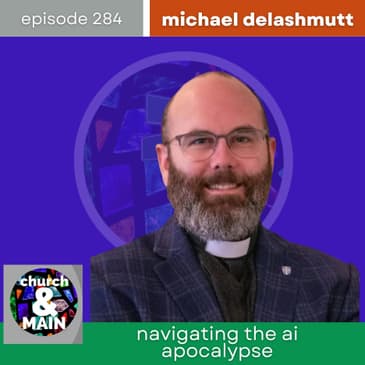
What does artificial intelligence reveal about what it means to be human—and what does faith have to say about it? In this episode, host Dennis Sanders sits down with the Reverend Michael DeLashmutt, Senior Vice President, Dean of the Chapel, and Associate Professor of Theology at General Theological Seminary in New York City, for a wide-ranging conversation about theology, technology, and the age of AI.
Michael argues that we are living through an "AI apocalypse"—not in the science fiction sense, but in the original meaning of the word: an unveiling. Rather than treating AI as something entirely new and frightening, he situates it within a long history of information technologies that have always shaped human life and the spread of the gospel, from Roman roads to the printing press to Zoom worship during the pandemic.
But Michael also issues a challenge: our culture has long reduced what it means to be human to intelligence and cognition alone, and AI is forcing us to confront the limits of that thin understanding. Drawing on Christian theology, neuroscience, and philosophy, he makes the case for a richer, more embodied vision of humanity—one rooted in relationship, presence, and the belief that our bodies matter to God.
Shownotes:
Theology After Intelligence by Michael DeLashmutt
Related Episodes:
Can AI Help or Hinder Human Flourishing? with Paul Hoffman | Episode 266
Join the Church and Main Email List
Facebook | Instagram | Threads | Twitter | Website | YouTube
00:00:25 --> 00:00:29 Greetings, everyone, and welcome to Church and Main, a podcast for people interested
00:00:29 --> 00:00:33 in the intersection of faith, politics, and culture. I'm Dennis Sanders, your host.
00:00:34 --> 00:00:39 Well, it wasn't by design, but this episode, as you can tell,
00:00:39 --> 00:00:43 is going to be on artificial intelligence, and it just so happens that earlier
00:00:43 --> 00:00:49 this week, on May 25th, Pope Leo XIV released his first papal encyclical,
00:00:49 --> 00:00:54 Magnific Humanitas, or Magnificent Humanity, which, of course,
00:00:54 --> 00:00:57 focuses on artificial intelligence.
00:00:57 --> 00:01:02 Now, I still need to read the letter, and I would love, I hope, that at some point,
00:01:03 --> 00:01:08 I can get someone on the podcast to kind of talk about it, but it was just kind
00:01:08 --> 00:01:12 of an interesting sense of coincidence that this happened.
00:01:13 --> 00:01:19 And as I said, this episode is again on kind of theology and intelligence.
00:01:20 --> 00:01:25 And my guest today is the Reverend Michael DeLashmut.
00:01:25 --> 00:01:29 He is the Senior Vice President and Dean of the Chapel of the Good Shepherd
00:01:29 --> 00:01:32 at General Theological Seminary in New York City.
00:01:33 --> 00:01:38 He has written extensively on artificial intelligence and theology,
00:01:38 --> 00:01:44 and today we're going to talk about his September 2025 article on his substack
00:01:44 --> 00:01:47 with the title Theology After Intelligence.
00:01:48 --> 00:01:54 As I said, as you can probably guess, Michael is an Episcopal priest,
00:01:54 --> 00:02:02 And he is actually working on a book that will talk about theology and technology,
00:02:02 --> 00:02:08 focusing on how churches can make sense of mission and ministry in the age of AI.
00:02:09 --> 00:02:14 With all the news going around these days about artificial intelligence,
00:02:14 --> 00:02:18 it's really important to talk about it and talk about what does it mean,
00:02:18 --> 00:02:19 especially as Christians.
00:02:20 --> 00:02:28 I'm not someone that thinks that artificial intelligence is necessarily bad. In fact, I use it.
00:02:28 --> 00:02:32 I use Claude, which is Anthropics.
00:02:35 --> 00:02:38 Chat chat bot and also chat
00:02:38 --> 00:02:41 sometimes chat gbt though i'm using more of
00:02:41 --> 00:02:44 claude these days but the question is kind of
00:02:44 --> 00:02:50 where where does faith fit into this and what does our faith say and how we
00:02:50 --> 00:02:56 use it um don't think it means it necessarily means that we can't use it but
00:02:56 --> 00:03:01 how do we use it and so i think that you will enjoy this conversation i think
00:03:01 --> 00:03:02 it's a well-needed conversation.
00:03:03 --> 00:03:09 So, with that out of the way, join me as we talk theology and artificial intelligence
00:03:09 --> 00:03:11 with Michael DeLashmutt.
00:03:31 --> 00:03:34 It's great to have you here this morning, and I wanted to start out to know
00:03:34 --> 00:03:38 a little bit about who you are and also kind of your faith background.
00:03:39 --> 00:03:44 Sure. Well, my name is Michael DeLashmet. I am the Senior Vice President,
00:03:44 --> 00:03:48 Dean of the Chapel, and Associate Professor of Theology at the General Theological
00:03:48 --> 00:03:49 Seminary in New York City.
00:03:50 --> 00:03:56 I am a priest in the Episcopal Church and also what we call a priest associate at St.
00:03:56 --> 00:04:00 Peter's Chelsea, which is our little parish here in the city that I'm associated with.
00:04:01 --> 00:04:05 Um, and, uh, so I've been, I think,
00:04:05 --> 00:04:09 um, I've been engaged in theological education now for over 20 years.
00:04:09 --> 00:04:14 I finished my PhD in 2006. And so since then, uh, almost continuously have been
00:04:14 --> 00:04:18 teaching and leading and doing research in theological education,
00:04:18 --> 00:04:21 uh, in the UK and in the US.
00:04:21 --> 00:04:24 And so I think my vocation,
00:04:25 --> 00:04:36 as it were, is to help form faithful and creative and engaged clergy for the
00:04:36 --> 00:04:37 Episcopal Church in particular.
00:04:39 --> 00:04:44 But my journey to become an Episcopal priest is kind of a winding one,
00:04:44 --> 00:04:46 like it is for so many people.
00:04:46 --> 00:04:50 I like to tell my students that only a quarter of seminarians in the Episcopal
00:04:50 --> 00:04:54 Church are actually cradle Episcopalians, that is grown up Episcopalians.
00:04:54 --> 00:04:57 So many people find their way into this church in circuitous roots.
00:04:59 --> 00:05:06 I was born in southwest Iowa to a kind of nominally Methodist family.
00:05:06 --> 00:05:11 I was baptized as a Methodist as a baby or as kind of a toddler.
00:05:11 --> 00:05:12 I have this like birthplace.
00:05:12 --> 00:05:16 Vague memory of being taken into a church and having a pastor pour water on my head.
00:05:17 --> 00:05:23 And then in the 80s, my mom had a born-again experience, and I was the youngest
00:05:23 --> 00:05:26 of three by about seven years.
00:05:26 --> 00:05:31 And so I was the only one that she could kind of force to go to church with her.
00:05:31 --> 00:05:38 And I have really fond memories of growing up in an evangelical Baptist church
00:05:38 --> 00:05:42 in the Midwest, going to vacation Bible school and hanging out in the church
00:05:42 --> 00:05:45 while my mom was in choir practice on a Wednesday evening.
00:05:45 --> 00:05:51 And so for me, church really became a really wonderful, safe, and delightful place.
00:05:51 --> 00:05:58 I teach this class, one of my classes on Christology, on the doctrine of Christ,
00:05:58 --> 00:06:02 and I ask students to share with us kind of their first memory of Jesus.
00:06:02 --> 00:06:07 And for me, it's this pastel flannelgram Jesus that I remember meeting,
00:06:08 --> 00:06:10 you know, sitting cross-legged on the floor of the church basement.
00:06:11 --> 00:06:14 And so that really formed my initial faith.
00:06:15 --> 00:06:20 In the late 80s, early 90s, my parents' marriage ended and my mother and I moved
00:06:20 --> 00:06:24 from the cornfields of Iowa to the forests of the Pacific Northwest. Yeah.
00:06:24 --> 00:06:29 And I found myself and we found ourselves worshiping at a Pentecostal church.
00:06:29 --> 00:06:32 We didn't know what that was. We didn't have Pentecostals in my town in Iowa.
00:06:33 --> 00:06:39 And eventually I started going to an Assemblies of God church and went to an
00:06:39 --> 00:06:44 Assemblies of God Bible college and was really interested in becoming an Assemblies of God pastor.
00:06:44 --> 00:06:49 And at about 19, when I graduated from my undergraduate program,
00:06:49 --> 00:06:51 I did an accelerated route.
00:06:51 --> 00:07:00 I was ordained as an associate pastor at this small Pentecostal church in rural Washington state.
00:07:01 --> 00:07:05 I think who in the world would ordain a 19-year-old now?
00:07:06 --> 00:07:16 And that tradition certainly gave me a sense of the immediacy of God's presence,
00:07:16 --> 00:07:17 the dynamism of the Holy Spirit.
00:07:17 --> 00:07:23 I think growing up vaguely evangelical gave me a really solid grounding in scripture.
00:07:24 --> 00:07:29 But my experience there was not great in that church. And I ended up,
00:07:29 --> 00:07:31 the church ended up splitting.
00:07:31 --> 00:07:37 And I ended up leaving the church behind, feeling really wounded by a community that had formed me.
00:07:38 --> 00:07:43 And felt kind of like the, I sometimes say I felt burned out by the Holy Spirit, I guess.
00:07:44 --> 00:07:51 And so, you know, God and I took a break. and I decided that I wanted to go
00:07:51 --> 00:07:52 the route of an academic.
00:07:52 --> 00:07:57 And so I pursued a PhD at the University of Glasgow and we moved abroad in 2002.
00:07:58 --> 00:08:03 And I picked Glasgow in part because, you know, I really wanted to study theology as a kind of...
00:08:05 --> 00:08:09 Of critical discourse, a way of thinking about the world. I wasn't particularly
00:08:09 --> 00:08:11 interested in questions of faith as such.
00:08:11 --> 00:08:15 I certainly wasn't interested in the church as a community to belong with.
00:08:15 --> 00:08:18 I probably didn't really believe in an interventionist God anymore.
00:08:18 --> 00:08:23 And for me, faith was deeply intellectual and certainly aesthetic,
00:08:23 --> 00:08:26 and I saw a lot of beauty in it, but it really didn't.
00:08:27 --> 00:08:32 I just couldn't believe in God. The God that I had grown up with just was no
00:08:32 --> 00:08:33 longer accessible to me.
00:08:34 --> 00:08:38 And then one day, I find myself worshiping.
00:08:38 --> 00:08:42 First of all, I don't know why I'm in this church, but I find myself in the
00:08:42 --> 00:08:46 chapel at the university for a midweek Eucharist, probably because one of my
00:08:46 --> 00:08:47 friends encouraged me to go or something.
00:08:47 --> 00:08:52 And there were like five of us. And we're standing around this stone altar in
00:08:52 --> 00:08:54 this gray stone, frigid building.
00:08:54 --> 00:08:58 And there was a Scottish Episcopal priest wearing vestments that I didn't know
00:08:58 --> 00:09:03 the names of, saying these beautifully poetic words that I had never heard before.
00:09:04 --> 00:09:10 And I could smell the strong smell of the port wine that was just a few feet
00:09:10 --> 00:09:13 away from me as he was pouring it into the chalice for the Eucharist.
00:09:13 --> 00:09:17 And for that like brief minute, a brief couple of minutes, I felt like I could
00:09:17 --> 00:09:19 believe or trust in God again.
00:09:20 --> 00:09:25 And so that started a long journey that was also very circuitous,
00:09:25 --> 00:09:31 where the liturgy became for me a kind of cast around a broken soul and allowed
00:09:31 --> 00:09:36 me to heal and to be found by God again and to learn how to trust God again.
00:09:36 --> 00:09:44 And I found myself drawn into theological education, not merely as critical
00:09:44 --> 00:09:46 discourse, but really as a ministry of the church.
00:09:46 --> 00:09:53 And how could I help form clergy who are faithful leaders, who at the very minimum
00:09:53 --> 00:09:58 do no harm, but at the very maximum are faithful in serving the gospel in their
00:09:58 --> 00:10:01 particular context and in the ways that God has called them to do.
00:10:01 --> 00:10:07 And so that's been my journey. I was confirmed in the Church of England in 2009
00:10:07 --> 00:10:12 and served as a lay theologian in the U.S. and the U.K.
00:10:12 --> 00:10:18 Until 2019 when I was ordained, largely because I took a position here at General
00:10:18 --> 00:10:22 Seminary as the academic dean and theology professor as a lay person.
00:10:22 --> 00:10:28 And in developing the disciplines of what we call ascetical theology,
00:10:29 --> 00:10:32 particularly around praying the daily office, morning and evening prayer,
00:10:32 --> 00:10:36 and living in a community of people who are wrestling with the disciplines of
00:10:36 --> 00:10:38 morning and evening prayer and life together,
00:10:38 --> 00:10:43 I found myself kind of drawn more deeply into the life of God and sensed a call
00:10:43 --> 00:10:45 to ordained ministry. And here I am today.
00:10:47 --> 00:10:53 So, it's interesting because you talk a little bit about, you just talked about ascetical life.
00:10:53 --> 00:10:58 And of course, we're talking today about artificial intelligence.
00:10:58 --> 00:11:02 And so, I'm curious, how did those two come together?
00:11:03 --> 00:11:07 What brought your interest in artificial intelligence?
00:11:07 --> 00:11:14 So, somewhere between undergraduate and becoming a pastor, and I was a bivocational
00:11:14 --> 00:11:19 pastor at the age of 19, I found myself working in the dot-com boom of the Pacific
00:11:19 --> 00:11:21 Northwest in the late 90s.
00:11:21 --> 00:11:30 And one of my first jobs was with this small internet startup called allrecipes.com,
00:11:30 --> 00:11:34 which at the time was one of the first user-generated content websites.
00:11:35 --> 00:11:39 And it was an exciting time to be in technology.
00:11:39 --> 00:11:43 And I was taking
00:11:43 --> 00:11:46 evening classes at Fuller Theological Seminary's Northwest Campus
00:11:46 --> 00:11:49 when they had one and working 70 hours
00:11:49 --> 00:11:55 a week at All Recipes and 10 hours a week at the church and it was a very full
00:11:55 --> 00:12:00 and complex life that something that only a 20-year-old could sustain as I look
00:12:00 --> 00:12:08 back at the age that I am today and I found that it was really curious to me.
00:12:09 --> 00:12:17 That my colleagues at the office would often use kind of what I call technomorphic
00:12:17 --> 00:12:19 language to describe themselves.
00:12:19 --> 00:12:25 They would think about memory in a way that was a bit like random access memory or RAM in your computer.
00:12:25 --> 00:12:29 They would think about long-term memories, kind of like your mind was a hard drive.
00:12:29 --> 00:12:33 They'd think about networking and sociality in very overlapping ways.
00:12:33 --> 00:12:37 And so at the level of discourse alone, there seemed to be this really intriguing
00:12:37 --> 00:12:41 overlap where how we talked about technology reflected how we talked about ourselves.
00:12:42 --> 00:12:47 And through the course of my PhD research, I learned that a lot of the philosophy
00:12:47 --> 00:12:51 of mind that we've inherited in the 20th and 21st century is itself kind of
00:12:51 --> 00:12:53 a cooperative product with information science.
00:12:53 --> 00:12:59 So as early as the mid 20th century, one of the kind of co-founders of modern
00:12:59 --> 00:13:01 day artificial intelligence, Marvin Minsky,
00:13:02 --> 00:13:05 wrote this really fascinating book called The Society of Mind,
00:13:05 --> 00:13:11 where he applied a computational model of consciousness to both the mind and
00:13:11 --> 00:13:13 the prospect of creating an artificial mind.
00:13:14 --> 00:13:19 Computer. So I was really intrigued at how all of this kind of worked together.
00:13:19 --> 00:13:25 And so the purpose of my PhD 20 some years ago was to look at how information
00:13:25 --> 00:13:28 technology functions as a kind of theological object.
00:13:28 --> 00:13:32 And I looked at it in terms of science fiction, because even today,
00:13:32 --> 00:13:39 I think science fiction is an immensely helpful guide as we consider what our future might hold.
00:13:39 --> 00:13:44 After all, much of the technology that we use today in our common life is itself
00:13:44 --> 00:13:46 the product of a science fictional imagination.
00:13:46 --> 00:13:52 The Apple watch that I wear is the kind of modern day version of the Dick Tracy
00:13:52 --> 00:13:54 watch that I coveted as a child.
00:13:55 --> 00:13:59 And so I use science fiction. I looked at post-humanism,
00:13:59 --> 00:14:03 post-human feminist discourse, so the work of like Donna Haraway and the Cyborg
00:14:03 --> 00:14:08 Manifesto, speculative science and radical life extension, and how all of these
00:14:08 --> 00:14:13 things kind of coalesce together to treat technology as a sort of a kind of theology.
00:14:14 --> 00:14:18 And I put that aside in 2006, thinking this was a great project.
00:14:19 --> 00:14:23 I did a little bit of ethnographic research to kind of test some of these theses
00:14:23 --> 00:14:27 to see if people who worked in tech areas happened to have, you know,
00:14:27 --> 00:14:32 maybe more kind of techno-theological worldviews as opposed to maybe,
00:14:32 --> 00:14:34 you know, mainline theological ones.
00:14:34 --> 00:14:37 And then I sort of put it aside because it didn't seem to be like the pressing
00:14:37 --> 00:14:39 issue that the church you needed to address at the time.
00:14:40 --> 00:14:46 And then in 2023, early 2023, I was at a conference with a handful of other
00:14:46 --> 00:14:50 deans of Anglican seminaries, of Episcopal seminaries, and one of my colleagues
00:14:50 --> 00:14:51 pulled out a smartphone and said.
00:14:52 --> 00:14:57 And he said, hey, watch this. I'm going to write a sonnet or have this AI write
00:14:57 --> 00:15:03 a sonnet about a gathering of Anglican theological deans and see what happens.
00:15:03 --> 00:15:07 And so 30 seconds later, he reads this sonnet. It's not particularly great.
00:15:07 --> 00:15:10 It's not Shakespeare or anything, but it's better than we could have come up
00:15:10 --> 00:15:11 with in a couple of minutes.
00:15:11 --> 00:15:15 And to a person, those of us around the table were kind of flummoxed.
00:15:15 --> 00:15:21 And I realized at that moment that we had crossed into a new horizon with artificial
00:15:21 --> 00:15:29 intelligence and the ability to engage in discursive ways, in linguistic ways, with AI,
00:15:29 --> 00:15:33 in ways that are deeply personal or interpersonal,
00:15:34 --> 00:15:38 that this is going to create some shockwaves.
00:15:38 --> 00:15:45 And this is going to require us to kind of resource our thinking theologically
00:15:45 --> 00:15:48 and philosophically about what it is that we have and are creating.
00:15:49 --> 00:15:56 And so I began to recover that work that had been sitting in the back drawer for 20 years.
00:15:56 --> 00:16:01 And so now I teach at the seminary an elective on theology and technology.
00:16:01 --> 00:16:08 I speak widely on issues of AI and the church, and I write on my substack and
00:16:08 --> 00:16:10 elsewhere on AI and theology.
00:16:10 --> 00:16:14 And I'm currently working on a book with Baylor University Press called,
00:16:14 --> 00:16:17 the working title is Technology and Theology After Intelligence.
00:16:18 --> 00:16:25 So the origins of this are in my kind of techno life in the late 90s, early 2000s.
00:16:25 --> 00:16:30 And then it really kind of sprang to life again in the last few years.
00:16:31 --> 00:16:36 Yeah, I mean, I think what's been fascinating about the article in question
00:16:36 --> 00:16:43 is that you help us to see that technology has always been a part of the faith.
00:16:44 --> 00:16:50 This is never – it's not like this just came about in the last 20 years. It's always been there.
00:16:50 --> 00:16:59 And what's interesting is that AI is just another one of those pieces of technology.
00:17:00 --> 00:17:04 And you kind of hinted at this a little bit earlier about how people,
00:17:04 --> 00:17:08 especially the people you were working with in the Pacific Northwest,
00:17:08 --> 00:17:14 saw things and saw themselves in terms of technology, but then also how that….
00:17:15 --> 00:17:22 Creates what you would say is very much of a thin kind of a community or spirituality.
00:17:23 --> 00:17:28 And that we should be thinking in things in a more kind of thicker,
00:17:28 --> 00:17:31 more embodied way. That's right.
00:17:32 --> 00:17:35 Yeah. Could you kind of expound a little bit more on that? Yeah.
00:17:35 --> 00:17:45 Well, so Arvind Naaran and Sayish Kapoor wrote an article called AI as Normal Technology.
00:17:45 --> 00:17:50 It was part of the Knight First Amendment Institute at Columbia University.
00:17:51 --> 00:17:57 And the idea of a normal technology is a helpful one to think about when we think about AI.
00:17:57 --> 00:18:02 It is incredible in terms of what it can do. It is novel.
00:18:03 --> 00:18:10 It can be a little bit bewildering or bewitching, maybe even bedeviling.
00:18:10 --> 00:18:15 But it is part of technology. And so that's helpful to ground it within this
00:18:15 --> 00:18:17 larger history of information science.
00:18:17 --> 00:18:23 Modern information science and the large language models that we interact with
00:18:23 --> 00:18:28 now on the daily have their origins in the early 19th century with the advent
00:18:28 --> 00:18:30 of the Jacquard loom in 1804,
00:18:30 --> 00:18:34 which is the first time a human technology takes a pattern,
00:18:34 --> 00:18:40 in this sense, the pattern of making a piece of fabric or a textile of some kind,
00:18:40 --> 00:18:44 which had been up until that point for thousands of years of human making,
00:18:44 --> 00:18:50 been the information in the maker and it puts it on a punch card.
00:18:50 --> 00:18:56 And he uses that punch card to control the means by which the loom pulls the
00:18:56 --> 00:18:58 fabric through with the shuttle, et cetera, et cetera.
00:18:59 --> 00:19:05 So we've been taking information and extending it into material forms through
00:19:05 --> 00:19:10 computing for over 200 years. So this is not new.
00:19:10 --> 00:19:14 And we've been thinking about artificial intelligence since the mid-20th century,
00:19:14 --> 00:19:17 largely in a theoretical basis for sure.
00:19:17 --> 00:19:23 But even in terms of actual use of neural networks and deep thinking and deep
00:19:23 --> 00:19:27 learning for well over 20 years. So this is not a new technology.
00:19:27 --> 00:19:32 But more to the point, the church has a fascinating history with technologies of information.
00:19:32 --> 00:19:37 And I may be overstretching things a bit, but I think it's fascinating that
00:19:37 --> 00:19:43 the John's Gospel describes the incarnation in terms of the word becoming flesh,
00:19:44 --> 00:19:45 the logos becoming flesh.
00:19:45 --> 00:19:52 So this kind of deep knowledge, reasoning, the mind of God becomes human in
00:19:52 --> 00:19:53 the form, in the person of Jesus Christ.
00:19:54 --> 00:19:58 And yes, that is a unique incarnation for sure.
00:19:59 --> 00:20:05 But the gospel of that word takes on materiality in letters that were transmitted
00:20:05 --> 00:20:12 on Roman roads, is preserved in scriptoria in medieval Europe after the fall of the Roman Empire,
00:20:13 --> 00:20:19 is represented in iconography and Christian art for a thousand years,
00:20:19 --> 00:20:24 is then distributed and democratized through the printing press in the 15th
00:20:24 --> 00:20:29 and 16th centuries, Then finds incredible expansion and transformation in radio
00:20:29 --> 00:20:32 and television in the 19th and 20th centuries.
00:20:32 --> 00:20:39 And then those of us who experienced worshiping on Zoom in the early 2020s experienced
00:20:39 --> 00:20:42 it also in distributed ways online.
00:20:42 --> 00:20:47 And just before that, multi-site churches and other forms of online new media
00:20:47 --> 00:20:50 gatherings of religious groups were occurring as well.
00:20:50 --> 00:20:55 So religion, and particularly Christianity, has a fascinating relationship with
00:20:55 --> 00:20:56 technologies of information.
00:20:57 --> 00:21:03 Now, non-dualistic religions of the sort like we see in Buddhism and Hinduism
00:21:03 --> 00:21:05 have also very interesting relationships with technology.
00:21:06 --> 00:21:11 Just this last week on my feed, I saw that a robot had become a Buddhist monk,
00:21:11 --> 00:21:12 and that's a fascinating thing.
00:21:12 --> 00:21:16 But within our world, within our kind of intellectual history,
00:21:16 --> 00:21:21 information technology has been part of the way that the gospel has been spread.
00:21:21 --> 00:21:25 And more to the point, you know, our founding stories, you know,
00:21:25 --> 00:21:28 the kind of primordial histories, as it were,
00:21:28 --> 00:21:33 the prehistories and mythologies of Genesis 1 to 11, paint a fascinating picture
00:21:33 --> 00:21:38 about human technologies and where they come from and how they're part of our
00:21:38 --> 00:21:40 call to be co-creators with the divine.
00:21:40 --> 00:21:48 So whether that's in the descendants of Cain, who are the first people who fabricate
00:21:48 --> 00:21:51 metal and engage in animal husbandry and create instruments,
00:21:51 --> 00:21:54 or whether it's the urban planners around the Tower of Babel,
00:21:54 --> 00:22:00 there's an interesting sense in which to be human is to be given the capacity
00:22:00 --> 00:22:02 to create in material culture.
00:22:02 --> 00:22:07 And like everything East of Eden, that material culture is ambiguous.
00:22:07 --> 00:22:13 It's marked by the same kind of fallibility, brokenness, and sin that the rest
00:22:13 --> 00:22:14 of the world experiences.
00:22:15 --> 00:22:20 And so our job as creators is to learn how to discern and to exercise wisdom
00:22:20 --> 00:22:22 in our use of technology.
00:22:22 --> 00:22:27 So all of that to say technology is part of the human experience and information
00:22:27 --> 00:22:29 technology in particular is part of the Christian story.
00:22:30 --> 00:22:33 And so when I look at AI...
00:22:34 --> 00:22:39 I kind of jokingly say that I think that we're in the middle of an AI apocalypse.
00:22:39 --> 00:22:43 And when I say that, people gasp. And they're like, oh my gosh,
00:22:43 --> 00:22:45 are you talking about Terminators? Are you talking about the Matrix?
00:22:46 --> 00:22:50 If anything, I might be talking about the WALL-E world of the Pixar film WALL-E,
00:22:50 --> 00:22:53 where we're sort of floating in space, you know, drinking Slurpees all the time.
00:22:55 --> 00:23:00 But what I mean by apocalypse is that I think about the original meaning of
00:23:00 --> 00:23:03 apocalypsis, which is it's an unveiling, it's a revealing.
00:23:03 --> 00:23:07 And I think what AI is doing is it's revealing some of the assumptions that
00:23:07 --> 00:23:11 we've made, particularly about what it means to be human, and then by extension,
00:23:11 --> 00:23:13 what it means for us to engage in Christian ministry,
00:23:13 --> 00:23:19 that maybe are assumptions that got us to this point in the 21st century,
00:23:19 --> 00:23:21 but may not be helpful anymore.
00:23:21 --> 00:23:25 They may be products of the Enlightenment that have served their purpose.
00:23:25 --> 00:23:30 So if we think that being human is primarily a kind of cognitive experience,
00:23:31 --> 00:23:34 if we reduce humanity to information or intellect,
00:23:35 --> 00:23:38 which is a trajectory that we have been set on since modernity.
00:23:39 --> 00:23:43 Number one, I think that's probably a colonial model, that it does not suit
00:23:43 --> 00:23:46 us well in a post-colonial or, God willing, a post-colonial age.
00:23:46 --> 00:23:50 But also, I think it neglects the fact that we are bodies.
00:23:51 --> 00:23:56 We are more than just our minds. And neuroscience and biology tells us it's
00:23:56 --> 00:24:01 not just our minds that are the thing that are helping us to sort of have this
00:24:01 --> 00:24:04 experience of being who we are in the world,
00:24:04 --> 00:24:06 that we sometimes think that it's our brains doing the work,
00:24:07 --> 00:24:12 but maybe because our primary sensors just happen to be surrounding our brain, our eyes, our ears,
00:24:12 --> 00:24:17 our nose, our mouths, but our whole bodies are involved in the experience of navigating this world.
00:24:17 --> 00:24:21 And even beyond our experience that we would call kind of consciousness or what
00:24:21 --> 00:24:26 have you, there's our relationship with one another in terms of sociality,
00:24:26 --> 00:24:30 our embeddedness in this material world, our shared creatureliness with other
00:24:30 --> 00:24:32 creatures of the sixth day.
00:24:32 --> 00:24:39 And of course, our engagement with God, our being called into being by the love of God that has no end.
00:24:39 --> 00:24:42 So all of these things speak to so much of a richer sense of self.
00:24:43 --> 00:24:49 And so maybe AI is apocalyptic in that it's revealing the lack of our own what
00:24:49 --> 00:24:51 we would call theological anthropologies.
00:24:51 --> 00:24:54 And calling us into a deeper sense of what it means to be human.
00:24:55 --> 00:25:03 I am not afraid of robots or AI becoming human, because human is a unique designator.
00:25:03 --> 00:25:07 I think if there is anything at all that is a kind of sci-fi,
00:25:08 --> 00:25:13 theological sci-fi possibility, it's that perhaps in 10, 50, 100 years.
00:25:14 --> 00:25:18 AI might become a person, or robots might become a person.
00:25:18 --> 00:25:21 And at that point, will have some interesting conversations,
00:25:21 --> 00:25:23 but they will never be human.
00:25:23 --> 00:25:27 Nor is human necessarily a kind of like fixed category.
00:25:27 --> 00:25:34 I think in many ways, humans and their technologies have always been deeply
00:25:34 --> 00:25:38 connected with one another because these technologies are part of our material world.
00:25:38 --> 00:25:42 And so as Donna Haraway used to say, we've always been cyborgs.
00:25:42 --> 00:25:46 And so there's a sense in which we We are human, created in the image of God,
00:25:46 --> 00:25:52 and we are cyborgs in that we are creators of the technologies through which we navigate the world.
00:25:54 --> 00:26:01 I find it interesting when you kind of talk about what you kind of say is a thicker,
00:26:02 --> 00:26:09 anthropology is that you use a lot of different examples from the Hebrew Scriptures to.
00:26:11 --> 00:26:14 Orthodox Christianity, which I think is especially interesting because it kind
00:26:14 --> 00:26:23 of talks about the trinity and then about relationship to a lot of kind of different
00:26:23 --> 00:26:25 types of liberation theologies.
00:26:26 --> 00:26:32 And I think what's interesting about all of them is that there is a sense of
00:26:32 --> 00:26:38 embodiment, which is different from intelligence.
00:26:39 --> 00:26:43 It's related. So, those two are not separate, it.
00:26:44 --> 00:26:48 But there is something more to that that I think you're getting at,
00:26:48 --> 00:26:57 that we're not just our brains, but an entire body, which is very different from what AI is.
00:26:58 --> 00:27:01 AI is intelligence, and that does make you kind of think about that.
00:27:01 --> 00:27:06 And I think as you talk about the thin anthropology of intelligence, that...
00:27:07 --> 00:27:13 That challenges that, but AI can't be embodied in that same way.
00:27:13 --> 00:27:17 Well, I think AI is embodied, but it's differently embodied.
00:27:17 --> 00:27:23 And what I mean by that is one of the challenges with technology,
00:27:23 --> 00:27:27 and there's a wonderful philosopher, American philosopher named Albert Borgman,
00:27:27 --> 00:27:30 who was writing in the late 20th century and into the early 21st.
00:27:30 --> 00:27:35 And in the 1980s, he posited this notion called the device paradigm.
00:27:35 --> 00:27:40 And by this, he basically means, and this is kind of my paraphrase of Borgman's
00:27:40 --> 00:27:42 work, that technology tends to hide itself.
00:27:43 --> 00:27:48 And an example I use of this often is the television set.
00:27:48 --> 00:27:53 So I'm, you know, almost 50. And so I grew up in the 70s and 80s.
00:27:53 --> 00:27:57 And in my parents' living room was this massive wooden cabinet with a relatively
00:27:57 --> 00:27:59 small color TV inside of it.
00:28:00 --> 00:28:05 And so and I see you're nodding. So you might know what I know, the image of your mind.
00:28:05 --> 00:28:09 It was big enough that my mom would put the nativity set on it at Christmas time.
00:28:09 --> 00:28:14 It was a piece of furniture. And fast forward 40, 50 years now,
00:28:14 --> 00:28:18 and the television that's in my house is basically a window.
00:28:18 --> 00:28:20 It's a flat screen that almost disappears.
00:28:21 --> 00:28:26 And you think about maybe the first cell phone that you got in the 90s that
00:28:26 --> 00:28:30 came with this massive manual about how to program it and how to find your way
00:28:30 --> 00:28:33 to that little worm game that you could maybe play from time to time,
00:28:33 --> 00:28:36 versus the iPhone or the Android that you just purchased that has no manual
00:28:36 --> 00:28:39 at all and assumes that you'll just figure out how to use it.
00:28:39 --> 00:28:43 So simple, so frictionless are these technologies that we can give a tablet
00:28:43 --> 00:28:46 to a child and they'll figure out how to use it without being taught how to use it.
00:28:47 --> 00:28:50 That's the example of the device paradigm of technology hiding itself.
00:28:50 --> 00:28:55 And so there's a sense that good technology or just technology in general eventually
00:28:55 --> 00:28:58 becomes not obsolete, but just transparent to us.
00:28:58 --> 00:29:01 It's still there, but we just don't see it. And the problem with not being able
00:29:01 --> 00:29:05 to see a technology is that it becomes very difficult to say anything.
00:29:06 --> 00:29:11 It becomes difficult to do moral reasoning around a technology that you can't see.
00:29:11 --> 00:29:16 So I mentioned all of this because I think one of the problems that we've inherited
00:29:16 --> 00:29:22 in the last 30 years is a tendency to talk about online experiences as virtual,
00:29:22 --> 00:29:28 which is either it either diminishes the potency of an online connection and
00:29:28 --> 00:29:32 makes it somehow substandard to face-to-face connections, which I think there
00:29:32 --> 00:29:34 is a sense in which it's different.
00:29:34 --> 00:29:38 But it's difficult to kind of qualify that necessarily.
00:29:40 --> 00:29:45 But or the worst one is that we sort of dismiss virtual and turn it into some
00:29:45 --> 00:29:48 sort of like third metaphysical state.
00:29:48 --> 00:29:51 It's neither material. It's neither spiritual. It's virtual.
00:29:51 --> 00:29:56 Well, that's just not true because behind, well, right in front of me,
00:29:56 --> 00:30:01 in front of me, what I'm looking through, my computer, is the product of countless
00:30:01 --> 00:30:06 human hands in the designing and manufacture,
00:30:06 --> 00:30:08 the extraction of rare earth minerals.
00:30:08 --> 00:30:13 The energy that is used not only to power my computer, but to power the connection
00:30:13 --> 00:30:21 between us is often extracted through polluting means of carbon-based energy extraction.
00:30:22 --> 00:30:28 But we don't see that. And when we call something virtual or we kind of don't
00:30:28 --> 00:30:32 embody or don't materialize in these kinds of technologies of information,
00:30:32 --> 00:30:37 we stop seeing the human and environmental and physical costs of all of these technologies.
00:30:37 --> 00:30:41 So I'd say AI is embodied. It's just it has a different body than our body.
00:30:41 --> 00:30:44 It's not a disembodied intelligence at all.
00:30:45 --> 00:30:51 Now, we also are embodied, and we're embodied in really beautifully complex
00:30:51 --> 00:30:53 ways. We're embodied physically.
00:30:53 --> 00:30:58 We're embodied socially. We're embodied in terms of our relationship with the
00:30:58 --> 00:30:59 creation and our creator.
00:30:59 --> 00:31:02 These are all different ways in which we're embodied. And effectively,
00:31:02 --> 00:31:06 by embodiment, I mean that we're engaged in various sorts of relationships.
00:31:06 --> 00:31:11 And we might call this a relational ontology or kind of that we become who we
00:31:11 --> 00:31:13 are because we are called into being through relationships.
00:31:13 --> 00:31:18 And this is deeply kind of orthodox Christian thinking, but also Christian thinking,
00:31:18 --> 00:31:22 because, you know, we understand to be made in the image of God,
00:31:22 --> 00:31:25 but our God is not a monolith.
00:31:25 --> 00:31:29 Our God is known to us in the three persons of the Trinity who exist in an eternal
00:31:29 --> 00:31:34 relationship between Father, Son, and Spirit. And so the model of being is the
00:31:34 --> 00:31:38 model of interpersonal relationships between the persons of the Trinity.
00:31:39 --> 00:31:45 So for me, I think it's just so important to fall back on this relational ontology,
00:31:45 --> 00:31:48 because I think what it does, it's very helpful.
00:31:48 --> 00:31:53 Particularly in morally complex times like ours, is it prevents us from making
00:31:53 --> 00:31:57 personhood contingent on a capacity.
00:31:57 --> 00:32:02 Because if we say that to be a person or to be a human is to have an intellect,
00:32:03 --> 00:32:07 then all of a sudden, anyone who has a diminished intellect can very easily
00:32:07 --> 00:32:11 be written off as not a person or a less than person.
00:32:11 --> 00:32:15 And that's very, very ethically dangerous territory to find ourselves in.
00:32:15 --> 00:32:17 And we have been in places like that before.
00:32:17 --> 00:32:22 But whereas relationality means that my sense, my kind of call into being as
00:32:22 --> 00:32:25 a person isn't contingent on anything that I bring to the table.
00:32:26 --> 00:32:30 It's ultimately contingent on the fact that God sees me before I am.
00:32:31 --> 00:32:37 And God's seeing me, God's knowing me before I exist even, calls me into this
00:32:37 --> 00:32:43 sense of relationship with the divine and into being a related person. Yeah.
00:32:44 --> 00:32:47 So, when we kind of talk about this,
00:32:47 --> 00:32:53 anytime we talk about AI, and we talked about this just before we went live,
00:32:54 --> 00:33:02 is what I hear in a lot of conversations on Substack, on social media, or everything is AI bad.
00:33:04 --> 00:33:10 And it's built on this sense of fear about artificial intelligence. Yeah.
00:33:11 --> 00:33:16 I'm kind of curious of your thoughts about why that is. Why are we fearful of it?
00:33:17 --> 00:33:22 Is there anything to it? Should we have a healthy, respectful fear?
00:33:23 --> 00:33:26 And what does that mean for the church?
00:33:26 --> 00:33:31 I mean, I'm not someone that thinks that we can just put all this back,
00:33:31 --> 00:33:34 go back in time and pretend it doesn't exist.
00:33:34 --> 00:33:41 It's here. It's a part of our lives. I use AI, a lot of people use it.
00:33:43 --> 00:33:47 And I think that it has a lot of good things. I mean, there was something I
00:33:47 --> 00:33:51 was just reading recently that used AI.
00:33:52 --> 00:33:58 They basically were able to put in scans of people and found a way that they
00:33:58 --> 00:34:03 might be able to detect pancreatic cancer before it's too late.
00:34:04 --> 00:34:07 So, there are things about artificial intelligence that are good.
00:34:07 --> 00:34:14 But how should the church reason with dealing with the onset of AI in a way
00:34:14 --> 00:34:19 that isn't just that it's bad or that it's, you know, that we're fearful of it?
00:34:20 --> 00:34:27 Yeah. Well, I think we have to be able to navigate a course between technophobia and technophilia.
00:34:28 --> 00:34:33 You know, the fear of the technology and the kind of unbridled love of the technology,
00:34:33 --> 00:34:34 uncritical love of the technology.
00:34:35 --> 00:34:37 And you're right. We can't go back.
00:34:37 --> 00:34:43 There are remarkably few technologies, maybe none, that have been able to be
00:34:43 --> 00:34:45 put back into the bottle.
00:34:45 --> 00:34:51 You know, we may make a case that atomic energy has in some sense,
00:34:51 --> 00:34:55 or the nuclear age was maybe put back in the bottle, but I think the war in
00:34:55 --> 00:34:57 Iran shows us that it actually isn't at all.
00:34:57 --> 00:35:02 And the fact that we need more electricity and a nuclear option seems like an
00:35:02 --> 00:35:06 increasingly palatable one, given the strides we've made in nuclear technology.
00:35:06 --> 00:35:10 So I don't think that there are very many technologies that we decide we're
00:35:10 --> 00:35:12 just not going to use that any longer.
00:35:13 --> 00:35:16 So, you know, I think that...
00:35:16 --> 00:35:21 I think that one of the things the gospel calls us to is a kind of theological
00:35:21 --> 00:35:25 realism, where we look at the world as it is, not as the world that we want it to be.
00:35:26 --> 00:35:31 Because to do so, it ignores the fact that God chose this world to be the world
00:35:31 --> 00:35:36 that God made, and God chose this world to be the world that God loves and redeems
00:35:36 --> 00:35:40 and is in the process of reconciling with.
00:35:40 --> 00:35:44 And so let's be real about the world we're in. And that world is one in which
00:35:44 --> 00:35:48 artificial intelligence now lives in it. So we can't avoid it.
00:35:49 --> 00:35:52 So we have to find a way to use it. But in the same sense, we can't just sort
00:35:52 --> 00:35:55 of, we can't ignore the risks of it.
00:35:55 --> 00:35:57 Because like with every technology, it is ambiguous.
00:35:58 --> 00:36:03 The biblical story I like to talk about when it comes to this is in Exodus,
00:36:03 --> 00:36:06 I think it's 31 and 32. It's one of my favorite stories.
00:36:07 --> 00:36:13 If I'm right, it's Exodus 31. we meet this character called Bezalel and his colleague Aholia.
00:36:13 --> 00:36:17 And as somebody who grew up Pentecostal, this is an important story to me because
00:36:17 --> 00:36:21 Bezalel is the first person in the Bible for whom the phrase,
00:36:21 --> 00:36:24 he was filled with the Holy Spirit, is used.
00:36:24 --> 00:36:28 So the first person filled with the Holy Spirit isn't a prophet, isn't a,
00:36:28 --> 00:36:31 pastor or an apostle or a king.
00:36:31 --> 00:36:36 It is a craftsperson. Bezalel is a craftsperson who is filled with the Holy
00:36:36 --> 00:36:40 Spirit so that he might fabricate items for the tabernacle, for the center of
00:36:40 --> 00:36:43 Israelite worship as they're sitting at the base of Mount Sinai.
00:36:44 --> 00:36:49 And this is the culmination of several preceding chapters in Exodus that describe
00:36:49 --> 00:36:52 in great detail how the tabernacle is going to be designed and outfit.
00:36:52 --> 00:36:56 And immediately after we meet Bezalel, directly in the following chapter,
00:36:56 --> 00:36:59 what we encounter is the story of the golden calf.
00:36:59 --> 00:37:05 Now, there is no textual evidence to say that Bezalel was involved in making
00:37:05 --> 00:37:10 the calf, nor does it say that the gold that was used for the tabernacle was melted for the calf.
00:37:10 --> 00:37:14 But the juxtaposition of these two, I think, gives us a little bit of a creative
00:37:14 --> 00:37:19 space to imagine that here we have an example of human material creativity that's
00:37:19 --> 00:37:24 ordained by God, An example of human material creativity that goes the wrong way,
00:37:24 --> 00:37:29 that is then used by human hubris or fear or self-service or what have you.
00:37:29 --> 00:37:33 So the argument that I take from this is that technology is always ambiguous
00:37:33 --> 00:37:36 and it requires a great deal of human discernment in its execution.
00:37:36 --> 00:37:41 And so we can't take AI and turn it into our golden calf.
00:37:42 --> 00:37:46 So we have to figure out a way to engage with it meaningfully and productively.
00:37:46 --> 00:37:51 And the best way that I think that we can do that is through the exercise of
00:37:51 --> 00:37:54 discernment and figuring out what are our values,
00:37:54 --> 00:37:59 what are the things that we consider to be perhaps non-negotiable or the kinds
00:37:59 --> 00:38:04 of world that we want to live in or the way that we want to be formed and formed each other.
00:38:04 --> 00:38:07 And that requires a lot of very difficult work.
00:38:07 --> 00:38:12 A colleague of mine, his name is Christopher Benick. He's a pastor at First
00:38:12 --> 00:38:17 Presbyterian Church in Miami and has been doing work like I have for decades
00:38:17 --> 00:38:19 in technology and theology.
00:38:19 --> 00:38:23 And he wrote a really excellent book a couple of months ago called something
00:38:23 --> 00:38:28 like Artificial Intelligence, A Field Guide for Leaders.
00:38:28 --> 00:38:32 And in it, he helps churches go through a process of discernment.
00:38:32 --> 00:38:37 That allows us to think about how we might, within our own context,
00:38:37 --> 00:38:39 faithfully engage artificial intelligence.
00:38:39 --> 00:38:43 So I think that kind of grassroots level of thinking about what is the right
00:38:43 --> 00:38:47 way for us to use it, at least beginning to question, is like a first step.
00:38:47 --> 00:38:51 Because I don't think that there is a single right or wrong way that's sort
00:38:51 --> 00:38:52 of universally applicable for everyone.
00:38:53 --> 00:38:59 Now, I will say for me, I'm mindful of the environmental cost,
00:38:59 --> 00:39:02 but not just of AI, but really of all technologies of information.
00:39:02 --> 00:39:05 And so that's something to be at least aware of.
00:39:06 --> 00:39:10 I'm also really mindful of what is lost and what is gained with AI.
00:39:10 --> 00:39:12 So I'm a professor who forms future clergy.
00:39:13 --> 00:39:18 And so I absolutely use AI in my own teaching and my own research.
00:39:18 --> 00:39:21 And I have students use AI from time to time in the classroom.
00:39:22 --> 00:39:26 And at the same time, I'm also really clear where I don't want them to use AI.
00:39:26 --> 00:39:33 And I also have pivoted a lot of my assigned work into forms that are less easy
00:39:33 --> 00:39:35 for AI to just be used reflexively.
00:39:35 --> 00:39:39 So rather than requiring a student to write a 15 page research paper,
00:39:39 --> 00:39:43 I'll often have a structured conversation with a student at the end of the semester.
00:39:43 --> 00:39:49 And, you know, of course, they could use Speechify or Otter or any number of,
00:39:49 --> 00:39:53 you know, of other tools to bypass what I'm hoping is going on within themselves.
00:39:53 --> 00:39:59 But what I hope before they make that step to some sort of over-reliance on
00:39:59 --> 00:40:04 the technology, that they think about, you know, not only what gets me the good grade in Dr.
00:40:04 --> 00:40:10 DeLashford's class, but also like, what am I giving up if I overly rely on this
00:40:10 --> 00:40:18 tool? And that question of what am I giving up is really the foundation of information ethics today.
00:40:18 --> 00:40:23 Because we're always making some kind of exchange between one thing and another
00:40:23 --> 00:40:26 when it comes to our use of information technologies.
00:40:26 --> 00:40:30 And the easiest example of this is in terms of our privacy.
00:40:31 --> 00:40:33 How many of us have downloaded an app?
00:40:34 --> 00:40:39 And scrolled through without reading the privacy agreement that we've just signed
00:40:39 --> 00:40:44 up to and reflexively said, you know, allow location tracking without thinking about it.
00:40:45 --> 00:40:50 All because when we open up Fandango or Yelp or whatever else it is,
00:40:50 --> 00:40:55 we want it to tell us what movie times are within a five mile radius of where
00:40:55 --> 00:40:59 I'm at and what are the best places to get sushi in my neighborhood right now.
00:40:59 --> 00:41:03 And what we've done there is we've said, I'm willing to give up my privacy.
00:41:03 --> 00:41:08 I'm willing for my details to be monetized and harvested in order for me to
00:41:08 --> 00:41:15 have the convenience of knowing when to go see The Devil Loves Prada 2 or to
00:41:15 --> 00:41:17 get that tuna maki roll that I want for lunch.
00:41:18 --> 00:41:21 And there's nothing inherently wrong with making that decision.
00:41:21 --> 00:41:26 But I think where we might go wrong is if we don't realize that we're making a decision.
00:41:26 --> 00:41:33 So in the same way, if a student or a pastor or anyone uses AI to do the work
00:41:33 --> 00:41:37 for them, they need to recognize that there's something that there may have
00:41:37 --> 00:41:38 been lost in that process.
00:41:39 --> 00:41:45 Sometimes I call it grist. It's the kind of the time and the effort that goes
00:41:45 --> 00:41:48 into doing something that forms us in the process.
00:41:49 --> 00:41:54 And without going all the way back to Aristotle to talk about virtue ethics,
00:41:55 --> 00:41:59 this really is the heart of what we would call in the Christian tradition, formation.
00:41:59 --> 00:42:03 So when we use technology to do something for us that we would otherwise do
00:42:03 --> 00:42:08 ourselves, our formation is changing, not necessarily for the bad,
00:42:09 --> 00:42:11 not necessarily for the good, but it's changing.
00:42:11 --> 00:42:16 And so in the same way that I want us to be mindful that what was once a TV
00:42:16 --> 00:42:21 that held the nativity, but is now a TV that is a window, that we might be missing
00:42:21 --> 00:42:24 something, that we might be changing something, that something in our lives has altered.
00:42:25 --> 00:42:28 And so it calls for us for a moment of discernment and awareness.
00:42:28 --> 00:42:32 And so at the very basic level, I think the Christian response to artificial
00:42:32 --> 00:42:37 intelligence is to be informed, to be reflective, and to know what it is that
00:42:37 --> 00:42:40 we're giving up and whether it's frankly worth it.
00:42:42 --> 00:42:48 In your article, you kind of mentioned that, And as we've talked about is that
00:42:48 --> 00:42:54 the basis of our faith is not and shouldn't be simply intelligence, but presence.
00:42:56 --> 00:43:00 What is presence? And then how does AI...
00:43:02 --> 00:43:05 How does it enhance and maybe also hurt presence?
00:43:07 --> 00:43:11 Yeah. So I think about that particularly in pastoral care.
00:43:12 --> 00:43:19 So if we think that pastoral care is basically an extension of some sort of
00:43:19 --> 00:43:25 structured therapy, which for many years, that's how pastoral care was kind of taught.
00:43:25 --> 00:43:31 It's sort of a stepping stone to therapy. I was taught pastoral care was basically
00:43:31 --> 00:43:36 learn what you need to know in order to refer your congregants out to somebody else.
00:43:37 --> 00:43:42 So know when you've got somebody who is beyond your help and use these diagnostic
00:43:42 --> 00:43:43 tools to help you get to that point.
00:43:44 --> 00:43:48 Or if you encounter X, then try approach Y.
00:43:48 --> 00:43:51 And it is reflected in how.
00:43:51 --> 00:43:57 And thankfully, in statistically grounded approaches to psychology,
00:43:57 --> 00:44:01 psychiatry, and psychotherapy today, the way that the DSM-5,
00:44:01 --> 00:44:02 for example, the diagnostic manual
00:44:02 --> 00:44:06 can be used in a way to support very particular kinds of treatments.
00:44:06 --> 00:44:13 If pathology X appears, then we treat with approach Y, whether that's a pharmacological
00:44:13 --> 00:44:19 approach or structured behavioral therapy, dialectical behavioral therapy, what have you.
00:44:19 --> 00:44:22 So there's a sort of if this, then this equals health.
00:44:22 --> 00:44:26 That's a kind of structured approach to psychology that's bled into, I think,
00:44:27 --> 00:44:32 in pastoral care and in some ways is also reflected in a kind of medieval understanding
00:44:32 --> 00:44:35 of the right of reconciliation and penance, which is to say,
00:44:36 --> 00:44:37 if person sins in this way,
00:44:38 --> 00:44:42 they need to do these kinds of things to, you know, work off their time in purgatory.
00:44:42 --> 00:44:47 All of this suggests that our behaviors can be met with certain kinds of responses
00:44:47 --> 00:44:50 that alleviate guilt or symptoms or what have you.
00:44:50 --> 00:44:55 And it's a very mechanistic understanding of what it means to be a person that,
00:44:55 --> 00:45:00 again, kind of removes this richly textured, thick understanding of humanity
00:45:00 --> 00:45:01 that I'm trying to argue for.
00:45:01 --> 00:45:06 If that is the model that we think pastoral care is.
00:45:06 --> 00:45:13 A care bot may not be able to do as good as a well-trained practitioner today,
00:45:13 --> 00:45:18 but they will be able to because it's precisely that kind of heuristic thinking
00:45:18 --> 00:45:22 that large language models are so very good at, where they see a pattern,
00:45:22 --> 00:45:30 they recognize a range of options to provide as a solution, and they can evaluate
00:45:30 --> 00:45:31 the effectiveness of that solution.
00:45:31 --> 00:45:34 That's how the models are almost designed to work.
00:45:35 --> 00:45:39 But what do we lose there? Well, we gain some things and we lose some things. We gain availability.
00:45:40 --> 00:45:46 A parishioner at 3 a.m. who's mourning the loss of a loved one and can't reach
00:45:46 --> 00:45:51 a friend or a family member or a member of the clergy can and may even helpfully
00:45:51 --> 00:45:54 reach out to a bot that could provide care.
00:45:54 --> 00:45:58 Now, we also know that there are some dangers with this, but I am of the mind
00:45:58 --> 00:46:02 that we will likely fix some of those problems.
00:46:02 --> 00:46:04 That may be a little overly optimistic right now, and I don't want to minimize
00:46:04 --> 00:46:11 the danger and risk of overly relying on just a kind of out-of-the-box chat bot.
00:46:11 --> 00:46:15 But the kinds of bots that have been tested and used in clinical settings have
00:46:15 --> 00:46:19 shown some significant success in providing comfort and consolation,
00:46:19 --> 00:46:21 and there may be a future there.
00:46:21 --> 00:46:28 But what a bot can't do... Even a kind of grief companion bot that we might
00:46:28 --> 00:46:34 see in Japan or Korea where it's not just on the screen but it's a physical robot,
00:46:34 --> 00:46:37 what they can't provide is the kind of presence that we have with one another,
00:46:38 --> 00:46:40 the holding of the hand of the dying,
00:46:41 --> 00:46:45 the bearing witness to of the suffering or joy of another person,
00:46:45 --> 00:46:49 or that kind of richly textured interpersonal relationships that make up human community.
00:46:49 --> 00:46:55 And so I argue for that what we need to be mindful of is just the value of productivity.
00:46:56 --> 00:47:01 And in my tradition as an Episcopalian, we talk a lot about presence,
00:47:01 --> 00:47:06 and we often use sacramental language to describe this, that the sacrament is
00:47:06 --> 00:47:08 the outward invisible sign of an inward spiritual grace.
00:47:08 --> 00:47:17 And so in the sacrament of baptism, we experience the presence of God adopting
00:47:17 --> 00:47:19 us into the family of God,
00:47:19 --> 00:47:24 calling us sons and daughters and children of God through this rite by the invocation
00:47:24 --> 00:47:29 of the Holy Spirit, by the remembrance of the baptism of our Lord,
00:47:29 --> 00:47:34 by the promise of God to be the parent of us who are brought into this family.
00:47:34 --> 00:47:37 We experience the presence of Christ in the Eucharist,
00:47:37 --> 00:47:46 not in some sort of formulaic kind of easy to kind of describe sort of sense
00:47:46 --> 00:47:50 of transubstantiation, but much more a sense that God is present in this,
00:47:50 --> 00:47:52 Christ is present in this bread and wine,
00:47:52 --> 00:47:59 in how we remember Christ, how we experience Christ, how Christ is both the
00:47:59 --> 00:48:02 host and the guest and the meal that we experience.
00:48:02 --> 00:48:05 And we experience this presence together.
00:48:05 --> 00:48:09 The reason why in our tradition we were really reluctant to
00:48:09 --> 00:48:14 to practice kind of distributed Eucharist during the pandemic was because we
00:48:14 --> 00:48:17 really think there's something to be said for gathering together in a physical
00:48:17 --> 00:48:22 space where this right makes the presence of God known to us together.
00:48:23 --> 00:48:26 And so I think, you know, and that's not, that's not, that theology doesn't
00:48:26 --> 00:48:28 work for every church and that's okay.
00:48:28 --> 00:48:32 But I think that we need to really think about what does it mean for us to be
00:48:32 --> 00:48:34 present with each other?
00:48:34 --> 00:48:38 And that may be one of the most countercultural things that we could do in a
00:48:38 --> 00:48:43 world that does tend to reduce what it means to be human to intelligence,
00:48:43 --> 00:48:48 to value the autonomous individual in this almost kind of quasi-libertarian,
00:48:48 --> 00:48:49 if not libertine kind of way,
00:48:50 --> 00:48:58 and tends to reduce the importance of the social fabric that holds us together,
00:48:58 --> 00:49:01 even in times of conflict and distrust.
00:49:01 --> 00:49:09 So I argue that presence between us as embodied humans is one of the ways that
00:49:09 --> 00:49:13 we uniquely experience what it means for us to be human.
00:49:15 --> 00:49:21 You talked earlier about how you saw AI as apocalyptic and being revealing.
00:49:21 --> 00:49:26 And one of the things that in this conversation that has made me think about
00:49:26 --> 00:49:33 what this is making me think about is that some of the issues that we talk about right now that are,
00:49:34 --> 00:49:41 we tend to blame on technology. I think that technology just revealed them,
00:49:41 --> 00:49:43 that they've always been present.
00:49:44 --> 00:49:46 And you talk about the autonomous human.
00:49:47 --> 00:49:50 That's an issue I think we've had dealt with for a long time,
00:49:50 --> 00:49:52 before social media, before AI.
00:49:53 --> 00:49:56 It's just that these things revealed what's been
00:49:56 --> 00:49:59 there all the time that we
00:49:59 --> 00:50:04 have to confront and question and
00:50:04 --> 00:50:07 all of that and that maybe i think
00:50:07 --> 00:50:10 that sometimes as the church and and
00:50:10 --> 00:50:15 the wider society we maybe look at technology the wrong way as as if it's the
00:50:15 --> 00:50:21 source of problems when it might be actually the revealer of of some of of things
00:50:21 --> 00:50:25 that are going on that's a great way of thinking of it and when you take that
00:50:25 --> 00:50:29 lens and you look at technology more broadly i think that pays plays out in
00:50:29 --> 00:50:30 really interesting ways.
00:50:31 --> 00:50:35 When my family moved back to the U.S. after living in the U.K.
00:50:35 --> 00:50:38 For almost a decade, we moved to the Twin Cities in Minnesota.
00:50:38 --> 00:50:46 And there's a really tragic and kind of helpful story about the Twin Cities
00:50:46 --> 00:50:48 that I think underscores this.
00:50:48 --> 00:50:52 In the 1950s, the Rondo neighborhood of St.
00:50:52 --> 00:50:57 Paul had the city's largest African-American community.
00:50:57 --> 00:51:01 About 80% of the African-American folks who lived in St. Paul lived in the Rondo neighborhood.
00:51:02 --> 00:51:08 And at that same time, I-94 was driven through that neighborhood and destroyed
00:51:08 --> 00:51:10 that community almost entirely.
00:51:10 --> 00:51:15 And it has displaced the African-American community in the Twin Cities even since.
00:51:15 --> 00:51:20 And it is a scar not only on the landscape or on the sense of this neighborhood,
00:51:20 --> 00:51:22 but really in the sort of social fabric of that city.
00:51:23 --> 00:51:27 So is it the interstate technology's fault that this happened?
00:51:27 --> 00:51:33 Or does it reflect what were the kind of racial biases that underpinned urban planning of that time?
00:51:34 --> 00:51:40 I think that so much of what we complain about technology is actually the world
00:51:40 --> 00:51:43 that we have created or that we live in that is the problem.
00:51:43 --> 00:51:48 So, you know, if I if I'm pessimistic about AI,
00:51:48 --> 00:51:54 I'm pessimistic because so much of what we're doing with AI is concentrated
00:51:54 --> 00:52:01 in the influence and in the wealth and in the power of a very small number of individuals.
00:52:01 --> 00:52:07 And that is just an extension of the trajectory of late-stage capitalism.
00:52:08 --> 00:52:13 And, you know, the hope that, you know, you hear someone like an Elon Musk occasionally
00:52:13 --> 00:52:19 say something like, don't save for retirement because in 20 years there will
00:52:19 --> 00:52:22 be something like a universal wage or,
00:52:22 --> 00:52:25 you know, all of our financial issues will be taken care of.
00:52:25 --> 00:52:32 Humans have been saying some form of that related to a new technology for millennia.
00:52:32 --> 00:52:37 This was the vision of Plato's Republic,
00:52:37 --> 00:52:45 that if we had a sufficient class of enslaved persons in the classical world,
00:52:46 --> 00:52:50 they would take the brunt of the labor and effort that it takes to run society
00:52:50 --> 00:52:55 so that some cast of people might enjoy contemplation and the pursuit of beauty.
00:52:55 --> 00:53:00 This was the kind of Marxist utopia where we'd go fishing in the morning and
00:53:00 --> 00:53:01 do criticism in the afternoon.
00:53:01 --> 00:53:06 But for him, thankfully, it was not an enslaved caste, but it was industrialization
00:53:06 --> 00:53:10 that would take the weight of the kind of banal labor away from us.
00:53:10 --> 00:53:14 But what we've seen time and time again is that even though the technology has
00:53:14 --> 00:53:19 made us more efficient, those who control the technology just want to get richer and richer and richer.
00:53:20 --> 00:53:24 And so the benefits of leisure or what have you that we have been promised have
00:53:24 --> 00:53:26 almost never materialized.
00:53:26 --> 00:53:30 Not because we don't have the technologies, but because we live in a world that
00:53:30 --> 00:53:36 is so shaped by greed, that greed and fear of the other.
00:53:36 --> 00:53:40 But that's the thing that's kept us living in the world that we live in today
00:53:40 --> 00:53:44 and which might lead us to that other version of the AI apocalypse.
00:53:45 --> 00:53:47 The one that we actually fear, the one that we've seen in film.
00:53:47 --> 00:53:53 So when I think about the church in this context, I'm not optimistic about the
00:53:53 --> 00:53:56 church's ability to sort of change the world.
00:53:56 --> 00:53:59 I don't even know if that's necessarily our call, as it were.
00:53:59 --> 00:54:03 But I can tell you one thing, that our call is to bear witness to a different
00:54:03 --> 00:54:07 way of living in this world, a way that reflects the kingdom of God,
00:54:07 --> 00:54:12 that God is so desires to see made manifest in this world.
00:54:12 --> 00:54:17 And that's a kingdom of equality and equity and justice and love.
00:54:17 --> 00:54:23 And if we can let those values steer our approach to technology and steer our
00:54:23 --> 00:54:24 approach to the common good,
00:54:24 --> 00:54:31 then maybe we can actually live in a world where our technologies and ourselves
00:54:31 --> 00:54:33 live in a kind of peaceable kingdom.
00:54:33 --> 00:54:38 I mean, after all, the vision of the end that we get in the Revelation isn't
00:54:38 --> 00:54:42 a return to the garden, but it's the city of God descending onto earth.
00:54:42 --> 00:54:49 And that represents all of human material, creaturely creativity coming together
00:54:49 --> 00:54:55 with God's perfect union with the world. So I think that that's our goal.
00:54:55 --> 00:55:00 How can we have the creativity that we've been given by God serve these deeper,
00:55:01 --> 00:55:03 truer ends that are aligned with God's own values?
00:55:05 --> 00:55:09 It's interesting. I've actually lived in, I grew up in Michigan,
00:55:09 --> 00:55:12 but I've lived in the Twin Cities now for about 30 years.
00:55:12 --> 00:55:16 So I know the story of the Rondo neighborhood in 94.
00:55:17 --> 00:55:20 I drive down that stretch of highway a lot.
00:55:20 --> 00:55:27 But that, you know, it's a story, like I said, it's not necessarily that,
00:55:28 --> 00:55:32 as you've said, the things like the interstate is the problem.
00:55:33 --> 00:55:36 It's the problem before that, which was, in that case, racism,
00:55:36 --> 00:55:40 that you didn't think much about the people who were there.
00:55:40 --> 00:55:42 And I think that they're, you know,
00:55:43 --> 00:55:51 this also then brings up the other thing that I think you bring up is the fact
00:55:51 --> 00:55:52 that a lot of these technologies,
00:55:53 --> 00:55:58 one, are, of course, made by humans, which means in the world that we live in.
00:56:00 --> 00:56:05 They are broken. They fall short. They're not perfect,
00:56:05 --> 00:56:13 which in some ways should keep us from being technophilic in that we think that
00:56:13 --> 00:56:17 they're perfect, because if they were made by humans,
00:56:17 --> 00:56:19 they are not perfect. That's right.
00:56:20 --> 00:56:24 That's right. And yet, they can still be loved by God.
00:56:24 --> 00:56:28 They can still be part of, you know, they can still participate in like good,
00:56:28 --> 00:56:31 good things. Like, I love vaccines.
00:56:32 --> 00:56:38 I love, you know, being able to pop on a plane and fly to Europe for a vacation with my family.
00:56:38 --> 00:56:44 And I love the fact that we can have this conversation on this platform together. It's amazing.
00:56:45 --> 00:56:46 It's amazing what we've got.
00:56:47 --> 00:56:51 And also, it just has to be balanced with a little bit of love of neighbor, you know?
00:56:52 --> 00:56:55 And it can't just be about love of self or aggrandizement of self.
00:56:55 --> 00:57:02 I mean, it just breaks my heart to hear the kind of escapist rhetoric that we
00:57:02 --> 00:57:04 get behind so much of, say.
00:57:05 --> 00:57:13 You know, Musk's or Bezos's dream of terraforming Mars or human colonization of other planets.
00:57:13 --> 00:57:18 I mean, y'all, we have a beautiful planet that if we put a little bit more energy
00:57:18 --> 00:57:19 into caring for this one.
00:57:19 --> 00:57:24 Just think what we could do together before we start thinking about terraforming some other place.
00:57:25 --> 00:57:33 And I think that it's a little bit like a child who makes a mess and just tries
00:57:33 --> 00:57:36 to sweep it under the rug.
00:57:36 --> 00:57:40 And I think that may be a little bit of our tendency is to not really own up
00:57:40 --> 00:57:42 to the damage that we've done.
00:57:42 --> 00:57:45 But in the Christian tradition, we call this.
00:57:46 --> 00:57:51 And we know that we make mistakes. We know that we sin and we continue to sin.
00:57:51 --> 00:57:56 But God constantly calls us back to repentance and meets us in that moment of
00:57:56 --> 00:57:59 repentance to make restitution for our mistakes.
00:57:59 --> 00:58:04 So I think what I would hope, again, discern with wisdom our use of technology.
00:58:04 --> 00:58:09 Recognize when it's not serving those goals to which God would have us orient
00:58:09 --> 00:58:14 our lives. And then let's work cooperatively to build a better world with God
00:58:14 --> 00:58:18 and with our technologies, as opposed to just trying to escape the one that we're in currently.
00:58:20 --> 00:58:27 What advice would you give to leaders in the future as we kind of,
00:58:27 --> 00:58:30 especially in churches, contend with technology?
00:58:31 --> 00:58:37 How would you help them to guide their congregations, especially as people are
00:58:37 --> 00:58:42 dealing with a lot of fear and uncertainty about technology,
00:58:42 --> 00:58:44 but just about the world in general?
00:58:44 --> 00:58:47 Yeah, that's a heavy question.
00:58:47 --> 00:58:51 I think, you know, when it comes to AI, one of the things that our leaders are
00:58:51 --> 00:58:55 going to need to wrestle with will be increased number of unemployment,
00:58:55 --> 00:58:59 there will be undoubtedly an economic shift.
00:58:59 --> 00:59:02 We're seeing some of it now, and the reading is a little ambiguous,
00:59:02 --> 00:59:07 but I think it's just if history of industrialization teaches us anything,
00:59:07 --> 00:59:11 that new technologies mean a de-skilling of some labor and a new skilling of
00:59:11 --> 00:59:16 others and a readjustment of what results in kind of meaningful,
00:59:16 --> 00:59:18 productive, viable labor.
00:59:18 --> 00:59:24 And so being prepared to lead congregations, particularly congregations where
00:59:24 --> 00:59:31 you have kind of white-collar labor that was told for generations that if you
00:59:31 --> 00:59:36 go to university and you get this job in law or computer science or whatever,
00:59:36 --> 00:59:37 you'll have a job for life.
00:59:37 --> 00:59:41 And that's just simply not going to be the case for many, many people in the future.
00:59:41 --> 00:59:44 So I think that is going to be a pastoral concern.
00:59:45 --> 00:59:50 I think being aware of the technology and where it rubs up against faith is
00:59:50 --> 00:59:51 going to be really helpful.
00:59:51 --> 00:59:56 I'm working on a course right now in development that I'm calling something
00:59:56 --> 00:59:59 like Theology and Love in an Age of AI Companions.
01:00:00 --> 01:00:05 And so I think that there will undoubtedly be pastoral issues around the relationships
01:00:05 --> 01:00:09 that humans form with AI chatbots or grief bots.
01:00:09 --> 01:00:13 And to kind of think about what it means for us to have the technology that allows humans.
01:00:13 --> 01:00:18 Me to take everything I've ever written in an email or on Substack or anything
01:00:18 --> 01:00:22 I've ever said in a sermon or in this conversation, load it up into an LLM and
01:00:22 --> 01:00:27 create a kind of virtual version of myself that may live well beyond my own physical being.
01:00:27 --> 01:00:31 And is that something that we want to do? Is that something that's beneficial
01:00:31 --> 01:00:34 to the grieving process? Is that something that's beneficial to our own sense
01:00:34 --> 01:00:40 of finitude and the need to recognize that we are finite creatures that aren't here forever.
01:00:41 --> 01:00:45 So I think we need to be mindful of how all of these technologies are pressing
01:00:45 --> 01:00:47 on very concrete areas of life.
01:00:48 --> 01:00:49 But, and I think also,
01:00:50 --> 01:00:57 To be mindful that, you know, one of the most common commendations in Scripture is to not fear.
01:00:59 --> 01:01:08 And I take that to heart, which doesn't mean that life is not going to throw us curveballs.
01:01:08 --> 01:01:12 I mean, my goodness, look at the Psalms. The Psalms are written in full knowledge
01:01:12 --> 01:01:14 that suffering and pain happens in this life.
01:01:15 --> 01:01:22 But God is with us in that suffering and pain and invites us to invite God into
01:01:22 --> 01:01:24 the kind of complexities of life.
01:01:24 --> 01:01:28 So I think these are just some of the basic, you know, these are sort of life
01:01:28 --> 01:01:32 of faith 101 that we need to continue to practice.
01:01:32 --> 01:01:35 But I think probably the most important one is to remember that we're more than
01:01:35 --> 01:01:42 just sort of sacks of meat with an intelligence or sort of like a spark or a
01:01:42 --> 01:01:44 soul that's sort of steering the ship.
01:01:44 --> 01:01:49 That vision that we have inherited from the classical world to through the Enlightenment
01:01:49 --> 01:01:54 and into the kind of contemporary popular imagination is not helpful anymore,
01:01:54 --> 01:01:59 and we need to recover something thicker and more kind of authentic and consistent with the tradition.
01:01:59 --> 01:02:03 After all, the great Christian hope is not that I'll live forever.
01:02:03 --> 01:02:06 The great Christian hope is that I believe in the resurrection of the body,
01:02:06 --> 01:02:09 of this body, and that this body matters to God.
01:02:09 --> 01:02:16 And that means that God has concern for my materiality and invites us to be
01:02:16 --> 01:02:18 concerned for our materiality as well.
01:02:20 --> 01:02:27 People want to read more, and I know you have a few other sub-stacks on AI. Where should they go?
01:02:28 --> 01:02:32 Yeah, so I write occasionally for Religion News Service. During Lent,
01:02:32 --> 01:02:33 I was writing more political pieces.
01:02:34 --> 01:02:40 They were just asking to be written. But I also sometimes write on technology
01:02:40 --> 01:02:43 for Religion News Service, of course, on my sub-stack.
01:02:43 --> 01:02:47 The book is coming out. I have a couple of books that are a couple of chapters
01:02:47 --> 01:02:51 in books that are coming out in the near future.
01:02:52 --> 01:02:58 But I would say follow my substack or my website, Making Theology.
01:02:58 --> 01:03:02 In addition to all of this AI stuff, I'm also an amateur potter.
01:03:02 --> 01:03:07 And so I find the work of, I know it's bizarre, I find the work of making ceramics
01:03:07 --> 01:03:11 has been incredibly helpful in framing how I think about material culture.
01:03:11 --> 01:03:17 And I lead workshops and talks and appear on podcasts and webinars from time
01:03:17 --> 01:03:22 to time and I'm always happy to be invited to a person's church or diocese or
01:03:22 --> 01:03:26 synod or denominational gathering to have conversations like this as well.
01:03:27 --> 01:03:30 Okay. Well, Michael, thank you so much for this time.
01:03:30 --> 01:03:35 This was, I think, very enlightening and very helpful. Happy to be here. Thank you.
01:03:36 --> 01:03:39 Okay, and hope to have you back. Yes. All right.
01:04:10 --> 01:04:15 So I will have Michael's article available in the show notes for you to read.
01:04:16 --> 01:04:20 As usual, I'm always interested to know what your thoughts are on this.
01:04:20 --> 01:04:24 Feel free to leave a note. You can send an email at churchinmain,
01:04:24 --> 01:04:27 all one word, at substack.com.
01:04:29 --> 01:04:33 Also, if you want to learn more about this podcast, listen to past episodes,
01:04:33 --> 01:04:39 or even make a donation, check us out at churchinmain.org.
01:04:40 --> 01:04:46 You can also check me out at churchinmain.substack.com to read related articles i do,
01:04:47 --> 01:04:53 post some of these episodes on that sub stack usually a week after they're released
01:04:53 --> 01:05:02 and you can also subscribe as you can subscribe there too and you can also become a paid subscriber,
01:05:03 --> 01:05:04 if you are interested.
01:05:05 --> 01:05:10 I hope that you will consider subscribing to this podcast on your favorite podcast
01:05:10 --> 01:05:14 app and to leave a rating or review that helps others find this podcast.
01:05:16 --> 01:05:25 There is also a link if you would like to have this podcast end up in your inbox when it goes live.
01:05:25 --> 01:05:29 That is it for this episode of Church in Maine. I'm Dennis Sanders,
01:05:29 --> 01:05:31 your host. Thank you so much for listening.
01:05:32 --> 01:05:36 I know I say that all the time, but I truly do mean it. Take care,
01:05:36 --> 01:05:39 everyone. Godspeed, and I will see you very soon.