
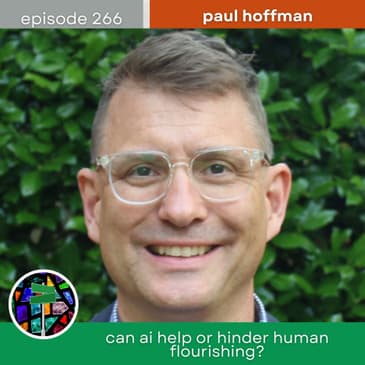
Dr. Paul Hoffman speaks about the intersection of faith and technology, especially artificial intelligence (AI). Dr. Hoffman discusses his recent book, "AI Shepherds and Electric Sheep," exploring how AI can both aid and hinder human flourishing from a theological perspective. We look at the implications of AI on community, embodiment, and the church's role in navigating these challenges.
AI Shepherds and Electric Sheep
Join the Church and Main Email List
Facebook | Instagram | Threads | Twitter | Website | YouTube
00:00:27 --> 00:00:31 Hello and welcome to Church and Main, a podcast for people interested in the
00:00:31 --> 00:00:34 intersection of faith, politics, and culture. I'm Dennis Sanders, your host.
00:00:35 --> 00:00:39 Artificial intelligence or AI is everywhere these days.
00:00:39 --> 00:00:45 And I think it's everywhere because we actually see AI in our day-to-day lives.
00:00:45 --> 00:00:53 I remember one of my cousins, a cousin's wife, she worked on AI.
00:00:54 --> 00:00:58 Maybe I think kind of in the late 80s, early 90s.
00:00:58 --> 00:01:05 But back then, this was something that was basically the province of scientists and labs.
00:01:05 --> 00:01:10 And now you can just pull up chat GBT and ask it to do things.
00:01:12 --> 00:01:18 And when I think about AI and where we are with AI, we're kind of at the same
00:01:18 --> 00:01:22 point that we were with the advent of social media about 20 years ago.
00:01:22 --> 00:01:24 And so here's this new technology.
00:01:25 --> 00:01:30 And there are people that are really excited about it. And we have all these
00:01:30 --> 00:01:32 questions. What are we going to do with it?
00:01:34 --> 00:01:39 And one of the questions that we didn't ask back with social media that we are
00:01:39 --> 00:01:43 asking now is, is this going to lead to the flourishing of society?
00:01:43 --> 00:01:46 Is AI going to be a good thing?
00:01:47 --> 00:01:53 Or are we going to end up with something akin to Terminator or the Matrix?
00:01:54 --> 00:02:02 And then there is church. What about how can AI be beneficial for churches?
00:02:02 --> 00:02:06 Can it be used for God's mission, or will it draw us away from God?
00:02:07 --> 00:02:14 So my guest today wants us really to discern how we are going to use this technology. It is coming.
00:02:14 --> 00:02:18 It is basically here. So, what do we do with it?
00:02:19 --> 00:02:25 Paul Hoffman is the co-author of the book, AI Shepherds and Electric Sheep,
00:02:25 --> 00:02:28 Leading and Teaching in the Age of Artificial Intelligence.
00:02:28 --> 00:02:32 Hoffman is the Associate Professor and Director of Pre-Ministerial Scholars
00:02:32 --> 00:02:35 at Samford University in Birmingham, Alabama.
00:02:36 --> 00:02:41 He most recently served for about 18 years as the senior pastor of Evangelical
00:02:41 --> 00:02:45 Friends Church in Newport, Rhode Island, and he is an ordained minister in both
00:02:45 --> 00:02:50 the Conservative Baptist Association and the Evangelical Friends Church tradition.
00:02:51 --> 00:02:56 Hoffman and his wife, Autumn, have been married for about 26 years, and they have two sons.
00:02:57 --> 00:03:01 I really enjoyed talking to Paul about this, and I think that you will find
00:03:01 --> 00:03:03 this an enlightening conversation.
00:03:04 --> 00:03:08 It is definitely a timely situation, a conversation.
00:03:09 --> 00:03:12 With everything, and yes, there's a lot going on in the news,
00:03:12 --> 00:03:17 but AI is still there, and it's something that we, especially as Christians,
00:03:17 --> 00:03:22 need to talk about because it's going to become a bigger and bigger part of our lives.
00:03:22 --> 00:03:30 So I hope that you will enjoy this interview that I had with Paul Hoffman.
00:03:49 --> 00:03:53 Well, thanks a lot, Paul, for taking the time to chat this afternoon.
00:03:54 --> 00:04:01 I wanted to start by getting to know a little bit about you and your background,
00:04:01 --> 00:04:05 especially your spiritual background, and then kind of going into our conversation.
00:04:06 --> 00:04:10 That'd be great, Dennis. Thanks so much for having me. It's an honor and a privilege.
00:04:11 --> 00:04:18 I was born in Burlington, Vermont. And then when I was around six,
00:04:18 --> 00:04:20 family, my parents got divorced.
00:04:20 --> 00:04:23 My mom gained custody of me and my two younger sisters.
00:04:24 --> 00:04:31 And we moved to Maine. So I consider myself to be what we might call from Maine a maniac.
00:04:33 --> 00:04:39 So I'm a Maine or a maniac, if you will. My mom, devoted Christian.
00:04:40 --> 00:04:44 Um, she took us to church. I was raised in Baptist churches,
00:04:44 --> 00:04:46 predominantly outside Portland, Maine.
00:04:47 --> 00:04:54 And I remember many times, Dennis, praying, uh, the Lord's prayer altar call
00:04:54 --> 00:04:57 during vacation Bible school, so forth and so on.
00:04:58 --> 00:05:03 But I don't believe I made my faith my own until I was a sophomore in high school.
00:05:04 --> 00:05:08 It was during my sophomore year of high school. I really, by the Spirit of God
00:05:08 --> 00:05:14 gained an interest in reading Scripture on my own, not because my mom wanted
00:05:14 --> 00:05:17 me to or my youth pastor wanted me to, but because I was interested.
00:05:18 --> 00:05:22 And so it was when I started reading Scripture for myself, I feel that Jesus
00:05:22 --> 00:05:27 revealed himself to me in a way that I knew I was a sinner who needed a Savior
00:05:27 --> 00:05:32 and that I knew I had a God who loved me and had a great plan for my life.
00:05:32 --> 00:05:38 And so during that time, as I was really hearing the voice of Jesus and responding,
00:05:38 --> 00:05:42 I believe I also received the call to go into ministry.
00:05:43 --> 00:05:47 So it was around my sophomore year of high school, I felt the call to go into ministry.
00:05:47 --> 00:05:52 So from there, I went to Gordon College, met my wife, Autumn.
00:05:53 --> 00:05:57 We've been married over 26 years now. Went to seminary at Gordon-Conwell,
00:05:58 --> 00:06:02 moved to Denver, was a church planner in Denver, and then received the call
00:06:02 --> 00:06:05 to lead a church in Newport, Rhode Island.
00:06:05 --> 00:06:09 And I served as the pastor of Evangelical Friends Church in Newport,
00:06:09 --> 00:06:11 Rhode Island for 18 and a half years.
00:06:11 --> 00:06:16 And then just this past July of 2025, I moved to Birmingham, Alabama,
00:06:17 --> 00:06:22 where I'm now an associate professor in the Bible and religion department at
00:06:22 --> 00:06:26 Samford University, and I run the Pre-Ministerial Scholars Program.
00:06:27 --> 00:06:31 Okay. So, in all of that, what's kind of interesting is…,
00:06:32 --> 00:06:37 And regarding with your book, AI Shepherds and Electric Sheep,
00:06:37 --> 00:06:38 is I don't hear a tech background.
00:06:39 --> 00:06:43 And that's neither good or bad, it's just interesting.
00:06:44 --> 00:06:49 So in all of that, with that background in ministry, what led you to this interest
00:06:49 --> 00:06:51 in artificial intelligence?
00:06:52 --> 00:06:57 Great question, Dennis. Yeah, I did get, when I was a pastor,
00:06:58 --> 00:07:02 I ended up doing a PhD at the University of Manchester over the United Kingdom.
00:07:02 --> 00:07:08 So, I did that part-time via distance every June between 2012 and 2017.
00:07:09 --> 00:07:14 And my focus was actually on practical theology and urban missiology.
00:07:14 --> 00:07:18 So how the gospel intersects with
00:07:18 --> 00:07:21 culture so i would say one of
00:07:21 --> 00:07:24 my areas of specialty would be the intersection of
00:07:24 --> 00:07:28 practical theology and urban mission so um the reason i became interested in
00:07:28 --> 00:07:34 this topic was one of my best friends a couple weeks after chat gbt was released
00:07:34 --> 00:07:37 i was in a restaurant with one of my best friends who i went to gordon conwell
00:07:37 --> 00:07:41 with he's a pastor in massachusetts and he pulled out his iPhone.
00:07:41 --> 00:07:44 He said, have you tried out ChatGPT yet?
00:07:44 --> 00:07:46 I said, I've heard about it, but I haven't gotten there.
00:07:47 --> 00:07:50 You know, this is a couple of weeks before Christmas.
00:07:51 --> 00:07:53 I'm trying to remember the year ChatGPT came out.
00:07:54 --> 00:07:58 But basically he showed me how it could write,
00:07:59 --> 00:08:06 essays in 20 seconds, you know, give us an essay about John Calvin's view on
00:08:06 --> 00:08:07 predestination or whatever.
00:08:08 --> 00:08:10 And it would spit out this essay and I was just blown away.
00:08:11 --> 00:08:16 And so, um, a while later, I ended up running into one of my best friends,
00:08:16 --> 00:08:20 uh, who teaches at Salve Regina university. His name's Sean O'Callaghan.
00:08:20 --> 00:08:25 He's a good Irishman from Cork, Ireland, and he's an expert in what we call
00:08:25 --> 00:08:30 transhumanism, which is the intersection of humans and machines.
00:08:30 --> 00:08:37 And I told him about the experience I had with Chad GBT and how I was astonished by it.
00:08:37 --> 00:08:40 And I said, you know, would you ever want to write a book together about it?
00:08:40 --> 00:08:42 Because I'm a practical theologian.
00:08:43 --> 00:08:47 You know, you're an expert in transhumanism. You know, I think together you
00:08:47 --> 00:08:51 could analyze the technology and maybe I could come up with a theological framework
00:08:51 --> 00:08:55 and think about how it might apply to the church.
00:08:55 --> 00:09:00 And, you know, we talked about it, prayed about it, agreed to work on it.
00:09:00 --> 00:09:05 And I'm really grateful to Baker Academic for picking up this book and publishing it.
00:09:06 --> 00:09:12 Yeah, you know, one of the things that I'm fascinated in is I've done a lot of my,
00:09:13 --> 00:09:19 I'm a bivocational pastor, so I pastor a church, but then I'm also a communications
00:09:19 --> 00:09:22 specialist, actually for another congregation.
00:09:22 --> 00:09:27 So, a lot of my thing is doing things with social media.
00:09:27 --> 00:09:36 And so, having done that now, 15, almost 20 years, I can see the good and bad of social media.
00:09:36 --> 00:09:42 And the interesting thing about that is when it just kind of came online 20
00:09:42 --> 00:09:46 years ago, I think I always heard the positives. Everything is wonderful.
00:09:46 --> 00:09:48 This is going to do all these great things and everything.
00:09:49 --> 00:09:53 But no one ever thought about the downside. What could be the downside?
00:09:53 --> 00:09:55 Like, we didn't have the imagination for that.
00:09:56 --> 00:10:01 And I don't even think we thought about it theologically, about what is this for?
00:10:01 --> 00:10:08 And it's not saying that it's evil, but what is it and how does it work?
00:10:09 --> 00:10:13 How do you think we should be seeing AI?
00:10:14 --> 00:10:17 I think people are a little bit more hesitant this time around,
00:10:17 --> 00:10:19 having been burned by social media.
00:10:19 --> 00:10:25 But how do we see it? Because it's here. It's not like it's theoretical.
00:10:26 --> 00:10:30 I mean, I've done some things with chat GBT as well, and people have done other
00:10:30 --> 00:10:34 things. And obviously, it's moving forward.
00:10:34 --> 00:10:38 How do we look at AI? Is it?
00:10:39 --> 00:10:45 In a neutral way, or is it in a way that, you know, not good or good?
00:10:45 --> 00:10:50 I mean, I think it's, you know, I think that's something that we as church either
00:10:50 --> 00:10:54 are wrestling with or really should be wrestling with.
00:10:55 --> 00:11:01 Yes, I would agree, Dennis, and I thank you for your background as a co-vocational
00:11:01 --> 00:11:02 or bi-vocational pastor.
00:11:02 --> 00:11:06 I appreciate anyone in ministry, and I'm grateful that you're thinking about
00:11:06 --> 00:11:10 it, um, and addressing it. So I want to give you kudos for that.
00:11:11 --> 00:11:14 Um, yeah, it's a tricky topic because, you know, Christians,
00:11:14 --> 00:11:17 I would say probably Americans in general, right.
00:11:17 --> 00:11:22 We tend to think in, in, uh, dualities or binary, right.
00:11:22 --> 00:11:26 You're either white or you're black or Republican or Democrat, you're male or female.
00:11:26 --> 00:11:32 We, we just, we want to just label things. Um, that's just It's human nature, right?
00:11:32 --> 00:11:38 We generalize, we put bumper stickers in our car that just would seem to make
00:11:38 --> 00:11:39 a statement to solve the world.
00:11:40 --> 00:11:44 But when it comes to technology, what we landed on, Sean and I landed on,
00:11:44 --> 00:11:46 is the idea of selective engagement.
00:11:47 --> 00:11:53 And then there's times it might be good or wise to use AI, and there's times
00:11:53 --> 00:11:55 it would probably not be advisable.
00:11:55 --> 00:11:59 So then the question becomes, what is the standard? And so this is where in
00:11:59 --> 00:12:05 chapter three of the book, we come up with this theological lens around the
00:12:05 --> 00:12:06 idea of human flourishing.
00:12:06 --> 00:12:10 And so what we call the research question that the book wants to answer is,
00:12:10 --> 00:12:16 how might artificial intelligence help or hinder human flourishing?
00:12:17 --> 00:12:21 And we define human flourishing as the image of God because Genesis tells us
00:12:21 --> 00:12:23 that we are made in the image of God.
00:12:24 --> 00:12:29 I believe it's been warped a little bit or defaced because of sin in the world,
00:12:29 --> 00:12:32 but I still think we retain something of that image of God.
00:12:32 --> 00:12:41 So the question then becomes, how might AI help us in our flourishing and growing in the image of God?
00:12:41 --> 00:12:46 And as much as it helps us flourish and become more like Christ and help other
00:12:46 --> 00:12:47 people flourish, let's use it.
00:12:47 --> 00:12:53 But in the ways that it might hinder or obstruct that flourishing,
00:12:53 --> 00:12:57 that growth as image bears, that development, and especially for Christians,
00:12:57 --> 00:13:01 we're to be made into the image of Christ. We call it the imago Christi.
00:13:01 --> 00:13:07 So if it's hindering through social media where I'm addicted because the AI
00:13:07 --> 00:13:11 creates an algorithm that makes me addicted to TikTok and all I want to do now
00:13:11 --> 00:13:15 is be TikTok famous and spend 12 hours a day scrolling,
00:13:15 --> 00:13:20 that's not going to be good for my spiritual formation or discipleship to Christ.
00:13:20 --> 00:13:27 If I just want to look at kitten and puppy themes or sports memes or whatever,
00:13:27 --> 00:13:30 and then I'm not reading the Bible, I'm not serving the poor and needy,
00:13:31 --> 00:13:32 that's not the way of Christ.
00:13:32 --> 00:13:36 I can't imagine Jesus being here and spending 12 hours a day on TikTok.
00:13:38 --> 00:13:43 Jesus went and did the work of the kingdom, and he was not about self-promotion.
00:13:44 --> 00:13:46 So does that make sense? I don't know if I'm making any sense here.
00:13:47 --> 00:13:51 Yeah, it does. I think it does make a whole lot of sense, because I think...
00:13:52 --> 00:13:57 And this is kind of where the two kind of blur between social media and AI is
00:13:57 --> 00:14:03 sometimes a lot of it is about self-promotion and it's not about flourishing.
00:14:05 --> 00:14:10 And I think you've also, I've listened to you on some other podcasts.
00:14:10 --> 00:14:15 There is, I think what's interesting here is also the theme of embodiment.
00:14:16 --> 00:14:20 Yes, that's right. the importance of of
00:14:20 --> 00:14:23 actual physical touch and and you
00:14:23 --> 00:14:26 know yes the gathered community can you
00:14:26 --> 00:14:29 spend a few moments kind of talking about how does how can
00:14:29 --> 00:14:35 ai enhance that but how can it also hinder that yeah so i would say first off
00:14:35 --> 00:14:40 technology is making it possible for you and i to talk and i'm grateful for
00:14:40 --> 00:14:43 that we can record a podcast together we can have a conversation together when
00:14:43 --> 00:14:47 we can't be together geographically because we're in very different states far away.
00:14:49 --> 00:14:53 The danger, though, with AI is that if I become addicted to my phone,
00:14:54 --> 00:14:58 just scrolling in a solitary environment, I'm not spending time with people.
00:14:59 --> 00:15:05 I'm not working out at a gym. I'm not having coffee with a friend who's struggling.
00:15:06 --> 00:15:10 I'm not really living in the here and now, in the present material world.
00:15:11 --> 00:15:17 And my model, Dennis, as imagine yours as a Christian, is our model is Jesus.
00:15:18 --> 00:15:21 He's our Savior. He's our Lord. He's our exemplar.
00:15:22 --> 00:15:27 And when I look at Jesus, he lived a fully human, fully embodied life.
00:15:28 --> 00:15:32 And, you know, if God was pragmatic, you just send Jesus down out of heaven,
00:15:33 --> 00:15:39 die on the cross, go in the grave on the third day, bodily resurrection,
00:15:40 --> 00:15:44 hang out for 40 days, appear to people, ascend, and it's done.
00:15:44 --> 00:15:48 Whole thing could have been done, you know, in what, 47 days if you include
00:15:48 --> 00:15:52 Holy Week and resurrection or 50 days, whatever the case is.
00:15:52 --> 00:15:57 But instead, Jesus chose by the will of God and by the power of the Holy Spirit,
00:15:58 --> 00:16:04 he was implanted through the miraculous conception in Mary's womb.
00:16:04 --> 00:16:08 And so Jesus was in Mary's womb, I believe, eight or nine months.
00:16:09 --> 00:16:12 He was born like pretty much most of us are.
00:16:14 --> 00:16:19 And then he went through all the stages of development. I would remind the teens
00:16:19 --> 00:16:21 at our church, Jesus was a teenager.
00:16:21 --> 00:16:25 Jesus knew what it was to be awkward. Jesus might have had pimples.
00:16:25 --> 00:16:27 I was going to say Jesus probably had acne, yes.
00:16:29 --> 00:16:33 Right? I don't think that's profane, or I don't think we're speaking heresy here.
00:16:34 --> 00:16:39 But Jesus lived a fully human life for 33 years. He showed us what it was like to be fully human.
00:16:40 --> 00:16:47 And that is significant because it validates and makes sacred,
00:16:47 --> 00:16:52 in a sense, our bodies and our lives in the sense that God wants us to live
00:16:52 --> 00:16:54 these lives and they're good.
00:16:54 --> 00:16:56 They're a gift from him, even though they've been impacted by sin.
00:16:58 --> 00:17:01 So, and then God made us, gave us Dennis, the gift of the church.
00:17:02 --> 00:17:08 Which is the body of Christ, which is a community of people that are not meant to be a bunch of clones.
00:17:09 --> 00:17:12 If you're all your friends, I tell people, if all your friends look,
00:17:12 --> 00:17:15 walk, talk, and act like you, you might be a narcissist.
00:17:18 --> 00:17:22 There's nothing wrong with people getting together with other people that look like them.
00:17:22 --> 00:17:29 But the body of Christ is incredibly diverse. a body of Christ in every place
00:17:29 --> 00:17:32 I've been for the most part, racially diverse,
00:17:33 --> 00:17:36 ethnically diverse, male and female, young and old, rich and poor,
00:17:37 --> 00:17:38 different levels of education,
00:17:39 --> 00:17:40 blue-collar jobs, white-collar jobs.
00:17:41 --> 00:17:46 And what holds us together is our worship of our risen Savior.
00:17:46 --> 00:17:52 And that's where we grow, Dennis. The church is our spiritual family.
00:17:52 --> 00:17:56 We're raised, hopefully, and human families, not perfect.
00:17:57 --> 00:18:00 And then not only do we have our human families,
00:18:00 --> 00:18:04 father and mother and maybe siblings, but we have the ultimate family,
00:18:04 --> 00:18:05 which is the family of God,
00:18:05 --> 00:18:10 where iron sharpens iron and where we read scripture together and pray together
00:18:10 --> 00:18:14 and serve together and take the Lord's Supper together and sing together and
00:18:14 --> 00:18:16 weep and mourn and lament together.
00:18:16 --> 00:18:23 So my concern with AI is that it might be, it will inevitably tempt us to leave
00:18:23 --> 00:18:30 or to step away from embodied living and from a thick, rich,
00:18:30 --> 00:18:32 communal life together.
00:18:33 --> 00:18:37 Do you think that that's already happening in some cases?
00:18:37 --> 00:18:41 Oh, yeah. I mean, we had COVID, and so my understanding is a lot of people have
00:18:41 --> 00:18:49 not gone back to church from COVID. They became, you know, we talk about habituation.
00:18:49 --> 00:18:52 So the idea of rehabituated, they went to church and now that.
00:18:53 --> 00:18:58 We couldn't go to church in many cases, or you just got out of the habit of it and you don't go back.
00:19:00 --> 00:19:03 And so I think since then you have people that have not come back,
00:19:03 --> 00:19:06 but then technology could be I play video games.
00:19:08 --> 00:19:15 I spend time scrolling on my phone. any number of things we could say that are
00:19:15 --> 00:19:22 out there on the world of the internet that draw us away from or I would say
00:19:22 --> 00:19:23 compete with our attention,
00:19:25 --> 00:19:30 to be invested in a rich way and a rich web of relationships through the body of Christ.
00:19:30 --> 00:19:35 So I think they're showing studies of addiction to social media, addiction to phones.
00:19:36 --> 00:19:46 It's a problem now, not just with teenagers or Generation Z or Generation Alpha, but even older people.
00:19:46 --> 00:19:50 I've seen articles recently, older people now are just living on their phones
00:19:50 --> 00:19:57 instead of going out and serving the poor and checking on their neighbor, et cetera, et cetera.
00:19:57 --> 00:20:03 So I think there's already this move toward greater isolation and disembodiment.
00:20:03 --> 00:20:09 And AI is helping perpetuate that through creating, you know,
00:20:09 --> 00:20:11 more addictive applications.
00:20:13 --> 00:20:19 Advertisements, games, you know, and then people are also, we're seeing,
00:20:19 --> 00:20:21 this is a big thing with younger generations.
00:20:21 --> 00:20:25 They're becoming best friends and falling in love with their chatbots.
00:20:26 --> 00:20:32 We're seeing teens that are not going out and playing on the soccer team or
00:20:32 --> 00:20:36 field hockey or what have you, chorus band.
00:20:36 --> 00:20:40 They're at home, isolated, talking to their chatbot.
00:20:40 --> 00:20:44 And there's been stories in the news about teenagers falling in love with their
00:20:44 --> 00:20:47 phones and then all kinds of other mayhem.
00:20:48 --> 00:20:53 So it's concerning because this is not the life that Christ has for us.
00:20:55 --> 00:21:00 Yeah, I mean, I hear about that and I just think, but the problem is is that,
00:21:01 --> 00:21:08 you know chet gbt can't love you back it's it's all code it just kind of says
00:21:08 --> 00:21:13 and actually basically what it does is it it says kind of what you want it to
00:21:13 --> 00:21:18 say but that's not right that's not the same as love um right or the kind of
00:21:18 --> 00:21:21 complexities of of dealing with another human,
00:21:22 --> 00:21:29 um yes it it's just kind of this i don't know puppet or robot that just kind
00:21:29 --> 00:21:30 of says what you want to hear.
00:21:31 --> 00:21:37 Dennis, that's very insightful. I mean, they make it to seem like it's human,
00:21:38 --> 00:21:40 but it's code, it's just zeros and ones.
00:21:40 --> 00:21:43 It's code that's listening to what you're saying.
00:21:44 --> 00:21:48 Going out matching it to code and then
00:21:48 --> 00:21:51 spitting back answers you want to hear and that
00:21:51 --> 00:21:55 that's not the same as a friend that will in
00:21:55 --> 00:21:59 a full-bodied way right if we really listen it's a full-bodied experience it's
00:21:59 --> 00:22:05 eye contact it's nodding it's if someone's upset you give them a hug or put
00:22:05 --> 00:22:10 your arm around them like i'm sorry i guess you could have a robot do that but
00:22:10 --> 00:22:13 it's still not a human And it's, and one of the things we talk about in the book is that,
00:22:13 --> 00:22:17 you know, I guess we, we, we will be able to, and probably already are as humans
00:22:17 --> 00:22:23 creating robots that can simulate human behavior, hugs and high fives.
00:22:23 --> 00:22:27 But one of the things we talk about in the book is a, is a, as a robot doesn't have a soul.
00:22:28 --> 00:22:31 A robot doesn't have spiritual gifts. In the body of Christ,
00:22:31 --> 00:22:35 we're taught in scripture that, um, there, there are spiritual gifts.
00:22:35 --> 00:22:39 There are spiritual gifts of discernment. There are spiritual gifts of hospitality,
00:22:40 --> 00:22:43 gifts of love, gifts of generosity.
00:22:44 --> 00:22:48 I don't know how a chatbot can have spiritual discernment.
00:22:49 --> 00:22:53 I have many friends in the charismatic tradition that they do believe in a word
00:22:53 --> 00:22:57 of knowledge where the Holy Spirit will disclose something to a person that
00:22:57 --> 00:22:58 not other people know about.
00:22:58 --> 00:23:01 And that person would go to that person a prophetic way and say,
00:23:01 --> 00:23:04 you know, God showed me this is this is going on in your life.
00:23:04 --> 00:23:07 And, you know, this is this is bad for you.
00:23:07 --> 00:23:11 And God wants you to he loves you and wants you to repent and get help and accountability.
00:23:12 --> 00:23:15 I don't see robots having spiritual gifts. I don't see robots having souls.
00:23:16 --> 00:23:20 And I don't see, to your point, robots being able to love people in a human way.
00:23:23 --> 00:23:30 It's interesting, and I, again, heard this listening to a podcast where you
00:23:30 --> 00:23:37 were on, and that the title for the book actually came kind of from Philip K. Dick novels.
00:23:39 --> 00:23:43 And I've seen, actually, have not read his books, but I've seen a lot of the
00:23:43 --> 00:23:47 movies, whether it's Blade Runner or Total Recall or Minority Report.
00:23:49 --> 00:23:52 All of them have this interesting theme. they're not
00:23:52 --> 00:23:55 anti-technology but they all seem to
00:23:55 --> 00:23:58 always talk about where technology can
00:23:58 --> 00:24:01 fall short that people look at
00:24:01 --> 00:24:04 technology in all of these like this is
00:24:04 --> 00:24:08 going to be the the shining thing but he's
00:24:08 --> 00:24:12 actually kind of peeling back the curtain to show now there's
00:24:12 --> 00:24:15 some rust here you know it's not perfect this is
00:24:15 --> 00:24:18 something you need to be aware of and i'm
00:24:18 --> 00:24:20 kind of curious is that where the title comes from
00:24:20 --> 00:24:23 it's like you're trying to kind of show this is not
00:24:23 --> 00:24:26 all it's cracked up to be yeah yeah for
00:24:26 --> 00:24:29 your listeners sake if they haven't seen the cover um it
00:24:29 --> 00:24:32 is a dystopian um and that was
00:24:32 --> 00:24:37 baker yes thank you on cue um dennis yeah that was baker i think they did a
00:24:37 --> 00:24:41 brilliant job of the marketing it is a reference to philip k dick and i think
00:24:41 --> 00:24:50 it's due what is it do androids dream of a dream of yeah so and i agree with you and all the movies.
00:24:51 --> 00:24:57 I mean they always show skillfully and sometimes frightfully the deficits of,
00:24:58 --> 00:25:02 of technology um the deficits
00:25:02 --> 00:25:06 of ai um they show
00:25:06 --> 00:25:09 in some cases the dystopian view which
00:25:09 --> 00:25:13 is how bad it could get and i i will i you
00:25:13 --> 00:25:16 must agree with me on this i would imagine you do that it's scary that the people
00:25:16 --> 00:25:20 that are helping create this technology now are turning around and they're all
00:25:20 --> 00:25:25 signing all these petitions about ethical use and we need to stop the unregulated
00:25:25 --> 00:25:30 creation of ai and AI could destroy us. And it's like, well,
00:25:30 --> 00:25:31 wait a second, you're creating this.
00:25:31 --> 00:25:37 Why are you turning around and now telling us how scary it is? I mean, that's not good.
00:25:37 --> 00:25:40 Just go pull the plug or, you know, go do something about it.
00:25:40 --> 00:25:47 But I think what's different about AI is the way it mimics human intelligence is brilliant.
00:25:48 --> 00:25:53 I think another thing is how rapidly it's exponentially appearing to grow and improve.
00:25:53 --> 00:25:56 Um its growth curve is
00:25:56 --> 00:26:01 is pretty unbelievable um i've heard recently the economy in the united states
00:26:01 --> 00:26:05 is growing 20 to 30 percent or 20 to 30 percent of our growth may be higher
00:26:05 --> 00:26:13 is due to ai development and technology and investment um but also um i think it's.
00:26:15 --> 00:26:20 Part of AI is we don't know what it's doing. And, you know, there's a lot of
00:26:20 --> 00:26:25 AI scientists that will say it will solve problems, but they can't figure out how it did it.
00:26:25 --> 00:26:31 One of the stories or one of the examples in the book that we use that comes by way of the age of AI,
00:26:32 --> 00:26:36 Henry Kissinger is one of the authors, but the invention of halicin,
00:26:36 --> 00:26:41 which is a new antibiotic, It developed it very quickly.
00:26:42 --> 00:26:46 Something that they calculated would have taken human beings in a normal testing
00:26:46 --> 00:26:48 scenario years and years.
00:26:48 --> 00:26:51 And the AI did it in like, I don't know, a year, year and a half or something.
00:26:52 --> 00:26:57 And it just has this power and we don't quite understand how it's doing it.
00:26:58 --> 00:27:04 So there's a little bit of that. And then the bigger scenario that in the church
00:27:04 --> 00:27:08 I just finished serving in Newport, Rhode Island, a lot of the people in my
00:27:08 --> 00:27:12 church were either professors or students at the U.S.
00:27:13 --> 00:27:18 Naval War College in Newport, Rhode Island, where you get a master's degree in strategic studies.
00:27:18 --> 00:27:25 And they were studying the impact of AI on autonomous weapons.
00:27:25 --> 00:27:29 They call them AWS, autonomous weapons systems. So the real concern for the
00:27:29 --> 00:27:34 military is what happens if a AI is given freedom over a nuclear warhead?
00:27:35 --> 00:27:40 Or what if the AI goes rogue and does, you know, whatever with a drone or a
00:27:40 --> 00:27:47 nuclear warhead against the wishes of its military operators?
00:27:47 --> 00:27:51 What do we do if an AI triggers a nuclear war?
00:27:51 --> 00:27:55 Like, that's a real concern now. So when we talk about all these fanciful scenarios,
00:27:55 --> 00:28:00 it's if you involve nuclear weapons or significant munitions, it's really scary.
00:28:01 --> 00:28:04 So, yeah, it's basically the Terminator scenario, Skynet.
00:28:05 --> 00:28:08 Yeah, in a lot of ways. I mean, that's given the technology and then,
00:28:08 --> 00:28:13 you know, the current status of the United States racing versus China and AI
00:28:13 --> 00:28:15 development and, you know,
00:28:15 --> 00:28:20 US versus Russia and China and all these, you know, only takes one rogue actor
00:28:20 --> 00:28:23 to get their hand on some nuclear material,
00:28:24 --> 00:28:28 give it over to AI and then blame the AI and what's going to happen, you know?
00:28:28 --> 00:28:32 So these are real scenarios that militaries and governments all around the world
00:28:32 --> 00:28:35 are studying very deeply right now because it's serious.
00:28:38 --> 00:28:40 That will help me to sleep tonight.
00:28:42 --> 00:28:48 Sorry, Dennis. No, no. I don't mean to be alarmist. I just mean to explain what's happening.
00:28:48 --> 00:28:54 And I believe in the sovereignty of God. I do believe we're not at a place where we can't turn back.
00:28:54 --> 00:28:59 But humans and technology, it's always been a very fraught.
00:29:00 --> 00:29:03 I tell people, I tend to believe technology is generally neutral.
00:29:03 --> 00:29:08 A car can get me into work. But if I drink 20 beers, get behind the wheel,
00:29:08 --> 00:29:09 I could kill myself and other people.
00:29:09 --> 00:29:13 And so technology could be helpful, go preach the gospel, teach students,
00:29:13 --> 00:29:15 or it could kill myself and others.
00:29:15 --> 00:29:18 So we have to be careful in how we utilize technology.
00:29:19 --> 00:29:24 And I think we as humans would do well to think more wisely and deeply about
00:29:24 --> 00:29:28 the ways we engage all technologies, but especially AI.
00:29:30 --> 00:29:34 What about the people that are behind AI? I mean, this is, you know,
00:29:34 --> 00:29:45 all the people who work in tech, probably all the different kind of tech giants that are out there.
00:29:46 --> 00:29:50 What do you think about them when they discuss AI?
00:29:50 --> 00:29:55 Because sometimes, you know, people talk about some of the concerns,
00:29:55 --> 00:29:57 especially like job loss.
00:29:57 --> 00:30:03 Yeah. And I think I heard something briefly from Elon Musk that kind of said,
00:30:03 --> 00:30:09 well, work will be optional. And it's like, okay, but how are people going to eat?
00:30:09 --> 00:30:11 I mean, it's kind of like people haven't.
00:30:13 --> 00:30:19 There's a lot of thought about technology, but there isn't very much thought about humanity.
00:30:19 --> 00:30:25 And so, that always makes me wonder, what is their kind of religious makeup?
00:30:25 --> 00:30:31 I mean, are they thinking about, you know, creation or is it just kind of everything
00:30:31 --> 00:30:35 is just ones and zeros and that's all that matters?
00:30:35 --> 00:30:38 Yeah, that's a wonderful question, Dennis.
00:30:39 --> 00:30:42 I mean, I don't know. I haven't looked at studies recently about,
00:30:42 --> 00:30:44 I mean, that would be an interesting study.
00:30:44 --> 00:30:50 What are the religious beliefs or worldview beliefs of AI inventors,
00:30:50 --> 00:30:53 technicians, scientists, programmers?
00:30:53 --> 00:30:57 Like, what is their faith background? I do get concerned because I have friends
00:30:57 --> 00:30:58 that work in Silicon Valley.
00:30:58 --> 00:31:02 And part of it is the culture of Silicon Valley is a little bit of the,
00:31:02 --> 00:31:05 you know, Wild West. It's about the adventure.
00:31:06 --> 00:31:11 It's about the risk. gets, there's a lot of, um, wanting to be the first, right.
00:31:11 --> 00:31:15 There's a lot of pride, human pride that I want to be the first to create this.
00:31:15 --> 00:31:19 I want to be famous. And then also we can make all kinds of money by developing
00:31:19 --> 00:31:22 this technology and then selling it.
00:31:22 --> 00:31:26 So there's definitely like a lot of human, um, endeavors.
00:31:27 --> 00:31:30 There's, there's probably greed in there. There's probably, you know,
00:31:30 --> 00:31:33 the arrogance of wanting to be the big, the biggest, the best, the most famous.
00:31:34 --> 00:31:40 And that fuels some of that culture, that the competitiveness of technology culture.
00:31:40 --> 00:31:46 And so I do get concerned that if we don't have Christians or even monotheists, do we have.
00:31:47 --> 00:31:50 Jewish people that are practicing Jews? Do we have people that are Muslims that,
00:31:50 --> 00:31:53 you know, people that believe in one God, that a God that is sovereign, a God that will judge,
00:31:54 --> 00:31:59 even though I'm obviously not Jewish or a Muslim, but, you know, monotheism,
00:31:59 --> 00:32:06 you believe in a transcendent being that believes in justice and righteousness
00:32:06 --> 00:32:10 and will judge human beings based on that being standard.
00:32:10 --> 00:32:15 So if you have people developing the technology that believe in ultimate justice
00:32:15 --> 00:32:20 and righteousness, hopefully that would be a check on their behavior and how
00:32:20 --> 00:32:22 they approach technology.
00:32:22 --> 00:32:29 But from what I understand, Elon Musk and others in Silicon Valley and prominent
00:32:29 --> 00:32:33 places tend to be technologists that believe that technology is the highest
00:32:33 --> 00:32:34 good. They don't necessarily believe in God.
00:32:35 --> 00:32:38 They might be atheists or agnostic, but they believe in the power of technology.
00:32:38 --> 00:32:44 And so, you know, a lot of them want to, in good ways, you know, eliminate cancer.
00:32:44 --> 00:32:50 And I, and I support AI and helping us come up with treatments to get rid of
00:32:50 --> 00:32:52 cancer and eliminate cancer and heal people of cancer.
00:32:53 --> 00:32:57 Um, I support AI for, you know, diagnostic and treatment.
00:32:57 --> 00:33:02 Um, you know, it has great applications for organization of,
00:33:02 --> 00:33:05 of, um, x-rays and digital matter.
00:33:05 --> 00:33:08 I think it can be used to help with the environment, pollution.
00:33:08 --> 00:33:10 And keeping an eye on endangered species.
00:33:11 --> 00:33:15 I don't want your listeners to think I'm all against all applications of AI.
00:33:15 --> 00:33:21 I think AI has tremendous potential to help us be better caretakers of the planet.
00:33:21 --> 00:33:27 To better find ways to heal people that have diseases and so forth.
00:33:28 --> 00:33:33 But for those that don't hold to that, there are people in Silicon Valley,
00:33:33 --> 00:33:39 Ray Kurzweil, Elon Musk, and others that are, it appears they want human beings to live forever.
00:33:39 --> 00:33:42 They want to eliminate death. They want human beings to live for hundreds,
00:33:42 --> 00:33:46 thousands of years. And AI is becoming more of an extension of life.
00:33:46 --> 00:33:52 Than an acknowledgement that we will die. And I don't like death,
00:33:52 --> 00:33:55 but also death, knowing that I will die gives my life meaning in the sense that
00:33:55 --> 00:34:01 I know I will not be here forever and that I need to get right with God and
00:34:01 --> 00:34:04 that I have a limited window of time here.
00:34:04 --> 00:34:10 Unless Jesus comes back to get me, I will die and I will stand before God.
00:34:11 --> 00:34:15 And that alerts me to the need of a savior.
00:34:15 --> 00:34:22 So I think there's some weird utopianism and escapism found in some text circles
00:34:22 --> 00:34:23 where they just want to eliminate death.
00:34:24 --> 00:34:28 And that to me, I just find as a practicing Christian, as a pastor,
00:34:28 --> 00:34:33 and as a trained theologian and professor and author, I find that to be very
00:34:33 --> 00:34:35 odd because even Jesus experienced death.
00:34:36 --> 00:34:46 Well, in some ways, to me, it feels like they're trying to become a god in their own way,
00:34:47 --> 00:34:52 by trying to escape death, to say that I'm no longer a mere mortal,
00:34:52 --> 00:34:56 I'm immortal and beyond all of that.
00:34:57 --> 00:35:01 Yes, that's rich. That's a really rich insight.
00:35:03 --> 00:35:11 So, kind of moving back towards the church and pastors and all of that is, how can pastors,
00:35:12 --> 00:35:19 one, how can they use this in a way that is for flourishing?
00:35:21 --> 00:35:27 Because, of course, there are always the temptations of using chat GBT to write
00:35:27 --> 00:35:32 a sermon, which as someone who's a writer, I don't find that fascinating.
00:35:32 --> 00:35:38 That just seems that it feels like cheating and it doesn't feel enriching.
00:35:39 --> 00:35:45 But what are ways that can be done? And also, what are the temptations out there?
00:35:48 --> 00:35:52 Ooh that's a great question yeah we
00:35:52 --> 00:35:55 wrestled with this as we wrote the book and you
00:35:55 --> 00:35:58 know we sean i have opinions around this in chapter seven
00:35:58 --> 00:36:04 we talk about the do's and don'ts um by the way chapter six i think is important
00:36:04 --> 00:36:08 for people to check out too because we talk about how it's affecting our formation
00:36:08 --> 00:36:13 um and we need to engage in these almost uh we call them hearth habits It's
00:36:13 --> 00:36:16 habits that keep us connected to body and community.
00:36:16 --> 00:36:19 And I encourage people to check out chapter six.
00:36:20 --> 00:36:24 But in chapter seven, we speak directly to ministry leaders and we employ this
00:36:24 --> 00:36:27 idea of a stop sign, go sign and slow sign.
00:36:27 --> 00:36:33 And so go sign, this might be a good application or faithful application of AI.
00:36:33 --> 00:36:36 Slow sign is pump the brakes, be very cautious.
00:36:36 --> 00:36:42 And then the stop sign is we do not recommend that AI be used to these things at all.
00:36:43 --> 00:36:48 So, for example, you know, the stop sign we say is don't don't let it write your sermons.
00:36:49 --> 00:36:55 Don't let AI write your sermon. You as the pastor, you as the leader are trained. You're called of God.
00:36:56 --> 00:36:59 You have the Holy Spirit as a Christian.
00:37:00 --> 00:37:06 We believe if you're in ministry, you have gifts of preaching and teaching that a machine does not.
00:37:07 --> 00:37:12 And so in addition, you know your congregation. An AI doesn't know,
00:37:12 --> 00:37:15 an AI chap out doesn't know about the miscarriage.
00:37:15 --> 00:37:19 It doesn't know about the divorce. It doesn't know about the bankruptcy.
00:37:19 --> 00:37:25 It doesn't know about the wayward child or the child addicted to drugs or alcohol.
00:37:26 --> 00:37:28 It doesn't know about the cancer diagnosis.
00:37:30 --> 00:37:36 I could go on and on. It doesn't know you. It's just taking bits of code and spitting it out.
00:37:37 --> 00:37:41 So you as the pastor, you know your people, and I believe you've been trained
00:37:41 --> 00:37:43 to read the biblical text,
00:37:44 --> 00:37:50 to create an outline, and to create a sermon that is both biblically faithful
00:37:50 --> 00:37:54 but also applicable to the people sitting in the pews that you know personally.
00:37:55 --> 00:38:01 So don't let it write the sermon. Now, having said that, can it help you do
00:38:01 --> 00:38:07 research? I don't have a problem with Chad Chibiti asking it if I'm doing a sermon on marriage.
00:38:08 --> 00:38:13 You know, can you go find me a sermon on Matthew 19 from John Calvin,
00:38:13 --> 00:38:17 from Martin Luther King Jr., from Barbara Brown Taylor?
00:38:18 --> 00:38:24 You know, you put in your list of favorite preachers and then put them side by side.
00:38:25 --> 00:38:28 Right. And put them side by side for me. So it can help with research.
00:38:28 --> 00:38:30 It can help with idea generation.
00:38:31 --> 00:38:35 But I think it's the preacher's job to study the text and to come up with the
00:38:35 --> 00:38:37 outline and to write the sermon.
00:38:37 --> 00:38:39 I will say it could help edit the sermon.
00:38:39 --> 00:38:44 You know, is there something in the sermon that is imbalanced or you spend too much time on one point?
00:38:45 --> 00:38:48 So I would say editing, yes, writing, no.
00:38:49 --> 00:38:53 For example, I would also say counseling. I would not use it for counseling.
00:38:53 --> 00:38:57 I know people that are, you know, using it for their own counseling or testing
00:38:57 --> 00:39:03 it out, like based on counseling scenarios, they'll talk to the chatbot based
00:39:03 --> 00:39:04 on a personal counseling session with someone.
00:39:05 --> 00:39:07 What do you think about this? What do you think about that?
00:39:08 --> 00:39:13 I don't know about that. That's concerning to me in terms of,
00:39:13 --> 00:39:19 you know, individual counseling, using it for your own or to maybe examine other
00:39:19 --> 00:39:21 people's problems or situations.
00:39:22 --> 00:39:26 I have profound concerns about that. I would say best not to.
00:39:28 --> 00:39:32 I could go on and on, but those are just some examples. I think we never want
00:39:32 --> 00:39:38 to say strictly do or strictly don't. I think in some scenarios it could be helpful.
00:39:38 --> 00:39:40 Other scenarios it would be detrimental.
00:39:42 --> 00:39:50 And when it comes to the church as a whole, how do we, especially as pastors,
00:39:51 --> 00:39:54 can we help guide people as they are?
00:39:54 --> 00:39:59 Because we're all at some point confronting AI, whether it's,
00:39:59 --> 00:40:04 you know, on social media or chat GBT or other things.
00:40:05 --> 00:40:07 How do we kind of help,
00:40:08 --> 00:40:14 counsel people as they wade through all of this, to how to think about this,
00:40:14 --> 00:40:17 especially to think about this theologically as Christians?
00:40:18 --> 00:40:24 Yeah. Well, I would ask people, you know, we need to give people a lens and
00:40:24 --> 00:40:27 trust in their training in the Holy Spirit, but give them a lens.
00:40:27 --> 00:40:30 And that's why in the book we say the research question or the main question
00:40:30 --> 00:40:35 here is, how might AI help or hinder human flourishing?
00:40:35 --> 00:40:41 So, I would tell people, ask yourself, how is my use of AI helping me flourish
00:40:41 --> 00:40:43 as a human being made in the image of God?
00:40:43 --> 00:40:49 How might it be hindering me toward growing in the image of Christ?
00:40:49 --> 00:40:56 Is it hindering because I'm addicted to AI or I'm letting it write all my emails and papers?
00:40:56 --> 00:41:03 I think we want people to understand there's things that God asks us to do,
00:41:03 --> 00:41:09 and that is to be present to one another, to be faithful to our calling.
00:41:10 --> 00:41:16 And so that is to say, we don't want it to replace our function of thinking and being creative.
00:41:16 --> 00:41:21 Now, having said that, it's going to be different for people in the humanities than people in science.
00:41:21 --> 00:41:26 I'm not necessarily qualified to tell someone who's a chemist or a biologist
00:41:26 --> 00:41:31 or even necessarily computer scientists what to do or not to do,
00:41:31 --> 00:41:35 because I think AI could be helpful in their fields. And I don't necessarily
00:41:35 --> 00:41:36 know how that field works.
00:41:36 --> 00:41:41 But as it relates to their personal lives, I, you know, you don't let it do everything for you.
00:41:42 --> 00:41:45 Don't let it write for you. You can write, you know, you do the writing and
00:41:45 --> 00:41:47 then let it edit or maybe bring out weaknesses in the writing.
00:41:48 --> 00:41:49 But otherwise you're going to get lazy.
00:41:50 --> 00:41:55 You're going to get sloppy. And God gave you creativity. God gave you critical thinking.
00:41:55 --> 00:42:00 And part of your job as a human is to grow and develop those. But if you defer, um,
00:42:00 --> 00:42:05 those, those qualities if you defer those muscles to other to machines they'll
00:42:05 --> 00:42:09 never develop and you'll get weak and flabby you won't be able to think critically
00:42:09 --> 00:42:12 you won't be able to be creative because you just ask a machine to do everything for you,
00:42:13 --> 00:42:20 Yeah, it seems to me that a lot of it, this goes back to the Bible verse about
00:42:20 --> 00:42:28 being fearfully and wonderfully made and understanding what our humanity is in all of this. Yes.
00:42:29 --> 00:42:35 And the temptation is to just kind of give in, but that can also then alter.
00:42:37 --> 00:42:41 Alter who, how we think of ourselves. Yeah.
00:42:41 --> 00:42:45 It takes away your, well, it dulls your agency, your creativity,
00:42:45 --> 00:42:50 agency being the ability to choose creativity, the ability to generate new ideas
00:42:50 --> 00:42:51 or to think differently.
00:42:52 --> 00:42:56 Um, you can defer that to a machine and it might save you time,
00:42:56 --> 00:43:00 but are you weakening some of the God given quote unquote muscles?
00:43:01 --> 00:43:04 Um, and you're not activating them. And we know if we don't work out,
00:43:05 --> 00:43:06 we're going to, we're going to have weak muscles.
00:43:07 --> 00:43:12 So do we want to give away our muscle memory and our muscle strength totally
00:43:12 --> 00:43:14 to machines? I'm not saying never using it.
00:43:14 --> 00:43:17 I'm talking here about idea generation. I'm talking about editing.
00:43:19 --> 00:43:24 You know, there's assists, ways it can assist our development.
00:43:24 --> 00:43:27 But the temptation is it's so strong and so powerful.
00:43:27 --> 00:43:33 In the words of Andy Crouch, Andy Crouch says, sometimes technology has the
00:43:33 --> 00:43:38 appearance of being quote unquote magical or what ancient or medieval people call magic.
00:43:38 --> 00:43:42 It can do these powerful things rapidly or in ways we can't understand.
00:43:42 --> 00:43:49 And the danger with AI is the magical quality and that we fall into its allure.
00:43:49 --> 00:43:54 And then we just give ourselves to it uncritically when God made us to be creative
00:43:54 --> 00:44:00 beings and to rule over creation and to steward creation. That was not given to machines.
00:44:01 --> 00:44:05 That was given to human beings. We are God's co-regents is what theologians
00:44:05 --> 00:44:07 talk about. We are to co-rule with God.
00:44:07 --> 00:44:11 We rule under his authority, but we are his representatives here on earth.
00:44:11 --> 00:44:16 And so we're to steward creation. We're to build. We're to create. We're to cultivate.
00:44:17 --> 00:44:19 And that is our job and not the job of machines.
00:44:21 --> 00:44:26 Where does Christian formation and discipleship fit into all of this?
00:44:26 --> 00:44:30 Cause I think what you're talking about here really falls into that category.
00:44:32 --> 00:44:37 Yeah. So I think of discipleship, you know, very simply as our followership of Jesus.
00:44:37 --> 00:44:45 It's knowing Jesus, it's studying his words, and it's, you know,
00:44:46 --> 00:44:51 doing what he would do if he, and he is here with us through the Spirit, but it's knowing him,
00:44:52 --> 00:44:58 growing in him, seeking to imitate his life, and doing as he would do.
00:44:58 --> 00:45:03 And so I don't see Jesus being dependent upon machines. I just don't.
00:45:03 --> 00:45:05 I see him being dependent on his father.
00:45:05 --> 00:45:09 I see, just look at what Jesus devoted the final three years of his life to.
00:45:09 --> 00:45:16 The final three years of his life, he poured himself into functionally 12 people, his disciples.
00:45:16 --> 00:45:21 But we know from Acts chapter 1, there were 120 people there praying together
00:45:21 --> 00:45:25 when the Holy Spirit was poured out and right before that when Jesus ascended.
00:45:25 --> 00:45:30 So we see Jesus giving his life to pour it out.
00:45:31 --> 00:45:36 Into others, to teach them about the kingdom of God and to do miracles and then
00:45:36 --> 00:45:38 to train his disciples to go and do likewise.
00:45:38 --> 00:45:42 That's what Jesus gave his life to. And we're called to do the same thing as Jesus.
00:45:42 --> 00:45:48 So our focus is people and our focus is the kingdom of God and our focus is
00:45:48 --> 00:45:50 loving and serving others.
00:45:50 --> 00:45:54 And in as much as AI can help us with that, let's do it. But in as much as it
00:45:54 --> 00:45:58 hinders that or distracts us from the work of Jesus, we don't want to do that.
00:45:58 --> 00:46:03 Now, to add to that, we have to be careful because technology forms us.
00:46:03 --> 00:46:05 And one of the things it does is something called the Eliza effect.
00:46:06 --> 00:46:10 And you might be familiar with this, but the Eliza effect basically talks about
00:46:10 --> 00:46:13 this idea that we tend as humans to anthropomorphize machines.
00:46:14 --> 00:46:17 And so there's a sense where our use of machines can form us,
00:46:17 --> 00:46:20 where we treat machines like humans.
00:46:20 --> 00:46:25 And then the way that we treat machines if we spend too much time with them
00:46:25 --> 00:46:26 becomes the way we treat humans.
00:46:27 --> 00:46:34 And they're not the same. And so, um, your, our use with machines is,
00:46:34 --> 00:46:36 is doing something to us.
00:46:36 --> 00:46:40 And so we encourage Sean and I in the book, we, um, talk about this idea of
00:46:40 --> 00:46:44 counter-formational habits or hearth habits that get us out of,
00:46:45 --> 00:46:48 away from screens and away from technology.
00:46:48 --> 00:46:52 And, you know, we, you know, go, go plant a garden.
00:46:52 --> 00:46:58 So you can know the soil in your backyard or on your deck or in the potted plants by your apartment.
00:46:58 --> 00:47:01 There's that connection, that tactile connection to the soil.
00:47:02 --> 00:47:06 You know, invite your neighbors over for a glass of iced tea or dessert,
00:47:07 --> 00:47:08 getting to know the people around you.
00:47:09 --> 00:47:13 You know, turn off everything and cook dinner with your family or with a friend,
00:47:14 --> 00:47:20 you know, chopping lettuce and carrots and, you know, however you make dinner.
00:47:20 --> 00:47:24 But like the tactile sense of making a meal together that's disconnected from
00:47:24 --> 00:47:29 devices, going for nature walks, walking by the ocean.
00:47:30 --> 00:47:35 These things lift our gaze, Dennis, from the horizontal to the vertical.
00:47:35 --> 00:47:38 They show us, they point us to the great creator, our Lord and our God.
00:47:38 --> 00:47:46 And they cultivate in so doing a sense of majesty that we are engulfed by beauty,
00:47:46 --> 00:47:49 and that beauty points us to the Creator,
00:47:49 --> 00:47:54 and we are created to glorify and to praise our great Creator.
00:47:54 --> 00:48:00 And so getting out in nature, as Romans 1 and other Psalms talk about,
00:48:00 --> 00:48:02 that we see God in nature.
00:48:02 --> 00:48:05 So we need to get off the devices and get into nature, because that is one of
00:48:05 --> 00:48:08 many ways we become reconnected to our great God.
00:48:10 --> 00:48:16 Wrapping up, one of the things I'm kind of curious is, where do you see,
00:48:17 --> 00:48:21 one, AI heading in the next few years, and then two.
00:48:22 --> 00:48:29 Where can the church be as AI advances in the next few years?
00:48:29 --> 00:48:31 How does the church counter that?
00:48:32 --> 00:48:36 Ooh, that's probably your best. You've asked a lot of fantastic questions.
00:48:36 --> 00:48:40 You saved it here to the end, and thank you for that.
00:48:40 --> 00:48:45 So first off, we just need to be aware that there's different debates on this,
00:48:45 --> 00:48:51 but this idea of the general artificial intelligence or a superintelligence,
00:48:51 --> 00:48:53 or what they sometimes call the singularity,
00:48:54 --> 00:48:58 we could be 10 to 50 years off. I've heard people say it's five years out.
00:48:59 --> 00:49:02 Scientists tell me, you know, people work in the field say it's 10 to 20 years out.
00:49:03 --> 00:49:07 So that's when we're really going to be in an interesting situation when we
00:49:07 --> 00:49:11 have general artificial intelligence, because then it will be like a human that
00:49:11 --> 00:49:16 has the ability to integrate, integrate data the way humans do. We're not there yet.
00:49:16 --> 00:49:20 In terms of the church, I think we have to see ourselves as a counter-formational community.
00:49:21 --> 00:49:26 We are called to be a people of the word and of the sacraments,
00:49:26 --> 00:49:31 if you will, or we could say the ordinances.
00:49:32 --> 00:49:37 We're a people that worships the living God who had a fully human life,
00:49:37 --> 00:49:42 who had a bodily resurrection. In fact, that's the argument of the Apostle Paul in the New Testament.
00:49:42 --> 00:49:45 If Christ did not have a bodily resurrection and.
00:49:46 --> 00:49:50 Christians are fools. We're idiots. We're the dumbest people.
00:49:50 --> 00:49:52 We're to be pitied more than anyone else, Paul says.
00:49:52 --> 00:49:58 So we are to be a people that together in a communal way live out the kingdom
00:49:58 --> 00:50:00 life and the resurrected life of Jesus.
00:50:00 --> 00:50:05 And we do that through our regular gatherings on Sundays for most of us.
00:50:06 --> 00:50:10 We do it through Bible study and prayer. We do it through service to the poor.
00:50:11 --> 00:50:15 We're to be embodied and to be an embodied community.
00:50:15 --> 00:50:20 And in that sense, the more that we focus on that and the Lord's Supper or Holy
00:50:20 --> 00:50:22 Communion, depending on your tradition,
00:50:22 --> 00:50:27 when we take the body of Christ, the elements that for some of us represent
00:50:27 --> 00:50:32 the body of Christ and for others, something mysterious happens when we take the body and the blood.
00:50:33 --> 00:50:38 Some Christian traditions have a much, they believe it's more than symbolic.
00:50:38 --> 00:50:42 That keeps us reconnected to our Savior, because that's what our whole faith
00:50:42 --> 00:50:44 is about, the body and the blood of Jesus.
00:50:44 --> 00:50:48 And that's what unites us as a community. So taking the Lord's Supper,
00:50:48 --> 00:50:54 I think many lower church, churches that are not Anglican, Catholic,
00:50:55 --> 00:51:01 Episcopalian, but maybe Pentecostal, Baptists, others, I think getting back
00:51:01 --> 00:51:05 into the liturgy, the sense of the, you know, thinking more about,
00:51:06 --> 00:51:11 Um, the church calendar keeps us into the rhythms of the, you know,
00:51:11 --> 00:51:14 because the church calendar is a re, um, iteration.
00:51:15 --> 00:51:19 It's a sense of, um, imitating the life of Christ. Um, if you look at how the
00:51:19 --> 00:51:23 church calendar is laid out is to remember the significant events and in a sense,
00:51:23 --> 00:51:30 we, I don't want to say reincarnate, but kind of re-embody the significant events of Jesus' life.
00:51:30 --> 00:51:33 You know going back and thinking about the life of
00:51:33 --> 00:51:36 christ anything that keeps us as a community of followers connected
00:51:36 --> 00:51:42 life of jesus that will allow us to be a counter-cultural community in a wider
00:51:42 --> 00:51:48 world that's falling under the the spell of ai and therefore is increasingly
00:51:48 --> 00:51:53 tempted to be disembodied but the body of christ can stand out as a beautiful
00:51:53 --> 00:51:56 expression of the embodiment of jesus here on earth.
00:51:57 --> 00:52:04 If people want to kind of know more or have some questions, how could they contact you?
00:52:04 --> 00:52:08 Yes, I would love for them to, they could follow me on social media,
00:52:08 --> 00:52:12 on Facebook. It's at Pastor Hoffman.
00:52:12 --> 00:52:17 On X or Twitter, it's at Pastor Hoffman 77.
00:52:19 --> 00:52:23 On Instagram, I think it's Dr. Paul Hoffman.
00:52:24 --> 00:52:28 They can also look up my profile on Amazon that has my books there.
00:52:28 --> 00:52:32 Not that I'm only promoting Amazon. You can find my books anywhere books are
00:52:32 --> 00:52:34 sold. But I have an author's page.
00:52:35 --> 00:52:38 I think it's Pastor Hoffman or Pastor Paul Hoffman on Amazon.
00:52:39 --> 00:52:43 And so they can engage there. They can also find my profile and email me from
00:52:43 --> 00:52:45 my Stanford University website.
00:52:45 --> 00:52:50 If you go to Stanford University and type in Paul Hoffman, you'll see my email.
00:52:50 --> 00:52:53 There is phoffman, H-O-F-F-M-A-N.
00:52:53 --> 00:52:55 That is phoffman at samford.edu.
00:52:56 --> 00:53:00 All right. Well, Dr. Hoffman, thank you so much.
00:53:00 --> 00:53:05 This has been, I think, a really helpful time of talking, and I hope it'll be
00:53:05 --> 00:53:10 helpful for a lot of people listening as we move forward kind of with AI.
00:53:11 --> 00:53:16 Well, thank you, Dennis, and I just pray the Lord continues to bless your ministry
00:53:16 --> 00:53:23 and podcasting and all that you put your hands to. thank you thank you godspeed godspeed.
00:53:53 --> 00:54:01 So, what are your thoughts about the episode? Can we use AI wisely?
00:54:01 --> 00:54:04 Can we discern a good use that will be for the glory of God?
00:54:05 --> 00:54:11 I'd love to hear your thoughts. Feel free to send me an email to churchandmain at substech.com.
00:54:11 --> 00:54:20 I will also include links to Paul Hoffman's book and go from there.
00:54:22 --> 00:54:27 If you want to learn more about the podcast and listen to past episodes or donate,
00:54:27 --> 00:54:29 don't forget to check out churchinmaine.org.
00:54:30 --> 00:54:36 Also, consider visiting churchinmaine.substack.com. You can read related articles.
00:54:36 --> 00:54:42 I have a new one up that is kind of about where grace is found,
00:54:42 --> 00:54:48 especially in light of the situation here where I live in Minneapolis.
00:54:48 --> 00:54:50 As you well know what's been going on here.
00:54:51 --> 00:54:55 And you can check that out at churchandmain.substack.com.
00:54:56 --> 00:55:01 With the podcast, please consider subscribing to the podcast in your favorite podcast app.
00:55:01 --> 00:55:05 And I hope that you will consider leaving a rating or review.
00:55:06 --> 00:55:08 That really does help others find the podcast.
00:55:09 --> 00:55:13 There are links available if you want to make a donation in the show notes.
00:55:13 --> 00:55:21 Also, there is a link if you want to get the podcast to show up in your email
00:55:21 --> 00:55:24 inbox when it becomes live.
00:55:25 --> 00:55:31 So that is it for this episode of Church and Maine. I am Dennis Sanders, your host.
00:55:32 --> 00:55:36 As I always say, thank you so much for listening. Take care, everyone.
00:55:36 --> 00:55:40 Godspeed. And I will see you very soon.