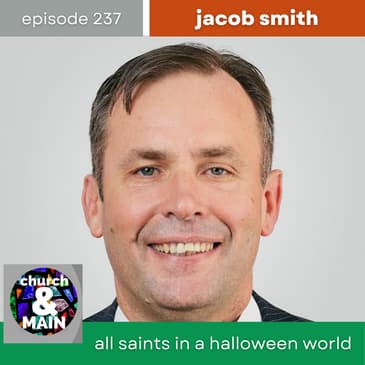
In this episode, I talk to Jacob Smith, the rector of Calvary St. George's Episcopal Parish in Manhattan. We compare politics to Halloween and religion to a celebration called All Saints Day, discussing how faith, politics, and today's issues connect. Jacob believes faith should guide our political actions and promote kindness and inclusivity instead of division. We also discuss the problems the church faces about fairness and economic gaps, urging Christians to put their beliefs into action. At the end, Jacob highlights how important worship and community are for bringing people together and giving hope during tough times.
Parish of Calvary-St. George's
Facebook | Instagram | Threads | Twitter | Website | YouTube
[0:11] Well, one pastor thinks that we need an All Saints Day kind of theology. That's coming up.
[0:20] Music.
[0:46] Hello, and welcome to Church in Maine, a podcast for people interested in the intersection of faith, politics, and culture. I'm Dennis Sanders, your host. You may have heard me say at some point on this podcast over the last few months that I've been part of something called the Iowa Preachers Project. This project basically is something that brings together 10 pastors from around the country. And basically the whole point of it is to meet, encourage one another and help each other become better proclaimers of the gospel. This is the inaugural cohort. And so next year, this coming fall, they will have another group. This actually will be expanded to 20 people. And it's been a good group. And I will actually, I'm hoping to have a person or two that will be on the podcast to talk a little about the project.
[1:53] Well, during late January, we had our kind of midwinter retreat that took place in Orange County. And we're having dinner. It was actually on Inauguration Day, which factors into this podcast. We were having dinner, and it was at In-N-Out Burger, which is something you need to do if you're in Southern California. Trust me on that.
[2:23] One of our guest speakers was joining us for dinner, and he said something that was fascinating to me. He said the following, my politics are Halloween, and my theology is All Saints Day. Now, that made my ears perk up, and it also made me ask some questions, like, what in the world did this sentence mean? I wanted to know more. So I knew that I had to have this person on my podcast to flesh out this sentence and, what it means for the church. So my guest today is the person who shared that odd sentence back in January, Jacob Smith. Jacob is the rector of Calvary St. George's Episcopal Parish in Manhattan and where he has been the rector since 2017.
[3:15] He's also served the Episcopal Church and the Episcopal Diocese of New York in various leadership roles, including vice president of the Bible and Common Prayer Book Society, a trustee of the Cathedral Church of St. John the Divine, and dean of the Lower Manhattan Clericus. He, along with his fellow priest Aaron Zimmerman, hosts the Same Old Song, which is a lectionary podcast of Mockingbird Ministries. It is a great podcast. If you are someone that likes to listen to lectionary podcasts, this is definitely one you want to listen to.
[3:55] This is a great conversation. I hope that you will enjoy it as much as I did. So without further ado, here is Jacob Smith.
[4:05] Music.
[4:22] Well, Jacob, I wanted to thank you for coming on to the podcast this afternoon. And I think the first thing I like to start with people is to know a little bit about your faith background, kind of where you grew up, but also kind of how did you come to the faith? Yeah, well, and pardon if it gets a little noisy sometimes. It's hard to keep the new sounds of New York City out of the podcast. I grew up, actually, I was born on the Navajo Indian Reservation in Monument Valley. My parents were, you know, a lot of people ask, were they missionaries? And I say, no, they were hippies. But they went out there to kind of change the world, and they went out to be teachers on the reservation. And so, I was born in Monument Valley, Utah, and lived in a little town called Cayenta, Arizona, for nine years.
[5:16] And then when I was nine, my parents, we moved to the southwest corner of Arizona to a little town called Yuma. And Yuma is so far southwest in Arizona that California is actually to the north of it and Mexico is to the west. And so I grew up eight miles from the Mexican border. And my mom was raised kind of disciples of Christ, Jordan, in Iowa. So, you know, kind of, but Christmas and Easter, Disciples of Christ. And my dad was raised Roman Catholic, and there was this Episcopal church at the top of the hill in Yume, Arizona, called St. Paul's, and it was like the perfect middle ground for my parents, because they were starting to raise kids and wanted them to go to church. And so, I grew up in second grade at a church called St. Paul's in Yume, Arizona. And so, I grew up in the Episcopal Church. My mom was eventually the acolyte mom, which means she ran all the kids who served around the table.
[6:19] And the church that, the Episcopal church that I grew up in, it was what would be called in the, it would be in the low church evangelical tradition of the Episcopal church, which is a part of the Episcopal church that's been affectionately forgotten. So, but it was there, you know, I had no idea who was coming to this church, like J.I. Packer would come and speak and we had this like whole world. And so coming through, I didn't mean much, but before all of that happened, so I was an acolyte. In the eighth grade, what happened was, is I sensed a call to ministry. And this was before we had this, like, the amazing rector who was the rector in my high school years, and that basically brought me back to ministry. But we had this interim, and I remember walking up to him after acolyting, because I had acolyted every Sunday, and I said, you know, I think I want to be a priest. and he kind of brushed me off. He waved my head and was like, that's wonderful, but first you've got to finish junior high and then high school, and then you'll go to college, and then the bishop will probably want you to work, and then maybe then. And I realized even at that young age, I knew that I was being brushed off.
[7:28] And so that kind of brushing off sent me on a different trajectory for a little bit. And I went to church, but hey, whatever. And then when I graduated from high school. I went to Finland, and my host family's father was a state Lutheran minister, which has made me today a staunch Jeffersonian when it comes to church and state. I'm a proponent of the separation. Jesus said, my kingdom is not of this world. And this guy was essentially a, well, I mean, he didn't believe much, and Easter was a metaphor for spring. And so when I came back, and I mean, what I believed was kind of held together with bubble gum and chicken wire. And so when I came back, I mean, I wasn't interested in a metaphor for spring, and I wasn't interested in religion at all. And so, kind of did my thing. And a couple of years in college, went to junior college, which is sort of like, you know, the late 90s was like high school with ashtrays. And then was doing my thing and made my way to the University of Arizona, where I reconnected with an old friend whose mom was an old school, like, Dust Bowl Pentecostal. Not prosperity Pentecostal but dust bowl Pentecostal a lot of talk of the blood of Jesus every other word coming out of her mouth was about being covered in the blood.
[8:52] And I remember I was with him and we had gone kind of out late one night and got horribly sunburned and we were sitting in this pool trying to cool off in Tucson, Arizona.
[9:04] And he said to me, you know, man, I'm going back to church. And I was like, man, I think I need to go with you. And so I went to church with him. And we went to this church, which was not an old Dust Bowl Pentecostal church, but it was a Pentecostal church in Tucson. And man, it was like nothing I'd ever seen. It was like cool kids up on a rock band and ba-ba-ba. And I mean, everybody was clapping and everybody was young. And I was like, what is going? when are we going to say, and also with you? But I heard this amazing gospel sermon about the forgiveness of sins and how God has saved you. And I'm coming out of a crazy college summer. And so I knew at that moment I needed saving. And so I went up and I had been baptized, but I gave my life to Jesus. And now I see that as God working things out in my life.
[10:00] And man, it was powerful. But that was one of the last times I ever heard the gospel in that church. Basically, from that moment on, it was like, Jesus got you into the dance, but you better learn how to dance if you're going to stay here. And I mean, that can be crushing as well. And by this time in my home Episcopal church, we had had this wonderful, called this wonderful minister, Tom Phillips. And I remember calling him and I just was like, you know, Christianity isn't working for me because I just couldn't keep up with the spiritual dynamic. And, um.
[10:33] I remember I was, so I called him, I said, this isn't working for me. And he said, what do you mean it's not working for you, Jake? It may never work for you. The question is, not it does Christianity work for you, but is it true? And that hit me like a Mack 10, like a truck, just blindsided. I'd never thought about the fact, was this true? Helpful, like that's okay. Okay, you know, sentimental, wonderful, but is Christianity true? And this sent me on a deep dive, like reading, you know, church history in college and things like that, and started checking out the prayer book again. I went and actually got my prayer book because I wanted to save my parents. And so, you know, I was going to find all the places that were wrong as if I knew, like, you know, what was it? But I was like, whoa, these words are powerful. We do not presume to come to this thy table, O merciful Lord, trusting in our own righteousness, but in thy manifold and great mercies. And it was just this, like these words washed over me. And I was like, where was I? You know, kind of like that great, I think it was a poison song for the metal band Poison, Don't Know What You Got Till It's Gone.
[11:48] And it just, God started calling me back. And I heard at that moment, man, during that time, you know, I've called you to be a priest. And I knew what that meant. And I kind of switched my major over in college and started talking to this rector, and he eventually invited me to be a youth minister. I graduated from the University of Arizona, became a youth minister in Yuma, Arizona, again at my home church, and was kind of coordinated stuff for the Diocese of San Diego. And three years later was sponsored for ordination and went to Trinity School for Ministry where I studied under Paul Zoll.
[12:27] And then always thought we'd go back west, but lo and behold, God had other plans and we made our way to New York City and where I served in various and sundry roles at an Episcopal church in Manhattan called Calvary St. George's for the last 18 years. I have a wonderful wife named Melina, who I met in college, and I definitely married up. She is currently the executive director of a nonprofit Sunday school curriculum program called Storymakers. And then I have two kids. I have a daughter named Sophia, who literally just graduated from Grace Church High School in Manhattan, and a son named Henry, who goes to—he's a freshman at a high school called Geneva here in Manhattan. And that is basically me in a nutshell.
[13:19] Well, first, congratulations to your daughter. Oh, thank you.
[13:24] So one of the reasons I had you on the podcast is something that you said.
[13:32] I've been part of the Iowa Preachers Project. Yeah. And you were a speaker at our kind of midway retreat in Corona Del Mar, California. I can even remember where you said this because it was at an In-N-Out, and I love In-N-Out. But every time I'm in California, you just have to have it. It's a spiritual place. It is. It is. You cannot be in Southern California and not be at an In-N-Out. But you said something to the effect of, my politics are Halloween, and my theology is All Saints Day. And I thought that that was just like, okay, that is just too interesting to just let that lie. And I wanted to have you on to talk a little bit more about that and to kind of unpack what that means and what are the implications of that. So, I guess maybe the first thing to start off with is kind of unpack the first part of that. How is politics like Halloween?
[14:35] I wish, actually, All Saints Day came before Halloween in this regard, because I think that it's, I think that really the theology being All Saints really begins to shape my politics.
[14:54] But I think, you know, what I mean by that is that I think that so often, you know, when we think about certain categories, like, so one time somebody said, Jake, you're not like any evangelical I've ever met. And I said to them, well, that's because every evangelical you've probably met is from the 1970s. I happen to be an evangelical from the 1570s. And so, I have a very high doctrine, a high Christology. I believe that Jesus is so much more than an example. I actually believe in the literal resurrection of Jesus Christ from the dead. I believe that there is no other name given under heaven and on earth or under the earth, as St. Peter says, given for salvation, but the name of our Lord Jesus Christ.
[15:46] So, you know, I have a high view of these certain categories. However, you would think then that should thrust you into a kind of a conservative, all-saints form of politics, as we would see today, you know what I mean? And so, you know, for example, you know, the hot button question today, when I said my politics are Halloween, I meant it. But, you know, when you think about, economics. I think that some of the disparity that's going on in this country by class and the rampant greed is atrocious, and Jesus would be furious about this. I think that oftentimes where you find the conservative church, if you will, its support and just open support of just the genocide that's going on in Gaza is irreprehensible.
[16:43] But what's happened, I think, in this country is that we've placed things in binaries, and we've left very little room for the gray anymore when it comes to the church and to explore these questions rightly and properly. And so, what happens is that, like, so, you know, you fall into this category and you fall into that category. And I think the church overall really needs to get in touch with the concept that came out of the Reformation, which is vocation, you know, and that we have a calling to our neighbors, not first to ourselves and our own nation, etc. Or I think, you know, the great traditions of like some of the great African American traditions here in this country, you know, the African Methodist Episcopal Zion Church is a perfect example of that, of a high Christology, but also a high vocation and call and duty as part of the process of sanctification to the neighbor. Yeah.
[17:48] Yeah, you know, one thing, maybe you can answer this question, I think it was brought up actually on the Mockingbird podcast. I haven't listened to the latest episode, but don't tell Dave. Go ahead. But there's this belief that if you believe in things like, let's say, the literal resurrection of Christ, that somehow you can't believe in support for or help for the poor. Yeah, social justice, yeah. I understood that. It's like, one doesn't follow the other, but it seems that people do that. They try to put things in boxes. And so, they think that, well, if I'm here and I believe all these things, well, then I can't believe in this when it comes to theology.
[18:41] Why do you think people do that? Well, I think it's because they have this mentality, the same mentality that actually started to drive me away from the church once again. This idea that Jesus got you into the dance, but you had better learn how to dance to stay in the dance. And so what this paradigm ultimately begins to do is, so I think there's two things. So that, the first is this bad teaching about now I've got to dance to stay into the dance. No, no, no, not at all. Jesus got you into the dance and get out there on the disco, you know, disco floor. Because, you know, as that old song goes, you're a freak and you can't help yourself, you know, so just get out there and dance. But if I'm worried about can I stay in the dance, if I'm worried about my moves, then this puts all of the focus on me and making sure that I'm doing the right thing. You know, it changes Christianity from primarily orthodoxy to beginning to be orthopraxy.
[19:43] But rather the doxy then gives us the freedom that informs our praxy. And if I am not worried about the way I'm looking on the dance floor, I am free for the first time to pay attention to the person I'm dancing with. I'm free for the first time to pay attention to my neighbor. And so this is what we're getting at. But I think the problem is that we get things into categories and we don't see kind of our service for those around us. We see it as offerings to give back to God as opposed to gifts to give to my neighbor. And that's really something that comes out of like the English Reformation and the German Reformation with this high understanding of vocation. There are two kingdoms in this world, the kingdom of heaven and the kingdom of this world. And the kingdom of heaven, which is inbreaking through the church and the ministry of the gospel, which is preaching and the administering of the sacraments as it is in my tradition, those are where we are nourished and assured to go out in peace, to love and serve the Lord, love and serve our neighbor, the Lord in the face of our neighbor. And so now it is no longer because my relationship is secure.
[20:59] It's, I can actually treat you as an individual, not as an object because I need to get something back from God. Is that clear? Mm-hmm. It is. What do you think that, kind of focusing again on the whole concept of Halloween, when I think about that, I think also about the state of the world. Sure. Which can be not the candy type of Halloween, but the horrific type of Halloween, like the movie Halloween. And where do you think the church is when it comes to that because I think sometimes the church either thinks that it can, do the kind of move us away from Halloween on our own power or maybe they're in denial that there is even that we're living in a world that is Halloween.
[21:53] Yeah Yeah, I think that the church right now in many ways is contributing to the Halloween because it has forgotten the gospel. And it is contributing to the Halloween in our society, both the left and the right, because the left and the right will have their prophets.
[22:15] I think what's happening is that in the church, both in the left and the right, we are othering people. You know, and so this is a big part of that contribution to the mess. And so what is happening is, is that, so for example, you'll take a passage like that wonderful passage from Luke where Jesus is in the synagogue and he opens the scroll and he reads, you know, to release the captives, you know, bring sight to the blind. And today this scripture has been fulfilled in your hearing. And we will, you know, the church, both on the left and the right, will speak of the blind over there. They'll speak of the captive over there. They'll speak of as opposed to what's going on in each of our hearts. You know what I mean?
[23:06] But when I realized that this gospel message, that today this has been fulfilled in my hearing, I have now, because there's parts in my life that I'm completely blind to. There are things that have happened to me that have made me a captive, and the only thing that will set me free is this word. I need this word as well. And what has happened is that in the church, on both the left and the right, we have forgotten that we need this word as well, this good news of the gospel. And so we're therefore busy othering people in doing exactly what the world does, and that is categorizing people as good and bad, as opposed to sinners in need of saving, which is, that is the lens by which we look at the world, You know, and so, you know, and sinners in need of saving. And this then, because it puts us back into the place of creature as opposed to creator or maybe some sort of mediator in between, we can actually have a conversation.
[24:07] About the horizontal, because the vertical is set, we can actually begin to have a horizontal about how these different policies are affecting our neighbor, how these different policies are affecting you and I. But it first comes first and foremost in the words of the good news of the gospel and the balm of Gilead that each and every one of us need. Jason Michele shares this powerful story of Karl Barth when he was teaching homiletics in Germany the night that Adolf Hitler was elected chancellor of Germany. And the story goes that everybody was just totally in panic, and they said, you know, Herr Barth, what do we say? This is going to come as a shock to some people, but Barth said, preach as if nothing happened. And they were like, you can't do that. And he was like, well, if you need to preach something, preach what we always preach, and that is Jesus Christ is risen from the dead, and he's still Lord and universe of all. You know what I mean? And that while Hitler may be the chancellor for a moment, Jesus is still Lord. And by the end of his time there in Germany, the SS was in the back, because ultimately, of his church all the time before he went back to Switzerland.
[25:24] Because ultimately, tyrants will have nothing above them. And so, but when we can preach that gospel that levels us all out on our knees, then we can link arms with our neighbor and begin to see, like, clearly the gray, but also what's really right and what's really wrong.
[25:46] One of the things that I've always had a problem with that people have said over time, because you talked about created and creator. And i see here this every so often it's that we're co-creators with god and i'm like.
[26:03] Yeah god may want to change may want to think about that rethink that because i don't think i'm that i'm all that and i don't you know it seems like that part of the thing about our Our walk is also a sense of humility, that we're not that great and that we are in need of salvation. And, you know, is there creativity that comes from us? Yes, of course. But I'm not a co-creator, no. Unless I have, you know, I really don't want to be, you know, nailed to a cross myself, so, you know. Yeah, good luck on walking on water. Yeah, that's not happening.
[26:49] Yeah, I think a co-creator is, I think, a little bit the doctrine of vocation on steroids. The problem with steroids is that it's going to hurt you later. I can't help, I don't think he thought of himself ever as a co-creator, but I noticed Axl Rose, and I noticed you had David Zoll on your podcast a little bit ago, but that's one of David Zoll's favorite singers is Axl Rose. But after Use Your Illusion 1 and 2, he was crippled for years because everybody was like, this is a masterpiece. You know what I mean? And it took him out of his box. Co-creator is a category mistake. There is only one creator.
[27:38] That's a category mistake. And what we have to do is get back into the right category, and that is the category of vocation. And this is where not I'm creating with God, but rather instead, going back to what St. Paul says, it's no longer I who live, but Christ who lives in me and the life I now live, I live by faith. You know, the reality is, is that on one level, on this podcast are two dead men talking. We've died and have been raised to life in Christ. So now the question is not what am I co-creating with God, but what is God doing through me? This is the question, not what am I doing for God either? It's what is God actually doing through me? Because God actually, by the power of his Holy Spirit, masks himself in the Christian. There's this great and powerful line from Luther. He said, God could make bread fall from the sky, but he deigns to work through the vocation of the farmer, the baker. You know what I mean? I always say, God could zap people and heal them right away, and that does happen. Make no doubt about it. But he also deigns to work through the vocation of the surgeon, you know? And this kind of causes me to go back to like a little bit of the question you said, kind of the Halloween a little bit, is that when we have forgotten...
[29:07] But when we have forgotten our call is vocation, and when we're thinking about co-creator, well, man, I want to co-create something awesome. You know what I mean? I want to co-create. I don't want to co-create just anything. I want to co-create something awesome.
[29:22] But you apply that even into the secular age, and what happens is that nobody's thinking about their neighbor anymore. They're going into vocations for the sake of money. I talk to a lot of these kids, and I'm like, well, why do you want to be a lawyer? it's not for the sake of justice. It's because, and for the sake of my neighbor, it's because I can make a lot of money that way. You know, why do you want to be a surgeon? Well, because I can make a lot, not because I want to heal people and, you know, and make advances in medicine, but we can make advances in medicine and make a lot more money. And so it becomes this curved focus inward, you know, where it's all about me or in the church, this curved focus inward where it's all about us and them, and this curved focus inward to do something great, as opposed to recognizing that God's glory is found in humble things, like a cross outside of a hill on Calvary, or maybe just working through you simply as a humble pastor loving your neighbor, or as a baker baking the bread, or whatever it may be. But I find that the phrase co-creator puts a tremendous amount of pressure on a Christian, And when it falls apart, well, it sends you into the spiral of Halloween as opposed to joining your voice with angels and archangels and all the saints of heaven in whatever God happens to be doing through you in this moment.
[30:42] So, then let's move to that second part of All Saints Day. And how is life and how is your theology like All Saints Day? Yeah. Well, so All Saints Day, I think it would be, well, the theology and the confession that the church has confessed through going back to the time of the apostles, which I think.
[31:08] Has united all of the Christian traditions through the Nicene Creed. So, I believe in one God, the Father, the Almighty. And why do I believe that he's the Father Almighty? Well, because, I know there's a lot of folks that want to change that, but because, well, one, it's an articulation of an intimate relationship, you know what I mean? But it's also separate. And then I believe in one Lord Jesus Christ, the only begotten Son of God. So, the Holy Spirit, one Catholic and apostolic church, you know, based on the teaching of the apostles. And it's holy because Christ has made it holy. And this calls me now, I would say, to...
[31:58] I can't help myself but try and other people from time to time, but when I do, to get off the box and surround myself with a community that can call me off the box and put me back where I belong on my knees, you know? And to recognize that within Jake are two people, not half, but two people, the saint and the sinner, until I finally die and the saint is the only thing that's left and I see Jesus Christ face to face, but not as a stranger, but as my friend. And so, I would say that it's that. And I find when people want to depart from that creed, from those basics, it sends people to a place of othering and quickly begins to lead to the place of Halloween.
[32:55] That actually reminds me, because you talked a little bit earlier about the fact that there are, people both on the left and the right in the church that put so much into othering. And I remember kind of growing up and seeing a lot of that in more conservative evangelical circles. But as I kind of wandered into more mainline circles, I was surprised to see it happening there again. And I think the thing that's fascinating about that, regardless of whether it's on the left or the right, is how popular it is. We love to other people. It's instead of to love others, it's one of other others. And that just seems to be so popular. Yeah, you know, that begins right at an early age. We have a preschool in my church, and I see kids categorizing themselves right away. But you're absolutely right. The main line and the progressive side is not any different. I remember, so, I've had a brief stint in church politics where I ran for church offices, and I got creamed every single time.
[34:14] And that's because there's a reputation that I'm an evangelical in the Diocese of New York, and I am. Like I said, I'm an evangelical of the 1570s, but a lot of people don't know what that is. But I remember standing in line after I got stomped, stomped for a particular role that I ran for. This was about three years ago, and I was standing in line getting coffee, smiling and holding my face, but there were people ahead of me, and they didn't know that I was behind them. And I overheard someone say, You know, it's so great that Jacob Smith runs every year because somebody has to lose.
[34:56] And I'll never forget it. It's like, oh, man, the Episcopal Church welcomes you as long as you agree with us 100%. And so, you know, and yeah, I mean, nobody's immune to this stuff at all. And the evangelical side, the conservative side is not immune to it, but most certainly the left isn't immune to it either. And I'll never forget something that really convicted me one time and has been a truth that I'm always thinking about. It came from Nadia Boltz-Weber, and she was speaking at St. George's, and she said, And she said, whenever you find yourself so strong on one side of the fence, watch out because Jesus might be on the other.
[35:48] And so, I think it's oftentimes, especially with those with whom I disagree, is to, you know, and I have friends that I disagree with on politics deeply, and I have friends that I've disagreed with on theology deeply, especially on issues of ecclesiology. And it's always important for me to, you know, sometimes when I find myself caught between a rock and a hard place with some of these folks is that we really sit down and we've started an exercise where we articulate the other person's position. So it's not just me flushing out what I think, you know what I mean? And why I think social democracy is very important, you know what I mean? And for the life. but actually to hear why these people, their position is, you know, rampant capitalism or libertarianism or something like that. And so, and how that jives. And so, for me to articulate that, trying to enter into that space of the other, and really, I mean, that's on one level, very incarnational. Now, it doesn't ever mean that I necessarily come to the same place of an agreement, but at least I can hear them. When most people are talking, they're not listening. They're waiting for their turn to talk.
[37:02] I once heard a man say, we're all born lawyers. We need to be taught the gospel. But this is the truth. I mean, even when I'm in conflict with my wife or somebody, you know what I mean? I can feel that moment where I'm defending myself and I'm just waiting for my turn to talk as opposed to actually listening. When you're listening, there you can begin to ask questions and you can begin to enter into the realm of the person and and begin to really start to understand where they're coming from. And you'll find oftentimes that some of these deeply held positions, Maybe they're held together with nothing more than bubblegum and chicken wire, but sometimes they're held because of a very deep wound. You know, I grew up deeply poor and I don't want to ever go back there again. You know what I mean? And I earned this and you can begin to hear these things. You know what I mean? And it comes out of a place of, gosh, when I was a child, there was a deep wound there. And then you can begin to come to a place of understanding and seeing that person, even though you may not ever agree, but begin to see them as a human being.
[38:07] Where do you think that the crucified God shows up in meeting people of different beliefs and everything? And the reason I bring that up, and I guess this happens when you go to a Lutheran seminary, is that, as you were talking, a lot of how we, you know, trying to listen, trying to do that, makes me really think of God in that sense of entering, you said, incarnational, and in some ways also sacrificial. It's not about me. It's about that other person, seeing that other person in a different way. So where does that show up? Because I think sometimes in our culture, that's not the God that shows up. Yeah, absolutely. Well, that's the God I definitely don't want to show up nine times out of ten. I want the God who's on my side because I'm right, and I want him to zap that other person, you know what I mean? I mean, like, you know, fire come down. Um, uh, the crucified God shows up in the midst of these conversations first, uh, in the conviction of your own sin, uh, you know, and in the conviction of, uh, you yourself need a savior and you don't have all the pieces of the puzzle together either.
[39:35] But then it shows up. It begins to be the lens by which I see the person that I'm having a conversation with, uh, to see them not as Halloween, but all saint as well. because the crucified God is the God who also imputes righteousness. He's the one who covers us in righteousness. And so to begin to actually see them as someone whom Jesus Christ, the God of the universe, is madly in love with as well. I mean, can you stand it that Jesus Christ is madly in love with your conservative uncle who's coming to your Thanksgiving party to talk about politics. Jesus Christ is madly in love with your, like, 67-year-old single aunt who has eight cats and listens to CNN and MSNBC all day and is totally, totally terrified, you know, because she's gotten a lot of misinformation herself, you know, but that Jesus Christ is madly, madly in love with that person. That begins to become extremely convicting.
[40:47] And then finally, the crucified God shows up after the conversation and after the engagement where it leads me to pray, and leads me to pray not only for myself, but also for that person, because there are some things that are clearly...
[41:08] That are clearly wrong. You know what I mean? I mean, racism is not good. It is condemned. You know what I mean? I mean, the mistreatment of the poor, we are called to love the poor. We're called to serve the poor because we ourselves are poor. Genocide is not cool. There's no position that justifies that at all. And so, nevertheless, I have to remember that the cruciform Lord also reminds me that he's the same one who says, I will lead them. I will lead you into all truth and righteousness. And so, it leads me to a place of not to argue and fight until the cows come home, but sometimes to recognize when I'm going around the mulberry bush with the monkey chasing the weasel, and I need to stop, and I need to get out of that conversation and pray.
[42:04] So, in the world that we live in, which is a Halloween world, I think it seems like the church should also be that community of all saints. And this reminds me, this was an article that David Brooks wrote maybe about two or three weeks ago about the importance of how not to lose your spirit in this time, where he kind of characterized a lot of what he is seeing as paganism, that it's kind of the strong kind of bullying the weak. Mm-hmm. And so how do church, how do you, and he even really stresses the importance of religion in this time. And that's kind of been in my mind all of this time of how do churches mirror that? And so, I guess I leave that question to you is, how do churches be communities of the saints in a time when it feels like a kind of a rising paganism?
[43:11] Oh, gosh, that is a great question. And because the rising paganism has entered into the church in a major, and co-opted it. And he brings that up too. Yeah, and I oftentimes, I feel like so much that masquerades itself as American Christianity is nothing more than... Do you remember the two creatures at the end of the last battle in C.S. Lewis? It was the little monkey and the donkey that masqueraded as Aslan and his prophet. And the problem was that when it was finally exposed as fraud, most of Narnia wasn't interested. Do you know what I mean? They had caused such havoc that most of Narnia wasn't interested in Aslan at the end until the very end. And so, I think that, one, this is an important time for the church to begin to look backwards, to move forward by looking backwards. So often, as communities in this country, you know, we've been baptized by just kind of the American idea of move on, get over it, sweep it under the rug.
[44:22] But unfortunately, I think that there's a lot of gross stuff under that rug that needs to come out. And so, one, we need to move forward by looking backwards. And when we look backwards, we find that Ebenezer, the greatest Ebenezer of all, and that is Christ in him crucified, which says, I love you, and I have forgiven you, and nothing can separate you from my love. And that enables us to begin to look underneath the rug. I just can't look under the rug alone. There's too much shame. There's too much guilt. There's too much fear there. But when I know that I am loved unconditionally, I can begin to look under the rug, and I can begin to pull the mess out, and I can begin to confess it, and I can begin, like my dear friend's old.
[45:07] Pentecostal, Dustable Pentecostal mom used to do, plead the blood right over it, because there is nothing that can separate us from the love of God when the blood of Jesus covers it. So, we need to be able to confess past sins and recognize that and lay that out because it's from a redeemed and forgiven past. From a forgiven past, the church can begin to move into a new and redeemed future, and not distracted by the folly on the left and the categories of the left and the right. But then, so that's the first, moving forward by looking backwards. I think the second thing is to gather, once again, around some form of liturgy. Maybe it doesn't necessarily have to be historic, like the Book of Common Prayer or something like that, but having a liturgy which shapes and informs our prayers and connects us to that church and that great army of saints that goes all the way back to the scriptures and to the earliest parts of the church. And so, something that connects us to something greater than ourselves. I think in America, with the church, why it falls into Halloween is because everybody's built their own little kingdoms, and we...
[46:20] We don't look much different than, you know, other stores and economics competing with each other. And so, but if we are connected, then we can begin through a liturgy and through common prayer, we can begin to see each other and begin to pray and remember that it's not just about us, but it's about joining our voices with angels and archangels and with all the company of heaven. And so, united with a liturgy that connects us to something greater than ourselves.
[46:49] And then the third thing I would say is being connected to the gospel and hearing the gospel, that Christ has died for you, Christ has risen for you, Christ is coming again for you, because that protects us from wanting to be co-creators, that protects us from the fear of not being able to look back and confess our sins, and that enables us to live into our vocation right where we're at, see where God has placed us, and serve him in the face of our neighbors, those who are around us. But that comes from hearing the gospel daily, that your sins are forgiven, and you have been made new, because behold, he makes all things new. And right now, you don't maybe see it, but you definitely need to be in a place where you can hear it. And so, that, and then I think, and there are different understandings of this, but you know, through emphasizing the sacraments or ordinances of the church, you know, baptism and Holy Communion, and what those outside things say about you, how God has connected you to those gospel promises. So, those three things, I think, would really help us move forward and protect us from the paganism that is infiltrating the church.
[48:06] Looking backwards and knowing that we're forgiven, One, being connected to a prayer life and a worship that is rooted in the history of the church. And then three, being nourished by the gospel in the preaching and in the sacramental or ordinances of the church.
[48:26] Well, if people want to know a little bit more about you, where should they go online? So, they can – I have a weekly podcast that I do with my colleague, the Reverend Aaron Zimmerman, who's the rector of St. Albans in Waco, Texas, called The Same Old Song. It's one of the Mockingbird podcasts. And then I also – you can listen to my sermons or just find me at Calvary St. George's. I haven't written a book or anything yet, but, you know, maybe someday. But right now, you can find me at Calvary St. George's, and from there, you can always email me, and I'm always up for a conversation. All right. Well, this has been a great conversation, I think an important conversation for me, and I hope for others. And I hope to have you back on the podcast sometime soon, Jacob. Dennis, this was a huge honor and I was so thrilled when you followed up with me and like I said, I've become a recent listener and I'm a huge fan and so I was a little intimidated actually after I heard the podcast and so I was like, oh my gosh, better prep for this but no, I am so touched that you would have me on and I look forward to staying in touch and looking forward to see where this friendship goes Okay, thank you so much All right.
[49:49] Music.
[50:18] So, what were your thoughts on the episode? I really hope that you enjoyed it. I enjoyed being a part of it. I'd love to hear what you're thinking. Feel free to send me an email at churchinmain at substack.com. If you want to learn more about the podcast or listen to past episodes, visit churchinmain.org. And you can also visit churchinmain.substack.com to read related articles. You can subscribe to the podcast on your favorite podcast app. And please consider leaving either a rating or a review. That helps others to find the podcast. I haven't shared this in a while, but I do want to let you know that if you are able to make a donation, I hope that you would consider doing so.
[51:07] Donations can help pay for some of the cost of the podcast. I don't expect it to cover all of it, But that does can help. And it also helps me to continue to keep producing great content like this episode. And to do that, you can do it fairly easy. You can donate by going to buymeacoffee, all one word, dot com backslash Dennis L. Sanders. And the link is in the show notes. That is it for this episode of Church in Maine. I'm Dennis Sanders, your host. As I always want to say, thank you so much for listening. It does mean a lot. Take care, everyone. Godspeed. And I will see you very soon.
[51:56] Music.