
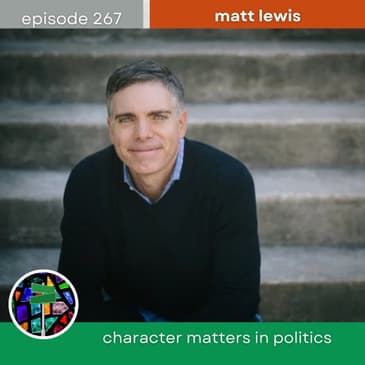

Political commentator Matt Lewis joins the podcast to talk about the shifting relationship between character and politics from the 1990s to the present. We examine how character dynamics during the Bill Clinton era contrast with current debates surrounding Donald Trump. Matt shares personal insights from his background while reflecting on the moral dilemmas faced by Republicans and the implications for the evangelical community.
Join the Church and Main Email List
Facebook | Instagram | Threads | Twitter | Website | YouTube
00:00:27 --> 00:00:30 Hello, and welcome to Church in Maine, a podcast for people interested in the
00:00:30 --> 00:00:33 intersection of faith, politics, and culture. I'm Dennis Sanders, your host.
00:00:34 --> 00:00:39 My guest today is political commentator Matt Lewis. He's on the podcast today
00:00:39 --> 00:00:41 to talk about character and politics.
00:00:42 --> 00:00:47 Now, character was something that we heard about a lot during the 1990s,
00:00:47 --> 00:00:51 especially in light of former President Bill Clinton's scandals,
00:00:51 --> 00:00:53 especially concerning Monica Lewinsky.
00:00:54 --> 00:00:59 But it seems like in the era of Donald Trump, who has a rather questionable
00:00:59 --> 00:01:04 character, that we actually don't hear about this anymore. Why?
00:01:06 --> 00:01:07 That's why I wanted to talk with
00:01:07 --> 00:01:11 Matt Lewis. Before we go into the conversation a little bit about Matt,
00:01:11 --> 00:01:15 he's the author of Filthy Rich Politicians and Too Dumb to Fail,
00:01:16 --> 00:01:23 and he's also served as a columnist at The Daily Beast and a senior contributor to The Daily Caller.
00:01:23 --> 00:01:28 He's currently a columnist at The Hill and Los Angeles Times,
00:01:28 --> 00:01:34 and he's also the host of two podcasts, Matt Lewis Can't Lose and the DMZ with
00:01:34 --> 00:01:36 political columnist Bill Scherr.
00:01:36 --> 00:01:42 So, sit back and join me in this conversation on character and politics with Matt Lewis.
00:02:03 --> 00:02:07 Well, good morning, Matt. It's good to have you on the podcast.
00:02:07 --> 00:02:12 I wanted to start by just getting to know a little bit about you and your faith background.
00:02:13 --> 00:02:17 Also, a little bit about who you are, because I know there are probably people
00:02:17 --> 00:02:20 on the podcast that don't know you as well than I do.
00:02:21 --> 00:02:28 Well, thank you for having me here. My name is Matt Lewis, and I've been a,
00:02:28 --> 00:02:32 well, I would say center-right. I was going to say a conservative.
00:02:32 --> 00:02:36 I'm a conservative, but the world has changed, and what that means has changed.
00:02:37 --> 00:02:44 But I've started blogging in 2005, became a conservative columnist,
00:02:44 --> 00:02:48 and I've worked at places like The Daily Caller, The Daily Beast.
00:02:48 --> 00:02:51 I was a contributor at CNN for about four years.
00:02:52 --> 00:02:58 And now I write for the LA Times, a weekly column, a fortnightly column for The Hill.
00:02:58 --> 00:03:04 And I'm on, you know, Substack, YouTube, all that stuff. So that's my professional part.
00:03:05 --> 00:03:12 I come from a really rural area in Western Maryland, close to Pennsylvania and West Virginia.
00:03:12 --> 00:03:15 My dad was a prison guard for about 30 years.
00:03:16 --> 00:03:23 And he was a very devout, very good, decent man. He's turned me on to politics.
00:03:24 --> 00:03:32 And it also definitely was instrumental in making sure that I went to church,
00:03:33 --> 00:03:34 Sunday school, all that stuff.
00:03:36 --> 00:03:40 You know, like when my dad died, we're going through stuff.
00:03:40 --> 00:03:42 And, you know, a lot of times people go through someone's stuff.
00:03:42 --> 00:03:43 You find out things about them.
00:03:43 --> 00:03:48 Maybe some things that aren't pleasant. You find a mistress's phone number or something.
00:03:48 --> 00:03:53 In the case of my dad, and look, life's messy, but in the case of my dad,
00:03:53 --> 00:03:57 I went looking through all of his stuff, and all I would find is Bible verses.
00:03:57 --> 00:04:01 He had scribbled down, stuck in different places.
00:04:02 --> 00:04:05 So that was his big secret that I was finding.
00:04:06 --> 00:04:10 So he was a great guy. My dad passed away in 2004, but he was a great guy.
00:04:10 --> 00:04:16 But it was interesting because I grew up in a very disparate background.
00:04:17 --> 00:04:19 The church really close to me was actually a brethren church,
00:04:19 --> 00:04:24 and that's where kind of my extended family and friends and community went.
00:04:24 --> 00:04:25 And I went there a lot as a child.
00:04:27 --> 00:04:31 But my dad was what you would call Pentecostal, full gospel,
00:04:32 --> 00:04:33 non-denominational, evangelical.
00:04:34 --> 00:04:39 I know those things aren't exactly, you know, they don't necessarily mean exactly
00:04:39 --> 00:04:46 the same thing, but we didn't know exactly what we were, but we went to a bunch of churches, and,
00:04:48 --> 00:04:52 and including a Pentecostal church in Hagerstown, Maryland for many years.
00:04:53 --> 00:04:57 And then when I was in high school, sadly, I didn't find out about this until
00:04:57 --> 00:05:02 my senior year, I got involved with this group called Young Life, which was super fun.
00:05:02 --> 00:05:07 And that was the first time I was actually able to kind of build community and
00:05:07 --> 00:05:10 make friends who were young Christians.
00:05:11 --> 00:05:15 That was something that had sort of escaped me.
00:05:15 --> 00:05:19 The church I went to in Hagerstown, Maryland, And the Pentecostal church was
00:05:19 --> 00:05:20 kind of a dying church, unfortunately.
00:05:20 --> 00:05:22 I mean, there weren't a lot of young people there.
00:05:24 --> 00:05:31 And then later, as I got involved in politics and as my political worldview
00:05:31 --> 00:05:36 kind of matured, I discovered Tim Keller, his podcast.
00:05:37 --> 00:05:40 And I started really listening to Tim Keller. And, you know,
00:05:40 --> 00:05:44 I never met him, but he mentored me through his podcasts and his sermons.
00:05:44 --> 00:05:47 And that really helped shape me.
00:05:48 --> 00:05:54 And, you know, obviously my Christian worldview has influenced my politics.
00:05:54 --> 00:06:00 And as I'm sure you've experienced, like about 10 years ago,
00:06:00 --> 00:06:02 those things started to really come into conflict.
00:06:03 --> 00:06:07 And that's been something, I've had something of an identity crisis for the last decade.
00:06:07 --> 00:06:11 And it's been something I've been wrestling with, as you could imagine.
00:06:12 --> 00:06:19 Yeah. I mean, Keller was, I think he's just kind of phenomenal in how he was and,
00:06:20 --> 00:06:25 his generosity of spirit, I think, which is that he was, I think,
00:06:25 --> 00:06:28 what was fascinating about him, just because of the fact that he planted a church
00:06:28 --> 00:06:33 in New York City and really had to learn how to reach out to people who were
00:06:33 --> 00:06:35 different from him, who thought differently,
00:06:36 --> 00:06:38 that made him, I think,
00:06:39 --> 00:06:44 Both someone that was true to who he was as a Christian, but also generous to
00:06:44 --> 00:06:46 reaching out and talking to others.
00:06:46 --> 00:06:50 And that feels like that's something that's lost in our society now.
00:06:51 --> 00:06:57 I think it definitely is. I can just tell you, it hit me at the right time because
00:06:57 --> 00:07:04 when I discovered Tim Keller.
00:07:05 --> 00:07:18 Which was probably around 2010, let's say, I was at a point where I was a more mature Christian.
00:07:18 --> 00:07:22 Like, I went to a church—the Pentecostal church I went to, every week there'd
00:07:22 --> 00:07:26 be the same 20 people there, and there was an altar call every single week.
00:07:26 --> 00:07:28 And it was great when it came to salvation.
00:07:29 --> 00:07:34 Their message was great. But when it came to, you know, if you were a college-educated
00:07:34 --> 00:07:36 person going to that church,
00:07:37 --> 00:07:40 you know, Tim Keller literally—I don't know if you've heard him talk about this,
00:07:40 --> 00:07:43 but because he was in New York City, there were actors and his,
00:07:44 --> 00:07:47 you know, Broadway actors, this sort of people that went to his church.
00:07:47 --> 00:07:51 And so he had to be able to like answer questions
00:07:51 --> 00:07:54 like uh if you're what's it
00:07:54 --> 00:07:57 called like being a process actor where you i'm trying to think of the the oh
00:07:57 --> 00:08:02 method actor like the term of art that's it method actor where you literally
00:08:02 --> 00:08:08 become the character and he had to deal with kind of the ethics of that and
00:08:08 --> 00:08:13 like can you be a christian and be a murderer like i'm using quote scare quotes here,
00:08:13 --> 00:08:18 but like if you're playing the Joker and you're the Joker for three years,
00:08:18 --> 00:08:21 like that's going to impact your soul at a certain level.
00:08:21 --> 00:08:25 There's no way around that. And so he wrestled with these very.
00:08:26 --> 00:08:33 Deep questions. He obviously was very well read, and that's important, right?
00:08:34 --> 00:08:40 Because if you've been a Christian for a couple of decades, and you're struggling
00:08:40 --> 00:08:46 with the real world, and you're a college graduate, and you're dealing with ideas,
00:08:46 --> 00:08:51 but the church you're going to is feeding you baby food, you know?
00:08:52 --> 00:08:57 This is actually an analogy I heard from the Pentecostal, which is,
00:08:59 --> 00:09:03 when I was a child, I spoke as a child, but same thing.
00:09:03 --> 00:09:09 If you're being fed in church, if all you're getting is the salvation message,
00:09:09 --> 00:09:13 but never any discipleship of how to actually live and flourish as a Christian,
00:09:14 --> 00:09:15 then that's not going to work either.
00:09:15 --> 00:09:20 So Tim Keller really helped provide that for me. I also ended up going to this great church.
00:09:21 --> 00:09:26 In Falls Church, Virginia, called Columbia Baptist. They're technically a part
00:09:26 --> 00:09:30 of the Southern Baptist Convention, but they were very independent.
00:09:30 --> 00:09:36 And in fact, the church Columbia Baptist was started by the first pastor of
00:09:36 --> 00:09:42 that church was an abolitionist who was killed by Mosby's Rangers because he
00:09:42 --> 00:09:48 had started a sort of a school for free black youth, I guess.
00:09:48 --> 00:09:53 And he was actually martyred. And so that church had a really long,
00:09:53 --> 00:09:56 proud tradition, even though it was part of the Southern Baptist Convention in a weird sort of way.
00:09:57 --> 00:09:58 And their pastor there, a guy
00:09:58 --> 00:10:04 named Jim Bauckham, was great and very much in the mold of a Tim Keller.
00:10:04 --> 00:10:09 So I was very blessed to have that experience as well.
00:10:12 --> 00:10:16 So this is kind of a good jump off into what we wanted to talk about Because
00:10:16 --> 00:10:22 the reason I wanted to chat with you is I read an article that you wrote about
00:10:22 --> 00:10:26 the recent invasion of Venezuela.
00:10:27 --> 00:10:35 And you kind of somewhat focused on Marco Rubio and who you supported in 2016.
00:10:35 --> 00:10:39 And I will admit I also did in 2016.
00:10:41 --> 00:10:44 And you talked about how if he were
00:10:44 --> 00:10:47 the president you would probably not
00:10:47 --> 00:10:51 have as much problem about this but what
00:10:51 --> 00:10:56 of course he's not the president donald trump is and that this kind of boils
00:10:56 --> 00:11:00 down to the sense of character and and the reason i found this fascinating because
00:11:00 --> 00:11:05 on the day that all happened i i would hear people on the news talking about
00:11:05 --> 00:11:08 how great this was and this was It's wonderful,
00:11:08 --> 00:11:14 and believe me, I think Maduro was a bad guy, this is good.
00:11:15 --> 00:11:18 But there was also something that bothered me about it, too.
00:11:19 --> 00:11:23 And it was obviously who was conducting it.
00:11:23 --> 00:11:29 And so I wanted to talk to you a little bit about the role that character and
00:11:29 --> 00:11:31 faith play in all of this.
00:11:32 --> 00:11:37 And why did you think that it was a little bit that this matters,
00:11:37 --> 00:11:43 especially with the outcome that happened, which I think we all think was a
00:11:43 --> 00:11:46 good outcome, but yet it kind of left you unsettled.
00:11:47 --> 00:11:51 Yeah. Well, I'm always trying to be introspective and be intellectually honest.
00:11:52 --> 00:11:55 And I want to say trying, I mean, trying because it's a daily struggle and,
00:11:55 --> 00:12:00 um, you know, uh, you are your own worst enemy.
00:12:00 --> 00:12:03 And when it comes, I'm trying to think of the quote, uh, but,
00:12:03 --> 00:12:07 uh, you know, you, you were most likely to fool yourself and that's,
00:12:07 --> 00:12:10 you know, I'm, I'm most likely to fool myself, but I try to be.
00:12:11 --> 00:12:16 And so I was trying to be honest, Like, would I have supported this sort of
00:12:16 --> 00:12:21 intervention if Rubio had been president?
00:12:21 --> 00:12:23 And to be honest, I definitely would have. Right.
00:12:24 --> 00:12:30 And then I question, like, was that good or bad? Would I have been would that
00:12:30 --> 00:12:35 have been good of me to just reflexively support it or not?
00:12:35 --> 00:12:38 Like, shouldn't should I have been more skeptical of George W.
00:12:38 --> 00:12:43 Bush and his interventionism? and therefore shouldn't I be more skeptical of Rubio um.
00:12:45 --> 00:12:52 But I also, so I think that was sort of one, like, argument I was wrestling with.
00:12:52 --> 00:12:56 You know, it's like, should I have always been a little more cautious and a
00:12:56 --> 00:13:00 little more skeptical of even the politicians that I liked? And I think the answer is yes.
00:13:01 --> 00:13:06 But then the other thing is, well, the politicians I did like at least were competent.
00:13:07 --> 00:13:11 Um well okay not all of them but um
00:13:11 --> 00:13:14 they they weren't they weren't
00:13:14 --> 00:13:17 as erratic as trump i think that's
00:13:17 --> 00:13:20 fair to say and someone like a rubio i
00:13:20 --> 00:13:23 think would have definitely been able to lay out the moral case for
00:13:23 --> 00:13:27 why we were doing this whereas trump
00:13:27 --> 00:13:30 is talking like openly about we're going to take their oil like
00:13:30 --> 00:13:33 that's what this is about or he was very mean to me if
00:13:33 --> 00:13:37 he had been nice you know what I mean so with Trump even
00:13:37 --> 00:13:42 if he does the right thing the motives are almost always going to be wrong yeah
00:13:42 --> 00:13:48 and so look I was I grew up in an era where I was taught that you know Bill
00:13:48 --> 00:13:51 Clinton was bad and part of the reason
00:13:51 --> 00:13:57 part of the lesson is that you know character matters and and that um,
00:13:58 --> 00:14:03 I, foolish me, actually believed that, and now I apply that same lesson to Donald Trump.
00:14:05 --> 00:14:10 Why do you think that people don't, I mean, you know, and I was around in the
00:14:10 --> 00:14:13 90s, too, and there was a lot of talk about character.
00:14:14 --> 00:14:19 Why were people so quick to jettison it once Trump came around?
00:14:19 --> 00:14:21 I think it's two things. I think it's two things.
00:14:22 --> 00:14:25 The first is just, they were always hypocrites, right?
00:14:26 --> 00:14:31 They were always just partisan tribalists, and so when the other side does it,
00:14:31 --> 00:14:33 it's bad. When we do it, it's okay.
00:14:33 --> 00:14:40 That's part of it. The other thing is, I do think amongst some Republicans,
00:14:40 --> 00:14:44 there was a sense that, well, we tried to be the good guys.
00:14:44 --> 00:14:49 We tried to do the right thing, but Bill Clinton got elected twice,
00:14:49 --> 00:14:52 and then Barack Obama. They were radicalized.
00:14:53 --> 00:14:57 When Mitt Romney, you know, you had John McCain saying, no, ma'am, no, ma'am.
00:14:57 --> 00:15:01 He's a decent, you know, father and husband.
00:15:01 --> 00:15:06 And John McCain tries from their perspective. This is the perspective of these
00:15:06 --> 00:15:08 Republicans who are rationalizing Trump.
00:15:08 --> 00:15:12 They said, you know, McCain tried to play nice and he was a decent guy.
00:15:12 --> 00:15:20 And Obama won. Mitt Romney tried to play too nice. He was a decent guy. Obama won again.
00:15:20 --> 00:15:25 The lesson that they took from it is, well, the Democrats, they put up with
00:15:25 --> 00:15:28 Bill Clinton and his antics.
00:15:28 --> 00:15:31 And then we tried to run these nice guys and nice guys finish less.
00:15:31 --> 00:15:33 So we have to fight fire with fire.
00:15:33 --> 00:15:36 And the reason we have to is that this is existential threat.
00:15:36 --> 00:15:38 It's the Flight 93 election.
00:15:38 --> 00:15:43 Like the matter in the 90s, that was just kids play. Today, the stakes are so
00:15:43 --> 00:15:46 high that the ends justify the means.
00:15:46 --> 00:15:49 So those are really the two big rationales, I think.
00:15:52 --> 00:15:55 The thing that's weird about that, though, is...
00:15:57 --> 00:16:05 I had a lot of problems with Clinton, but he wasn't Trump in the way that he
00:16:05 --> 00:16:07 acts, and definitely not Obama.
00:16:08 --> 00:16:13 It's kind of like you couldn't understand that in a democracy,
00:16:13 --> 00:16:15 someone's going to lose.
00:16:18 --> 00:16:23 That's the way that things happen. People vote, and then they vote for someone,
00:16:23 --> 00:16:26 and they lose. But there's always the next time.
00:16:26 --> 00:16:33 It's kind of like if you're looking at things always as existential crisis,
00:16:33 --> 00:16:39 it's just kind of it feels like you're just going to lower your values to do
00:16:39 --> 00:16:42 whatever instead of thinking it's not a crisis.
00:16:43 --> 00:16:48 You lost this time, but, you know, you'll get them again four years from now.
00:16:50 --> 00:16:55 I totally agree. Like, I don't get it. Right. So Republicans had three presidencies
00:16:55 --> 00:16:57 in a row. Reagan, Reagan, Bush.
00:16:57 --> 00:17:02 Then Clinton had two. Then Republicans had two, George W. Bush.
00:17:03 --> 00:17:09 And then Democrats got two. The fact that Obama got reelected in 2012 wasn't
00:17:09 --> 00:17:11 like, in my opinion, it wasn't a shock.
00:17:11 --> 00:17:14 Presidents tend to get reelected in the modern era.
00:17:16 --> 00:17:20 And so to me, it was pretty evenly balanced. Republican, if you just add up
00:17:20 --> 00:17:25 the last 50 years, how many terms had Republicans had, how many terms had Democrats had.
00:17:26 --> 00:17:29 I think Republicans were winning actually in the number of terms.
00:17:29 --> 00:17:33 But for some reason, the sense that Republicans couldn't win in 2012,
00:17:33 --> 00:17:39 there was a sense that if Obama got reelected, then we had crossed the Rubicon.
00:17:39 --> 00:17:41 America was over. We were never going to get it back.
00:17:42 --> 00:17:48 And I'm with you. I don't get why they thought that was the end of the game
00:17:48 --> 00:17:50 as opposed to like, well, this is normal.
00:17:50 --> 00:17:56 This happens we'll probably win the next election so when it kind of comes to
00:17:56 --> 00:17:57 the character obviously you know,
00:18:00 --> 00:18:03 Trump is someone that doesn't have a whole lot of good character.
00:18:06 --> 00:18:09 And I guess this is the thing that I'm also fascinated, because,
00:18:10 --> 00:18:15 of course, among a lot of Republicans tend to be more evangelical.
00:18:17 --> 00:18:23 And usually, I don't want to kind of stereotype, but usually belief character
00:18:23 --> 00:18:26 is a big, important, at least I have said it.
00:18:27 --> 00:18:31 And I guess maybe I'm re-answering this or re-questioning this again,
00:18:32 --> 00:18:36 but these were people that talked a lot about morals,
00:18:36 --> 00:18:43 and they go to church, but they were seen to be okay with someone that obviously
00:18:43 --> 00:18:47 doesn't have any of that.
00:18:47 --> 00:18:52 And was it just kind of a transactional thing that this is who we need for now?
00:18:53 --> 00:19:00 I mean. Yeah. I mean, the rationalizations were, um.
00:19:01 --> 00:19:07 It went from, when Bill Clinton was president, we were saying, character matters.
00:19:08 --> 00:19:12 It's vital that we elect a president who has character. It went from that to
00:19:12 --> 00:19:15 saying, well, look, I'm not trying to elect a pastor.
00:19:16 --> 00:19:22 We need someone who's going to fight fire with fire. And God uses very flawed people.
00:19:22 --> 00:19:25 God uses, look at King David or even King Cyrus.
00:19:25 --> 00:19:32 And so they very quickly changed their tune from character matters,
00:19:32 --> 00:19:38 we have to elect a leader who shares our values and who has character,
00:19:38 --> 00:19:40 to, well, no, we need a fighter.
00:19:40 --> 00:19:46 And God can use and has used very flawed people to achieve his ends,
00:19:47 --> 00:19:51 which is like, couldn't that have been applied to Bill Clinton?
00:19:51 --> 00:19:56 You know, like, couldn't we have said or couldn't Democrats have said the same
00:19:56 --> 00:19:57 exact thing about Bill Clinton?
00:19:58 --> 00:20:03 We would have laughed them out of the room if they tried. The audacity of that wouldn't have held.
00:20:04 --> 00:20:07 It would have been absurd. But you could talk yourself into a lot of things.
00:20:09 --> 00:20:15 Yeah, and I think what's also interesting, if you go back to George W.
00:20:15 --> 00:20:19 Bush and Iraq, and there are kind of the similarities to Venezuela,
00:20:19 --> 00:20:29 is you may disagree with going into Iraq or the Iraq War, but you never kind
00:20:29 --> 00:20:32 of question—I mean, there are a lot of people, especially on the left,
00:20:32 --> 00:20:34 that would say this was for oil.
00:20:34 --> 00:20:38 And I never believed that. I believed that they.
00:20:39 --> 00:20:43 I think that their reasonings were misplaced, but I never thought it was so
00:20:43 --> 00:20:47 naked of, we're just going in to get oil.
00:20:48 --> 00:20:56 They actually had some sense of a value there, where with Trump, it just is that.
00:20:56 --> 00:21:01 And I'm always fascinated that the people around him who are also,
00:21:01 --> 00:21:08 in many cases, at least profess a faith, don't seem to challenge his assumption
00:21:08 --> 00:21:10 that, oh, yeah, we're just going to take the oil.
00:21:11 --> 00:21:16 It's just kind of, really? You're not going to say anything?
00:21:17 --> 00:21:24 Yeah, you could have been a sincere, devout Christian who was like, look,
00:21:25 --> 00:21:29 Saddam Hussein probably has weapons of mass destruction, and besides,
00:21:29 --> 00:21:35 he is this horrible, bloodthirsty dictator, and we are going to help bring democracy
00:21:35 --> 00:21:40 to the Middle East and help women have equal rights.
00:21:40 --> 00:21:47 And make sure that Hussein isn't funding terrorism.
00:21:47 --> 00:21:52 That may have been misguided, but you could have made a sincere,
00:21:52 --> 00:21:55 compassionate, conservative argument.
00:21:57 --> 00:22:05 And that would have been plausible to justify the Iraq invasion and the Iraq war.
00:22:05 --> 00:22:09 But Trump doesn't give you that opportunity.
00:22:09 --> 00:22:15 He is nakedly opportunistic, self-serving.
00:22:17 --> 00:22:21 It's like if you don't give him the Nobel Prize, he's going to do this or that.
00:22:21 --> 00:22:25 If you aren't nice to him, if you didn't treat him very nice.
00:22:26 --> 00:22:33 And he wants the oil. And so he is going to be very transparent about his motives,
00:22:33 --> 00:22:39 which are not pure or compassionate or in any way Christian.
00:22:39 --> 00:22:43 And, you know, it used to be, it was kind of funny to watch because it did sort
00:22:43 --> 00:22:47 of used to be, certainly in the first term, you would have someone like Trump
00:22:47 --> 00:22:49 would say, like, we got to get the oil, we're going to do the oil.
00:22:49 --> 00:22:52 And then you have like a Mike Pence come in and be like, you know,
00:22:52 --> 00:22:56 we're going to go over there and we're going to do the right thing and we're going to help people.
00:22:56 --> 00:22:58 And he would try to clean it up. And then Trump would be like,
00:22:58 --> 00:22:59 no, no, we're going to get the oil.
00:22:59 --> 00:23:03 That's what it is. Michael say nice things, you know, sort of like the Erica
00:23:03 --> 00:23:06 Kirk, you know, Erica Kirk says we should love our enemies. Not me.
00:23:06 --> 00:23:12 Like he can't even, he doesn't even want to pretend to be like a compassionate conservative.
00:23:12 --> 00:23:15 He's an uncompassionate right winger.
00:23:16 --> 00:23:17 So yeah.
00:23:18 --> 00:23:24 Growing up, and I kind of came from an evangelical background,
00:23:24 --> 00:23:26 I remember there was an exercise,
00:23:27 --> 00:23:35 that people would do, and this was something about how you shouldn't be unequally yoked,
00:23:36 --> 00:23:39 and this was to not marry a non-Christian.
00:23:40 --> 00:23:44 I never know how I feel about that itself, but it was always an interesting
00:23:44 --> 00:23:48 exercise, because the exercise is that you would have someone on a chair,
00:23:48 --> 00:23:50 standing on a chair, and someone on the floor.
00:23:51 --> 00:23:56 And what would happen was that that person on the floor would then pull you off the chair.
00:23:57 --> 00:24:05 And the whole point of that exercise was to say that being unequal tends to
00:24:05 --> 00:24:08 change the person of faith.
00:24:08 --> 00:24:15 And I'm always wondering, for people who are around the president,
00:24:15 --> 00:24:18 but also who support the president, who are,
00:24:19 --> 00:24:25 I think, sincere Christians, what does that do to them?
00:24:25 --> 00:24:30 Because I think we've talked a lot about his character, but how does it change their character?
00:24:32 --> 00:24:36 I completely agree with, I think, where you're going with this,
00:24:36 --> 00:24:38 which is it degrades their character.
00:24:39 --> 00:24:43 Jonah Goldberg has made this point. Maybe he got it from someone else.
00:24:43 --> 00:24:46 I'm not sure, but maybe it's Yuval Levin.
00:24:46 --> 00:24:52 But I think it's true that people have a hard time with cognitive dissonance.
00:24:52 --> 00:24:56 And so if you start off saying, if you start off as a person that says,
00:24:56 --> 00:24:59 look, I don't really like Donald Trump.
00:24:59 --> 00:25:04 I don't think he's got a great character, but I'm going to vote for him because
00:25:04 --> 00:25:07 he's better than the other people or whatever.
00:25:08 --> 00:25:14 If once you make that decision, you will then over time...
00:25:16 --> 00:25:22 Possibly subconsciously, you will begin to come up with reasons why Trump is
00:25:22 --> 00:25:25 actually good and right about everything.
00:25:26 --> 00:25:34 And you will kind of reverse engineer this rationale and you'll begin to agree
00:25:34 --> 00:25:38 with him on things that you used to disagree with him on and make excuses for him.
00:25:38 --> 00:25:41 And it seems to be human nature that because you have to justify like,
00:25:42 --> 00:25:47 well, I voted for Trump. Trump did this crazy thing.
00:25:47 --> 00:25:49 I'm still supporting Trump.
00:25:50 --> 00:25:56 Ergo, Trump's actually right about it. And it seems to be that there's that thing happens.
00:25:56 --> 00:26:01 And I would imagine that that's corrosive to your own soul and your own character
00:26:01 --> 00:26:06 by making that compromise. And I think it happens gradually over time.
00:26:06 --> 00:26:08 And I think it can be somewhat subconscious.
00:26:09 --> 00:26:13 You wake up a few years later and you've been like, well, I guess we're okay
00:26:13 --> 00:26:15 with detaining five-year-olds.
00:26:15 --> 00:26:18 I guess we're okay with shooting women in the face.
00:26:18 --> 00:26:20 I guess, you know, you've made all of these compromises.
00:26:21 --> 00:26:23 It can't help but change you at a certain point.
00:26:24 --> 00:26:29 Yeah. I mean, one of the things that I find fascinating is, and I don't know
00:26:29 --> 00:26:35 his personal faith, but here in Minnesota is Representative Tom Emmer.
00:26:38 --> 00:26:45 I remember maybe eight or ten years ago, it might have been This American Life
00:26:45 --> 00:26:52 interviewed him just about anti-Muslim things and how he was concerned about them.
00:26:53 --> 00:27:00 And it was a really good interview. It seemed like he was really concerned about this,
00:27:02 --> 00:27:04 And it's interesting to hear him now.
00:27:06 --> 00:27:10 He doesn't have a problem. I mean, he's talked about, well, we should strip
00:27:10 --> 00:27:14 citizenship for people who have committed fraud.
00:27:14 --> 00:27:20 And he just doesn't blink an eye. And it's just kind of shocking to see that.
00:27:21 --> 00:27:29 And it's kind of like, has he made so many compromises that he no longer knows who he is anymore?
00:27:29 --> 00:27:37 Or at least he's sold his conscience to be in the good graces of the president.
00:27:37 --> 00:27:42 I think it's, yeah, I think it's very hard. Because think of the other,
00:27:42 --> 00:27:43 there's another option.
00:27:43 --> 00:27:48 There's another version where Tom Emmer is still the same person he used to be.
00:27:49 --> 00:27:54 And he knows that this is wrong or different, but he's playing the game.
00:27:54 --> 00:27:57 He says, I'm going to play, I just have to play the game for three years.
00:27:58 --> 00:28:04 I think that's harder. I think it's easier to actually change, right?
00:28:04 --> 00:28:10 It'd be hard to be a phony for three or four years and to live with yourself
00:28:10 --> 00:28:15 knowing that you are a phony and that you are not being true to your own values.
00:28:15 --> 00:28:17 It'd be easier to change your values.
00:28:19 --> 00:28:26 Even if you never consciously have that, you know, if you don't make the decision,
00:28:26 --> 00:28:27 it just sort of happens gradually.
00:28:27 --> 00:28:32 I think it'd be easier and more comfortable to change your values than it would
00:28:32 --> 00:28:38 be to like literally go four years knowing that you are a con artist.
00:28:40 --> 00:28:46 So the other question that I have is how do you think that this affects Christianity as a whole?
00:28:49 --> 00:28:56 It seems like this is going to I mean you hear a lot about people looking,
00:28:57 --> 00:29:03 really down on evangelicals in a way that 30 years ago they didn't.
00:29:03 --> 00:29:08 At least I remember listening to stuff on the news, and it was more evangelicals
00:29:08 --> 00:29:13 were kind of this interesting oddity that people were fascinated in.
00:29:14 --> 00:29:19 That's not how people look at evangelicals now. It's a much more darker assessment.
00:29:19 --> 00:29:27 And so how do you think Trump is having an effect on basically how people look
00:29:27 --> 00:29:30 at Christianity as a whole?
00:29:32 --> 00:29:40 So I don't really care if people, if the world, as a Christian or as an evangelical,
00:29:40 --> 00:29:44 I don't really care if the world doesn't like us.
00:29:45 --> 00:29:48 Because that's sort of what Jesus promised, right?
00:29:49 --> 00:29:57 What bothers me is I think we deserve the reputation now, right?
00:29:57 --> 00:30:06 And so the problem is if I weren't a committed believer and if I didn't have
00:30:06 --> 00:30:10 pretty developed theological beliefs and all that,
00:30:10 --> 00:30:14 if I were like a young person who had not grown up in the church,
00:30:15 --> 00:30:19 and someone invited me to church today, to Sunday school, to a Bible camp.
00:30:20 --> 00:30:23 I'd be like, no way. I don't want anything to do with those people.
00:30:23 --> 00:30:29 Why? Because Trump has co-opted the whole brand of the Christian.
00:30:29 --> 00:30:34 I think it extends beyond evangelical to the Christian. I do too. Yeah.
00:30:34 --> 00:30:38 And so I think he has tarnished it, and I believe there are probably people
00:30:38 --> 00:30:48 who will not be open to the gospel, to even hearing it, that in the past would have been. And that's.
00:30:50 --> 00:30:54 And part of, I always thought evangelical,
00:30:55 --> 00:31:00 I would think of like William Wilberforce, who was, as I'm sure you know,
00:31:00 --> 00:31:06 this member of parliament who became a Christian and an evangelical and devoted
00:31:06 --> 00:31:09 his life to ending the slave trade.
00:31:10 --> 00:31:14 And that was an example of how someone's
00:31:14 --> 00:31:19 faith can inspire their politics and
00:31:19 --> 00:31:24 rather than them being corrupted by the political process they're able to to
00:31:24 --> 00:31:32 use it to do good um and so that was like an inspirational kind of story to
00:31:32 --> 00:31:35 me and when i thought of being an evangelical that's what i thought of,
00:31:36 --> 00:31:40 but that's the opposite of when most Americans nowadays hear that term.
00:31:40 --> 00:31:48 And so I think it's a very big problem that the Christian witness has effectively
00:31:48 --> 00:31:52 been tarnished because of Donald, not solely because of Donald Trump,
00:31:52 --> 00:31:54 but in large part because of Donald Trump.
00:31:55 --> 00:32:00 Well, it's interesting you talk about how he brands everything,
00:32:00 --> 00:32:02 because of course he does.
00:32:02 --> 00:32:11 As we know now with the Kennedy Center and other things, that that's also what
00:32:11 --> 00:32:14 he's done with an entire faith is brand it.
00:32:16 --> 00:32:22 And how do you combat that? I mean, how do you try to change things?
00:32:23 --> 00:32:28 I mean, I think at the micro level, pastors need to...
00:32:31 --> 00:32:38 To do it. I mean, I went to, uh, all the churches I've gone to are very conservative
00:32:38 --> 00:32:44 in the sense of they are, they're like, we don't endorse anybody,
00:32:44 --> 00:32:48 but I'm going to, you know, I'm going to stand here and tell you that abortion's
00:32:48 --> 00:32:51 wrong, but I'm going to tell you that racism's wrong.
00:32:51 --> 00:32:55 And, uh, I'm going to tell you that we need to take care of the,
00:32:55 --> 00:32:58 the poor and we need to take care of the widow.
00:32:58 --> 00:33:02 But I'm also going to tell you, if you're sleeping with your girlfriend and
00:33:02 --> 00:33:04 you're not married, that that's right. You know what I mean?
00:33:05 --> 00:33:08 They were hardcore across the board.
00:33:09 --> 00:33:14 And as you know, Jesus spent more time talking about things like poverty and
00:33:14 --> 00:33:16 greed than he did other stuff.
00:33:17 --> 00:33:24 So I just think at the micro level, that's what we need is leader,
00:33:25 --> 00:33:29 church leaders, pastors to exercise
00:33:29 --> 00:33:32 that sort of leadership that rejects uh
00:33:32 --> 00:33:35 the the politics you know
00:33:35 --> 00:33:39 when i say politic wilbert ford's use politic but
00:33:39 --> 00:33:42 the partnership and buying in
00:33:42 --> 00:33:46 on things that are frankly um unscriptural and
00:33:46 --> 00:33:48 not biblical and a lot of
00:33:48 --> 00:33:52 the trump agenda isn't just non-christian it's
00:33:52 --> 00:33:55 like anti-christian it's very anti-christian the
00:33:55 --> 00:33:58 opposite of what a christian should believe so these local
00:33:58 --> 00:34:01 leaders local pastors to stand for the
00:34:01 --> 00:34:07 bible and for their faith and not be sucked into the right vast right-wing conspiracy
00:34:07 --> 00:34:14 you know you um i just noticed the other day you well yesterday you you shared
00:34:14 --> 00:34:20 a picture that i've also seen that was on in the Minnesota Star Tribune of someone,
00:34:21 --> 00:34:25 I would say being pepper spray but it was more like they were kind of being,
00:34:26 --> 00:34:30 doused with pepper spray. It was like literally at their face,
00:34:30 --> 00:34:32 they were spraying it. Like inches away.
00:34:33 --> 00:34:37 Yeah. Inches. Mirror inches away. It was just graphic.
00:34:39 --> 00:34:47 And I'm just always kind of wondering for people who I think are devout Christians,
00:34:47 --> 00:34:53 well, I shouldn't ask how they can do this, Because in some ways,
00:34:53 --> 00:34:56 at least for me, I think we've seen this before.
00:34:59 --> 00:35:04 And probably in the American South with African Americans.
00:35:04 --> 00:35:12 Because I think there was a system in place that I think degrades people to
00:35:12 --> 00:35:16 the point that they're fine seeing someone get pepper sprayed.
00:35:16 --> 00:35:24 Just like they were fine seeing someone get lynched or that they were fine beating
00:35:24 --> 00:35:28 up young kids who are trying to integrate a school.
00:35:29 --> 00:35:32 It's kind of that sense that there is this kind of a system,
00:35:32 --> 00:35:43 and you could even say a power, that can just kind of really crush people's,
00:35:43 --> 00:35:48 or not crush, but twist people's souls into thinking, this is okay,
00:35:48 --> 00:35:50 this is fine, it's not a problem.
00:35:52 --> 00:35:59 Yeah, look, I think, I mean, wow, you know, putting yourself in the shoes of
00:35:59 --> 00:36:02 an ICE agent or whatever,
00:36:03 --> 00:36:07 you know, you may have trauma in your own life.
00:36:09 --> 00:36:13 Probably these people many of them not all many of them are not highly trained.
00:36:16 --> 00:36:20 They probably do deal with people every day who are,
00:36:22 --> 00:36:26 hurling epithets at them being mean to them whatever um
00:36:26 --> 00:36:30 and they've probably talked themselves into
00:36:30 --> 00:36:37 believing that the people that they're confronting are evil bad lesser like
00:36:37 --> 00:36:45 less than human so you make all these rationalizations for them right and i
00:36:45 --> 00:36:48 mean it's a tough i you know i I can't speak to being an ICE agent,
00:36:48 --> 00:36:54 but I've just always thought about just being a police officer is a very tough gig.
00:36:54 --> 00:36:59 And I think just the responsibility is so immense.
00:37:01 --> 00:37:11 And I just think that we can make all the excuses and I can understand why police
00:37:11 --> 00:37:12 sometimes do the things that they do.
00:37:14 --> 00:37:16 Um but when you see some of
00:37:16 --> 00:37:19 these images and video things that have
00:37:19 --> 00:37:22 happened you can make excuses for it
00:37:22 --> 00:37:24 you can understand it you can try to rationalize it
00:37:24 --> 00:37:31 but at the end of the day you cannot justify some of these things we're saying
00:37:31 --> 00:37:37 you just can't it's it would be defending the indefensible and to me i think
00:37:37 --> 00:37:42 we should all do this but being a police officer or someone in law enforcement,
00:37:42 --> 00:37:50 it would be so important to be, um, at the right place with God.
00:37:50 --> 00:37:59 Because I think if you were truly, um, where you need to be in your walk with
00:37:59 --> 00:38:03 the Lord, you wouldn't do those things.
00:38:03 --> 00:38:11 Mm-hmm. Because those things are even, you know, the, the visceral, you know.
00:38:12 --> 00:38:19 Fleshly response to something, um, to get revenge.
00:38:19 --> 00:38:26 You know, you watch the video of that ice agent who shot Renee Good in, uh, in Minnesota.
00:38:27 --> 00:38:30 And on one hand, in his defense, it's bang, bang, bang, right?
00:38:30 --> 00:38:34 We're watching the slow motion play, but it happened real quick.
00:38:35 --> 00:38:39 So that's, you know, the caveat for him.
00:38:39 --> 00:38:41 But if you watch the video and you slow
00:38:41 --> 00:38:48 it down in fairness the first shot maybe there's an argument maybe there's an
00:38:48 --> 00:38:54 argument he thinks he might get shot the next two are like revenge the last
00:38:54 --> 00:38:59 two shots are like i'm gonna get you you're trying to get away i'm gonna get you,
00:39:00 --> 00:39:03 it's not it doesn't sit well with that badge,
00:39:05 --> 00:39:10 no it doesn't it's yeah it's
00:39:10 --> 00:39:13 it's just kind of horrific and i think
00:39:13 --> 00:39:17 it's the same with some of the other things that we've been seeing as you talked
00:39:17 --> 00:39:24 about the abduction of a five-year-old um or pepper spring someone there there's
00:39:24 --> 00:39:31 a sense of kind of dehumanizing another person and.
00:39:33 --> 00:39:37 I mean, I just worry, what is that doing to someone's soul?
00:39:39 --> 00:39:45 And it's being endorsed, condoned, and probably led from the top.
00:39:45 --> 00:39:58 Yeah. You know, Trump and Noem have created a culture where being aggressive, shooting from the hip,
00:39:59 --> 00:40:01 shooting first and asking questions later,
00:40:02 --> 00:40:04 aggressiveness is rewarded and defended.
00:40:07 --> 00:40:14 And so that's, you know, you kind of get what you reward and what you incentivize. And here we are.
00:40:16 --> 00:40:19 Yeah. I wanted to ask you, I don't know if you read a while,
00:40:19 --> 00:40:26 maybe last week, there was an article that, um, it was Ross Douthat wrote,
00:40:27 --> 00:40:31 And it was about kind of what he considered the end of the conservative era.
00:40:32 --> 00:40:36 It was an interesting article. And
00:40:36 --> 00:40:43 I think I kind of have some agreement with him that there are some parts of
00:40:43 --> 00:40:49 what I guess we want to consider Reaganite conservatism that may not be working
00:40:49 --> 00:40:54 now in the early 21st century than when it worked in the 80s and 90s.
00:40:55 --> 00:41:00 But I think what was disturbing about the article was this sense of...
00:41:02 --> 00:41:08 Trumpism is kind of the way of the future, and maybe we'll have someone that can moderate.
00:41:09 --> 00:41:12 And I've seen other people kind of make that argument.
00:41:14 --> 00:41:19 And I always kind of say I'm a bit, when it comes politically, of a squish.
00:41:19 --> 00:41:23 And I always joke that my parents were both New Deal Democrats,
00:41:23 --> 00:41:25 and they gave birth to an Eisenhower Republican.
00:41:25 --> 00:41:31 And so I can see the need, like with him or Henry Olson,
00:41:31 --> 00:41:36 that there are some things that the party or conservatism needs to do to be
00:41:36 --> 00:41:41 more attentive towards the poor or towards the working class.
00:41:42 --> 00:41:50 But I'm always, like, they always seem to think that he's going to do that, which one, he's not.
00:41:51 --> 00:41:57 And then two, it's like, what is the cost to this?
00:41:57 --> 00:42:01 Because this is a person that doesn't, I think, have a moral center.
00:42:03 --> 00:42:09 And so why are you kind of latching on to someone who you know is not going to do this?
00:42:09 --> 00:42:14 And whoever follows him, either A, is not going to have the same power he once
00:42:14 --> 00:42:16 did, but two, could actually even be worse.
00:42:18 --> 00:42:26 Yes. So I can't speak specifically to that article, but I think I understand
00:42:26 --> 00:42:31 and agree with the larger thing that's bothering you,
00:42:31 --> 00:42:39 which is I feel like there are some very smart and good conservative writers
00:42:39 --> 00:42:48 who frustrate me because I don't think they fully appreciate what time it is, to use a term.
00:42:50 --> 00:42:51 Um...
00:42:53 --> 00:43:00 And I also, you know, there are other people who I think maybe have radicalized
00:43:00 --> 00:43:01 and they become leftists themselves.
00:43:02 --> 00:43:08 That's not me either. But I do find some of the people you mentioned a little
00:43:08 --> 00:43:18 frustrating because they're almost up here like sitting on high talking about political sciences.
00:43:19 --> 00:43:26 I don't think we have the luxury to be at that distance anymore and to look
00:43:26 --> 00:43:29 at Trump like he's a normal politician or this is just another,
00:43:30 --> 00:43:33 oh, we could just tweak a few things and it'll be fine.
00:43:33 --> 00:43:46 No. So there's a fundamental, deep problem, and underplaying that,
00:43:46 --> 00:43:52 I find troubling and offensive at a certain level, to be honest.
00:43:52 --> 00:43:58 When they act as if he's a normal politician and his program is normal and that
00:43:58 --> 00:44:04 we can just make a few changes around the edges and everything is going to be hunky-dory.
00:44:06 --> 00:44:07 Why do you think they do that?
00:44:12 --> 00:44:19 I don't know. I can hypothesize two arguments.
00:44:19 --> 00:44:28 One argument would be that it's comforting to think that Trump is normal and
00:44:28 --> 00:44:33 that you can go about your job the same way you went about it 10, 15 years ago.
00:44:33 --> 00:44:41 I guess it's a comforting thought that things are normal and you have the liberty to...
00:44:43 --> 00:44:50 You know, to be sort of on high looking at this like it's a normal movement or cause.
00:44:51 --> 00:44:55 And then the other argument is, I've just been surprised at how much,
00:44:57 --> 00:45:01 how many people are actually really right-wing.
00:45:01 --> 00:45:05 And I'm making a distinction between conservative and right-wing,
00:45:05 --> 00:45:09 you know, and it's a subtle distinction in some cases, you know,
00:45:09 --> 00:45:14 Yuval Levin name dropping that guy twice today, but he talks about the differences.
00:45:14 --> 00:45:18 Like if you're a conservative, you're focused on things you love and you want
00:45:18 --> 00:45:22 to preserve and conserve the things you love, like human flourishing,
00:45:22 --> 00:45:25 liberal democracy, those kinds of things.
00:45:25 --> 00:45:29 And if you're right wing, it's more about the things you hate.
00:45:29 --> 00:45:33 And it's reacting to the things you hate and punishing the people you hate.
00:45:33 --> 00:45:39 And I've been really surprised at how many people within the conservative movement,
00:45:39 --> 00:45:45 my friends and family are actually not conservative as much as they are right-wing.
00:45:46 --> 00:45:53 And so it could be that they're a little more right-wing than I thought they were.
00:45:54 --> 00:45:56 I would suspect it's one of those two theories.
00:45:59 --> 00:46:02 So here's a kind of somewhat scary question.
00:46:03 --> 00:46:10 Where do you think we are headed as a nation in the next few years,
00:46:10 --> 00:46:15 and how do people of faith respond?
00:46:18 --> 00:46:25 I could write a book because there's no clear answer. So...
00:46:27 --> 00:46:32 My first priority is getting rid of Donald Trump. But that doesn't mean it's
00:46:32 --> 00:46:35 smooth sailing afterwards. It just means that's step one.
00:46:35 --> 00:46:40 And partly because Trump is so bad and partly because Trump is very charismatic, right?
00:46:40 --> 00:46:46 Like his appeal, the things that's gotten him elected is that he's funny and
00:46:46 --> 00:46:48 he's charismatic and there's a lot of people, he's famous.
00:46:48 --> 00:46:54 And it's very possible that J.D. Vance will, not just J.D.
00:46:54 --> 00:46:59 Vance, that anybody else trying to sell what Trump has been selling without
00:46:59 --> 00:47:04 Trump's likability will crash and burn,
00:47:04 --> 00:47:09 that they'll get all the negatives of Trump and none of the positives, you know?
00:47:12 --> 00:47:17 And so that's one possible outcome. And I think that would probably be maybe
00:47:17 --> 00:47:24 a best case scenario is that once Trump leaves, but look, Trump could leave
00:47:24 --> 00:47:27 office, but find a way to be vice president.
00:47:27 --> 00:47:31 I think that's unconstitutional, but maybe he pulls it off and he's really like,
00:47:31 --> 00:47:34 he's like Putin when Medvedev was running Russia, he's still calling the shots.
00:47:34 --> 00:47:40 He could go run the Institute of Peace or whatever this group is called and
00:47:40 --> 00:47:44 still be somehow calling the shots, he could.
00:47:45 --> 00:47:52 So there's so many possible scenarios. It's also possible Democrats win in 2028.
00:47:53 --> 00:47:59 But fail to fix the economy or do whatever it is the public wants them to do.
00:47:59 --> 00:48:04 And then we go back to a right wing regime that never ends, you know.
00:48:04 --> 00:48:10 And so if Democrats ever get power again, they need to do actually do a good
00:48:10 --> 00:48:12 job and try to fix some of the things right.
00:48:13 --> 00:48:17 Constitutional amendment addressing pardon power, things like that.
00:48:18 --> 00:48:23 I got it. It would be a tall, tall order. Do you seek revenge?
00:48:24 --> 00:48:31 Do you have a Nuremberg Trials for all the people who've been complicit in Trump's activities?
00:48:32 --> 00:48:36 He'll probably pardon everybody, so that might be a moot point.
00:48:36 --> 00:48:42 So it's a big, big, big, big, big question, and no one knows what's going to happen.
00:48:44 --> 00:48:53 For Christians, I think the key is to go micro, focus.
00:48:54 --> 00:48:58 I can't control Christendom. I can only,
00:48:58 --> 00:49:06 you know, I would try to talk to pastors and to individuals to do the right
00:49:06 --> 00:49:13 thing and to be leaders and to reject hatred and racism and all of that and
00:49:13 --> 00:49:17 to reject becoming co-opted by either political party.
00:49:19 --> 00:49:22 But I don't have much advice at the global level for the church.
00:49:24 --> 00:49:30 Well i think actually probably the micro is going to be the best way to do it i mean you can't.
00:49:32 --> 00:49:36 It's really hard to try to affect global outcomes.
00:49:37 --> 00:49:43 However, sometimes starting small can actually lead to global outcomes.
00:49:44 --> 00:49:49 What's interesting is that in the Catholic Church, the Pope is actually,
00:49:49 --> 00:49:56 for now at least, saying some great things and leading in a very positive way, I think.
00:49:56 --> 00:50:02 But obviously, Protestantism lacks that hierarchy, especially these days.
00:50:04 --> 00:50:07 So going micro is probably even more important.
00:50:08 --> 00:50:12 More important than ever, yeah. Yeah. Yeah, I mean, I think,
00:50:12 --> 00:50:18 you know, it's, I think the next few years are going to be very challenging. Yeah.
00:50:20 --> 00:50:24 That's probably an understatement, what I'm saying, but I just think,
00:50:24 --> 00:50:31 you know, I don't think it will be smooth sailing in the next three to five
00:50:31 --> 00:50:33 years is, I guess, what I'm getting at.
00:50:34 --> 00:50:39 Agreed. And I think it will probably get worse before it gets better.
00:50:39 --> 00:50:46 Yep. I think we're in agreement. Um, you know, if Trump had just been one term,
00:50:47 --> 00:50:50 then it would have still been, there would have still been a lot of work to do.
00:50:50 --> 00:50:56 It would have still been hard because Trump is in many ways a symptom of a larger problem.
00:50:56 --> 00:51:03 But I think the damage would have been much less than now.
00:51:03 --> 00:51:09 He's effectively got 12 years because he, in terms of if you're a Republican,
00:51:09 --> 00:51:12 he has dominated the Republican.
00:51:12 --> 00:51:15 If you're a young republican under the age of 30 you really
00:51:15 --> 00:51:17 don't know anything else this is all you
00:51:17 --> 00:51:21 kind of like reagan yeah it's like
00:51:21 --> 00:51:31 reagan but but um even probably even more enduring which is scary yeah i think
00:51:31 --> 00:51:37 you're right maybe fdr might be might be a better analogy because he had,
00:51:38 --> 00:51:41 you know he was elected four times so mm-hmm.
00:51:43 --> 00:51:52 So um well on that happy note um if people want to know more about you where should they go,
00:51:53 --> 00:51:58 well you can read me la times and the hill and uh check out my sub stack that's
00:51:58 --> 00:52:02 where yep that's probably the coolest place if you want to get everything just go to the sub stack,
00:52:03 --> 00:52:10 and it's like sub stack.com slash matt k lewis i think okay and then also your podcast.
00:52:11 --> 00:52:13 Yeah you i'm on youtube and audio podcast
00:52:13 --> 00:52:16 it's called matt lewis can't lose sort of
00:52:16 --> 00:52:21 a play on the uh parker lewis can't lose short-lived tv
00:52:21 --> 00:52:25 show but it's you know it's all about just nostalgia that
00:52:25 --> 00:52:28 that's where the name comes from anyway well and
00:52:28 --> 00:52:31 your prior podcast it's always kind of interesting because they're
00:52:31 --> 00:52:34 always kind of gen x um nostalgia so
00:52:34 --> 00:52:37 you know matt lewis in the news he was in the news so
00:52:37 --> 00:52:40 i yeah i i love i don't even think most people knew
00:52:40 --> 00:52:43 i don't think most people even get the the
00:52:43 --> 00:52:47 references are now so old um that most
00:52:47 --> 00:52:51 people don't get them but uh i love i love the 90s what can i say the 80s and
00:52:51 --> 00:52:58 the 90s yeah me too i get an exer yep well yep well matt thank you so much for
00:52:58 --> 00:53:03 taking the time to chat this has been a good i think helpful um discussion and
00:53:03 --> 00:53:05 hopefully I'll have you back on the podcast.
00:53:06 --> 00:53:09 Thanks, Dennis. It was a pleasure. Good talk. All right.
00:53:40 --> 00:53:46 So, if you have any thoughts about this episode, feel free to send me an email
00:53:46 --> 00:53:50 at churchandmaine at substack.com.
00:53:51 --> 00:53:57 And just to let you know, I will include links to Matt's website and also to
00:53:57 --> 00:53:59 the article that was in question.
00:54:00 --> 00:54:04 If you want to know more about this podcast, listen to past episodes,
00:54:04 --> 00:54:09 or donate, as usual, check us out at churchandmaine.org. You can also visit
00:54:09 --> 00:54:12 churchinmain.substack.com to read related articles.
00:54:14 --> 00:54:19 And you can also see I did a recent video with a past guest,
00:54:19 --> 00:54:25 Jason Michelli, and another pastor, Todd Littleton, to talk about the current
00:54:25 --> 00:54:28 situation here in the Twin Cities.
00:54:29 --> 00:54:33 And you can find that at churchinmain.substack.com.
00:54:34 --> 00:54:37 To subscribe to the podcast, you can do that on your favorite podcast app.
00:54:38 --> 00:54:42 And I hope that you would consider leaving a rating or review that does help
00:54:42 --> 00:54:43 others find the podcasts.
00:54:44 --> 00:54:49 You can make a donation. There are links available in the show notes as well
00:54:49 --> 00:54:58 as a link if you would like to have the newest episode show up in your inbox.
00:54:59 --> 00:55:02 So that is it for this episode of Church and Maine.
00:55:03 --> 00:55:06 Thank you again for listening. I'm Dennis Sanders, your host.
00:55:06 --> 00:55:11 Take care, Godspeed, and I will see you very soon.