
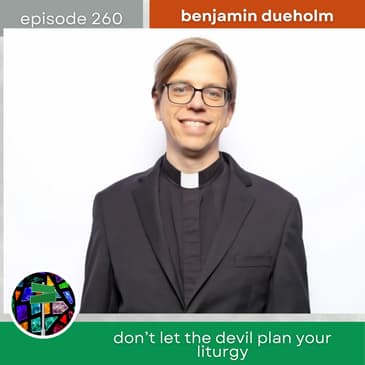
I talk with Pastor Benjamin Duholm from Christ Lutheran Church in Dallas about the intersection of faith and the current political landscape. What does worship look like in an era of political polarization? Dueholm explores the idea of liturgy extending beyond church walls to address societal issues. He offers practical advice for church leaders to focus on the gospel amid political pressures, emphasizing that worship can unite and heal in a complex world.
Template and Transcript: The Roles of Liturgy amid Rhetorical Polarization
Join the Church and Main Email List
Facebook | Instagram | Threads | Twitter | Website | YouTube
00:00:27 --> 00:00:31 Hello, everyone, and welcome to Church in Maine, a podcast for people interested
00:00:31 --> 00:00:34 in the intersection of faith, politics, and culture.
00:00:34 --> 00:00:38 I'm Dennis Sanders, your host. I hope you all had a happy Thanksgiving.
00:00:38 --> 00:00:42 As you can tell, we had the week off last week from episodes,
00:00:42 --> 00:00:45 but we are now back with episodes in December.
00:00:46 --> 00:00:51 So, how do we worship in light of all the news that is happening?
00:00:51 --> 00:00:53 And there is a lot of news happening.
00:00:53 --> 00:01:00 As we speak, I am living here in the Twin Cities, and there's a lot of news
00:01:00 --> 00:01:03 happening if you've been keeping up with what's going on in the news.
00:01:04 --> 00:01:12 So what do we do with that? Do we not pay attention to it, or do we just lean into it?
00:01:13 --> 00:01:19 For Lutheran Pastor Benjamin Duholm, there are two ways that you can do this.
00:01:19 --> 00:01:25 You can look at worship as a transcript or a template.
00:01:26 --> 00:01:33 He's my guest today to talk about what is the role of liturgy in politically polarized times.
00:01:34 --> 00:01:37 Before we get into that conversation a little bit about Benjamin,
00:01:38 --> 00:01:43 he is currently the pastor of Christ Lutheran Church and ELCA Congregation in
00:01:43 --> 00:01:45 Dallas, where he has served since 2019.
00:01:45 --> 00:01:49 Before that, he served congregations in the Chicago area.
00:01:50 --> 00:01:55 He's a graduate of the University of Chicago Divinity School and the Lutheran
00:01:55 --> 00:02:00 School of Theology at Chicago, and he is the author of Sacred Signposts,
00:02:00 --> 00:02:04 Words, Water, and Other Acts of Resistance.
00:02:05 --> 00:02:09 Duholm's writings have appeared in the Dallas Morning News, the New York Times,
00:02:10 --> 00:02:15 the Washington Post, the Christian Century, and other periodicals.
00:02:15 --> 00:02:23 He and his wife, Carrie, have three children and have been foster parents to eight more.
00:02:23 --> 00:02:28 So, here is my conversation with Benjamin Duholm.
00:02:48 --> 00:02:52 All right. Well, thanks for coming on the podcast. I kind of wanted to start
00:02:52 --> 00:02:58 to know a little bit more about you and your journey of faith,
00:02:58 --> 00:03:02 kind of your background, and also know a little bit about Christ Church in Dallas.
00:03:03 --> 00:03:08 Well, thank you for having me. It's great to be here. And I'm always happy to talk about my church.
00:03:08 --> 00:03:11 And as a pastor, we end up talking about our own faith journeys,
00:03:12 --> 00:03:15 too, of course. I didn't grow up going to church.
00:03:16 --> 00:03:24 I was baptized in a Lutheran church in a then fairly small town in western Wisconsin
00:03:24 --> 00:03:28 when I was eight or nine years old.
00:03:28 --> 00:03:37 And there were family reasons for that that didn't necessarily come along with
00:03:37 --> 00:03:41 a strong conviction about Christian education and the rest of it.
00:03:41 --> 00:03:45 But we went to church for about a year. I was baptized along with my little brother.
00:03:46 --> 00:03:53 And then we kind of slipped out the side door of that congregation and explored
00:03:53 --> 00:03:58 Unitarianism for a little while, and then eventually kind of settled into a
00:03:58 --> 00:04:00 routine of just not going to church on Sunday,
00:04:01 --> 00:04:03 which was really most of my life.
00:04:05 --> 00:04:13 And coming to the church again as a young adult, a lot of it was very new to
00:04:13 --> 00:04:20 me, and there were sort of intellectual and social and personal reasons that I was looking for God.
00:04:20 --> 00:04:25 But I'm grateful to that church that baptized me, both because of the gift of baptism,
00:04:25 --> 00:04:30 which in our theological understanding is an irrevocable trust and gift that
00:04:30 --> 00:04:36 God gives to the person being baptized, whether they're one hour old or a hundred years old.
00:04:37 --> 00:04:43 And so I'm grateful for that. And I'm grateful also for the fact that I knew
00:04:43 --> 00:04:46 my Lord's Prayer and my Apostles' Creed and my Ten Commandments and so forth
00:04:46 --> 00:04:49 when I started poking around back into churches.
00:04:49 --> 00:04:52 And so when I was in college, I was confirmed.
00:04:53 --> 00:05:00 I had been poking in and out of different churches in Chicago for about a year at that point.
00:05:02 --> 00:05:06 And I found a community that spoke to my,
00:05:07 --> 00:05:12 I guess you could say, spiritual need That spoke to that dimension that was
00:05:12 --> 00:05:21 maybe missing in my academic and personal life And gave me a way to experience it,
00:05:21 --> 00:05:28 a way to talk about it And that kind of set me on my path from that point on
00:05:28 --> 00:05:31 That was 25, almost 25 years ago.
00:05:32 --> 00:05:35 I came to Dallas six years ago.
00:05:39 --> 00:05:45 Out of a call in Northern Illinois. And I didn't set out to go to Dallas particularly.
00:05:45 --> 00:05:47 I didn't know anyone here.
00:05:47 --> 00:05:54 I had one friend in town and no connections for one state in every direction, as far as I can remember.
00:05:54 --> 00:06:00 And so it was a new thing. But the congregation here.
00:06:02 --> 00:06:07 Had some interesting connections and opportunities. And I thought, well, I'll give it a try.
00:06:08 --> 00:06:13 I came here and visited, and I was deeply impressed by the hospitality and the
00:06:13 --> 00:06:18 friendliness of Texans, which had not been oversold to me before.
00:06:18 --> 00:06:23 And I thought, well, let's give this a try. So that's how I ended up here. Okay.
00:06:25 --> 00:06:30 And so I wanted to talk a little bit about an article that you wrote that was
00:06:30 --> 00:06:32 in the Journal of Lutheran Ethics.
00:06:34 --> 00:06:41 And yes, I'm that sort of a geek that I actually will read the Journal of Lutheran
00:06:41 --> 00:06:44 Ethics Hey, we need that, so that's good.
00:06:46 --> 00:06:51 So, it was an article where you kind of wrote and it's kind of where you talk
00:06:51 --> 00:06:58 about liturgy as template and transcript and I think what was interesting is,
00:06:59 --> 00:07:05 how you kind of view liturgy in those two different ways and in a context of
00:07:05 --> 00:07:11 political polarization and you kind of talk especially about the transcript
00:07:11 --> 00:07:17 part was fascinating because you use something especially about the,
00:07:18 --> 00:07:24 Seeing something on social media is something I saw a lot, I would say about
00:07:24 --> 00:07:28 between five or ten years ago.
00:07:29 --> 00:07:34 And it was a phrase. And it was something that if your preacher doesn't address
00:07:34 --> 00:07:36 X, you should stand up and walk out.
00:07:38 --> 00:07:46 Strangely, I just saw it again two months ago in the wake of Charlie Kirk's assassination.
00:07:47 --> 00:07:51 And this time it was coming from instead of because 10 years ago was coming
00:07:51 --> 00:07:56 from the political left you would hear it and strangely now it was coming from the political right,
00:07:57 --> 00:08:03 which was weird because i think that neither side was addressing the irony of
00:08:03 --> 00:08:11 that um but it's interesting how about that but you're kind of talking about these two ways of how.
00:08:13 --> 00:08:20 Liturgy can be done and how people use liturgy.
00:08:21 --> 00:08:26 I guess first the question I wanted to talk about is when you're talking about
00:08:26 --> 00:08:32 liturgy, you're not simply just talking about what's going on in the church, are you?
00:08:33 --> 00:08:37 I think it sounds like you're talking about a little bit more than just what's
00:08:37 --> 00:08:41 happening within the walls of the church, but what's happening outside of what's happening.
00:08:41 --> 00:08:43 In the church. Yes.
00:08:44 --> 00:08:51 You know, I am not a historian of liturgy or a scholar of liturgical theology.
00:08:52 --> 00:08:57 So I want to preface what I say about this by being clear that I'm speaking
00:08:57 --> 00:09:02 here primarily as a practitioner and as someone who has done unsystematic reading
00:09:02 --> 00:09:03 and research out of his own interest.
00:09:05 --> 00:09:09 So, but yes, I take as...
00:09:11 --> 00:09:17 Written, basically, that liturgy, the work of the people or the public work
00:09:17 --> 00:09:22 of the church is not bounded by the walls of a building and it's not necessarily
00:09:22 --> 00:09:26 bounded by the strict definition of a community.
00:09:26 --> 00:09:30 So things can be liturgical if they're happening in public spaces.
00:09:30 --> 00:09:34 They can be liturgical if they're happening at political rallies or conventions
00:09:34 --> 00:09:36 or sporting events and things of that nature.
00:09:37 --> 00:09:42 So liturgy isn't defined by happening on Sunday morning in a Christian community.
00:09:42 --> 00:09:48 But it is, in my view, in my usage anyway, it's going to be connected to Christians
00:09:48 --> 00:09:52 engaging in that public work of.
00:09:54 --> 00:09:58 In the Lutheran context, we talk about word and sacraments, you know,
00:09:58 --> 00:10:02 proclaiming the word and celebrating the sacraments of baptism and Holy Communion.
00:10:02 --> 00:10:06 Other traditions have other ways of articulating that, of course,
00:10:07 --> 00:10:12 but doing something essential, I guess, that you would say to the practice of our faith.
00:10:14 --> 00:10:23 And so, the habit that you mentioned of people online saying,
00:10:23 --> 00:10:27 you know, unless your preacher mentions, you know, or if your preacher doesn't
00:10:27 --> 00:10:29 mention thus and so, stand up and,
00:10:30 --> 00:10:37 is an aspect of that demand for relevance that I think ends up confronting us
00:10:37 --> 00:10:40 as preachers first, because there will be a sense that, well,
00:10:40 --> 00:10:44 you can preach whatever you want, so if you aren't preaching about the thing
00:10:44 --> 00:10:48 that's on my mind, that must mean that you have a certain attitude about it that I don't like.
00:10:49 --> 00:10:54 But it comes for liturgy, too. It comes for those collective rituals.
00:10:55 --> 00:11:04 Those practices and secret texts that we have for embodying our lives together.
00:11:04 --> 00:11:11 And what I say to people when I've taught preaching or when I've talked to colleagues
00:11:11 --> 00:11:16 is about that mindset of if your preacher doesn't say something about this, stand up and walk out,
00:11:16 --> 00:11:19 is to say, you know, we don't have to let the devil set the agenda.
00:11:19 --> 00:11:26 And we don't need to react to every evil thing because evil,
00:11:26 --> 00:11:29 we do not view evil as the primary agent in the world.
00:11:30 --> 00:11:41 God is the primary agent in the world and exegeting God's work is of the first importance.
00:11:41 --> 00:11:45 Now, that doesn't mean that you should simply ignore things or pretend that
00:11:45 --> 00:11:48 they aren't happening, because that can be a bad attitude as well.
00:11:48 --> 00:11:55 But the idea that every instance of human wickedness that rises to a sufficient
00:11:55 --> 00:12:00 level of visibility needs to be addressed by every preacher on the land is something
00:12:00 --> 00:12:01 that I've always tried to resist,
00:12:01 --> 00:12:06 frankly, because then all you're doing is talking about evil.
00:12:06 --> 00:12:11 All you're doing is talking about man's inhumanity to man or whatever. and that's not our job.
00:12:15 --> 00:12:22 Yeah, I actually kind of related to that was that I did not,
00:12:22 --> 00:12:25 in light of the kind of recent news,
00:12:26 --> 00:12:30 talk about either of that event, of Charlie Kirk's event.
00:12:33 --> 00:12:39 And there was a time when I felt like I had to always relate to every news event.
00:12:39 --> 00:12:46 And I have kind of said, we're not ecclesiastical version of CNN.
00:12:47 --> 00:12:52 We don't. You know, I was trained as a journalist, but, you know,
00:12:52 --> 00:12:55 being a pastor and being a journalist are two different jobs.
00:12:55 --> 00:12:58 And one is a calling.
00:12:58 --> 00:13:05 They're very different approaches. And I think leave the news gathering to the journalist.
00:13:06 --> 00:13:09 You know there are times that you do bring those things in
00:13:09 --> 00:13:12 but that's not every time and not everything has to
00:13:12 --> 00:13:22 be brought in to be preached about yes and i mean i certainly agree i know that
00:13:22 --> 00:13:29 we have colleagues who who would would make the opposite case and i respect that but i do think that.
00:13:31 --> 00:13:35 Communication within the church works on people on multiple levels.
00:13:36 --> 00:13:43 And I think there is a tendency in Christians today, if they're politically
00:13:43 --> 00:13:47 activated, whether on the right or on the left, depending on your context,
00:13:47 --> 00:13:49 you're going to see more of one than of the other.
00:13:49 --> 00:13:58 But there is a tendency to discount all rhetoric,
00:13:58 --> 00:14:05 all use of language that does not very explicitly and clearly say what you think
00:14:05 --> 00:14:08 right or wrong is about something.
00:14:10 --> 00:14:18 Things working by repetition, symbolism, metonymy, rhetorical techniques where
00:14:18 --> 00:14:21 the part stands for the whole, or just the language.
00:14:22 --> 00:14:27 For me as a Lutheran, we draw from the language of a tradition that we don't
00:14:27 --> 00:14:30 necessarily reinvent week to week or year to year.
00:14:30 --> 00:14:34 I mean, we can, we have a lot of freedom, unlike some other Christian traditions
00:14:34 --> 00:14:40 where the text of worship is more or less established for you,
00:14:40 --> 00:14:45 and you have to work within a very narrow range of variations.
00:14:45 --> 00:14:52 As a Lutheran pastor, I can mostly do what I want, but I start with what I call
00:14:52 --> 00:14:55 in my essay, which you very kindly mentioned,
00:14:56 --> 00:15:04 I start with a template that is rooted in the early centuries of Christian worship.
00:15:05 --> 00:15:11 And in some cases, the connection is very distant now, as has to do,
00:15:11 --> 00:15:16 as would be the case with some of our prayers at the altar in the consecration
00:15:16 --> 00:15:18 of the elements for Holy Communion.
00:15:18 --> 00:15:24 Many of those are of very recent origin, but some of them go back to the second or third century.
00:15:25 --> 00:15:30 Or other acts of worship. I mentioned in the essay litanies, um.
00:15:31 --> 00:15:36 But you could also look at the baptismal rite and other things that we do that
00:15:36 --> 00:15:40 generalize from the experience of the moment,
00:15:40 --> 00:15:46 from the intensity of the moment that you're in, and pull you back to a more
00:15:46 --> 00:15:51 trans-historical understanding of what God is doing.
00:15:51 --> 00:15:56 So that you're not just frozen in the moment of political crisis,
00:15:56 --> 00:16:03 but that you are interpreting that political crisis as part of a larger story
00:16:03 --> 00:16:04 of God's action in the world.
00:16:05 --> 00:16:13 And for Christians, it goes back not just to medieval Europe or ancient Rome
00:16:13 --> 00:16:17 or the Mediterranean world or or, you know,
00:16:17 --> 00:16:25 the Eastern churches, but into the Old Testament and the whole story of perseverance
00:16:25 --> 00:16:31 through the rise and fall of regional empires that dominated the life of God's people.
00:16:32 --> 00:16:38 And when you look at liturgy as a template rather than as simply a transcript
00:16:38 --> 00:16:41 or a repetition of what's going on in the world.
00:16:42 --> 00:16:48 In my view, that gives you a freedom to look at these contemporary controversies,
00:16:48 --> 00:16:52 which consume so much of our attention and so much of our moral indignation,
00:16:52 --> 00:16:55 and look at them as being one instance of something much larger.
00:16:56 --> 00:17:00 And I find that liberating. Some people find it oppressive.
00:17:00 --> 00:17:04 So, I don't want to establish that as kind of the only way this can be done.
00:17:06 --> 00:17:12 But that's where I start, is from the assumption that God gives us work to do
00:17:12 --> 00:17:16 that isn't rooted in reacting to every single thing that's going on around us,
00:17:16 --> 00:17:19 but that is meant to call our attention and our minds and our hearts to something bigger.
00:17:21 --> 00:17:26 When you look at these different ways as transcript and template,
00:17:28 --> 00:17:34 Is one better than the other? Are there good things and bad things about them?
00:17:35 --> 00:17:42 So I'll back up just a bit here because I didn't really offer a summary of my work. So I wrote this.
00:17:43 --> 00:17:48 The essay that was published by the Journal of Lutheran Ethics grew out of a
00:17:48 --> 00:17:53 talk I was asked to give to the Lutheran Ethicists'
00:17:53 --> 00:17:58 Gathering, which is a professional organization of people who do Christian ethics
00:17:58 --> 00:18:05 from a Lutheran perspective in Lutheran contexts in connection with the Society of Christian Ethics.
00:18:07 --> 00:18:13 So I was asked to speak on their topic, which was polarization,
00:18:13 --> 00:18:14 political polarization,
00:18:15 --> 00:18:25 how to interpret that in a theological perspective rooted in the Lutheran tradition.
00:18:26 --> 00:18:33 So I, as a liturgical practitioner, not as a scholar of Christian ethics,
00:18:33 --> 00:18:37 but as somebody who has to navigate this week in, week out for a community with
00:18:37 --> 00:18:39 politically mixed views,
00:18:39 --> 00:18:46 I wanted to characterize the different ways that Christians have attempted to
00:18:46 --> 00:18:50 use worship to address contemporary political controversy.
00:18:51 --> 00:18:55 So, one is what I called transcript,
00:18:56 --> 00:19:00 which is basically where the language of public culture wars,
00:19:00 --> 00:19:07 political conflicts, and major issues gets carried over, sometimes word for
00:19:07 --> 00:19:08 word or phrase for phrase,
00:19:08 --> 00:19:13 but always recognizably into the worship of the church, into the words that
00:19:13 --> 00:19:18 we use for prayer, for confession,
00:19:18 --> 00:19:23 for speaking to and hearing from God.
00:19:25 --> 00:19:31 And transcript, the idea of using liturgy as a transcript or making liturgy
00:19:31 --> 00:19:36 into a transcript of political polarization is that it allows you to see pretty quickly where you are.
00:19:37 --> 00:19:44 If you're a newcomer to a church and you see certain buzzwords or hear certain phrasings used,
00:19:44 --> 00:19:49 what it allows you to do is know right away, oh, this is a church for people
00:19:49 --> 00:19:52 who vote the way I vote, or it's not.
00:19:53 --> 00:19:56 And that allows a certain amount of self-sorting so that you can,
00:19:56 --> 00:20:01 you know, as the online people are used to say, stand up and walk out.
00:20:01 --> 00:20:04 It allows you to know, oh, you know what, this is not going to be for me.
00:20:05 --> 00:20:11 But on the other hand, it allows the people who are part of that community to really be formed,
00:20:11 --> 00:20:23 to get a set of interpretations, a rhetorical style book that they can use as
00:20:23 --> 00:20:25 Christians in the world to talk about things.
00:20:25 --> 00:20:31 And so, people find it very powerful, I think, to just wholesale import the
00:20:31 --> 00:20:35 conflicts of the world into the worship of the church. And that's what I call the transcript.
00:20:35 --> 00:20:39 On the other hand, I talked about the other approach that people can generally
00:20:39 --> 00:20:42 take or do generally take as being a template.
00:20:42 --> 00:20:46 We're using liturgy, liturgical language and liturgical practices as a template
00:20:46 --> 00:20:49 for how we understand public life.
00:20:49 --> 00:20:56 And there, the work of the worship is more to help us abstract or help us step
00:20:56 --> 00:21:02 out of the immediacy of present-day conflicts and see them in a larger light.
00:21:03 --> 00:21:11 And I think there are gains and losses to either approach.
00:21:11 --> 00:21:15 I think there are good reasons that people do one or the other,
00:21:15 --> 00:21:21 but there are also costs that I think people are not always cognizant of paying.
00:21:22 --> 00:21:27 And in the context of mainline denominations with generally,
00:21:27 --> 00:21:30 let's say, progressive-leaning clergy, the danger,
00:21:30 --> 00:21:34 the cost that you pay by importing the issue
00:21:34 --> 00:21:39 emphases and the very language of sort of secular progressivism is that you
00:21:39 --> 00:21:47 will not always be aware of when people are having a very conditioned reaction
00:21:47 --> 00:21:50 to those words and those rhetorical choices.
00:21:52 --> 00:21:59 A reaction that short-circuits their ability to listen to whatever it is that you want them to hear.
00:22:00 --> 00:22:06 That is a real danger. I see it happening in churches in my denomination,
00:22:06 --> 00:22:08 and I know it happens in others as well,
00:22:08 --> 00:22:15 that people stop listening when they hear that word or string of words that
00:22:15 --> 00:22:17 triggers a certain kind of reaction.
00:22:17 --> 00:22:21 Whatever you say after that is just gone. You know, they didn't hear it because
00:22:21 --> 00:22:23 they heard something that made them mad.
00:22:23 --> 00:22:26 And that's when they stopped interacting with what you were trying to say.
00:22:27 --> 00:22:35 And I think there can be a reluctance to realize that that is the cost of being
00:22:35 --> 00:22:37 very topical, of being very direct.
00:22:39 --> 00:22:44 That, you know, when you sound like cable news, people will just change the channel.
00:22:44 --> 00:22:50 They will turn it off or they will react the same way. and then you cannot communicate anymore.
00:22:50 --> 00:22:55 So that is just one example of where I think this can go wrong for people.
00:22:57 --> 00:23:01 Yeah, I think I remember a while back, there was a, and I've seen this more
00:23:01 --> 00:23:06 than once, a survey by the sociologist Ryan Berge.
00:23:08 --> 00:23:13 And I don't, you know, he's, you know, done surveys, of course,
00:23:13 --> 00:23:17 of both mainline and evangelical Protestants.
00:23:18 --> 00:23:23 But he did want, especially of voters, how many people voted in the 2024 elections,
00:23:24 --> 00:23:26 especially in mainline denominations.
00:23:26 --> 00:23:33 Who voted for who, and there were a lot of people in the 2024 elections in mainline
00:23:33 --> 00:23:37 denominations that voted for Donald Trump.
00:23:38 --> 00:23:44 And I think people, especially a lot of progressive clergy, don't always understand that.
00:23:45 --> 00:23:52 And I think don't always, and sometimes when they come to the pulpit, I don't think.
00:23:54 --> 00:24:02 I think they kind of come in full bore and don't really understand how to tackle
00:24:02 --> 00:24:09 those issues in any other way than at volume 11,
00:24:09 --> 00:24:13 instead of dealing with it in a more finesse way.
00:24:14 --> 00:24:23 And so it, I think, can have the effect that a lot of people then just shut down and don't listen.
00:24:24 --> 00:24:30 And yes, I think, and that's an issue with preaching. It's an issue with the language of prayer.
00:24:32 --> 00:24:40 The example I started with in the lecture, I will confess, I don't remember
00:24:40 --> 00:24:43 if it made it into the published version or not,
00:24:43 --> 00:24:50 but a story that I heard way back when I was a Divinity School student in the
00:24:50 --> 00:24:51 early years of this century.
00:24:54 --> 00:25:02 Of a pastor, from a pastor who was herself a student in the 1980s when her supervisor,
00:25:04 --> 00:25:06 prayed during the pastoral prayer. This was a Baptist church.
00:25:08 --> 00:25:15 The lengthy intercession done by the pastor included a prayer against,
00:25:15 --> 00:25:18 quote, the evil of the Trident submarine.
00:25:18 --> 00:25:24 Now, if you're a child of the 80s, of the 70s and 80s, this might mean something to you.
00:25:25 --> 00:25:29 The nuclear-armed submarines that were kind of at the time destabilizing the
00:25:29 --> 00:25:35 balance of power in the Cold War, and this was a very progressive congregation,
00:25:35 --> 00:25:37 but some of the people in the congregation were very mad about this.
00:25:37 --> 00:25:41 They felt that it was not an appropriate use of the language of prayer.
00:25:42 --> 00:25:48 And there is always the danger that you will mistake your moral intuitions and
00:25:48 --> 00:25:56 your media diet and your set of preoccupying issues for that of your listeners.
00:25:58 --> 00:26:03 It is a real danger. And I think for preachers,
00:26:03 --> 00:26:11 it's important to always start with including yourself in whatever judgment,
00:26:11 --> 00:26:14 you know, your words are propounding.
00:26:15 --> 00:26:20 If you can't take God's side against yourself in preaching, then think again
00:26:20 --> 00:26:23 about what you're doing and take another approach.
00:26:24 --> 00:26:28 Because the whole point is I understand it, and again, I'm a Lutheran,
00:26:28 --> 00:26:31 I have a certain Augustinian Theological Heritage, which is about human sin,
00:26:32 --> 00:26:38 the point, as I understand it, is that we're all kind of enmeshed in the same evil, the same,
00:26:39 --> 00:26:42 orientation of our lives away from God, and that might manifest differently
00:26:42 --> 00:26:46 in different people and in different social circumstances and in different historical
00:26:46 --> 00:26:51 moments, but we're all, we all participate in this kind of human resistance to God.
00:26:51 --> 00:26:57 So, if you don't see your moralizing as implicating yourself and your own sins,
00:26:57 --> 00:27:01 then start from scratch and find a way to talk about yourself not just people
00:27:01 --> 00:27:05 who aren't in the room or that you don't think are in the room because it may
00:27:05 --> 00:27:09 turn out they are in the room and and they will feel you know miss,
00:27:10 --> 00:27:13 ill-used by by your words.
00:27:16 --> 00:27:20 Agree because the prophets when they spoke were also implicating themselves
00:27:20 --> 00:27:26 as much as they were implicating the people as well they were yeah they were
00:27:26 --> 00:27:28 part of the people who were implicated You know,
00:27:29 --> 00:27:36 this is, it wasn't God's going to come and mess with y'all, but he's got a special arrangement with me.
00:27:37 --> 00:27:39 You know, that was, I mean, maybe with Moses, I guess you could say that.
00:27:41 --> 00:27:47 You know, Moses was a special case, but generally speaking, you know, they're part of it.
00:27:47 --> 00:27:50 And that doesn't mean that everybody is guilty of everything or whatever.
00:27:50 --> 00:27:57 But I do think that there is a way of talking that can put the problem out there.
00:27:58 --> 00:28:02 And at least when I am visiting churches, when I'm not preaching,
00:28:02 --> 00:28:05 and I feel like I may be...
00:28:06 --> 00:28:10 Being reassured, you know, that I'm not like the other Christians.
00:28:11 --> 00:28:14 I actually find that the opposite of reassuring. I find it very.
00:28:19 --> 00:28:27 I find it very actually discouraging because it makes me think,
00:28:27 --> 00:28:30 wait a minute, if I'm supposed to be the good Christian here,
00:28:30 --> 00:28:34 what does it mean that I'm really only a mediocre Christian?
00:28:35 --> 00:28:43 Um, if, if I'm, if I'm not like the other ones, it's a real problem that I'm not better than I am.
00:28:44 --> 00:28:52 Um, and so I personally find it not, those kinds of sermons backfire with me.
00:28:52 --> 00:28:56 Um, I, I do not hear them the way I think they are intended to be heard.
00:28:57 --> 00:29:00 And I only speak for myself there. Um, But I
00:29:00 --> 00:29:05 do think there are reasons to just refrain from assuming what your listeners
00:29:05 --> 00:29:09 believe about themselves or each other or the world or Christians who aren't
00:29:09 --> 00:29:15 in the room and really try to work with what Christ is saying through the scriptures
00:29:15 --> 00:29:17 that we can start from there.
00:29:18 --> 00:29:29 Do you think that people might think that the liturgy as template is not paying
00:29:29 --> 00:29:32 attention to what's happening or is kind of an escapist?
00:29:33 --> 00:29:39 Oh, yeah. And I think that's a fair—every—every—.
00:29:42 --> 00:29:47 Every strength of these two types that I identified has a corresponding weakness.
00:29:48 --> 00:29:54 And I think for liturgy as a template, as a structure for understanding.
00:29:58 --> 00:30:06 The strength, one of the strengths, is that it takes you a little bit out of
00:30:06 --> 00:30:09 immediate conflicts and helps you to see things in a larger perspective.
00:30:09 --> 00:30:14 The weakness, the corresponding weakness is that you end up potentially not
00:30:14 --> 00:30:22 having an appropriate word for a situation that requires it or that requires
00:30:22 --> 00:30:23 some kind of moral clarity.
00:30:23 --> 00:30:32 I didn't want and I would not wish for the typology that I came up with to be
00:30:32 --> 00:30:36 characterized as sort of being
00:30:36 --> 00:30:42 activist versus being indifferent or always splitting the difference.
00:30:42 --> 00:30:47 I think there's a way that you can hide in traditional language,
00:30:47 --> 00:30:54 that you can avoid naming actual evils and you can avoid identifying injustice
00:30:54 --> 00:31:00 because you sort of pile it under this language of sin,
00:31:00 --> 00:31:06 of whatever it is that I might be drawing from. That is a risk.
00:31:06 --> 00:31:11 That is a very real risk. And I think the way out of that for me is to,
00:31:12 --> 00:31:14 when a word is needed, to try to do it in preaching.
00:31:15 --> 00:31:21 And my feeling, I've never tested this, and this is a sense of mind that's too
00:31:21 --> 00:31:23 important to me now to ask if it's actually true.
00:31:23 --> 00:31:31 But my attitude is that if the liturgy is fairly by the book,
00:31:31 --> 00:31:36 if it's fairly, quote-unquote, traditional for me, for my world—.
00:31:37 --> 00:31:41 And if it's reliable, if it's not, oh, what's the litany this week?
00:31:41 --> 00:31:42 What's the issue going to be?
00:31:42 --> 00:31:45 What's the kind of flavor of the month here?
00:31:47 --> 00:31:54 If the liturgy is consistent within certain parameters, people are willing to...
00:31:55 --> 00:32:03 Go to harder places with preaching, because they are not as anxious about,
00:32:05 --> 00:32:08 is the Lord's Prayer going to be in the wrong place today, or is it going to
00:32:08 --> 00:32:10 be the wrong words, or is it going to be a different translation,
00:32:10 --> 00:32:15 or is there going to be some huge novelty,
00:32:16 --> 00:32:20 in the intercessions, or the Eucharistic prayer at the altar, or whatever it may be.
00:32:20 --> 00:32:24 If people aren't worrying about that, if people aren't distracted by the thought
00:32:24 --> 00:32:29 of, oh, well, they released a whole bunch of butterflies instead of doing the
00:32:29 --> 00:32:31 prayers, and isn't that kind of ridiculous?
00:32:31 --> 00:32:37 If people aren't fixating on those things, they are more willing to hear you
00:32:37 --> 00:32:40 if you need to say a harsh word.
00:32:40 --> 00:32:43 That's my theory. I've never tested it.
00:32:43 --> 00:32:48 I'm so committed to it now, 16 years into this, that there's no going back for me.
00:32:48 --> 00:32:53 So I just offer it for consideration, that if you can hold certain things constant
00:32:53 --> 00:32:57 and take away that source of anxiety that worshipers have, because it's easy to forget.
00:32:58 --> 00:33:03 Church, for pastors, church is the creative high point of our week.
00:33:03 --> 00:33:07 This is where we exercise our agency. This is where we get to try out new ideas.
00:33:07 --> 00:33:11 For people who are worshiping, by and large, that is not necessarily their motive.
00:33:11 --> 00:33:15 You know, they have to spend all week at work.
00:33:18 --> 00:33:22 Being stretched, being pulled in different ways, and very many of them come
00:33:22 --> 00:33:25 to church for something that is comforting and reliable, and you don't want
00:33:25 --> 00:33:27 to let that turn into, you know,
00:33:28 --> 00:33:35 just pap every week, but taking certain anxieties off the table so that you
00:33:35 --> 00:33:40 allow them to sit with other ones is,
00:33:40 --> 00:33:45 I think, a valid choice that preachers and liturgical leaders can make.
00:33:48 --> 00:33:53 Yeah, and what does it mean, especially when kind of dealing with,
00:33:56 --> 00:34:06 especially kind of harder issues or issues that are, well, let's say culture war issues.
00:34:08 --> 00:34:13 You know, and I think you even deal with this in the article.
00:34:15 --> 00:34:22 One of the, and it caught news here, and it was actually came from here,
00:34:22 --> 00:34:27 was a Lutheran church here in Minnesota that has something called the Sparkle Creed. Yes.
00:34:29 --> 00:34:36 And that just got, it just kind of blew up everywhere. And some people didn't
00:34:36 --> 00:34:40 see it as a big deal, others saw it as a very big deal.
00:34:43 --> 00:34:51 And it was just kind of an interesting thing and how people were kind of dealing with it all.
00:34:53 --> 00:34:56 But it was an interesting thing because it was dealing with liturgy.
00:34:57 --> 00:35:03 Mm-hmm. Yep. And so, how do you handle something like that? How was it handled?
00:35:04 --> 00:35:08 Was it handled well? And how was the response handled?
00:35:09 --> 00:35:14 Well, what was interesting about that example is that when I presented this
00:35:14 --> 00:35:24 as a talk to a primarily Lutheran group of people, I had two main examples in the paper.
00:35:24 --> 00:35:30 One was the Sparkle Creed, and the other was this kind of take back the border
00:35:30 --> 00:35:37 Christian nationalist revival rally that was held on the US-Mexico border in 2024.
00:35:39 --> 00:35:45 And everybody in the room, I asked, who heard this story? Everybody had heard
00:35:45 --> 00:35:46 about the Sparkle Creed.
00:35:47 --> 00:35:52 And at least one person in the room had had way more involvement in the story
00:35:52 --> 00:35:56 than I think they, this was somebody who was not eager to revisit the topic.
00:35:57 --> 00:36:01 Nobody, nobody had heard about this Christian nationalist border caravan.
00:36:02 --> 00:36:08 And it wasn't necessarily that huge of a story, but it was in major media.
00:36:09 --> 00:36:13 It just didn't penetrate that world.
00:36:13 --> 00:36:18 I heard about the Sparkle Creed because, and I don't watch cable news,
00:36:18 --> 00:36:24 and I try to keep my media consumption as boring and as non-sensationalized as I can, but...
00:36:27 --> 00:36:33 But I heard about it from a church member who was upset, who was upset about
00:36:33 --> 00:36:38 this kind of rewrite is not even the right word.
00:36:38 --> 00:36:41 It's kind of an homage to the Apostles' Creed.
00:36:42 --> 00:36:46 And if you grew up Lutheran or you've worshiped a long time in a Lutheran church
00:36:46 --> 00:36:51 or an Episcopal church or probably a Roman Catholic church and some other traditions,
00:36:51 --> 00:36:54 the Apostles' Creed is going to be a very important thing to you.
00:36:54 --> 00:36:58 It's going to be something that you have recited many Sundays,
00:36:58 --> 00:36:59 depending on the time of year.
00:37:00 --> 00:37:01 You know, it might be different, created at a different time,
00:37:01 --> 00:37:07 but you've probably been forced to memorize it if you're old enough as part of your confirmation.
00:37:08 --> 00:37:12 It's one of those bits that I carried over from my one year in a Missouri Synod
00:37:12 --> 00:37:16 Lutheran church when I was a kid, all the way into adulthood.
00:37:16 --> 00:37:19 You know, I didn't go to church for years and years, but when I showed back
00:37:19 --> 00:37:23 up and it was, I believe in God, the Father, Almighty, Creative Heaven,
00:37:23 --> 00:37:24 it was all still there for me.
00:37:24 --> 00:37:33 So, it's this kind of, I don't want to disparage it unnecessarily.
00:37:33 --> 00:37:37 It's kind of like a parody of the Apostles' Creed, I guess you could say.
00:37:37 --> 00:37:39 I don't think it's meant that way, but it reads that way.
00:37:40 --> 00:37:44 And I don't have the text right in front of me, but it refers to,
00:37:44 --> 00:37:50 you know, Jesus having two dads, and his, which, by the way,
00:37:50 --> 00:37:54 kind of eliminates the role of his human mother.
00:37:54 --> 00:37:57 I'm not sure that's what anybody would have intended there.
00:37:59 --> 00:38:05 And anyway, it's a very, very, it's a document of American cultural progressivism,
00:38:05 --> 00:38:10 you know, from circa the 2010s, you know. Yeah.
00:38:12 --> 00:38:16 And I heard about it because somebody was unhappy about it.
00:38:18 --> 00:38:23 And I responded to this person and responded in a way that was appropriate to my own role there.
00:38:25 --> 00:38:30 But I wasn't really aware until later that it had become this huge cultural
00:38:30 --> 00:38:34 moment and that there were death threats, that the FBI had been involved because
00:38:34 --> 00:38:37 people were threatening this pastor in this church.
00:38:37 --> 00:38:45 I really had no idea what a firestorm this was. And obviously, that's outrageous.
00:38:45 --> 00:38:51 I mean, if people want to do some kind of what you might consider tacky variation
00:38:51 --> 00:38:53 on a creed, that's their business.
00:38:53 --> 00:38:56 You know, it doesn't hurt you. It doesn't involve you in any way.
00:38:56 --> 00:39:02 It's just leave them alone. And I really wasn't aware of how completely deranged
00:39:02 --> 00:39:03 people's reaction was to this.
00:39:05 --> 00:39:12 But after that was all had kind of died down a little bit, and I was looking at it simply as a text,
00:39:14 --> 00:39:21 you know, I think it's a good example of letting our own desire for relevance
00:39:21 --> 00:39:25 and to speak to current controversies kind of run away with us.
00:39:25 --> 00:39:30 And not think through what we're actually doing. When we, for example,
00:39:30 --> 00:39:35 make a creedal statement that cuts Jesus's human mother out of the story of salvation.
00:39:38 --> 00:39:45 Other than that, I mostly felt it was just a little tacky, but that is,
00:39:45 --> 00:39:51 it cost a lot of people a lot of fear and a lot of heartache,
00:39:51 --> 00:39:54 And I'm genuinely sorry about that.
00:39:55 --> 00:40:02 And there's no excuse for any of that. But simply as a liturgical text,
00:40:02 --> 00:40:05 I found it very notably wanting.
00:40:10 --> 00:40:20 Can we look at our modern moment and where we're kind of at right now as a nation and as a church?
00:40:21 --> 00:40:28 What advice would you give to churches and especially to pastors as we're trying
00:40:28 --> 00:40:35 to kind of figure out the moment and figure out how to best preach and how to
00:40:35 --> 00:40:39 best plan worship in this moment?
00:40:40 --> 00:40:47 Because I think that there is a strong temptation of, how do I speak at this moment?
00:40:51 --> 00:40:56 And there are going to be some that feel like they have to always speak all the time to everything.
00:40:56 --> 00:41:01 And then there are some that feel like they can't, they just can't do that.
00:41:01 --> 00:41:08 And so, what advice would you give to pastors in how they approach all of this?
00:41:09 --> 00:41:11 How much time do you got?
00:41:12 --> 00:41:17 Yeah. And maybe short of probably not watching cable news. Yeah.
00:41:19 --> 00:41:22 Well, I do think, I do think, I should,
00:41:22 --> 00:41:32 I think looking to our own information diet and our own habits of media engagement
00:41:32 --> 00:41:34 is not a bad place to start.
00:41:36 --> 00:41:39 Think about the kinds of communication that actually
00:41:39 --> 00:41:42 do edify us that change our minds that
00:41:42 --> 00:41:47 shape our moral intuitions rather than just getting us riled up or giving us
00:41:47 --> 00:41:53 something to giving us a bouncing ball to chase think about about what media
00:41:53 --> 00:41:59 consumption and media engagement is good for us as moral actors and as christians
00:41:59 --> 00:42:01 and try to do more of that and and less,
00:42:02 --> 00:42:06 marinating in kind of outrage of the minute type media.
00:42:06 --> 00:42:10 I mean, one aspect to this, which I touch on in the essay, but we haven't talked
00:42:10 --> 00:42:17 about a whole lot here, is just the role that modern media forms have in amplifying
00:42:17 --> 00:42:20 outrage, instantaneously replicating it around the world,
00:42:21 --> 00:42:28 with unreliable variations and seeing that as though we are seeing the world
00:42:28 --> 00:42:32 unfiltered rather than essentially being manipulated into different kinds of
00:42:32 --> 00:42:35 reactions by tech platforms that live on that.
00:42:35 --> 00:42:40 So I think in the first instance, yes, actually, you know...
00:42:42 --> 00:42:49 Uh look to our own look to our own spiritual health in the realm of media engagement,
00:42:50 --> 00:42:56 secondly as i said and i and i have said and i do say don't let don't let the devil set the agenda,
00:42:57 --> 00:43:02 um don't don't let the devil pick your sermon topic for you or your liturgical
00:43:02 --> 00:43:06 language um that doesn't mean run from things it doesn't mean hide from things
00:43:06 --> 00:43:14 but it does mean that that evil doesn't get to set the imperative all the time.
00:43:16 --> 00:43:24 And then thirdly, just what I also mentioned, be sure to implicate yourself
00:43:24 --> 00:43:29 in the evils that you are deploring,
00:43:29 --> 00:43:32 even if it's not your own evil, like the temptation,
00:43:33 --> 00:43:37 certainly the temptation to mischaracterize people, to stereotype them,
00:43:37 --> 00:43:42 to dehumanize them, or whatever it may be that is going on is something that's
00:43:42 --> 00:43:47 common to all of us, or at least to most of us in some moods, in some circumstances.
00:43:48 --> 00:43:54 And to not set yourself apart, to not be scorning or looking down on the people
00:43:54 --> 00:43:59 that you want to, whose minds you want to change. I think that's important.
00:44:00 --> 00:44:03 And then really, you know, beyond those things,
00:44:04 --> 00:44:13 just being mindful that almost no one is waiting for us to tell them how to
00:44:13 --> 00:44:19 vote or what to think about top marginal tax rates or what the optimal trade
00:44:19 --> 00:44:22 or immigration policy for the United States of America is. Almost no one.
00:44:24 --> 00:44:30 And I wish they were, because my opinions on all those things are correct,
00:44:30 --> 00:44:31 and people should listen to me.
00:44:33 --> 00:44:37 But they don't, and they don't have to, and I can't make them.
00:44:37 --> 00:44:45 So having some self-awareness about what exactly, what role we play in people's
00:44:45 --> 00:44:51 lives, and what they need from us as teachers, as preachers,
00:44:51 --> 00:44:52 as someone of the proclamation.
00:44:52 --> 00:44:59 In the end, for me, and this is true for many of us, giving people Jesus is my job.
00:44:59 --> 00:45:03 And that doesn't mean a Jesus who isn't invested or engaged in things of the world.
00:45:03 --> 00:45:07 But preaching good news is my job.
00:45:08 --> 00:45:12 And if people won't believe that from me, if they don't think they're going
00:45:12 --> 00:45:17 to hear that from me, they don't really have any reason to listen to me about
00:45:17 --> 00:45:21 immigration policy or top marginal tax rates or anything else.
00:45:22 --> 00:45:26 Because none of those things are what I am called and commissioned to do.
00:45:26 --> 00:45:32 So, I think that would be, yeah, piece of advice number four,
00:45:32 --> 00:45:36 keep some perspective because it's a long game with people.
00:45:36 --> 00:45:39 Ideally, you're talking to them week in and week out over a period of time,
00:45:39 --> 00:45:46 and both you and they are being sanctified by the Word of God and the means of grace,
00:45:47 --> 00:45:52 and both you and they are in need of being healed and being restored and made
00:45:52 --> 00:45:59 holy by the grace of God, which will hopefully allow all of us to be better citizens,
00:45:59 --> 00:46:05 better neighbors, to love each other more, to be free from pointless hostilities and prejudices and.
00:46:05 --> 00:46:09 Take better care toward the earth and toward one another.
00:46:09 --> 00:46:14 But that's slow work. It's slow work on me, and it's certainly going to be slow
00:46:14 --> 00:46:18 work on everyone for whom I am God's poor and limited instrument.
00:46:22 --> 00:46:28 If people want to know more about you, where can they go? Great question.
00:46:30 --> 00:46:39 I do have a sub stack, benjaminduhome.substack.com.
00:46:40 --> 00:46:46 It's called the Parish Bulletin, and it is irregularly published because it's
00:46:46 --> 00:46:49 not my day job. But I do try to keep up with it.
00:46:50 --> 00:46:54 And I also, I write regularly for the Christian century.
00:46:57 --> 00:47:01 So, you know, you can find lots of my writing there.
00:47:01 --> 00:47:06 And if you come to clcdallas.org or look up Christ Lutheran Church Dallas on
00:47:06 --> 00:47:12 YouTube, you can find out more than you ever would want to know about my preaching.
00:47:13 --> 00:47:15 You want to see how I've handled some of these things.
00:47:16 --> 00:47:21 There are plenty of examples, good and bad, right there. that YouTube page. Okay.
00:47:22 --> 00:47:26 Well, Ben, thank you so much for this. This was a really good conversation.
00:47:26 --> 00:47:30 I think it will be helpful for a lot of pastors and lay leaders as we're all
00:47:30 --> 00:47:34 trying to figure out how best to lead our congregations in this time.
00:47:36 --> 00:47:39 Thank you, Dennis. I really appreciate it. It was great talking to you. All right.
00:48:10 --> 00:48:15 So, what are your thoughts about this episode? What do you think about seeing
00:48:15 --> 00:48:19 worship as either a transcript or a template?
00:48:20 --> 00:48:25 And especially if you're coming from a more liturgical tradition,
00:48:25 --> 00:48:27 what do you think about this?
00:48:28 --> 00:48:34 But I actually would be fascinated if you come from a more kind of,
00:48:34 --> 00:48:37 as I used to say, low church tradition. What do you think?
00:48:39 --> 00:48:44 Whatever you think, feel free to send me an email. You can do that by sending
00:48:44 --> 00:48:47 it to churchandmeatsubstack.com.
00:48:47 --> 00:48:56 I will include links to Benjamin's article that was found in a journal of Lutheran ethics.
00:48:56 --> 00:49:01 I think it's a good read, and I think you will enjoy it. And I think,
00:49:01 --> 00:49:03 like I said, it's a good article.
00:49:04 --> 00:49:08 If you want to learn more about this podcast, listen to past episodes,
00:49:08 --> 00:49:12 or donate, feel free to go to churchinmain.org.
00:49:13 --> 00:49:17 There you will listen to all of the old episodes I have.
00:49:18 --> 00:49:23 You can also go to churchinmain.substack.com to read related articles.
00:49:23 --> 00:49:25 I have a few new ones that are up.
00:49:26 --> 00:49:32 Some that are actually reposts of a few years ago and some that are actually
00:49:32 --> 00:49:36 brand new that I have. So check those out.
00:49:36 --> 00:49:40 Again, that's at churchandmain.substack.com to read those articles.
00:49:41 --> 00:49:47 I would also encourage you to subscribe to the podcast on your favorite podcast app.
00:49:48 --> 00:49:53 And if you listen to wherever you listen to this, whether it's Apple Podcasts
00:49:53 --> 00:49:57 or Spotify or wherever that you can leave a rating or review.
00:49:57 --> 00:49:58 I hope that you will do so.
00:49:59 --> 00:50:02 When you do that, that actually helps others find a podcast.
00:50:03 --> 00:50:08 Um, also, uh, if you're able to make a donation, there is a link in the show
00:50:08 --> 00:50:14 notes to do so, um, that can help pay for the cost of this podcast.
00:50:14 --> 00:50:18 Um, it can be a one-time donation, or you can also make that a recurring donation.
00:50:19 --> 00:50:24 Um, if you would like to have this episode, uh, show up in your email inbox,
00:50:24 --> 00:50:25 there's a link for that too.
00:50:26 --> 00:50:33 Um, and just hit that link. and that will make sure that when a new episode
00:50:33 --> 00:50:37 is available, that it will go to your email inbox.
00:50:38 --> 00:50:42 So, that is it for this episode of Church in Maine.
00:50:42 --> 00:50:46 My name is Dennis Sanders. I'm your host. As I always like to say,
00:50:46 --> 00:50:47 thank you so much for listening.
00:50:47 --> 00:50:52 Take care, everyone. Godspeed, and I will see you very soon.