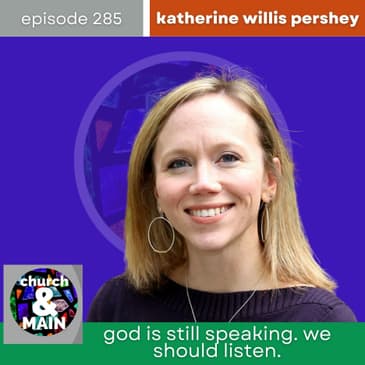

What does it mean to trust God in an age when trust itself feels almost impossible? In this episode, Dennis sits down with pastor, author, and Christian Century contributor Katherine Willis Pershey, who opens up about her journey from secular skepticism through ordained ministry to a renewed and deepening faith in the God who acts. They talk honestly about the decline of progressive mainline denominations like the UCC, asking whether the crisis is not just numerical but spiritual, rooted in a slow drift away from confidence in the resurrected Christ toward a gospel of human programs and good intentions. Katherine brings both unflinching honesty about the institutions she loves and a hard-won hope grounded not in optimism about what we can do but in the promise of what God is already doing. If you have ever felt the tension between pursuing justice and trusting in grace, or wondered whether the church can find its way through death to resurrection, this conversation is for you.
Shownotes:
Life, Death, and Resurrection in the United Church of Christ
Please, liberal Christians, read Eugene Peterson
Join the Church and Main Email List
Facebook | Instagram | Threads | Twitter | Website | YouTube
00:00:27 --> 00:00:30 Greetings, everyone, and happy June. Welcome to Church and Main,
00:00:30 --> 00:00:33 a podcast for people interested in the intersection of faith,
00:00:33 --> 00:00:35 politics, and culture. I'm Dennis Sanders, your host.
00:00:36 --> 00:00:41 Most Protestants don't really think much about the day that's sandwiched in
00:00:41 --> 00:00:43 between Good Friday and Easter Sunday.
00:00:43 --> 00:00:47 That day is called, not shockingly, Holy Saturday.
00:00:48 --> 00:00:52 This is the in-between time as we await the resurrection of Jesus.
00:00:52 --> 00:00:57 It was on this day that Disciples of Christ Pastor Catherine Willis Percy,
00:00:57 --> 00:01:04 wrote an article about the denomination where she has served for about 15 years,
00:01:05 --> 00:01:06 the United Church of Christ.
00:01:06 --> 00:01:11 Now, Holy Saturday is, as I said before, an in-between moment.
00:01:11 --> 00:01:17 As an article in Mockingbird wrote, quote, Holy Saturday is the day the disciples
00:01:17 --> 00:01:19 didn't know what to think. The tomb was sealed.
00:01:20 --> 00:01:23 Jesus was dead. They had believed he was the one who would redeem Israel.
00:01:24 --> 00:01:25 And now they were sitting in
00:01:25 --> 00:01:31 an upper room, terrified, trying to figure out what any of it had meant.
00:01:32 --> 00:01:38 They were not in despair, exactly. They hadn't yet had time to fully reckon with what had happened.
00:01:38 --> 00:01:44 But they certainly weren't celebrating. They were just waiting. In the in-between.
00:01:44 --> 00:01:46 And the not yet. Unquote.
00:01:48 --> 00:01:54 In Pershey's substat post, which is titled The Life, Death, and Resurrection
00:01:54 --> 00:02:02 of the United Church of Christ, She talks about the in-between phase that the UCC finds itself in.
00:02:02 --> 00:02:07 She highlights the bold witness of the denomination, and that includes being
00:02:07 --> 00:02:14 one of the first to ordain women, and also one of the first to ordain openly
00:02:14 --> 00:02:16 gay and lesbians as pastors.
00:02:16 --> 00:02:20 But she also wrote about some of the challenges that are facing the denomination.
00:02:20 --> 00:02:25 That includes pastoral shortages, shrinking congregations, and the temptation
00:02:25 --> 00:02:29 to focus on human efforts instead of the grace of God.
00:02:30 --> 00:02:36 Now, there is a lot of talk these days, and I should know, about the decline of the mainline.
00:02:38 --> 00:02:44 Being a mainline pastor myself, you hear a lot about that decline talk, but the,
00:02:45 --> 00:02:48 Since this article, as I said, was written on Holy Saturday,
00:02:48 --> 00:02:56 kind of on the edge of Easter, this is also a conversation really about hope.
00:02:57 --> 00:03:01 And so, my guest today is Catherine Willis-Pershey.
00:03:01 --> 00:03:05 And before we get into the interview, a little bit more about Catherine.
00:03:05 --> 00:03:09 She is ordained, as I said, in the Christian Church, Disciples of Christ,
00:03:09 --> 00:03:14 and she serves as one of the co-pastors at First Congregational Church,
00:03:14 --> 00:03:17 United Church of Christ, in Appleton, Wisconsin.
00:03:18 --> 00:03:23 She is a native of Ohio and received her Master's of Divinity at Claremont School
00:03:23 --> 00:03:29 of Theology in California, and she recently completed a Doctor of Ministry on
00:03:29 --> 00:03:30 the theme Holy Presence,
00:03:31 --> 00:03:36 Eugene Peterson and Pastoral Imagination from Western Theological Seminary in Michigan.
00:03:36 --> 00:03:42 Now, before serving First Congregational in Appleton, she served as associate
00:03:42 --> 00:03:46 pastor of the First Congregational Church of Western Springs,
00:03:46 --> 00:03:49 just outside of Chicago, for 14 years.
00:03:49 --> 00:03:55 She is an author of two books, Any Day of Beautiful Change, A Story of Faith
00:03:55 --> 00:04:01 and Family, and also the book Very Married, Field Notes on Love and Fidelity.
00:04:01 --> 00:04:09 She also happens to be a yoga instructor, living in Appleton with her husband and two teenage kids.
00:04:10 --> 00:04:15 Now, without further ado, here's my conversation with Katherine Willis-Pershey.
00:04:33 --> 00:04:36 Well, Catherine, I want to welcome you to the podcast.
00:04:37 --> 00:04:41 And I think first to start off is if you could tell us a little bit about yourself
00:04:41 --> 00:04:42 and your spiritual journey.
00:04:44 --> 00:04:48 Well, good morning, Dennis. It is so good to finally have a chance to talk to
00:04:48 --> 00:04:50 you. This conversation is a long time coming.
00:04:51 --> 00:04:56 You had first reached out to me when I was in the middle of our transition to
00:04:56 --> 00:05:02 Wisconsin. And I think I said yes, and then dropped the ball as hard as a ball can be dropped.
00:05:02 --> 00:05:05 So thank you for your grace, first of all.
00:05:05 --> 00:05:12 And I'm just so glad to finally be here. Um, so I, um, yeah,
00:05:12 --> 00:05:19 I, I've been a minister actually today is my, uh, 21st ordination anniversary. So congratulations.
00:05:19 --> 00:05:25 Thank you. Um, it was, uh, Pentecost, uh, Sunday, um, 21 years ago today.
00:05:25 --> 00:05:28 Um, and so I, I've been in, um,
00:05:29 --> 00:05:35 congregational ministry for the whole of my, um, my time as an ordained pastor
00:05:35 --> 00:05:40 and have always been serving within churches in the mainline.
00:05:40 --> 00:05:48 So I was ordained in the Disciples of Christ and have been serving in UCC contexts since 2010.
00:05:48 --> 00:05:52 Not so good at math, so whatever, however that adds up.
00:05:53 --> 00:06:00 So I did grow up United Methodist and I was in a number of different traditions
00:06:00 --> 00:06:07 for a time of some spiritual seeking, but I found a home in the disciples of Christ.
00:06:07 --> 00:06:14 So I find myself in a pretty, I would say, theologically center place,
00:06:14 --> 00:06:16 but I don't think that really tells you much.
00:06:17 --> 00:06:26 I think of myself as a fairly theologically orthodox Christian who is unapologetically inclusive.
00:06:26 --> 00:06:33 And so oftentimes that means I don't really fit anywhere, but I also find myself
00:06:33 --> 00:06:39 able to connect with Christians across the spectrum, which is a real joy.
00:06:41 --> 00:06:48 Yeah, that kind of the theologically orthodox and kind of practicing inclusive
00:06:48 --> 00:06:52 sounds very familiar, because that's kind of the position where I'm at.
00:06:52 --> 00:06:59 I've noticed that, and I really appreciate when I find those kindred spirits.
00:07:00 --> 00:07:04 So thank you for your voice. I'm really grateful for your voice. Well, thank you.
00:07:05 --> 00:07:09 Well, I wanted to talk to you, because you wrote something actually on Holy Saturday.
00:07:11 --> 00:07:17 And it's kind of a reflection of several different articles on Substack,
00:07:18 --> 00:07:23 that were all kind of talking about the current situation in the UCC,
00:07:23 --> 00:07:27 in the United Church of Christ, which has been the context that you serve in.
00:07:29 --> 00:07:36 And kind of talking about all of the good things that you've had in serving
00:07:36 --> 00:07:42 in those churches, but also kind of some of the things that are maybe fall short,
00:07:42 --> 00:07:47 but also expressing your love for this tradition.
00:07:49 --> 00:07:53 Can you kind of give a synopsis of what you were trying to get at in that?
00:07:53 --> 00:07:55 Because I think there is a lot of good stuff in there.
00:07:56 --> 00:08:01 You know, Ryan Berge was the one that kind of, as he is wanting to do,
00:08:01 --> 00:08:06 gives the numbers, because it was talking kind of about the number situation
00:08:06 --> 00:08:07 in the United Church of Christ.
00:08:08 --> 00:08:14 And then Tony Robinson, who is a retired UCC minister, kind of gave the more
00:08:14 --> 00:08:20 his own experience as a pastor, and you had your own reflection.
00:08:20 --> 00:08:24 And so I wanted to give you the chance to kind of share the synopsis of that.
00:08:26 --> 00:08:33 Well, the first thing I would say is that I think the UCC makes for a great case study,
00:08:34 --> 00:08:40 but much of what we might say about the UCC could be applied to a number of
00:08:40 --> 00:08:44 different progressive mainline Christian churches.
00:08:44 --> 00:08:53 It may be most pronounced in the UCC, But it also applies probably to disciple
00:08:53 --> 00:08:56 context, maybe PCUSA churches.
00:08:57 --> 00:09:01 We know that many churches are experiencing a crisis of decline.
00:09:02 --> 00:09:13 Because I have been serving in large, stable UCC churches, multi-staff churches for some time.
00:09:14 --> 00:09:23 I have honestly, I think I've been a little bit irresponsible as a member of the wider church,
00:09:23 --> 00:09:30 as a pastor in the wider church, and not really participated in the conversation.
00:09:31 --> 00:09:40 That is not to say that I don't know intimately what it is to be part of a declining
00:09:40 --> 00:09:44 congregation. My first church did close three years after.
00:09:44 --> 00:09:48 I moved back to the Midwest.
00:09:48 --> 00:09:54 I'm profoundly Midwestern. I loved my people in California. I loved being there,
00:09:54 --> 00:09:57 but it was not a place I could call home.
00:09:59 --> 00:10:06 So I know that experience, and it was a painful one. And I love small churches.
00:10:07 --> 00:10:14 But for quite some time, I kind of opted out, in part out of avoidance and kind
00:10:14 --> 00:10:20 of needing to not go there for those kind of personal reasons.
00:10:20 --> 00:10:27 But I think we're in a time when nobody can really afford to step away from
00:10:27 --> 00:10:33 the conversation. We are in a point of crisis and across so many different areas.
00:10:35 --> 00:10:39 So I'm glad you said his name first because I would have called him Ryan Birch, and it's Bergy.
00:10:40 --> 00:10:47 So part of his analysis was in relation to the decline of pastors.
00:10:47 --> 00:10:54 So there aren't enough pastors. We know there are very few full-time positions
00:10:54 --> 00:10:58 anymore as churches become smaller and smaller.
00:10:58 --> 00:11:07 There are very few churches with a worship attendance above like 250,
00:11:07 --> 00:11:09 I think might have been one of the markers.
00:11:09 --> 00:11:13 I might be conflating that in my mind.
00:11:13 --> 00:11:19 I also read a report about the United Methodist Pacific Northwest Conference,
00:11:19 --> 00:11:23 which has, and I don't remember exactly the timeframe they were reporting on,
00:11:23 --> 00:11:31 but it has also experienced a very similar decline in numbers.
00:11:31 --> 00:11:37 And so numbers aren't everything. We know the Holy Spirit does remarkable things
00:11:37 --> 00:11:42 in small places among two or three.
00:11:42 --> 00:11:46 When two or three are gathered together, we know extraordinary things happen.
00:11:46 --> 00:11:54 And I actually just heard an incredible story from a colleague who was a UCC
00:11:54 --> 00:12:01 colleague who shared just beautifully.
00:12:04 --> 00:12:12 Beautifully empathetic, caring, sacrificial ministry that a small church shared
00:12:12 --> 00:12:16 with her during a time of crisis when she was young that was formative in her
00:12:16 --> 00:12:20 choice and her call to ordain ministry.
00:12:22 --> 00:12:26 All of that is to say, and I realize I'm being long-winded, Um,
00:12:28 --> 00:12:35 my piece on that Holy Saturday, uh, Substack post comes from a place of,
00:12:36 --> 00:12:38 of love for the church, um,
00:12:39 --> 00:12:45 love for my UCC and, and ecumenical colleagues in, in the progressive mainline.
00:12:45 --> 00:12:49 Um and i
00:12:49 --> 00:12:57 have for especially over the last maybe five years as i've had some spiritual
00:12:57 --> 00:13:08 and theological internal rumblings and i would say renewal um i have some frustrations with
00:13:09 --> 00:13:14 the way our movement,
00:13:14 --> 00:13:19 for lack of a better word, has proclaimed the gospel.
00:13:20 --> 00:13:26 I mean, that's put in it really blunt. And Tony Robinson really laid it out
00:13:26 --> 00:13:28 in a way that I hadn't heard before.
00:13:30 --> 00:13:36 But he talked about how rather than focusing on God's action,
00:13:37 --> 00:13:43 so many of the sermons focus on what we should be doing.
00:13:43 --> 00:13:47 Now, Andrew Root, who is one of my favorite living theologians,
00:13:47 --> 00:13:49 has talked about this in different ways.
00:13:50 --> 00:13:58 He talks about our need to relearn how to wait on God and to trust in God's
00:13:58 --> 00:14:05 action, not to say that we don't minister in the time period.
00:14:06 --> 00:14:11 Of waiting. But we are so focused on mission statements and what we're doing
00:14:11 --> 00:14:25 and innovating and trying to save our institutions that the true crisis is that we have lost our,
00:14:26 --> 00:14:30 engagement and trust and faith in the God who is God.
00:14:31 --> 00:14:40 And that is a real crisis. And I do see that sometimes in the United Church of Christ.
00:14:43 --> 00:14:55 And I am not saying that we need to use theology as a tool to fix our churches,
00:14:55 --> 00:15:00 but we do need to have a maybe different conversation about why this has happened.
00:15:06 --> 00:15:09 Why do you think that this has happened because i think that this is something
00:15:09 --> 00:15:18 that is fascinating and and i think the way that i look at tony robinson's article especially,
00:15:19 --> 00:15:23 that whole point of everything being focused on what we need to do,
00:15:24 --> 00:15:32 it's something like a weird shift it kind of became instead of as you've talked
00:15:32 --> 00:15:36 about the God who is God it becomes,
00:15:37 --> 00:15:44 all about what we need to do kind of a moralistic thing sermons become what
00:15:44 --> 00:15:51 I've always heard as lettuce sermons instead of who is God and,
00:15:53 --> 00:15:59 How has that shift happened and how does that kind of contribute to kind of
00:15:59 --> 00:16:03 the decline for lack of a better word?
00:16:05 --> 00:16:16 So I think it's this sort of, it's this really complicated tangle of factors that if we say one thing,
00:16:16 --> 00:16:24 there's this danger of people assuming the implication is something we don't mean.
00:16:25 --> 00:16:31 And so when I talk about this, I'm always aware that I could be misinterpreted.
00:16:32 --> 00:16:34 And I think that's why I didn't say anything for a long time.
00:16:34 --> 00:16:36 You know, there was a period of
00:16:36 --> 00:16:40 grief and avoidance, but then there was a period of this is complicated.
00:16:41 --> 00:16:51 So I think, you know, we know in the 20th century, there was this deep belief in human goodness.
00:16:51 --> 00:16:57 I mean, progressivism is that if we just educate sufficiently,
00:16:58 --> 00:17:03 then people will no longer, you know, racism will go away.
00:17:03 --> 00:17:08 If we educate, you know, if we educate people, then we will have goodness.
00:17:08 --> 00:17:15 And if we can fix systemic injustices, if we, you know.
00:17:18 --> 00:17:19 I'm losing my words.
00:17:23 --> 00:17:28 What's the word for not renovate a system, but if we, you know what I mean?
00:17:28 --> 00:17:31 Reform. Reform. That's the word I was looking for. We just need to reform.
00:17:31 --> 00:17:38 We need to reform all the things with our human ingenuity, and then we will make it happen.
00:17:38 --> 00:17:41 And some of that comes out of the social gospel, which I was all about.
00:17:42 --> 00:17:44 I just thought, okay, this is it.
00:17:44 --> 00:17:51 And that's all predicated on an incredibly high anthropology, a human anthropology.
00:17:52 --> 00:18:02 You know, we, we, we believe in, um, you know, human nature can be, you know, um, can do it.
00:18:03 --> 00:18:10 Um, and, and at the same time with liberal Christian thinking,
00:18:11 --> 00:18:16 we are trying to be in a more, um.
00:18:18 --> 00:18:25 Elevated conversation with, we are in a more elevated conversation with the
00:18:25 --> 00:18:33 sciences and with certainly with psychology, we take on a more therapeutic approach.
00:18:33 --> 00:18:40 I mean, that's part of what becomes also part of the newer versions of preaching is a more, you know,
00:18:41 --> 00:18:45 church becoming something that you go to to feel good rather than worship,
00:18:45 --> 00:18:49 worshiping God, glorifying God through our time of worship.
00:18:50 --> 00:18:57 And so we have a social program and we have a sort of human optimization program.
00:18:58 --> 00:19:05 And the thing is, I am not discounting the profound importance of discipleship.
00:19:05 --> 00:19:14 It's not that we are not to do the work of justice and righteousness.
00:19:15 --> 00:19:18 So, it's not this either-or.
00:19:19 --> 00:19:26 There's no false dichotomies here, but all of that is in response to the grace
00:19:26 --> 00:19:33 of God and in response to the invitation to follow Christ to the side of those who suffer and despair,
00:19:33 --> 00:19:35 to take up our cross,
00:19:36 --> 00:19:38 to lay down our life.
00:19:39 --> 00:19:48 There's this whole robust vision of the gospel that we kind of maybe found secondary
00:19:48 --> 00:19:56 in light of sexier messages of progressivism. Mm-hmm.
00:20:02 --> 00:20:06 And I think it, so maybe a little bit of cart before the horse.
00:20:06 --> 00:20:15 So in some contexts, it can feel to me that we have a message of justice with
00:20:15 --> 00:20:16 some Jesus sprinkled on.
00:20:18 --> 00:20:27 And rather than we are called to pursue justice because this is what our Lord
00:20:27 --> 00:20:33 and Savior has given us a vision to do.
00:20:33 --> 00:20:40 Now, that is such a blanket statement that is unfair, and I know that.
00:20:40 --> 00:20:42 I'm claiming that for myself.
00:20:43 --> 00:20:49 And yet, sometimes it's the feeling I get in some of these contexts.
00:20:53 --> 00:20:55 I don't know if that answers your question. No, it does.
00:20:56 --> 00:21:03 I think one of the things that I've known over the years, it feels like we get everything backwards.
00:21:04 --> 00:21:10 So I've always kind of believed that our work for justice, for inclusion,
00:21:10 --> 00:21:17 all of that is really the fruit of, it's kind of the response to God's grace.
00:21:17 --> 00:21:23 It's kind of what comes out of that. But I think sometimes we get it backwards.
00:21:24 --> 00:21:27 And so, we think we have to do this stuff.
00:21:28 --> 00:21:33 And I don't think we necessarily say so that God will be pleased,
00:21:33 --> 00:21:36 but that's kind of how we practice it.
00:21:36 --> 00:21:44 And I think that that doesn't – it feels like when you do that, then it's never enough.
00:21:45 --> 00:21:54 And I think it also then leads to a very thin spirituality or thin religion
00:21:54 --> 00:22:02 that it just doesn't hold and I think can lead to some sense of decline.
00:22:02 --> 00:22:03 Mm-hmm.
00:22:04 --> 00:22:09 For myself, and again, I kind of alluded to that this has been,
00:22:10 --> 00:22:16 for me, something that has been an internal transformation over maybe five to seven years.
00:22:16 --> 00:22:23 The first time I encountered contemporary writers engaging with some of the
00:22:23 --> 00:22:26 Charles Taylor secular age philosophy,
00:22:27 --> 00:22:31 which, you know, his sort of core question at the beginning of his book,
00:22:31 --> 00:22:33 which I have not read because I am not that smart.
00:22:33 --> 00:22:37 It's, you know, the secular age is like, I don't know, 800 pages?
00:22:37 --> 00:22:40 I don't even know. Like, I'm not there. I'm not that fast of a reader.
00:22:41 --> 00:22:46 I just rely on Andy Root to tell me everything. That is exactly who I rely on.
00:22:46 --> 00:22:52 And I hadn't gone to Andy Root yet, but it was a book by Alyssa Wilkinson and
00:22:52 --> 00:22:56 I want to say Robert Joustra, but I might be wrong. And it was about...
00:22:58 --> 00:23:02 It had apocalypse in the title. Maybe you can look it up and put it in your show notes.
00:23:03 --> 00:23:08 It's been several. I mean, it's probably been almost 10 years since I read it.
00:23:08 --> 00:23:10 I didn't write it. I read it.
00:23:12 --> 00:23:21 But they introduced me to the Charles Taylor concept of how he lays out how
00:23:21 --> 00:23:25 it was almost impossible not to believe in God.
00:23:26 --> 00:23:30 500 years ago, and now it's almost impossible to believe in God.
00:23:31 --> 00:23:36 And I had, in my early years of ministry, really struggled with that sort of,
00:23:36 --> 00:23:43 with my own inability to believe,
00:23:43 --> 00:23:48 to really trust and let go of that inherent secularism.
00:23:48 --> 00:23:55 There's a Jenny Lewis song that begins with the line, I was born secular and inconsolable.
00:23:56 --> 00:23:58 And I was like, oh, so was I.
00:23:58 --> 00:24:04 And I went to seminary, sort of deeply confused why I was called to ministry
00:24:04 --> 00:24:09 when I wasn't sure if I believed in God, not fully understanding that this is
00:24:09 --> 00:24:12 the air we breathe in this disenchanted world.
00:24:12 --> 00:24:19 So when I read that for the first time, my takeaway was this sense of freedom.
00:24:20 --> 00:24:25 Oh, see, we don't have to make ourselves believe. We can just do the work. This is great.
00:24:25 --> 00:24:31 We can be released from that because now we're free.
00:24:33 --> 00:24:39 We act. It's all about orthopraxis. We're not beholden to orthodoxy.
00:24:40 --> 00:24:42 We can just do.
00:24:43 --> 00:24:49 And then when I circled back to that through Andy Root's work,
00:24:50 --> 00:24:57 I had a completely different posture and um when he when I read more deeply
00:24:57 --> 00:25:07 into the whole concept of the imminent frame that sense that our culture and I'm again really um,
00:25:08 --> 00:25:17 using, boiling it down to such overly simplified terms, but that our culture
00:25:17 --> 00:25:21 has sort of cropped out our capacity to encounter God.
00:25:23 --> 00:25:31 I really grieved that, but also what it made me realize is that,
00:25:31 --> 00:25:38 you know, that's not, it's not, ultimately, I'm not experiencing reality.
00:25:38 --> 00:25:42 And it's not entirely closed.
00:25:42 --> 00:25:47 Like we can still, we can be encountered.
00:25:47 --> 00:25:51 And I was, and I am.
00:25:51 --> 00:25:57 And it's not any moment I could point to,
00:25:57 --> 00:26:04 it became this, I don't even know how to describe it,
00:26:05 --> 00:26:15 except that in returning to it, it suddenly became clear to me,
00:26:16 --> 00:26:20 gradually and all at once to Ernest Hemingway, this conversation.
00:26:22 --> 00:26:33 The God who became God suddenly became a more ultimate reality that was so much
00:26:33 --> 00:26:37 bigger than what any, you know,
00:26:37 --> 00:26:40 human being, human endeavor produced.
00:26:46 --> 00:26:49 I have lost the plot, but it's beyond words.
00:26:50 --> 00:26:58 It's the numinous. It's God. And so everything, every conversation about the church,
00:26:59 --> 00:27:09 every sermon, every prayer became enfolded in transcendence,
00:27:09 --> 00:27:13 or at least tilting toward transcendence.
00:27:14 --> 00:27:17 Now that's a Christian Wymaning allusion.
00:27:20 --> 00:27:27 I think, I wonder, in mainline churches, but I mean, obviously you could also,
00:27:28 --> 00:27:33 looking at kind of what's happening in evangelicalism. Sorry, my dog. That's okay.
00:27:35 --> 00:27:44 Does some of this boil down to how trusting in God, in the sense of, And, you know,
00:27:45 --> 00:27:51 as I think Andy talks about, you know, waiting on God, waiting includes trusting,
00:27:51 --> 00:27:57 trusting that, you know, the person on the other end is actually going to do
00:27:57 --> 00:27:57 what they're going to do.
00:27:59 --> 00:28:06 And I sometimes wonder if what happens with us is that it's hard for us to trust,
00:28:06 --> 00:28:15 especially in our current context and current age, but also just to trust in general.
00:28:15 --> 00:28:22 As you said and kind of reflected on Charles Taylor, that we live in an age
00:28:22 --> 00:28:28 where it is very easy for us to not believe in God, to believe it's all on us.
00:28:28 --> 00:28:34 And so, especially in mainline churches, does it really boil down to trusting
00:28:34 --> 00:28:36 that there is someone on the other side?
00:28:38 --> 00:28:44 Absolutely. You just said it so much more succinctly than I did. It is a matter of trust.
00:28:45 --> 00:28:56 And, you know, I think part of what had happened was that we often,
00:28:56 --> 00:29:03 a lot of times our conversations were about, well, you don't have to believe to have faith.
00:29:03 --> 00:29:08 And that's, you know, there are differences between belief and faith.
00:29:09 --> 00:29:20 However i think we had um we had let go of so much and ultimately if if the
00:29:20 --> 00:29:23 foundation of our faith is this sort of.
00:29:26 --> 00:29:29 Secular skepticism, how can you trust?
00:29:30 --> 00:29:34 I mean, we had stopped trusting in Scripture.
00:29:34 --> 00:29:39 We live in a culture where we don't trust one another anymore.
00:29:40 --> 00:29:46 And sometimes for good reason. I mean, Christian nationalism is scary.
00:29:47 --> 00:29:53 I mean, I'm not minimizing the situation we're in.
00:29:53 --> 00:29:59 I mean, we and we can't, it's not like we can trust that our institutions are
00:29:59 --> 00:30:02 going to be here in 10 or 15 years.
00:30:03 --> 00:30:09 Like, I am not like fundamentally an optimistic person, but I guess this is where I've come to be.
00:30:09 --> 00:30:19 I am so hopeful because the other piece that has built over the time that I
00:30:19 --> 00:30:25 have been a person of faith and a person of mounting faith is that is a faith
00:30:25 --> 00:30:29 that is eschatological in nature.
00:30:30 --> 00:30:39 I mean, I am not waiting just in terms of like, what is the Spirit going to do on Sunday?
00:30:40 --> 00:30:45 How is God moving in the immediate? Like, I am waiting forever.
00:30:46 --> 00:30:51 On the fullness of time. And so my perspective, now I'm not saying I'm good at this.
00:30:52 --> 00:30:56 I am like the most anxious and frenetic and neurotic person.
00:30:57 --> 00:30:59 I mean, I drive my cell crazy.
00:30:59 --> 00:31:08 But in terms of what is the foundation of how I understand the universe and ecclesiology and who,
00:31:08 --> 00:31:17 when I stand at the table and say, Christ is risen and will come again, I actually mean that.
00:31:19 --> 00:31:24 And I don't need to worry about the details. I'm not saying it's going to happen on 2039.
00:31:25 --> 00:31:31 I don't know how it's going to happen, and I am as pessimistic as it can be
00:31:31 --> 00:31:40 about human endeavors, and I am as hopeful as I can be about what God is doing cosmically.
00:31:44 --> 00:31:49 What would you say to people who, I think one of the things that people get
00:31:49 --> 00:31:58 worried about, especially when it is looking at being kind of more orthodox in your theology,
00:31:59 --> 00:32:05 is that there is this fear that you're going to jettison justice.
00:32:06 --> 00:32:13 And I think you bring that up in your article about being thankful for the UCC's
00:32:13 --> 00:32:16 stance on a lot of the issues.
00:32:16 --> 00:32:21 And I think what you're getting at is that sense of, this isn't,
00:32:21 --> 00:32:27 as you said earlier, it's a false choice. It's not like one or the other.
00:32:27 --> 00:32:30 But why do we have that? Why do we so.
00:32:31 --> 00:32:38 Fall into that that if if i'm an orthodox in a small or orthodox well then i
00:32:38 --> 00:32:44 can't i'm gonna have to give up all of this um belief which i don't think is
00:32:44 --> 00:32:46 true and hasn't been true,
00:32:46 --> 00:32:55 yeah i mean i think that partially comes down to like we're dumb like i mean i like like like i I mean,
00:32:55 --> 00:33:04 it is in line with my generally low anthropology of who we are as human beings.
00:33:04 --> 00:33:11 And I am grateful to David Zoll for articulating that so well in the book he
00:33:11 --> 00:33:15 wrote that I had really wanted to write myself but hadn't gotten around to before
00:33:15 --> 00:33:18 he did, which I have told him.
00:33:18 --> 00:33:24 And I only a little bit. I'm joking. I really wanted to write my book,
00:33:24 --> 00:33:27 but I never was going to get around to it. So I'm glad he did.
00:33:29 --> 00:33:39 It is a longstanding problem in particularly American Christianity that the
00:33:39 --> 00:33:44 different forms of Protestantism in particular, because to be clear,
00:33:44 --> 00:33:50 generally speaking, the Catholic church has done a better job of keeping integrity
00:33:50 --> 00:34:00 in social justice being integrated into their understanding of the gospel.
00:34:00 --> 00:34:09 And Protestants just don't. They lean one direction or the other and tend to lose the plot.
00:34:09 --> 00:34:13 And I think that's just a.
00:34:14 --> 00:34:21 Indicative of our nature, being fallen, to use some super orthodox language.
00:34:21 --> 00:34:27 I believe that God will vindicate every injustice and that we are,
00:34:27 --> 00:34:36 it behooves us to participate in the pursuit of justice in as much as it is
00:34:36 --> 00:34:38 in our power as we wait on God.
00:34:40 --> 00:34:50 I mean, period. I am so grateful for the United Church of Christ's relentless advocacy for justice.
00:34:50 --> 00:35:04 I mean, we can get into how whether pursuing justice in the political arena
00:35:04 --> 00:35:08 is always the best way to do it.
00:35:08 --> 00:35:17 But I think a lot of times using our citizenship as one tool is because, as we know,
00:35:18 --> 00:35:24 it's only the state that has the kind of capacity to do something.
00:35:24 --> 00:35:26 I mean, like USAID, come on.
00:35:28 --> 00:35:32 USAID can do more than the United Church of Christ, and therefore it makes sense
00:35:32 --> 00:35:37 that the United Church of Christ was advocating for USAID.
00:35:38 --> 00:35:42 Those are the kind of practicalities that just make sense.
00:35:45 --> 00:35:50 But yeah, I mean, it's a false dichotomy.
00:35:51 --> 00:35:55 And I'm not saying that my theology always makes sense in a systematic way.
00:35:59 --> 00:36:04 It's inconsistent, and I don't care. I believe in theology.
00:36:06 --> 00:36:09 That, you know, like, the gospel's inconsistent.
00:36:09 --> 00:36:15 There's, like, differences in the way that, you know, things happened, and, like, whatever.
00:36:16 --> 00:36:20 Like, I'm not, like, really concerned about that. Like, I don't concern myself with these details.
00:36:20 --> 00:36:29 Like, I trust that it is not my responsibility to make it make sense.
00:36:31 --> 00:36:35 It is my responsibility to proclaim that Jesus is Lord and Savior,
00:36:36 --> 00:36:45 And God is going to vindicate all injustice and that we are called to trust
00:36:45 --> 00:36:52 and follow and be disciples. There you go.
00:36:53 --> 00:37:00 You know, there is something, you share a quote from Trick V.
00:37:00 --> 00:37:02 Johnson, who I'm trying to get on this podcast.
00:37:03 --> 00:37:05 I hope you do. I hope so.
00:37:06 --> 00:37:10 And it's a quote that he has here that says,
00:37:10 --> 00:37:15 The privilege, lethargy, and spiritual malaise of Protestant liberalism that
00:37:15 --> 00:37:22 is dying from within for a lack of conviction and confidence in the resurrected and ascending Christ.
00:37:25 --> 00:37:28 That makes me think, how do we…,
00:37:30 --> 00:37:36 I want to say, how do we turn this around? And I don't know if I want to say that.
00:37:37 --> 00:37:41 I don't think you do because that's emphasis is on the we and I know you don't.
00:37:42 --> 00:37:43 Exactly. That's exactly.
00:37:45 --> 00:37:49 So what do we do? I guess maybe the better question is what do we do with that?
00:37:57 --> 00:38:07 I think that when we say, when I say Christ is risen, and you say,
00:38:07 --> 00:38:09 Christ is risen indeed. Alleluia.
00:38:11 --> 00:38:22 Alleluia. We trust that, and we don't treat that like empty liturgy that we say on Easter.
00:38:24 --> 00:38:28 And we find a way to live as if that is true.
00:38:34 --> 00:38:42 And that's what I've been really imperfectly trying and failing to do for the
00:38:42 --> 00:38:43 last few years of my life.
00:38:44 --> 00:38:49 I mean, like I'm failing, like I know I'm failing and that's because like,
00:38:49 --> 00:38:54 I'm like super, I was just going to say I'm superhuman, but that means something else.
00:38:56 --> 00:39:04 That's not what I meant. I'm almost in tears because I am so aware of how much
00:39:04 --> 00:39:07 I depend on the grace of God.
00:39:08 --> 00:39:13 But that is literally only God can save us now.
00:39:18 --> 00:39:21 I mean, ultimately, that's what I was trying to say. I mean,
00:39:21 --> 00:39:29 maybe I didn't say it when I was writing that Holy Saturday substack.
00:39:29 --> 00:39:33 And for some reason, it really mattered to me that I wrote it on Holy Saturday,
00:39:33 --> 00:39:38 which is like the day that Jesus is in the grave. Like, it's the moment in between
00:39:38 --> 00:39:41 Christ has died and Christ has risen.
00:39:42 --> 00:39:44 Like, that mattered to me.
00:39:45 --> 00:39:50 I mean, that is like a weird day for a pastor to be like, and now I will write a substack.
00:39:50 --> 00:39:57 Like, I mean, I'm pastoring a big, exhausting, wonderful church.
00:39:57 --> 00:40:03 I was tired. I had to do the sunrise service. I preached the sunrise service
00:40:03 --> 00:40:07 this year because we go back and forth between, I have a co-pastor,
00:40:07 --> 00:40:11 and we go back and forth between preaching the two big ones and leading the sunrise.
00:40:11 --> 00:40:15 I also decided I was going to memorize the gospel. And so I was like,
00:40:15 --> 00:40:17 I was busy on Holy Saturday.
00:40:17 --> 00:40:21 And I just had to write that.
00:40:21 --> 00:40:28 But it's because that is what matters, trusting that.
00:40:29 --> 00:40:32 And that's why that quote, ever since I heard Trigby say that,
00:40:33 --> 00:40:36 I almost levitated in my seat when I heard Trigby say that.
00:40:37 --> 00:40:40 Can you say it one more time? Can you read the quote one more time?
00:40:42 --> 00:40:47 The privileged lethargy and spiritual malaise of a Protestant liberalism that
00:40:47 --> 00:40:54 is dying from within for a lack of conviction and confidence in the resurrected and ascended Christ.
00:40:55 --> 00:41:00 Yeah, and that's what I had felt for years. until I stopped feeling it.
00:41:02 --> 00:41:13 Hmm. And I think it's important to, it's hard, especially in this situation
00:41:13 --> 00:41:16 in mainline Protestantism, as things are,
00:41:17 --> 00:41:22 I think as Ryan Berge and also Tony Robinson have kind of talked about,
00:41:22 --> 00:41:26 things are kind of seemingly falling apart.
00:41:26 --> 00:41:33 Actually, they kind of are, to think we have to do something about this.
00:41:33 --> 00:41:40 And I think one of the things that has been, I mean, I still wrestle with it
00:41:40 --> 00:41:47 because I'm human, is when I read Church in the Crisis of Decline from Andy Root,
00:41:48 --> 00:41:51 is how much the whole point of waiting.
00:41:53 --> 00:42:00 And that is hard. because it gets back to the whole thing we've talked about earlier.
00:42:00 --> 00:42:04 It's about trust and trusting that God is going to do something.
00:42:05 --> 00:42:11 And we live in an age where it is hard for us to trust anyone.
00:42:12 --> 00:42:21 And so, especially in this situation with kind of the crisis in the main line,
00:42:21 --> 00:42:24 it really does boil down to trusting.
00:42:26 --> 00:42:28 I think that's difficult for all of us.
00:42:31 --> 00:42:40 So it dawned on me that one of the other things we might do is pray for revival,
00:42:40 --> 00:42:45 which is some real scary language for mainline folks. Yes, it is.
00:42:47 --> 00:42:53 But I mean that. I'm not saying that ironically.
00:42:53 --> 00:43:03 So one thing I noticed for a period of time was that in the main line, there was a,
00:43:04 --> 00:43:12 and I'm curious if you notice this, the conversation shifted toward God is still
00:43:12 --> 00:43:14 working in our churches. And this is true.
00:43:14 --> 00:43:16 Like, this was absolutely true. God is still working in our churches.
00:43:16 --> 00:43:28 The decline is simply, it's not that it doesn't matter, but we know that numbers are not all that is.
00:43:28 --> 00:43:32 We'll restructure and it's going to be fine.
00:43:32 --> 00:43:38 And we don't really need to think about that so much because we know that the
00:43:38 --> 00:43:39 good ministry is still happening.
00:43:40 --> 00:43:51 And it wasn't like avoiding the conversation, but there was a little bit of, um, that it's fine.
00:43:52 --> 00:43:56 And now that sort of, um.
00:44:02 --> 00:44:14 Agree to reframe and ignore the numbers for a while, like,
00:44:15 --> 00:44:18 institutionally, from an institutional point, but also from, like,
00:44:18 --> 00:44:30 a spiritual health standpoint, maybe we're starting to acknowledge that something is not quite right.
00:44:32 --> 00:44:36 And and maybe it's not oh that's the other thing we were telling we were telling
00:44:36 --> 00:44:44 ourselves this is just the culture this is happening because the culture is no longer interested in,
00:44:46 --> 00:44:51 religion you know there's secularism they have sports on sundays you know there
00:44:51 --> 00:44:57 were all these sort of justifications for the situation that were out of our
00:44:57 --> 00:45:01 hands and i just don't know if that's.
00:45:05 --> 00:45:09 To me, that's starting to feel like that's the head in the sand.
00:45:10 --> 00:45:14 And again, I just want to pray for revival.
00:45:15 --> 00:45:18 I want a much different conversation.
00:45:18 --> 00:45:32 And I want that waiting on God and praying for God to act if we can trust that God is going to be.
00:45:35 --> 00:45:42 And maybe it is. Maybe these denominations,
00:45:42 --> 00:45:52 as they came to exist in the last century, maybe they're not going to survive.
00:45:52 --> 00:45:58 But the church has gone through other things and survived.
00:45:58 --> 00:46:05 The church has had other deaths. mm-hmm denominations denominations as institutions
00:46:05 --> 00:46:07 are not the equivalent of the body of christ.
00:46:12 --> 00:46:17 Well, and I think it's kind of the interesting thing of the title of your thing,
00:46:17 --> 00:46:22 because it talks about life, death, and resurrection.
00:46:24 --> 00:46:28 And there's only one person that can do that.
00:46:30 --> 00:46:36 And, you know, maybe the survival of these institutions isn't up to us.
00:46:36 --> 00:46:39 I don't think it ever has been up to us.
00:46:39 --> 00:46:43 But that's also hard to admit. I know it's hard to admit for me,
00:46:43 --> 00:46:46 but it really isn't up to us.
00:46:48 --> 00:46:49 No.
00:46:53 --> 00:46:58 It's not. And again, I don't mean to sound like a doomsday prophet.
00:47:00 --> 00:47:04 And I think that's why I felt like I was walking on a tightrope when I wrote
00:47:04 --> 00:47:14 that. because, I mean, I think it's probably clear that I'm not optimistic about our denominations.
00:47:15 --> 00:47:22 But I am so hopeful that God can work.
00:47:22 --> 00:47:30 God does work. I did not expect to have a midlife,
00:47:31 --> 00:47:40 mid-career transformation proclamation in my heart and my, and again, in my theology.
00:47:41 --> 00:47:43 And it does, I mean, that's the other thing. That was one of the arguments,
00:47:44 --> 00:47:49 that our theology wasn't the problem, that our proclamation wasn't the problem,
00:47:49 --> 00:47:55 that it was actually, if people knew we were there, they would come.
00:47:56 --> 00:48:00 Best kept secret, which is what I kept hearing about the disciples.
00:48:01 --> 00:48:08 Mm-hmm. And I remember one of the first things that I, I, this is actually, um.
00:48:10 --> 00:48:15 I can kind of trace the, my, I mean, there were little seeds of discontent.
00:48:15 --> 00:48:21 I mean, I was discontented when I was in seminary and like, I'm trying to believe in God.
00:48:21 --> 00:48:23 I'm not quite there, but I want to.
00:48:25 --> 00:48:29 Rachel Held Evans wrote, boy, do I miss her voice.
00:48:30 --> 00:48:37 Rachel Held Evans wrote a post in 2012 about why she couldn't join a mainline church.
00:48:37 --> 00:48:43 And ultimately, she did, because her relationship with evangelicalism became
00:48:43 --> 00:48:47 so painful and irreconcilable.
00:48:48 --> 00:48:53 But at the time, she said, so much of what they're saying, it's great.
00:48:53 --> 00:48:57 I mean, yes, sure, best kept secret.
00:48:57 --> 00:49:02 But when I go to your churches, where is the fire in the belly for Jesus?
00:49:03 --> 00:49:05 And I'm paraphrasing. I don't have it memorized.
00:49:06 --> 00:49:14 And I was like, oh, yeah, that's a problem. Do we love Jesus?
00:49:15 --> 00:49:21 Do we love God? I mean, are we passionate? Do we believe and trust?
00:49:22 --> 00:49:30 And I don't, I mean, there's so much of like mid-century protestantism was tied
00:49:30 --> 00:49:37 up in it was the thing to do on sunday morning and it's not anymore.
00:49:41 --> 00:49:48 Do we live as if Christ is risen, Christ is risen indeed, is the single most
00:49:48 --> 00:49:51 crucial truth of our lives?
00:49:53 --> 00:49:54 Hmm.
00:49:56 --> 00:50:02 Kind of wrapping this up, I have my question to you is, where do you see hope?
00:50:04 --> 00:50:09 I think that the article is hopeful, but kind of where do you see that?
00:50:09 --> 00:50:10 And hope is different from optimism.
00:50:12 --> 00:50:17 Oh, yeah, it's very different from optimism. I try. I mean, I think I am.
00:50:18 --> 00:50:23 One of the ways I try to make sure that's clear is by owning my pessimism.
00:50:23 --> 00:50:27 Like using the phrase, I am hopeful, I'm pessimistic, but deeply hopeful.
00:50:28 --> 00:50:31 I mean, that's my way of differentiating hope from optimism.
00:50:32 --> 00:50:34 Where do I see hope?
00:50:39 --> 00:50:49 I mean, I think I want to say it in, I want to say, I see hope in a very disciples of Christ way.
00:50:50 --> 00:50:54 And that is, I see hope at the table.
00:50:56 --> 00:51:01 Because the table is where everything comes together for me.
00:51:01 --> 00:51:09 The table is where everyone is welcome. So the table is, is...
00:51:09 --> 00:51:17 Inherently inclusive and not just of the people who are in the room,
00:51:17 --> 00:51:24 the gorgeous, beloved, broken, forgiven,
00:51:25 --> 00:51:27 diverse,
00:51:28 --> 00:51:35 exquisite community that God gathers at this feast.
00:51:35 --> 00:51:38 But it's the communion of saints through history.
00:51:39 --> 00:51:45 I mean, oh my gosh, there's that image, and I forget who said it first,
00:51:45 --> 00:51:53 but we have to imagine the table being so long that it can't even see the ends
00:51:53 --> 00:52:00 of the table because this is an inclusion that is beyond imagining.
00:52:00 --> 00:52:06 And it is the table where Christ is the host and it's the table where we have this foretaste of.
00:52:10 --> 00:52:19 All things redeemed and reconciled, and it's the already and not yet.
00:52:21 --> 00:52:24 It tastes good. I mean, taste and see that the Lord is good.
00:52:25 --> 00:52:32 It's bread and cup, and I hope in the fullness of time, you know,
00:52:32 --> 00:52:34 the gluten-free bread tastes better.
00:52:36 --> 00:52:41 And we will feast in the presence of the Lord, and it will just be,
00:52:41 --> 00:52:45 I mean, that, but the thing is, we get to, in disciple churches,
00:52:46 --> 00:52:49 you get to do that every Sunday, and I still miss that after all these years.
00:52:50 --> 00:52:55 But it's our, it is a glimmer of such a profound hope.
00:52:56 --> 00:53:00 And the promise is that it's coming.
00:53:03 --> 00:53:11 And it's for everyone and so yes I I hope we continue to set that table and
00:53:11 --> 00:53:14 that God continues to invite us and that it.
00:53:18 --> 00:53:20 That feast is,
00:53:22 --> 00:53:28 is set for all I know that feast is set for all E.
00:53:30 --> 00:53:34 If people want to know more about you and read up on you, where should they go?
00:53:36 --> 00:53:41 I have a website that doesn't get updated very much, but you can find some links
00:53:41 --> 00:53:47 to my books. I just co-authored a book with Devin Spencer called Love Letters to God.
00:53:49 --> 00:53:53 It's a best-kept secret. I don't think many people have read it,
00:53:53 --> 00:53:55 but we really kind of loved it.
00:53:56 --> 00:54:03 It was such a great experience. It does kind of reflect some of the transformation that I experienced.
00:54:03 --> 00:54:09 And she was writing very shortly after her conversion to Christianity.
00:54:10 --> 00:54:15 And then it has some of my pageants and things that I've written for the church.
00:54:16 --> 00:54:20 And then I do have a sub stack. And both of those things can be found just by searching for my name.
00:54:21 --> 00:54:27 And so, yeah. And I write for the Christian Century is the magazine that I write for the most.
00:54:27 --> 00:54:31 I love The Christian Century, and as a member of the board, I would be remiss
00:54:31 --> 00:54:36 if I didn't encourage your listeners to be subscribers. It is a phenomenal magazine
00:54:36 --> 00:54:40 and has become only better in recent years.
00:54:40 --> 00:54:48 And you had a really great article last year on why liberal Christians should
00:54:48 --> 00:54:53 read Eugene Peterson, which I will put in the show notes because that was great.
00:54:53 --> 00:54:59 I loved that. And I have to say, of all the things that I, that all the articles
00:54:59 --> 00:55:05 that could have been the most read for the year of 2025, I did not expect an
00:55:05 --> 00:55:08 article about Eugene Peterson to be the thing.
00:55:08 --> 00:55:12 So I'm not normally a person who like super toots my own horn,
00:55:12 --> 00:55:18 but I was so excited when that ended up being the most read article because
00:55:18 --> 00:55:20 I really do want people to read Eugene Peterson,
00:55:20 --> 00:55:23 probably more than any other voice.
00:55:23 --> 00:55:26 He has been formative for me.
00:55:28 --> 00:55:32 Well, Catherine, thank you so much. This was a really great interview,
00:55:32 --> 00:55:34 and I hope to talk to you again soon.
00:55:35 --> 00:55:38 I hope so, too. Thank you. It was great to finally have the conversation.
00:55:38 --> 00:55:42 And again, I'm so grateful for the good work that you are doing in the local
00:55:42 --> 00:55:49 church and for the greater church through this podcast and your writing. Thank you. All right.
00:56:21 --> 00:56:26 So, as usual, I will put in links to the article in question about the life,
00:56:26 --> 00:56:28 death, and resurrection of the United Church of Christ.
00:56:28 --> 00:56:34 I will also put a link to another article that Catherine wrote in 2025 on why
00:56:34 --> 00:56:37 liberal Christians should be reading Eugene Peterson.
00:56:37 --> 00:56:45 As you heard in the introduction, she received a doctorate that focused on the
00:56:45 --> 00:56:47 late Presbyterian pastor and writer.
00:56:47 --> 00:56:53 So, I will put a link to that. That actually was the most read article on a
00:56:53 --> 00:56:56 Christian century in 2025.
00:56:56 --> 00:56:59 So, that is an honor to have that distinction.
00:57:00 --> 00:57:05 And I also put a link to that article from Mockingbird about Holy Saturday,
00:57:05 --> 00:57:11 because I think it's an important thing to talk about, especially as people
00:57:11 --> 00:57:14 live in an in-between time sometimes between.
00:57:15 --> 00:57:17 Utter despair and hope.
00:57:17 --> 00:57:20 And sometimes that's in a church context, but that can also be in many other
00:57:20 --> 00:57:23 contexts in life. So, I will put a link to that as well.
00:57:23 --> 00:57:28 As usual, if you want to know more about the podcast, listen to past episodes,
00:57:28 --> 00:57:31 donate, check us out at churchinmain.org.
00:57:31 --> 00:57:36 You can also check out churchinmain.substack.com to read related articles.
00:57:37 --> 00:57:42 I do also put most of these episodes, not all of them, but I usually put most
00:57:42 --> 00:57:48 of these episodes about a week after they appear on Facebook.
00:57:50 --> 00:57:56 On the main website um so that is there also uh you may want to read the latest
00:57:56 --> 00:58:02 article that is up uh on why we need uh purple churches and what i mean purple
00:58:02 --> 00:58:04 as in politically purple.
00:58:05 --> 00:58:09 And that was a response to some an article that someone else had written so
00:58:09 --> 00:58:15 i hope you will check it out uh you can make a donation on substack um making
00:58:15 --> 00:58:22 a uh be a paid subscriber if you want That is $5 a month, $60 a year.
00:58:22 --> 00:58:27 And you can also make a one-time donation. There will be a link in the show
00:58:27 --> 00:58:28 notes if you'd like to do that.
00:58:29 --> 00:58:34 That is it for this episode of Church and Maine. As I always like to say,
00:58:34 --> 00:58:36 thank you so much for listening. It does mean a lot.
00:58:37 --> 00:58:41 Take care, everyone. Godspeed. And I will see you very soon.