
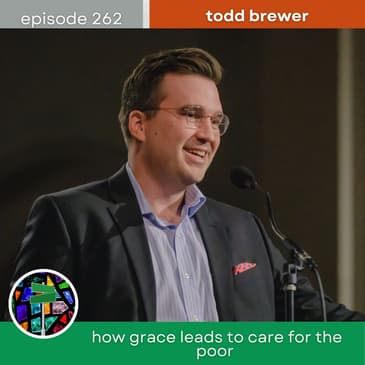

Episcopal priest and theologian Todd Brewer explores grace and charity through the contrasts of Roman and Christian gift-giving practices, Paul's perspective on charity, and reflects and the implications of these ideas for modern society.
Reckless Charity and Infinite Grace
Notes From the Fragmented Ivory Tower
Grace and Mercy in Ones and Zeroes
Join the Church and Main Email List
Facebook | Instagram | Threads | Twitter | Website | YouTube
00:00:27 --> 00:00:32 And welcome to Church and Maine, a podcast for people interested in the intersection
00:00:32 --> 00:00:33 of faith, politics, and culture.
00:00:34 --> 00:00:36 I'm Dennis Sanders, your host.
00:00:37 --> 00:00:44 So, I want to take you back to 1977 or 78, and I was, I think,
00:00:45 --> 00:00:51 in third grade, and I was introduced to the story A Christmas Carol by Charles Dickens.
00:00:51 --> 00:00:58 I played a part in the chorus in that play, and in the years since,
00:00:58 --> 00:01:02 I've seen various versions of that story.
00:01:05 --> 00:01:15 And I have to say I really liked the 1988 movie Scrooged with Bill Murray and
00:01:15 --> 00:01:18 Carol Kane, one of my favorites.
00:01:20 --> 00:01:25 As I've grown up and become a pastor, I've really come to see that story of
00:01:25 --> 00:01:30 Ebenezer Scrooge really as a story of redemption and grace.
00:01:30 --> 00:01:38 I have no idea if Dickens was a Christian, but there is a lot of Christian themes in that story.
00:01:41 --> 00:01:45 The reason I'm thinking about that is because of an article that I read on the
00:01:45 --> 00:01:54 Mockingbird website by the theologian Todd Brewer that is called Reckless Charity and Infinite Grace.
00:01:54 --> 00:01:58 The article examines why Christians are so charitable.
00:02:00 --> 00:02:08 And have you ever really wondered, why is it that our societies care about the poor?
00:02:08 --> 00:02:14 Why do churches care about the poor? Why do non-profits, even if they have no
00:02:14 --> 00:02:16 religion at all, care about the poor?
00:02:16 --> 00:02:19 Why do governments care about the poor? Well...
00:02:20 --> 00:02:25 Might have a lot to do with the church. To boil it down, Brewer believes that
00:02:25 --> 00:02:29 because we have been shown grace by God through Jesus Christ,
00:02:30 --> 00:02:35 Christians down through the ages have shown their gratitude by caring for the least of these.
00:02:36 --> 00:02:40 The article was so good I had to have him on the podcast.
00:02:41 --> 00:02:46 Since we are just a few days out from Christmas, which is of course the birth
00:02:46 --> 00:02:51 of the one who showed Grace, I thought that this is an interview that you would want to hear.
00:02:51 --> 00:02:55 A few things about Brewer. Todd is an Episcopal priest.
00:02:56 --> 00:03:02 He is also one-third of the hosts of the great podcast that is put out by Mockingbird
00:03:02 --> 00:03:08 Ministries called Terrible Parables, and I will put a link in the show notes to that podcast.
00:03:08 --> 00:03:11 You will really want to check it out.
00:03:12 --> 00:03:17 So, without further ado, here is my interview with Todd.
00:03:36 --> 00:03:39 Well, thanks for taking the time to chat with me this morning.
00:03:39 --> 00:03:45 I wanted to kind of start out by knowing a little bit about who you are and your faith journey.
00:03:46 --> 00:03:54 Sure. I am the managing editor for the website of Mockingbird Ministries.
00:03:54 --> 00:03:59 I've been in this position for about, oh gosh, five and a half years now.
00:03:59 --> 00:04:04 Before that, I taught at undergrad and seminaries.
00:04:05 --> 00:04:14 And then before that, I was at a church for a little bit and doing PhD and did
00:04:14 --> 00:04:17 a curacy while doing that as well. I'm an ordained Episcopal minister.
00:04:20 --> 00:04:28 And yeah, how much time do you have for the faith journey? That's my… You've got time.
00:04:29 --> 00:04:32 Yeah. I mean, I would say I grew up an Episcopalian.
00:04:34 --> 00:04:46 My dad is an Episcopal priest. And I would say I've always been – how do I say –.
00:04:48 --> 00:04:55 Curious. I've always had more questions than my youth group Bible study leaders
00:04:55 --> 00:05:00 were capable of answering, and that continued on even through seminary.
00:05:00 --> 00:05:05 I mean, before seminary,
00:05:05 --> 00:05:12 I was actually an engineering undergrad, and I loved it, except for the point
00:05:12 --> 00:05:15 in which I was a junior in college, yes,
00:05:16 --> 00:05:18 taking a class on engineering design.
00:05:18 --> 00:05:25 And the class was springs, nuts, bolts, screws, nails, and it was terrible.
00:05:26 --> 00:05:30 And made worse by the fact that the professor said at the time,
00:05:30 --> 00:05:33 this is going to be 90% of what you do as an engineer.
00:05:34 --> 00:05:39 So by the end of the class, I said, I'm out. This isn't what I want to spend 90% of my life doing.
00:05:41 --> 00:05:46 But at the same time, I was doing stuff with the college ministry and thought,
00:05:46 --> 00:05:53 well, I think I could do this for the rest of my life, some sort of ministry to college students.
00:05:54 --> 00:05:59 But when I got to seminary, I had more questions than there were answers and
00:05:59 --> 00:06:05 ended up doing an independent study, which then led to being encouraged to do a PhD.
00:06:05 --> 00:06:13 And so, yeah, and so that's sort of kind of the background of a bit of the background
00:06:13 --> 00:06:15 as to how I got to where I am now.
00:06:16 --> 00:06:23 Yeah, and I think one of the things I have known about you is that you are one-third
00:06:23 --> 00:06:26 of a podcast that I listen to,
00:06:26 --> 00:06:35 Terrible Parables, which I think is really great because I think you have, as that podcast,
00:06:35 --> 00:06:40 I think you talked about the fact that you have a lot of questions,
00:06:40 --> 00:06:45 and I think you bring all of that to that podcast.
00:06:46 --> 00:06:52 Kind of trying to work through some of those really hard passages in scripture,
00:06:52 --> 00:06:54 which I think is helpful.
00:06:54 --> 00:06:59 It's helpful for me because I'm always like, okay, so how do you deal with these passages?
00:07:02 --> 00:07:06 Yeah, that podcast is really born of kind of two things. The first is that I
00:07:06 --> 00:07:09 did a lot of work in parables in my PhD thesis.
00:07:10 --> 00:07:18 And then the second is perhaps related. When it came to studying or looking
00:07:18 --> 00:07:19 at how to preach parables,
00:07:20 --> 00:07:23 I often found that the solutions given
00:07:23 --> 00:07:26 were either terrible
00:07:26 --> 00:07:29 or they were a kind of theological magic
00:07:29 --> 00:07:32 trick where you sort of take the
00:07:32 --> 00:07:39 parable and you sort of shoehorn it into a kind of theological paradigm rather
00:07:39 --> 00:07:44 than understanding the parable within the context of the narrative and the meaning
00:07:44 --> 00:07:52 that sort of the evangelists themselves wanted to sort of were proffering.
00:07:55 --> 00:07:59 And so out of that, I said, you know,
00:08:00 --> 00:08:05 Robert Farrar Capon is amazing, but I think there's more to be said that sort
00:08:05 --> 00:08:13 of stays true to the kind of narrative framework of a parable and nevertheless
00:08:13 --> 00:08:16 ends up with good news. Yeah.
00:08:18 --> 00:08:23 Well, I wanted to, one of the reasons I have you on the podcast is you wrote
00:08:23 --> 00:08:30 an interesting article for Mockingbird that's called Reckless Charity and Infinite Grace.
00:08:30 --> 00:08:38 And it's kind of talking about the, kind of, in some ways, the history of Christianity's
00:08:38 --> 00:08:43 belief in caring and, as I say, remembering the poor.
00:08:43 --> 00:08:50 And you kind of talk about that in the foundations of our Jewish foundations,
00:08:50 --> 00:08:54 but then kind of building on that and the concept of grace.
00:08:54 --> 00:08:59 And can you kind of give a kind of synopsis of what you're trying to get at
00:08:59 --> 00:09:04 in that article and kind of just to get into the article itself?
00:09:05 --> 00:09:10 Sure. I think when you look at Christianity and its understanding of….
00:09:13 --> 00:09:17 Charity and grace, I think there's kind of two things that are going on.
00:09:18 --> 00:09:21 The first is that they, as Jews,
00:09:22 --> 00:09:27 all have a common understanding that remembering the poor is important.
00:09:27 --> 00:09:31 Um and um
00:09:31 --> 00:09:33 but and but even
00:09:33 --> 00:09:36 within that i think sort of
00:09:36 --> 00:09:42 the understanding of gift giving takes on a particular character it's a sharpened
00:09:42 --> 00:09:48 profile in light of the christ gift so there so the word for grace and the word
00:09:48 --> 00:09:55 an hour uh and the word for gift in english are actually the same in Greek, charis.
00:09:55 --> 00:10:01 And so when they think of the divine human relationship in terms of grace,
00:10:02 --> 00:10:11 they're thinking of it in terms of a gift, a benevolent favor that's imparted to the believer.
00:10:11 --> 00:10:13 And the particular shape of
00:10:13 --> 00:10:23 that is a gift that is given before it's asked for and is given, in fact,
00:10:23 --> 00:10:27 to people who are unworthy or undeserving of it.
00:10:27 --> 00:10:33 It's an unmerited gift, and it's an abundant gift.
00:10:33 --> 00:10:37 In other words, what is given is not.
00:10:40 --> 00:10:44 Proportional to, but rather it's an excess.
00:10:44 --> 00:10:53 It comes out of God's character as an excessive gift giver, as revealed in the person of Jesus.
00:10:53 --> 00:11:00 And so it's not simply that early Christians, they take on this sort of, as Jews,
00:11:00 --> 00:11:04 they take on their belief that the poor should be cared for,
00:11:04 --> 00:11:08 But it takes on an even more kind of radical character, that it's not simply
00:11:08 --> 00:11:13 for those in our own community, but extends even farther.
00:11:14 --> 00:11:19 And that's the inner working out of the logic of the Christ gift,
00:11:19 --> 00:11:27 which is universal in scope, which is for sinners, which is prior to anyone
00:11:27 --> 00:11:29 even sort of turning to God.
00:11:30 --> 00:11:39 And so how Christians gave was in that way different and took on a different
00:11:39 --> 00:11:40 character than their Jewish context.
00:11:41 --> 00:11:46 The other is that you sort of see this in light of Greco-Roman gift-giving policies
00:11:46 --> 00:11:53 or sort of ideals, which admittedly, there's a variety of different positions.
00:11:53 --> 00:11:57 But one of my favorite foils is Seneca, who I draw attention to in that,
00:11:57 --> 00:12:00 who wrote a whole book on gift-giving.
00:12:00 --> 00:12:04 And for Seneca,
00:12:04 --> 00:12:10 he understands gift-giving as a kind of modification of the Greco-Roman patronage
00:12:10 --> 00:12:18 model in which you don't give to people who are bad gift-givers themselves.
00:12:19 --> 00:12:24 You need to give to people who will reciprocate. You need to give to people
00:12:24 --> 00:12:29 who will show gratitude. for whom, and this is important for Seneca because
00:12:29 --> 00:12:32 gift giving is the means by which relationships are established.
00:12:33 --> 00:12:36 And so you wouldn't be reckless in your gift giving.
00:12:37 --> 00:12:43 He sort of cautions and urges a judiciousness in terms of who you give your gifts to.
00:12:45 --> 00:12:51 And one of the corollaries to that is you want to just give to the poor a farthing,
00:12:51 --> 00:12:53 This is the old English translation.
00:12:55 --> 00:12:59 You want to give them a dollar simply because they asked for it.
00:13:00 --> 00:13:09 But rather because your gifts are always instrumental, you only give to those who would reciprocate.
00:13:10 --> 00:13:17 A farthing or a dollar given to a beggar is nothing. It's not even worth mentioning to Seneca.
00:13:19 --> 00:13:25 And especially if you think of that model within the broader Roman societal
00:13:25 --> 00:13:32 structure, there were a lot of poor in that day.
00:13:32 --> 00:13:37 I mean, wealth was highly concentrated at the top with elites.
00:13:37 --> 00:13:44 There was some middle class, but if we're thinking in terms of abortions,
00:13:44 --> 00:13:51 there were a lot of people who were at or near poverty or below the poverty line.
00:13:52 --> 00:13:56 And this was always a kind of source of anxiety for the Roman elites.
00:13:56 --> 00:14:03 They wanted the poor to be, not starve, lest they revolt, but they also wanted
00:14:03 --> 00:14:04 to have their own wealth.
00:14:04 --> 00:14:12 And so if you think of that context as the backdrop for Seneca's gift giving,
00:14:12 --> 00:14:17 what you end up with is you're only really giving to your fellow elites.
00:14:18 --> 00:14:25 You're not actually giving much, if anything, to those who are below your station, so to speak.
00:14:25 --> 00:14:32 And that's an even sharper contrast to the Christian practice of gift giving.
00:14:33 --> 00:14:41 Uh, because Christians not only didn't just give to their sort of social status
00:14:41 --> 00:14:47 because the church was, was, was comprised of people from all three sort of three or four rungs of,
00:14:47 --> 00:14:51 of society, but rather you, you'd give, uh,
00:14:52 --> 00:14:55 yeah, across the board and especially to those who are in need.
00:14:55 --> 00:15:02 And that's the kind of interesting, if there is an indexing of one's gift in
00:15:02 --> 00:15:08 early Christianity, it's not in accordance with worth, but rather it's in accordance with need.
00:15:10 --> 00:15:15 So would you, basically, it sounds like then the Roman model was more of a transactional
00:15:15 --> 00:15:19 model in that case, that it was kind of, I do something for you,
00:15:20 --> 00:15:24 kind of you do something for me kind of way of doing things.
00:15:24 --> 00:15:32 Yeah, Seneca likens gift giving to the throwing of a ball in which you give
00:15:32 --> 00:15:34 a gift and a gift comes back.
00:15:34 --> 00:15:41 And that kind of back and forth and back and forth is, you know, fun.
00:15:41 --> 00:15:45 But it's the means by which a relationship is established.
00:15:45 --> 00:15:47 And that's the ultimate goal.
00:15:48 --> 00:15:54 You know, you wouldn't play catch with a toddler, as far as Seneca's concerned.
00:15:55 --> 00:16:00 You'd only play catch with someone who could return the ball. Hmm.
00:16:02 --> 00:16:14 And how did Roman society view this kind of Christian model that was so foreign to them,
00:16:14 --> 00:16:21 that was so different and wasn't in this kind of a transactional or kind of a,
00:16:21 --> 00:16:27 in a way that just kind of benefited them, but that just was just kind of reckless
00:16:27 --> 00:16:36 in who they gave, and especially to care for those who just wouldn't be able to give back at all.
00:16:37 --> 00:16:48 Yeah, one of the—we have a kind of handful of Roman writings where they engage with Christianity,
00:16:49 --> 00:16:58 and one of the consistent themes is that they note that Christians are just stupid in how they give,
00:16:59 --> 00:17:06 To the point that they assume that it either must be made up by poor people,
00:17:06 --> 00:17:07 like Jesus didn't actually say it.
00:17:07 --> 00:17:11 It was made up by someone who's poor as a way of taking advantage of the rich.
00:17:12 --> 00:17:17 Note the suspicion and the kind of moral imputing of ill will there.
00:17:17 --> 00:17:26 Or they assume that people are just flocking to Christians simply because they
00:17:26 --> 00:17:29 wish to take advantage of their charity,
00:17:29 --> 00:17:36 which also then has a moral kind of judgment view of it.
00:17:36 --> 00:17:44 But I think the kind of funnest anecdote for me in the sort of writers that
00:17:44 --> 00:17:47 comment on this actually comes from Julian the Apostate.
00:17:48 --> 00:17:54 Because Julian was raised as a Christian, and then – this is after Constantine
00:17:54 --> 00:18:01 – he was raised as a Christian, and then he defects back to Greco-Roman religion.
00:18:02 --> 00:18:10 He thinks Christianity is bunk. And one of the things he does is he tries to
00:18:10 --> 00:18:17 instill a kind of Christian model of charity within the Greco-Roman temples.
00:18:18 --> 00:18:28 And he thinks it's to our shame that the Christians give not only to themselves, but also to our own.
00:18:28 --> 00:18:30 And this is to our shame.
00:18:31 --> 00:18:38 And it's a kind of window into what happens after Christianity.
00:18:38 --> 00:18:44 In other words, reviling the poor that you see in earlier writers just isn't there.
00:18:44 --> 00:18:51 And he's trying to almost take a Christian ideal of giving to the poor and map
00:18:51 --> 00:18:54 it onto Greco-Roman beliefs. And it's not really taking it.
00:18:56 --> 00:18:58 Much to his disappointment.
00:19:00 --> 00:19:06 Yeah, so charity was certainly something that the Romans viewed the Christians
00:19:06 --> 00:19:10 as with suspicion, for sure.
00:19:12 --> 00:19:19 One of the things that you bring up in the article a lot is basically from the
00:19:19 --> 00:19:22 writings of Paul, and actually you begin this with Paul.
00:19:23 --> 00:19:28 And I think some of the early church were nervous about Paul and,
00:19:28 --> 00:19:34 you know, was he the real deal and kind of were worried about him.
00:19:35 --> 00:19:40 And Paul, you know, obviously is a writer that focuses a lot about grace.
00:19:41 --> 00:19:47 And he does write a little bit about, and well, probably more than a little
00:19:47 --> 00:19:50 bit about the concept of caring for the poor.
00:19:51 --> 00:19:57 But it's interesting, I think, modern theologians, I don't think always lift that up as much.
00:19:59 --> 00:20:04 And in fact, I don't think Paul always gets a lot of love from modern theologians.
00:20:04 --> 00:20:10 And I'm kind of curious your thoughts about that, why that doesn't happen and why.
00:20:12 --> 00:20:18 I mean, I think you point here that in one part of the article that you say
00:20:18 --> 00:20:22 that one cannot remember the poor if it has not first been made,
00:20:22 --> 00:20:26 if one has not been first made infinitely rich in grace,
00:20:26 --> 00:20:35 which I think is an important aspect, but that isn't always lifted up that kind
00:20:35 --> 00:20:41 of concept of understanding the concept of grace and how that is linked with charity.
00:20:42 --> 00:20:48 And I think also the concept of seeing Paul in that light is not always lifted up.
00:20:49 --> 00:20:51 And I'm kind of curious why you think that is.
00:20:54 --> 00:21:01 So, I think if I were to sort of try to diagnose a little bit in terms of the
00:21:01 --> 00:21:02 history of New Testament scholarship,
00:21:03 --> 00:21:09 it would be that if you wanted – it has to do with going back to a divide between
00:21:09 --> 00:21:15 Jesus and Paul that emerges after the Enlightenment in some senses.
00:21:15 --> 00:21:20 But I think modern theologians, if they want to talk about the poor, they go to Jesus.
00:21:20 --> 00:21:23 They don't go to Paul. And I think part of
00:21:23 --> 00:21:29 that is this kind of caricature of Paul who's just interested about in theology
00:21:29 --> 00:21:40 rather than social practice and versus Jesus who has Beatitudes,
00:21:40 --> 00:21:43 has several explicit teachings about the poor.
00:21:43 --> 00:21:49 And I think, so if you're looking, if you're sort of looking at the New Testament
00:21:49 --> 00:21:54 and trying to find sort of go-to statements about the poor, you'll probably go to Jesus.
00:21:55 --> 00:22:00 And for Paul, it takes a bit of understanding of his theology.
00:22:00 --> 00:22:05 It takes a bit of understanding, sort of overcoming of the distance between
00:22:05 --> 00:22:10 us and him. And you have to sort of think with Paul. And it's a heavier lift to do that.
00:22:12 --> 00:22:19 But I think ultimately arises from this kind of rupture that is seen between Jesus and Paul.
00:22:22 --> 00:22:27 As William Vreda said that Paul was the second founder of Christianity.
00:22:27 --> 00:22:33 You have sort of Jesus and then the second and in fact real founder was Paul.
00:22:33 --> 00:22:42 And as soon as you start seeing those two as distinct and separable,
00:22:42 --> 00:22:52 and you're then going and asking about how do you create a theology of giving to the poor,
00:22:52 --> 00:22:55 the easier route to go is with Jesus.
00:22:58 --> 00:23:06 What do you think are the implications of this article and what you wrote for today?
00:23:06 --> 00:23:11 What is it talking about? What does it mean for modern Christians for today?
00:23:11 --> 00:23:13 And what does it mean for society for today?
00:23:14 --> 00:23:17 Yeah, one of the things I...
00:23:18 --> 00:23:27 Love about the study of history and the scripture in general is that it's just so different.
00:23:32 --> 00:23:38 Because they're working from within a framework, which is just vastly historical
00:23:38 --> 00:23:40 context, social location,
00:23:40 --> 00:23:48 all of the ways in which you sort of map, if you try, it creates difficulty.
00:23:50 --> 00:23:54 And potentials when trying to understand.
00:23:54 --> 00:24:05 So I think the first is that sheer difference is fruitful.
00:24:06 --> 00:24:14 We like to think of, we have a whole enterprise of giving, for example, of charity.
00:24:14 --> 00:24:24 And we think of this as something which is perhaps separate to faith, right?
00:24:24 --> 00:24:28 We give to all different kinds of charities if we do give, but it's in this
00:24:28 --> 00:24:32 kind of little box of here's charity.
00:24:32 --> 00:24:38 And what I do is I sort of give money to it. And I think it's great.
00:24:38 --> 00:24:43 Give to charities, give to Mockingbird, right? Like these are all wonderful things.
00:24:43 --> 00:24:52 But I think the kind of vision outlined in the New Testament is far more integrated than that.
00:24:54 --> 00:25:03 Charity isn't quite a box, it's rather a way of being that arises from gratitude
00:25:03 --> 00:25:10 and the excess that one has received by way of God.
00:25:12 --> 00:25:20 So that's probably the first thing. The second is that there's just no space to deride the poor.
00:25:20 --> 00:25:27 There's no space to assume that the poor, who are the benefits of charity,
00:25:28 --> 00:25:30 are somehow taking advantage of it.
00:25:30 --> 00:25:36 I think one of the lines that sticks out in Paul's letter to the Corinthians
00:25:36 --> 00:25:42 when he's talking about lawsuits among believers, which I think is transposable to this context.
00:25:43 --> 00:25:45 Paul says, why not be wronged?
00:25:45 --> 00:25:49 In other words, better to suffer
00:25:49 --> 00:25:58 the cost of benevolence than to be judicious, than to be calculating.
00:25:58 --> 00:26:05 In other words, even if one were to find examples of malfeasance of reception
00:26:05 --> 00:26:09 of charity, that's not a reason to not give.
00:26:11 --> 00:26:20 You shouldn't be calculating or discriminant in terms of who is worthy for one's charity.
00:26:20 --> 00:26:24 Right there's there's no so even
00:26:24 --> 00:26:26 in if there's ever people like
00:26:26 --> 00:26:30 to talk about you know people who who receive
00:26:30 --> 00:26:35 charity who don't need it i don't care about that right um that's not a reason
00:26:35 --> 00:26:37 not to give because what that actually ultimately ends up doing is you don't
00:26:37 --> 00:26:41 give anything if you're trying to be judicious with your gift giving you don't
00:26:41 --> 00:26:48 give at all and that and and paul and paul would say that's the wrong way to think about it.
00:26:49 --> 00:26:59 Built into the idea of grace is the potential that it could be misused, so to speak.
00:26:59 --> 00:27:02 And that's the risk of it.
00:27:03 --> 00:27:05 But that's not a reason not to give.
00:27:08 --> 00:27:08 So,
00:27:09 --> 00:27:11 So that's a second one.
00:27:14 --> 00:27:26 If I were to say a third one, it would be that just the sheer injunction that
00:27:26 --> 00:27:29 Christians and society should,
00:27:29 --> 00:27:39 at least society that is probably comprised of Christians, should be more charitable than it is, right?
00:27:41 --> 00:27:47 And that there should be a structure for and a sort of ubiquitous,
00:27:47 --> 00:27:52 there should be excessive gift, then there should be a lack of it.
00:27:54 --> 00:27:58 I think when we think of, so it's Christmas now, I don't know when this is going
00:27:58 --> 00:28:08 to go up, but we are excessive in our gifts to those who we love, sometimes to a fault.
00:28:09 --> 00:28:16 In terms of economics of what that actually does to people who are taking out credit cards.
00:28:16 --> 00:28:24 But I think that excess is in fact should be characteristic of charity as well.
00:28:27 --> 00:28:35 So, one of the things I noticed in the article, which is not something that
00:28:35 --> 00:28:37 was written, but it was actually the images.
00:28:37 --> 00:28:41 And the images were from movies.
00:28:42 --> 00:28:49 It was The Muppets, Christmas Carol, and Scrooge. So, obviously,
00:28:49 --> 00:28:54 also, they came from both takes on Dickens' Christmas Carol.
00:28:54 --> 00:28:59 And so, I was interested, what was the parallel that you were trying to evoke
00:28:59 --> 00:29:03 there from Dickens' Christmas Carol?
00:29:04 --> 00:29:09 Yeah. So, what I – there's all – first of all, there's all different kinds of
00:29:09 --> 00:29:10 Christmas Carol movies.
00:29:12 --> 00:29:14 The definitive ranking puts the Muppets at the top.
00:29:15 --> 00:29:22 Uh, I think it's brilliant, funny, timeless, um, way better than the Jim Carrey ones.
00:29:23 --> 00:29:26 So that's, uh, the first thing to say.
00:29:26 --> 00:29:32 The second thing to say would be that, uh, yeah, that I think the story of Scrooge
00:29:32 --> 00:29:40 is a perfect example of what happens when someone has a kind of encounter with, um,
00:29:41 --> 00:29:43 mercy and grace.
00:29:43 --> 00:29:46 And it leads directly to charity
00:29:46 --> 00:29:49 um i think
00:29:49 --> 00:29:52 you know he's he's docking
00:29:52 --> 00:29:59 his employees pay at the beginning uh for taking a half day off uh for taking
00:29:59 --> 00:30:06 uh christmas off depending on your version and and by the end he's giving in
00:30:06 --> 00:30:12 excess he's giving indiscriminately uh and and i think,
00:30:13 --> 00:30:19 it's a picture of an inward change that leads to an outward, uh,
00:30:20 --> 00:30:21 excessive charity.
00:30:22 --> 00:30:26 Um, and I think those two go hand in hand.
00:30:26 --> 00:30:34 I think if, if you're, if you are, um, a kind of calculating person who doesn't
00:30:34 --> 00:30:39 believe in grace, so to speak, uh, in a, in a practical everyday way, right.
00:30:40 --> 00:30:53 Whether you're Christian or not, then I think that leads to the picture of Scrooge as a miser.
00:30:53 --> 00:30:58 But he has an encounter with grace and is fundamentally changed.
00:30:58 --> 00:31:02 And the first way that works itself out is with excessive gift giving.
00:31:03 --> 00:31:09 So in that way, it's about Christmas, so to speak, But it's also about sort
00:31:09 --> 00:31:10 of the Christian faith in a nutshell.
00:31:15 --> 00:31:21 Yeah, I think there's always a part from that play, I think,
00:31:21 --> 00:31:26 where some people come and ask him early on—this is before the encounter with
00:31:26 --> 00:31:33 the spirits—for charity, and he says something to the effect of that if the poor die,
00:31:33 --> 00:31:39 that helps the population or something,
00:31:39 --> 00:31:45 which reminds me of this article about how sometimes Romans sometimes acted
00:31:45 --> 00:31:54 with the poor or even with infants that had deficiencies or something to that effect.
00:31:54 --> 00:32:04 And then how his change was at the end of the story that that kind of miserly spirit does change,
00:32:04 --> 00:32:11 and it is a story of redemption and mercy and grace. So, yeah.
00:32:12 --> 00:32:16 I mean, I knew that there was a reason that those images were there,
00:32:16 --> 00:32:19 and it wasn't by accident. So...
00:32:20 --> 00:32:24 Yeah, if I had timed it right, I would have published the article a month later,
00:32:25 --> 00:32:26 right at the height of Christmas.
00:32:27 --> 00:32:31 But yes, decrease the surplus population, I think is what he says.
00:32:32 --> 00:32:37 Exactly. That is exactly what he says. Decrease the surplus population. Yep, that is it.
00:32:38 --> 00:32:42 Well, I wanted to briefly talk a little bit about the other article that you
00:32:42 --> 00:32:45 wrote just came out a few days ago.
00:32:45 --> 00:32:50 And that was your recent trip to – and I'm always going to get this wrong.
00:32:50 --> 00:32:53 It was Society of Biblical Literature, and then there's the other organization,
00:32:53 --> 00:32:54 which I'm always forgetting.
00:32:55 --> 00:32:59 But you've written actually two articles about that, and I wrote something,
00:33:00 --> 00:33:05 kind of riffed on that one earlier, about kind of your journeys about going
00:33:05 --> 00:33:10 to the Society of Biblical Literature and how that has changed over time.
00:33:10 --> 00:33:19 And I'm just kind of curious of your observations about that and kind of to
00:33:19 --> 00:33:23 share your thoughts about how has that changed?
00:33:23 --> 00:33:27 How it has kind of the you kind of talk a little bit into that article about
00:33:27 --> 00:33:34 the splintering of theology and how that in some ways people don't really allow
00:33:34 --> 00:33:41 the text well they don't take the text seriously in the way that um it should be taken.
00:33:44 --> 00:33:51 Yeah. So I've been going to the Society of Biblical Literature and American
00:33:51 --> 00:33:57 Academy of Religion meeting for, gosh, I think my first one was 2005.
00:34:01 --> 00:34:06 Gosh, now I feel old. Yeah, it was about right. No, not 2000.
00:34:07 --> 00:34:13 Anyway, it was 2008. Sorry, there you go. Still old.
00:34:15 --> 00:34:22 And when I first went, I was interested in historical Jesus studies.
00:34:22 --> 00:34:28 And so I basically went to any and every historical Jesus session that I could.
00:34:29 --> 00:34:31 I was kind of never done a conference before.
00:34:32 --> 00:34:35 This is what I want to study. Let's go to all the sessions.
00:34:36 --> 00:34:42 And one of the things I've noticed even since then is that that kind of.
00:34:44 --> 00:34:53 So creating your custom conference experience that's all sort of together isn't really possible.
00:34:54 --> 00:35:03 And what's been replaced by it has been a kind of further fragmentation of what
00:35:03 --> 00:35:06 used to be sort of seen as like the mainstream studies.
00:35:06 --> 00:35:15 So that if I wanted to look at Paul, for example, which is already a subfield
00:35:15 --> 00:35:19 within a subfield, I couldn't.
00:35:19 --> 00:35:24 The Pauline Epistles section and the Pauline Theology section,
00:35:24 --> 00:35:29 which presumably are the same people, are happening at the same time,
00:35:29 --> 00:35:32 and they're kind of in conflict with one another.
00:35:32 --> 00:35:37 Yeah, so you had to choose one session over another session.
00:35:37 --> 00:35:46 And the reason for that is basically that it's unofficial, put it that way.
00:35:46 --> 00:35:50 This is the unofficial hypothesis of everyone who goes. And I think it's true
00:35:50 --> 00:35:57 as someone who's tried to create a session himself, is if there's what's viewed
00:35:57 --> 00:36:00 to be overlap between sessions, they get rid of one.
00:36:00 --> 00:36:04 So they're always trying to prune branches to create new sessions.
00:36:05 --> 00:36:06 And,
00:36:07 --> 00:36:15 And so I think the state of academia right now is that we all have our specializations,
00:36:16 --> 00:36:24 but even within our specializations, there's a kind of expertise within our
00:36:24 --> 00:36:28 specialization that's even more narrow than one might think.
00:36:28 --> 00:36:37 So a good sort of for example, if you are a Paul in politics person,
00:36:38 --> 00:36:45 that is the lens by which you interpret the entire New Testament.
00:36:45 --> 00:36:50 And in fact, I saw a message on the SBL message board that was something to
00:36:50 --> 00:36:53 the effect of, I'm a Paul and politics person.
00:36:53 --> 00:37:00 What introductions to New Testament should I be using that reflect this approach?
00:37:00 --> 00:37:04 So that they were going to be teaching the entirety of the New Testament according
00:37:04 --> 00:37:07 to a kind of politics and Christianity angle.
00:37:08 --> 00:37:18 Now, as a study, sure, but that's not the only, nor is it perhaps the best lens
00:37:18 --> 00:37:20 by which to understand the New Testament.
00:37:20 --> 00:37:28 But that's the state of the field. You are a gospel scholar,
00:37:28 --> 00:37:31 but really you're a parable scholar.
00:37:32 --> 00:37:38 And even within that, you're a parable scholarship scholar within the last 50 years.
00:37:40 --> 00:37:48 Everyone's sort of burrowing down into these kind of smaller and smaller niches
00:37:48 --> 00:37:55 of expertise and with very little interest in sort of outside your field.
00:37:57 --> 00:37:57 So...
00:37:59 --> 00:38:07 Yeah. So one of the reasons why I chose the supervisor that I did for my PhD
00:38:07 --> 00:38:13 is that he wrote a book on Paul, which is excellent, called Paul and the Hermeneutics of Faith.
00:38:14 --> 00:38:21 And what I walked away from that impressed with was his ability to both do Paul
00:38:21 --> 00:38:28 and theology and Old Testament and hermeneutics.
00:38:28 --> 00:38:36 It was a very unified field theory almost of an understanding of Paul and his
00:38:36 --> 00:38:37 relationship to the broader canon.
00:38:39 --> 00:38:46 And I said, that's someone who's an integrated thinker who isn't happy with
00:38:46 --> 00:38:48 a very small, narrow band of expertise.
00:38:49 --> 00:38:56 And that's the kind of scholar I wanted to be that's what I wanted I didn't
00:38:56 --> 00:39:02 want to be a niche scholar who knew everything about two lines in Paul right.
00:39:04 --> 00:39:12 And but that kind of scholar is rare which is part of why I chose him is that
00:39:12 --> 00:39:20 there were very few scholars for whom that was true most are sort of burrowing into their expertise.
00:39:21 --> 00:39:24 So you're not just a Paul scholar, you're an apocalyptic Paul scholar.
00:39:24 --> 00:39:32 You're not just a gospel scholar, you're a gospel scholar with a historical
00:39:32 --> 00:39:35 lens in the first century on the basis of archaeology.
00:39:36 --> 00:39:43 Or the latest sort of trend in the last few years is an emphasis on the physical
00:39:43 --> 00:39:44 artifacts of Christianity.
00:39:45 --> 00:39:55 So you are a Paul and slavery scholar who has a very extensive understanding of,
00:39:56 --> 00:40:03 uh, of jail sites, um, or, um, in early Christianity.
00:40:04 --> 00:40:10 Um, and, and this kind of expertise is, is needed, but at the same time,
00:40:10 --> 00:40:14 we're also, there's no broadening of the scope. There's there.
00:40:14 --> 00:40:19 So the new Testament itself is very, is so fragmented across,
00:40:19 --> 00:40:24 you know, an expounding and exponentially
00:40:24 --> 00:40:30 expounding diversity of ways of looking at the New Testament.
00:40:32 --> 00:40:38 So a book that I have found really helpful is called The Invention of the Biblical Scholar.
00:40:39 --> 00:40:46 And it outlines this kind of move from knowledge and expertise in everything
00:40:46 --> 00:40:52 all the way to the burrowing down of various subfields within the subfields within the subfields.
00:40:54 --> 00:40:58 And it's much to our kind of loss.
00:41:00 --> 00:41:05 I mean, another kind of data point for you is that it used to be that the kind
00:41:05 --> 00:41:08 of capstone 60 years ago,
00:41:08 --> 00:41:16 the capstone book that you would write as a recently retired New Testament scholar
00:41:16 --> 00:41:20 was a theology of the New Testament.
00:41:21 --> 00:41:29 And in which you would take your 40 to 30 years of study in the field and you'd
00:41:29 --> 00:41:31 write a whole book about the whole theology of the New Testament.
00:41:32 --> 00:41:33 Those books aren't written anymore.
00:41:35 --> 00:41:40 People don't write theologies of the New Testament because I'm a Paul scholar.
00:41:40 --> 00:41:45 I'm not a gospel scholar. I'm not a James scholar. I'm not a Revelation scholar.
00:41:45 --> 00:41:52 I am fundamentally incapable of doing that work and or the constraints of the
00:41:52 --> 00:42:00 field are such that it's impossible to try to say that there is a single theology of the field.
00:42:01 --> 00:42:04 Uh there's just multiplicity of
00:42:04 --> 00:42:10 theologies at best is sort of sort of what people say now it is and that's um
00:42:10 --> 00:42:15 it's missing help it's missing the force for the trees yeah it doesn't seem
00:42:15 --> 00:42:21 that this is helpful for the church no no no not at all i mean think about it
00:42:21 --> 00:42:23 if you're a seminary professor for example.
00:42:25 --> 00:42:30 And all you know is this very narrow band,
00:42:30 --> 00:42:35 but you're nevertheless required to teach within a broader field,
00:42:35 --> 00:42:46 the kind of preachers and ministers that you will inevitably produce are either
00:42:46 --> 00:42:50 going to be students who are really interested in your niche,
00:42:51 --> 00:42:58 or you'll have students who have no sense for any kind of theological center
00:42:58 --> 00:43:00 of gravity of the New Testament.
00:43:01 --> 00:43:09 And because all that's left is a view of New Testament as kind of a multiplicity
00:43:09 --> 00:43:10 of histories of early Christianity.
00:43:12 --> 00:43:16 And I mean, that view has been around for a while, but the inability to then
00:43:16 --> 00:43:24 turn to say that there's a kind of unity that holds all of these together or a God, for example,
00:43:25 --> 00:43:36 to which all of these texts testify is a lost art.
00:43:37 --> 00:43:41 That is, yeah, is unhelpful.
00:43:41 --> 00:43:52 I mean, yeah. Part of the problem here is that it becomes less of a religious
00:43:52 --> 00:43:55 or theological exercise as
00:43:55 --> 00:44:00 the old faith-seeking understanding of kind of understanding who God is,
00:44:00 --> 00:44:08 and it's more of an academic exercise, is that it's just really kind of a mind game. I don't know.
00:44:08 --> 00:44:13 Mind game is probably the wrong word, but that it just becomes more about academics
00:44:13 --> 00:44:18 and that it's not really tied to understanding who God is.
00:44:18 --> 00:44:24 You know, if you were trying to understand or reading maybe a century ago,
00:44:24 --> 00:44:28 someone like a Bart or Niebuhr or someone,
00:44:29 --> 00:44:35 they were trying to understand who God was And it sounds like with these ever,
00:44:35 --> 00:44:37 ever kind of burrowing down,
00:44:37 --> 00:44:39 it's almost like God becomes disconnected.
00:44:40 --> 00:44:45 We're just trying to understand these little narrow bands, but it doesn't seem
00:44:45 --> 00:44:46 to be connected to anything at all.
00:44:47 --> 00:44:59 Yeah, I think where we're sort of… So if I think about seminary education and
00:44:59 --> 00:45:01 the kind of preacher it produces,
00:45:01 --> 00:45:04 it's all very disconnected.
00:45:04 --> 00:45:08 You will have a preaching class, and you'll have a New Testament class,
00:45:08 --> 00:45:09 and you'll have a theology class.
00:45:09 --> 00:45:14 And those distinctions are meaningful,
00:45:14 --> 00:45:23 but it can leave one with the impression that how one reads a text when one's
00:45:23 --> 00:45:29 preaching is different from how one reads a text when one is asking questions of theology,
00:45:29 --> 00:45:35 which is different from how one reads a text when one is looking at New Testament
00:45:35 --> 00:45:37 as a history of early Christianity.
00:45:37 --> 00:45:47 And so how a seminarian will put those pieces back together, it feels impossible.
00:45:47 --> 00:45:52 And the fact that we sort of leave it to them to do so is a tragedy, honestly.
00:45:53 --> 00:45:59 It should be that a seminarian leaves education, their sort of education,
00:45:59 --> 00:46:02 with a firm grasp of how these all fit together.
00:46:03 --> 00:46:11 But that's not how we think. That's not how scholarship works. I mean, one of the...
00:46:11 --> 00:46:21 So, one of the things that's just manifestly true is we have no overriding conception
00:46:21 --> 00:46:25 of unity in scholarship.
00:46:25 --> 00:46:28 And this is at the postmodern turn, right? Right?
00:46:29 --> 00:46:34 But the thing about the postmoderns, the very first thing I had to read when
00:46:34 --> 00:46:38 I was doing my PhD was Hans-Georg Gadamer's Truth and Method.
00:46:40 --> 00:46:43 And it was a kind of classic foundational postmodern thinker.
00:46:43 --> 00:46:48 But if you read Gadamer, or if you read Foucault, or if you read Derrida,
00:46:49 --> 00:46:54 the thing about them is that they are observing the diversity and fragmentation
00:46:54 --> 00:46:57 of the world. and that meaning is multiple.
00:46:57 --> 00:47:02 It's not singular, it's multiple. They saw that and they were trying to convince
00:47:02 --> 00:47:05 everyone that that was in fact true.
00:47:07 --> 00:47:12 But now we're in a situation in which everyone already believes that to be true.
00:47:14 --> 00:47:21 Foucault is boring. Derrida is boring because it's what people are raised to think nowadays.
00:47:21 --> 00:47:26 This is just the world in which we live in. And so the more interesting question
00:47:26 --> 00:47:30 is after this kind of great philosophical and societal fragmentation,
00:47:31 --> 00:47:39 is there some sense of truth or God that is somehow true despite or through the diversity?
00:47:40 --> 00:47:46 And to me, that's the bigger kind of philosophical, theological,
00:47:46 --> 00:47:51 pedagogical question that is largely unanswered.
00:47:54 --> 00:48:02 Because if God is one, you know, the Shema repeated by Jesus and Paul,
00:48:02 --> 00:48:04 then God is not multiple.
00:48:05 --> 00:48:12 And while it might be true that the gospel in which we preach has abounding
00:48:12 --> 00:48:14 significance, In other words,
00:48:14 --> 00:48:23 it can be understood in various different ways, but it's nevertheless one gospel.
00:48:26 --> 00:48:35 And so I think within the diversity, there is nevertheless a kind of unity.
00:48:36 --> 00:48:44 To call it a kernel would be a kind of pejorative Kantian term. It's not a kernel.
00:48:46 --> 00:48:53 The gospel is a multifaceted, multi-aspect phenomenon that has different significance
00:48:53 --> 00:48:58 depending on the question you ask of it. But that nevertheless says that it is a thing.
00:48:58 --> 00:49:01 It is a diamond, not a kernel,
00:49:02 --> 00:49:10 that refracts the light differently according to how it's perceived,
00:49:10 --> 00:49:18 the history or the kind of questions one asks of it, the longings one has, the history one has.
00:49:18 --> 00:49:21 Uh, and that's, that's amazing, right?
00:49:21 --> 00:49:28 That's the, it is an ever living word that addresses people in the life that they actually live.
00:49:28 --> 00:49:37 It's not a monolithic thing, but, but for that very reason, it is living, it is active, um.
00:49:38 --> 00:49:44 And I think that kind of diversity is precisely what's attested to in the New Testament,
00:49:44 --> 00:49:54 that there is different language that's used to talk about this kind of super
00:49:54 --> 00:50:01 abundant event of Jesus that is in some sense, that is not beyond words,
00:50:01 --> 00:50:08 but is nevertheless a kind of test has an abounding significance. of words.
00:50:09 --> 00:50:16 So that we have redemption as one way of talking about it. We have forgiveness as another way.
00:50:16 --> 00:50:20 We have the turning of the ages. It's another way of talking about it.
00:50:20 --> 00:50:24 These are all attempts of grasping what
00:50:24 --> 00:50:30 is otherwise an unconditioned and unparalleled event in human history.
00:50:30 --> 00:50:37 And so the language doesn't fail in an absolute sense, but it is nevertheless
00:50:37 --> 00:50:42 grasping at something for which there is no words,
00:50:43 --> 00:50:48 something that is sort of a true novum in human history.
00:50:52 --> 00:50:55 Kind of circling back to what we talked
00:50:55 --> 00:50:58 about at the beginning how does this all relate do
00:50:58 --> 00:51:04 you think to what we were talking about with charity and grace when you have
00:51:04 --> 00:51:11 this kind of narrowing down where it just kind of everything is so broken down
00:51:11 --> 00:51:17 and you're left with people pastors is trying to put things back together,
00:51:17 --> 00:51:21 but they don't really always have the tools to put things back together.
00:51:21 --> 00:51:24 I think what it means, it means a couple of different things.
00:51:25 --> 00:51:30 It means you can simply ignore scholarship that's just outside your expertise, right?
00:51:32 --> 00:51:35 Oh, that's what that person does. That's not my field.
00:51:37 --> 00:51:41 So that's the first thing that can happen.
00:51:41 --> 00:51:48 The second is that it could lead to a kind of odd, weird degree of compartmentalization
00:51:48 --> 00:51:52 in your own personal sort of faith.
00:51:54 --> 00:52:01 Because scholars are real people and the students they teach are real people.
00:52:01 --> 00:52:09 And so if your understanding of Christianity is so narrow,
00:52:10 --> 00:52:21 it can lead to a view of faith as compartmentalized to that one thing.
00:52:22 --> 00:52:29 And what happens when people compartmentalize is they become informed by other things.
00:52:30 --> 00:52:35 In other words, the gospel is just one thing, but the life that we live is many things.
00:52:35 --> 00:52:42 And so the questions that we have in those other aspects of life ultimately
00:52:42 --> 00:52:47 end up getting answered by other voices,
00:52:47 --> 00:52:52 which could be anything.
00:52:52 --> 00:52:56 It could be politics. It could be consumerism.
00:52:56 --> 00:53:01 It could be any number of the isms that we live within the day.
00:53:01 --> 00:53:06 But compartmentalization leads to idolatry.
00:53:06 --> 00:53:18 And I think that's at least one side effect of the kind of burrowing. So….
00:53:24 --> 00:53:29 That's kind of dangerous. That's not good.
00:53:29 --> 00:53:33 Well, right. I mean, because it leads to a view of faith that is just this kind
00:53:33 --> 00:53:38 of little box, or an understanding of faith, which is just in this little box.
00:53:40 --> 00:53:48 And in some senses, the fracturing of the academy is reflected by the fracturing
00:53:48 --> 00:53:51 of society, the fracturing of the church.
00:53:52 --> 00:53:57 So there is no sense in which we're able to talk to each other outside of our
00:53:57 --> 00:54:03 camps, much to our fault.
00:54:03 --> 00:54:09 And I think we're certainly not helped by it.
00:54:11 --> 00:54:15 And it seems like the danger is that you can set up an idol and not really know
00:54:15 --> 00:54:22 you're setting up an idol, that you could set up something that looks like God, but really isn't God.
00:54:25 --> 00:54:36 Yeah. I mean, yeah. I mean, everyone has their blind spots, but we've made our
00:54:36 --> 00:54:37 own blind spots of virtue.
00:54:39 --> 00:54:49 Yeah. I've noticed that I've noticed that a lot lately and I think that that's sometimes the most,
00:54:50 --> 00:54:55 dangerous of the blind spots is when we make those our virtues,
00:54:57 --> 00:54:57 so
00:54:59 --> 00:55:07 well if people want to know more about you read more listen to you more where should they go,
00:55:08 --> 00:55:18 uh they should go to uh ember.com uh it's it's where uh it's where all my writing
00:55:18 --> 00:55:25 basically appears um i also my my phd thesis was published if you are so brave,
00:55:26 --> 00:55:30 and have have an extra chunk of change i'm
00:55:30 --> 00:55:32 not plugging it to make money i don't make any money off of
00:55:32 --> 00:55:37 it uh it's called hermeneutics and early christian gospels um i
00:55:37 --> 00:55:40 uh i i think it i attempted
00:55:40 --> 00:55:46 to try to make it um an integrated not a study that isn't simply restricted
00:55:46 --> 00:55:54 to one particular field um my advisor's kind of adage apocryphal adage i'll
00:55:54 --> 00:55:59 say is go big or go home so don't burrow keep asking bigger questions.
00:56:00 --> 00:56:06 And so I like that. So look there. Or ember.com for sure.
00:56:09 --> 00:56:12 Well, Todd, thank you so much for this. This was really a great conversation
00:56:12 --> 00:56:16 on both topics, and I hope maybe sometime in the future to have you back.
00:56:17 --> 00:56:20 Yes. Thanks for having me, Dennis. All right. Take care.
00:56:50 --> 00:56:54 So, what are your thoughts about the episode? What do you think about the links
00:56:54 --> 00:56:56 between grace and charity?
00:56:57 --> 00:57:01 Now, as you can tell, we did talk about other things besides that.
00:57:02 --> 00:57:07 We went on to talk about another article that he had written afterwards about
00:57:07 --> 00:57:14 his recent visit to the latest meetings of the Society of Biblical Literature
00:57:14 --> 00:57:16 and the American Academy of Religion.
00:57:16 --> 00:57:19 So, I'd also love your thoughts about that.
00:57:19 --> 00:57:22 I'm hoping to have him back to talk a little bit more about that.
00:57:23 --> 00:57:27 Those were some important discussions, and I'd love to talk more about that,
00:57:27 --> 00:57:34 just because I think they have important implications about seminary and then
00:57:34 --> 00:57:43 how that relates to the forming of pastors and how that relates to then congregations.
00:57:43 --> 00:57:48 So, I'd love to hear your thoughts on all of that.
00:57:48 --> 00:57:52 As usual, you can send me an email at churchinmain at substat.com.
00:57:52 --> 00:57:58 I will include links to both articles and also links to the Terrible Parables podcast.
00:58:00 --> 00:58:04 Also, if you want to learn more about the podcast, listen to past episodes,
00:58:04 --> 00:58:06 or donate, as usual, visit churchinmain.org.
00:58:07 --> 00:58:11 You can also visit churchinmain.substat.com to read related articles.
00:58:11 --> 00:58:24 I have a new one up that I will also include the link to that is GoToChurchAnyway
00:58:24 --> 00:58:31 that you might want to listen to or might want to read.
00:58:32 --> 00:58:35 And I also have a recent one that you may also want to.
00:58:35 --> 00:58:39 It didn't get a whole lot of play, I don't know why.
00:58:40 --> 00:58:48 That was about social media, and that was actually related to a recent podcast
00:58:48 --> 00:58:54 that I did with Joseph Womniak, where I,
00:58:55 --> 00:59:04 i think that sometimes we only want to kind of focus on just kind of blaming the people,
00:59:04 --> 00:59:11 you know we want to blame the algorithms and all of that and and i'm i'm here
00:59:11 --> 00:59:17 for that but i think too often we want to let ourselves off the hook um and
00:59:17 --> 00:59:21 usually it's it's always interesting that we want to blame social media.
00:59:21 --> 00:59:26 And sometimes I see videos on YouTube of people blaming social media,
00:59:26 --> 00:59:32 which is really weird that they're blaming social media on social media.
00:59:33 --> 00:59:39 That's just kind of somewhat strangely, pardon the term, meta.
00:59:40 --> 00:59:46 So I wanted to kind of talk about that. So I'll also include the link to that as well.
00:59:49 --> 00:59:56 So also, as I said, so you can see all of that at churchinmain.subset.com to read those articles.
00:59:56 --> 01:00:00 If you want to please consider subscribing to the podcast, you can do that on
01:00:00 --> 01:00:01 your favorite podcast app.
01:00:02 --> 01:00:08 I hope that you will consider leaving a rating or review that always helps others find this podcast.
01:00:09 --> 01:00:15 You can leave a donation. There is a link for that, a link to buy me a coffee
01:00:15 --> 01:00:18 to make a one-time or recurring donation.
01:00:18 --> 01:00:29 There is also a link if you want to make sure that you receive this new episodes in your email inbox.
01:00:30 --> 01:00:33 That is it for this episode of Church and Main.
01:00:34 --> 01:00:38 This is actually going to be the, probably going to be the last episode before
01:00:38 --> 01:00:44 Christmas. So, um, if I don't have a new episode before Christmas,
01:00:44 --> 01:00:49 I will say it right now that I hope you have a Merry Christmas.
01:00:49 --> 01:00:51 Um, and, um.
01:00:53 --> 01:00:57 I hope that you are able to take some time to celebrate, take some time to rest,
01:00:57 --> 01:01:02 and we will see you on the other side. So take care, everyone.
01:01:03 --> 01:01:07 Godspeed. And I will see you very soon.
01:01:09 --> 01:01:16 This is Dennis cutting back in. I just wanted to say this is the last podcast
01:01:16 --> 01:01:24 for 2025. And I did want to say a big thank you to everyone who listened throughout the year.
01:01:24 --> 01:01:32 Thanks to anyone who donated both here for the podcast and for anyone who donated on Substack.
01:01:33 --> 01:01:37 Anyone who left a rating or a review.
01:01:38 --> 01:01:46 Just wanted to say thank you. Thank you for making this podcast what it is.
01:01:46 --> 01:01:51 And, um, I look forward to, uh, doing more podcasts in 2026,
01:01:52 --> 01:01:56 uh, 2026 will mark five years of doing this podcast.
01:01:56 --> 01:02:00 It started kind of as a, just trying to do something.
01:02:00 --> 01:02:06 And, uh, first episodes were kind of a little odd and, um, have kind of,
01:02:07 --> 01:02:09 kind of evolved over time.
01:02:10 --> 01:02:16 And, um, I just wanted to say thank you. And we will be back in the first week
01:02:16 --> 01:02:18 of 2026 with new episodes.
01:02:19 --> 01:02:25 And we'll be going on from there, talking about the intersection of faith, politics, and culture.
01:02:25 --> 01:02:28 And of course, with everything that is happening in the world,
01:02:28 --> 01:02:31 we will have a lot to talk about.
01:02:31 --> 01:02:43 Things will not be boring from what is going on in Washington to things such as AI to other issues.
01:02:43 --> 01:02:46 We will have things to talk about and where.
01:02:48 --> 01:02:55 Faith intersects with all of that. So, I hope that you have a good holiday.
01:02:56 --> 01:03:02 And as just kind of in keeping with the episode that we just listened to,
01:03:02 --> 01:03:06 I will leave you with the words of Tiny Tim.
01:03:08 --> 01:03:13 I hope that you all have a Merry Christmas and God bless us, everyone.