
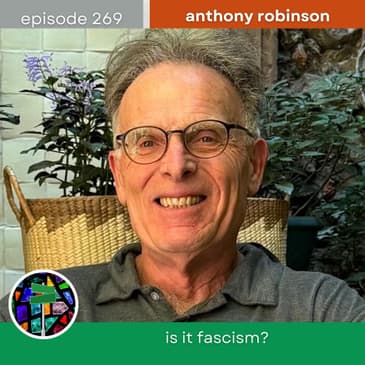

I engage with Pastor Anthony Robinson to discuss the contentious label of fascism in relation to Donald Trump's political rise. We look at Jonathan Rauch's essay, "Yes, It's Fascism," and explore the implications of such labels for American democracy. Robinson shares his evolving perspective, while I highlight the complexities of terminology and its potential to divide.
Suggested Reading and Listening:
Join the Church and Main Email List
Facebook | Instagram | Threads | Twitter | Website | YouTube
00:00:26 --> 00:00:31 Hello, and welcome to Church and Maine, a podcast for people interested in the
00:00:31 --> 00:00:35 intersection of faith, politics, and culture. I'm Dennis Sanders, your host.
00:00:36 --> 00:00:41 There's a president of the United States, who, of course, happens to be Donald Trump, a fascist.
00:00:43 --> 00:00:48 This has been an ongoing debate ever since Trump became president in 2017.
00:00:48 --> 00:00:55 It really ramped up again, or ramped up even higher, during the presidential campaign in 2024.
00:00:56 --> 00:01:00 And really went into overdrive through his first year in office.
00:01:01 --> 00:01:05 It's not a surprise that many people, including yours truly,
00:01:06 --> 00:01:13 think that Trump and his administration are very authoritarian and seem not
00:01:13 --> 00:01:16 to care much about little things like democracy.
00:01:17 --> 00:01:21 But does that mean that Trump is a fascist?
00:01:21 --> 00:01:28 In late January, Jonathan Rauch wrote an essay in The Atlantic with the very
00:01:28 --> 00:01:31 stunning title, Yes, It's Fascism.
00:01:31 --> 00:01:36 Roush was hesitant in the past in saying that Trump was a fascist,
00:01:37 --> 00:01:41 but over time, he started to see patterns that made him change his mind.
00:01:42 --> 00:01:50 Shortly after that essay, another essay came out with someone else that was changing his mind.
00:01:50 --> 00:01:56 Pastor Anthony Robinson wrote in late 2025 that he really wasn't joining in
00:01:56 --> 00:02:01 with a lot of other people that wanted to say that Donald Trump was a fascist.
00:02:02 --> 00:02:07 But in a very recent essay, he has come to the same conclusion that Jonathan
00:02:07 --> 00:02:12 Rauch has come to, that Trump is a fascist.
00:02:13 --> 00:02:18 So on this episode, Tony Robinson is coming back on the podcast to talk about
00:02:18 --> 00:02:20 why he came to this conclusion.
00:02:20 --> 00:02:25 Now, I'm going to be honest that I'm still wary of calling the president a fascist.
00:02:25 --> 00:02:31 I think that there are a lot of parallels to what we're seeing here in the United
00:02:31 --> 00:02:37 States, especially as what I'm seeing here in Minnesota,
00:02:37 --> 00:02:45 to what we would have seen in Latin America, such as in Argentina or Chile in the 1970s.
00:02:46 --> 00:02:51 But I don't know if I see that as fascism. And as you will hear,
00:02:51 --> 00:02:53 I make that known into discussion.
00:02:54 --> 00:03:02 But I wanted to have Tony back on the podcast to talk about this and actually to make his case.
00:03:03 --> 00:03:07 So before we go into that discussion, a little bit about Tony.
00:03:07 --> 00:03:12 He is a writer, teacher, speaker, and an ordained minister in the United Church of Christ.
00:03:12 --> 00:03:16 He served as senior minister of Seattle's Plymouth Congregational Church for
00:03:16 --> 00:03:22 14 years, and he currently divides his time between Seattle and a cabin in Wallowa
00:03:22 --> 00:03:25 County in northeastern Oregon.
00:03:25 --> 00:03:34 So, let's get into this discussion on Donald Trump and fascism with Anthony Robinson.
00:03:54 --> 00:03:57 Well, Tony, thanks for joining me back on the podcast.
00:03:58 --> 00:04:03 And the reason I wanted to talk to you is to kind of, I guess,
00:04:03 --> 00:04:10 reason together about an article that you wrote for your substack that's actually
00:04:10 --> 00:04:17 based on another article by Jonathan Rauch that appeared in The Atlantic recently
00:04:17 --> 00:04:21 that was entitled Yes, It's Fascism.
00:04:21 --> 00:04:24 And you wrote kind of your response to
00:04:24 --> 00:04:28 that basically agreeing with with
00:04:28 --> 00:04:30 jonathan roush right right and i think the first thing
00:04:30 --> 00:04:33 i want to ask is what led you to
00:04:33 --> 00:04:41 kind of come to what led you to write your article um and kind of where do you
00:04:41 --> 00:04:46 where do you kind of line up and how do you change your mind on whether or not
00:04:46 --> 00:04:51 donald trump is a fascist yeah uh Thank you.
00:04:51 --> 00:04:54 Well, it's good to be with you again, Dennis, and I appreciate the invitation
00:04:54 --> 00:04:57 and the chance to, as you say, reason together.
00:04:58 --> 00:05:05 I guess I began my article by noting that I'd written one last September that
00:05:05 --> 00:05:08 I called I'm Not Crying Fascist Fascist.
00:05:09 --> 00:05:15 And the reason I was, I have, you know, a lot of friends who were in that camp
00:05:15 --> 00:05:18 and where I had some people writing to me and saying, why aren't you,
00:05:18 --> 00:05:23 why aren't you calling Donald Trump what he is and a fascist?
00:05:23 --> 00:05:31 And my reluctance had a fair amount in common with that of Jonathan Rauch,
00:05:31 --> 00:05:33 who I respect enormously.
00:05:33 --> 00:05:39 His book, Cross Purposes, I think that's the title of it, Christianity's Broken
00:05:39 --> 00:05:44 Bargain with Democracy, is a really important book, I think.
00:05:44 --> 00:05:52 And I just respect him a lot. And his, anyhow, but he wrote in that piece,
00:05:53 --> 00:05:57 until recently, I resisted using the F word to describe President Trump.
00:05:57 --> 00:06:01 For one thing, there were too many elements of classical fashion that doesn't seem to fit.
00:06:02 --> 00:06:05 For another, the term has been overused to the point of meaninglessness,
00:06:05 --> 00:06:10 especially by left-leaning types who call you a fascist if you oppose abortion
00:06:10 --> 00:06:13 or affirmative action. So I shared some of that.
00:06:13 --> 00:06:21 I felt like I, in a previous lifetime, I was a graduate student in modern European history.
00:06:22 --> 00:06:33 And so I am not completely ignorant about fascism in Germany and Italy and other expressions.
00:06:35 --> 00:06:38 And it didn't seem to me to quite fit.
00:06:38 --> 00:06:41 But the other thing that bothered me about it was that I think it was being
00:06:41 --> 00:06:45 used as an epithet, as a kind of a,
00:06:46 --> 00:06:49 name-calling and swear word, if you will,
00:06:49 --> 00:06:53 and in that sense, it reminded me,
00:06:53 --> 00:07:05 or it seemed to be a flip side of Trump himself calling people that he didn't
00:07:05 --> 00:07:07 agree with him or were immigrants.
00:07:07 --> 00:07:14 He'd call them vermin, and he'd call people who were on the left,
00:07:14 --> 00:07:18 he'd call them un-American and whatnot.
00:07:18 --> 00:07:25 So name-calling is very popular, and ad hominem argument is very popular.
00:07:25 --> 00:07:32 But I think what's different for me now is I don't want to use fascism as just
00:07:32 --> 00:07:34 a name-call or an epithet.
00:07:35 --> 00:07:37 I want to use it as an analytical tool.
00:07:39 --> 00:07:46 To help us get a more accurate picture of what is going on.
00:07:46 --> 00:07:52 And I thought Roush's article in which he enumerated, and he's obviously very
00:07:52 --> 00:07:59 well schooled in the history of fascism, and particularly he knows a lot about Mussolini,
00:07:59 --> 00:08:06 which is the guy who actually coined the term fascism, if I remember correctly.
00:08:07 --> 00:08:11 It was called National Socialism in Germany.
00:08:12 --> 00:08:22 And so Rauch enumerates 18 characteristics, and I suspect he could have gone on to 20 or 25.
00:08:22 --> 00:08:30 But I think it's a pretty good fit, and it helps us, in my view, to...
00:08:32 --> 00:08:37 To take a bigger picture to see the forest for the trees.
00:08:37 --> 00:08:45 It's very easy with the political times and temper and with Donald Trump,
00:08:45 --> 00:08:51 who monopolizes the news cycle to just get focused on one thing after another,
00:08:51 --> 00:08:56 one tree after another, and not see the forest, so to speak.
00:08:56 --> 00:09:03 But I thought Roush's article was very helpful in terms of listing some of the
00:09:03 --> 00:09:12 things that are characteristic of fascist movements and fascist leaders.
00:09:13 --> 00:09:19 And so you can put the, instead of just looking at a tree and often getting
00:09:19 --> 00:09:23 caught in both-siderism, let's look at the tree from the north side,
00:09:23 --> 00:09:26 let's look at the tree from the south side, which you can do on the immigration
00:09:26 --> 00:09:29 thing in Minneapolis or any place else.
00:09:31 --> 00:09:34 Let's take a larger perspective.
00:09:36 --> 00:09:40 And the other thing that Rauch emphasized, which I'd also emphasize,
00:09:40 --> 00:09:45 is that Trump 2.0 is different than Trump 1.0.
00:09:46 --> 00:09:54 And one of the big differences which fits the profile of fascism is territorial expansionism.
00:09:55 --> 00:09:59 I mean, it was always, you know, Mussolini invading Ethiopia,
00:10:00 --> 00:10:08 Hitler invading Czechoslovakia, Poland, you know, layman's realm.
00:10:08 --> 00:10:10 We've got to increase our space.
00:10:10 --> 00:10:14 We are the chosen anointed people. We're the special tribe.
00:10:15 --> 00:10:19 And so we have a right to increase our space. Well, Trump didn't do much of
00:10:19 --> 00:10:21 that in the first go-round.
00:10:21 --> 00:10:29 He was pretty much a semi-isolationist, I would say, and wanted to avoid what
00:10:29 --> 00:10:31 we call foreign entanglements.
00:10:32 --> 00:10:36 He may still want to avoid foreign entanglements, but he sure would like to
00:10:36 --> 00:10:42 extend territory, notably Greenland, of course.
00:10:43 --> 00:10:49 This huge mass of land and ice. We have to have it.
00:10:50 --> 00:10:56 So that adds an important marker of fascism.
00:10:56 --> 00:11:01 It wasn't really on the table in such a prominent way.
00:11:02 --> 00:11:07 The first term. And the other thing that I think is a big change in the second
00:11:07 --> 00:11:15 term is that those around him, like General Kelly, who was his chief of staff,
00:11:15 --> 00:11:17 were kind of experienced people.
00:11:18 --> 00:11:22 They were not.
00:11:23 --> 00:11:30 They were not just Trumpists, they were Americans, and they knew something about
00:11:30 --> 00:11:33 how the government operated and how it was supposed to operate and what the
00:11:33 --> 00:11:34 role of the military was.
00:11:35 --> 00:11:40 And they exercised some restraint, I think, on him,
00:11:40 --> 00:11:46 sometimes just by, you know, kind of bureaucratic slowdown and sometimes by
00:11:46 --> 00:11:51 telling him directly, well, you actually can't do that.
00:11:51 --> 00:11:59 He's got nobody, as far as I can tell, in the current administration who plays that role.
00:12:01 --> 00:12:07 And on the contrary, you know, I mean, just look at the difference between Pam
00:12:07 --> 00:12:12 Bondi and Jeff Sessions or even Bill Barr as heads of DOJ.
00:12:12 --> 00:12:19 They had some understanding of the DOJ that the Department of Justice was independent
00:12:19 --> 00:12:23 of the White House and was not to be politicized,
00:12:23 --> 00:12:29 which, of course, cost them both jobs, which was probably a blessing for them.
00:12:29 --> 00:12:36 But Pam Bondi has no such scruples, no such hesitation, as far as I can tell.
00:12:36 --> 00:12:40 So I think that those are, those are two big changes.
00:12:41 --> 00:12:43 Uh, and, uh,
00:12:44 --> 00:12:50 So I think it's, you know, when things change, you need to evaluate where your
00:12:50 --> 00:12:53 position is and what you see and what you're saying.
00:12:53 --> 00:13:01 So like Roush, I have believed that things have changed and that I think identifying
00:13:01 --> 00:13:12 the fascistic elements of Trump's style and administration are a helpful analytical tool.
00:13:13 --> 00:13:17 So I still don't want to just run around screaming like, you know,
00:13:18 --> 00:13:21 the sky is falling, fascist, fascist.
00:13:23 --> 00:13:31 But I do want to say, okay, there are some things that we can learn from previous
00:13:31 --> 00:13:38 experience of these kind of movements that help us to see the forest beyond the trees.
00:13:40 --> 00:13:46 So you mentioned earlier about your earlier article that you wrote back in the
00:13:46 --> 00:13:53 fall, and why you weren't so interested in kind of running to that yet.
00:13:54 --> 00:13:57 And then, of course, the most recent one.
00:13:58 --> 00:14:02 So that's a space of a few months that have happened.
00:14:03 --> 00:14:07 Is it because of some of the things that have happened in the intervening times,
00:14:07 --> 00:14:12 such as Greenland, such as what's happening here in Minneapolis,
00:14:12 --> 00:14:15 um, that made you change your mind in that way?
00:14:16 --> 00:14:23 Yeah, definitely. I mean, it, it becomes clear that he is creating a state police,
00:14:23 --> 00:14:29 uh, force that is under his command that is not either, uh, uh,
00:14:29 --> 00:14:35 a local or regional body under, under command of local, uh, politicians.
00:14:36 --> 00:14:45 Uh, and, but that in this, uh, uh, you know, the, the amount of buildup for
00:14:45 --> 00:14:48 ICE and border patrol is incredible.
00:14:48 --> 00:15:03 I think at one point, Roush notes that with the amount of money allocated for those agencies.
00:15:05 --> 00:15:08 Let me see if I can find the exact quote here,
00:15:10 --> 00:15:12 it will be...
00:15:14 --> 00:15:24 There will be more money going into ICE than, let's see, okay, so here's the quote.
00:15:27 --> 00:15:31 He more than doubled the agency size in 2025,
00:15:31 --> 00:15:37 and its budget is now larger than those of all other federal law enforcement
00:15:37 --> 00:15:43 agencies combined, and larger than the entire military budget of all but 15 countries.
00:15:45 --> 00:15:53 Uh, so that's, that's a, you know, that's a, that's a significant,
00:15:53 --> 00:15:55 uh, that's an understatement.
00:15:56 --> 00:16:02 That's a significant, uh, element, uh, and, uh, and a huge, uh,
00:16:03 --> 00:16:09 kind of domestic police force that is pretty much directly responsible to him.
00:16:09 --> 00:16:14 Now, some of the people that have historically served in the Border Patrol and
00:16:14 --> 00:16:27 ICE are very worried about those agencies because with such a free reign and so many resources,
00:16:27 --> 00:16:35 they will destroy whatever good reputation or goodwill that some of them might have had.
00:16:35 --> 00:16:43 Um and yes so anyhow yes you to your question what's been focused in your in
00:16:43 --> 00:16:55 your city but not alone there um is is another factor that's changed um and uh i just think it's very.
00:16:58 --> 00:17:05 It's not us, not America, to deploy troops against its own citizens.
00:17:06 --> 00:17:11 In fact, that was one of the major objections of the founders in the Declaration
00:17:11 --> 00:17:16 of Independence to what George III was doing in the colonies,
00:17:18 --> 00:17:23 quartering troops among them and giving them free reign.
00:17:25 --> 00:17:35 And so I think we, yeah, that is one of the factors that has changed and should not be taken lightly.
00:17:35 --> 00:17:49 I mean, I think there was general support for the idea that serious and identifiable criminal immigrants,
00:17:49 --> 00:17:56 people who come here and somehow were either active criminals before they came
00:17:56 --> 00:18:02 or active criminals after they got here or both, you know, that there were issues
00:18:02 --> 00:18:04 and they needed to be somehow addressed.
00:18:05 --> 00:18:09 I don't think anybody, well, somebody, some had a problem with that,
00:18:09 --> 00:18:13 but generally speaking, Americans were supportive of that. But I think this
00:18:13 --> 00:18:15 has gone far beyond that.
00:18:17 --> 00:18:25 And really just sweeping up obviously citizens and refugees like the Hmong who,
00:18:25 --> 00:18:29 and Afghanis who have a, I feel, a moral claim on us.
00:18:33 --> 00:18:38 One of the questions that I have and I've had about the whole,
00:18:38 --> 00:18:41 as people say, the F-word is.
00:18:45 --> 00:18:54 How is it different from, say, what happened in South America in the 70s?
00:18:55 --> 00:19:02 Places like Chile or Argentina, where there were military— El Salvador, Brazil,
00:19:02 --> 00:19:13 where there were military juntas, where people were disappeared by the government
00:19:13 --> 00:19:16 if they were considered an enemy of the state.
00:19:19 --> 00:19:24 I mean, is there a similarity there, or can we use that as a similarity,
00:19:24 --> 00:19:27 or is this even something that you think is much more insidious.
00:19:30 --> 00:19:35 Well, I think, I wouldn't say that I'm highly informed.
00:19:35 --> 00:19:41 I mean, I'm not uninformed. I spent several trips to Nicaragua in that time period,
00:19:42 --> 00:19:54 but I'm not, I don't feel like I'm as well-informed as I am about Europe in the 20th century.
00:19:54 --> 00:20:03 But I would say, yeah, I mean, clearly there was a use of secret or state terror
00:20:03 --> 00:20:07 police to eliminate any kind of opposition.
00:20:11 --> 00:20:24 And in some cases it had a lot of financial support and rhetorical support from the U.S.
00:20:25 --> 00:20:31 That was in the Cold War context where the framework for that was, well,
00:20:31 --> 00:20:37 if we don't suppress this, They're going to become, you know,
00:20:37 --> 00:20:40 an arm of the Soviet Union or something like that.
00:20:41 --> 00:20:50 But that doesn't make it irrelevant or anything.
00:20:50 --> 00:20:56 But, yeah, I think there clearly were parallels, and that's still going on in
00:20:56 --> 00:21:00 some places there, you know, with a renewed force in El Salvador.
00:21:04 --> 00:21:12 So one of the things that I have struggled with, and that it's why I'm sometimes
00:21:12 --> 00:21:18 a little hesitant to use the word fascist, is for a different—,
00:21:20 --> 00:21:28 I think it's for the reason that I—and I've read this in some people who've written this—is how we—.
00:21:30 --> 00:21:35 It might be something that feels good, and I know that's not necessarily what
00:21:35 --> 00:21:38 you're getting at, but it's not effective.
00:21:39 --> 00:21:48 And this was something that I read, but that it might make it hard to,
00:21:49 --> 00:21:59 persuade people to not support Trump, that it might actually harden lines.
00:22:00 --> 00:22:07 And then also the thing that I see a lot especially is that when things happen,
00:22:07 --> 00:22:12 how people will kind of conflate that anyone who voted for him,
00:22:12 --> 00:22:15 and that was like 77 million people,
00:22:15 --> 00:22:18 that obviously this is what they've all supported.
00:22:18 --> 00:22:25 And so there's always that fear that using that word then means we're going
00:22:25 --> 00:22:30 to use that word towards everyone that casted a vote towards him,
00:22:31 --> 00:22:37 and that that makes it harder for us to—that it kind of hardens, in some ways,
00:22:37 --> 00:22:39 these lines that we have now.
00:22:40 --> 00:22:45 Because once you've kind of used the word fascist, it's not like you can,
00:22:45 --> 00:22:47 especially if you're a politician,
00:22:47 --> 00:22:50 especially if you're a democratic politician to say
00:22:50 --> 00:22:54 yeah let's work on this bill now um because
00:22:54 --> 00:22:58 it's such a a loaded term to
00:22:58 --> 00:23:07 use yeah yeah i i wrestle with that yeah yeah yeah i i i agree uh i i i understand
00:23:07 --> 00:23:15 what you're saying and i agree with it and that was that was part of my reluctance um uh up until,
00:23:16 --> 00:23:22 recently to use that word either because it is um.
00:23:24 --> 00:23:28 Them's fighting words uh and um
00:23:28 --> 00:23:34 we've got enough of that going on and and i don't think um i i simply don't
00:23:34 --> 00:23:39 think that everybody who supports trump is a fascist i think that by any means
00:23:39 --> 00:23:43 uh i think that they're uh so
00:23:43 --> 00:23:48 i i that business of tarring everybody with the same brush is a concern.
00:23:49 --> 00:23:56 And I agree. And I said, I remember, you know, some people were on me before
00:23:56 --> 00:24:01 the election in 2024 and say, why don't you call this what it is, fascism?
00:24:02 --> 00:24:08 And my response was very similar to what you've just said, that it hardened.
00:24:09 --> 00:24:12 I didn't think it was going to convince any Trump supporters.
00:24:12 --> 00:24:17 They were going to say, oh, we hadn't thought about that.
00:24:17 --> 00:24:20 We see, now we get it. Okay, we're going to change our mind.
00:24:21 --> 00:24:24 No, there is a kind of...
00:24:29 --> 00:24:37 Impermeability to his support that is impressive and mystifying,
00:24:39 --> 00:24:46 and calling him or, by implication, them fascist, I didn't think was going to help.
00:24:46 --> 00:24:53 So I shared that, but I do think, as I said before, that at this point,
00:24:53 --> 00:24:55 with the changes we've seen.
00:24:58 --> 00:25:07 It's a helpful framework when we have a good working definition of fascism and
00:25:07 --> 00:25:13 it's not just a kind of a vague sort of semi-swear word.
00:25:14 --> 00:25:18 I sent you an article. I don't know if you got it or opened it,
00:25:18 --> 00:25:23 but it's from the Dispatch newsletter called How Not to Be a Fascist.
00:25:23 --> 00:25:31 And it's an essay about a Hungarian Jewish philosopher, a Hungarian Jew who was a philosopher,
00:25:33 --> 00:25:40 and Orell Colney, who I had not really heard of. I thought it was an excellent essay.
00:25:40 --> 00:25:43 I don't know if you're able to link to it. Yeah.
00:25:45 --> 00:25:50 But one of the things the author of the article, his name I don't have right
00:25:50 --> 00:25:56 in front of me, points out is that in the 1920s,
00:25:58 --> 00:26:05 There was a kind of, there were liberalism, liberal democracy was really under
00:26:05 --> 00:26:08 attack in Europe from the left and the right.
00:26:08 --> 00:26:11 From the left, communism from the right.
00:26:14 --> 00:26:19 Fascism, not national socialism. But in this article, he writes,
00:26:19 --> 00:26:22 not Colney, but the article's author,
00:26:23 --> 00:26:29 the fascists and communists of the 1920s were not all crazed lunatics.
00:26:29 --> 00:26:35 Many of them were simply conservatives or progressives who took the wrong road,
00:26:35 --> 00:26:40 who step by step were desensitized to their own radicalization.
00:26:42 --> 00:26:45 And that strikes me as an important point because in hindsight,
00:26:45 --> 00:26:53 we look back in kind of our post-World War II horror, you know,
00:26:53 --> 00:26:59 and the concentration camps and everything, how could anybody support that?
00:27:01 --> 00:27:14 But he's pointing out here that at the time, in the run-up, in the 20s and even into the 30s,
00:27:15 --> 00:27:23 these were not people that identified as fascists. It was not a swear word then.
00:27:25 --> 00:27:35 Yeah, I think that's interesting. Yeah, it was clearly one sort of political option.
00:27:38 --> 00:27:49 And it was not, you know, for us, it has the resonance of Hitler, of Mein Kampf,
00:27:50 --> 00:27:55 of Sudetenland, and land of devil
00:27:55 --> 00:28:02 chamberlain and, and, and then the concentration camps and, uh, all of it.
00:28:02 --> 00:28:09 And, and so we see it through that lens, but at that time, people, uh,
00:28:10 --> 00:28:16 didn't, didn't have those associations and thought of national socialism or
00:28:16 --> 00:28:20 fascism or communism as one among the options.
00:28:22 --> 00:28:28 That were compelling as liberal democracies seem, particularly in Germany,
00:28:29 --> 00:28:31 to be ineffective and inept.
00:28:32 --> 00:28:37 And I think that seems to me an important point to keep in mind,
00:28:37 --> 00:28:39 that these were not all lunatics.
00:28:39 --> 00:28:47 They were not all people who were ready to ship ships.
00:28:48 --> 00:28:52 Jews and others off to concentration camps, not at all.
00:28:52 --> 00:28:59 They were people who kind of felt like liberal democracy had failed them or
00:28:59 --> 00:29:03 was failing them, and there were terrible economic conditions in Germany and
00:29:03 --> 00:29:06 Italy, and they were looking for an alternative.
00:29:06 --> 00:29:13 And people, I think the last maybe many 20 years in the U.S.
00:29:13 --> 00:29:17 Have been, there's been a high level of that looking for an alternative.
00:29:17 --> 00:29:23 I mean, it's many times been remarked how many people voted for Obama in 2008
00:29:23 --> 00:29:26 and even 2012, voted for Trump in 2016.
00:29:26 --> 00:29:32 They all wanted change, you know. They all felt like this, whatever we had,
00:29:32 --> 00:29:34 wasn't really working, you know.
00:29:35 --> 00:29:43 And so we're not that far in the early part of the 21st century that they were
00:29:43 --> 00:29:45 for the early part of the 20th century.
00:29:45 --> 00:29:56 There's some comparability there, and I think understanding that people, you might say—.
00:29:58 --> 00:30:03 You know, as he said here, they were conservative or progressive who took the
00:30:03 --> 00:30:08 wrong road, but they didn't know it was the wrong road at the time.
00:30:08 --> 00:30:13 They thought it was a viable option alternative. And I think that's kind of
00:30:13 --> 00:30:15 how fascism or totalitarianism works.
00:30:16 --> 00:30:22 It just gets, you know, it starts here and grows.
00:30:22 --> 00:30:31 And it requires to be sustained. it requires that its excesses be amped up.
00:30:33 --> 00:30:41 And I think that's what we're seeing with Trump. He needs to take what were
00:30:41 --> 00:30:47 muted tones if Trump won and push them further.
00:30:51 --> 00:30:56 And, you know, I don't know, you know, many have asked, is there a tipping point?
00:30:56 --> 00:31:03 Is there some point at which some of the people who have either tacitly supported
00:31:03 --> 00:31:10 him or vocally supported him would say, no, this is a bridge too far?
00:31:10 --> 00:31:17 And it appeared that there might be some of that happening with reference to
00:31:17 --> 00:31:21 ICE and Minneapolis among Republicans.
00:31:21 --> 00:31:25 I'm not quite sure where that stands at this point.
00:31:28 --> 00:31:34 And I noted that that dispatch newsletter, which is basically a center-right group of folks, was...
00:31:37 --> 00:31:41 He wrote recently, maybe last week, I don't know, a week before,
00:31:42 --> 00:31:47 basically calling out the Senate Majority Leader John Thune and saying,
00:31:47 --> 00:31:52 hey, you have this office, but you're not doing diddly squat.
00:31:52 --> 00:31:58 You know, and if there's going to be reigning in of Trump, it's going to come
00:31:58 --> 00:32:04 from Congress, which is so far been, you know,
00:32:04 --> 00:32:12 pretty flattened, pretty just doormat to whatever Trump wished.
00:32:13 --> 00:32:19 So I thought that was interesting. I don't know. I would like to know what specifically
00:32:19 --> 00:32:22 they would like Thune to be drawing.
00:32:23 --> 00:32:27 It's a tough position for any of those folks, but at the same time,
00:32:27 --> 00:32:32 you wonder when you're going to get to the kind of the Margaret Chase Smith
00:32:32 --> 00:32:38 moment where she turns to Joe McCarthy and says, and long last, sir, have you no shame?
00:32:39 --> 00:32:42 Now, of course, with Trump, the answer is no, he has no shame.
00:32:42 --> 00:32:49 So that ain't going to work, but, uh, but, but, uh, congressional resistance.
00:32:49 --> 00:32:58 And there has been some congressional resistance, uh, and it's hard for Congress is a little bit like, um.
00:32:59 --> 00:33:01 Mainline Protestantism versus
00:33:01 --> 00:33:07 Catholicism in the sense that they always have one prominent leader.
00:33:09 --> 00:33:14 So it's easier for them to get media attention, I think, than it is for Protestantism.
00:33:14 --> 00:33:24 We're much more decentralized, no hierarchy like that, no single pope.
00:33:25 --> 00:33:31 And so Trump is kind of a little bit in the position of the Pope versus Congress
00:33:31 --> 00:33:33 being in the position of mainline Protestants.
00:33:33 --> 00:33:37 You know, people say, well, where are the Protestants?
00:33:37 --> 00:33:43 And, you know, well, they're all over the place and there's no one who really
00:33:43 --> 00:33:51 speaks for, even for all mainline Protestants, much less Protestants, all of them.
00:33:51 --> 00:33:55 So he has that advantage vis-a-vis Congress,
00:33:55 --> 00:34:07 but I would hope that they would find it within themselves to,
00:34:07 --> 00:34:09 you know, draw certain lines.
00:34:09 --> 00:34:16 And I think the Democrats have proposed some restrictions on ICE that I think,
00:34:16 --> 00:34:20 you know, they probably won't get all of them.
00:34:20 --> 00:34:24 But I see that they're going to start wearing, what do you call those, cams?
00:34:25 --> 00:34:32 Body cams. Body cams. So I guess you can argue that's to protect them,
00:34:33 --> 00:34:35 but it's also to protect others.
00:34:35 --> 00:34:38 So although there seems to be
00:34:38 --> 00:34:41 no lack of footage of what's going on so i
00:34:41 --> 00:34:47 don't know so that's that's one but i think the business of uh no masks i think
00:34:47 --> 00:34:54 is very important uh and i don't buy that crap about you know it's gonna their
00:34:54 --> 00:34:59 families will be harassed um you know it,
00:35:00 --> 00:35:05 that could happen. Most of the harassment seems to come from Trump's side of
00:35:05 --> 00:35:09 the aisle of people in that kind of way.
00:35:10 --> 00:35:15 But it's something people on the left can and might do.
00:35:16 --> 00:35:20 But you don't mask up police on the same basis.
00:35:20 --> 00:35:24 You don't mask up military on the same basis. It's not who we are.
00:35:24 --> 00:35:31 And it presents an ominous visage to, I think,
00:35:33 --> 00:35:39 on the streets of your city and of us to the world.
00:35:42 --> 00:35:47 So I agree with what you're saying about it could only harden the lines and
00:35:47 --> 00:35:55 it could only, you know, be counterproductive in that sense.
00:35:55 --> 00:36:02 But I think we've gone, to me, we've gone beyond that place at this point.
00:36:03 --> 00:36:08 And insofar as we can use this, as Roush does in his article,
00:36:09 --> 00:36:15 as a big picture tool of understanding, it's,
00:36:15 --> 00:36:18 I think, can have some value.
00:36:19 --> 00:36:28 But I'm not going to, you know, get into an argument with somebody in the neck
00:36:28 --> 00:36:32 of the woods I'm in right now, living on this farm out here.
00:36:32 --> 00:36:36 This is 70-some percent of the people out here voted for Trump.
00:36:38 --> 00:36:41 And I'm not going to get into an argument and call anybody a fascist.
00:36:41 --> 00:36:47 To me, that's kind of an ad hominem argument. It's just attacking the person
00:36:47 --> 00:36:49 rather than the ideas. I'm interested in the ideas.
00:36:50 --> 00:36:51 I'm interested in the principles.
00:36:53 --> 00:36:59 And so Rausch, you know, he points out a number of these principles.
00:37:00 --> 00:37:07 But I do want to not lose the point of that article about the Hungarian philosopher
00:37:07 --> 00:37:14 who moved to Vienna to escape anti-Jewish persecution and then eventually moved
00:37:14 --> 00:37:16 to North America, I believe.
00:37:16 --> 00:37:21 But that in the run-up, there was...
00:37:22 --> 00:37:33 And to the, in the 20s and 30s, he says, the 1920s were an era in which everything seemed up for grabs.
00:37:34 --> 00:37:38 Critics left and right declared the liberal consensus dead. Well,
00:37:38 --> 00:37:39 does that sound familiar?
00:37:39 --> 00:37:46 I mean, I think that's, you know, we've been hearing that and not without reason.
00:37:47 --> 00:37:52 There has been an inability to, as demonstrated by the Biden administration,
00:37:52 --> 00:37:56 to deal with an issue like the border.
00:37:56 --> 00:38:09 You know, and its impact on particularly towns and communities that were,
00:38:09 --> 00:38:13 you know, you can only absorb so many people of a different culture.
00:38:14 --> 00:38:17 I mean, it was a real challenge when we were involved in settling Hmong refugees.
00:38:17 --> 00:38:23 Geez, we were in a little town east of Seattle, population of the whole town,
00:38:23 --> 00:38:26 and it was a logging and farming community with 700 people.
00:38:26 --> 00:38:30 By the time we left there, 10% of the population were Hmong.
00:38:31 --> 00:38:36 So that was a big, you know, and so you've got to build out the infrastructure
00:38:36 --> 00:38:40 for that in the schools, in the healthcare system, in employment.
00:38:40 --> 00:38:50 And it's not a slam dunk and not everybody who gets upset about the demands
00:38:50 --> 00:38:54 there is a racist or a xenophobe.
00:38:54 --> 00:39:02 There are legitimate issues, but liberalism.
00:39:03 --> 00:39:09 Liberal democracy, as represented by Biden in his recent term,
00:39:10 --> 00:39:14 was effective on some issues, but ineffective on...
00:39:21 --> 00:39:29 As a little flaccid and feckless, I think we have in common in the early 21st
00:39:29 --> 00:39:36 century in this country and the world with people in Europe in the 20s.
00:39:36 --> 00:39:44 And the point that the author of that article about Colney is making is that
00:39:44 --> 00:39:50 these weren't not the people that, you know, were kind of said, hey,
00:39:50 --> 00:39:55 let's give this national socialist thing a run.
00:39:56 --> 00:40:03 We're not all, you know, vicious, racist, prejudiced idiots.
00:40:03 --> 00:40:13 And that's the same in our situation and so we.
00:40:15 --> 00:40:24 And I was also struck in that article by, and this is very resonant for our times, he says,
00:40:24 --> 00:40:31 the rejection of liberal democratic norms and institutions felt transgressive and exciting.
00:40:32 --> 00:40:38 The kind of struggle, combat, and of dedicating oneself to a great national
00:40:38 --> 00:40:41 cause proved attractive to new fascists.
00:40:41 --> 00:40:47 Fascism, wrote Colney, has a keen consciousness of opening out a new era,
00:40:48 --> 00:40:54 unquote, quote, unquote, and of closing the, quote, outworn epoch of liberalism.
00:40:54 --> 00:40:59 It glories in the paradoxical attitude of shaking off liberty as those shaking
00:40:59 --> 00:41:01 off oppressive fetters.
00:41:01 --> 00:41:06 A new youth is breaking the bonds of dried up formulas and hoary ideas.
00:41:06 --> 00:41:11 For Colney, however, what attracted the young to fascism was not so much any
00:41:11 --> 00:41:15 real practical concern, nor any real coherent philosophy.
00:41:15 --> 00:41:21 It was rather a kind of boredom with the peace and orderliness of liberal time.
00:41:21 --> 00:41:26 Distinctly lacking in liberal societies is the kind of enmity,
00:41:26 --> 00:41:33 battle, and conflict, and esprit de corps that a conquering master nation can provide.
00:41:33 --> 00:41:38 And I just, again, that's very resonant to me of our times, of this longing
00:41:38 --> 00:41:47 for some kind of great cause, longing to be bonded together against an enemy,
00:41:48 --> 00:41:54 longing for men to be men, you know, and all that kind of stuff.
00:41:56 --> 00:42:02 And again, it doesn't have a lot of policy content. It's more of an emotive thing.
00:42:03 --> 00:42:12 And it reflects again, I think, on our line of work, which is in many ways the failure of religion to.
00:42:14 --> 00:42:19 To capture hearts and minds for a cause that is not militaristic,
00:42:19 --> 00:42:27 that is not conquesting and that kind of thing.
00:42:27 --> 00:42:33 I mean, I think partly, and this is an easy generalization and maybe too broad,
00:42:33 --> 00:42:43 but the attraction of a kind of fascistic movement or a nationalist America
00:42:43 --> 00:42:53 First movement or even the white Christian nationalism movement is people looking for a story,
00:42:53 --> 00:42:57 looking for meaning, looking for a narrative, looking for something they're a part of. of.
00:42:58 --> 00:43:04 And liberal procedurism isn't often very good at that and has gotten worse at it.
00:43:04 --> 00:43:09 I mean, I think when I was growing up, we had a pretty strong sense of America
00:43:09 --> 00:43:15 and American patriotism and, you know, our heritage and so on and so forth.
00:43:15 --> 00:43:20 But for a variety of reasons, that has really atrophied.
00:43:20 --> 00:43:26 And I think probably the only ones who know really much about America's founding
00:43:26 --> 00:43:30 history and documents now are the recent immigrants who've had to go through
00:43:30 --> 00:43:32 some kind of citizenship school.
00:43:36 --> 00:43:42 I can't say that I know exactly what is being taught in schools these days,
00:43:42 --> 00:43:48 but I would guess that in a place like Seattle, where I spend most of my time,
00:43:48 --> 00:43:54 the narrative is not so much about the great ideas of the Declaration of Independence
00:43:54 --> 00:44:00 as the failures of the Founding Fathers and their hypocrisies.
00:44:01 --> 00:44:06 And, you know, so it's an unbalanced...
00:44:08 --> 00:44:15 Narrative and has been for some time and has perhaps led to just not much interest
00:44:15 --> 00:44:18 in civics or governance or how our government works.
00:44:19 --> 00:44:26 And I think that's one of the upsides of this whole catastrophe is that we are
00:44:26 --> 00:44:33 starting belatedly to pay attention to our history,
00:44:33 --> 00:44:36 to our values, to our heritage
00:44:36 --> 00:44:39 uh to our documents i mean i've heard
00:44:39 --> 00:44:42 more about the constitution in the last couple years
00:44:42 --> 00:44:48 and i've heard in much of my life you know it's and uh and and i wrote another
00:44:48 --> 00:44:56 piece about um a group of friends and uh we we would get together uh the group
00:44:56 --> 00:45:01 had kind of broken up for a variety of reasons now people moved away or gotten older died.
00:45:01 --> 00:45:08 But what we did every year on the 4th of July was read the Declaration of Independence out loud.
00:45:08 --> 00:45:17 And it was, I thought it was, you know, kind of a little cheesy and maybe a
00:45:17 --> 00:45:20 little over the top on American patriotism.
00:45:21 --> 00:45:26 But over time, I found it very moving and very instructive. I mean,
00:45:26 --> 00:45:32 it's a number of the things they cite, the founders cite in the case against Georgia 3rd.
00:45:35 --> 00:45:41 Can be rewritten pretty easily to side against what's going on under the purview
00:45:41 --> 00:45:42 of the Trump administration.
00:45:43 --> 00:45:50 So I'm hoping that for the upcoming 250th anniversary this summer of the Declaration,
00:45:50 --> 00:45:55 that there will be kind of what used to be back in my day, sit-ins,
00:45:55 --> 00:45:59 teach-ins around the Declaration of Independence and the Bill of Rights so that
00:45:59 --> 00:46:04 people all over the country will be gathering and hearing these read aloud and discussed.
00:46:06 --> 00:46:17 So one of the things that I want to—so if we want to see that Trump is a fascist
00:46:17 --> 00:46:21 and the people around him have these kind of fascistic ideas,
00:46:21 --> 00:46:25 what is the church's response to this?
00:46:27 --> 00:46:33 You were just talking earlier about how people didn't immediately see kind of—obviously,
00:46:33 --> 00:46:39 they did not see when people joined in to fascism that this was going to lead
00:46:39 --> 00:46:41 to concentration camps the next day.
00:46:42 --> 00:46:49 And I've been reading a book about the theologian Karl Barth as he was teaching
00:46:49 --> 00:46:53 at the University of Bonn around the time that Hitler comes to power.
00:46:54 --> 00:46:59 And one of the things that's fascinating is reading about how the church leaders
00:46:59 --> 00:47:05 within the German churches kind of bought into it,
00:47:05 --> 00:47:10 and it wasn't necessarily because they hated Jews or they wanted to do it,
00:47:10 --> 00:47:18 but it was something exciting to be a part of in that same way that you were just talking about.
00:47:20 --> 00:47:26 With all of this happening, what should be, how do we as Christians respond to this?
00:47:28 --> 00:47:38 Well, I think we're just talking about kind of a renewal of American understanding
00:47:38 --> 00:47:39 of our roots, our history,
00:47:40 --> 00:47:44 our values, our convictions, our origins.
00:47:45 --> 00:47:49 And I think for the church it's a parallel we need to.
00:47:51 --> 00:47:54 Get back to our sources our source
00:47:54 --> 00:47:58 is of course is Jesus Christ and
00:47:58 --> 00:48:04 the Barman Declaration articulated that they were very much a minority against
00:48:04 --> 00:48:10 the German Christian movement and there again it does seem like the Christian
00:48:10 --> 00:48:17 nationalist movement today is is not dissimilar from the German Christian church,
00:48:17 --> 00:48:25 which basically supported Hitler, at least in that run-up period.
00:48:26 --> 00:48:30 And so I think, you know,
00:48:32 --> 00:48:38 the church I go to in Seattle last year, the pastor there did a series called
00:48:38 --> 00:48:45 Beyond Christian Nationalism, And basically he took the, I've forgotten what you call them,
00:48:45 --> 00:48:50 the theses or whatever of the Barman Declaration and just went through them one by one.
00:48:52 --> 00:48:57 And, you know, the bottom line is we have no leader other than Jesus.
00:48:59 --> 00:49:09 And the claim of Hitler was that, you know,
00:49:10 --> 00:49:16 I am the leader and the only leader, and so supplanting.
00:49:16 --> 00:49:23 And the Trumpist movement kind of dances around that, saying he's either been
00:49:23 --> 00:49:27 sent by God or he's God-anointed or God-appointed.
00:49:31 --> 00:49:37 Or Trump himself saying, I am the only one, that kind of thing.
00:49:37 --> 00:49:39 And there is one of the...
00:49:44 --> 00:49:54 One of Rausch's characteristics of fascism is leader aggrandizement.
00:49:54 --> 00:50:01 I'll just read a little bit from that pertaining to our own situation.
00:50:01 --> 00:50:08 So it's really since Rausch writes, since 2016 when he declared I alone can
00:50:08 --> 00:50:13 fix it and bragged that his supporters remain loyal even if he shot someone
00:50:13 --> 00:50:16 on Fifth Avenue. Trump has cultivated a personality cult.
00:50:16 --> 00:50:21 Although some of his efforts in self-aggrandizement can seem comical,
00:50:21 --> 00:50:24 the gilding of the Oval Office, the renaming of a Kennedy senator,
00:50:25 --> 00:50:29 proposed triumphal arch, he understands the centrality of leader worship in
00:50:29 --> 00:50:31 a fascist-style regime.
00:50:31 --> 00:50:36 In sharp contradistinction to the American presidential tradition since George
00:50:36 --> 00:50:40 Washington, he makes no pretense of serving the people or the Constitution.
00:50:40 --> 00:50:44 His mindset, his symbolism, and his rhetoric all understand the point,
00:50:44 --> 00:50:47 underscore, the point he made to the New York Times this month.
00:50:48 --> 00:50:52 His own mind and morality are the only limits on his global power.
00:50:53 --> 00:50:56 This is fascism 101, end of quote from Rausch.
00:50:57 --> 00:51:05 So I think, you know, it's a time where the church has to ask who is.
00:51:07 --> 00:51:12 Who is Lord? And it's not a new question for the church.
00:51:12 --> 00:51:19 I mean, early Christians went to the cross for Jesus is Lord, not Caesar.
00:51:20 --> 00:51:25 Caesar wanted them to say he was God, Lord and God and Son of God.
00:51:25 --> 00:51:39 And they didn't, and they got in trouble. And so I think the church's response has to be,
00:51:39 --> 00:51:44 and I know you have urged this and sympathetic to it yourself,
00:51:44 --> 00:51:52 has to be theological and has to be Christological, but not so much so that
00:51:52 --> 00:51:56 we don't have anything to say about what's going on. And it's a both hand.
00:51:57 --> 00:52:05 But we have to be careful, you know, not because to save our butts,
00:52:06 --> 00:52:12 but we have to be careful because I don't—I think one of the things that is
00:52:12 --> 00:52:15 really of concern to me is the politicization of the church,
00:52:16 --> 00:52:18 whether on the left or the right.
00:52:18 --> 00:52:21 It may be more evident on the right, but, you know,
00:52:21 --> 00:52:28 I'm United Church of Christ, and I would say my denomination has been for some
00:52:28 --> 00:52:35 time quite politicized in that anybody who had any sympathy for Christianity.
00:52:36 --> 00:52:41 Not just Trumpist, but almost Republican positions, you know,
00:52:41 --> 00:52:46 you got the message pretty clearly, you weren't welcome here.
00:52:46 --> 00:52:50 I mean, I remember, yeah, so I don't want to.
00:52:54 --> 00:53:08 And so it's a—I don't want to just—and I wouldn't—were I preaching regularly today,
00:53:08 --> 00:53:16 I would not do a sermon like the article I wrote, I was wrong.
00:53:16 --> 00:53:25 Yes, it's fascism, I might do what my pastor did and do a series on the Barman
00:53:25 --> 00:53:28 Declaration, because a lot of people haven't even heard of it.
00:53:29 --> 00:53:35 Even though this is a Presbyterian church, and they include the Barman Declaration
00:53:35 --> 00:53:37 in their Book of Confessions.
00:53:38 --> 00:53:44 But, of course, I'm in UCC. We're a non-creedal, non-confessional denomination,
00:53:44 --> 00:53:48 so we don't have such a collection of things to refer to.
00:53:52 --> 00:53:59 So what is the—I've forgotten what you name for it—the rule of faith.
00:54:01 --> 00:54:14 And what do we turn to to say as we try to make determinations about our own actions,
00:54:14 --> 00:54:17 our own decisions, our own commitments.
00:54:17 --> 00:54:23 And I think if you've already politicized the church one direction or another,
00:54:23 --> 00:54:30 you don't have any reference point beyond contemporary politics.
00:54:32 --> 00:54:39 And, you know, one of my problems with my own denomination is that I'm not interested
00:54:39 --> 00:54:40 in going to church just to hear.
00:54:43 --> 00:54:49 You know, a rehash of the New York Times or Fox News. I want to hear about Jesus.
00:54:49 --> 00:54:56 And I want to hear about—and the other thing, another thing that I think is
00:54:56 --> 00:55:01 directly, a direct conflict between Christian faiths, there's so many,
00:55:01 --> 00:55:04 and this fascistic tendency,
00:55:04 --> 00:55:13 one of them is this business of there are only some people that are the good people.
00:55:14 --> 00:55:19 There are only some people that are in the tribe. There are only some people that are the pure Volk.
00:55:20 --> 00:55:27 And you're getting this now with J.D. Vance talking about heritage Americans. Yes.
00:55:27 --> 00:55:35 You have to have been here and almost be a property holder.
00:55:35 --> 00:55:45 And so instead of America being a set of ideas, it's a racial, ethnic identity.
00:55:46 --> 00:55:50 And the corollary of that then is the people that aren't part of the tribe and
00:55:50 --> 00:55:54 the Volk are, as Trump has called them, vermin.
00:55:54 --> 00:56:00 You know, which is a very, very national socialist Nazi term,
00:56:00 --> 00:56:09 that they are, that's another characteristic Roush cites, dehumanization.
00:56:09 --> 00:56:14 Fascism draws its legitimacy, I'm quoting here, from his claims of defending
00:56:14 --> 00:56:18 people from the enemies who are animals, criminals, and brutes.
00:56:19 --> 00:56:23 Trump characterizes, for instance, political opponents as vermin and immigrants
00:56:23 --> 00:56:27 as garbage who are, quote, poisoning the blood of our country.
00:56:28 --> 00:56:32 Vice President Vance, as a senator, endorsed the book called Unhumans,
00:56:32 --> 00:56:34 a title that refers to the left.
00:56:35 --> 00:56:39 And who can forget his false claims about Haitians abducting and eating cats and dogs?
00:56:39 --> 00:56:53 So that is directly in opposition to Christianity's understanding of the value
00:56:53 --> 00:56:56 of each human person created in the image of God and of human dignity.
00:56:56 --> 00:56:59 And more than that,
00:56:59 --> 00:57:08 it's in direct conflict with the persistent, overwhelming emphasis of Scripture
00:57:08 --> 00:57:10 on hospitality and welcome to
00:57:10 --> 00:57:13 the stranger and the outsider and the foreigner and the alien among you.
00:57:28 --> 00:57:34 That doesn't mean that you just have an open border and that it doesn't mean
00:57:34 --> 00:57:37 that you, you know, that you,
00:57:37 --> 00:57:40 some of the issues we talked about earlier, that you're not attentive to the
00:57:40 --> 00:57:49 things you need to support assimilation and you don't,
00:57:49 --> 00:57:56 I mean, there's going to be an even worse crisis, I think, with climate refugees in the years to come.
00:57:57 --> 00:58:05 We can't, as Americans, violate our own values in history by just becoming xenophobic,
00:58:05 --> 00:58:14 as the current administration would like, but we can't degrade and dehumanize
00:58:14 --> 00:58:23 people and create some kind of mystical unity of heritage Americans.
00:58:23 --> 00:58:27 Then the other thing I was going to say, so that's in direct conflict with Scripture.
00:58:28 --> 00:58:34 And the other thing I was going to say was that, you know, if I understand Scripture
00:58:34 --> 00:58:38 at all, it is that we are all flawed people.
00:58:39 --> 00:58:45 There are no—there's no—there isn't the right people and the wrong people.
00:58:46 --> 00:58:49 There isn't the saints and the sinners. Yeah.
00:58:51 --> 00:58:56 All of us are sinners in need of grace—Republicans, Democrats,
00:58:57 --> 00:59:06 Independents, Socialists—and so you can't just gather a congregation on a political,
00:59:07 --> 00:59:14 partisan political basis and congratulate yourselves that we are the enlightened
00:59:14 --> 00:59:20 Christian nationalists or we are the enlightened Christian socialists or what have you.
00:59:20 --> 00:59:26 And the rest are under judgment.
00:59:26 --> 00:59:32 No, we're under judgment, every one of us, and every one of us in need of grace.
00:59:32 --> 00:59:40 And that's an approach to humanity and to life that is fundamentally at odds
00:59:40 --> 00:59:50 with this dividing the world up into the righteous and the heathen.
00:59:52 --> 00:59:56 Everything in Scripture is against that.
00:59:57 --> 01:00:02 And Christ died for the ungodly, not for the godly. And, you know,
01:00:02 --> 01:00:05 I love what great essayist Pascal
01:00:05 --> 01:00:08 said. He said, the world does not divide between saints and sinners.
01:00:08 --> 01:00:15 The world is divided between sinners who believe themselves to be saints and
01:00:15 --> 01:00:17 saints who know themselves to be sinners. Hmm.
01:00:20 --> 01:00:30 And so we're chronically as human beings wanting to cast ourselves as either
01:00:30 --> 01:00:36 the righteous or the cool or the in or the above.
01:00:38 --> 01:00:43 And that requires that there be somebody who's below and somebody who's out
01:00:43 --> 01:00:48 and somebody who's... and Christianity cuts right through that and says,
01:00:48 --> 01:00:51 no, every one of us is a sinner in need of grace.
01:00:51 --> 01:00:57 Every one of us has played our part in crucifying Christ, and every one of us
01:00:57 --> 01:01:03 has shouted, crucify him, crucify him, and every one of us has been the priest
01:01:03 --> 01:01:05 and Levite that walked by on the other side.
01:01:05 --> 01:01:15 You know, so this whole business of dividing the country along the lines of the ins and the outs,
01:01:15 --> 01:01:25 I think, is profoundly and dangerously unchristian, reflects our lack of theological formation.
01:01:25 --> 01:01:25 Civilization.
01:01:27 --> 01:01:36 And so a whole has been created by, I think, kind of a civic Christianity,
01:01:37 --> 01:01:40 a light once-over nominal Christianity.
01:01:41 --> 01:01:45 And just as we are driven now back to the Bill of Rights and the Constitution,
01:01:45 --> 01:01:48 we are driven now back to Scripture, back to Jesus Christ,
01:01:48 --> 01:01:53 back to the sacraments of the Church, back to the body of Christ as a place
01:01:53 --> 01:01:57 where the person next to you may have profoundly different ideas about what
01:01:57 --> 01:01:59 is a good political philosophy,
01:01:59 --> 01:02:01 but that person is baptized.
01:02:05 --> 01:02:09 And has been saved by Christ. And let us break bread together.
01:02:10 --> 01:02:18 So we're lacking that kind of transcendent dimension that goes beyond politics.
01:02:18 --> 01:02:20 We're only left with politics now.
01:02:20 --> 01:02:25 And politics cannot bear that freight.
01:02:26 --> 01:02:32 It asks too much. Politics will not save you. Okay? and,
01:02:35 --> 01:02:39 you know I really feel for actually the people in Congress I mean and all people
01:02:39 --> 01:02:44 working in that sector it just doesn't look like a happy life and,
01:02:45 --> 01:02:51 but God bless them for putting themselves out there and trying and let's pray
01:02:51 --> 01:02:58 for the ones that are trying to keep some sort of faith and ethical foothold in the midst of all that,
01:03:01 --> 01:03:09 one final question before we kind of wrap up is where do you think that this is,
01:03:09 --> 01:03:14 you know all heading i mean i think the question that i always want to know
01:03:14 --> 01:03:20 is you know do we get through this and there are days i think we will it'll
01:03:20 --> 01:03:24 be difficult but we will and there are days I wonder.
01:03:26 --> 01:03:37 Right, yeah. Yeah, you're talking about what I toss and turn about at 3 in the
01:03:37 --> 01:03:40 morning, among other things.
01:03:40 --> 01:03:45 And I think we do get through it.
01:03:47 --> 01:03:59 How soon and in what shape, I don't know. So I, again, will turn to Roush here,
01:03:59 --> 01:04:02 and in his closing remarks,
01:04:04 --> 01:04:11 which I found some element of hope. Now, he's writing as a social scientist and a secularist.
01:04:11 --> 01:04:15 He's not writing from a faith position, but he writes, If, however,
01:04:15 --> 01:04:20 Trump is a fascist president, that does not mean that America is a fascist country.
01:04:21 --> 01:04:24 The courts, the states, and the media remain independent of him,
01:04:24 --> 01:04:27 and his efforts to browbeat them will likely fail.
01:04:27 --> 01:04:33 He may lose his grip on Congress in November. He has not succeeded in molding
01:04:33 --> 01:04:36 public opinion except against himself.
01:04:37 --> 01:04:39 He has outrun the mandate of his voters.
01:04:39 --> 01:04:43 His coalition is fracturing, and he has neglected tools that allow presidents
01:04:43 --> 01:04:45 to make enduring change.
01:04:45 --> 01:04:50 He and his party may defy the Constitution, but they cannot rewrite it. Thank goodness.
01:04:50 --> 01:04:54 So the United States, once the world's exemplary liberal democracy,
01:04:54 --> 01:05:00 is now a hybrid state, combining a fascist leader and a liberal constitution.
01:05:00 --> 01:05:06 But no, it has not fallen to fascism, and it will not. Those are Rausch's words.
01:05:08 --> 01:05:16 When sometimes fear gets the best of me, I fear that may not be true,
01:05:16 --> 01:05:20 but I hope it's true, and I actually believe it's true.
01:05:21 --> 01:05:27 Part of America is such a big, complex place.
01:05:27 --> 01:05:34 You know, it's just for anyone, even a president as manic as Trump,
01:05:34 --> 01:05:38 to get his hands around it all seems to me unlikely.
01:05:38 --> 01:05:47 But it's not so much, if things get worse, I don't think it's necessarily only coming from the top.
01:05:47 --> 01:05:55 It's from out here in the rest of the country and among the rest of us,
01:05:56 --> 01:06:02 and if we consent to the idea that there are...
01:06:05 --> 01:06:09 There are good Americans, heritage Americans, good enlightened Americans,
01:06:09 --> 01:06:22 and then there are some that are fascists or there are some that are, you know,
01:06:23 --> 01:06:29 leftist crazies that some people have to be exiled out.
01:06:29 --> 01:06:36 If we live that reality on the ground and we keep living into it and accepting
01:06:36 --> 01:06:38 it and turn against one another,
01:06:38 --> 01:06:50 that seems to be ultimately more dangerous and ominous than focusing only on
01:06:50 --> 01:06:51 who's in the White House.
01:06:52 --> 01:06:59 So I think, and this takes us back to the church as a place where we are reminded
01:06:59 --> 01:07:04 of truth and identity that is beyond politics,
01:07:04 --> 01:07:08 that is beyond American, that is beyond this moment.
01:07:10 --> 01:07:16 And churches in this little town where we are out in northeastern Oregon,
01:07:16 --> 01:07:20 the church we go to here, a Methodist church, has started doing a wonderful
01:07:20 --> 01:07:23 thing, which is they started two years ago, community dinners.
01:07:24 --> 01:07:30 They serve a free meal on Monday nights, but it's not as so often as the case
01:07:30 --> 01:07:32 with these kind of things.
01:07:32 --> 01:07:36 It's not the well-off people providing something for the hungry.
01:07:36 --> 01:07:44 It's everybody coming for a good dinner and hanging out together because people
01:07:44 --> 01:07:49 are isolated and people are lonely and people are without social support,
01:07:49 --> 01:07:52 even in a small community like this.
01:07:52 --> 01:07:57 And it's been a real blessing to this community.
01:07:57 --> 01:08:05 And it's been a place where people cross lines. And I think the church has always,
01:08:05 --> 01:08:09 at its best, always done that and needs to be doing more of it.
01:08:12 --> 01:08:16 On that note, which is like hopeful note. Yeah.
01:08:17 --> 01:08:21 It's a challenging time, but I think there is hope.
01:08:21 --> 01:08:27 And I think that's, hope is not optimism, but it's something deeper and I think
01:08:27 --> 01:08:28 something more meaningful.
01:08:29 --> 01:08:31 So I think that's a good place to end it.
01:08:32 --> 01:08:37 Yeah, yeah. Tony, thank you for being able to come on and chat and have this discussion.
01:08:38 --> 01:08:41 And definitely we'll have you back on next time.
01:08:42 --> 01:08:46 Okay. It's great to be with you again, Dennis. Thank you for hosting me,
01:08:46 --> 01:08:49 and thank you for the work you're doing and for your pastoral work.
01:08:49 --> 01:08:51 I pray for you and for your congregation.
01:08:52 --> 01:08:55 Bless you. All right. Okay.
01:09:26 --> 01:09:36 So, what are your thoughts? This is a topic that I think there is still a lot
01:09:36 --> 01:09:39 of argument, discussion about.
01:09:40 --> 01:09:49 I don't think it's, I think it's settled among many people that Trump and his
01:09:49 --> 01:09:50 administration are authoritarian.
01:09:53 --> 01:09:59 Is it fascist that one the jury is still out as you can tell but i'm kind of
01:09:59 --> 01:10:06 curious to know what you think and obviously in the discussion that we had it
01:10:06 --> 01:10:07 was also a discussion about,
01:10:08 --> 01:10:15 what is the church's response this is not simply a political discussion and
01:10:15 --> 01:10:17 it's not an exercise in name-calling.
01:10:19 --> 01:10:29 But I think whether or not we think that Donald Trump is a fascist or an authoritarian,
01:10:29 --> 01:10:33 the church has to respond.
01:10:33 --> 01:10:35 So how does it respond?
01:10:36 --> 01:10:44 And obviously, as you could hear, Tony has his views on how the church should best respond.
01:10:44 --> 01:10:48 I have my view, and I do think the church should respond.
01:10:49 --> 01:10:51 I'm curious what you think.
01:10:52 --> 01:10:59 As usual, you can send an email to leave a comment at churchandmain,
01:10:59 --> 01:11:02 all one word, at substack.com.
01:11:02 --> 01:11:10 I'm also going to put links here to Jonathan Rausch's essay from The Atlantic,
01:11:10 --> 01:11:14 and then also Tony's own essay and
01:11:14 --> 01:11:17 again I'd love to hear what you're thinking
01:11:17 --> 01:11:26 about this because it does matter and either way whether you think that Trump
01:11:26 --> 01:11:36 and his administration is fascist or not it's still I believe a danger to American democracy.
01:11:37 --> 01:11:40 So how does the church best respond?
01:11:43 --> 01:11:50 Also, if you want to listen to past episodes, learn more about what this podcast
01:11:50 --> 01:11:57 is all about, or even make a donation, you can check us out at churchandmaine.org.
01:11:57 --> 01:12:05 And you can also visit churchandmaine.substack.com to read articles that I've
01:12:05 --> 01:12:11 written. I just wrote one about Ash Wednesday and a practice that is called Glitter Ash.
01:12:12 --> 01:12:18 And you can find that at, again, at churchandmain.substack.com to read that
01:12:18 --> 01:12:19 article and other articles.
01:12:20 --> 01:12:24 I'd also hope that you would consider subscribing to the podcast on your favorite
01:12:24 --> 01:12:27 podcast app and consider leaving a review.
01:12:28 --> 01:12:30 That helps others find the podcast.
01:12:33 --> 01:12:36 That is it for this episode of Church in Maine.
01:12:37 --> 01:12:39 I'm Dennis Sanders, your host.
01:12:39 --> 01:12:43 As I always say, thank you so much for listening. Take care, everyone.
01:12:44 --> 01:12:47 Godspeed. And I will see you very soon.