
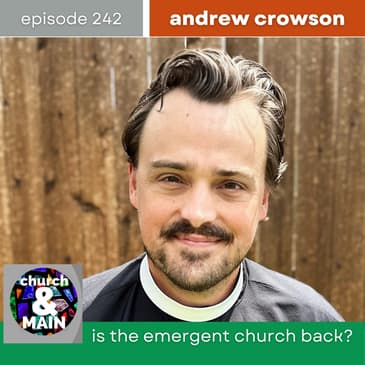
The Emergent Church seemed to be the future of the church, until it wasn't. Andrew Crowson joins the podcast to discuss how the movement initially attracted young evangelicals by challenging traditional church norms, yet ultimately struggled with its identity and connection to foundational beliefs. Andrew shares insights from his experiences and his article "Are We Back?", pondering if today's context might rekindle the movement with lessons learned from its past.
Are We Back? by Andrew Crowson
Dispatches from a God-Bathed World (Andrew's Substack)
Join the Church and Main Email List
Facebook | Instagram | Threads | Twitter | Website | YouTube
[0:12] Music.
[0:38] Hello, and welcome to Church and Main, a podcast for people interested in the intersection of faith, politics, and culture. I'm Dennis Sanders, your host. I hope that you are having a good July. So, if you're a millennial or Gen X Christian, you've heard of the Emergent Church movement. Now, this movement was really big in the late 90s, throughout the aughts, and I think into maybe the early teens. And the thing about this movement was that young Christians, especially evangelicals, were questioning the excesses of the church. And then, of course, for many, since it was a lot of evangelicals, they were questioning mainly the evangelical church. At the same time, they were also trying to create something new and different.
[1:29] And the result was that there was a whole lot of new churches that sprouted up. Here in the Twin Cities where I live, I can remember there were churches around that time that were such as Bloor, Safe House, and probably the one that is the most famous and most well-known, Solomon's Porch. And there were little churches all over the place trying to do something different maybe do things that were somewhat more ancient but also a little bit more laid back, a little bit more feeling, a weird kind of combination of a kind of an abbey mixed up with a coffee shop.
[2:14] Mainline churches also got into the act because they saw a lot of questioning from evangelicals and thought that this was a way of bringing them in. And so they were putting money into new churches, very much such as Church of the Apostles in Seattle is probably the most well-known, which is an Episcopalian slash Lutheran congregation.
[2:38] And then all of it's just seen to end. So of those churches that I just mentioned, four of them, the only one that is really still in existence is Church of the Apostles. The rest all ended their ministries at some point. So the question is, what happened? What made the emergent church implode? And that's kind of what seems to happen, because especially around by the early teens, a lot of you didn't hear as much about the emergent church. It just kind of imploded or kind of vanished. And I can remember sitting with a group of a remnant of an emergent congregation.
[3:24] And we will talk a little bit more about this in the interview, but it was just interesting talking to these people because they didn't seem like they were people who had faith anymore. In fact, when they talked about the death of Christ, the crucifixion, it was kind of, dissed as torture porn, which kind of surprised me.
[3:47] So, as I said earlier, what caused the emergent church to implode? What made it a very hot movement until it wasn't? So, my guest today is Andrew Croson, and he gives his take on what happened to the movement and kind of what caused this downfall. He found his way into the emergent church, so he was able to see what really made it work well and also why it collapsed.
[4:20] The reason I was able to find out about Andrew was through an article that he wrote for Mockingbird that is called, Are We Back? And he talks again about all the ups and downs of the emergent church, why it might be coming back, why the times might actually make it suitable for it to return, and also how to best prevent it from falling back into the same traps that it faced the first time. Now, Andrew is an Episcopal priest. He is also a church planter. He is in the midst and the beginnings of planting a church in the Dallas-Fort Worth area. So we talk about his experience, as I said, in the emergent church. We're also going to talk a little bit about his church planning work and probably throw in a little bit about our apprehensions with social media.
[5:21] It all gels, trust me. So with all of that, let's listen to my conversation with Andrew Croson.
[5:31] Music.
[5:49] Well, Drew, thank you for taking the time to chat this afternoon. I kind of wanted to start out by knowing a little bit more about you, who you are, what is your faith background, and a little bit about where you're working right now. Yeah. So I grew up Baptist in East Texas. I grew up in a town called Longview, which is, I mean, me and Matthew McConaughey, that's who's from Longview. Okay. So I grew up in Longview going to the Baptist church there and never knew a time where I didn't feel good. Like I knew God and loved Jesus. I was a church kid growing up Sundays and Wednesdays. Every single Sunday and Wednesday, I was at church. Then I graduated high school. I went to college at Auburn University in Alabama.
[6:45] I went to college to be a sports talk radio host. So very much not, ministry was not really on my radar ever growing up. It was just, I love Jesus. I like going to church, but I was going to work in sports. Went to college to do sports talk radio and sports writing. And when I was 21 years old, a junior in college, my father passed away of a massive heart attack. And this was kind of the pivotal moment in my life, both in my life in ministry, my life with God, and just my life in general. There's a lot that I can trace back to February of 2007.
[7:26] And that following summer and the summer after that, I was working at a camp. And there were people at this camp that would ask me to speak, to talk to kids, kind of share testimony of sorts. The summer after my senior year of college, I was sharing this testimony to these kids about how important it was for me to have a good group of friends in my life who loved me and loved Jesus and would gather around me and allow me to just vent about how sad I was for losing my dad and how confused I was at what God was doing in my life and why would God let this happen? The classic questions. I had people in my life that allowed me to ask those questions and gave me space to do that and to grieve. And people really reacted to this message about how, look, Part of what life is about is finding people to be around, to create community, to love one another, so that when bad things happen, you've got your faith and you also have this family of fellowship. And a friend of mine came and told me that I should look into going to ministry instead. I really didn't want to do it.
[8:40] But I ended up, you know, long story short, I ended up taking his advice. I went to Denver Seminary in Denver, Colorado, graduated from there, but through a series of unfortunate events, graduated without any job lined up, no prospects, no ministry of any nature wanting to hire me. And around this same time I'm really deep into what was called the emergent church movement, post-hardcore Christian music just really, rethinking how to live our faith and a lot of that stuff was really great but then some of it I ended up in the years to come realizing like hey a lot of this may just be, people not really wanting to deal with the Bible and having to actually wrestle with the text. They just want to do whatever they want and have Jesus's name attached to it. But then I was given the opportunity to do international youth ministry through the camp that I worked at. And I went overseas to the Middle East for a couple of years, did youth ministry on oil and gas compound to English speaking kids. That was the first time that I ever interacted with an Anglican at the Anglican ministry over there. Really, already at that moment, because of my background in seminary, I was a spiritual formation major.
[10:09] I had been exposed to more liturgical forms of worship through that and had found them substantial and formational, to put a better word on it, for me. And then over in the Middle East, meeting this priest over there, putting a face to it was really great. I ended up getting a job with Young Life, working in Germany for a couple of years, got married, my wife and I got married, came back to the States. And I.
[10:40] Really felt like once I came back to the States, that would have been 2017, end of 2017, we moved back to the States. At that moment, I really did not fit in any longer with evangelicalism as it had become. And the emergent church didn't exist, or at least not in the way that I still, I didn't know where I was. I didn't have a home. Uh and i then i went into an episcopal church there and immediately i kind of got the feeling again like i had gotten in the middle east and in germany when i'd go to the church of england churches there the missions there of this place fits me this place it i tell people all the time it feels like i finally had a pair of pants on that fit like i've been walking around wearing And pants it didn't fit for years, not even knowing it. And then I applied for a job in Dallas at a church called Church of the Incarnation and ended up getting a different job than the one I applied to, moving here and really feeling like, okay, this is home. I want to be in this tradition, in this space, in the Diocese of Dallas, doing ministry. The bishop then, when I approached the bishop and said, I'd like to discern for holy orders, he immediately said, would you be interested in planting a church?
[12:06] And that was the first time in my entire life that I ever thought about planting a church. But then looking back at my resume and looking at my life experience, well, yeah, I do kind of have some of the gifting and skill set and experiences necessary. So now seeing it from his eyes, hey, there's not this many of these guys coming through the discernment process in the Episcopal church. Would you be willing to be our church planter? So that's what I'm doing now. I am attempting to plant an Episcopal church, Lord willing, in a town called Salina in north, north Texas, north of Dallas. Okay. Okay.
[12:45] So, and I want to get to that, kind of how you get to that point, but I'm kind of curious, and part of the reason you're on the podcast is to talk a little bit about your experience in the emergent church. Yeah. And I found the article interesting just because around the time that you're kind of talking about all this, and I'm about a decade older or so than you, and knowing all of this is kind of like, I wonder how this is all going to end up. Right. You know, it seemed wonderful, but there was a part of me that was, I'm a skeptical kind of person and just wondered how it was kind of ending. And you kind of voiced some of those same things that you kind of came to those conclusions. And can you kind of expound upon that a little bit? Well, there were times in which it felt like I was playing a game of musical chairs, but the chairs were belief in a personal God and a relationship with Jesus of Nazareth. And there were times where I'd look around and go, wait, I'm the only one sitting down.
[13:56] Everyone else's chair had been taken from them. And I talk about this in the article that what started out, the emergent church was attempting to recapture something, of the tradition of the church, the ancient church, while also making it relevant to a postmodern culture. I mean, those were all the buzzwords, relevant, refreshing, things like that were often said, authentic. Authentic was a big word used in the emergent church movement. We wanted an authentic Christianity. And what ended up happening is this became, paradoxically, ironically, it became unmoored to any sort of tradition. And so therefore, it was kind of listless and was able to be blown hither and yon by anything. And a lot of it was, I believe, started out with the best intentions to appeal to people who had either church trauma or zero church background whatsoever growing up in a post-church West. And what ended up happening was as we deconstructed, I say they, I was part of this, as we deconstructed this Christianity, try to get rid of all of the Christian buzzwords and redefine things so that people from a different context could understand it.
[15:24] We began to take a critical look at Christianity itself, and then like a flamethrower was taken to it. And for a lot of people, nothing was left. And everything was on fire and everything burned to the ground. And now a lot of people that I'm still very close friends with lost their faith completely. And what started out as a movement facing outward became a movement that was pointed way too inward. And you would read these books that were over and over again, just harsh critiques of the American church. And it wasn't until about a few years into it, towards the end of this thing's run, that I began to realize that all these books are just pointing out problems and none of them are offering solutions. None of them are telling us, okay, but this is the way to do church. But instead, they're just pointing out all of the issues. I'm like, I don't need you to tell me there's a problem with church. I go. I am very aware of all the problems in my church, but at least give me something I can change or do, or at least point me back to Jesus. And there was very little grace in the emergent church. It was more just like, you don't have to worry about what you've done because God doesn't care. Instead of, God cares very much about what you've done, but he's handled it. And those are two wildly different messages.
[16:51] Why do you think that that message of grace did not carry over i mean it's it's fascinating, in some ways and one of the things that i've observed is that and this is not the case with everyone it's not that everyone is a fundamentalist but it's kind of like the things that they were carrying with them they never really got rid of it it just kind of morphed into what oh yeah new thing that they were in. And so why do you think that that became the case and that they didn't really receive this message of grace? No, that's a good point, Dennis. I know a lot of people that went from being fundamentalists, Christians to fundamentalist atheists, and they still have all of the same issues that they had. They just keep pointing out those issues in another group.
[17:44] I think the problem with grace for this church, and I really can speak only to my own experience, is that it seemed like words like grace or anything that had to do with Jesus' death and atonement on the cross, were scrapped as irrelevant or this is too hard to explain or that's bad theology that could lead to pain as opposed to, well, let's redeem that theology. Is there a way, because this is still true, and if it is true, then how can we phrase this in a way that doesn't lead to people using it to inflict trauma? How can we rephrase this in a way that actually is true to the gospel message without being harmful or being used to oppress others? That was not really tried. It was more just like, this is abandoned. We'll just abandon this and focus on acts of service, or making sure we're on the right side of the political program as opposed to saying, how do we tell people about Jesus, and then in that way be transformed by the Holy Spirit for good works that he's prepared for us to walk in? How do we keep that and lose some of the other issues that the church definitely has, but without losing the gospel?
[19:09] I think that, you know, when it came out, this was actually before, I would say, the arrival of, or the coming down from the escalator of Donald Trump and that story within American evangelicalism. Had the emerging church kind of, became a stronger movement could have had an effect of maybe I don't know stemming some of the excesses that we would later see.
[19:45] Yeah I mean I definitely had it stayed true to its original message of how do we evangelize because that was the original message it was an evangelical in the best sense, movement um had it stayed true to that original message the church looks a lot different today, than it did than it does um it's less i believe it would be less fractured and a less fractured church would then reflect a less fractured america hopefully and so yes i think that you could stem some of the excesses in american evangelicalism politically and ecclesiologically, I think, yeah, I think losing the gospel, which is easy to do, you know, it is a treasure we hold in jars of clay, Paul says, is an easy thing to lose because it runs so counter to what we want to do, which is point to our being on the right side, point to our achievements as evidence in some way of our correctness, as opposed to pointing to Jesus and pointing to what he's done and pointing back to the message of mercy.
[20:52] Yeah, one of the things that also fascinates me is looking, you know, a lot of churches kind of sprouted up during the emerging church. And again, I don't think this is the case with every church, but it seems to happen a lot, is that a lot of those churches are no longer in existence. They were planted, they seem to be doing really kind of innovative, kind of cool things. And then there just kind of becomes this very period of decline, and next thing you know, they're having their final worship service. And I'm kind of curious, what was going on that just didn't create a sense of longevity? Or was there a planned obsolescence in there? Yeah.
[21:46] That's a good question. I think there's a lot of factors. I think there's always the factor in some traditions of it being tied to one dynamic speaker, one dynamic speaker, one dynamic church leader who wrote a great book or who has a great sermon series or whatever, has some good thoughts. And then when that person leaves or has a scandal or whatever, goes to a bigger church, quits being a pastor. Any of those types of things. You often see those churches just fail because the next person doesn't have the same charisma, doesn't have the same buy-in as the first guy did.
[22:28] And I think that's a huge issue. The other issue is when you lose the evangelical part of this, when you lose the charismatic, when you lose the part that's talking about the gospel, then really what are you doing on sundays and eventually people are going to figure that out they go hey this is an hour of my time it isn't doing anything i couldn't do at my hoa meeting or at my habitat for humanity build site or at like any number of things that do amazing things in the world uh you can go to a soup kitchen have great conversations with people and have amazing fellowship. Your kids' t-ball team, the parents can all get together and you have kids who have an activity, the parents can talk about life. That's not church, but it can replace what you do on Sunday mornings if what you're doing on Sunday mornings is no different than that. But if on Sunday mornings you're still offering people the reminder that their sins are forgiven, the body and blood of Jesus, and an opportunity to commune and worship God, spirit, and truth if you're doing that, people will continue to come because that's what we desperately need. But if you're not doing that, then again, what are you doing on Sunday mornings? And why should I be there?
[23:48] And it seems like in a lot of ways what happened with the emergent church is that they forgot that latter half, that it really just became about being on the right side of something. Right. And I have, you know, very political opinions, but I don't want to necessarily say that those in some way have to be the political opinions of everybody in my congregation. No. And I really have a hard time when churches become homogenous in that way. And that also, I think, happened to the emergent church. All of a sudden you had this homogenous political movement that was basically just a church of people who all were like-minded, all had the same ideas, and there wasn't the diversity of thought that I think is necessary for growth. Mm-hmm. So the title of your article is, are we back? And so, you know, what does that mean that it's back? It's a hopeful title. I hope we're back. Yeah. And the point of the article is to kind of is tongue in cheek at first of like, hey, look, there's a new Bon Iver record.
[25:06] I think what I read the other day, the swell season's got new stuff coming up. For those of us who were hipsters in the aughts, we are reliving the best time of our life.
[25:20] And in the church, if we are back, maybe, just maybe, we can redo this thing without making those same mistakes. We can, because the best parts of the immersion church was the creativity that came out from that. And the fact that people were coming up with fresh expressions on how to do church, especially up front at first, things that no one had ever done before. People were coming up with new ways of doing church and staying true to the gospel message. People were rethinking what a Sunday morning gathering could look like. Fresh liturgies, new things that were happening. The marriage of church and the arts that came out of the emergent church up front in the early stages is idealistic i think like i really hope that we we can bring it back to that that's idyllic we really if we can marry church and art in such a beautiful way that was attempted by the emerging church in the early 2000s up until about 2014 i would i would say that we've won, And so hopefully we are back, and we don't make the same mistakes a second time through, and we don't lose the gospel message for maybe a political win here or there. I mean, everybody's guilty of that, I would say. Both sides have been guilty of that.
[26:40] And I think if we can capture the gospel message while at the same time coming up with fresh expressions on how to reach people who lived through this, who lived through the 08 financial crisis, people like that who have lived through those things have a different way of seeing the world. And so if we can find ways to reach them with the good news, I have a church planting coach who always says, when you see somebody in town, think to yourself. How is this good news for them? What makes this good news for them? Because it isn't the same. It's still good news, but it's not good news in the same way for me as it is for them, perhaps. And that's what the Emergent Church did well. When it was doing its thing well, it was recapturing how the gospel is good news for each and every person. It was tying ancient traditions and teachings into modern day. And it was marrying the arts and the gospel in a positive way. Do you see examples of that happening? I think so. There's a really amazing thing happening in Christian music right now, in independent Christian music, with artists like Sandra McCracken, John Guerra, Wendell Kimbreu.
[28:02] Jess Rae. There are some amazing things happening in Christian music that has me excited for what the future of that medium could become, where it's not just necessarily worship music for a Sunday morning, but music for devotionals, for listening to in your car and feeling some sort of communion with the divine, as opposed to just re-listening to the song that you heard the worship band sing on Sunday. I really am hopeful for that and Christian art there are some amazing Christian artists visual artists that are making some exciting stuff that I think can only help the kingdom I'm hopeful that we continue to see more of that instead of less of that.
[28:50] So kind of moving into your planning of planning a church is, how did that come about? And you've also written something about that too, in that you want your church to be a parish church. What is a parish church? How is it different from any other church? Yeah, so I'm planting a church in Salina, Texas. That's with a C. Salina is the fastest growing city in the United States last year. It grows at about a clip of 800 people a month. It is a rapidly growing suburb north of Dallas. We are, I mean, it is growing so quickly that people kind of can't keep ahead of it. And so there's a different culture of people moving here from all over the country, but also different parts of texas who work in frisco plano dallas and that's exciting because you have people with different ideas and viewpoints all moving to the same place it's exciting because, uh there's no thought of this is the way we've always done it because no one i mean people there were there were 20 000 people that lived in this town in like 2017 and now there's 60 000 people like it's.
[30:15] There's a lot of people who have no idea how it's always been done. And that gives me the opportunity to think of something new. A parish church is a new idea of a very, very old idea. In the United Kingdom in England, when the Church of England was started, the parish kind of defined geography. You were divided up by parish, and there'd be the one church in the middle of your village, and the priest at that church was the parish's priest. Meaning if you ever went to communion on Sunday mornings, they were your priest. But if you never turned up at all, they were still your priest. And that to me is the first mindset change that I think needs to happen. I am the priest of everybody in my neighborhood, whether they attend my church or not, which changes my attitude towards them at the grocery store. It changes my attitude towards them when I see them on the sidewalk. It doesn't matter if they ever come on Sunday mornings, they're mine. God has given them to me to be their parish priest. The parish was also the center for intellectual life and the life of the arts, cultural life in the community. And I want to recapture that as well. As this city grows, there's going to need going to be a need for a place for visual artists and musicians to.
[31:41] Workshop ideas come together and change how they do things rethink the way they've been doing things and and try things out and i want to be a space i want to create a space for that to take place so where are you kind of in the process what is that looking like so far and does it Yeah, we're still have a name or is it still kind of.
[32:03] Yeah, the name of the church is going to be Advent. It's going to be Advent Church, Salina, part of the Episcopal Diocese of Dallas and the Worldwide Anglican Communion. We are very much pre-launch. So we are still at the moment just having interest meetings, getting to know people in town. I go to the coffee shop downtown and just chat with anybody that comes in that sees me wearing a collar and is confused. because we've never had a church in this town. There's never been an Episcopal church. There's never been a Roman Catholic church. So seeing somebody in a collar is very unique for people's experience up here. So I had the opportunity to kind of explain myself and what I'm doing to four or five people a day just by sitting at the coffee shop. I do that, get to know people, get folks interested, have interest meetings, have cookouts, people's houses. And then hopefully in the next year, we'll have our first service and start meeting Sundays, Lord willing.
[33:04] So, how do you think that Anglicanism, Episcopalian, can take root in a place, and I mean, I know that there are churches, Episcopal churches in Texas, but how does it take root in a place that is very, very, very Baptist? Yeah. No, this is as Baptist as it gets.
[33:25] It takes root here, I think, because there are a lot of people in this town that are, I would almost say religiously unconverted, in that they would claim Christianity. But they don't really go to church, have a church home, or know what it would be to be like to be a member of a church. And so it's the opportunity to connect with those folks and to introduce this tradition that I believe is still an amazing and relevant foundational version of Christianity, where people can be formed through the liturgy, through morning and evening prayer, and can see lives changed. The Holy Spirit can use what we do to change people's lives. And so introducing people to that, that has this groundedness and this rootedness to something that's centuries old, that's not going to go away when I leave. Because, you know, we don't build churches for six weeks here in the Episcopal Church. We build churches to last for hundreds of years. That's what the Anglican Church has always done.
[34:35] That, I think, has staying power here. the idea of connecting with Christians around the world through the liturgy as well is something that appeals to people. To know that there is a Christian in Nigeria who's praying a very similar prayer to what we're praying because it's the fifth Sunday after Easter or whatever. I think that connects with people for them to know that they're part of a larger thing that is Christ's church in the world. I think those are the main aspects for it. And to try to show people that you can do church without having to grab a gun for the culture war or to enlist. You're not part of the culture war at my church. We're here to worship God. And we leave all that stuff outside the building, come in here, and we try to not be conformed to the pattern of the world, but be transformed by the renewal of our mind that's what the episcopal church does better i think better than anybody else how hard is that to do and especially in our own our current culture because it seems like everything if it almost feels like you can't escape the culture war, um no it's impossible yeah it's inescapable.
[35:55] So how do you try to do it, I try to do it by making God the subject of as many sentences as possible, as Flannery O'Connor would say, or as Fleming Rutledge would say. Try to make God a subject of as many sentences as possible in my sermons. I don't preach about that stuff. I preach about Jesus. I preach about mercy and grace. I preach about how we can encounter God in our daily lives, how we can begin to see God in the people around us. And yeah, that's what I preach. So I think the preaching segment, the sermon segment of the service is crucial for that because that's when it creeps in. Obviously, liturgy doesn't change. The sermon's where you could begin creeping in Drew's opinions on whatever. Instead, I just want to show them what the text says about who Jesus is for them. And then the Holy Spirit transforms their life to go out and to love their neighbor as themselves.
[36:59] So, kind of bringing it back in, what we talked about earlier with the Emergent Church, and now this plan to plant a new church, where do you see those two things connecting? And taking your experience from what you learned 20 years ago, how are you kind of bringing that into the present, into this kind of church that is being born?
[37:26] It has it taught me to not be a policeman of people's theology um because the emergent church you would run into people with all kinds of wacky things and you have to just kind of be okay as everyone's on everyone's understanding something new about jesus hopefully every sunday and so we're all kind of heading in the same direction because of what has been done for us um and that I think is a skill that I learned in that experience. It also taught me to run everything I do through the lens of Jesus. So how does this make sense through the person and work of Jesus Christ? And I think that's a skill that people desperately still need and need to run everything they read in the Bible, in culture, in life. How does this jive with the person and the work of jesus christ those are two skills that i think the emerging church movement while i was a part of it was teaching me it also i think taught me how delicate and fragile this whole thing can be, and how when we don't hold on to the main thing we don't keep the keep our heart set on jesus and keep ourselves rooted to the truth of the gospel it falls apart because nothing else lasts.
[38:50] When you look at the, especially the church today and especially evangelicalism today, is there, do you think, any chance for, and we kind of talked about this earlier, but for some type of a new movement that can rise up? And what do you think are the challenges that it's going to face that might be different from what it faced in the late aughts? Yeah i really do think that there's a there's a massive challenge that all churches face in that our we are all addicted to our phones oh yeah and so our brains have now been rewired to choose certain things over other things um and you're fighting constantly this battle against people just taking your your opinion out of context and putting it on a reel or a tiktok and sharing it. And that's what people want out of their sermons now is like a three-minute or 35-second clip for their reel.
[39:54] And I think we're going to have a hard time giving people context for their lives in short snippets that are suitable for social media. At the same time, We're going to have a hard time competing with that. So churches have to be able to get off of it in a certain way and have to be able to go, you know what? Maybe we're the group that says this thing is not how we reach people as much. I don't know. Maybe I'm being too bold, but I think social media is not a net positive for the church and could actually be looked at as like, hey, this thing might be problematic for us down the road because if we continue to keep people on it maybe we're not helping them become better versions of themselves through jesus i um i think that's an issue because then what's on instagram and tiktok and everything else are just your curated feeds which then makes it even more difficult to get out of the culture war because you're going to constantly see and be bombarded with people who are telling you to get back in and people who are telling you to be mad at the other group. And it's really easy to be mad, especially on your six inch screen. Whereas opposed to like, you know, meeting people face to face and getting to know somebody.
[41:18] That has been a challenge for me because I'm so a pastor, communications professional, and have done that for about 20 years, especially for churches. And so I'm always struggling. Oh! Does this still have any use? And I've kind of also learned that if you want to focus on a message of grace and a message of God's love, you have to understand that that's not going to be—it's not going to get tons of views.
[42:00] I've seen the churches that are totally into the culture war, and they get tons of views. And it's like, great, but you've also lost your soul. And so it's always that kind of challenge because I think there is some use to social media, but I also think you also have to understand that the nature of it being what it is, it's going to be the road. It's going to be the narrow path. It is not going to be the wide, wide road. And so you just have to kind of understand that, I mean I'm on it and I've got this church that I'm trying to get people interested in and the best way to do that is marketing through social media so I'm complicit but at the same time I have to be like alright at what point do I get people in and then tell them hey quit, throw away your TV burn your papers let's just figure this thing out like John Prine would say move to the country eat a lot of peaches I I am, this is a, it's a dangerous tightrope that we walk. Oh yeah.
[43:12] And I think it's not going to make it any easier for us. No, I don't think that there is an easy answer to it either. I think it's really about how do you try to keep, as you said, the main thing, the main thing. And that's really the challenge, but it's hard. And, you know, it's also, it gave, back to the emerging church, you could really put social media on the top of the list of what killed it. I was wondering about that because social media kind of blew up around that time. So, yeah, the second, basically the second Twitter got, like, took off, everybody got a megaphone and everybody just became as loud as possible. And so the smartest and most nuanced voices in the room, they got shouted over. And so whoever was the loudest, whoever could take one thing you said and say, oh, see, this person's a heretic or see that this person isn't on our side anymore. They're a fundamentalist. And then the thing fractured because it was not being used in a way to build community, but it was being used in a way to build brands or to build clout.
[44:30] Twitter, for all the things that maybe it did, which I don't know if it's in that positive in the world or not, probably not, but it definitely, I think, killed the emerging church. And it kind of basically forced people into ideological bubbles and not really reaching out. It was just purity test after purity test. And then you're just doing legalism. So you lose grace for another law that you cooked up. Which seems very human. Absolutely. It's all we do every single time. Yeah. Well, one of the things, if people want to know more, and especially because if they live in the Dallas, in the Metroplex, how can they contact you to learn more about this new church that you're building? This is really ironic because I'm going to tell them to follow Advent Salina on Instagram.
[45:29] I mean, look, the best way to contact me right now is follow Advent Salina on Instagram. Search Advent Salina on Facebook. We don't have a website as of yet that is in process, and that will launch sometime in the next few months. But yeah, I am also at a coffee shop in downtown Salina basically every Thursday from noon to two. And you can stop there and look for a guy dressed in black with a white collar on and hang out. Thanks this has been a great conversation so many different topics um hopefully i will have you back i would because i do want to hear i'm i've always been someone interested in in church planning so i'd always love to hear how things are going once things get up and running, absolutely we'd love to be back on dennis this is great all right.
[46:20] Music.
[46:49] I'm kind of curious if you were a member or somehow familiar with the Emergent Church. Were you a part of a congregation? What was your experience like? If you're interested in sharing that, feel free to drop me a line. As usual, you can send it to churchandmain, all one word, at substack.com. I'm also going to include links to Andrew's article in Mockingbird and also to his sub stack. His sub stack is actually called Dispatches from a God-Bathed World. And so I'll put a link to that. He wanted to remind me to put that because we didn't include it, talk about it in the interview. So I wanted to make sure that that was put here so that people know that.
[47:48] Also, if you want to learn more about this podcast, listen to past episodes, or even make a donation, be sure to visit churchinmain.org. And also, you can visit churchandmain.substack.com to read related articles. I have a few articles up. My latest one is called The Savior and Donald Trump. And I will just let you guess what that's all about. But read it. And as I said, you can find that out at churchandmain.substack.com. I also hope that you would consider subscribing to the podcast. You can do that on your favorite podcast app. Please consider leaving a review or a rating that allows to help others find this podcast. That is it for this episode of Church and Main. I'm Dennis Sanders, your host. Thank you so much for listening. Take care, everyone. Godspeed. And I will see you very soon.
[48:58] Music.