
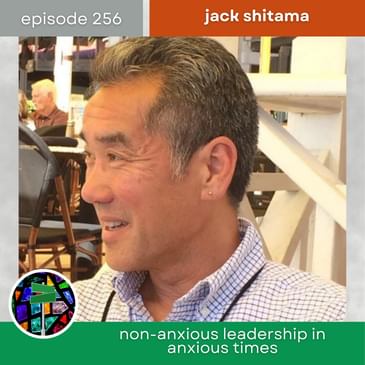

Jack Shitama, an ordained United Methodist minister, talks about the concept of societal regression and its implications for leadership and community engagement. Shitama explains how societal regression mirrors emotional regression in families, characterized by polarization and a desire for quick fixes. He discusses the role of non-anxious leaders in navigating these challenges and emphasizes the importance of love and understanding in overcoming societal divides. The conversation also touches on the future of society, the potential for hope amidst crisis, and the responsibilities of faith communities in fostering a non-anxious presence.
5 Ways to Lead during a Societal Regression
Join the Church and Main Email List
Facebook | Instagram | Threads | Twitter | Website | YouTube
00:00:01 --> 00:00:06 On this episode of Church in Maine, we talk about being a non-anxious leader
00:00:06 --> 00:00:10 in a very, very anxious time. That's coming up.
00:00:38 --> 00:00:41 Hello, and welcome to Church in Maine, a podcast for people interested in the
00:00:41 --> 00:00:45 intersection of faith, politics, and culture. I'm Dennis Sanders, your host.
00:00:45 --> 00:00:52 My guest today is Jack Shatama, an ordained United Methodist minister who is
00:00:52 --> 00:00:56 an author and host of the Non-Anxious Leader podcast.
00:00:57 --> 00:01:00 We're going to talk about the concept of societal regression,
00:01:00 --> 00:01:04 which kind of describes what's kind of happening in our society right now,
00:01:05 --> 00:01:10 and how spiritual leaders can really navigate what's going on right now.
00:01:10 --> 00:01:15 So if you're the leader in a congregation, whether you are clergy or lay,
00:01:15 --> 00:01:17 you're going to want to listen to this episode.
00:01:17 --> 00:01:23 So without further ado, here is my conversation with Jack Shatama.
00:01:45 --> 00:01:48 Well, thank you, Jack, for taking the time to chat with me.
00:01:48 --> 00:01:52 I first wanted to start by just kind of taking the time to introduce yourself
00:01:52 --> 00:01:54 and kind of going from there.
00:01:57 --> 00:02:04 Sure. I am an ordained United Methodist minister, and I've been in ministry since 1991.
00:02:06 --> 00:02:12 I pastored for nine years, and then I ran the United Methodist Camp and Retreat
00:02:12 --> 00:02:16 on the eastern shore of Maryland for 23 years.
00:02:16 --> 00:02:23 And at the very beginning in seminary, I encountered Edwin Friedman's generation-to-generation
00:02:23 --> 00:02:26 family process in church and synagogue.
00:02:26 --> 00:02:30 And it really enlightened me in terms of not only my own functioning and my
00:02:30 --> 00:02:35 own family of origin, but also how it applies to leadership,
00:02:35 --> 00:02:39 especially leading as a non-anxious presence in congregational systems.
00:02:39 --> 00:02:44 And so that's kind of been my area of focus for the last three decades.
00:02:44 --> 00:02:52 And I've written several books on family systems theory and have a podcast.
00:02:52 --> 00:02:58 And I feel like it's kind of my calling to help people understand how they can
00:02:58 --> 00:03:01 function as a non-anxious presence personally and professionally.
00:03:03 --> 00:03:07 And one of the reasons I wanted to have you on the podcast is that you did a
00:03:07 --> 00:03:14 kind of a two-part podcast series on something called societal regression.
00:03:16 --> 00:03:22 And I thought that that was fascinating, and I thought basically it kind of fit with the time.
00:03:23 --> 00:03:26 Because you were trying to really kind of talk about the times that we're in,
00:03:26 --> 00:03:33 and that what's happening is not – in some ways, it's not unusual.
00:03:33 --> 00:03:39 And that this is almost something that seems somewhat cyclical.
00:03:39 --> 00:03:47 And so could you kind of explain what that is all about and how does that fit,
00:03:47 --> 00:03:51 especially into some of what you work in with family systems?
00:03:52 --> 00:03:59 Sure. So the idea of a societal regression is based on the idea of an emotional
00:03:59 --> 00:04:01 regression in a family of origin.
00:04:01 --> 00:04:04 Murray Bowen was the founder of Family Systems Theory,
00:04:04 --> 00:04:12 and what he said was that when a family of origin or a family system is experiencing
00:04:12 --> 00:04:17 chronic anxiety, it goes into an emotional regression.
00:04:18 --> 00:04:23 And an emotional regression is characterized by polarization, by reactivity.
00:04:23 --> 00:04:29 So reactivity is people getting defensive or aggressive, and that it.
00:04:29 --> 00:04:34 Makes it very, very difficult for people to function in healthy ways because
00:04:34 --> 00:04:36 of this polarization that is going on.
00:04:36 --> 00:04:41 He then also, and this was in the late 60s, early 70s,
00:04:41 --> 00:04:49 he said that the United States was in a societal regression that had started
00:04:49 --> 00:04:56 after World War II and was probably not going to end until somewhere in the 21st century.
00:04:57 --> 00:05:03 And one of the elements of a societal regression besides the polarization is
00:05:03 --> 00:05:05 this desire for a quick fix.
00:05:05 --> 00:05:13 So people aren't willing to go through kind of the long-term work that it takes to get healthy.
00:05:13 --> 00:05:19 And so they're constantly looking for that thing that's going to turn things
00:05:19 --> 00:05:20 around, going to save us.
00:05:20 --> 00:05:26 And so one of the things I said in the podcast was that Donald Trump is not
00:05:26 --> 00:05:30 the cause of our societal regression. He's a symptom of it.
00:05:30 --> 00:05:35 He is the symptom of that desire for a quick fix.
00:05:35 --> 00:05:40 People latched onto him because they were seeing that where a political system was working,
00:05:40 --> 00:05:44 it wasn't working, that we weren't getting anywhere, and people were looking
00:05:44 --> 00:05:51 for some way out, and he happened to be at the right place at the right time.
00:05:52 --> 00:05:57 And ironically, I think if it weren't Donald Trump, it probably would have been Bernie Sanders.
00:05:58 --> 00:06:03 One of the principles in family systems theory is it's process, not content.
00:06:04 --> 00:06:08 So the emotional process that's going on is we're in this depolarization.
00:06:09 --> 00:06:11 People are looking for a way out. They're looking for a quick fix.
00:06:12 --> 00:06:16 I don't think they would have cared if it was on the left or the right,
00:06:16 --> 00:06:17 the extreme left or the extreme right.
00:06:17 --> 00:06:25 And in fact, I'm pretty sure I've seen data that shows that when Bernie didn't
00:06:25 --> 00:06:29 win the nomination, people who were frustrated with the status quo,
00:06:29 --> 00:06:35 the Democratic Party establishment whom they thought fixed it for Hillary and
00:06:35 --> 00:06:38 took it away from Bernie, a lot of those people went to Trump.
00:06:39 --> 00:06:42 It's like they wrapped around to the other side.
00:06:42 --> 00:06:48 And so this idea of a societal regression is that people are not functioning
00:06:48 --> 00:06:53 well, and they make it hard for leaders to function well.
00:06:53 --> 00:06:58 So leaders who are actually trying to think about the common good and trying
00:06:58 --> 00:07:04 to think about compromise and trying to figure out ways to deal with all of
00:07:04 --> 00:07:08 the challenges that we have in society, they're not going to get a voice.
00:07:08 --> 00:07:12 They're not going to get people's ear because people just—.
00:07:13 --> 00:07:16 They can't stand it. They want something quick. They want it now.
00:07:17 --> 00:07:23 And so they go to these extremes that they think will change things for the better.
00:07:23 --> 00:07:29 But at least from my perspective, what we've seen in this most recent administration
00:07:29 --> 00:07:33 is, you know, we're bordering on fascism now.
00:07:33 --> 00:07:36 We're getting to the point where it's going in the other direction.
00:07:36 --> 00:07:43 And ironically, I think the peak of the last regression, I think,
00:07:43 --> 00:07:46 was the 30s and Nazi Germany.
00:07:47 --> 00:07:54 And then the thing that broke us out was World War II when this – because that's
00:07:54 --> 00:07:57 what Murray Bowen says is the only thing that's going to get us out is a worldwide
00:07:57 --> 00:08:00 crisis that forces people to figure something out.
00:08:00 --> 00:08:07 And it's almost like fascism with Nazi Germany and Mussolini in Italy and Hirohito
00:08:07 --> 00:08:11 in Japan had this movement that was taking over the world,
00:08:11 --> 00:08:17 and the only thing that stopped it was this massive world war,
00:08:17 --> 00:08:19 which lost a lot of lives.
00:08:19 --> 00:08:23 So I hope that's not the case. I hope we don't have a world war or something
00:08:23 --> 00:08:26 worse, but that's the theory.
00:08:26 --> 00:08:29 The theory is telling us that that's what we're in right now.
00:08:30 --> 00:08:36 What causes us to enter into such a regression?
00:08:37 --> 00:08:45 So one of the elements is rapid technological change, that things are moving
00:08:45 --> 00:08:49 so quickly that it makes people feel anxious.
00:08:50 --> 00:08:53 Another element is rapid population growth.
00:08:53 --> 00:08:58 Although, you know, if you look at the statistics now, that seems to be reversing
00:08:58 --> 00:09:04 itself. In fact, the most recent data shows that we might actually see a tremendous
00:09:04 --> 00:09:08 population decline by the late 21st century.
00:09:08 --> 00:09:13 But at the time, post-World War II, baby boom, lots of technological change
00:09:13 --> 00:09:19 that just got even more rapid in the 60s, 70s, 80s, and beyond, right?
00:09:19 --> 00:09:26 Things were happening very quickly. And so people are looking for a way to find stability.
00:09:26 --> 00:09:34 And I don't think it's any coincidence that the moral majority arose in the
00:09:34 --> 00:09:40 80s as people were starting to look for a way to take us back in time.
00:09:40 --> 00:09:52 In fact, I think I found it ironic that the last campaign, one of the campaign
00:09:52 --> 00:09:54 slogans was take America back.
00:09:54 --> 00:09:59 And some people read that as taking political power back.
00:09:59 --> 00:10:02 And I read it as taking us back in time.
00:10:02 --> 00:10:10 People wanted to go back in time to when the privileges they had were more stable
00:10:10 --> 00:10:15 and more entrenched in society instead of being challenged at every turn.
00:10:16 --> 00:10:22 So I think it's this rapid change that causes people to feel anxious sometimes.
00:10:23 --> 00:10:26 And so they're looking for a way to find stability.
00:10:26 --> 00:10:33 And as soon as that happens, it creates a polar opposite for people who are
00:10:33 --> 00:10:39 wanting to see progress and wanting to see us move towards, I'm going to say
00:10:39 --> 00:10:41 it, diversity, equity, and inclusion.
00:10:42 --> 00:10:48 And that's where the polarization really starts to intensify.
00:10:48 --> 00:10:54 And so you had the civil rights movement in the 60s, and then you had the women's
00:10:54 --> 00:10:55 rights movement in the 70s.
00:10:55 --> 00:11:00 And those things, I believe, you know, if you were to look at family systems theory,
00:11:01 --> 00:11:06 gave rise to the moral majority and the conservative right and as a way to push
00:11:06 --> 00:11:14 back against what they thought was the erosion of their own values and what
00:11:14 --> 00:11:16 I would say is more of the erosion of their own power.
00:11:17 --> 00:11:24 So with both of these kind of movements and counter-movements.
00:11:26 --> 00:11:31 Where do you find what probably you would say is a non-anxious presence?
00:11:32 --> 00:11:37 Because it seems like there's a lot of anxiety on both sides of the ledger there.
00:11:39 --> 00:11:44 Yeah. So, in fact, I think your colleague, Lauren Richman, was the one who asked
00:11:44 --> 00:11:48 the question about, well, where do you see a non-anxious presence as a leader nowadays?
00:11:48 --> 00:11:59 And I don't see it really very often. And I would say probably Barack Obama was a good example.
00:11:59 --> 00:12:03 I think George Bush was a good example, both on different sides of the aisle.
00:12:04 --> 00:12:08 But if you think about each one of them, what a non-anxious presence is able
00:12:08 --> 00:12:10 to do is they're able to say, this is what I believe.
00:12:10 --> 00:12:14 This is what I think is going to help us make us better.
00:12:14 --> 00:12:18 You don't have to agree with me, but I think this is what we need to do.
00:12:18 --> 00:12:25 And so I think Bush's moment was Iraq and the weapons of national destruction.
00:12:26 --> 00:12:33 Now, he was wrong, but he was a non-anxious leader in that respect in that he
00:12:33 --> 00:12:34 made his case to the country.
00:12:35 --> 00:12:39 He didn't demonize people who disagreed with him.
00:12:40 --> 00:12:49 And enough people went along in Congress that we ended up with the Iraq War.
00:12:50 --> 00:12:53 Some people will call it a mistake. A lot of people will call it a mistake.
00:12:54 --> 00:12:59 Barack Obama's signature legislation was affordable health care,
00:12:59 --> 00:13:05 or what I think he claims now is Obamacare. because I think he's proud to have
00:13:05 --> 00:13:07 his name on it. Same kind of thing.
00:13:07 --> 00:13:11 He wasn't telling people what they had to do, but he was saying,
00:13:11 --> 00:13:13 this is what I believe we should do.
00:13:13 --> 00:13:19 And enough people went along that it changed. And in fact, when they tried to
00:13:19 --> 00:13:23 take it away, they didn't have enough votes to take it away.
00:13:24 --> 00:13:25 I don't think,
00:13:25 --> 00:13:33 I think our society has been so polarized that those two leaders couldn't really
00:13:33 --> 00:13:34 make a lasting difference.
00:13:34 --> 00:13:37 I think they were able to make a difference while they were in office,
00:13:37 --> 00:13:43 but I'm not sure how much—I would love to see an Obama legacy,
00:13:44 --> 00:13:46 but I'm not sure what that's going to be.
00:13:46 --> 00:13:51 I think the two in the late 20th century, I think,
00:13:51 --> 00:13:58 that did really change society were Nelson Mandela and Martin Luther King Jr.,
00:13:58 --> 00:14:06 because they showed that you don't even need power to change things.
00:14:06 --> 00:14:09 Neither one of them really had political power.
00:14:09 --> 00:14:17 Nelson Mandela ended up with political power, but it really was his willingness to suffer, I think.
00:14:18 --> 00:14:28 That enabled a movement to grow and really change the entire nation and Dr.
00:14:28 --> 00:14:34 King in the same way. He had no political power, but it was his idea that,
00:14:34 --> 00:14:37 you know, he's not going to hate.
00:14:37 --> 00:14:41 He's going to love and he's going to show people, he's going to share with people
00:14:41 --> 00:14:43 what he believes should happen.
00:14:43 --> 00:14:49 And enough people went along that some laws changed, some progress was made.
00:14:49 --> 00:14:53 I think there's still a long way to go to battle systemic racism.
00:14:53 --> 00:14:57 But there's those two, I think.
00:14:57 --> 00:15:05 And then if you were to go earlier in the 20th century, I think Mahatma Gandhi was a similar one. Yeah.
00:15:05 --> 00:15:11 We don't have anybody like that nowadays. I think I gave a couple examples in the podcast.
00:15:11 --> 00:15:18 I thought Mitt Romney, when he voted for Donald Trump's impeachment,
00:15:18 --> 00:15:22 I thought he was taking a stand as a non-anxious leader.
00:15:22 --> 00:15:27 He didn't criticize people who disagree with him, but he stood up for what he believed in.
00:15:27 --> 00:15:31 And I think more recently, Chuck Schumer,
00:15:32 --> 00:15:38 when he compromised with the Republicans just to get a budget through to keep
00:15:38 --> 00:15:40 the government from shutting down,
00:15:40 --> 00:15:48 those are little examples of people who are actually willing to stick with their
00:15:48 --> 00:15:52 principles, but at the same time find ways to work with other people to move things forward.
00:15:52 --> 00:15:56 And we don't see it very often right now, especially with this administration.
00:15:58 --> 00:16:10 There's been a lot of talk especially recently with the battle over redistricting of the sense that,
00:16:12 --> 00:16:18 One side has fights, so the other side needs to fight harder.
00:16:20 --> 00:16:27 And is this kind of the perfect example of societal regression?
00:16:27 --> 00:16:35 Absolutely. And is that helpful? I mean, on one hand, I guess it makes sense,
00:16:35 --> 00:16:40 but I don't know if it's really going to do anything.
00:16:41 --> 00:16:44 Yeah, I mean, it just makes things worse.
00:16:45 --> 00:16:49 One of my neighbors has a yard sign that says, Democracy is Precious.
00:16:49 --> 00:16:57 And this type of fighting is anti-democratic, right? Anti-democracy.
00:16:58 --> 00:17:02 And that being said, I'm a human being too. So when I hear Gavin Newsom is going
00:17:02 --> 00:17:06 to fight back, I'm like, yes, we got to do something.
00:17:06 --> 00:17:13 But then what my training tells me is that's going to make things worse.
00:17:16 --> 00:17:21 It's like the Hatfields and the McCoys. It's a feud where how many people have
00:17:21 --> 00:17:25 to die before we figure out that this is not the way?
00:17:25 --> 00:17:33 And I think there is a way forward. I'm just not sure right now.
00:17:33 --> 00:17:38 I still believe it has something to do with Dr.
00:17:38 --> 00:17:46 King's principles of nonviolent resistance and showing we care about people
00:17:46 --> 00:17:51 that disagree with us, even as we disagree vehemently with their policies.
00:17:53 --> 00:17:59 One of my colleagues who works in she's the Executive Minister of Beloved Community
00:17:59 --> 00:18:04 for our region of the United Methodist Church she's working on a campaign called
00:18:04 --> 00:18:08 United in Love and the basic,
00:18:09 --> 00:18:12 principle is that hate divides and love unites.
00:18:12 --> 00:18:19 So we have to figure out how to love in a way that is life-changing for people that disagree.
00:18:19 --> 00:18:26 And I think that also means that we need to be willing to think hard about what
00:18:26 --> 00:18:34 we believe and think, okay, what do we need to change to find a way forward?
00:18:34 --> 00:18:38 Because it's really easy for me as a progressive to just, you know,
00:18:39 --> 00:18:42 double down and say, hey, let's get a socialist mayor in New York.
00:18:43 --> 00:18:45 Well, you know, maybe.
00:18:46 --> 00:18:55 But, you know, are there ways forward to, you know, find solutions where people
00:18:55 --> 00:18:58 are able to say this is actually, this is good for all of us.
00:18:59 --> 00:19:03 And that's not happening right now. That's for sure.
00:19:06 --> 00:19:13 So what is usually, you talked about the way that is the way out of a social
00:19:13 --> 00:19:18 societal regression is usually not the way that we want,
00:19:19 --> 00:19:21 which is violent conflict.
00:19:21 --> 00:19:31 Um and but i think one of the other things that's it's kind of fascinating is that usually,
00:19:31 --> 00:19:34 the leaders that can can kind
00:19:34 --> 00:19:41 of lead are not the people that we expect can you kind of say a little bit more
00:19:41 --> 00:19:46 about that because i think that that is fascinating because i think we are right
00:19:46 --> 00:19:51 now so attuned to thinking that the leaders that are going to get us out of
00:19:51 --> 00:19:53 this are going to be in Washington.
00:19:54 --> 00:20:01 And maybe they're not. In fact, I'm beginning to think I'm pretty sure they aren't going to be.
00:20:01 --> 00:20:09 I would agree because to be in Washington, you have to play that game. And.
00:20:11 --> 00:20:14 Actually, the parties benefit more from that game than anybody else.
00:20:14 --> 00:20:20 They benefit from sharing that power and it going back and forth because that's
00:20:20 --> 00:20:22 how they can keep a lot of other people out of power.
00:20:23 --> 00:20:25 So I would agree that,
00:20:26 --> 00:20:31 I think her name is, is it Greta Thunberg? Is that the young woman who,
00:20:31 --> 00:20:39 you know, really made a name for herself and made it and focused on climate change, right?
00:20:40 --> 00:20:43 I mean, I think, you know, it's that type of thing, I think,
00:20:43 --> 00:20:48 that might emerge. And, yeah, I hope it's not a world war.
00:20:48 --> 00:20:50 I hope it's not a worldwide economic crisis.
00:20:50 --> 00:20:55 What I said in my podcast episode was I think the best hope for us is it's some
00:20:55 --> 00:21:03 kind of climate crisis and that because of what we're doing to the climate,
00:21:04 --> 00:21:07 some things happen that are maybe disastrous.
00:21:07 --> 00:21:09 But we don't destroy each other.
00:21:09 --> 00:21:15 We realize we're destroying the earth and we need to start to work together because I think that's.
00:21:17 --> 00:21:23 If that is the case, I don't know that that's, I don't know that we're actually
00:21:23 --> 00:21:24 in a societal regression.
00:21:24 --> 00:21:28 I don't know that, you know, Murray Bone is right about how it's going to end.
00:21:29 --> 00:21:36 I do believe that we need non-anxious leaders no matter what because non-anxious
00:21:36 --> 00:21:41 leaders are people who are able to say what they believe and give others the freedom to disagree.
00:21:41 --> 00:21:46 And again, that's where I see Dr. King was just a prophet in that respect,
00:21:47 --> 00:21:49 you know, the prophetic in that respect.
00:21:49 --> 00:21:57 And so I hope it doesn't happen that way, but regardless, to the extent that
00:21:57 --> 00:21:59 we can, especially as people of faith,
00:22:00 --> 00:22:07 trying to raise up and encourage and affirm people who can live that way,
00:22:07 --> 00:22:12 I think that's one of the few things we might be able to do besides pray right now.
00:22:18 --> 00:22:23 What about us? What about people, especially as Christians in churches?
00:22:26 --> 00:22:32 What can we do to be basically a non-anxious presence in churches?
00:22:32 --> 00:22:41 What can we do in our communities so that we're not basically caught up in the anxiousness?
00:22:41 --> 00:22:48 Because I think it's very easy for us to, in reading the news,
00:22:48 --> 00:22:53 especially in social media, to get caught up in emotion.
00:22:54 --> 00:22:59 And so, how do we not be so anxious?
00:23:01 --> 00:23:07 Well, that's a tall order because I have family members who just maybe on a
00:23:07 --> 00:23:12 daily basis are getting riled up with what they see in the news.
00:23:14 --> 00:23:20 But I do think, to the extent that we can focus on our own functioning,
00:23:20 --> 00:23:25 in other words, not focus on what other people are doing.
00:23:26 --> 00:23:34 Now, I read two newspapers daily, and so I see what's going on out there.
00:23:34 --> 00:23:36 I don't want to put my head in the sand.
00:23:37 --> 00:23:42 But I know that I can't change those people who are doing that.
00:23:43 --> 00:23:47 The only thing I can do is work on how I respond to things.
00:23:48 --> 00:23:51 And quite honestly, Dennis, I'm still trying to figure out.
00:23:52 --> 00:23:58 What to do because I'm feeling a little bit powerless right now.
00:23:59 --> 00:24:04 But just owning that and just saying, okay, I'm not sure what I can do right
00:24:04 --> 00:24:09 now, but I'm not going to blame other people for what they're doing because that's not helpful.
00:24:10 --> 00:24:15 When we start to blame and we start to demonize, we're focusing on what other
00:24:15 --> 00:24:17 people are doing instead of how we can respond.
00:24:18 --> 00:24:25 And so, I would say is as people of faith, one thing definitely is to pray.
00:24:26 --> 00:24:33 I think another thing is to be able to speak to issues from a faith perspective
00:24:33 --> 00:24:39 in a way that doesn't tell people what they have to believe,
00:24:39 --> 00:24:43 but says, this is how I interpret things as a Jesus follower.
00:24:43 --> 00:24:51 So, for example, I'm working through Genesis right now, and they're talking
00:24:51 --> 00:24:53 about how you are an alien in this land,
00:24:53 --> 00:24:59 you know, and it makes me think immediately of how in the Hebrew scriptures
00:24:59 --> 00:25:02 it says, take care of the widow, the alien, and the orphan.
00:25:02 --> 00:25:08 And people don't interpret alien as immigrant nowadays, but Jesus was an immigrant.
00:25:09 --> 00:25:12 And so, I don't know if you've seen the...
00:25:13 --> 00:25:15 He gets us commercials.
00:25:17 --> 00:25:22 What's funny to me, this is the example.
00:25:22 --> 00:25:26 This kind of tells you how we are in a societal regression.
00:25:28 --> 00:25:33 They're making everybody mad. People on the right are saying this is a progressive conspiracy.
00:25:33 --> 00:25:37 People on the left are saying, well, the guy from Hobby Lobby is behind it,
00:25:37 --> 00:25:43 so it must have an evangelical Christian purpose that we don't know about.
00:25:44 --> 00:25:48 And I'm looking at it, and the one I love is the one that shows the journey
00:25:48 --> 00:25:51 walking through South America to the border.
00:25:51 --> 00:25:54 It's like, Jesus was an immigrant.
00:25:54 --> 00:26:03 And so, I think as people of faith, if we can share these things, for example,
00:26:03 --> 00:26:09 I like to try to phrase things in ways that help people understand how to be
00:26:09 --> 00:26:10 a non-anxious presence.
00:26:10 --> 00:26:16 I might say to somebody, you know, I realize that world trade,
00:26:16 --> 00:26:23 you know, free trade costs a lot of people jobs, but I'm not sure that how we're
00:26:23 --> 00:26:26 doing things right now is the right approach.
00:26:27 --> 00:26:34 And as a Christian, I believe that we owe it to people to make a place for those
00:26:34 --> 00:26:39 who are outcasts, for those who are refugees, for those who are looking for a better world.
00:26:39 --> 00:26:43 And I actually believe that our Christian faith tells us that when we do that,
00:26:43 --> 00:26:47 we all benefit. And I think the economics are there, too.
00:26:47 --> 00:26:54 I mean, you know, just a side note, these mass deportations are going to hurt our economy.
00:26:54 --> 00:27:01 They're going to create labor shortages. They're hurting our industries and agriculture. And so—.
00:27:02 --> 00:27:07 I think there are ways that we can do good where everybody benefits.
00:27:08 --> 00:27:11 And so, being able to share those things from a faith perspective,
00:27:12 --> 00:27:14 that I believe this is what it means to be a Christian.
00:27:16 --> 00:27:19 But you're implying that those who don't believe that are not Christians?
00:27:21 --> 00:27:26 I don't want to say that. I believe they do believe in Jesus.
00:27:28 --> 00:27:31 I just don't agree with how they are interpreting the way they follow Jesus.
00:27:38 --> 00:27:49 So, what do you think is going to be kind of the future, and let me rephrase that.
00:27:49 --> 00:27:55 Where do you think we're going to be as a society a few years down the road,
00:27:55 --> 00:27:59 as a society, as we're kind of dealing with this societal regression?
00:28:02 --> 00:28:09 Yeah, I think that the hopeful scenario would be people get so fed up with this
00:28:09 --> 00:28:17 administration and somebody rises up who can provide leadership for the common good.
00:28:20 --> 00:28:25 I don't know if that will happen, and it almost seems to me that that would
00:28:25 --> 00:28:31 have to be a third-party candidate that's not beholden to either party.
00:28:32 --> 00:28:37 So that seems a little bit like a long shot. I live in the state of Maryland,
00:28:37 --> 00:28:43 and my governor, Wes Moore, is somebody I'm cheering for because I think he's that kind of guy.
00:28:43 --> 00:28:49 But again, if he's in the Democratic Party, I don't know what that means.
00:28:50 --> 00:28:55 In terms of being able to break free from the stuckness that we have in our regression.
00:28:57 --> 00:29:05 So I think that's the more hopeful scenario. I think the pessimistic scenario is that in four years,
00:29:05 --> 00:29:13 or three and a half years or whatever, we are so polarized that we're on the
00:29:13 --> 00:29:15 border of absolute chaos.
00:29:16 --> 00:29:23 And that, you know, that scenario is Trump trying to stay in office or people
00:29:23 --> 00:29:26 trying to take power through force or who knows what.
00:29:27 --> 00:29:31 I mean, you know, these occupations that are going on, you know,
00:29:32 --> 00:29:39 it started in California. It wasn't really an occupation. It was more of an incursion.
00:29:39 --> 00:29:43 But, you know, D.C. is definitely an occupation. And, you know,
00:29:43 --> 00:29:44 they're talking about Chicago.
00:29:45 --> 00:29:46 Those things...
00:29:49 --> 00:29:53 What concerns me is that it's just the tip of the iceberg.
00:29:57 --> 00:30:04 I can't remember. It wasn't Bonhoeffer who said the thing in Nazi Germany.
00:30:04 --> 00:30:06 They came to take away them. They came to take away so-and-so.
00:30:07 --> 00:30:10 When they came to take away me, there was nobody left to stand up.
00:30:10 --> 00:30:19 And my concern is that these things are going to just happen incrementally.
00:30:19 --> 00:30:23 And that's really not incrementally. I mean, that's a big deal to send troops into D.C.
00:30:23 --> 00:30:27 But these things are happening and they're not being stopped.
00:30:27 --> 00:30:29 And so what are things going
00:30:29 --> 00:30:38 to look like by November of 2028 or even sooner if Trump tries to stay in power
00:30:38 --> 00:30:45 so to me those are the different ends of the spectrum I really hope it's not
00:30:45 --> 00:30:48 the more pessimistic one because,
00:30:49 --> 00:30:57 I think you could really see people hurt physically I mean I think and it you
00:30:57 --> 00:31:00 know it might be people on both sides I don't want to see a civil war I don't
00:31:00 --> 00:31:02 think we would have a civil war but,
00:31:05 --> 00:31:05 I don't know.
00:31:10 --> 00:31:11 So, where is the hope in all of this?
00:31:15 --> 00:31:20 Well, my wife and I, you know, we're like, good time for Jesus to come back.
00:31:21 --> 00:31:24 You know, that's the eschatological hope.
00:31:26 --> 00:31:31 You know, and I, you know, I chuckle about that, but I, you know,
00:31:31 --> 00:31:36 I do believe that God does win in the end.
00:31:36 --> 00:31:44 I do believe that, in the end, the beloved community becomes a reality on earth as it is in heaven.
00:31:46 --> 00:31:51 I don't expect to see it in my lifetime, but if I did, I wouldn't be upset.
00:31:53 --> 00:32:06 But having that hope helps me to believe that I can maintain my desire to follow
00:32:06 --> 00:32:08 Jesus the way I believe he wants us to follow him,
00:32:08 --> 00:32:14 even when everything else seems to be crumbling around us.
00:32:14 --> 00:32:19 And, you know, that's not a lot of hope.
00:32:19 --> 00:32:25 But, you know, if you were in one of the concentration camps in Germany,
00:32:26 --> 00:32:28 there wasn't a lot of hope there.
00:32:28 --> 00:32:34 Or if you were enslaved in the first, you know, several hundred years of this,
00:32:34 --> 00:32:40 you know, our colonization in this country, there wasn't a lot of hope there,
00:32:40 --> 00:32:41 and yet people maintained hope.
00:32:41 --> 00:32:50 So in some ways, I think others before us have shown us that it's possible even
00:32:50 --> 00:32:51 when things seem really dire.
00:32:55 --> 00:33:00 If people want to know more or follow your podcast, where should they go?
00:33:01 --> 00:33:07 The website's thenonanxiousleader.com, and the podcast is The Non-Anxious Leader.
00:33:07 --> 00:33:14 And you can find everything on the website, and the podcast is on all the platforms.
00:33:15 --> 00:33:18 They're short episodes. That's one of the things people say they like about
00:33:18 --> 00:33:22 them. 10 to 15 minutes, a new episode every week.
00:33:23 --> 00:33:28 All right. Well, Jack, thank you so much for this very important episode.
00:33:28 --> 00:33:30 And I hope to have you back on.
00:33:31 --> 00:33:34 Thank you. Thanks for having me. All right.
00:34:05 --> 00:34:08 So, if you have thoughts about this episode, of course, you can always send
00:34:08 --> 00:34:13 me an email, drop me a line at churchinmain at substack.com.
00:34:13 --> 00:34:23 I will include links to the episode that kind of started this off that is from Jack's podcast.
00:34:23 --> 00:34:27 So, the link is in the show notes.
00:34:27 --> 00:34:31 If you want to learn more about this podcast, listen to past episodes,
00:34:32 --> 00:34:35 or donate, check us out at churchinmain.org.
00:34:36 --> 00:34:41 You can also visit churchinmain.substack.com to read related articles.
00:34:42 --> 00:34:46 So you can subscribe to the podcast on your favorite podcast app,
00:34:46 --> 00:34:49 and please consider leaving a rating or review.
00:34:49 --> 00:34:52 That really does help others find this podcast.
00:34:53 --> 00:34:58 If you want make a donation, you can do that. I have a link to Buy Me a Coffee.
00:34:58 --> 00:35:03 That's also in the show notes. There's also a link there if you want to have
00:35:03 --> 00:35:07 the latest episodes show up in your email inbox.
00:35:11 --> 00:35:16 Also, feel free to pass this episode along to family and friends who might be interested.
00:35:16 --> 00:35:19 Again, that helps spread the word for about this podcast.
00:35:20 --> 00:35:25 That is it for this episode of Church in Maine. Thank you again for listening.
00:35:25 --> 00:35:29 I'm Dennis Sanders, your host. Take care, everyone. Godspeed,
00:35:29 --> 00:35:31 and I will see you very soon.