
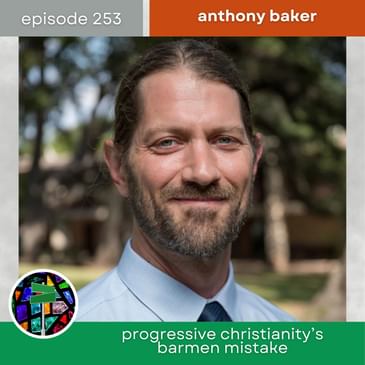
Professor Anthony Baker discusses the Barmen Declaration and its implications for American Christianity today. We analyze its historical context from the 1930s and why we are not currently experiencing a similar moment. Professor Baker emphasizes the declaration's intent to maintain the church's independence from the state, a principle that modern churches risk overlooking. We explore the complexities of Karl Barth's ideas and the dangers of conflating faith with political ideologies, highlighting the need for unity within the church. Our conversation advocates for grace and understanding in theological discourse, encouraging a culture that prioritizes listening and empathy over division. Ultimately, we reflect on how the lessons from the Barmen Declaration can help shape our faith in today's sociopolitical climate.
Progressive Christianity’s Barmen Mistake
Are We In A Bonhoeffer Moment (Ministry in A Secular Age Podcast)
Join the Church and Main Email List
Facebook | Instagram | Threads | Twitter | Website | YouTube
00:00:01 --> 00:00:05 On this episode of Church in Maine, I talk to a professor and pastor about why
00:00:05 --> 00:00:11 we are not living in a barman moment. That's coming up.
00:00:39 --> 00:00:43 Hello, and welcome to Church of Maine, a podcast for people interested in the
00:00:43 --> 00:00:46 intersection of faith, politics, and culture. I'm Dennis Sanders, your host.
00:00:47 --> 00:00:53 I want to begin by sharing a few paragraphs from an essay that caught my attention a while ago.
00:00:55 --> 00:01:01 Quote, In 1934, Lutheran, Reformed, and United Protestant churches gathered
00:01:01 --> 00:01:06 in Barman, Germany, to compose and sign a declaration of resistance to Hitler's
00:01:06 --> 00:01:08 nationalization of the churches.
00:01:08 --> 00:01:12 The integrity of Christianity was under attack, and the purpose of the Barman
00:01:12 --> 00:01:16 Declaration was to assert the independence of the church.
00:01:16 --> 00:01:22 The signers were not a group of politically like-minded pastors publicly declaring
00:01:22 --> 00:01:26 their convictions about ethics or the Constitution,
00:01:26 --> 00:01:33 but rather shepherds of the church well on its way to becoming an extension of a partisan platform.
00:01:34 --> 00:01:40 In recent months, I have heard many centrist and left-leaning Christians appeal
00:01:40 --> 00:01:47 to the Barman Declaration as a model for the action that American Christianity,
00:01:47 --> 00:01:52 co-opted by a perceived radical agenda of the current White House needs today.
00:01:53 --> 00:01:57 But this is not our Barman moment, unquote.
00:01:59 --> 00:02:04 Those words were written by Anthony Baker, an Episcopal priest and seminary
00:02:04 --> 00:02:09 professor of systematic theology at Seminary of the Southwest in Austin, Texas.
00:02:09 --> 00:02:16 He wrote this in August of this year in an essay entitled Progressive Christianity's
00:02:16 --> 00:02:22 Barman Mistake, and he wrote it for the Living Church. This is an Anglican journal.
00:02:22 --> 00:02:29 And he talked about how progressive Christians misuse the Barman Declaration.
00:02:30 --> 00:02:37 Because this was such a provocative title for an essay, I wanted to read this article.
00:02:38 --> 00:02:41 And after reading it, I really wanted to talk to Professor Baker.
00:02:41 --> 00:02:49 So he is my guest today. And instead of really going into more talking about
00:02:49 --> 00:02:54 all of this, I thought, let's just get to this interview.
00:02:54 --> 00:02:58 So without further ado, here's my conversation with.
00:03:17 --> 00:03:21 Well, Professor Baker, thank you for taking the time to join me this evening.
00:03:23 --> 00:03:27 I wanted to start off by getting to know a little bit about you,
00:03:27 --> 00:03:32 a little bit about your faith background, and then also your position at the seminary.
00:03:33 --> 00:03:37 Well, thank you, first of all, Reverend Sanders, for the invitation to be on
00:03:37 --> 00:03:41 your podcast and to have this conversation in front of your audience.
00:03:41 --> 00:03:46 So it's an honor to be in this setting with you.
00:03:47 --> 00:03:54 So I am the Systematic Theology Professor at Seminary of the Southwest in Austin, Texas.
00:03:55 --> 00:04:00 That's an Episcopal seminary. I've been in that role for 21 years now.
00:04:03 --> 00:04:06 And I also currently teaching Christian ethics.
00:04:07 --> 00:04:11 I teach a course for students of counseling.
00:04:11 --> 00:04:17 I'm co-teaching that with another counselor educator, and that is religion.
00:04:17 --> 00:04:22 It's called Issues in Religion, and it's basically American religions for counselors
00:04:22 --> 00:04:24 and for spiritual directors.
00:04:25 --> 00:04:30 And then I teach courses. I teach electives on contemporary theology, classical theology.
00:04:31 --> 00:04:37 I teach a course called Hope for Creation on theology and creation care and
00:04:37 --> 00:04:39 climate crisis, that sort of thing.
00:04:40 --> 00:04:44 But those are my main teaching gigs. And our seminary is about,
00:04:44 --> 00:04:49 I think it's maybe around 130 full-time students.
00:04:49 --> 00:04:53 And they're in various programs, but mostly they're heading into ordination
00:04:53 --> 00:04:59 in the Episcopal Church or into counseling, into counseling degrees.
00:05:00 --> 00:05:04 And just professionally, I should also say that I am a theologian in residence
00:05:04 --> 00:05:06 at St. Julian Norwich Episcopal Church.
00:05:06 --> 00:05:12 Got to give a shout out to my people at church and my side hustle there on the weekends.
00:05:14 --> 00:05:20 I teach and I coordinate our adult education curriculum there with folks at St.
00:05:21 --> 00:05:23 Julian's. So that's what I spend most of my time doing.
00:05:25 --> 00:05:31 I've always been fascinated by that position of a theologian in residence. I know not many...
00:05:34 --> 00:05:39 Congregations have those, and I kind of wish more did. I joke with our people
00:05:39 --> 00:05:42 that it sort of sounds like I live there. Is this my residence?
00:05:43 --> 00:05:46 Do I have a little cot in the back and they wheel me out when they need some
00:05:46 --> 00:05:48 theology? Is that what this is about?
00:05:50 --> 00:05:55 No, it's been good. One of the ways that St.
00:05:55 --> 00:05:59 Julian's was able to do it is this was a church plant from about 12,
00:06:00 --> 00:06:03 13, no, 14, 15 years ago now.
00:06:05 --> 00:06:10 And one of the priorities up front was that they wanted, that was one of the
00:06:10 --> 00:06:13 things that they were gathering the money for and gathering support for.
00:06:13 --> 00:06:18 They wanted to devote a certain amount of time of their funds to outreach work,
00:06:18 --> 00:06:24 and they wanted to devote a certain amount of funds to education and church education work.
00:06:24 --> 00:06:28 So from the beginning, this has been written into the budget to have a theologian
00:06:28 --> 00:06:31 in residence there. Wow, that's fascinating that that was built in.
00:06:32 --> 00:06:38 Yeah, yeah. It's a good place. It's a good place full of good people who are
00:06:38 --> 00:06:42 sort of figuring out the Christian faith one Sunday at a time.
00:06:43 --> 00:06:47 Well, this actually, this really does kind of flow into what we're talking about.
00:06:47 --> 00:06:52 And this is the article that was in the Living Church magazine,
00:06:52 --> 00:06:56 which is titled Progressive Christianity's Barman Mistake.
00:06:56 --> 00:07:05 And I hear a lot about the Barman Declaration, which is a...
00:07:07 --> 00:07:13 It's basically a, it has become really an important kind of creed of the church
00:07:13 --> 00:07:17 over the last almost century now.
00:07:18 --> 00:07:23 And you have, I've heard it a lot, especially in the, basically in the last
00:07:23 --> 00:07:30 year or so, especially in the run up to the 2024 presidential election.
00:07:30 --> 00:07:36 But I think it's kind of important to understand the situation of what brought
00:07:36 --> 00:07:38 about the Barman Declaration.
00:07:40 --> 00:07:45 And I think you talk about this a little bit in the article of what was the
00:07:45 --> 00:07:52 background and the situation in Germany in the early 1930s that brought about
00:07:52 --> 00:07:55 Barman, the Barman Declaration?
00:07:55 --> 00:07:59 And also maybe to talk a little bit about the author, which was Carl,
00:07:59 --> 00:08:03 or the main author, I should say, which was Carl Barth.
00:08:03 --> 00:08:09 Yeah, one of the reasons, Reverend Sanders, one of the reasons I wanted to write
00:08:09 --> 00:08:13 about the essays, I am hearing a lot about Barman, and I think it completely
00:08:13 --> 00:08:17 makes sense that we would because the theme is Christian nationalism,
00:08:18 --> 00:08:23 and that was the world in which that declaration emerged, And it's rhetoric
00:08:23 --> 00:08:29 that has emerged in a brand new way, maybe since the beginning of the American
00:08:29 --> 00:08:31 democratic experiment here,
00:08:31 --> 00:08:35 or at least in recent generations here.
00:08:35 --> 00:08:38 And so it makes sense that that would be a touchstone. One of the things that
00:08:38 --> 00:08:44 I wanted to sort out and write about was just noting the historical differences
00:08:44 --> 00:08:50 so that we don't overdo the analogy and so that that analogy maybe doesn't do
00:08:50 --> 00:08:54 some rhetorical work that's not actually helpful. Yeah.
00:08:57 --> 00:09:03 I think you probably can see what I mean, but it's sort of the problem of if
00:09:03 --> 00:09:07 it's too easy to call the other people Hitler, then that sort of shuts down the conversation.
00:09:08 --> 00:09:11 Of course, the Barman Declaration was saying that was when there was a real
00:09:11 --> 00:09:14 Hitler and there was something that the church needed to say to the actual Adolf Hitler.
00:09:15 --> 00:09:21 So I wanted to sort out some of what that was and the situation that gave rise to it.
00:09:21 --> 00:09:26 I mean, really, I think for Barthes especially, it originates in the First World War.
00:09:28 --> 00:09:36 When a strong Christian nationalism movement emerges in Switzerland and in Germany
00:09:36 --> 00:09:38 for the Germanic peoples.
00:09:39 --> 00:09:45 And the famous story about Barthes is that he's appalled to wake up one morning
00:09:45 --> 00:09:50 and see the names of all his theology professors signing a declaration that
00:09:50 --> 00:09:55 the young men of Germany should go off and fight for the fatherland,
00:09:55 --> 00:09:56 and fight for blood and soil,
00:09:57 --> 00:10:00 and God and blood and soil, and they're sort of mixing all this together.
00:10:00 --> 00:10:04 And so he has a very strong reaction to this, and that really shapes his early theology.
00:10:04 --> 00:10:10 It's his sense of, you know, his understanding that all revelation about what's
00:10:10 --> 00:10:13 good and true for Christians has to begin with Jesus Christ,
00:10:13 --> 00:10:16 and it can't begin with citizenship in
00:10:16 --> 00:10:19 a particular nation um so that
00:10:19 --> 00:10:22 shapes you know that that shapes his first couple of
00:10:22 --> 00:10:25 decades really and barman then is the
00:10:25 --> 00:10:31 big is in the early 1930s uh i think i i wrote all the dates and everything
00:10:31 --> 00:10:35 down in the article and then this sort of wandered out of my mind but um you
00:10:35 --> 00:10:38 got a you got a systematic theologian who's writing about history here you know
00:10:38 --> 00:10:43 um but uh i think it was 1933 uh 33 34.
00:10:45 --> 00:10:48 And the particular thing that
00:10:48 --> 00:10:51 ignites the
00:10:51 --> 00:11:00 masses of the Bart and the folks around him and the pastors and the leaders
00:11:00 --> 00:11:08 of the church in Germany is the organization of a national bishop who's going
00:11:08 --> 00:11:11 to be the head of the Protestant churches of Germany.
00:11:12 --> 00:11:16 And the Catholics are involved in this, too, in some complex ways.
00:11:16 --> 00:11:23 But the bishop is basically going to be Hitler's mouthpiece controlling and
00:11:23 --> 00:11:28 dictating and organizing the Christianity within Germany.
00:11:28 --> 00:11:35 And part of the point I make in the article is that's sort of ratcheting nationalism
00:11:35 --> 00:11:43 up a level. That's not just a rhetoric about, you know, for God and country.
00:11:43 --> 00:11:45 That's actually aligning God and country.
00:11:45 --> 00:11:49 And what Bart and the others around him said was this actually,
00:11:50 --> 00:11:53 the church can't function as an arm of the state.
00:11:53 --> 00:11:57 The church needs a critical distance to read scripture, to interpret scripture,
00:11:57 --> 00:12:03 to follow its theological principles, and to do that without the control of
00:12:03 --> 00:12:07 any party or any state figure, any dictator.
00:12:08 --> 00:12:11 And that's really, and this is the big point I was making, is that that's what
00:12:11 --> 00:12:17 the Barman Declaration was doing. They were not one side of a political spectrum
00:12:17 --> 00:12:19 saying, we've got to speak to the other side.
00:12:19 --> 00:12:25 We've got to make sure that Christianity looks like our version and not like their version.
00:12:25 --> 00:12:30 They were basically saying, Christians need to be in charge of what Christianity looks like.
00:12:30 --> 00:12:36 Christians and churches need to be able to debate and sort things out and get
00:12:36 --> 00:12:42 mad at each other within the confines of Christian community and not have an
00:12:42 --> 00:12:43 arm of the state saying, actually,
00:12:43 --> 00:12:46 debate ends because this is what the Fuhrer has said.
00:12:48 --> 00:12:51 This is what the Fuhrer has declared the solution to whatever particular debate
00:12:51 --> 00:12:52 we're having is going to be.
00:12:54 --> 00:12:58 And this was also a movement that was made up of people who didn't all agree
00:12:58 --> 00:13:01 on the same things. That's right. That's right.
00:13:02 --> 00:13:04 You know, Bart was a personality.
00:13:07 --> 00:13:13 He made sure that his point of view got represented and rubbed a lot of people the wrong way.
00:13:13 --> 00:13:16 And I think that's part of the brilliance of Barman is it is,
00:13:16 --> 00:13:20 I mean, Bart had the strongest hand in it.
00:13:21 --> 00:13:23 And sometimes later on, he would sort of claim to be the author.
00:13:24 --> 00:13:27 But when he would say that, others would be like, hold on, I was there,
00:13:27 --> 00:13:31 and this is a conciliar piece. This is a council they gathered.
00:13:32 --> 00:13:36 And yeah, there were debates about one of the ones that point out not everybody
00:13:36 --> 00:13:40 was happy with his language of everything has to be funneled through Jesus Christ.
00:13:41 --> 00:13:46 Some said there's got to be sort of, you know, some had more of what a sort
00:13:46 --> 00:13:53 of a kind of a classic 18th century Calvinist understanding of spheres of influence
00:13:53 --> 00:13:55 and the state is over here and the church is over here.
00:13:55 --> 00:13:59 And they're also, you know, if you do them that way, they're also agreeing that
00:13:59 --> 00:14:03 the state can't mess within the church's sphere.
00:14:04 --> 00:14:07 But they're also saying that how we declare Jesus Christ can't,
00:14:07 --> 00:14:10 you know, in this place can't interfere with how we govern.
00:14:10 --> 00:14:14 And Bart wanted Jesus to interfere with everything. So that was part of the
00:14:14 --> 00:14:15 debate that they were having.
00:14:15 --> 00:14:22 But they could have that debate only if they could declare the church has autonomy
00:14:22 --> 00:14:25 to discern its own theological positions, which is what they were.
00:14:25 --> 00:14:28 Everybody was agreeing that's what we're fighting for.
00:14:29 --> 00:14:35 So, you know, that's kind of the way that people that basically has happened
00:14:35 --> 00:14:37 or at least historically happened.
00:14:37 --> 00:14:42 But how have people misinterpreted Barman?
00:14:42 --> 00:14:44 Yeah, yeah, yeah.
00:14:45 --> 00:14:55 I think there is a, I mean, it's a very, you know, exciting is sort of the wrong
00:14:55 --> 00:14:59 word to use when you're dealing with sort of life and death issues of that era.
00:14:59 --> 00:15:06 But there's so much energy, you know, around that particular sort of crisis in the world,
00:15:06 --> 00:15:14 in governance and in community and in the genocide that's just sort of making
00:15:14 --> 00:15:17 its first sort of moves in that early stage,
00:15:17 --> 00:15:21 the Shoah, the Holocaust.
00:15:22 --> 00:15:25 Um and so it's easy to sort of you know
00:15:25 --> 00:15:29 look back at something you know that's a that's a that's a uh
00:15:29 --> 00:15:32 a sort of a low watermark of human culture and we
00:15:32 --> 00:15:35 learn that and we learn about world war ii in school and
00:15:35 --> 00:15:38 we learn about the shoar the holocaust and uh
00:15:38 --> 00:15:41 we're also part of what we learn is the
00:15:41 --> 00:15:44 sort of the patterns of appeasement you know what led to
00:15:44 --> 00:15:47 it this didn't just come out of nowhere and uh
00:15:47 --> 00:15:50 the famous statement i think is it oh it's um um
00:15:50 --> 00:15:54 not elie but um oh the
00:15:54 --> 00:15:58 other one man's search for meaning um there we
00:15:58 --> 00:16:01 go you and i said at the same time victor frankel i think that's where his
00:16:01 --> 00:16:05 um i think it's victor frankel has that sort of the the the
00:16:05 --> 00:16:09 um lines about um you know
00:16:09 --> 00:16:12 first they came for these oh martin nemo or martin there
00:16:12 --> 00:16:15 we go there we go we'll get there eventually um yeah
00:16:15 --> 00:16:19 so anyway we just sort of we we take this in as like we
00:16:19 --> 00:16:27 for one thing that was sort of that was a kind of um just unthinkable period
00:16:27 --> 00:16:30 of human violence and destruction on the other on the other hand we learn like
00:16:30 --> 00:16:36 it can happen humans did it and human patterns of evasion led to it human patterns
00:16:36 --> 00:16:37 are sort of looking the other way,
00:16:38 --> 00:16:40 And so I understand that sort of vigilance.
00:16:40 --> 00:16:44 Like, well, it's not a bad question. What would it look like in any time and
00:16:44 --> 00:16:46 place to have something that horrific?
00:16:47 --> 00:16:51 Like, would we be able to recognize the initial stages? You know,
00:16:51 --> 00:16:53 would we be able to recognize if something began and we're like,
00:16:53 --> 00:16:55 ooh, if this went too far?
00:16:56 --> 00:16:59 And so I think we're right in that sense to sort of keep our eyes open.
00:17:00 --> 00:17:05 But I think what we do when we move too quickly, I think what we'll say like
00:17:05 --> 00:17:07 something with Barman. Like we'll, we'll miss, we'll, we'll,
00:17:07 --> 00:17:12 we'll misinterpret it as in sort of in the way of just saying that, um, well, um,
00:17:13 --> 00:17:17 Sometimes the church has to be prophetic. Sometimes the church has to make strong
00:17:17 --> 00:17:21 statements and be bold and be brave. And all these things are true.
00:17:22 --> 00:17:30 But when boldness and bravery turns into declare an identity of the church that
00:17:30 --> 00:17:35 isolates people who are of a different point of view within the church,
00:17:35 --> 00:17:37 that's risky stuff. Sometimes it's got to happen.
00:17:38 --> 00:17:42 But I think if we rush to that, this is part of the theological point I was
00:17:42 --> 00:17:43 trying to make in the article.
00:17:43 --> 00:17:46 That if we too quickly say, well, okay,
00:17:46 --> 00:17:50 they were prophetic at Barman, it's time to be prophetic now,
00:17:50 --> 00:17:57 let's all gather around and agree that Trump is a really dangerous dictator
00:17:57 --> 00:18:00 and the things that he's doing are taking Christianity in a terrible direction
00:18:00 --> 00:18:05 and we're going to become nationalists and this could lead to some terrible, terrible things.
00:18:05 --> 00:18:11 If we make that not just sort of as a point of view within a church that's up
00:18:11 --> 00:18:14 for debate, but as a declaration of the church to the outside world,
00:18:14 --> 00:18:20 then I think we're breaking something within the sort of fabric of the church,
00:18:21 --> 00:18:24 which is that invitation to discern really hard stuff together.
00:18:25 --> 00:18:30 I think when a preacher gets up and says something like, this is our Barman
00:18:30 --> 00:18:35 moment and it's time to declare, here are the principles, political principles
00:18:35 --> 00:18:37 by which you can recognize Christianity.
00:18:38 --> 00:18:42 I think at that point you've basically said we're a church of the left.
00:18:42 --> 00:18:45 We're not interested in Christians who vote a certain way.
00:18:45 --> 00:18:48 And there may be communities in which that's appropriate.
00:18:49 --> 00:18:54 But I think for the most part, I think for the most part it's not.
00:18:54 --> 00:18:59 I think for the most part, priests and pastors need to be a bit more creative
00:18:59 --> 00:19:02 in how they say, we need to take a stand, we need to follow Jesus,
00:19:03 --> 00:19:07 and we're not going to do so in a way that tells half of America they're not
00:19:07 --> 00:19:10 welcome in our church because we vote the other way.
00:19:11 --> 00:19:17 Why do you think, though, that people—and I think there are people, I think,
00:19:17 --> 00:19:23 that we live in this kind of moment where it feels like everything is kind of
00:19:23 --> 00:19:28 boiling over and people's emotions are very much boiling over.
00:19:29 --> 00:19:39 And so, and I've heard it very much, the comparisons to the 1930s.
00:19:43 --> 00:19:47 And the dangers of kind of wanting to shut off debate,
00:19:48 --> 00:19:58 what are the dangers of kind of witness, kind of the dangers to our Christian
00:19:58 --> 00:20:00 witness in doing that? It's what I'm getting at.
00:20:02 --> 00:20:06 Yeah, in thinking that we're being prophetic,
00:20:07 --> 00:20:13 are we in some ways shutting off any hope of actually reaching out to someone
00:20:13 --> 00:20:20 that could actually be persuaded or could actually be given the gospel in some way,
00:20:20 --> 00:20:23 but we're basically telling them,
00:20:24 --> 00:20:26 well, you vote the wrong way, so you're out.
00:20:26 --> 00:20:36 Yeah, I think I feel that risk for just the reasons that you said it.
00:20:36 --> 00:20:40 I think there is, I mean, back to the Barman for a second.
00:20:40 --> 00:20:47 Part of what Barman does is Barman sort of gathers as an ecumenical body,
00:20:47 --> 00:20:51 ecumenical representative body of Christians and says, we've got a thing to declare.
00:20:51 --> 00:21:01 And I do want to hold out a place for individual Christians and smaller groups
00:21:01 --> 00:21:03 of Christians to be prophetic.
00:21:03 --> 00:21:07 To say, this is not a conciliar statement we're making, but I think that there's
00:21:07 --> 00:21:10 something that's got to be said, and it's got to be said loudly and boldly.
00:21:10 --> 00:21:16 I think, for instance, Bishop Buddy and her response after the inauguration,
00:21:16 --> 00:21:20 I thought that was a prophetic moment. And she was not up there.
00:21:20 --> 00:21:25 I mean, first of all, what she said was actually not inflammatory.
00:21:25 --> 00:21:30 I think it was calling somebody, you know, it was doing the work of a preacher
00:21:30 --> 00:21:35 calling a politician to mind the scripture
00:21:35 --> 00:21:39 and mind the faith and mind the vulnerable, as our faith calls us to.
00:21:39 --> 00:21:47 I think that's a prophetic moment that is completely different than the kind
00:21:47 --> 00:21:48 of thing I'm arguing against.
00:21:48 --> 00:21:54 So I do want to hold out place for that sort of following a call, not to be prophetic.
00:21:58 --> 00:22:06 The risk that you're talking about, I think, is that in our drive to sort of
00:22:06 --> 00:22:07 give voice to righteous anger,
00:22:08 --> 00:22:13 Uh, that we're not being, we're not discerning, uh, the, the,
00:22:14 --> 00:22:16 the, the way to express that.
00:22:16 --> 00:22:19 We're not discerning the way, what we're trying to do with that anger.
00:22:19 --> 00:22:23 If my, if my righteous anger, if the whole point is that I'm going to say a
00:22:23 --> 00:22:26 thing and I'm going to feel better, then that's not prophetic.
00:22:26 --> 00:22:29 That's not doing the work of the spirit. That's just sort of, I'm venting.
00:22:30 --> 00:22:33 Uh, one of the things that we teach at my seminary, we teach,
00:22:33 --> 00:22:36 um, we teach strategies for difficult conversations.
00:22:37 --> 00:22:43 And we do that so that priests and pastors who go into work in ministry can
00:22:43 --> 00:22:45 sort of take that next discerning step.
00:22:45 --> 00:22:48 Well, there's, you know, the way that my community treats the homeless or the
00:22:48 --> 00:22:54 way that we treat immigrant farm workers, you know, around here.
00:22:54 --> 00:22:57 There's a real justice problem. There's a real ethics problem.
00:22:58 --> 00:23:01 But how are we going to have that conversation that listens to what we might
00:23:01 --> 00:23:05 not be hearing from the people, from people who, you know, small business owners
00:23:05 --> 00:23:08 in the town, from farmers on the edges of town,
00:23:08 --> 00:23:13 if I just get up and say the thing, then I'm losing them maybe forever, maybe for generations.
00:23:13 --> 00:23:18 Those folks aren't coming back. But if I can hold a difficult conversation in
00:23:18 --> 00:23:20 which I can actually reach for empathy,
00:23:20 --> 00:23:26 we'll even teach patterns of speech and ways into a conversation that just sort
00:23:26 --> 00:23:29 of disarm folks, let us all put our guard down,
00:23:29 --> 00:23:36 look for something surprising and revealing in what the other person was saying,
00:23:36 --> 00:23:39 And as simple as those things seem, I mean, it's not simple to practice,
00:23:39 --> 00:23:41 obviously, when your rage is up.
00:23:41 --> 00:23:47 But as simple as those seem, I think that there's real gospel work in there.
00:23:47 --> 00:23:51 Because what you're saying is, you're not saying the world, it doesn't make
00:23:51 --> 00:23:54 sense to say, you know, the kingdom of God is going to come to earth when those
00:23:54 --> 00:23:56 people know how mad I am at them.
00:23:57 --> 00:24:01 Kingdom of God comes to earth when we learn how to recognize the image of God
00:24:01 --> 00:24:05 in the people that we disagree with really, really strongly.
00:24:06 --> 00:24:09 I think that's kind of what I'm trying to get at. There may be a moment for
00:24:09 --> 00:24:12 a big declaration, but I don't think we're there.
00:24:12 --> 00:24:16 And I think we're at a moment when we need to reach for empathy and need to
00:24:16 --> 00:24:20 listen better and need to find something more constructive to do with the righteous
00:24:20 --> 00:24:23 anger that so many of us all around the political spectrum are feeling.
00:24:25 --> 00:24:28 So in this kind of moment that we're in,
00:24:28 --> 00:24:34 especially, let's say recently with some of the protests where there have been
00:24:34 --> 00:24:39 or situations where there have been things like National Guard that have been
00:24:39 --> 00:24:41 sent to places like in DC,
00:24:41 --> 00:24:43 there have been, you know, things and,
00:24:44 --> 00:24:51 possibilities in Chicago or things with ICE and other things to that extent
00:24:51 --> 00:24:58 where there There have been clashes, and there have actually been some cases
00:24:58 --> 00:24:59 where churches have been involved.
00:25:00 --> 00:25:11 How do churches deal with that, and how do they listen and kind of try to keep—.
00:25:13 --> 00:25:22 I mean, to try to keep channels open in those very kind of tension-filled situations. Yeah.
00:25:22 --> 00:25:30 No, it's a great question, and I am very much an armchair theologian when it comes to this.
00:25:30 --> 00:25:33 I'm an actual theologian who spends a lot of time in armchairs.
00:25:34 --> 00:25:46 So I am not the pastor of a church where there are protests or police violence
00:25:46 --> 00:25:49 happening right outside the walls.
00:25:51 --> 00:25:58 I know that there are pastors and parishioners and folks who are being very
00:25:58 --> 00:26:06 creative on trying to bring conversation about in a new way trying to host town halls,
00:26:08 --> 00:26:17 or just search for disarming empathy and all of that so I don't know the best
00:26:17 --> 00:26:23 way to do it But I do really admire those who are out there looking for it.
00:26:23 --> 00:26:27 And I think so much of it is, so much of it starts with local questions.
00:26:27 --> 00:26:32 Like, well, what is, you know, I'm down here in Austin in my seminary.
00:26:33 --> 00:26:38 I'm not going to, I'm not, nobody needs to listen to what I think about,
00:26:38 --> 00:26:40 you know, the National Guard in Chicago.
00:26:42 --> 00:26:43 I'm not a political scientist.
00:26:45 --> 00:26:48 Because another thing that I wanted to say about Barman was,
00:26:48 --> 00:26:54 as sort of agitated as we get about threats to democracy, we need to understand
00:26:54 --> 00:26:56 that democracy itself is sort of theologically complicated.
00:26:57 --> 00:27:01 Barman wasn't saying, hey, democracy equals the kingdom of God,
00:27:01 --> 00:27:02 and so a threat to democracy.
00:27:03 --> 00:27:08 Democracy is intermeshed with theological ethics and principles, but it's complex.
00:27:08 --> 00:27:12 And just some space to sort of work some of that out. So all that to say,
00:27:12 --> 00:27:15 nobody should listen to me hold opinions about these things.
00:27:15 --> 00:27:18 But I do think that when faith leaders can...
00:27:19 --> 00:27:25 Look outside, look into their communities and see the complexity of their communities.
00:27:25 --> 00:27:32 And whether we're talking about crime in various neighborhoods in Chicago,
00:27:32 --> 00:27:36 whether you're talking about immigration, police brutality, whatever it is.
00:27:38 --> 00:27:44 I love the old, for us it sort of feels quaint, but in so many parts of the
00:27:44 --> 00:27:48 world it's still a real thing, including Louisiana, is the parish system in
00:27:48 --> 00:27:53 churches where you just say, oh, this is, you know, my parish isn't just my building.
00:27:53 --> 00:27:57 It's this neighborhood. It's this region. And I'm, you know,
00:27:57 --> 00:27:59 as a pastor, I'm a pastor over this parish.
00:27:59 --> 00:28:02 And so what's going on out here? Who's in it?
00:28:03 --> 00:28:06 And what are the feelings that are emerging? And what are the ways that,
00:28:06 --> 00:28:10 I don't know how we could solve the problems globally, but what are the ways
00:28:10 --> 00:28:13 that we could create some sort of new space for.
00:28:14 --> 00:28:20 Conversation that might let some kingdom of God emerge within this little local
00:28:20 --> 00:28:22 space that I call my parish.
00:28:24 --> 00:28:28 You know, one of the things you kind of write about in the article,
00:28:28 --> 00:28:34 or at least I picked up in the article, and I think you were kind of a criticism,
00:28:34 --> 00:28:40 was that I think you seem that the more modern, I guess,
00:28:40 --> 00:28:49 misinterpretation seems to be more focused on politics, whereas the original
00:28:49 --> 00:28:52 writers of Barman were focused on the church.
00:28:53 --> 00:28:57 And I wonder if you can kind of speak to that a little bit more,
00:28:57 --> 00:29:02 because it seems like the people today aren't as focused about the church as
00:29:02 --> 00:29:07 a whole as they are about just modern politics.
00:29:07 --> 00:29:13 Yeah, no, I think that's a really good question, a really, really good way of phrasing it.
00:29:13 --> 00:29:18 And it gets to that problem of what I see as a theological problem of confusing
00:29:18 --> 00:29:25 the kingdom of God with democracy.
00:29:26 --> 00:29:32 Again, they're not opposites, but they're not identical. And I think that is
00:29:32 --> 00:29:39 part of the problem that many on the left have,
00:29:39 --> 00:29:43 is that this is a caricature.
00:29:43 --> 00:29:47 I'm a left-leaning Christian myself, so this is a caricature of my people.
00:29:49 --> 00:29:57 But a caricature is to say that, you know, if we reduce the gospel down to ethical
00:29:57 --> 00:30:00 principles, they look a lot like democratic principles.
00:30:00 --> 00:30:03 I mean, it's sort of Rauschenbush, the social gospel, sort of,
00:30:03 --> 00:30:07 you know, that's, it looks, you can see why you'd say, oh, if that's what the
00:30:07 --> 00:30:11 gospel means, it kind of looks like sort of left-leaning democratic principles.
00:30:13 --> 00:30:16 Then if somebody starts stepping on left-leaning democratic principles,
00:30:17 --> 00:30:24 it feels like they're walking on your face because you've forgotten the difference between them.
00:30:27 --> 00:30:36 There's an article I wrote a few years ago that was trying to get at the flocking
00:30:36 --> 00:30:40 of conservative Christians towards Donald Trump in the 2016 election.
00:30:40 --> 00:30:45 And I mean so many people tried to sort that out and I'm not sure I got too
00:30:45 --> 00:30:50 far in it but one of the things I suggested there was maybe,
00:30:54 --> 00:31:00 progressive Christianity has lost something and maybe a lot of more conservatives
00:31:00 --> 00:31:05 are intuiting like we want actually we don't want our faith reduced to,
00:31:06 --> 00:31:11 ethical principles we want some sort of you know we want the ability to touch
00:31:11 --> 00:31:16 something more real than that we want the power of God in our lives and the
00:31:16 --> 00:31:19 power of God looks more like the sort of you know some of the stuff we're hearing
00:31:19 --> 00:31:23 from from Donald Trump you know and so I was that was my attempt to say,
00:31:24 --> 00:31:29 where could I find empathy I kind of get it um I kind of get I kind of get if
00:31:29 --> 00:31:35 if if if it sounds like often leftist Christians baptize democracy and just
00:31:35 --> 00:31:39 say well that's that's our faith I can see people saying, nah,
00:31:39 --> 00:31:42 that's not good enough. I'm going to need more than that.
00:31:46 --> 00:31:52 And you also kind of talked about the fact that in some ways then.
00:31:55 --> 00:32:02 That kind of what we end up doing, or at least especially those on the left are ending up doing,
00:32:02 --> 00:32:08 is in some ways no better than kind of the Christian nationalists on the right,
00:32:08 --> 00:32:12 that it becomes really kind of a church of the left.
00:32:12 --> 00:32:16 Yeah. And that it, you know,
00:32:16 --> 00:32:22 basically you're kind of going in thinking you're trying to save democracy,
00:32:22 --> 00:32:28 but it ends up you're really just kind of create fashioning your own kind of
00:32:28 --> 00:32:31 idol in some way. Oh, that's a great way to say that.
00:32:31 --> 00:32:38 That's a great way to say it. And this is where the sort of the spirit of Barth
00:32:38 --> 00:32:41 would rise up and be saying amen right now.
00:32:41 --> 00:32:47 Because I think this was, you know, his whole position was nothing can be an
00:32:47 --> 00:32:50 idol for our faith in Christ.
00:32:50 --> 00:32:53 And that can't be democratic principles it
00:32:53 --> 00:32:56 can't be a nation it can't be a political
00:32:56 --> 00:32:59 party it can't be a figure of a party and yeah
00:32:59 --> 00:33:02 in a sense if that's if that's what that moment in
00:33:02 --> 00:33:04 germany was doing if it was saying hey the integrity of
00:33:04 --> 00:33:11 our faith is is our ability to argue around what the gospel means if that's
00:33:11 --> 00:33:18 if that was bread and butter to christianity for them um what what left What
00:33:18 --> 00:33:24 many on the left are doing now is creating just a different kind of idol.
00:33:25 --> 00:33:31 Our idol is democratic principles. Yours is a political party.
00:33:32 --> 00:33:36 Not sure which one's better. Maybe one's a little better, but neither one are
00:33:36 --> 00:33:42 adequate to the broader, longer,
00:33:43 --> 00:33:46 historical, traditional view of what the Christian faith actually is.
00:33:47 --> 00:33:55 What reminds me, I've been reading a book, and I believe the author is Angela Dienhardt.
00:33:57 --> 00:34:02 Karl Barth's Emergency Homiletic. Emergency? Yep.
00:34:02 --> 00:34:10 And it's just basically talking about him trying to—he's teaching in 1932 and 1933,
00:34:11 --> 00:34:18 kind of basically trying to help his students during this time as Hitler becomes chancellor.
00:34:19 --> 00:34:23 And one of the things that's fascinating about that is that during that time,
00:34:24 --> 00:34:29 because you're talking about the German church and how much they were so much
00:34:29 --> 00:34:32 into this whole German-ness.
00:34:34 --> 00:34:40 But especially at that time, just this competing nature that there were the
00:34:40 --> 00:34:42 kind of the National Socialists in the church,
00:34:42 --> 00:34:47 but then there were also the Social Democrats, and they were just kind of competing
00:34:47 --> 00:34:52 and competing, and there was no one really kind of really sharing the gospel.
00:34:52 --> 00:35:01 And he was kind of trying to do that, that, you know, in that kind of place is trying to share that.
00:35:01 --> 00:35:04 There were very few people that were doing that, and it was just
00:35:04 --> 00:35:07 kind of basically everyone
00:35:07 --> 00:35:10 kind of using the church kind of for their platforms for
00:35:10 --> 00:35:13 their political platforms yeah that sounds like
00:35:13 --> 00:35:16 a it sounds pretty powerful and i love the i think
00:35:16 --> 00:35:19 that i feel like that title sort of nails especially the early
00:35:19 --> 00:35:21 carl bar because that's what's so compelling about
00:35:21 --> 00:35:25 him he's got such an ear for the moment and so this is why he's a you know his
00:35:25 --> 00:35:29 in some sense his all of at least his early theology i i hear is a kind of a
00:35:29 --> 00:35:34 homiletics this is it's this is this is somebody who has an ear for what this
00:35:34 --> 00:35:41 public needs to hear from the gospel right now in order to address.
00:35:41 --> 00:35:44 Where we are in the moment that we're stuck in.
00:35:44 --> 00:35:48 And I think a lot of that, I have critiques of Barth, but my critiques of Barth
00:35:48 --> 00:35:52 are sort of, I'm reading him 100 years later, and I'm thinking,
00:35:52 --> 00:35:56 some of this stuff, I'm, again, systematic theologian. I want to sort of see, where does this go?
00:35:56 --> 00:35:59 What if you extrapolate? What if you try to connect these parts?
00:35:59 --> 00:36:01 What if you try to read this up against the doctrine of creation?
00:36:01 --> 00:36:03 How does that work? And maybe it really doesn't.
00:36:04 --> 00:36:07 And I think Barth would say, that's not what I was doing, at least not then.
00:36:08 --> 00:36:13 I was saying, hey, we've got a world in crisis. What does the gospel have to say?
00:36:13 --> 00:36:20 And I don't think anybody has ever nailed it with quite such exactitude as what
00:36:20 --> 00:36:27 Barth did in those early decades, from 1919 through the mid-30s.
00:36:27 --> 00:36:33 That's an era when he knew what the gospel sounded like, and it was a pretty compelling message.
00:36:35 --> 00:36:40 What do you think that that BART would have to say to us today?
00:36:41 --> 00:36:48 I don't want to make it sound like today is 1930s Germany. That's not what I'm trying to get at.
00:36:49 --> 00:37:00 But what that BART would have to teach us about today and what lessons could we learn from him? Yeah.
00:37:03 --> 00:37:12 I have a feeling that Bart would want
00:37:12 --> 00:37:22 to call MAGA Christians and progressive Christians into the room and say,
00:37:23 --> 00:37:24 look, both of y'all, we've got to talk.
00:37:24 --> 00:37:32 Because somehow we've lost the unique revelation of God that is Jesus Christ
00:37:32 --> 00:37:36 in the midst of whatever else is going on. Y'all have big passions.
00:37:36 --> 00:37:41 Y'all have a lot of things that you care deeply about.
00:37:42 --> 00:37:47 But the whole point of the gospel is it gets to critique everything that we
00:37:47 --> 00:37:49 have passions about and everything that we care deeply about.
00:37:50 --> 00:37:56 We just heard in church last Sunday that harsh text about hating your father
00:37:56 --> 00:38:01 and mother and you've got to hate them and follow me.
00:38:01 --> 00:38:05 And whatever you do with that, you come away. I think every preacher who's ever
00:38:05 --> 00:38:08 dealt with it has sort of wrestled with it, but it's got to be some version
00:38:08 --> 00:38:15 of the gospel gets to critique all culture and all society.
00:38:16 --> 00:38:19 And I think Bart would say, I don't see a lot of that happen.
00:38:19 --> 00:38:27 I see, like you said, I see idolatry, idolatry of political parties,
00:38:27 --> 00:38:29 idolatry of identities,
00:38:29 --> 00:38:36 idolatry of bumper stickers, you know, just idolatry of who we want ourselves to be.
00:38:36 --> 00:38:40 And sometimes we baptize it and say, and by the way, Jesus is with me.
00:38:40 --> 00:38:44 And I think Bart would say, I think Jesus has some words for you.
00:38:46 --> 00:38:50 Yeah, I think I just saw someone was sharing that there was a book or something
00:38:50 --> 00:38:53 about Christians should be leftists.
00:38:53 --> 00:38:58 And I was like, no, no, no, no, no, no, no.
00:38:59 --> 00:39:04 I don't know. Yeah. On some things, maybe you could get there.
00:39:04 --> 00:39:08 But, yeah, when you set it up that way,
00:39:08 --> 00:39:17 then what you've said is there's nothing persuasive about anybody on the right
00:39:17 --> 00:39:19 that anybody on the right could ever have to say.
00:39:20 --> 00:39:25 And even as a sort of a pillar of my faith, I need to hold that.
00:39:26 --> 00:39:29 Well, as a faithful Christian, I can't listen to people on the right because
00:39:29 --> 00:39:33 Jesus is over here. And that's pretty messed up. Yeah.
00:39:36 --> 00:39:39 You know, I think the other question that I would have is, you know,
00:39:39 --> 00:39:44 as we are dealing with all of these things that we're dealing with these days
00:39:44 --> 00:39:50 on immigration and a whole host of other issues that we're dealing with,
00:39:50 --> 00:39:56 how do Christians come at these issues?
00:39:56 --> 00:39:59 How do we listen to one another?
00:40:01 --> 00:40:07 Because I think that seems to be something that's key is how do we listen and
00:40:07 --> 00:40:11 how do we as Christians deal with these issues?
00:40:11 --> 00:40:14 Yeah, yeah. Yeah, and I think...
00:40:16 --> 00:40:22 I think the way that you framed the question sort of points to the first answer is that if it is a crisis,
00:40:22 --> 00:40:29 if it is a situation in which there are lives under threat,
00:40:29 --> 00:40:37 in which there are people right in harm's way, I mean, the first step is we
00:40:37 --> 00:40:38 just, we got to get there.
00:40:38 --> 00:40:41 You know, Christians have to, and that's, that's maybe as a prophetic moment.
00:40:41 --> 00:40:46 And this is what I heard from Bishop Buddy was, I'm not, I'm not condemning
00:40:46 --> 00:40:48 people who voted for you, Mr.
00:40:49 --> 00:40:54 President. I'm saying there are, there are vulnerable people who are in danger and scared right now.
00:40:55 --> 00:41:00 That's got to be one where we, you know, I think Christians have to be able
00:41:00 --> 00:41:06 to say, before we even sort the issues out and say, what's the best way forward?
00:41:06 --> 00:41:09 And how are we going to develop these kind of listening skills that I'm talking
00:41:09 --> 00:41:13 about and have the better conversation, I think first we've got to say,
00:41:13 --> 00:41:15 who's got a gun pointed at them?
00:41:15 --> 00:41:22 Who's in danger of starving or not making it through the night if we don't do something?
00:41:22 --> 00:41:28 I think first there's got to be a Christian call to crisis intervention.
00:41:29 --> 00:41:35 But then the second thing I think is, okay, now that we've all agreed,
00:41:36 --> 00:41:40 Nobody should starve or go without water. That's real simple.
00:41:41 --> 00:41:48 Now, what am I as a person on the left missing when I'm saying that's the whole issue?
00:41:48 --> 00:41:53 We've got to make sure immigrants are kept safe and refugees are kept safe. What am I missing?
00:41:53 --> 00:41:57 And I know I'm missing something. And I know that people who are very passionate
00:41:57 --> 00:42:05 about securing the borders or whatever the issue is, I know that it's not because
00:42:05 --> 00:42:06 they're wicked, you know?
00:42:07 --> 00:42:14 And so I need to frame it that way. Like I have an ethic that I'm operating
00:42:14 --> 00:42:15 from that sees real clearly –,
00:42:17 --> 00:42:20 part of this issue, but I don't see real clearly all of the issue.
00:42:20 --> 00:42:24 And you're going to tell me what you see clearly, and you're not seeing clearly what I'm seeing.
00:42:24 --> 00:42:30 And hey, you know what? We're limited humans. And I'm formed by the world I
00:42:30 --> 00:42:36 come from, by my family, by my society, by my education, and so are you.
00:42:36 --> 00:42:40 And we're probably going to be a little bit better,
00:42:41 --> 00:42:45 representatives of the body of Christ, if we recognize that,
00:42:45 --> 00:42:50 my perspective doesn't get to dominate because you're not me and you see things
00:42:50 --> 00:42:54 and know things and love things that I don't even consider.
00:42:57 --> 00:43:03 Where does grace fit in in all of this? Because I think that's also something
00:43:03 --> 00:43:05 that Bart would consider, too.
00:43:05 --> 00:43:08 Oh, yeah. We talked a lot about grace, didn't we? Yeah.
00:43:09 --> 00:43:11 Yeah. Where does grace fit in?
00:43:13 --> 00:43:19 In which particular part of the conversation? I think in realizing that we don't
00:43:19 --> 00:43:20 have all the information.
00:43:20 --> 00:43:24 I think that's where, when you were just talking, is that we don't have all.
00:43:24 --> 00:43:27 We think we have all the information, but we don't. Yeah.
00:43:28 --> 00:43:32 But too often, I think all of us think that we have all the information.
00:43:32 --> 00:43:42 Yeah. One of the other parts of my vocation is I do work as a spiritual director. And one of the...
00:43:45 --> 00:43:52 One of the disciplines that I've been taught as a spiritual director is guiding
00:43:52 --> 00:43:56 people to ask, I wonder what God's doing in me in this moment?
00:43:58 --> 00:44:03 Which is, I mean, if you're in these conversations where the passions are up,
00:44:03 --> 00:44:06 we always start with, we know exactly what God needs to be doing in you.
00:44:07 --> 00:44:10 You know, there's transformation that needs to happen in you,
00:44:10 --> 00:44:14 and I can see it, and if you just let me tell you about it. And maybe we're right.
00:44:14 --> 00:44:20 Maybe that's the Spirit moving, but that's never all the Spirit's got to say,
00:44:20 --> 00:44:25 because the deeper, harder question is,
00:44:25 --> 00:44:32 here I am in this moment, and God's grace is working on me and inviting me to
00:44:32 --> 00:44:37 some kind of change and transformation, and I don't want to yell so loud that I can't hear it.
00:44:37 --> 00:44:42 You know, I don't want to, I don't want to be so sure that I know what's stuck
00:44:42 --> 00:44:45 in your eye that I don't have any perspective on what's in mine.
00:44:46 --> 00:44:48 And I know there's stuff in my eyeballs.
00:44:50 --> 00:44:54 It's getting in the way of my vision, but I'm too busy telling you what the
00:44:54 --> 00:44:58 spirit's got for you that I, that I can't, that I can't pay attention to it.
00:44:58 --> 00:45:03 So I think, I think, I think the grace can come through in those discerning
00:45:03 --> 00:45:08 moments of waking up to self-awareness. I think that's one way.
00:45:12 --> 00:45:17 Where do you think you see moments where people are actually listening to one
00:45:17 --> 00:45:19 another? Ooh, yeah, yeah.
00:45:23 --> 00:45:28 You know, again, I'm sort of, I'm a little bit cloistered.
00:45:29 --> 00:45:32 Uh in that um most of my work is
00:45:32 --> 00:45:36 the sort of center left-leaning seminary and so
00:45:36 --> 00:45:39 we do you know we most of
00:45:39 --> 00:45:43 my work is with students who come into a classroom um ready to try out new skills
00:45:43 --> 00:45:47 of conversation that we're offering ready to sort of let's bracket that and
00:45:47 --> 00:45:54 let's see where this trail leads um but i also go to church with with with folks
00:45:54 --> 00:45:56 who are not you know paying for seminary education.
00:45:57 --> 00:46:01 Uh, who are, who are, um, uh, and it's a bit, you know, our,
00:46:02 --> 00:46:06 our, our, uh, church is a, it's on the edge of Austin.
00:46:07 --> 00:46:11 It's sort of on the edge of, on the edge of, of blue Texas and red Texas.
00:46:11 --> 00:46:16 Uh, and we get, we get a, we get a complex variety of folks and they come into
00:46:16 --> 00:46:20 my class and they come into, uh, the, the sermons that the, that the vicar preaches.
00:46:21 --> 00:46:28 And, and we sometimes have to sort of sort out, how are we going to talk about this?
00:46:28 --> 00:46:32 How are we going to stay friends when you're wearing that hat?
00:46:32 --> 00:46:36 Or how are we going to stay friends when I'm leading this class and I'm really
00:46:36 --> 00:46:46 worked up about the refugee ministry that we're starting?
00:46:46 --> 00:46:49 And you got some feelings about that um so
00:46:49 --> 00:46:52 i see it there i see it i see it um
00:46:52 --> 00:46:55 i see it uh at church and i mean like most
00:46:55 --> 00:46:59 i see it in fan our family you know we got a lot of families you know folks
00:46:59 --> 00:47:03 from different perspectives and families and that you know it's the same sort
00:47:03 --> 00:47:09 of thing like i know nothing's gonna nothing's gonna move me to stop loving
00:47:09 --> 00:47:15 the people in my family who i disagree with sharply um i think probably in families,
00:47:15 --> 00:47:17 the better thing is to be like, yeah, let's just not talk about that.
00:47:18 --> 00:47:23 But in church, you want to press that a little bit.
00:47:24 --> 00:47:27 Church isn't a place where you say, yeah, let's stay on the surface here.
00:47:27 --> 00:47:31 Church, you want to get into the deep stuff, but we kind of lack the skills
00:47:31 --> 00:47:33 to get into the deep stuff together.
00:47:33 --> 00:47:41 And so I think that's the need that I see is for Christians who are part of
00:47:41 --> 00:47:45 communities where they're learning the skills to love one another through hard things.
00:47:47 --> 00:47:52 Yeah, and I think as another pastor friend of mine who said church has to be,
00:47:52 --> 00:47:57 is one of the few places where people of differing parts of society can actually
00:47:57 --> 00:48:00 reach across and get to know one another.
00:48:00 --> 00:48:02 Or it should be one of those places.
00:48:03 --> 00:48:09 Yeah, I've been thinking about just the various ways that our communities are shaped.
00:48:11 --> 00:48:16 Last week I met for the first time with some folks from my neighborhood who
00:48:16 --> 00:48:20 are running together and we're taking a jog together I never met these folks
00:48:20 --> 00:48:23 and as we're jogging and talking I'm just thinking oh this is.
00:48:25 --> 00:48:28 This is what we share in common. We share one thing, that we are people who
00:48:28 --> 00:48:30 showed up at this time to run together.
00:48:31 --> 00:48:35 And this is what, I mean, there's always something that gives shape to our community. We work together.
00:48:36 --> 00:48:40 You know, we happen to be part of the same family. We share DNA. That's what gathers us.
00:48:41 --> 00:48:44 And then the question becomes, what's the thing?
00:48:45 --> 00:48:48 What is it that shapes the church and holds the church together?
00:48:49 --> 00:48:53 It's not just a, it is a volunteer association, but it's not a volunteer association
00:48:53 --> 00:48:58 of people who sort of generally want to run the same number of laps around the lake.
00:48:59 --> 00:49:02 So being able to name it, like, okay, what is it that brings us together?
00:49:03 --> 00:49:07 And of course, as soon as you ask it, you know, it's our faith in Jesus Christ. It's our baptism.
00:49:08 --> 00:49:13 It's our confidence in what God has revealed to the world in Christ.
00:49:14 --> 00:49:19 And then, so the question then is, how do we let that actually be what shape us?
00:49:19 --> 00:49:22 How do we not fall into, yeah, that'd be great, but we're an interest group.
00:49:22 --> 00:49:25 You know we're a church of the left we're
00:49:25 --> 00:49:28 a church of the right we're a cowboy church you know we're
00:49:28 --> 00:49:31 we're an entrepreneur church you know as soon
00:49:31 --> 00:49:35 as you start doing that you said it's it's interesting i don't i don't see where
00:49:35 --> 00:49:40 that whole one body you know theology from ephesians i don't see where that's
00:49:40 --> 00:49:45 happening here that's looks like you know churches church is a lobbyist group
00:49:45 --> 00:49:49 or something like that so it's getting at that deeper i mean you hear what i'm
00:49:49 --> 00:49:51 saying getting at that getting that deeper sense of it.
00:49:51 --> 00:49:55 If that really is what binds us, then we need to reach for the skills to make
00:49:55 --> 00:49:57 sure that that can remain what binds us.
00:49:59 --> 00:50:04 Well, if people want to know a little bit more about you, how can they contact you?
00:50:04 --> 00:50:10 Oh, yeah. You can, probably the easiest way to find me is to look me up on the
00:50:10 --> 00:50:14 seminary of the Southwest website, ssw.edu, and I'm faculty there.
00:50:15 --> 00:50:21 I would also, I run a sub stack newsletter and I would, you can find the link,
00:50:21 --> 00:50:24 you can find the link, hopefully on my biography. I need to make sure it's updated.
00:50:25 --> 00:50:31 But I do a sub stack where I really engage with a lot of theology and literature.
00:50:31 --> 00:50:36 It's another interest of mine, but also play around in some of these issues
00:50:36 --> 00:50:38 around politics there from time to time as well.
00:50:38 --> 00:50:40 Thank you for asking that question. I do appreciate that.
00:50:42 --> 00:50:46 All right. Well, thank you so much, and I hope to have you back on sometime
00:50:46 --> 00:50:50 soon to talk a little bit more. This was really a cool discussion.
00:50:50 --> 00:50:54 Oh, this was my pleasure, Reverend Sanders, and I would love to be back and
00:50:54 --> 00:50:59 I would love to interview you about the reading that you're doing and the work
00:50:59 --> 00:51:00 that you're doing in your church.
00:51:01 --> 00:51:03 That would be awesome. I would love to do that.
00:51:04 --> 00:51:06 Thank you so much. Okay.
00:51:37 --> 00:51:38 Curious what you think.
00:51:40 --> 00:51:47 Is Barman being misused? I actually tend to agree with Professor Baker.
00:51:47 --> 00:51:54 I think Barman was really specific towards how the church was,
00:51:54 --> 00:51:57 how should the church respond,
00:51:59 --> 00:52:05 to Hitler, especially the church itself, not as much the society.
00:52:07 --> 00:52:12 And especially getting to know a little bit more about Karl Barth,
00:52:12 --> 00:52:16 that makes a lot of sense. But I'm curious what you think.
00:52:18 --> 00:52:25 Please feel free to drop me a line. You can send me an email at churchinmain at substack.com.
00:52:26 --> 00:52:30 Always want to hear what you are thinking.
00:52:31 --> 00:52:39 I will include the link to his essay. Again, the essay is Progressive Christianity's
00:52:39 --> 00:52:44 Barman Mistake, and that was in the Living Church magazine.
00:52:45 --> 00:52:54 And then I'm also going to include a link to an episode from a podcast from Andy Root.
00:52:55 --> 00:53:00 Many of you know he is a theologian at Luther Seminary here in St. Paul, Minnesota.
00:53:00 --> 00:53:05 He did a podcast a few months ago. I think it might have been just before the
00:53:05 --> 00:53:11 November election about people have talked about a, you know,
00:53:11 --> 00:53:17 if this is our Barman moment, but also people have talked about a Bonhoeffer moment.
00:53:17 --> 00:53:20 And he also talked about that.
00:53:20 --> 00:53:24 And I think that that that might be something for people to listen to as well.
00:53:25 --> 00:53:29 So I will put that link for that episode in the show notes.
00:53:30 --> 00:53:35 If you want to know more about this podcast, listen to past episodes,
00:53:35 --> 00:53:39 or donate, as usual, visit churchinmain.org.
00:53:39 --> 00:53:45 I also would suggest that you visit churchinmain.substack.com to read related articles.
00:53:46 --> 00:53:52 I just actually posted a new one up today about kind of the...
00:53:54 --> 00:53:59 Kind of basically a church in kind of what I would say the gathering dark.
00:53:59 --> 00:54:04 This is actually riffing off of my colleague, Lauren Richmond Jr.
00:54:04 --> 00:54:11 He wrote an article about kind of the times that we live in and his view that
00:54:11 --> 00:54:16 basically things are not going to get any better anytime soon.
00:54:16 --> 00:54:24 And I kind of, as he said, being an elder millennial and myself being an elder Gen Xer,
00:54:24 --> 00:54:35 I basically said how this reminded me very much of the early 1980s and kind
00:54:35 --> 00:54:41 of talked about my fears of nuclear war and really talking about living into those fears.
00:54:41 --> 00:54:45 And what does it mean about the church.
00:54:47 --> 00:54:53 And that the church in some places where we have to face our fears with God.
00:54:54 --> 00:54:57 And so check out that essay.
00:54:58 --> 00:55:04 And again, you can find that at churchandmain.substack.com to read that essay
00:55:04 --> 00:55:07 and some others and hope you'll read it.
00:55:08 --> 00:55:14 I hope that you will also subscribe to the podcast And you can do that on your favorite podcast app.
00:55:14 --> 00:55:21 And please consider leaving a rating or review that can help others find the podcast.
00:55:22 --> 00:55:29 If you'd like to ever make a donation, there is a link in the show notes for you to do that.
00:55:30 --> 00:55:40 There's also a link if you would like to get the episodes that could go straight to your email inbox.
00:55:41 --> 00:55:45 So, that is it for this episode of Church in Maine. As I always like to say,
00:55:46 --> 00:55:47 thank you so much for listening.
00:55:48 --> 00:55:52 I'm Dennis Sanders, your host. Take care, everyone. Godspeed,
00:55:52 --> 00:55:54 and I will see you very soon.