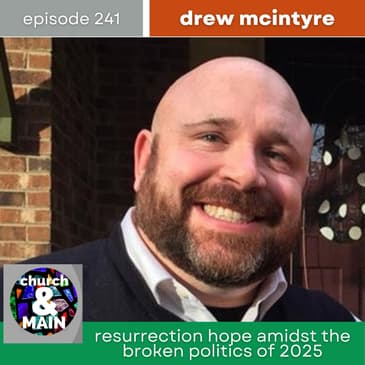
Where can we find hope in the current political context? For Methodist pastor Drew McIntyre, that hope took place in an empty tomb when Jesus rose from the dead. Drew and I talk about the distinction between hope and optimism, and the cultural pessimism prevalent in society today. We also look at the significance of the bodily resurrection of Jesus as the foundation of hope, the role of the church in bridging divides, and the importance of practicing hope as a virtue in daily life. The Resurrection isn’t just something we remember on Easter, but it is a living reality, from whence hope springs forth and changes the world.
Easter Means Hope, Not Optimism by Drew McIntyre
ICE Goes After Church Leaders and Christians Fleeing Persecution by Andy Olsen
Join the Church and Main Email List
Facebook | Instagram | Threads | Twitter | Website | YouTube
[0:09] Music.
[0:35] Hello, and welcome to Church in Maine, a podcast for people interested in the intersection of faith, politics, and culture. I'm Dennis Sanders, your host. So, I was online a while back, and I saw something that was fascinating. It was a headline about from a news station that was kind of, I guess, talking to a supporter of Donald Trump who looked to his returning back to the White House with a sense of hope. Now, I found that interesting because since Trump has returned to the White House back in January, a number of people who don't support Trump feel that there is no hope. I've seen more than one comment about how democracy is over, how we are either at the edge or within now, a dictatorship, and everything is over. Nothing will ever change. Now, what ties these two things together, these two views, is how each side places its hope in politics. So, if your side wins, well, there's hope. And if your side loses, well, it's hopeless.
[1:53] So, this being a podcast that is centered on faith, and specifically the Christian faith, the question I want to ask is, where does the Christian find hope? As I've said before on this podcast, and I'm laying my cards here again, I'm not a Trump supporter. And I look at how the Trump administration is managing, or some would say mismanaging, the country. I have to wonder, where is hope? If you have the time, and if you really want to get that sense of how.
[2:26] How it can feel hopeless, is to read a story in Christianity Today by Andy Olson. I will include the link in the show notes. And it's basically about how Immigration Customs Enforcement came for an Iranian couple. They were here basically on asylum, and that has since been revoked by the Trump administration. So, these ICE agents come basically to arrest these two people. Their pastor is also an Iranian, an Iranian immigrant, and he tries and tries to plead with the ICE agents, but it falls on deaf ears. They're not listening. They don't care. The pastor pleads one more time, explaining that the couple is here because they were being persecuted in Iran because of their Christian faith. They are Christians. Iran is a Muslim-majority country, and it's a country that, well, doesn't believe in freedom of religion. But again, there was no response. So, the pastor finally says this, frustrated, I can imagine, and angry. He says, I know you're doing your job, but shame on you. Shame on this government.
[3:49] So, where do you find hope when things like this are happening? And this is happening in many places around the country. And there are other things that are happening that make you wonder, where is hope? So, to answer that question, I brought back Drew McIntyre on the podcast. In late May, he wrote an article for Firebrand magazine that is called, Easter Brings Hope, Not Optimism. So in this episode, we are going to be talking about the difference between the two and where we find hope. And as I said in the cold open, hope is found in an empty tomb, which means that hope is found in the resurrection of Jesus Christ raised from the dead. I think that this is an important episode, especially this is coming two days before the 4th of July, Independence Day. And I think that we need to hear this message as we are prepared to celebrate, commemorate the 249th birthday of our nation. What does it mean to have hope? What does it mean to have hope that Jesus is risen from the dead?
[5:07] We'll find out with Drew McIntyre. If you have not heard about Drew before, he's been a frequent guest on this podcast, but he is the pastor of Grace United Methodist Church in Greensboro, North Carolina, and a host of the God and Whiskey podcast.
[5:28] As I said, he has been a frequent guest here. Every time, it's always a fascinating discussion, and this is definitely a fascinating and important discussion. So, please join me as I talk with Drew McIntyre.
[5:46] Music.
[6:05] All right drew it's good to have you back and um i wanted to talk to you about an article, Well, it's kind of interesting because you kind of talked about this before it actually was an article, kind of it was an embryo of an article, and that it came out late in May on a firebrand magazine that is called Easter Means Hope, Not Optimism. I think the first question I want before we kind of go really delve in is what led you to write this article?
[6:41] Yeah, it'd been percolating for a bit. And a lot of it, some of the contents and stuff, it was a mix of things that ended up in my Easter sermon, and also things I use in my Christian ethics course that I teach occasionally. So it was a mix of stuff from those two places.
[7:04] And I think part of it too is just observing, you know, friends, colleagues, neighbors, church members, uh, in an extreme state of anxiety, uh, over world events, current events, politics, et cetera. Um, I think reminding people that we don't have to be optimistic about the future to still have hope. And, uh, I think differentiating those concepts is helpful. And the ground of that is not our action, but divine action and the cross and resurrection of Jesus. So, obviously, the Easter theme there. So, it'd been percolating for a while as an article, but it was stuff I used both in preaching and teaching. And you start off the article with an interesting quote from Leslie Newbigin, who was a missiologist, and when he was asked whether he was optimistic or pessimistic, he gave an answer that was rather, I would say, sideways, wonderfully sideways, actually. And he just simply says, I am neither an optimist nor a pessimist. Jesus Christ is risen from the dead.
[8:21] What does that mean, you think, in light of the article you were writing, and what does it mean when it comes to hope? Yeah, I think about hope classically, it's a theological virtue, right? Aquinas took the end of 1 Corinthians 13, and he added faith, hope, and love as the theological virtues to the four cardinal virtues. So for Christians, it's a virtue that is sustained and made possible by God, by the ministry of the Holy Spirit. And I think that's a better ground for our hope, for our lives, than either expectation. And so kind of where I go in the article is, if optimists have a belief about what will happen positively and pessimists have a belief about what will happen negatively, as Christians, our hope is grounded not in an expectation, either positive or negative. Our hope is actually grounded in an event, right? And God breaking into history in Jesus Christ, in the incarnation, in his holy life, in his ministry, his healing, his teaching, his miraculous work, and his death and resurrection and ascension. So I think that the idea of event and...
[9:47] Something that has happened in history versus expectation based on, you know, some people are Eeyores and they're more negative in their outlook. Some people are just naturally more positive. But actually, it's not either of those things. It's Jesus has risen from the dead. And that's the ground of our understanding of history and the unfolding purposes of God and whatever else is happening in the world. That fact becomes sort of the load-bearing wall of our worldview or should. And what does that mean for our worldview when we're living in a world with all of our, all the issues that we're dealing with to look back at this event in history? It's kind of the, so what, what does it mean? What is the, the, the big point of it all? I think, and this, this is where I found it helpful to link to the Stockdale paradox.
[10:46] That the hope is not blindness, but it's also not optimism. So it's not shutting ourselves down to reality in any sort of way, but it's also not surrendering to reality either. So the Stockdale Paradox, Admiral Jim Stockdale was the highest ranking military personnel that was in the Henway Hilton in Vietnam. He was there with John McCain, the future senator and presidential candidate. And Jim Collins in his book, Good to Great, which is a fabulous book, a leadership book, and there's a really good sort of addendum written to it called Good to Great in the Social Sectors. That'd be great for pastors and nonprofit leaders and so forth. But he interviewed Stockdale in preparation for that book.
[11:33] The way he recounts it, there's a great YouTube video, YouTube clip you can find of it, but Stockdale is telling his story, and Jim Collins gets very impressed with it. He says, you must have been so optimistic. How did you survive?
[11:51] Stockdale gets kind of mad and says, no, I'm not an optimist. The optimist didn't make it until Christmas. The point being that the people that thought they'd be out by Christmas, they kept putting their expectation in that they would say, okay, out by Christmas. Christmas came and went, okay, out by Easter, home by Easter. It would come and go, and he would say they would die for lack of hope. And so the Stockdale paradox is, he said, the reason he lasted and the people that made it out were the people that were able to hold together the brutal facts of their reality, along with a belief that they would not only escape the Henry Hilton, but also thrive as a result of it. And I think he said that it would become the defining event of my life that I would grow from and would define me in a new and positive way. But holding those two things together. And I think there's something of Christian hope in that because Christian hope, right. You have to confront good Friday to have the hope of Easter. And so, you know, forms of Christian faith that downplay good Friday, downplay death, downplay sin. There's no, there's no road to hope there.
[13:05] But also you have to take that seriously. Otherwise you're, you're just sort of, you know, head in the sand. you're avoiding evil and sin and injustice in a way that the Bible, the prophets, and Jesus will not let us do.
[13:23] Where do you see in our current culture a lot of people who, I think you talk about this a little bit in the article, but to kind of spell it out, that are kind of, overly optimistic about things to a point that it doesn't, you know, that it may not really be in touch with reality in some ways?
[13:48] Sure. You know, I think one version of that is the prosperity gospel, obviously, within churches, which is the notion that if your faith is strong enough, if you pray enough, if you give enough in many cases, that life will turn out well for you. That if you put in your best, God will reward you. And typically it's in material ways, physical blessings, healings, that sort of thing. And of course, there's a kernel truth in that in Scripture that gets exploited in very negative ways. And the church, that's one of the biggest, I think, that we see. And pastorally, I've seen it harm people. You probably have as well, and others watching this where someone who bought the Joel Osteen books and watched the TV preachers and gave the money to whatever, the ministry, the preacher online.
[14:41] They invested their lives and souls and material resources in that. And then they still got sick and their loved ones still died or they didn't get healed or nothing in their life changed or their relationship didn't get fixed. So I think that sort of, you know, hollow optimism hurts people, frankly, aside from being untrue, it ultimately hurts people because it's not reality. It's not true. That's one place I've seen it hurt people for sure. Yeah. Yeah, I mean, it sounds like sometimes it's, well, it puts part of the agency on us that if we do something, then God will do something. And so, if something doesn't happen…, Then partially it would say, well, you didn't do something enough or that God failed. It's kind of how it seems like it looks like that. Yeah, in some ways it's a theodicy, right? It's a way of explaining what does and doesn't happen. So you can see the appeal of it in some ways is, well, this is how God works. And if you're not getting what you want out of life, it's your fault. But here's three simple steps to get what you want.
[16:07] But it's pernicious, obviously, because no one is more obedient, of course, than God's own son, and he still gets crucified. So I think that's where it kind of preys on people. But you understand it's a simplistic explanation of the world. I will sometimes call it vending machine theology, right? God is his vending machine that if you put in the right currency, the right amount, you will get out of the machine what you want. Which in some ways is, I don't love the distinction of gospel versus religion. But one way of understanding that distinction that is helpful is the gospel is God coming to us, God doing for us what we could not do for ourselves. God taking the initiative to redeem and restore us, whereas religion is us doing things to manipulate the divine to get what we want. And in that sense, it's a form of religion rather than gospel. Hmm.
[17:10] And where do you think there's been any, let's look at it from the other side, of pessimism? How does pessimism kind of make itself known, especially in our society, and maybe not as much as in the church, but in our wider society? And how does that kind of… you kind of yeah i think i mentioned this in the in the piece and i've harped on it before but i'm i really think that and neil postman was onto this 50 years ago um marshall mccloon he was picking up on mccloon's work but the the mixing of entertainment and news i think is a huge problem, um well and in it started long before cable news long before podcasts um but there's a cynicism to it, you know, um, podcast culture. And I listened to, to podcasts and I under, I understand why, you know, this move away from mainstream media and institutions and traditional outlets to, to podcasts. Um, of course, but the downside of that is then the, it's sort of like, um, I have a Catholic friend who says that, you know, Martin Luther, uh, caught a cold and all of Christendom got the flu.
[18:25] Luther obviously was responding to real issues in the medieval German church, medieval Catholic church in Germany. But what he unleashed was something he never expected. And I think in the same thing with the advent of new media, there are obviously positives to it and giving more voices to more people, a broader conversation, a less policed conversation by various forces, but the downside of it is you can find anyone that says, you know, that'll defend the craziest idea possible, but we'll defend anything. Um, And I think the incentives are all perverse, right? The people that make these algorithms, much like Vegas, they know what makes us tick. And what makes us tick and what keeps us looking and clicking and viewing are things that make us angry, things that stir us up. And so we are constantly bombarded, and various studies have shown this, that whether you're more left or more right, YouTube, other algorithms, they're designed to give you sort of more and more extreme versions of wherever you're at. You know, so I don't know. You start with, you know, like Fox News and Ben Shapiro, but then you're heading towards InfoWars and, you know, same thing on the left, right? And I think we're seeing the sort of intellectual decay of that.
[19:52] John Haidt wrote a piece called Why the Last Ten Years of American Life Have Been Uniquely Stupid that was very important. I'm a big fan of his work. And I think we're seeing this in culture, and certainly it's in the church as well.
[20:08] And an inability that's to hold together the bad news that's on TV with the good news of the gospel, you might say. And both sides do it, right? So when the left wins, the right gets happy and the left gets apoplectic. And then when the left wins, then the kingdom of God is here and the right thinks that the world is going to hell, right? And with that piece, I kind of want to say a pox on both your houses. No matter who's in the White House or who's in charge, there's still a kingdom that is in breaking even now. And that's the ground of our hope, rather than whoever is in the White House for this four-year term. Yeah, I guess I see this from a content creator, too, is that you can be tempted to do things that cause more and more outrage. Sure. It's the only way to get attention. Yeah. The only way to get more people watching and more views, more likes, is to do something that's more and more outrageous. You might start with something that's very sedate and interesting, and the next thing you know, it's the most outlandish conspiracy theory thing that you have out there. It's kind of more and more.
[21:32] I think the old saying of bad news traveling much faster than the truth is very much the case here. Yeah. I mean, content creates sugar rewards speaking to a clearly defined audience. And it's not hard to say, this is who my audience is. I know what they want to hear. And we see it all the time on Facebook and Instagram, people sharing. And especially you can find, you know, whatever your ideology is, you can find the court jesters on the left and the right who are clergymen and women just spouting whatever ideology you have and, you know, maybe somewhat connecting it to the Bible. It's the easiest thing in the world. I don't find it very interesting. I don't want to name names because there's no value in that, but I see it all the time. But it is the quickest way to get attention is attach yourself to an existing tribe and be their chaplain.
[22:37] So when we kind of talk about hope and you really, as you said, really put this to an event, and that is the resurrection of Jesus, which is something that we celebrate on Easter. What is the importance of Easter when it comes to hope and how we live our lives today?
[23:04] We kind of will go to get up on Easter Sunday, we go to worship, and then have our Easter meal. But do we, I think sometimes it feels like we don't always grab the importance of this time and how much it can change things. So, I mean, what does Easter mean for hope? I think the obvious answer is St. Paul in 1 Corinthians 15, that if Christ is not risen from the dead, then we are of all people with no hope, right? It's kind of the ground of our whole thing. And this is a technicality, but I'll call it a gentle pushback. We don't just celebrate Easter on Easter Sunday. Technically, every Sunday is a little Easter, as you know. Of course, yes. As seminary-trained clergy, technically every Sunday is a little Easter. We worship on Sundays because it was the first day of the week, the day of the resurrection. So technically, it is our song, you know, all year long. There's a particular feast, obviously, a season actually at Easter, but technically it's what gets us up in the morning every Sunday.
[24:23] You know, Easter is both, you know, sort of the... The vindication of Christ's divine identity as the Son of God. And later, reflection clarifies as the second person of the Holy Trinity, that Jesus is God in the flesh. Now, all that is implicit in Scripture, gets worked out through ecumenical councils and the fathers and mothers of the church, all that stuff. But resurrection is that sort of definitive, like, this is not an ordinary human being, and you can't say that anymore about Jesus. And then it's also, again, biblical language, New Testament language. It's a sign and foretaste of what God will do, not only with people, but with the cosmos, right?
[25:04] And again, Paul uses this language of the first fruits. The first fruits is a sign of what's to come. So this is not just an indicator of who Jesus is, but also the indication of God's purpose for the cosmos. I like N.T. Wright makes a point of saying that the gospel writers want us to know that it's the first day of the week because it's like a new creation, right? I love that beautiful imagery of new creation. I'm a big N.T. Wright fan. And I've got two of his books sitting here, but his book, Surprised by Hope, goes into this a lot. And this is why it's so important that we talk about a literal, physical resurrection and not a spiritual resurrection or not a resurrection into the parousia. Like, no, there were scars on his hands and feet inside.
[25:59] If there is a tomb somewhere that has the bones of Jesus, then it's all for nothing. And I think we have to hold on to that. So that's where what I say to my folks is that I'm a creedal Christian. If it's in the creeds, it's a settled question. If it's not in the creeds, we can have a conversation. This is a settled question. That's not popular to say in our mainline clergy circles. But it is a settled question in terms of historic Christianity. Okay. Why do you think that that, you know, you kind of talk about the importance of that physical body? Because I think you're right. But, you know, obviously there are going to be people who will say, well, you know, it was really, the one I remember the most is Marcus Borg, was that kind of people kind of understood what, finally, what Jesus was all about. Which I don't think is true, because if you keep reading the Bible, the disciples still didn't get it.
[27:02] But, I mean, what you're trying to say, really, and I think what I would believe is correct, is that for it to really be hope, you have to have that kind of physical, something that basically escapes our expectations, even our reality, going back to that Newbigin statement that Jesus Christ is raised from the dead. Yeah, and that our hope is not, again, the incarnation, right? God takes on the Jewish flesh of Jesus, our hope is not just in a everlasting spiritual existence, but in new creation, right? A renewed earth, healed earth, renewed bodies, right? Eating and feasting and walking and singing and worshiping and hugging and all those things. I think that's one of many reasons why it matters. And it's a physical resurrection and not just a psychological realization or, or something, something like that.
[28:17] I don't think we're smarter than the gospel writers. I think it's a disservice, and it takes a lot of mental gymnastics, theological gymnastics, to read those plain accounts and say that this was all something that the early church either made up because they were embarrassed or made up because they were in a situation of grief and their minds played tricks on them. Um it's either you know a massive conspiracy of some sort or he was raised from from the dead and i think nt wright is strong on this point of there were lots of uh miracle workers uh lots of prophets lots of teachers uh lots of messiahs um in you know in the ancient ancient world um but The only thing that makes sense of the early Christian movement is that those people at least believed that Jesus Christ had been risen from the dead. So let's actually move this from kind of where we've been talking to actual brass tacks to the real deal.
[29:31] You know, the last, I will be honest, and obviously people know where I stand on kind of the Trump administration and all that, have been challenging, to put it lightly, with some of the things that we've seen from the Trump administration. And what I see a lot more often than not about different things that are going on is either more often than not, I see a pessimism that all is lost, that nothing will change. Some going as far as say that democracy is over, to those that might say at the end of this, we will probably get through this or that things aren't as bad and give this example of past historical wrong that has happened. So you kind of have these two viewpoints. I think a lot of people weigh more on the pessimism than they do on the optimism here.
[30:46] But how does this article speak to that? Yeah.
[30:57] Maybe one result I would love to encourage in followers of Jesus is first thing in the morning to spend time in prayer or to open a Bible rather than open their news app of choice or turn on the TV. I think one way that we get to this place is that a lot of the energy and time and hope, frankly, that people used to put in what we call traditional religion is now put into the political realm. Right so we talk a lot about secularization thesis and that westerners are getting less and less religious there's truth to that in terms of.
[31:46] Traditional you know practice but they're finding another place for religion exactly yeah strange rights makes a good point of this we may have talked about that before the book strange rights makes a good point of this that, both left and right that people are putting their religious fervor into social justice movements, into MAGA movement, into all of this. So I think that's a piece of it, is that people are literally giving their souls to what happens in Washington. To me, that's the only explanation for the degree of hopelessness that ensues when their team loses, right? Right. Um, so that's, that's one thing I would want to say to, to everyone is, um, where your treasure is there, your heart is right. So if you're finding that your heart is stirred up, it might be that you're investing your treasure in the wrong place. Um, now certainly there are Christians called to political office to, you know, to work in government, all those things. I want to affirm that as, as a legitimate calling. Um, um, I think, and this is related, but what I would hope to say through that piece is that, you know, politics is penultimate, right? It's not the ultimate, it's penultimate. It matters. It's important.
[33:12] But if we put all of our eggs in that basket, we're always going to be disappointed. Because there is no, you know, politician, there is no polity, there is no party that is not riddled with sin. This is where Reinhold Niebuhr is so helpful, that all of our plans, no matter how good, no matter how well-intentioned, are riddled with sin. So whether your guy loses or my guy loses or whatever, all the plans that come from that are going to be flawed by human sin, by human finitude, and to be more humble about that. And I think humility is a huge missing piece in this, um.
[33:54] Because we're so self-righteous that we can't relate to one another. Um, and I think that's another piece of it is that if we can kind of take the temperature down, we might actually be able to build some connections across these lines. Because I understand the need people have to react towards activism and things of that nature, and there's certainly a place for that. But I also wonder how much of that is the energy maybe better spent trying to get a cup of coffee with someone you disagree with than spending all day at the No Kings protest to put it on Instagram. Do you know what I mean? I wonder how much of that is driven by tribal solidarity, by tribal signaling, and how much maybe the effort would be better served by groups like Better Angels that are actually trying to bring different kinds of people together. I don't know that...
[35:01] Retreating into our corners and yelling at each other is actually going to make anything better.
[35:08] And certainly, you know, social media, Instagram podcasts are only doing that. And where the church, I think, should offer hope, can offer hope, is that the church can and should be one of the last places in American society, at least Western society, where different kinds of people come together for a common purpose, because we're so segmented in our society by interest, by age, by class, by race, by sexuality, by ideology. The church really should be one of those places where those bonds of civic affection can be nurtured across those normal divides.
[35:50] Of course, I'm saying that as United Methodists, we've just been through our own massive schism. So we're not great at it, but the church should be a site where those differences are relativized. And that's part of what also I wanted to encourage in that piece. I'm a moderate by temperament and by conviction, but I really do believe the church should be a place where those divides are being bridged, right? I mean, our progressive friends love to always quote Galatians 3.28, and that should be reflected in the church. Like, yeah, we're coming across. No, the problem with that is if you want to do that, you can't just be a shill for one side, right? That's the catch, is if you want to actually have different kinds of people come together, the messaging can't all be, you know, the Republican National Convention at Prayer or the Democratic National Convention at Prayer.
[36:42] And I think Protestant Christians struggle with that. Most, you know, most, I think, Protestants devolve into one or the other. And we've had some of those conversations before. Of course, you know, it's kind of in our name, protest. Yes, we do love to protest. But I think in talking about this, the thing that I come to a realization of this is, as much as I think hope is important, it's not sexy. And I think that we live in a time where we want things that are sexy.
[37:25] And you know you talk a lot about podcasts or social media and all that and all the doom and gloom that you know i see from my friends on both sides that's sexy i mean that's something that holds people's attention that's something that gets people upset and angry and like you said going to the no kings protest that's sexy speaking to someone from across the um political aisle just to try to understand them, not so sexy, not so interesting. People aren't as interested in that. I think it's important, but I think a lot of people don't think it's important. They think it's just, you know, why would you do that? I mean, I know pastors that they spend their time on Facebook, which is probably a problem, where all they do is talk about the other side and talk about them in incredibly dark terms that I keep thinking, okay, so what does this have to do with the whole love your enemies thing?
[38:33] And so I think that that's just something that I kind of realized is that sense of hope, and even I think if I went as far to say that the hope that we have in Christ rising from the dead just does not hold our attention as much as, you know, the, the accident that we see on the, on the freeway.
[38:58] Yeah. Yeah. I think you're, I think you're right on. Um, I think it's, it's, it's easier.
[39:10] Oppositional energy is easy, right? What you're, what you're against. It's making, connecting with people based on shared disdain is somewhat easy. I think as the church, it's like, what are we for? And maybe part of the answer is, if we spent more time saying what we're for, it might be easier to build some of those connections because we spend so much time on who we're against and what we're against. And as Christians, too often we're known for what we're against rather than what we're for.
[39:51] I think we have to... Yeah, offer something that is not just constant battle is exhausting. I think it's a space a lot of people are living in. What am I opposing today? There's a line, is it the second of the sequel, Star Wars movies, episode eight, maybe, which I didn't have my issues with those films. We could have a different Star Wars conversation. But the character, I think her name is Rose, has a line where she says, we're going to win by defending what we love, not fighting what we hate. Yes, I do remember that. That's a good line. And there's some truth in that because there's a whole lot of people that just seem to spend most of their time want to talk about what they're mad about, what they hate. And to your point, it's sexy. it gets attention, it maybe feels good but it doesn't build anything it's all deconstructive.
[40:59] And I think especially as followers of Jesus it's like no, there's an event that is the ground of our hope it's the resurrection of Jesus, we are for people made in the image of God we are for human flourishing we are for the poor and oppressed let's start there and then we can have some conversations, Well, this brings up something that I was, as I read this, brought up another Star Wars reference. And I'm going to bring up. Yeah, I've got my Star Wars. You can see my, I've got some of my Star Wars stuff in the background here. I've got my Mandalorian helmet. There's some other stuff. I've got some of my nerdy stuff in the office. Well, I wanted to bring up, actually, it's the very end of the movie Rogue One.
[41:46] And you know spoiler alert pretty much everyone dies, and it kind of seems like a downer of a movie, and you know all these people die and especially they have to get this information, and they finally get it and even then they're still having to battle, Darth Vader and they finally get it and they give it to, at that point, a CGI-ed version of Princess Leia, because we know that Carrie Fritcher had died the year before. And they give it to her, and it's like, why is this so important? So many people died for this, it's all that stuff. And she ends it by saying one word. Hope. And I think there's something about that importance of hope. Hope is not always a happy ending it's not always that everything is going to turn out okay, at least in that you know you're going to be unscathed and we could go back to the stockdale um hypothesis that he went through hell i mean he did ultimately get released but, that was several years of hell yeah um.
[43:08] The ending, and I think you talk about this in the article, is that all of the kind of evil that happens, they don't put the period to the sentence in life. They don't have the last word. It's hope. It's the hope of Jesus. It doesn't mean you're not going to get roughed up along the way, but that that does happen. It does come.
[43:34] Yeah. Yeah, and C.S. Lewis has this concept of heaven working backwards, right? That God will sort of undo every wrong and dry every tear and make every bad thing come untrue. I think that's an important concept as well, because it's not that at the end of history, Jesus comes back and now we forget about everything. No, Lewis has this fuller sense of, in some mysterious way.
[44:05] Heaven works backwards, and all that has gone wrong in humanity and in creation and the cosmos gets completely healed and redeemed and restored. And I think we have to hold on to that. And this is where the idea of hope as a virtue is helpful, right? Because a virtue is not something that you have innately. A virtue is something that you, as Christians may believe, with God's help that we grow. N.T. Wright talks about a virtue is something that practiced over time becomes second nature. Not your first nature, but your second nature. And so hope has to be practiced. This is why worship matters, prayer matters, reading scripture matters, serving the poor matters. because we have to remember these stories, live these stories, practice them, rehearse them, teach them to our children, sing them. Because it's not that you read the Bible one day and now I have hope and nothing can take me down. No, it's a continual long obedience in the same direction. It's a practice of hope, a virtue of hope that God grows in us. Not that we just magically get one day and nothing ever bothers us again. There's a discipline to it in which God can grow us. It's not just something that we decide one day to have.
[45:34] Yeah, I think you had talked a little bit earlier about how the church needs to be that place where we're trying to build bridges, and I think that that is a temptation, to not do that these days in churches, to kind of pick a side, even though I think we try to think we're not, or at least we're not doing it for partisan purposes, that we end up doing it for that reason. But I also think that there is a way, especially in talking about things that are shocking, events that are horrible, and trying to lift up hope out of that. And again, it goes back to that whole thing that I just talked about with Princess Leia. And as you know, here in Minnesota, a few weeks ago, we had basically, literally a political assassination and a shooting. And I preached on that the next day and talked about the fact that this is horrible, this is terrible, but it doesn't have the last word. It can't have the last word that it's Christ that has the last word.
[47:00] And that when these kind of times that we live in are present it is, again, I keep going back to what you, echo Leslie Newbigin it's that Jesus Christ is risen from the dead and that that's what we have to preach and it might seem weird to say that, People might get upset because it thinks that has nothing to do with this time when I think it does. But that's what we need to do, is keep preaching that.
[47:31] Yeah, I think it's tempting, especially in the main line, but in general, to focus our preaching on anthropology, right? On people, on the power and possibility of people, or on sociology, again, people. And I think the New Begin quote, it refocuses us on where our hope is grounded is in divine action. Our hope is in what God has done, what God is doing, what God will do, and pointing people to that. Because ultimately, if your hope is grounded in whatever you want to call it, human decency or the march of whatever economic and moral and scientific progress, you're going to be sorely disappointed every day of your life, right? It's got to be grounded in divine action and what God is up to and going back to that and looking for signs of hope and resurrection. And as John Paul II says, we are Easter people and hallelujah is our song.
[48:40] We have to keep shouting hallelujah in the midst of, again, the harsh realities. Um and my my congregation we've had several tragic losses of um pretty young people in in the last year um like people in their like 40s people with kids my kids age and a little bit older um and and so easter has become very you know real for me and and for us in terms of um you know it's, I think we can be tempted in church work when you're doing a funeral for someone that's 90 or 86, they had a good life, and this is sad, but they're at peace now. You can't say that when it's someone that's young. You can't say that in a tragic situation. You have to hold on to the hope of resurrection. You have to hold on to this is not the end of their story. This is not the last word. Jesus gets the last word, and today is not goodbye. So it's become very real to me in the pastoral sense in the last year because of having to hold on to it for myself and for the people I serve, these families.
[49:59] Well, if people want to know, want to chat more with you about this, where can they go? I'm active on on facebook um less so on instagram that's not really a chat platform anyway but facebook i'm still on on twitter because i haven't found anything you know better than that yet i know it's bad for my soul but i try to engage it uh wisely but yeah facebook and twitter um i'm pretty easy to find online um my sermons are online on our uh serve grace united methodist Church in Greensboro, North Carolina. I'm always happy for dialogue. If folks have watched this or read the piece, I'd love to hear their thoughts and hear more. And I write for Firebrand and also some for Ministry Matters and other places and stuff. I did recently start a THD program, so my life has gotten busier. So I'm hoping I can still publish fun pieces and shorter pieces in the midst of my academic work. But please do seek me out, say hello. I love to have a conversation with colleagues and readers and friends. I will say, I kind of agree with you. I'm not a, Twitter is not a great place these days, but the alternatives aren't that great. And I don't, I don't know why, but they just, you know, you always kind of hope going in, oh, maybe this will be, no, it's not. Yeah. I, I, nothing. Yeah. None of the other options have grabbed me. I haven't looked that hard, to be honest.
[51:29] But what I have gotten pretty good at is muting and unfollowing when necessary. Muting certain words is helpful and using it in a way that doesn't rot my soul completely. But it's the Wild West. And Facebook is, too, in different ways. So I think with all those technologies, it's you know, using them and not being used by them is an important distinction. Yeah. All right, Drew. Well, thank you again for this message about hope that I think is actually hopeful. So take care. Thanks, Dennis. Hope to talk to you soon. Thanks.
[52:11] Music.
[52:41] I want to thank Drew for coming back on the podcast. As always, I'm always curious what you're thinking about the episode and would love to hear from you. Feel free to send me an email at churchinmain at substack.com. Hopefully, I'll get something. Very seldom do I get people who actually respond. I'd actually love to hear it sometime. I'd like to hear what people are thinking about the episode. Um but i also know people are busy but would love to hear from you um i wanted to conclude actually with something.
[53:24] A few weeks ago and i think i may i don't know i may have talked about it in the podcast um here in minnesota many of us were shocked to find out, two weeks ago on a Saturday that the former state speaker of the House and her husband were assassinated. And then a state senator and his wife were also shot. The assailant also had I planned to go to two other places, and just basically out of sheer luck, they either weren't there or the police got there before anything could happen. And so I preached kind of on that. I want to be careful to not automatically become kind of pastoral CNN, but the sermon is really about hope. And I felt like I wanted to share a paragraph from it because I think it has something to say about our current situation.
[54:39] And it's based on Romans 5, 1 through 5, and being expectant, believing that God can do the impossible. And so this is what I said. Being expectant means having a hope in a God that can do the impossible, even when the world is ending. We can boast in our suffering, sufferings like what happened yesterday, knowing that we have a hope that is beyond all understanding and beyond all suffering. We have a hope that is beyond us and the powers of sin and death. A hope that tells us that the devil and those who follow him don't have the last word. Those powers may injure and even take life, but they will not ever win. This is why Paul can tell the church in Rome that hope, God's hope will never put us to shame because the love of God has been poured into our hearts by the Holy Spirit. If we walk with God, we can see things differently. We can see hope where others see despair. We can work for justice and unity when others see only division and injustice. And we can plant trees and buy land because we know God will prevail.
[55:58] And that reference to planting trees is from a reference that has been attributed to Martin Luther that what would he do when the world would end is that he would plant a tree and then I end it really with that as say here the world that we once knew is ending it feels like an asteroid is heading our way, and yet we are not without hope. So, what kind of trees are you going to plant? I think that's what it comes down to. What are we going to plant?
[56:37] The world is ending in some ways, or at least the world that we knew. Bad things may happen. I think that we will see bad things. I think we will see very bad things in the next few years in our nation. The thing is, we have hope. Because we have hope and praise our trust in someone who defeated death. We believe in someone who rose from the dead. Just as Leslie Newbigin says, I believe Jesus Christ is risen from the dead. The powers and the people that seek to oppress us aren't going to rule forever. They will fall. In time, they will be defeated by Jesus Christ. Evil right now may seem ascendant, and it very well may harm us, but it will never ever have the last word and that is the hope that we can have, in the days and months and years ahead.
[57:52] If you want to learn more about this podcast if you want to check out past episodes, please go to churchinmaine.org you can also go to churchinmaine.subside.com that's where i have related articles i hope that you will consider subscribing to the podcast and leaving a review um that helps others if when you do that leaving a review or rating that helps others find the podcast um you can make a donation uh either on sub stack or there is i will put a there's a link in the show notes where you can donate to support this podcast and help me to continue to produce good content. I also do hope that you will consider sharing this podcast with family and friends. So that is it for this episode of Church in Maine. I'm Dennis Sanders, your host. As I always like to say, thank you so much for listening. Take care, Godspeed, and I will see you very soon.
[59:04] Music.