
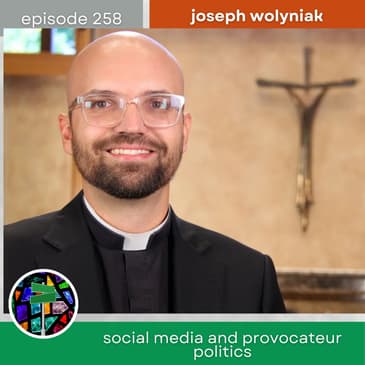

Joseph Wolyniak discusses the profound impact of media and technology on the faith and political engagement of American Christians. He emphasizes the need for believers to be aware of how their beliefs and actions are influenced by external factors, rather than solely by the teachings of Jesus.
Resisting Provocateur Politics
Join the Church and Main Email List
Facebook | Instagram | Threads | Twitter | Website | YouTube
00:00:00 --> 00:00:05 On this episode of Church in Maine, we talk about the good and bad of social media.
00:00:05 --> 00:00:11 And yes, there is still something good about social media. That's coming up.
00:00:38 --> 00:00:42 Greetings, everyone, and welcome to Church in Maine, a podcast for people interested
00:00:42 --> 00:00:45 in the intersection of faith, politics, and culture.
00:00:45 --> 00:00:47 I am Dennis Sanders, your host.
00:00:49 --> 00:00:56 Well, back in 2007, I can remember sitting in a hotel conference room in Omaha,
00:00:56 --> 00:01:00 Nebraska, and I was there for a meeting of the Presbyterian Communicators Network.
00:01:00 --> 00:01:05 And while I was there, I was learning about this new website that was called Facebook.
00:01:06 --> 00:01:11 And I was learning that it was growing like wildfire. And I also learned that
00:01:11 --> 00:01:16 there was a new generation of people out there that were going to be what they
00:01:16 --> 00:01:17 were calling digital natives,
00:01:18 --> 00:01:21 that were going to know nothing but being online.
00:01:23 --> 00:01:29 And I can kind of remember those days, kind of from 2007, probably maybe until
00:01:29 --> 00:01:34 the early teens of being on Facebook and Twitter.
00:01:34 --> 00:01:40 And I can remember setting up pages and Facebook pages and groups for churches
00:01:40 --> 00:01:45 and other organizations and how that kind of helped them.
00:01:46 --> 00:01:50 And, and I can remember just kind of connecting with people near and far, making friends.
00:01:51 --> 00:01:55 And I was seeing how things were, how social media was doing good.
00:01:55 --> 00:02:03 I could see how Twitter was, was being used to foster evolutions in places like Iran and Egypt.
00:02:04 --> 00:02:11 And it really seemed like social media was going to make the world a better place until it didn't.
00:02:12 --> 00:02:14 Flash forward to the modern day.
00:02:15 --> 00:02:19 And if going back to 2007, social media could not do anything wrong,
00:02:19 --> 00:02:22 it seems like in 2025, it can't do anything right.
00:02:23 --> 00:02:28 Now, we seem to blame it for everything. We blame it for increasing polarization.
00:02:29 --> 00:02:36 We blame it for mental health problems affecting our youth. We blame it for conspiracy theories.
00:02:36 --> 00:02:40 And we even blame it for the rise of a certain president.
00:02:42 --> 00:02:48 And two decades now into the social media era, we're learning that this invention, which,
00:02:50 --> 00:02:55 back in 2007, we thought was this wonderful thing, was going to bring kind of
00:02:55 --> 00:02:59 nirvana, isn't all that it's cracked up to be.
00:03:01 --> 00:03:05 So what do we do with it? Do we just walk away?
00:03:05 --> 00:03:13 Do we just consider it evil and have nothing to do with it? Do we try to ban it?
00:03:14 --> 00:03:20 And what do churches do? Do how do churches deal with social media?
00:03:22 --> 00:03:27 COVID in some ways meant that churches had to rely on social media.
00:03:28 --> 00:03:32 The question is now five years after COVID, do we still have to?
00:03:34 --> 00:03:40 I know of a church here in the Twin Cities where I live that basically totally ditched social media.
00:03:41 --> 00:03:43 Is that the wisest strategy?
00:03:44 --> 00:03:49 My guest today argues that maybe the answer isn't that we have to walk away
00:03:49 --> 00:03:56 from social media, but maybe the answer lies in how Christians act on social media.
00:03:58 --> 00:04:02 Joseph Wolniak is an Episcopal priest.
00:04:02 --> 00:04:06 He wrote an article that I found fascinating was found in The Living Church
00:04:06 --> 00:04:10 magazine that was entitled Resisting Provocateur Politics.
00:04:11 --> 00:04:15 And I have him on the podcast today, and we're going to talk about that article.
00:04:15 --> 00:04:22 And it talks about how we act on social media in this age of polarized politics,
00:04:23 --> 00:04:29 especially in this age where the algorithms basically feed on outrage.
00:04:31 --> 00:04:34 Before we get into the conversation, a little bit about Joseph.
00:04:34 --> 00:04:40 He serves as a remote member of the pastoral staff at Christ Church in Denver,
00:04:40 --> 00:04:43 Colorado, and he's also a vicar at St.
00:04:43 --> 00:04:48 David Emmanuel Church in Shoreline, Washington, a suburb of Seattle.
00:04:48 --> 00:04:52 He also teaches theology at Seattle University.
00:04:54 --> 00:04:59 And he actually also is involved in some other things that are social media
00:04:59 --> 00:05:04 related, which we will, you will find out in, in our conversation.
00:05:05 --> 00:05:15 So with that, let's go into this, I think, helpful conversation that I had with Joseph Wolniak.
00:05:33 --> 00:05:38 All right. Well, I think we'll start things off in this interview with a little
00:05:38 --> 00:05:42 bit of introduction about yourself and just to tell me a little bit about your
00:05:42 --> 00:05:48 faith journey and where you work and where you,
00:05:48 --> 00:05:54 you kind of work in two places at once, which is kind of interesting.
00:05:55 --> 00:05:58 Thank you very much for the invitation to be in conversation with you,
00:05:58 --> 00:06:02 Dennis. It's great to meet you and to be a part of this conversation today.
00:06:03 --> 00:06:09 So I was baptized Catholic, say discipled by some faithful charismatic evangelicals,
00:06:09 --> 00:06:18 received into Anglicanism by the Church of England in 2009, ordained an Episcopal priest in 2016,
00:06:18 --> 00:06:21 and have served in a variety of different capacities since then,
00:06:21 --> 00:06:27 both lay and ordained, from bishop staff to community organizing to university
00:06:27 --> 00:06:31 teaching and ministry to the local Church,
00:06:31 --> 00:06:36 which is where I currently serve and really is where my heart is.
00:06:37 --> 00:06:41 So you'll note out here in this conversation that you can take the boy out of
00:06:41 --> 00:06:43 Rome, but you can't take Rome out of the boy.
00:06:43 --> 00:06:47 So I find myself still very much shaped by,
00:06:47 --> 00:06:52 maybe you could say claimed by Catholic teaching, Catholic social teaching in
00:06:52 --> 00:07:02 particular from Leo XIII's Rerum Novarum in 1891 to Leo XIV's and Deluxee Tay from October 2025,
00:07:02 --> 00:07:05 which encouraged everybody to make a pause and read that document.
00:07:06 --> 00:07:11 It's been hugely informative for me. But currently, I serve as a remote member
00:07:11 --> 00:07:17 of the pastoral staff at Christ Church Denver, as well as a vicar of a local
00:07:17 --> 00:07:19 congregation in the Seattle area, St.
00:07:19 --> 00:07:23 David Emanuel Shoreline, and teach theology at Seattle University.
00:07:24 --> 00:07:30 And your position at Christ Church in Denver is kind of very much related to
00:07:30 --> 00:07:37 this conversation, and it's basically related to kind of online ministry,
00:07:37 --> 00:07:41 because you kind of flesh out what your position is there at Christ Church.
00:07:41 --> 00:07:46 Yeah, so I'm a program director for a Lilly-funded project called the Narthex,
00:07:46 --> 00:07:49 developing digital capacity for the analog church.
00:07:49 --> 00:07:55 So the goal is to help mainline congregations engage with folks online.
00:07:56 --> 00:08:00 The conviction being that most folks aren't just going to walk into a church,
00:08:00 --> 00:08:03 but they're going to first interact with us in online spaces.
00:08:03 --> 00:08:07 So how do we be more intentional about the ways in which we engage with folks
00:08:07 --> 00:08:12 online? I like to joke that Episcopalians discovered the internet in the pandemic,
00:08:12 --> 00:08:16 even if it was the AOL dial-up version with the screech, screech,
00:08:16 --> 00:08:17 screech, screech, screech, all that stuff.
00:08:18 --> 00:08:22 So the goal is to, how do we meet people where they are, spend most of their
00:08:22 --> 00:08:26 time online? So we're working with Episcopal, Lutheran, AME,
00:08:26 --> 00:08:30 Zion churches, and others that are trying to do this faithfully and well.
00:08:33 --> 00:08:39 And well, one of the things that has been interesting is, and one of the things
00:08:39 --> 00:08:42 that has been interesting for me is social media.
00:08:43 --> 00:08:49 And kind of one of the things that I have been working on almost for 20 years is on social media.
00:08:50 --> 00:08:55 And when I came in, this was 20 years ago, it was how wonderful it was and how,
00:08:55 --> 00:09:00 you know, this is, especially Facebook and everything, how great it was and
00:09:00 --> 00:09:05 how great it was going to be for the church fast forward to now,
00:09:06 --> 00:09:12 people don't think of it as so great anymore. But I also think we still think
00:09:12 --> 00:09:16 of a need for it, especially really in light of the pandemic,
00:09:17 --> 00:09:20 after the pandemic, we still see a need for it.
00:09:21 --> 00:09:27 But I think we also see that it is not the panacea that we once thought it was.
00:09:28 --> 00:09:35 And you wrote this very interesting article about resisting provocateur politics.
00:09:36 --> 00:09:42 And i think one i wanted to kind of talk to you about that and and i think the
00:09:42 --> 00:09:46 title and i know that you didn't necessarily pick the title but i'm kind of curious.
00:09:48 --> 00:09:51 What is it about um and how
00:09:51 --> 00:09:56 would you define first provocateur politics and how is it related really to
00:09:56 --> 00:10:05 kind of social uh media and and kind of digital life in general so i did pick
00:10:05 --> 00:10:09 the title so So all of the errors in that article are the author's phone. All right.
00:10:11 --> 00:10:16 Begin by defining provocateur politics. What did I mean by that?
00:10:17 --> 00:10:22 And I had in mind there figures, and there are plenty in our social media age
00:10:22 --> 00:10:27 that deliberately provoke, disrupt, or inflame public discourse,
00:10:27 --> 00:10:32 and doing so for a variety of different reasons, Whether it's to destabilize
00:10:32 --> 00:10:38 some settled opinions or the status quo about conversation or assumptions about our world,
00:10:38 --> 00:10:42 maybe to expose contradictions, often comedians will do this,
00:10:42 --> 00:10:48 or perhaps to mobilize supporters to achieve certain legislative goals, for instance.
00:10:48 --> 00:10:55 So the provocateur is somebody who stirs controversy and theoretically to achieve
00:10:55 --> 00:10:57 certain intentional ends.
00:10:57 --> 00:11:05 And to be clear, there is a healthy provocateur, a healthy kind of provocation,
00:11:05 --> 00:11:08 I'd say from the prophets to protesters.
00:11:08 --> 00:11:13 In community organizing, where I've had some background, there's a lot of conversation
00:11:13 --> 00:11:21 about agitation being used as a strategic tool to help provoke reflection,
00:11:21 --> 00:11:24 to maybe challenge complacency and inspire action.
00:11:24 --> 00:11:30 I'm always mindful of Saul Alinsky, who famously said that the community organizer's
00:11:30 --> 00:11:34 job is to rub raw the resentments of the community,
00:11:34 --> 00:11:40 to help fan latent hostilities and to search out controversy rather than to avoid it.
00:11:40 --> 00:11:46 But the idea there for the community organizer was not conflict for its own sake,
00:11:46 --> 00:11:53 but about awakening people to their own moral commitments and to their own power,
00:11:53 --> 00:11:56 that is the ability to affect change for themselves,
00:11:56 --> 00:11:59 for others, and for the common good.
00:11:59 --> 00:12:03 And here, I think, is the critical difference for us as Christians.
00:12:04 --> 00:12:10 It's not that we are averse to conflict. Jesus himself was quite the provocateur.
00:12:10 --> 00:12:15 He's very agitational. I mean, And Mr. Turn the Other Cheek also said,
00:12:16 --> 00:12:20 I haven't come to bring peace, but a sword, Matthew 10, 34.
00:12:21 --> 00:12:27 And even if you parse that out contextually, it is a very provocative statement.
00:12:27 --> 00:12:35 So my concern in this piece and generally is about that provocation that seems
00:12:35 --> 00:12:39 to me to be for the sake of being provocative.
00:12:39 --> 00:12:46 Content that is then algorithmically rewarded clicks likes views and that kind
00:12:46 --> 00:12:50 of memetic meanness of our social media age.
00:12:51 --> 00:12:56 And you also kind of talk about in that article the whole point of speaking
00:12:56 --> 00:13:02 the truth in love and how in some ways in our context of social media,
00:13:03 --> 00:13:07 love has been replaced for clicks and likes.
00:13:07 --> 00:13:16 And that's been basically what we kind of derive more,
00:13:16 --> 00:13:23 is that more you're kind of speaking the truth for clicks,
00:13:23 --> 00:13:24 basically.
00:13:25 --> 00:13:29 Absolutely. I mean, I don't know about you, but I've seen all kinds of videos
00:13:29 --> 00:13:33 that have the title of, this person destroys that person.
00:13:33 --> 00:13:39 Yeah, exactly. One of my particular favorites, this person owns this other person,
00:13:39 --> 00:13:45 that there's something about that kind of, again, mimetic meanness in our culture today.
00:13:45 --> 00:13:52 It's more about put downs and political platitudes and actually having discussion with one another.
00:13:52 --> 00:13:57 And that's what I'm particularly concerned about and concerned about us as Christians
00:13:57 --> 00:14:05 engaging in whatever political ends we may be interested in achieving. I don't know.
00:14:07 --> 00:14:10 How do you think that that helps with, and how do you think that that,
00:14:10 --> 00:14:15 one of the things I think in reading your article and what I think came to mind
00:14:15 --> 00:14:20 is how does that reflect Christian witness?
00:14:20 --> 00:14:30 You know, how does that make people think about what a Christian is or looks like or.
00:14:32 --> 00:14:40 Define Christianity and how people engage one another on social media when people
00:14:40 --> 00:14:47 are, quote-unquote, owning one another or destroying one another or doing kind of how they respond.
00:14:48 --> 00:14:52 And, you know, I kind of see how people do respond on social media,
00:14:52 --> 00:14:55 and it can be rather toxic.
00:14:56 --> 00:15:04 And you're kind of wondering, how do you go to do you act this way when you go to church?
00:15:05 --> 00:15:07 And it's just kind of shocking.
00:15:10 --> 00:15:13 That is my primary concern, I would say, as a pastor.
00:15:13 --> 00:15:19 Too often, I fear that American Christians are shaped, you could even say discipled,
00:15:19 --> 00:15:26 more by media and partisan politics than by the teachings and lived example of Jesus,
00:15:26 --> 00:15:29 this person we purportedly follow.
00:15:29 --> 00:15:36 And we will often say, at least in my tradition, about liturgy that the form forms.
00:15:36 --> 00:15:42 But I think the same could be true of technology and social media as a platform,
00:15:42 --> 00:15:48 that the ways that we consume and contribute to political dialogue are often
00:15:48 --> 00:15:53 shaped by the platitudes and platforms themselves that we're engaging.
00:15:54 --> 00:15:59 I've certainly seen this as a pastor, that I've got these churchgoers who are
00:15:59 --> 00:16:06 perfectly pleasant on Sundays, and yet on Mondays, they may share some pretty
00:16:06 --> 00:16:07 shocking things online.
00:16:08 --> 00:16:13 In many ways, of course, this is nothing new. Social media is just the latest
00:16:13 --> 00:16:19 way that we expose the hatred and maybe the primal instincts,
00:16:19 --> 00:16:22 I would say, the sin that is within all of us.
00:16:22 --> 00:16:29 As Jesus said some 2 years ago, Luke 6.45, out of the abundance of the heart, the mouth speaks.
00:16:29 --> 00:16:34 But in other ways, I do think that we're dealing with something that is particularly
00:16:34 --> 00:16:37 new, that we've created these devices,
00:16:37 --> 00:16:43 these platforms, these modes of discourse that we are now really struggling
00:16:43 --> 00:16:45 to constructively contain.
00:16:46 --> 00:16:50 Well, you know, that brings up this question, is...
00:16:52 --> 00:16:58 Is this something new? Is social media the problem or smartphones a problem?
00:16:59 --> 00:17:06 Or is this something that has always been there that we're just always dealing with?
00:17:08 --> 00:17:16 Because I think that there is something new about this that has not been here before.
00:17:17 --> 00:17:20 And yet there also is something old about this.
00:17:22 --> 00:17:30 That is kind of there, has been here from the beginning. It seems like there is a mixture.
00:17:34 --> 00:17:39 And part of me is always a little nervous when we want to say that this is new,
00:17:39 --> 00:17:43 because I think we want to pretend that there was some kind of golden age where
00:17:43 --> 00:17:48 everything was wonderful, and I don't think it was a golden age.
00:17:50 --> 00:17:59 But I think we also know that things are different, that things are very different
00:17:59 --> 00:18:00 than what they once were.
00:18:01 --> 00:18:07 So, I mean, I'm just kind of curious where you see things and how you would kind of suss things out.
00:18:09 --> 00:18:13 I think my answer to that question would be yes. It is both very,
00:18:13 --> 00:18:16 very old and quite new and different.
00:18:16 --> 00:18:19 I was just preaching about this in my congregation a couple of weeks ago,
00:18:20 --> 00:18:23 a somewhat separate subject, but it's related.
00:18:23 --> 00:18:30 And the sort of selfie and self-centered culture is also very much indicative of our age.
00:18:31 --> 00:18:38 And my joke there was iPhone 17 meets Genesis 3, that much of that self-centeredness
00:18:38 --> 00:18:40 is actually nothing new for us.
00:18:40 --> 00:18:44 It's been endemic to the human condition since the fall.
00:18:45 --> 00:18:50 And even joked with my congregation, imagine Adam and Eve with a selfie stick
00:18:50 --> 00:18:55 at the tree, that there's really nothing new to this.
00:18:55 --> 00:18:58 But in other ways, there is something quite new.
00:18:58 --> 00:19:04 Quoted in that sermon, a moral psychologist who who had a great quote that said,
00:19:04 --> 00:19:11 you know, our paleolithic brains are just not able to contain these devices that we have created.
00:19:11 --> 00:19:15 From the mobile phone that is both our camera and our means of connectivity
00:19:15 --> 00:19:20 to one another, to the world, and the online platforms, again,
00:19:20 --> 00:19:24 that are just algorithmically addictive for us.
00:19:24 --> 00:19:30 It's really hard to break the addiction of the scroll, and I am not holier than thou in this regard.
00:19:30 --> 00:19:33 I too am scrolling and engaging on social media.
00:19:34 --> 00:19:40 But these things are really hard to break these habits and habits of conversation.
00:19:42 --> 00:19:46 These things are forming us. They're not just neutral.
00:19:46 --> 00:19:52 So yes, I think it is both very ancient. It has been there with us from the beginning.
00:19:53 --> 00:19:57 And there's something particularly powerful about the devices and the platforms
00:19:57 --> 00:20:04 that we're using in this digital age that's become really toxic to our discourse
00:20:04 --> 00:20:06 in the United States and throughout the world.
00:20:09 --> 00:20:16 In some way, then, it can become almost a liturgy in its own way.
00:20:18 --> 00:20:27 You know, a way of another form of a liturgy that's forming us and molding us.
00:20:28 --> 00:20:34 Absolutely. And we have to resist the habit-forming tendencies of those devices
00:20:34 --> 00:20:40 and platforms in order to follow Jesus in this day and age.
00:20:41 --> 00:20:44 So one of the things that I noticed,
00:20:45 --> 00:20:52 and I even wrote about this after the assassination of Charlie Kirk,
00:20:52 --> 00:21:00 was I think a lot of what I noticed about social media is how it can flatten
00:21:00 --> 00:21:05 people and how you don't really know people in their fullness.
00:21:07 --> 00:21:13 And you actually talked about that in the article.
00:21:13 --> 00:21:18 And it was something that I kind of picked up on my own, but it's how we just,
00:21:19 --> 00:21:24 we don't see people as people. They become avatars.
00:21:24 --> 00:21:29 And because they are avatars, and they're really easy to pick apart and just
00:21:29 --> 00:21:37 kind of destroy and not really see them as full human beings in the eyes of God.
00:21:40 --> 00:21:46 How does the Christian faith stand to thwart that temptation to do that?
00:21:48 --> 00:21:51 So first of all, not to turn this into a mutual admiration society,
00:21:51 --> 00:21:58 but I also loved your piece, your Substack piece on this and everything that you said in that piece.
00:21:58 --> 00:22:02 And really love the word that you used here, flatten.
00:22:03 --> 00:22:08 And I think memory serves, you said something similar in the article that you
00:22:08 --> 00:22:13 wrote that it's really easy to make a caricature out of a figure like Charlie
00:22:13 --> 00:22:16 Kirk or really any public figure,
00:22:16 --> 00:22:19 and to kind of flatten them more, again, I love the word avatar.
00:22:21 --> 00:22:26 I particularly go to Pope Francis on this, and a beautiful document that he
00:22:26 --> 00:22:30 wrote called Fatelli Tutti, which is called an encyclical letter,
00:22:30 --> 00:22:35 and it's sort of in the mode of Paul and John and James and others in the New
00:22:35 --> 00:22:38 Testament, written to the church and to the world.
00:22:38 --> 00:22:44 And in that article, he talks about the breakdown.
00:22:44 --> 00:22:46 He's calling us back to social friendship.
00:22:47 --> 00:22:53 He talks about the breakdown of communication in our world today and the illusion
00:22:53 --> 00:22:58 of communication in our digital social media connected age.
00:22:58 --> 00:23:03 He's got this amazing quote where digital relationships do not demand the slow
00:23:03 --> 00:23:08 and gradual cultivation of friendships, stable interaction, or the building
00:23:08 --> 00:23:10 of a consensus that matures over time.
00:23:10 --> 00:23:18 They have the appearance of sociability, he says, yet they do not actually build community.
00:23:18 --> 00:23:23 Instead, they tend to disguise and expand the very individualism that finds
00:23:23 --> 00:23:27 expression in xenophobia and in contempt for the vulnerable.
00:23:27 --> 00:23:32 It's not enough. Digital connectivity, he says, isn't enough to build bridges.
00:23:34 --> 00:23:38 I think that's really, really true, that what we tend to do is we have these
00:23:38 --> 00:23:42 sort of caricatures, the way that we present ourselves and others present themselves
00:23:42 --> 00:23:45 online, and we think we know them.
00:23:46 --> 00:23:49 There's a whole proverbial thing about, I know what you had for breakfast,
00:23:49 --> 00:23:54 or I could know if I just looked at your social media, but I don't really know you.
00:23:54 --> 00:23:59 What I encounter is, again, use your word, a flattened caricature of you,
00:24:00 --> 00:24:03 not the full person behind the screen.
00:24:04 --> 00:24:07 And there's something about technology that does this.
00:24:08 --> 00:24:13 I can use another example. There's a great comedian, Daniel LaBelle,
00:24:13 --> 00:24:22 who posted a very funny sketch comedy video about if people acted like they do in cars.
00:24:22 --> 00:24:26 And it's a situational comedy where he's going around the world,
00:24:26 --> 00:24:32 walking around in sidewalks and in public spaces, acting like we do in cars, tailgating,
00:24:33 --> 00:24:37 cutting people off, so on and so forth, merging without warning.
00:24:38 --> 00:24:46 It's this really observant social comedy that helps us reflect on how technology
00:24:46 --> 00:24:50 shapes our behavior in relationship with others.
00:24:50 --> 00:24:53 So whether it's getting in the car and the way that we tend to act on the freeway
00:24:53 --> 00:24:57 or the way that we are acting with our digital devices.
00:24:57 --> 00:25:06 Again, these technologies mediating our relationships tend to form us and our response to others.
00:25:10 --> 00:25:17 I think when you say that about that, it makes me want to also think about with church and,
00:25:19 --> 00:25:26 how we use social media and things like YouTube and doing digital ministry.
00:25:27 --> 00:25:35 I think I've always seen that more as the doorway into a church.
00:25:36 --> 00:25:41 I mean, I think it's interesting that you talk about how your project is called the Narthex,
00:25:41 --> 00:25:46 which I'm assuming there's a reason you called it the Narthex,
00:25:46 --> 00:25:52 because the Narthex is the entrance into the church, which is different from
00:25:52 --> 00:25:54 making it the church itself.
00:25:56 --> 00:26:02 Because I don't think you can have really good community through a screen.
00:26:03 --> 00:26:06 I mean, it's hard, I think.
00:26:06 --> 00:26:15 Whereas I think having it through as a narthex, as an entrance in,
00:26:15 --> 00:26:21 is a different way of looking at it, where it's more of an entrance into a community,
00:26:21 --> 00:26:22 but it is not the community.
00:26:24 --> 00:26:30 It's more, for me at least, the way that we churches should be looking at what that is.
00:26:31 --> 00:26:37 And I think too often we want it to be actually the community.
00:26:37 --> 00:26:41 And I don't think that that works that way.
00:26:42 --> 00:26:46 It's a great way of putting it. Thanks for picking up on the nerd reference there.
00:26:48 --> 00:26:54 Don't know that narthex is a Greek architectural term that is meant in traditional
00:26:54 --> 00:26:59 church architecture to be kind of a meeting place between the church and the world.
00:27:00 --> 00:27:03 And you're right, it is an entry point to come into the church,
00:27:03 --> 00:27:09 but it's also the space that you, before you leave the church and head back out into the world.
00:27:10 --> 00:27:14 I kind of want to see the church moving in both directions, both being welcoming
00:27:14 --> 00:27:20 to those who are outside, but then also being sent forth back out into the world
00:27:20 --> 00:27:22 and into their everyday lives.
00:27:23 --> 00:27:27 And that is essentially how I see the gift of technology, and it can be a gift.
00:27:27 --> 00:27:33 I mean, look, it's facilitating our conversation and hopefully friendship in
00:27:33 --> 00:27:38 a way that we wouldn't have maybe discovered without the gift of this technology.
00:27:38 --> 00:27:40 We would not be having this conversation.
00:27:41 --> 00:27:49 So it has its place. But when it becomes a replacement for that real human offline connectivity,
00:27:49 --> 00:27:54 that kind of deep social friendship that Pope Francis and others have talked
00:27:54 --> 00:27:57 about, that's where it becomes problematic.
00:27:58 --> 00:28:03 Or again, to go back to the polarized and the put-down discourse of our age,
00:28:04 --> 00:28:09 when it becomes all about put-downs and soundbites and we're talking past one another,
00:28:10 --> 00:28:13 trying to score points and likes on Twitter,
00:28:14 --> 00:28:19 Facebook, Instagram, whatever the platform may be, that's where the discourse
00:28:19 --> 00:28:25 starts to break down and we lose that real human connection that we so desperately need in our world.
00:28:28 --> 00:28:36 I'm kind of curious what your opinion is about pastors or,
00:28:36 --> 00:28:40 and there are pastors, I think, both progressive and conservative,
00:28:40 --> 00:28:46 that do these kind of videos that are like on TikTok or Instagram.
00:28:46 --> 00:28:50 They're kind of, I basically influence our pastors.
00:28:51 --> 00:28:56 You know, what are your opinions on that? Do you think that that is helpful
00:28:56 --> 00:28:59 or does it make any difference?
00:28:59 --> 00:29:04 How does that, you know, I mean, it seems like they get lots of, of,
00:29:05 --> 00:29:11 of hits and likes and lots of people watch them, but I don't,
00:29:11 --> 00:29:15 I'm just always curious. Does it make a difference?
00:29:17 --> 00:29:21 It certainly has its place. Again, if we're going to be trying to meet people
00:29:21 --> 00:29:24 where they are, where they are is often online.
00:29:24 --> 00:29:29 People spend upwards of eight hours a day total online in their workplace and
00:29:29 --> 00:29:33 engaged and often multitasking with multiple devices.
00:29:34 --> 00:29:39 On social media in particular, upwards of two to three hours a day,
00:29:40 --> 00:29:45 closer to three hours a day for younger generations including Gen Z.
00:29:46 --> 00:29:50 So certainly, if we're going to connect with people where they are,
00:29:50 --> 00:29:57 then folks and individuals and congregations have to be in those digital social media spaces.
00:29:59 --> 00:30:04 I would just hasten to add, even though this is certainly part of my job.
00:30:06 --> 00:30:08 Prudence is really important here.
00:30:08 --> 00:30:12 And seeing that these technologies are not just neutral, that we
00:30:12 --> 00:30:15 are also being formed by and participating in
00:30:15 --> 00:30:18 these platforms and have to be really careful
00:30:18 --> 00:30:21 both about the ways in which we engage and
00:30:21 --> 00:30:24 the types of content and continually asking
00:30:24 --> 00:30:29 ourselves whether we are contributing towards constructive dialogue and the
00:30:29 --> 00:30:35 building up not just of the church but of the common good or are we contributing
00:30:35 --> 00:30:44 to something that is on the whole kind of net negative for society and for the world and um,
00:30:45 --> 00:30:50 I flip-flop on the days of the week, my feelings on these things.
00:30:50 --> 00:30:54 So look, this is where people are. And I think it's really good to engage some
00:30:54 --> 00:30:57 good content in those spaces.
00:30:57 --> 00:31:02 I certainly have colleagues that use TikTok and other platforms faithfully and well.
00:31:02 --> 00:31:06 I'm not cool enough for those platforms, so you won't see me on there.
00:31:07 --> 00:31:15 But I am worried writ large about what these platforms are doing societally,
00:31:16 --> 00:31:19 the impacts that it's having on some of the most vulnerable,
00:31:19 --> 00:31:25 including teenagers and others in our society, and whether to what extent we
00:31:25 --> 00:31:31 are fanning some kind of darker tendencies in our society.
00:31:33 --> 00:31:40 Yeah, I mean, there are some of the ones that I've watched, I feel sometimes, I mean,
00:31:41 --> 00:31:48 it feels sometimes that they're more fanning the more culture war flames.
00:31:48 --> 00:31:55 And I keep feeling, okay, but is this really engaging dialogue or is it just
00:31:55 --> 00:32:06 more just kind of lobbing another kind of throwing more just fuel on the fire?
00:32:07 --> 00:32:12 And I don't know if it helps, but... I would absolutely agree with you.
00:32:12 --> 00:32:16 I mean, all for Christians being engaged in the public square.
00:32:16 --> 00:32:20 There's no denying that the gospel is inescapably political.
00:32:20 --> 00:32:24 So of course, Christians, people of all faith, people of no faith are going
00:32:24 --> 00:32:32 to be engaging in political discourse and in legislative democracy in the United States.
00:32:32 --> 00:32:38 But I really worry if that is our main goal.
00:32:38 --> 00:32:40 I think we've gotten something wrong.
00:32:41 --> 00:32:45 I'm not as interested in fighting culture war, I want to build up the kingdom
00:32:45 --> 00:32:49 of God, which is, of course, breaking into this world.
00:32:49 --> 00:32:54 We're taught not only to pray, but to work for on earth as it is in heaven.
00:32:55 --> 00:33:02 But the kingdom of God is not ultimately of this world. It transcends this world.
00:33:02 --> 00:33:08 And sometimes we can lose focus when we're fighting those culture wars or we're
00:33:08 --> 00:33:14 mainly interested on acquiring political power or achieving certain political ends,
00:33:15 --> 00:33:20 I really do worry about both our pastoral leaders and our everyday folks in
00:33:20 --> 00:33:25 the pews when that becomes our main focus and our zero-sum game.
00:33:28 --> 00:33:35 So, one of the things that you talk about in the article is something about speech as justice.
00:33:36 --> 00:33:41 And we've talked, in culture, I've heard the phrase speech is violence,
00:33:41 --> 00:33:46 and you talk about that as justice, and that it can be connected really to the
00:33:46 --> 00:33:49 dignity of the other person.
00:33:50 --> 00:33:54 And I'd love to hear a little bit more about why that's so important right now.
00:33:55 --> 00:34:01 So, Dennis, I have no original ideas, so I'm just always borrowing from somebody who's smarter than me.
00:34:01 --> 00:34:05 And in this case, it's Thomas Aquinas, who wrote in this in something called
00:34:05 --> 00:34:09 the Summa Theologica, or the Summary of All Theology.
00:34:10 --> 00:34:14 And for your listeners that are especially interested, it's in the second part
00:34:14 --> 00:34:19 of the second part, question 109, where he's talking generally about truth,
00:34:19 --> 00:34:26 and specifically about the connection between truth as a virtue and justice as a virtue.
00:34:26 --> 00:34:32 And the long and the short of it here is that he basically says that the truth
00:34:32 --> 00:34:34 is like a little sister to justice,
00:34:35 --> 00:34:41 that just in the same way that justice is paying a moral debt to somebody,
00:34:42 --> 00:34:47 so truth is a way, speaking truth is a way of paying a moral debt to our neighbor.
00:34:47 --> 00:34:51 It's a way of acknowledging their dignity by speaking truth,
00:34:51 --> 00:34:56 even painful, hard truths to our neighbor.
00:34:56 --> 00:35:01 And this is a way of acknowledging their dignity. But I would hasten to add
00:35:01 --> 00:35:08 here that all throughout Scripture, we are told to speak the truth in love,
00:35:08 --> 00:35:10 as it says in Ephesians 4.15,
00:35:11 --> 00:35:17 or another favorite, Colossians 4.6, to let your speech always be gracious.
00:35:17 --> 00:35:19 Seasoned with salt.
00:35:19 --> 00:35:25 And Paul is here trading on both ancient Jewish and Roman understandings of
00:35:25 --> 00:35:33 salt and this kind of rich cultural language that he's using here as a preservative,
00:35:33 --> 00:35:38 as an opportunity for purity, even symbolizing covenant commitment,
00:35:38 --> 00:35:42 including the commitment to loving our neighbor.
00:35:42 --> 00:35:51 So even when Christians are called to speak hard truths, we are called to do so especially in love.
00:35:51 --> 00:35:57 And a model for me that I've been turning back to in recent days has been Oscar
00:35:57 --> 00:36:01 Romero, who spoke some really hard truths.
00:36:01 --> 00:36:06 I was not shy about the gospel and its implications and Salvadorian context
00:36:06 --> 00:36:13 and was ultimately martyred for speaking truth to power, as we would say.
00:36:14 --> 00:36:18 The word that has really stuck out to me as I've been rereading some of his
00:36:18 --> 00:36:21 sermons and radio addresses, here's somebody else by the way who was using the
00:36:21 --> 00:36:29 media of his day to engage audiences, but the word that he uses over and over again is conversion.
00:36:29 --> 00:36:36 I'm inviting you to conversion, to be converted to the way of Jesus and away
00:36:36 --> 00:36:40 from the violence and the oppression that you are peddling.
00:36:40 --> 00:36:47 And I love that word because it is an invitation to relational connection.
00:36:47 --> 00:36:52 It's not the cutoff, you're my enemy, I can't wait to defeat you or own you
00:36:52 --> 00:36:54 or whatever these other terms of our day.
00:36:55 --> 00:37:00 But I'm inviting you into relationship with Jesus and a relationship that converts
00:37:00 --> 00:37:02 every aspect of our being.
00:37:05 --> 00:37:11 Yeah and I think that actually goes back to what you were saying earlier of,
00:37:12 --> 00:37:15 not seeing that person just as,
00:37:17 --> 00:37:23 an avatar but as someone deeper and I think trying to,
00:37:25 --> 00:37:30 have a relationship with that person to go beyond just.
00:37:32 --> 00:37:38 Seeing that just as someone on the screen, but someone beyond that person on the screen.
00:37:38 --> 00:37:43 I think this is absolutely key. I mean, another person who's really shaped my
00:37:43 --> 00:37:46 thinking on this is Howard Thurman and Jesus and the Disinherited.
00:37:46 --> 00:37:48 He has an amazing chapter on hate.
00:37:49 --> 00:37:55 And he says in this book, written in 1949, in the context of the then very racially
00:37:55 --> 00:38:02 segregated United States, He says that hate is fostered when you have contact without fellowship.
00:38:03 --> 00:38:09 So you have some interfacing with somebody, but there's no real fellowship with that individual.
00:38:09 --> 00:38:16 That's where misconceptions can grow and hatred can be fostered.
00:38:16 --> 00:38:21 And his response to that is to go back to the person and the teachings,
00:38:21 --> 00:38:27 the example of Jesus, who was constantly reaching out past all of the social
00:38:27 --> 00:38:32 boundaries of his own day to be in close proximity and fellowship,
00:38:33 --> 00:38:37 you could say solidarity and subsidiarity with his neighbors and constantly
00:38:37 --> 00:38:43 pushing the bounds of what his fellow Jews in first century Palestine would
00:38:43 --> 00:38:44 have considered their neighbors.
00:38:44 --> 00:38:49 In Leviticus 19.18, where they're called to love their neighbor.
00:38:49 --> 00:38:52 Well, the question then for thousands of years was, who is my neighbor?
00:38:53 --> 00:38:57 And Jesus is constantly saying, the Samaritan is your neighbor.
00:38:57 --> 00:39:01 The centurion is your neighbor. The tax collector is your neighbor.
00:39:02 --> 00:39:07 The woman at the well is your neighbor. All of humanity is our neighbor.
00:39:07 --> 00:39:13 We're called to be in fellowship with them, fellow human beings made in God's image and likeness.
00:39:15 --> 00:39:20 So one of the things these days that is the easiest, I think,
00:39:21 --> 00:39:28 temptation right now with social media and technology in general is to just walk away.
00:39:29 --> 00:39:33 I mean, I don't know how many people have just said, well, I've deleted my app
00:39:33 --> 00:39:36 or I've given up my smartphone.
00:39:37 --> 00:39:38 Usually they haven't.
00:39:39 --> 00:39:41 Usually they haven't given up social media.
00:39:43 --> 00:39:50 There's a lot of lying. But there's a lot of trying to talk about how they've given this up.
00:39:52 --> 00:39:57 But I don't know if that's a solution. I mean, I think these things are here to stay.
00:39:58 --> 00:40:03 They're not going away. I think we have to figure out how to live with them.
00:40:03 --> 00:40:10 So the question is, how do we live with them? And how do we live with them as followers of Jesus?
00:40:12 --> 00:40:16 And what do we do? And I feel like we don't, as a church,
00:40:17 --> 00:40:22 have not really dealt with that, that it feels like it's just much more easier
00:40:22 --> 00:40:29 to just talk about how bad they are instead of what do we do and how do we live?
00:40:29 --> 00:40:39 And what would your advice be for Christians and for faith communities as we are dealing with this,
00:40:40 --> 00:40:45 and especially faith communities as we're dealing with young people,
00:40:45 --> 00:40:51 because they are also very affected by this.
00:40:54 --> 00:40:59 Again, I may have a crystal clear answer because I'm wrestling with this as well.
00:40:59 --> 00:41:03 Depending on the day of the week, I feel really energized and excited about
00:41:03 --> 00:41:08 the possibilities of digital engagement, social media, and so forth.
00:41:09 --> 00:41:14 And then I see the net effects on society and the world as a whole and think,
00:41:15 --> 00:41:17 this is really destructive and dangerous.
00:41:18 --> 00:41:23 Maybe I've read a little bit too much Jacques Loul to be totally positive about
00:41:23 --> 00:41:27 the effects of technology in our society today.
00:41:28 --> 00:41:32 One of the things I go back to is Jesus himself said, if your hand causes you
00:41:32 --> 00:41:34 to sin, cut it off. And of course, he's not exorcist.
00:41:35 --> 00:41:41 Telling us to amputate our appendages. But the idea there is that there's something
00:41:41 --> 00:41:45 that is a stumbling block for us, something that is causing us to sin,
00:41:45 --> 00:41:48 maybe there is a place for turning it off.
00:41:48 --> 00:41:55 Or one said a youth that just said, I couldn't stop scrolling on my phone,
00:41:55 --> 00:41:58 so I had to get a dumb phone, not a smartphone, but a dumb phone.
00:41:59 --> 00:42:02 And I really applauded that youth for actually
00:42:02 --> 00:42:05 doing this thing that you say a lot of people a lot of us talk about it
00:42:05 --> 00:42:08 but we don't actually do um so i do
00:42:08 --> 00:42:12 actually think that there's a real place for getting offline
00:42:12 --> 00:42:19 for getting off our phones to um to counterbalancing whatever our inclinations
00:42:19 --> 00:42:24 might be in terms of jumping online and getting into the fray um to be offline
00:42:24 --> 00:42:28 to be building relationships with real people in the real world,
00:42:29 --> 00:42:32 there really is no replacement for that at the end of the day.
00:42:32 --> 00:42:37 But I also don't want to see the church completely cede that ground,
00:42:37 --> 00:42:43 this space to other voices, because right now, I think Christianity in social
00:42:43 --> 00:42:47 media is dominated by the most cantankerous, clamorous voices.
00:42:48 --> 00:42:53 I tend to teach a lot of students that are Gen Z, and the vast majority of their
00:42:53 --> 00:42:59 opinions about Christianity are formed by 30-second or less videos that they
00:42:59 --> 00:43:02 see on Instagram, TikTok, and Snapchat.
00:43:02 --> 00:43:09 And if the church just completely abandons that space, then there will be no
00:43:09 --> 00:43:13 other voices to counteract those voices that are in that space.
00:43:15 --> 00:43:19 So I'd go back to another old virtue prudence
00:43:19 --> 00:43:22 which is you know just just
00:43:22 --> 00:43:25 dealing with these technologies wisely not seeing them
00:43:25 --> 00:43:28 as the panacea as you were talking about earlier as a
00:43:28 --> 00:43:32 thing that's going to be the cure-all for the church nor seeing them as holy
00:43:32 --> 00:43:39 evil but as a tool that can be used both for good and for evil and to understand
00:43:39 --> 00:43:45 its place both for the individual Christian and within the context of a congregation.
00:43:47 --> 00:43:52 Yeah, I think that that is kind of the best way to do, and kind of starting
00:43:52 --> 00:43:55 to think that that's the way we have to look at it.
00:43:55 --> 00:44:00 It's not the panacea, as I said 20 years ago.
00:44:00 --> 00:44:06 I think right now we're all in kind of the, it's evil and we have to get rid
00:44:06 --> 00:44:10 of it, but I don't think it's that either. It's a tool.
00:44:11 --> 00:44:18 And we have to decide how best to use it and how it can be used.
00:44:18 --> 00:44:20 And sometimes it has not been healthy.
00:44:20 --> 00:44:24 And I think there are cases where you just need to not use it.
00:44:26 --> 00:44:30 One question that I do have, and you actually just brought it up in your talk,
00:44:30 --> 00:44:33 is how, How,
00:44:33 --> 00:44:42 as a culture, do we deal with the fact of you now have a generation that has
00:44:42 --> 00:44:47 grown up with videos that are, I don't know, 15 to 30 seconds.
00:44:48 --> 00:44:54 And so they're used to things that are very short. And.
00:44:57 --> 00:45:00 How do you kind of deal with that where, you know,
00:45:00 --> 00:45:07 we're a generation that grew up with the longer stuff and, you know,
00:45:07 --> 00:45:16 our generations were considered short attention span and this is even shorter attention span.
00:45:16 --> 00:45:22 And I'm just kind of curious as a teacher how you're dealing with that.
00:45:25 --> 00:45:30 It's a great question. My first degree was in neuroscience, so I think a lot
00:45:30 --> 00:45:34 about this and read a lot of the literature that says, look,
00:45:34 --> 00:45:36 these short-form videos are highly addictive,
00:45:37 --> 00:45:44 they give us the dopamine boost that we're looking for, and they're really bad for us writ large.
00:45:44 --> 00:45:48 And here's another place where I have that ambivalence about the technology
00:45:48 --> 00:45:50 because it is not just neutral, it is forming us.
00:45:51 --> 00:45:56 And forming us in some really unhealthy ways. And one of those ways that's really
00:45:56 --> 00:46:02 unhealthy is becomes really difficult to stay attentive to a task,
00:46:02 --> 00:46:08 whether it's reading or work or things that don't give us that immediate dopamine boost.
00:46:09 --> 00:46:11 I often feel really bad for students in my
00:46:11 --> 00:46:17 class that have to sit in a class for two hours with a professor that is nowhere
00:46:17 --> 00:46:23 near as engaging as these very carefully curated 15-second soundbite videos
00:46:23 --> 00:46:29 with great music and theatrical effects and all the rest.
00:46:31 --> 00:46:37 One of the things the church has often done is just invite us to counteract whatever it is.
00:46:37 --> 00:46:41 So maybe there's a period of fasting where we decide that we're going to not
00:46:41 --> 00:46:43 wholly get rid of our smartphone,
00:46:44 --> 00:46:48 but for a season, whether it's Lent or another season of the year,
00:46:49 --> 00:46:53 to put away these devices, to stop engaging that short-form content,
00:46:53 --> 00:46:56 and to discipline ourselves in, say,
00:46:57 --> 00:47:02 30 minutes of silent prayer or in reading for an hour a day,
00:47:02 --> 00:47:07 which most of us would love to do, but we often feel we don't have the time
00:47:07 --> 00:47:11 until we've realized we've sunk two or three hours and to social media, right?
00:47:12 --> 00:47:18 So how do we develop the disciplines, the practices, the habits on a daily basis
00:47:18 --> 00:47:22 to put away our phones, our devices, to be attentive to one another,
00:47:23 --> 00:47:29 and to be attentive to the still small voice of God that is speaking to us,
00:47:29 --> 00:47:36 but we've often so busied ourselves with all of these inputs that we can't hear that God speaking.
00:47:39 --> 00:47:43 Yeah, and I think that that is actually, at the end of the day,
00:47:43 --> 00:47:47 that's the key, is discipline and practice.
00:47:47 --> 00:47:53 And maybe that's actually where it comes down to is some of the old spiritual
00:47:53 --> 00:48:00 practices that some of us that I'm learning,
00:48:01 --> 00:48:07 actually having to come to and learning to spend time to read more,
00:48:08 --> 00:48:11 spending an hour or two reading or trying to do that.
00:48:12 --> 00:48:18 You know, I try to spend some time in daily prayer. I mean, I think that that
00:48:18 --> 00:48:20 is something that can help.
00:48:22 --> 00:48:27 It's really difficult. I mean, again, I will say I'm no holier than thou on this.
00:48:27 --> 00:48:30 I love my Instagram reels like anybody else does.
00:48:31 --> 00:48:35 But it is so easy to just give in to those the technologies,
00:48:36 --> 00:48:41 and to get the easy, the low-hanging fruit, it is an act of discipline and of
00:48:41 --> 00:48:46 attention to turn away from those things and towards things that ultimately,
00:48:46 --> 00:48:50 I would argue, and have certainly experienced in my own life,
00:48:50 --> 00:48:51 are more fruitful for me.
00:48:52 --> 00:48:56 Prayer, reading, attentiveness to friends and loved ones offline.
00:49:00 --> 00:49:07 Well, if people want to know a little bit more about you and maybe read more
00:49:07 --> 00:49:13 kind of about your kind of thoughts, especially on technology and faith, where can they go?
00:49:14 --> 00:49:18 Thanks so much. You can go to narthex.church to find out a little bit more about
00:49:18 --> 00:49:21 the Narthex Project and about the church that I'm associated with,
00:49:21 --> 00:49:24 Christ Church Denver, and certainly connect with me there.
00:49:25 --> 00:49:28 I'd love to talk with anybody about that project and ways that could be helpful,
00:49:28 --> 00:49:32 supportive of them and their congregations.
00:49:33 --> 00:49:37 And we'd love to continue this conversation with anybody else who's struggling
00:49:37 --> 00:49:40 with this in the same way that you and I are.
00:49:40 --> 00:49:44 I'm sure we haven't answered all the questions that there are on this.
00:49:46 --> 00:49:49 Well, Joseph, thank you so much for taking the time to talk.
00:49:50 --> 00:49:54 This, I think, has been a great conversation, especially on this topic.
00:49:55 --> 00:50:01 I don't think we talk enough about this. So I hope to have you back sometime soon to talk again.
00:50:01 --> 00:50:04 Thank you so much, Dennis. It was a pleasure. All right.
00:50:35 --> 00:50:39 So I hope you enjoyed that talk. I hope it was helpful.
00:50:40 --> 00:50:44 It's also a little bit different. I think too often, especially these days,
00:50:44 --> 00:50:48 when we talk about social media, it seems to always be the same talk. Social media is bad.
00:50:49 --> 00:50:54 That's usually the end of the discussion. And I think that what has been helpful
00:50:54 --> 00:50:58 with Joseph is that it's a lot more nuanced.
00:51:00 --> 00:51:04 I think in a lot of ways, social media is here to stay. The question is,
00:51:04 --> 00:51:11 what do we do with it? How do we work with it and how do we make it maybe better?
00:51:12 --> 00:51:19 And maybe the tool, the question, and maybe the missing component sometimes is really us.
00:51:20 --> 00:51:23 How do we comport ourselves, especially as Christians?
00:51:24 --> 00:51:28 Unfortunately, today I was just watching something or here looking at something.
00:51:28 --> 00:51:37 And as I'm recording this today, Senator John Fetterman had an episode that
00:51:37 --> 00:51:38 sent him to the hospital.
00:51:39 --> 00:51:47 And someone on social media who isn't a fan of the senator basically commented
00:51:47 --> 00:51:51 that they had wished they had.
00:51:53 --> 00:52:01 They had died um and that was rather horrible and i think that that's one of the things is that,
00:52:02 --> 00:52:07 we can comport ourselves to be better and i think sometimes the thing on social
00:52:07 --> 00:52:12 media is that it's because we're not dealing with that person face to face it's
00:52:12 --> 00:52:16 just easy for us to just say something really crass.
00:52:17 --> 00:52:21 And maybe sometimes,
00:52:21 --> 00:52:26 I don't know, I sometimes wonder maybe we need to remember that while that other
00:52:26 --> 00:52:33 person can't see us, and maybe this sounds silly, but I think it's still real.
00:52:34 --> 00:52:37 Actually, I know it's real. God is watching.
00:52:38 --> 00:52:47 Um, and so maybe if that's something that God isn't pleased with,
00:52:47 --> 00:52:49 maybe we shouldn't do it.
00:52:51 --> 00:52:52 It's just a thought.
00:52:54 --> 00:52:58 Anyway, I'd love to know what your thoughts are about on this episode.
00:53:00 --> 00:53:04 Feel free to send me an email at churchinmain at substack.com.
00:53:04 --> 00:53:08 I will include a link to the article that Joseph wrote.
00:53:09 --> 00:53:13 And I also want to let you know I'm actually working on getting a different email address.
00:53:16 --> 00:53:21 Just, I really do want to hear from people. So I'm working on trying to get
00:53:21 --> 00:53:25 a different email address. So just stay tuned for that.
00:53:25 --> 00:53:33 But also, if you want to learn more about the podcast, this is your first time listening.
00:53:33 --> 00:53:37 If you want to listen to past episodes, if you want to donate,
00:53:37 --> 00:53:40 check me out at churchinmain.org.
00:53:40 --> 00:53:45 You can also go to churchinmain.substack.com to read related articles.
00:53:46 --> 00:53:50 I hope that you will subscribe to the podcast. You can do that on your favorite podcast app.
00:53:50 --> 00:53:55 And while you're there, leave a review or a rating.
00:53:55 --> 00:53:58 When you do that, that helps others find the podcast.
00:53:59 --> 00:54:05 You can also, there is a link in the show notes to make a donation if you'd like to do that.
00:54:06 --> 00:54:12 And there is also a link if you would like to receive a new episode in your
00:54:12 --> 00:54:16 email inbox whenever that becomes live.
00:54:18 --> 00:54:24 That is it for this episode of Church in Maine. My name is Dennis Sanders. I'm your host.
00:54:25 --> 00:54:29 Thanks so much for listening. Take care, everyone. Godspeed,
00:54:29 --> 00:54:31 and I'll see you very soon.