
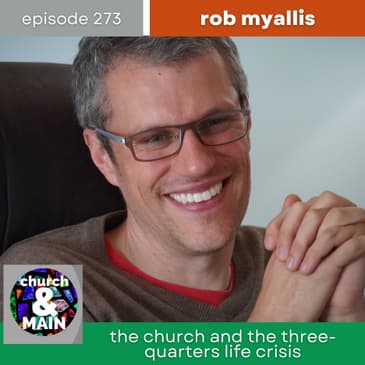

What happens when the people who built your church — the ones who carried it through lean years, chaired every committee, and showed up faithfully for decades — start to feel like the ladder has been taken away from them? In this episode, I welcome back Lutheran pastor and Rob Myallis to explore what Rob calls the "three-quarter life crisis": the profound emotional, physical, and spiritual transition many people face in their mid-to-late seventies.
Shownotes:
The Three-Quarter Life Crisis (Rob's Article)
Related Episode:
Luther Seminary and the Future of Mainline Protestantism with Rob Myallis | Episode 239
Join the Church and Main Email List
Facebook | Instagram | Threads | Twitter | Website | YouTube
00:00:27 --> 00:00:31 Church in Maine, a podcast for people interested in the intersection of faith,
00:00:31 --> 00:00:34 politics, and culture. I'm Dennis Sanders, your host.
00:00:35 --> 00:00:40 So, the most downloaded episode of 2025 was one featuring a Lutheran pastor
00:00:40 --> 00:00:43 by the name of Rob Mialis.
00:00:44 --> 00:00:48 Rob and I are both alumni of Luther Seminary in St.
00:00:48 --> 00:00:54 Paul, Minnesota, and I had him on the episode to talk about the decision by
00:00:54 --> 00:00:58 the seminary to sell their property and move to a new location in the cities.
00:00:58 --> 00:01:04 And that actually became a launching point to talk about the changing church
00:01:04 --> 00:01:08 in our culture, but also the changing pastorate.
00:01:08 --> 00:01:13 And like I said, it was an incredibly popular episode.
00:01:15 --> 00:01:20 And so I'm bringing Rob back now, and actually not for one episode, but for two,
00:01:21 --> 00:01:27 that are talking about two different generations, one that is definitely in
00:01:27 --> 00:01:30 our church and one that is sort of in our church.
00:01:31 --> 00:01:37 This first episode is going to deal with what Rob calls the three-quarter life crisis.
00:01:37 --> 00:01:44 And that means folks that are in their seventies, as they're facing all of the challenges of aging.
00:01:46 --> 00:01:53 And kind of how they deal with that. Sometimes it's not an easy transition as
00:01:53 --> 00:01:59 they reach a certain part of their life where things stop working and they're
00:01:59 --> 00:02:02 losing people around them that they've known for a long time,
00:02:02 --> 00:02:05 friends, family, loved ones.
00:02:07 --> 00:02:12 And this is actually, can be a challenge for pastors, but it can also be an opportunity.
00:02:13 --> 00:02:20 And what Rob writes about in an article for Mockingbird is how pastors and church
00:02:20 --> 00:02:25 leaders can find ways to help those who are in their eighth and ninth decade,
00:02:25 --> 00:02:27 so their seventies and eighties,
00:02:28 --> 00:02:33 kind of regain that sense of finding a place in the church.
00:02:34 --> 00:02:37 Now, next week, we're going to go to the other end of the spectrum,
00:02:37 --> 00:02:42 and we're going to be talking about Gen Z, and especially the ongoing debate
00:02:42 --> 00:02:46 on whether or not there is a revival among this generation.
00:02:48 --> 00:02:52 A little bit about Rob. Rob is the pastor of St.
00:02:52 --> 00:02:57 Paul Evangelical Lutheran Church in Lititz, Pennsylvania, and he writes a blog
00:02:57 --> 00:03:00 that I use a lot called Lictionary Greek.
00:03:00 --> 00:03:06 This is a great resource for pastors, especially I'm not naming names,
00:03:06 --> 00:03:11 but those who maybe have forgotten some of their seminary Greek.
00:03:12 --> 00:03:18 So with that out of the way, here is my conversation, part one of my conversation
00:03:18 --> 00:03:22 with Rob Maialis, this one featuring the three-quarter life crisis.
00:03:43 --> 00:03:49 Well, Rob, it is good to have you back. I wanted to talk today because you wrote
00:03:49 --> 00:03:57 something that ended up on the Mockingbird website about something I had not heard before.
00:03:58 --> 00:04:01 Because obviously we've heard about midlife crisis.
00:04:04 --> 00:04:10 And maybe a few of us have heard of quarter life crisis. But you talk about
00:04:10 --> 00:04:12 the three quarter life crisis.
00:04:13 --> 00:04:19 Um which i found was kind of fascinating and i think i've seen that a bit at
00:04:19 --> 00:04:24 my own congregation so why don't you kind of break down what do you mean by
00:04:24 --> 00:04:28 three-quarter life crisis and what led you to write it write this article sure
00:04:28 --> 00:04:32 sure again dennis it's great to be uh to be back here um,
00:04:34 --> 00:04:41 What I have observed is that time and time again, in different contexts with
00:04:41 --> 00:04:42 myself and with friends,
00:04:42 --> 00:04:49 the conflicts that people have with people in their congregations almost always
00:04:49 --> 00:04:51 involve people in the same age range,
00:04:51 --> 00:04:55 that kind of mid-70s, early 70s.
00:04:55 --> 00:04:59 And I started wondering what was going on.
00:05:00 --> 00:05:05 And as I've kind of seen the way my parents have kind of moved through retirement,
00:05:05 --> 00:05:10 I was just kind of thinking about kind of what maybe my life could or should
00:05:10 --> 00:05:13 look like in the next, you know, 15 to 20, 30 years.
00:05:14 --> 00:05:21 What I've observed is that many Americans, especially Americans,
00:05:21 --> 00:05:27 we get a lot of status and a lot of value out of making positive contributions.
00:05:29 --> 00:05:34 And that for many people, retirement itself can be like a real change,
00:05:34 --> 00:05:36 kind of going from the working world to the non-working world.
00:05:36 --> 00:05:43 But a lot of people in their retirement, they actually find it really generative.
00:05:44 --> 00:05:46 They're able to get involved in churches
00:05:46 --> 00:05:51 or in political causes or in food pantries or all sorts of things.
00:05:51 --> 00:05:56 I know so many retirees, especially kind of coming out of the middle upper class,
00:05:56 --> 00:05:59 this kind of this boomer sort of generation's wealth i mean they're they're
00:05:59 --> 00:06:01 in their retirement and they're traveling they're doing things they're busier
00:06:01 --> 00:06:05 now than they were when they were in their 50s when they were taking care of
00:06:05 --> 00:06:09 their parents and still kind of having to sort of the tail end of their raising
00:06:09 --> 00:06:17 their kids um but but i noticed that somewhere kind of in the mid 70s,
00:06:18 --> 00:06:24 uh people start like their health kind of starts to catch up with them and it's um,
00:06:26 --> 00:06:30 And they just kind of lose a little bit of steam and energy.
00:06:31 --> 00:06:36 And the way that I see this playing itself out is like the church or the pastor
00:06:36 --> 00:06:39 or a staff member wants to take something in a new direction.
00:06:39 --> 00:06:43 And suddenly something becomes like a big conflict. You're like, what's going on here?
00:06:46 --> 00:06:50 And, you know, or somebody who didn't go to the meeting, hasn't been on the
00:06:50 --> 00:06:54 committee or whatever in a year, or somebody's in your office or on the phone,
00:06:54 --> 00:06:56 like really upset with you for doing something.
00:06:57 --> 00:07:00 And so I just started to think like, what is going on here?
00:07:01 --> 00:07:04 And so I sort of thought, you know, there's kind of like a, I was kind of made
00:07:04 --> 00:07:08 up the term, a three quarter life crisis, where the first, the quarter life
00:07:08 --> 00:07:12 crisis is there's so many options in this world. I don't know which ladder to choose.
00:07:13 --> 00:07:18 The midlife crisis is I climb the ladder and like, well, was it the right ladder to climb?
00:07:18 --> 00:07:21 And I kind of feel like the three quarter life crisis is like,
00:07:22 --> 00:07:24 They took the ladder away from me because they were worried I was going to get
00:07:24 --> 00:07:27 hurt and nobody wants me to climb anything anymore.
00:07:28 --> 00:07:32 And that's just a big shift for people, especially in our culture that so values productivity.
00:07:35 --> 00:07:45 And I mean, what have you kind of noticed about these people once they kind of hit that age?
00:07:45 --> 00:07:50 What is it that hitting their 70s, especially their mid 70s,
00:07:50 --> 00:07:52 all of a sudden there's like this switch?
00:07:53 --> 00:07:59 Yeah, I think a lot of it. I think part of it is physical just for a lot of people.
00:08:02 --> 00:08:06 I remember when we were going through the COVID era, they always talked about
00:08:06 --> 00:08:07 underlying conditions.
00:08:07 --> 00:08:11 And I just began to realize that everybody in my family that I knew was in their
00:08:11 --> 00:08:13 70s had an underlying condition.
00:08:15 --> 00:08:21 And I just think, you know, when people go in there, I just noticed that when
00:08:21 --> 00:08:25 I start talking to people in that age range, when I talk to people in their
00:08:25 --> 00:08:27 60s, they're kind of joking about all the medicines they take.
00:08:27 --> 00:08:30 When I talk to people in their 70s, they're just talking about all like the
00:08:30 --> 00:08:33 surgeries and doctor's appointments that they have to go to and their spouse.
00:08:33 --> 00:08:36 And, you know, typically by the time you get in your mid 70s,
00:08:36 --> 00:08:40 if people are married, one of the two is starting to have some pretty,
00:08:40 --> 00:08:44 I think, significant health limitations, either mental or physical.
00:08:46 --> 00:08:52 I also think emotionally something happens where, you know, I'm in my second parish.
00:08:53 --> 00:08:57 And there are some things I've done at the previous church and I've done at this church.
00:08:59 --> 00:09:01 I would honestly say, like, if I had to do that at another church,
00:09:02 --> 00:09:06 like, I don't necessarily want to clean up, you know, safe child regulations
00:09:06 --> 00:09:07 at another church. Like, I've done it.
00:09:08 --> 00:09:11 I did it twice. You know, I don't want to do it a third time.
00:09:11 --> 00:09:15 And so I think that for some of the people as well, there's just a sense of, like,
00:09:16 --> 00:09:21 they've carried so much water for an organization for so long that they really
00:09:21 --> 00:09:24 are ready for somebody else to kind of do that.
00:09:25 --> 00:09:28 And there what I think happens is that kind of their head is like,
00:09:28 --> 00:09:33 I don't really want to change the bylaws of my organization another time.
00:09:34 --> 00:09:38 I don't really want to reorganize the committee structure and,
00:09:38 --> 00:09:42 you know, cause they were there in 1960 when they merged these two committees,
00:09:42 --> 00:09:44 they were there in 1980 and they split the committees apart and then they're
00:09:44 --> 00:09:46 there in the aughts and they merged them together again.
00:09:46 --> 00:09:48 And now this pastor's saying, we want to split the committees,
00:09:48 --> 00:09:51 you know, okay, like I'm done.
00:09:52 --> 00:09:57 But just because they don't want to have that kind of that burden of more night
00:09:57 --> 00:09:59 meetings or this kind of stuff,
00:09:59 --> 00:10:04 it's very disorienting for them to go from people who were leaders in an organization
00:10:04 --> 00:10:11 who were always sought after for their opinion to people who only find out inadvertently
00:10:11 --> 00:10:14 in an email chain that there's been some change in how their church is going
00:10:14 --> 00:10:18 to do some worship or administrative or outreach. Yeah.
00:10:19 --> 00:10:23 And what I found was that I started talking to other pastors,
00:10:23 --> 00:10:28 and I just felt like so many people in the parish just instantly registered
00:10:28 --> 00:10:33 because they've had themselves experiences with people in this kind of cohort,
00:10:33 --> 00:10:37 long, faithful stewards of beautiful resources and giftedness,
00:10:38 --> 00:10:42 kind of hitting that kind of emotional, physical kind of wall of not wanting
00:10:42 --> 00:10:47 to kind of carry the church, but feeling guilty about that, feeling frustrated
00:10:47 --> 00:10:49 they're not a part of it, and just kind of observing.
00:10:49 --> 00:10:55 And so I was kind of thinking, like, what might it be like for us to be pastor
00:10:55 --> 00:11:02 to people who, in some cases, may be quite adversarial to certain pastors,
00:11:02 --> 00:11:04 but how can we be pastoral to them?
00:11:04 --> 00:11:10 And what's really, I think, a pretty profound shift in where they're going to get their meaning from.
00:11:11 --> 00:11:16 Yeah, you say something interesting in the article that for a long time,
00:11:16 --> 00:11:18 these people were climbing the ladder.
00:11:19 --> 00:11:23 And now they're at a point where the ladder is being taken away from them because
00:11:23 --> 00:11:25 you might fall from the ladder.
00:11:25 --> 00:11:29 So it's that sense of that they're no longer useful anymore.
00:11:31 --> 00:11:38 But it sounds like here is that there's also a lot of grieving because you're
00:11:38 --> 00:11:43 grieving the sense of maybe power
00:11:43 --> 00:11:49 or influence that you once had that you don't have anymore on top of…
00:11:49 --> 00:11:51 your body is not working the way it used to be,
00:11:52 --> 00:11:55 and you're starting to lose people around you.
00:11:56 --> 00:11:58 So it's all of that.
00:11:59 --> 00:12:04 Yeah. Yeah, it's really intense. And so sometimes some of my staff members will
00:12:04 --> 00:12:06 be frustrated with somebody in the church, and I'm like.
00:12:08 --> 00:12:13 Look, this is what's happening in that person's life. Or they were brought up
00:12:13 --> 00:12:16 in this kind of church, and this is what they were taught, and this is what they did.
00:12:16 --> 00:12:19 And when the church went to struggle, they were like one of three people that
00:12:19 --> 00:12:23 got the church through that five years when there was no pastor or...
00:12:24 --> 00:12:29 Yeah, they have a real sense of ownership. And now here we come along and we've
00:12:29 --> 00:12:31 only been at the job for one or two years.
00:12:31 --> 00:12:33 We're telling them the church doesn't operate this way anymore.
00:12:33 --> 00:12:39 You can see why it's kind of hard, but there's a lot of other grief.
00:12:40 --> 00:12:45 So there's a man in my town who doesn't go to my church. He used to be very involved in politics.
00:12:45 --> 00:12:49 And what I've observed is that he goes to all of these events.
00:12:49 --> 00:12:56 And it's kind of sad because nobody really asks him for his opinion.
00:12:57 --> 00:13:03 And so what he does is he just starts talking and kind of aggressively almost
00:13:03 --> 00:13:07 cornering people like, now I've got this captive audience to listen to.
00:13:08 --> 00:13:14 And what I observed, though, is that there are other people who kind of realize
00:13:14 --> 00:13:16 this is what's going on and they grieve.
00:13:17 --> 00:13:22 And then they come out on the other side and they're just really delightful
00:13:22 --> 00:13:29 people who have kind of said, like, I don't need to be at every meeting anymore. Don't forget me.
00:13:30 --> 00:13:35 I'll tell you things really, really, really get get crazy. But generally,
00:13:35 --> 00:13:37 they're just really, truly supportive people.
00:13:39 --> 00:13:43 So I want to say that this isn't like a final condition for people where they're
00:13:43 --> 00:13:46 going to live in misery the last quarter of their lives.
00:13:46 --> 00:13:49 I would say this is just a time of transition for them.
00:13:49 --> 00:13:53 And some people take a little bit longer to go through that transition.
00:13:54 --> 00:13:58 But I think as pastors, if we can help people gently name the grief or at least acknowledge it,
00:13:59 --> 00:14:05 find ways to show appreciation for them, they might find a little bit easier
00:14:05 --> 00:14:09 time of letting go and then kind of just stepping into whatever the next chapter
00:14:09 --> 00:14:12 is, which may still involve leadership or involvement,
00:14:12 --> 00:14:15 but just kind of in a slightly different way than they've done before.
00:14:17 --> 00:14:26 So, I mean, because what this is really leading to is kind of a time of pastoral
00:14:26 --> 00:14:29 care, is how do you do that?
00:14:29 --> 00:14:35 How do pastors be there for these people in a way that pastorally,
00:14:35 --> 00:14:41 because it would be easy, and I think you talk about this in the article beginning,
00:14:41 --> 00:14:47 of being frustrated at these people and why don't they get it? or why are they?
00:14:48 --> 00:14:53 How do we, as pastors, but even if you're not even not a pastor,
00:14:53 --> 00:14:56 just be there for a person pastorally?
00:14:57 --> 00:15:01 Yeah, I certainly don't have all the answers. And if there are people listening
00:15:01 --> 00:15:04 to this that have ideas, I'd love to hear them.
00:15:06 --> 00:15:16 One of the things that I find this generation really wanting to do and not quite
00:15:16 --> 00:15:21 sure how to do it is actually to talk about their faiths.
00:15:21 --> 00:15:25 I think a lot of them have been through a ton in their life.
00:15:26 --> 00:15:33 By the time you get to be 75, you've survived deaths of loved ones.
00:15:33 --> 00:15:38 You've probably gone through economic hardship. You've seeing the country at
00:15:38 --> 00:15:40 war and in times of social unrest.
00:15:43 --> 00:15:47 So, there's a way in which this cohort, I think, has a deep faith.
00:15:48 --> 00:15:53 But many of them, as is evidenced by the sort of the decline of religious participation,
00:15:54 --> 00:15:59 especially among Gen X and millennials, somehow the boomer generation didn't
00:15:59 --> 00:16:02 know how to talk about their faith when they were in their 30s and 40s.
00:16:05 --> 00:16:09 Yeah, we can blame the sort of the collapse of the mainline Protestant or the
00:16:09 --> 00:16:11 sort of the church in the West on a lot of things.
00:16:11 --> 00:16:20 But I think it's clear that the boomer generation didn't quite know how to talk
00:16:20 --> 00:16:22 about why faith mattered to them.
00:16:22 --> 00:16:26 And I meet so many people who they took their kids to church,
00:16:26 --> 00:16:29 their kids don't go to church anymore, and they just feel trapped.
00:16:30 --> 00:16:33 But they don't know actually how to give witness to faith.
00:16:34 --> 00:16:37 Even though they're having these powerful experiences in their life,
00:16:37 --> 00:16:43 reflecting back on all that God, Father, Son, and Holy Spirit has done for them.
00:16:43 --> 00:16:49 So I think if there's a way that we can equip people to talk about and share
00:16:49 --> 00:16:52 their faith, that can be really profound.
00:16:53 --> 00:16:57 One of the ways in which I've done that is that people will have anxiety about
00:16:57 --> 00:17:02 funeral planning. I mean, and I have no problem planning this funeral.
00:17:02 --> 00:17:08 I mean, we're going to sing Amazing Grace, How Great Thou Art, How Beautiful Savior.
00:17:08 --> 00:17:13 We can do this. We're going to read from Romans 8, John 11.
00:17:14 --> 00:17:18 But what's really what I've encouraged people to do is I give people a sheet
00:17:18 --> 00:17:23 and I have them, their funeral planning is actually, you know,
00:17:23 --> 00:17:28 what hymns or Christian songs mean something to you and why.
00:17:29 --> 00:17:33 Why? Because a lot of people are like, oh, that was at my wedding or that was
00:17:33 --> 00:17:36 at, you know, the baptism of my children or that was at my mom's funeral.
00:17:37 --> 00:17:41 You know, what Bible verses are meaningful and why? What were places that were
00:17:41 --> 00:17:47 spiritually meaningful to you? or what were times when faith was drier in their life.
00:17:47 --> 00:17:50 Kind of just kind of giving people the kind of the encouragement and the tools
00:17:50 --> 00:17:54 so that then when, you know, Grandma Jones dies and we're all gathered as a
00:17:54 --> 00:17:58 family, I can say, well, what was, you know, what was meaningful?
00:17:58 --> 00:18:02 And they can say, oh, well, it turns out that number 375 was meaningful.
00:18:02 --> 00:18:05 Well, why? Well, it turns out that, you know, when they were a kid,
00:18:06 --> 00:18:10 they sang that in the church they grew up in when they went to church with their mom or whatever else.
00:18:11 --> 00:18:18 So I think that, again, Finding ways to give people a space to tell their stories
00:18:18 --> 00:18:23 in a way where people aren't feeling like they're trapped by them,
00:18:23 --> 00:18:24 but they want to listen to them.
00:18:25 --> 00:18:31 I also think that finding ways
00:18:31 --> 00:18:38 to connect people in those ministries with listening ministries. Yeah.
00:18:40 --> 00:18:43 Like when i was like younger i really wanted people in
00:18:43 --> 00:18:45 their 20s to help out with confirmation which for those of
00:18:45 --> 00:18:49 your listeners that might not know is kind of like a typically a
00:18:49 --> 00:18:52 middle school early high school kind of faith formation program related to kids
00:18:52 --> 00:18:57 being able to affirm their baptism that they had when they were a child or an
00:18:57 --> 00:19:02 infant and but what i realized is that 20 somethings were still working out
00:19:02 --> 00:19:06 all of their junk they were terrible listeners to 13 year olds,
00:19:07 --> 00:19:10 but somebody who's like 70 75 like
00:19:10 --> 00:19:15 they're not trying to be cool anymore and they
00:19:15 --> 00:19:18 just look at the youth and they're like oh you know how was your soccer game
00:19:18 --> 00:19:23 and the youth does what youth does they just say nothing or they go on a 10
00:19:23 --> 00:19:26 minute rant and all sorts of level of details that no other adult would care
00:19:26 --> 00:19:33 about but the 75 but says oh okay wow you know that's great you know, oh, well, way to go.
00:19:33 --> 00:19:36 Or, you know, oh, I went, I played soccer as a kid. Oh, you like that?
00:19:36 --> 00:19:41 You know, I'm like, and what happens then is that like, sometimes it's formal.
00:19:41 --> 00:19:46 And then, you know, a couple of weeks later, you know, that adult is going up
00:19:46 --> 00:19:49 to the kid after, you know, before church and just saying, you know,
00:19:49 --> 00:19:51 hey, I haven't seen you in a couple of weeks or things.
00:19:51 --> 00:19:58 Okay. Like, you know, it's forming ways to empower the elders of the church
00:19:58 --> 00:20:02 to not just be the elderly, but to be the elders, those who know the stories,
00:20:03 --> 00:20:04 but also are able to listen.
00:20:06 --> 00:20:10 Because youth, right, think that whatever they're going through is the end of the world.
00:20:10 --> 00:20:14 And people that are older are like, well, I only did that seven times in my
00:20:14 --> 00:20:17 life, and each time I came out, okay, so you're going to be fine.
00:20:17 --> 00:20:25 So I would want to equip the elderly to be the elders and to give them a capacity
00:20:25 --> 00:20:29 and a voice, especially to share and to mentor.
00:20:31 --> 00:20:37 You also talk a lot about in that article about justification and i found that
00:20:37 --> 00:20:43 it kind of interesting because so much of their of people's life is trying to
00:20:43 --> 00:20:48 justify ourselves and you are,
00:20:48 --> 00:20:58 I think you adroitly kind of talk about that theologically, and that at that
00:20:58 --> 00:21:03 age, in some ways, they don't have to justify themselves.
00:21:03 --> 00:21:06 They don't have to talk about their accomplishments or all of that,
00:21:06 --> 00:21:13 because it's just them, and that can be a gift in some ways.
00:21:14 --> 00:21:18 I think for some of them, you can tell they're struggling with that.
00:21:19 --> 00:21:24 You know, a lot of the most powerful hymns in the Christian faith are those
00:21:24 --> 00:21:33 where there's kind of a moment in the hymn where we recognize that our true worth,
00:21:33 --> 00:21:37 that our true justification is in Christ, in Christ alone.
00:21:38 --> 00:21:41 And I think most of life is a struggle with that. like we
00:21:41 --> 00:21:44 all know that in the end we're well at
00:21:44 --> 00:21:47 least protestants would but i didn't think catholics i i just
00:21:47 --> 00:21:50 think that humans would say yeah in the end like you know it's god's
00:21:50 --> 00:21:58 grace of course um but uh i i think for even those of us that are seeked in
00:21:58 --> 00:22:02 that kind of tradition of wanting to emphasize god's grace i think our whole
00:22:02 --> 00:22:07 lives we're always wondering like have i done enough uh and and trying to sort
00:22:07 --> 00:22:09 of prove to others that we have value.
00:22:11 --> 00:22:18 And I think you get to a certain age at which some people look back and just
00:22:18 --> 00:22:19 take extreme pride in what they've done.
00:22:20 --> 00:22:28 But I think others are just able to make a big shift to recognizing that their
00:22:28 --> 00:22:32 value is going to be ultimately in Christ.
00:22:33 --> 00:22:38 But if it's going to be in generative, productive works, it's going to be in
00:22:38 --> 00:22:40 praying for people and listening to them.
00:22:41 --> 00:22:46 And being patient when other people can't be patient. So I think it just really
00:22:46 --> 00:22:53 shifts from a, you know, a life that's about achievement to a life that's really,
00:22:54 --> 00:22:55 you know, productivity to presence.
00:22:57 --> 00:23:01 And I don't think that is just an on-off switch in some people that's easier than others.
00:23:01 --> 00:23:05 But I think for all for people in that age range when they shift to realizing
00:23:05 --> 00:23:11 that like they're invited to the party just because you know their grandma or their grandpa and,
00:23:12 --> 00:23:15 like it just you know and they're just automatically going to make the kids
00:23:15 --> 00:23:18 happy because everybody loves to have their grandparent come up to them and
00:23:18 --> 00:23:24 say nice job I love you um yeah it's just it's just a really so I think some
00:23:24 --> 00:23:25 people are able to kind of.
00:23:28 --> 00:23:32 Embrace a different way, a different sense of worth. But I think for,
00:23:32 --> 00:23:35 probably for many, it's a really pretty, a long struggle.
00:23:36 --> 00:23:38 I predict for me, it'll be a long, hard struggle too. So,
00:23:40 --> 00:23:45 why do you think that is? I think, well, I mean, I guess on the Enneagram,
00:23:45 --> 00:23:48 I'm a three, so I love achievement.
00:23:48 --> 00:23:54 But I also just think that, you know, as I've been a pastor for a year,
00:23:54 --> 00:23:55 as a leader in a community.
00:23:57 --> 00:24:03 And in one day, like I'll just, I mean, every week people like listen to me
00:24:03 --> 00:24:09 talk for 15 minutes, but one day people will not want to hear me talk for 15 minutes.
00:24:12 --> 00:24:17 So this is true. Yeah. Yeah. This is most certainly true. Right. As they say.
00:24:18 --> 00:24:22 So I would just want to offer that. I think there is a way in which for many
00:24:22 --> 00:24:23 people in this age range.
00:24:24 --> 00:24:28 We've talked their whole life about how we're saved by grace and
00:24:28 --> 00:24:31 first of all they're really looking at their own mortality now really
00:24:31 --> 00:24:34 wondering like am i say like you know it's the people that
00:24:34 --> 00:24:37 care about whether they're saved or not i think it would start to be in your upper 70s
00:24:37 --> 00:24:40 yeah like start to think about like really like you know
00:24:40 --> 00:24:43 what is next is there you know is this is there
00:24:43 --> 00:24:46 really an afterlife you know is there really a
00:24:46 --> 00:24:49 resurrection of the dead and am part of it so i
00:24:49 --> 00:24:53 think there's just it's going to be a more natural question and it
00:24:53 --> 00:24:57 becomes more difficult to stack up your life's achievements especially if
00:24:57 --> 00:25:00 you've done stuff in the past and you can't atone for it anymore you
00:25:00 --> 00:25:03 can make the worst mistake in the world at 20 you have your whole life
00:25:03 --> 00:25:06 to fix it but you know the mistakes you
00:25:06 --> 00:25:10 made at 20 about time you're 70 you know it's a little bit tougher to to kind
00:25:10 --> 00:25:15 of rectify them at that point so sort of you start to see like wow like resurrection
00:25:15 --> 00:25:19 and forgiveness sort of become the only options on the table for redemption
00:25:19 --> 00:25:23 rather than our own kind of fixing it. Hmm.
00:25:26 --> 00:25:30 And I think that what's also interesting about all of this is that I think it's
00:25:30 --> 00:25:35 going to be, I mean, as our society is aging,
00:25:36 --> 00:25:43 and I think, you know, this year is kind of the first boomer turns 80, I think.
00:25:43 --> 00:25:48 And so that's a big thing, is that this is going to be a big issue of how do
00:25:48 --> 00:25:58 we help older Christians in our churches feel that they still matter,
00:25:58 --> 00:26:05 that they're still loved, and that they still have something to give in a community.
00:26:05 --> 00:26:09 And I think that we haven't always talked about that as much.
00:26:12 --> 00:26:21 I think partially because we've been so focused on decline that we kind of focus on the young.
00:26:22 --> 00:26:28 And we don't as much focus on the people who are there and what they have to
00:26:28 --> 00:26:34 bring just by being who they are and that their giftedness is,
00:26:35 --> 00:26:43 as you've said, they've lived a life and have something to give to that community.
00:26:45 --> 00:26:48 Yeah, that's great. Yeah, Dennis, I think you're absolutely right.
00:26:48 --> 00:26:54 Like this isn't, this is going to be a huge issue for the church. Um,
00:26:56 --> 00:27:02 Outside of a handful of mission congregations, just congregations in the United
00:27:02 --> 00:27:05 States are going to be dominated the next five to 10 years by retirees.
00:27:06 --> 00:27:10 There's always a skew towards retirement because they're the ones who typically have the time.
00:27:10 --> 00:27:16 But I mean, the next five to 10 years in American church is just going to be really dominated.
00:27:16 --> 00:27:23 And the question is, how do we, on the one hand, ensure that the next generation
00:27:23 --> 00:27:28 has space and room to have ideas and to become leaders and to grow themselves.
00:27:30 --> 00:27:34 But also to really truly honor and
00:27:34 --> 00:27:37 i think in our society uh going back to what i was
00:27:37 --> 00:27:41 kind of elderly versus elders earlier i
00:27:41 --> 00:27:44 don't think as a culture we tend to value the
00:27:44 --> 00:27:49 elderly i don't think we know we don't elders i mean it's america right we're
00:27:49 --> 00:27:55 a culture that loves youth since i was like seven every single church event
00:27:55 --> 00:27:59 that i've gone to has told me that i was the future of the church or the people
00:27:59 --> 00:28:01 that were younger than me was the future of the church,
00:28:01 --> 00:28:05 that the church, you need to be getting more young people, more young families.
00:28:06 --> 00:28:11 So there's always been this push that the young people are the good thing at
00:28:11 --> 00:28:14 a church and the old people who are just give their money and that gets all.
00:28:14 --> 00:28:20 But I really think that for the church to be vibrant in the next five to 10 years,
00:28:20 --> 00:28:28 helping the people that are retired, not just that they can volunteer,
00:28:28 --> 00:28:33 but to really view them as spiritual elders,
00:28:33 --> 00:28:37 as the ones who know the songs of the church, who know the stories of the church,
00:28:37 --> 00:28:42 who have the stories of faith. If you're 15, you just don't have as many.
00:28:42 --> 00:28:50 If you're 75, you just should have six times as many stories of faith as a 15-year-old by life.
00:28:51 --> 00:28:55 So I think that, yeah,
00:28:55 --> 00:29:00 I would want a church to have a culture where the elderly were not threatened
00:29:00 --> 00:29:05 and the elderly were viewed as elders so that they were not threatened and allowed
00:29:05 --> 00:29:08 younger people into leadership positions,
00:29:08 --> 00:29:10 accepted that something was just going to have to change,
00:29:10 --> 00:29:15 but that they were viewed as pillars of faith and really looked at to draw on
00:29:15 --> 00:29:17 their strength and their wisdom.
00:29:18 --> 00:29:23 And recognizing, at least from a pastoral perspective, that they're likely going
00:29:23 --> 00:29:28 through the most spiritually generative time, almost akin to like when they
00:29:28 --> 00:29:32 were like that preteen, really kind of forging an identity and thinking about who they are.
00:29:32 --> 00:29:36 But there's just this huge kind of growth. And I've seen it. I'm sure you have, too.
00:29:37 --> 00:29:42 There are some people much later in life who they're just really having like
00:29:42 --> 00:29:44 an incredible epiphany of God's grace in their life.
00:29:46 --> 00:29:51 And it's glorious to see. So that maybe would be why kind of what I'm going
00:29:51 --> 00:29:55 for in the article is not like, hey, you know, if you have 73-year-olds in your
00:29:55 --> 00:29:57 church, just get ready. They're going to complain to you in the next year.
00:29:58 --> 00:30:02 My point was more to say, hey, there's a big life change that's going to happen at this point in life.
00:30:03 --> 00:30:07 And that the beautiful thing is that your church can be blessed by elders.
00:30:09 --> 00:30:16 But like all transition phases of life, people are going to need some congregational
00:30:16 --> 00:30:20 and pastoral kind of love and care to kind of help them through that transition.
00:30:24 --> 00:30:28 I'm kind of curious, what do you think, especially about,
00:30:29 --> 00:30:35 you kind of talked about things like confirmation and how that's been helpful
00:30:35 --> 00:30:41 to have older people instead of trying to get someone in their 20s, which,
00:30:41 --> 00:30:44 remembering my 20s,
00:30:44 --> 00:30:47 yeah, you're still trying to work through your stuff.
00:30:49 --> 00:30:56 I mean, what other ways do you see older people being kind of a part of the
00:30:56 --> 00:31:03 congregation and giving in their own way, fitting their own kind of stage in life?
00:31:05 --> 00:31:09 Yeah, Dennis, feel free. I mean, if you've seen other things at churches or
00:31:09 --> 00:31:14 have ideas, I'd want to hear from you or whatever else you've seen as well.
00:31:17 --> 00:31:20 I mean obviously i mean people who are uh
00:31:20 --> 00:31:24 retirees are going to uh you
00:31:24 --> 00:31:28 know be involved in the committee apparatus of a church i don't i don't see
00:31:28 --> 00:31:32 any mainline protestant church that's not going to have or even established
00:31:32 --> 00:31:37 evangelical churches that just aren't going to have their boards i mean you
00:31:37 --> 00:31:41 kind of almost have to to try to find younger people because they don't have the time.
00:31:41 --> 00:31:44 So I think you're obviously just going to have volunteers.
00:31:45 --> 00:31:51 And there's probably a number of ways of, again, certain, I guess,
00:31:51 --> 00:31:53 megachurches probably have just staff on stage.
00:31:53 --> 00:31:58 But if you have volunteers involved in your worship, there's probably going
00:31:58 --> 00:32:01 to be a lot of ways in which they can be involved in worship.
00:32:01 --> 00:32:04 And I think this is really where the challenging part comes.
00:32:04 --> 00:32:09 I think that most historically mainline or established churches have had church choirs.
00:32:11 --> 00:32:14 And there was a time in American life when everybody sang all the time.
00:32:15 --> 00:32:17 Like, I mean, Boy Scouts sang.
00:32:19 --> 00:32:22 Fraternities had songs, right? I mean, like men in their 40s,
00:32:22 --> 00:32:24 men in the 1940s would just sing with each other.
00:32:25 --> 00:32:30 Like, totally unheard of for us today for men to sing in that way, typically.
00:32:32 --> 00:32:36 So, you know, choirs were such a sort of a part of the American kind of mindset.
00:32:36 --> 00:32:41 And now we have all these church choirs in our churches that typically just
00:32:41 --> 00:32:43 don't have a lot of younger people.
00:32:43 --> 00:32:48 And it becomes really tricky for churches. How do we honor the people that care
00:32:48 --> 00:32:52 about that when maybe anymore at certain churches, their sound isn't as full
00:32:52 --> 00:32:56 anymore? So how do we, you know, kind of invite to an intergenerational choir?
00:32:57 --> 00:33:02 What ways in which does the choir ministry need to be redone so that you can
00:33:02 --> 00:33:05 have people, not just, you know, four people who are 80, but,
00:33:05 --> 00:33:09 you know, how could we get different voices in there or even for easier?
00:33:09 --> 00:33:13 But I think that's going to really take a lot of, this is where it's not just pastoral care,
00:33:13 --> 00:33:17 but also leadership to figure out ways to take some of the things that were
00:33:17 --> 00:33:22 really meaningful to this cohort of people in the way that they did church for
00:33:22 --> 00:33:26 six, seven, eight decades, and to try to say, okay,
00:33:26 --> 00:33:30 can you get enough trust and can you respect them enough that they're going
00:33:30 --> 00:33:35 to be willing to kind of tweak the model a little bit to allow that next generation
00:33:35 --> 00:33:37 to come up alongside of them.
00:33:38 --> 00:33:42 So, yeah, I guess, again, I don't have the magic wand.
00:33:44 --> 00:33:47 And in part, Mockingbird kind of didn't want me to write just for clergy.
00:33:47 --> 00:33:49 They wanted me to write more for general society.
00:33:50 --> 00:33:56 Yeah. But I would say that if there would be a way to, I think,
00:33:56 --> 00:34:00 again, this takes leadership to figure out ways to take some things that are
00:34:00 --> 00:34:03 really more meaningful in terms of committee involvement.
00:34:04 --> 00:34:09 Certain outreach ministries that likely kind of developed in the 60s and 70s,
00:34:09 --> 00:34:12 maybe 80s, and maybe now have kind of lost some of their steam.
00:34:12 --> 00:34:16 I think every church at least has one of those things like church choirs that
00:34:16 --> 00:34:19 were super meaningful for the buster and boomer generation, for the builder
00:34:19 --> 00:34:23 and boomer generation, but maybe not as much for Gen X and millennials.
00:34:24 --> 00:34:31 So what are ways to kind of expand those or figure out different ways to kind of get people involved?
00:34:31 --> 00:34:36 And that probably actually, you know, requires listening and asking people,
00:34:36 --> 00:34:39 you know, why is this choir meaningful to you?
00:34:40 --> 00:34:44 You know, and if you can get to the why, then sometimes you can then rearrange
00:34:44 --> 00:34:47 the how, if you can honor the why.
00:34:48 --> 00:34:51 So I would say working with any of these kind of institutions within our churches,
00:34:51 --> 00:34:57 these organizations, to help people, again, to do the listening work,
00:34:57 --> 00:34:59 that's the pastoral work of getting to the why.
00:35:00 --> 00:35:03 And then I think once you get to the why conversation, then sometimes people
00:35:03 --> 00:35:09 can let go of the how and can be more open to figuring out ways to,
00:35:09 --> 00:35:13 again, make room to honor the people that have been doing it a certain way for
00:35:13 --> 00:35:15 a long time, but kind of make room for the next generation.
00:35:16 --> 00:35:20 Because once you get people from generations together, that's really exciting stuff at a church.
00:35:21 --> 00:35:24 And then you have people learning and laughing together. are,
00:35:24 --> 00:35:29 yeah, I think that's, the church may be one of the last truly intergenerational
00:35:29 --> 00:35:31 communities. I think that can be pretty exciting.
00:36:02 --> 00:36:09 So I will include links to the article that Rob wrote for Mockingbird and also
00:36:09 --> 00:36:16 links to his blog and links to that episode from last summer.
00:36:17 --> 00:36:22 If you haven't heard it before, it's, I think, still timely.
00:36:22 --> 00:36:29 It's basically dealing especially with mainline Protestant congregations as they're facing.
00:36:31 --> 00:36:37 Not being able to find pastors. So, I will put all of those in the show notes.
00:36:38 --> 00:36:41 Just a reminder that if you ever want to learn more about the podcast,
00:36:41 --> 00:36:46 listen to past episodes, or donate, check us out at churchinmain.org.
00:36:47 --> 00:36:53 You can also visit churchinmain.substack.com to read related articles.
00:36:53 --> 00:36:59 I have a new one up, kind of my take on the parable of the sheep and goats that
00:36:59 --> 00:37:01 is entitled We're All Goats.
00:37:02 --> 00:37:08 You can subscribe to the podcast on your favorite podcast app and please consider
00:37:08 --> 00:37:13 leaving a rating or a review that helps others find the podcast.
00:37:13 --> 00:37:17 You can also make a donation. There are links in the show notes.
00:37:18 --> 00:37:24 And if you want to receive Leave the episode when it goes live in your email
00:37:24 --> 00:37:26 inbox. There's a link for that as well.
00:37:27 --> 00:37:33 That is it for this episode of Church and Maine. I'm Dennis Sanders, your host.
00:37:34 --> 00:37:37 And actually, before I go, just one more thing.
00:37:38 --> 00:37:42 I'm going to be in the very near future changing podcast hosts.
00:37:43 --> 00:37:51 You probably won't see anything change unless you are someone that has subscribed to Podbean.
00:37:52 --> 00:37:58 If you have, you may want to consider resubscribing on your favorite podcast
00:37:58 --> 00:38:05 app, or you can subscribe to the new podcast host when that becomes available.
00:38:05 --> 00:38:09 But I wanted to let you know that's happening in the next few weeks,
00:38:09 --> 00:38:12 and just to help you to be aware.
00:38:13 --> 00:38:18 So again, that is it for this episode of Church in Maine. I'm Dennis Sanders, your host.
00:38:19 --> 00:38:22 Thank you so much for listening. Take care, everyone. Godspeed,
00:38:22 --> 00:38:24 and I will see you very soon.