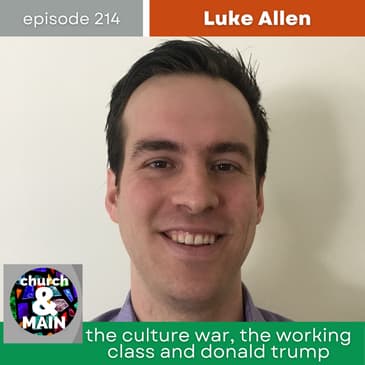
I speak with Luke Allen, lead organizer for Michigan Faith in Action, about the intersection of faith, community organizing, and cultural change after recent elections. Luke shares his journey from rural roots to urban organizing, highlighting shared struggles among diverse groups in the working class. We discuss the importance of building relationships, particularly with faith leaders, to foster trust and collaboration on issues like affordable housing and internet access. Luke also emphasizes the need for empathy in understanding political affiliations, advocating against oversimplified narratives.
What Culture War? by Luke Allen
Facebook | Instagram | Threads | Twitter | Website | YouTube
[00:00:01] A community organizer learns how the culture war could end from an evening at a bar in Ypsilanti, Michigan. That's coming up.
[00:00:38] Hello, everyone, and welcome to Church and Main, a podcast for people interested in seeing where faith, politics, and culture intersect. I'm Dennis Sanders, your host.
[00:00:47] My guest today is Luke Allen. Luke is the lead organizer for Michigan Faith in Action. He has several years of experience in community organizing and public policy.
[00:00:59] And today we're going to be talking about an article that he wrote on his sub stack called What Culture War?
[00:01:06] And in our conversation, we talk about what he's learned about people who might vote for Donald Trump, community organizing, as well as the church and the working class.
[00:01:19] If you're still trying to figure out why Donald Trump won last month's presidential election, you might want to listen to this conversation.
[00:01:28] Please join me in this conversation with Luke Allen.
[00:01:49] Well, Luke, thanks for taking the time to chat today. And I'd like to actually start by talking a little bit about you, kind of your story and your background, and then also the work that you're doing.
[00:02:06] Yeah. Well, thanks for having me. So I'm a community organizer and what we call an institution-based community organizer.
[00:02:17] So I work with churches primarily, but also mosques and synagogues and even some sort of more secular institutions.
[00:02:28] And I'm kind of an old school organizer. I was trained by a guy that was in his 60s at the time and in his 70s now, and he was sort of a, you know, old school Irish American, Alinsky style organizer. Right.
[00:02:42] So that's for better or worse. That's what I am at this point. And I actually think there's a lot of value in that.
[00:02:48] I think it's something that's being lost a little bit to the detriment of, of sort of social movements.
[00:02:57] I also am a rural guy. I grew up in a town of 300 people, which is a half hour away from the other town of 300 people that I live in now.
[00:03:09] So I grew up, yeah, I grew up there very, my parents were middle-class. I was middle-class, you know, we didn't, we certainly weren't rich, but we didn't struggle for too much.
[00:03:19] But I grew up around a lot of poor and working class white kids, right. For the most part, although my best buddy was a Mexican American guy, but, you know, it just seemed sort of, that's, that seemed like the norm to me.
[00:03:36] And then I went to college in the upper peninsula, which was upper peninsula of Michigan, which was obviously similar, right. A lot of poor and working class white people up there.
[00:03:48] I mean, there's poverty and the UP is pretty entrenched. And I was in Sault Ste. Marie, which is just very much like a blue collar city.
[00:03:59] You know, a big native population and a lot of poor and working class white people. And so that was sort of the milieu that I came of age in. And then I moved to Detroit right after that.
[00:04:11] And I lived in a neighborhood that was historically black, that was a hundred percent black with one exception, me. Right.
[00:04:21] I was probably the only white person for a mile in any direction at that time. Although I think that neighborhood has changed since I was there. But, and, you know, when I moved down there, everybody was like, wow, that's going to be a big difference, man.
[00:04:35] That's going to be 180 degrees difference than Bear Lake where you grew up.
[00:04:39] And that's sort of what I thought too. And it was at first, right. I mean, the race thing, obvious, unavoidable. Right.
[00:04:49] But, you know, after you live there for a while, I'm a pretty extroverted guy. I would talk to my neighbors. I would sit out on the porch and have a beer with people. Right.
[00:04:57] And I didn't sort of think, overthink that. I just kept doing that, you know, when I was in Detroit, the same way I would have up North.
[00:05:05] And you sort of realize like the problems are the same, right? Like the issues that people are dealing with in like a poor and working class urban community, that's a hundred percent people of color.
[00:05:16] Are, for the most part, are, for the most part, the same issues that poor and working class white people in a rural community are dealing with. Right.
[00:05:23] Like we're talking about lack of good jobs, drugs, addiction, disinvestment, outsourcing, inequality, you know.
[00:05:35] And so I think I, I sort of stumbled into a unique position where I was able to make that connection pretty organically myself without, you know, reading about it in a book or anything, but just having lived in those, both of those places.
[00:05:50] And I think, you know, it's pretty obvious if you live in both those places, but not many people live in Bear Lake and then the North end of Detroit or vice versa. Right. And that's like kind of a, still kind of a rare thing.
[00:06:02] So, so then I became a community organizer again, sort of by happenstance. I had originally planned to go to grad school after I did a year of AmeriCorps in Detroit.
[00:06:14] Right. Um, but I met my wife, uh, that when I was there and, uh, I also sort of, you know, when you're living in the North end Detroit and seeing all those problems, the idea of an academic career somehow becomes less appealing. Right. Um, and I wanted to do something.
[00:06:33] I don't know. I wanted to be around real people and do something a little more practical. And, uh, I met Bill O'Brien, my, my first boss, the guy that I was just talking about.
[00:06:44] Old school organizer guy, um, uh, who had been organizing. He has a former priest who had left the priesthood to, to get married and, um, became a community organizer and was involved in, uh, training Obama and, you know, all this other stuff. So, um, he offered me an internship and I sort of built an organization over the course of a year, uh, which we can talk more about.
[00:07:09] I mean, the work in Detroit and Metro Detroit, um, was pretty eyeopening and that was formative for me, but, uh, you know, after that, he sort of had to hire me and, um, uh, you know, on a full-time basis.
[00:07:21] Uh, and that was, you know, that was 2012. So we're talking, you know, 12 years ago at this point. Um, and I've been doing organizing in different capacities ever since. Um, so I started in, you know, a hundred percent black neighborhood in Detroit working out of a black Catholic church.
[00:07:41] And then I sort of started working in Metro Detroit wide. So I was doing suburbs and city. Um, and then, uh, I started doing statewide and that's what I do now. Um, including rural, which is, uh, you know, near and dear to my heart being that I grew up in the rural, uh, community. So, so yeah, I mean, that's sort of how I got to where I'm at now. Um, yeah.
[00:08:02] Yeah. And how would you describe or kind of, you know, talk a little bit about your community organizing? What has that entailed over the last few years?
[00:08:10] Yeah. Yeah. I'm glad you asked. I mean, I, sometimes I have these zoom conversations usually with people that are other organizers, right? So it's easy to assume that people know what I'm talking about. Um, so there's a lot of people that call themselves community organizers. Um, some of them I would not call community organizers, right. Um, because I think
[00:08:32] that community organizing is something pretty specific, um, and pretty, it's different from activism, right. Or, um, you know, uh, mobilization. So, uh, the organizing I do is very process focused, right. And there's a way that you go about this. Right. Um, so if I come into a new community with the goal of organizing it, I do not talk about issues right away. Right. Like the first thing I do is do as many one-on-ones
[00:09:02] in my case, in a faith-based organizers, um, case with pastors, as many one-on-one meetings with pastors as I can. Right. Or, or, you know, rabbis or imams. Um, and in those one-on-ones, I'm really just trying to build a relationship, um, and also sort of determine what we call that person's self-interest. Um, and in the case of a pastor like yourself, right. Uh, that self-interest might be career focused, but it's also pretty tied up with
[00:09:31] with your congregants. Right. So, um, pastors know what the issues are that their congregants are dealing with in a community. Uh, and they have goals for their church, obviously, but they also have a pretty good sense of the on the ground issues because they have regular people in their pews. So, um, from there, I'll go, uh, expand to doing one-on-ones with regular laid people, um, with, you know, local community leaders. I don't, you know, the president of the Lions Club or whatever. Um,
[00:10:00] Um, and at some point, um, if I have enough interest from clergy, I'll convene a clergy gathering. Right. So for example, up here in my rural Northern Michigan work, I spent six months just doing one-on-ones with pastors. And then I said, well, let's have a, have lunch. And we had like six pastors there. Um, and then I said, well, let's have another one of these in a month. And then we had like eight. And, uh, but we got like the important ones, the key ones, right. And eight is
[00:10:30] pretty good in a county like Benzzi County. Um, and from there we're sort of off and running because we found what we found was the conservative evangelical church and the liberal UCC church. Um, they disagreed on, you know, a lot of doctrine and theology. Um, but they did, they agreed on the fact that a, we want to be in relationship with each other and we don't like how siloed we are.
[00:10:57] And B, um, our people are dealing with the same problems. Now up here was very obvious that the issue was affordable housing or lack thereof. Um, and that was something that, you know, churches across the political and denominational spectrum had pretty, um, clear agreement on.
[00:11:17] So we launched a listening campaign, um, which is sort of the next step of organizing where we recruited key leaders in each congregation, uh, lay leaders, uh, to form a listening team.
[00:11:29] Um, and they did basically what I did, right? Like their job was to go out and do one-on-ones with other people in their church.
[00:11:37] Maybe that they didn't know that well, but that they would like to know better. You know, there's a lot of that. I'm sure you see that in your congregation, right? People that talk about, you know, the weather or how did the Vikings play or whatever. Right. But, um, they might not know each other at the deeper level. Uh, but also like their friends and neighbors, people in the neighborhood, people in the community. Um, and we spent like six months doing that. We would, we would report back once a month. Here's what we're learning.
[00:12:01] Um, and eventually we got to the point where we had an issues convention, right? Where we said, here's what we learned about the issues. And we voted on what our top two issues were. Um, and here in rural Michigan, the two were affordable housing and internet access. So that's what we went with. Uh, and at some point the, the lay people and the clergy decided they wanted to form an organization. And so they did. And we had a founding convention. We had like 200 people there.
[00:12:27] In the midst of COVID or I guess it was right after COVID, but we had to be outside, you know, and, um, uh, and we lost. We said, we're going to take on affordable housing and, uh, an internet. And so, um, the next step is, well, what do you do about them? Right. You don't just sit around and think in your own head. Well, here's what the solution would be. Um, we actually do research meetings. So we went out, we met with people that had power in our community, like the county commission and stuff like that. And we found what the issues were.
[00:12:56] Um, and you know, just to, uh, make a long story short, like for a concrete example, when the affordable housing piece, we found that there was this piece of land in sort of a vacation community that was available that a land trust, um, had access to, and they basically just needed money to build affordable housing. And so that's where we came in as we exercise the political will to get the county commission to put money into that. Right.
[00:13:25] And so when we brought 50 people to a county commission meeting in rural Michigan, that's a lot, right?
[00:13:33] That's a lot.
[00:13:34] Especially when you got the pastor of the biggest conservative evangelical church and the pastor of the biggest liberal mainline church, both there saying the same thing. Right. Um, and so we were able to get a win in there, you know, they're building a bunch of affordable housing. Now it's dropping the bucket compared to what's needed, but it's, you know, it's an example that we can build out in terms of.
[00:13:55] What we can actually do when we find an issue cut and then, um, exert some political pressure in a sort of nonpartisan way. So I don't know. Does that make sense?
[00:14:05] Oh yeah. It makes a lot of sense. I'm reminded this. I mean, I'm somewhat familiar with some of the old concepts from like Saul Alinsky and all that. Yeah.
[00:14:16] From this is a long time ago, but it's fascinating to hear kind of the difference because I think a lot of, when I hear about community organizing, one, it tends to not be what you just described.
[00:14:32] Um, what does it tend to be when you hear about it?
[00:14:36] I think a lot of it more or less is, it's a lot of meeting with legislators, but it doesn't feel like it's the community kind of thing of getting people together, especially people maybe from differing viewpoints and all that. It feels sometimes very siloed.
[00:14:59] Yeah. This is my, uh, yeah, this is my, what I'm shouting from the mountaintops about. I think, I mean, meeting with legislators is certainly part of it, right? Like that's, you know, that's, that's what America is supposed to be.
[00:15:14] That's, you know, um, politics and action, not just voting, but actually having some relationship with your elected officials. But the problem is if you don't take the time to build up a base and build power before you go into those meetings, you know, they can tell you whatever they want, but they don't really have to listen to you.
[00:15:32] Right. Um, especially if you're a group of people that always, that's all liberals are all conservatives. Right. Then why would, um, you know, have a group of everybody that's just going to vote for Democrats no matter what. And I go meet with a Republican state Senator.
[00:15:48] I mean, you know, he might be a nice guy and agree to meet with us, but that doesn't mean he has to listen to what we say. Um, and vice versa. Right. I mean, even if, even if it's all people that vote Republican every time, um, he doesn't have to listen to them either. Right.
[00:15:59] So it's important to get sort of a cross section of people. Um, and really, I mean, like, you know, it comes down to strength in numbers, right? Like if I take a couple of people to go meet with their state Senator, you know, it's, it's not a bad thing to do, but, um, if they know that we have all these churches behind us, right.
[00:16:17] They have our back that are in agreement with us, at least on this one issue. Um, they got to take you seriously. Right. Um, and if they don't, you can shame them. Right. You can, um, you know,
[00:16:28] we invite the media to our stuff, you know, like, so we can make them look bad if we need to. It's another part of organizing.
[00:16:35] Yeah. Yeah. I mean, I, and this actually kind of leads into the article that you wrote about, um, culture war in the election because I think you kind of open it up and you talk about that experience and experience you had in Ypsilanti when you were living there, um, in 2016.
[00:16:56] And just in dealing with people who didn't fit, most people would look at these people. One, they probably would not have a relationship with these people, but then two, they didn't fit the, what people would think of the stereotype of someone that let's say would vote for Trump or would, um, and all of that.
[00:17:19] And how, I think you even say early on in the article that you kind of knew where this, you know, how the, the election was going to end up. Um, and part of that was from your experience, um, in just living and as a community organizer. Can you kind of talk a little bit more about that?
[00:17:42] Yeah. Well, I mean, I certainly predicted this time, 2024, that Trump was going to win. And, um, I even wrote an article where I said, I think he's going to win the popular vote and the electoral college, um, pretty handily. And I, you know, obviously I was right about that. Um, in 2016, I think I was still a little bit enthralled to the experts, right.
[00:18:05] Whether I want to admit it or not. And so despite what I was seeing on the ground, I was like, well, you know, everybody's saying Hillary's going to got this in the bag. So they must be right. Um, but, uh, yeah, I mean, I think the, you know, the Ypsilanti thing people should know what Ypsilanti is like. I mean, this is where I lived in 26. I lived there for eight years. Um, we just moved up here about a year and a half ago, uh, back up here. Uh, so Ypsilanti is, it's a very blue collar town.
[00:18:35] It's sort of the blue collar sister of Ann Arbor, which is one of the wealthiest places in Michigan. And also the place where U of M is very like rich liberal place. Right. And, and Ypsilanti has, um, a much wider sort of range of people, both class wise ideology. I really loved Ypsilanti. It was a really, really wonderful place because of that. Right. Like I could walk into any bar or diner in Ypsilanti and there would be like a redneck guy.
[00:19:05] Sitting next to a drag queen sitting next to like a black dude wearing a cowboy hat sitting next to like a trans person. Right. Like there, you know, every kind of person could be present at any place in Ypsilanti at any moment, which I loved. Uh, and so, um, it made for some interesting sort of subcultures. And we were, you know, I'm a, I am, despite how I look and despite where I live, I'm a leftist, right? Like I was a big Bernie Sanders guy. Um,
[00:19:33] I've read my marks, you know, I'm like, I am a lefty. I'm an old school lefty. Right. Um,
[00:19:41] and so we were involved in like sort of socialist communist anarchist stuff down there. Um, those
[00:19:48] were a lot of our friends and they were really good people. Um, even if they were weirdos and freaks in some
[00:19:53] ways, they were, they were really, um, good, genuinely like good hearted people that would,
[00:19:59] they were like doing everything they could for the poor, uh, which they were themselves,
[00:20:03] a lot of cases. But, um, I really loved those people. And, uh, uh, you know, we were working
[00:20:09] on the Bernie campaign and then we, um, you know, we got, he got shanked for the first time. So we gave
[00:20:15] up on that, but, um, I still thought Hillary was going to win. So, uh, for a minute I was kind of shook,
[00:20:23] um, just like everybody else, right. That Trump won. And I thought, well, what does this mean about
[00:20:29] our country? Are we ever going to be able to talk to our neighbors again? You know, all this stuff.
[00:20:34] Uh, and the story I told him in the, in the piece, I think you're getting to us the Friday night of the,
[00:20:39] after the election, I went to my local dive bar, which, you know, I walked down the block and then
[00:20:43] I'd go through this like scraggly woods. And then I come out behind the dive bar and you go in the dive
[00:20:48] bar and, uh, you know, you go in there and it's like this old biker bar and it's like a very diverse
[00:20:54] crowd in there. Like there's the anarchist guys in there playing pool. There's like the biker guys
[00:21:00] who, you know, don't want to jump to conclusions. I assume many of them voted Trump. Um, and then
[00:21:07] there's a bunch of like black people and, uh, and I was sitting there just having a couple of beers
[00:21:12] and talking to the guy next to me on the bar stool and in the door walks a couple of guys.
[00:21:18] And, uh, it was like a weirdly hot day. So there were the white, there was a white guy,
[00:21:22] a black guy and the white guy was wearing, um, what we call an a shirt now, right? There's a
[00:21:27] less PC term for it. Um, uh, and, uh, they walked in arm and arm, right? I mean, I think they had had a
[00:21:34] few, uh, but they walked in arm and arm. And like I said, the piece like they, you know, they,
[00:21:39] I think they were good buddies. They could have even been more than that. Right. Like
[00:21:43] Ypsilanti is a place with a thriving LGBT community, uh, community. Um, but very, I mean,
[00:21:49] they were like, you know, it was like a redneck guy and, uh, you know, a poor black guy like there.
[00:21:55] Um, and they walk in and they get beers and, and I'm just sort of like talking. I see them all
[00:22:01] like, and they go up to the jukebox and they, and, and I see as the guy, the white guy walks by,
[00:22:06] he has a tattoo of the Confederate flag and it says rebel. Right. Um, and he, meanwhile,
[00:22:13] he's arm in arm with a black dude as he's doing this. Uh, and they go up to the jukebox and they
[00:22:17] put a kid rock song on cowboy, which I will defend to my dying day. That song rocks. Um, and, uh,
[00:22:25] and I was like, Oh hell yeah. And they, um, and everybody in the bar started singing along,
[00:22:30] right? Like the anarchists shooting pool in the back, the, the Trump Trumpy biker dudes and everybody
[00:22:39] in between. And I remember thinking like, Oh, maybe, maybe I'm like getting a little, uh,
[00:22:46] paranoid if I think that like people aren't gonna be able to hang out with each other anymore. Right.
[00:22:51] Um, and so, you know, I don't know, that was sort of an illustrative thing in my life because
[00:22:56] what happened from then on is I, I felt that the more I hung out with regular blue collar people,
[00:23:02] the, the division seemed less. Right. And then when I'm hanging out with like highly educated,
[00:23:08] um, upper middle class people, there's this like fear about, you know, America being pulled apart
[00:23:14] at the seams. And I, I just don't see it as much when I'm out in the real world with regular people,
[00:23:19] which I actually do a lot, right. Being living where I am and, and, um, doing what I do. So
[00:23:24] uh, you know, you can go back and I go back and forth between those two, two worlds. I think
[00:23:29] I wrote that piece because I saw this like weird, you know, distance between them in terms of their
[00:23:35] perception of what America was and, and, um, how divided we are and everything.
[00:23:41] Yeah. I mean, one of the things I found out I was fascinated about with this recent election
[00:23:47] and I mean, I could see it happening and, you know, it's funny after the election, there's just
[00:23:53] been a lot of talk about, well, we voted for this because we're a racist nation and all this stuff,
[00:24:00] but yeah, yeah, we're still doing that. Yeah. Yeah. But you do the, you know, you hear some of these
[00:24:05] stories or, or look into who voted and how voted and how many people, you know, persons of color have
[00:24:15] voted for Trump and, um, realize that the story is not so neat. And, and that's something that I found
[00:24:24] fascinating that if, you know, you have like one level that seems to want this very neat story
[00:24:33] of here are the good people, here are all the bad people. And I think the story that you're kind
[00:24:39] of telling is that it's a lot more complex. It's not so simple. Um, and you know, none of this is to
[00:24:46] say, you know, and I'm someone that didn't has not ever voted for Trump, but yeah, it seems like
[00:24:54] the voters are not so simple to understand, but, but there are people that seem to want that simple
[00:25:02] story. I mean this, I, yeah, I agree. I, I, I mean, I'm also, I would never, never would if you're
[00:25:09] Trump, I think it would have been better. America would be a better place if he was never born. Um,
[00:25:15] but you know, I think, I also think this is like a human nature thing, right? We have this thing in
[00:25:19] our head where we want to sort people, right? And sometimes that sorting we call racism, right?
[00:25:25] When we're sorting people by the color of their skin or, you know, the ethnic identity. Um, but we really,
[00:25:31] what we want to do is sort people into good and bad. And, um, and I do think part of the church's call,
[00:25:38] I mean, and you can, you know, I'd love to hear what your thoughts are on this as a pastor, but,
[00:25:43] you know, from the pastors I've talked to, I, I, I do think that, um, one thing that sort of
[00:25:49] I've been pleased to see that, uh, both the liberal pastors and the conservative pastors agree on is that,
[00:25:54] um, we can't be in the church. We can't be about sorting people into good and bad, right? Like
[00:25:59] what we have to be about is, is loving people and understanding them. All of us are both good
[00:26:05] and bad, right? I mean, that's why I think, uh, you know, Jesus, when he was on the Mount had some
[00:26:12] stuff to say about that. Right. But, um, uh, you know, and so to me, you know, I think voting for
[00:26:22] Trump is not a good thing to do. It's not something, if someone asked me who they should vote for,
[00:26:26] or I would say, I wouldn't tell him to vote for Trump. Um, but I don't think that one act alone
[00:26:31] makes you a bad person. Um, in fact, I don't really like believe in bad people. I think, I think
[00:26:37] most people are for the most part inherently good. And the Trump voters, I know I'm including my neighbor
[00:26:42] across the street that I was just talking to this morning. It's like one of the best people I know.
[00:26:47] He would give me the shirt off his back if I wanted it. He came over and snowed my driveway.
[00:26:50] He's like, um, you know, uh, and so I don't, I don't think like judging people, the worth of
[00:26:58] people's character based on who they vote for is a moral thing to do. Um, and I don't think it's a
[00:27:05] strategic thing to do either. Right. Because when you start sorting people out into good and bad and
[00:27:11] narrowing the definition of good based on really arbitrary stuff, your power base is greatly diminished.
[00:27:17] And there's like, um, very little you can accomplish if you're, you know, only trying to
[00:27:22] talk to, uh, people that agree with you on everything. Right. So, um, yeah, I mean, I don't
[00:27:28] know. I think there's, there is part of human nature that wants to sort everybody we know and
[00:27:32] you know, friend and enemy. Um, and I think we can admit that, but I don't think that means we have
[00:27:37] to like give into it, you know? And I think that part of what the church does is, is call us together
[00:27:42] with people that aren't different from us. Um, at least at its best of the church's best. And I think
[00:27:46] that's a really important role in America in 2024, you know?
[00:27:51] Yeah. I think, you know, as a, as a Christian, I believe that, you know, we're all people who
[00:27:57] sin, we're all sinners and there is no one that's perfect. And so I think that, you know, we have
[00:28:04] that and then we're also called to love one another and, and that's not always easy, but I
[00:28:10] think that that's the call. And it's not supposed to be easy, right?
[00:28:13] Yeah. Like if, uh, if you want to be a Christian and you want to just love the people that it's
[00:28:18] easy to love, like, I don't know, there's some tension there, right? Like that's not what I read
[00:28:23] the whole Bible. I read it during COVID front to back. And I always tell the pastors I talk with
[00:28:28] the thing that I was struck by most is in the gospel. Um, the main thing Jesus does is sit down
[00:28:36] and talk with people that other people tell me shouldn't, right? Like he's like, Oh, Oh, you can't
[00:28:41] talk with that guy. He's the wrong kind of guy. And he's like, you know what? I'm going
[00:28:44] to go have dinner with him. And that happens over and over and over again. And like, to
[00:28:48] me, that's the main point of the gospel. Like that, that happens more often in the gospel
[00:28:52] than, than anything else. Uh, and so if you are following the gospel, like that's got to
[00:28:57] mean something for how you live your life. You got to be willing to talk to people that,
[00:29:01] um, are not only are different from you, but even people that make you uncomfortable,
[00:29:05] right? Even people that say the others are telling you not to talk with, right? Um, and be
[00:29:09] open to relationship with them. You know, it doesn't mean if someone's like punching the
[00:29:13] in the face, you got to just keep hanging out with them, but it does mean you got to like,
[00:29:18] um, have a little bit of courage to talk to people that might, might seem different from
[00:29:22] you. Yeah. Yeah. I think there, um, it was fascinating after the election this year. Um,
[00:29:32] there was an article that I saw on Twitter and some other places, um, by John Pavlovitz.
[00:29:38] He is a writer, I think former pastor. Um, and he basically said to the effect that,
[00:29:48] you know, you can end relationships with people who didn't, who voted for Trump. And I was kind
[00:29:55] of like, no, really, we're, we're doing, we're, we're doing this, aren't we? But, and it just
[00:30:02] shocked me that someone would even write something like that. But I saw lots of people actually even
[00:30:09] putting up memes on social media with that. And there's just something, it's like, we kind of
[00:30:18] weren't listening in, in Sunday school, were we?
[00:30:22] Right. Well, yeah. And I, I mean, to me, like my big frustration is I hear that and I'm like,
[00:30:28] we're still doing this. It's been a decade, right? Like grow. A lot of you people are in
[00:30:32] your forties and fifties, like grow up. Um, but I, my challenge is like, you know, being that I
[00:30:39] am a guy that, and I have friends that are Trump voters and stuff, and it's not really a challenge
[00:30:43] for me to hang out with them. I also have family that is sort of hysterical liberals that I love.
[00:30:49] Right. But they're, they're in hysterics. Um, I have to cultivate, cultivate some empathy for them
[00:30:55] too. I know what it's like to be anxious about something that you can't control. And that's a
[00:31:01] horrible thing. Um, it doesn't mean that I want to encourage their, um, hysteria. Right. But it does
[00:31:09] mean that I, I have to love them just like I love the Trump voters. Um, just like I would love,
[00:31:13] you know, anybody that I think is, um, needs it, you know, or that I would try to love anybody,
[00:31:18] you know, I would, I'm caught, I feel called to love. So, um, yeah, but like, I don't know.
[00:31:22] I just think that to me, when I hear that, like, well, just cut off the people that voted for Trump,
[00:31:26] it's like, man, what a cop out, you know, like what is this? What an easy way out. And like,
[00:31:30] also like strategically, where, where does that get us? Right. Like, uh, as a country, like,
[00:31:35] what, what is that accomplishing? Right. Like, um, what's the, what's the, what's the goal here?
[00:31:41] Yeah. So, you know, one of the things that in reading your article, I kept thinking about over
[00:31:47] and over is, and, and this is something that I've always found that is a, at least in the, in the
[00:31:55] kind of liberal Protestantism that I'm in, in is we don't talk that much about class.
[00:32:04] Um, it's something, you know, we do talk a lot about race and that's still an issue that
[00:32:11] is still pertinent. Um, but we don't talk about class and, um, I'm curious, is that something that
[00:32:18] you have noticed? And does some of our, our perceptions, especially, um, about people who might
[00:32:27] vote, have voted for Trump are grounded sometimes in, in a sense of, of class or not
[00:32:33] understanding, you know, people who are working, especially who are working class?
[00:32:40] Yeah. Yeah. I think so. I mean, I agree. So I'm Catholic. Uh, so, you know, I'll take my shots
[00:32:47] at the Protestants from time to time. I think the Catholics do a better job of talking about the
[00:32:50] poor, right? Oh, I agree. Yeah. And, uh, obviously I have my problems with the Catholic church and a lot
[00:32:59] of cases, but I do think caring for the poor is one thing that they still do well, that we still
[00:33:04] do well. Um, and, and being open about that. Uh, yeah, I think, I mean, when I hear people like,
[00:33:13] you know, there's a common refrain, like we don't talk about race in this country. And I always want
[00:33:16] to be like, the only thing we do is talk about race, right? We don't do anything about it, but we
[00:33:21] talk about it all the time. Yeah. Um, it's like, Oh, we need to have a conversation. Like we've
[00:33:26] been having a conversation. Like that's all we do is have a conversation. Um, we don't even
[00:33:30] have conversations about class. And I mean, the, the, the irony is like, I hang out with
[00:33:36] a lot of like poor and blue collar black people too. And I think that they would rather us talk
[00:33:42] about class and, you know, like, would they rather, uh, you know, the, um, Grammy awards be more,
[00:33:51] you know, the, would we rather hand out more gold Oscars to more people of color? Would you
[00:33:55] rather have money to put food on your table for your family? Right? Like, but, um, it's
[00:34:00] much easier as a country for the ruling elites. I mean, this is where I come back to my sort
[00:34:05] of Marxist stuff is like those people would rather have symbolic victories for people of
[00:34:09] color because it doesn't cost them anything. Um, then, then actually, um, reduce inequality,
[00:34:16] which would do more for more people of color, obviously, but also help poor white people.
[00:34:20] Um, so I think there's like a, a little bit of a concerted effort to keep this, um,
[00:34:28] conversation from being real honest about class stuff and about, um, inequality in this country
[00:34:34] and keep it at a symbolic level. Uh, I also think that, um, you know, there is a little bit
[00:34:41] of an ugly thing that happens where rich liberals talk about how stupid Trump voters are or how
[00:34:50] backward and racist they are or whatever. Um, and it's like, well, you're a rich person talking
[00:34:55] about a blue collar person. Um, it makes me a little uncomfortable to hear that. And I think
[00:35:01] that it's an excuse for them to, um, not have to feel conflicted in a lot of cases, right? Like
[00:35:06] if you can blame the, uh, poor redneck that, you know, lives in my neck of the woods that has a Trump
[00:35:14] flag on his trailer, um, then you don't have to worry about where your, uh, Amazon goods are coming
[00:35:21] from, right. Or where your, um, you know, what the, uh, politician you support is doing. Right.
[00:35:29] I mean, cause it's like, yeah, I think that Trump and the Republicans are worse than the Democrats,
[00:35:34] but it's not like Kamala Harris wasn't going to do a bunch of evil stuff too. Right. Um, I mean,
[00:35:40] look at what's happening, uh, all across the world with, with our military at this point. Right. And
[00:35:45] the amount of military funding, we keep throwing into that, um, year after year, more and more. And
[00:35:49] that happened under the Biden administration, even at a higher rate than, than the Trump administration.
[00:35:54] So, um, it's a really easy way to sort of pin things on the scapegoats and, uh, and not have to
[00:36:03] reflect on our, your complicity in a, in a evil system. Right. Um, and I also think like,
[00:36:10] you know, being trained as an organizer, as I am, I was told that, uh, what racism is about is power
[00:36:19] plus prejudice. Right. And what I see when I see some guy living on a two track in a trailer,
[00:36:27] right. That might have a Confederate flag on his trailer. I'm sorry. That guy doesn't have a lot
[00:36:32] of power. Right. You know, um, he might have prejudice, but he doesn't have a lot of power.
[00:36:40] Uh, and so, you know, like when I lived in Ypsilanti, I often thought about this when I
[00:36:44] lived in Ypsilanti. Right. So I would go to, go to Ann Arbor and I would see these signs that said
[00:36:50] immigrants welcome here. And meanwhile, the, um, the houses are like one and a half million
[00:36:55] dollars, right. Or $2 million. And I'm like, well, what kind of immigrants are we talking?
[00:37:00] Right. Like, I don't think the average immigrant is welcome here. And then I go back to my neighborhood
[00:37:04] and like, there was a guy that lived on the road for me that, I mean, certainly like
[00:37:08] was, I'd be, was a racist. Right. Like he, I heard him say the N word. Um, but he also
[00:37:15] had like a black, black granddaughter. Right. And like, he loved her and he, like he cared
[00:37:20] for her, you know, cause I don't, you know, his parents were sort of in and out. Um, and
[00:37:25] so it's like, well, yeah, I mean, I'm not going to say that guy's not racist, but I'm also
[00:37:29] not going to say those rich people in Ann Arbor aren't racist too. Right. Um, it sort
[00:37:35] of complicates our view, you know, like I've got Trump voters around the corner from me
[00:37:39] right over here. They have two big Trump flags and they have like a cutout of them. I just
[00:37:43] thought that was so lame, but then, you know, may like, it's like, dude, you guys are just
[00:37:47] as cringy as the liberals you make fun of. But, um, but they're like great people and they
[00:37:52] have two black grandkids too, that they, they're like the only black people in my neighborhood
[00:37:55] are their grandkids, you know? Um, and so it's like, are we judging people by who they
[00:38:00] vote for or are we judging people on how they treat the people around them? Right. Um,
[00:38:05] and maybe we need to be a little bit more open to, to seeing the good in people. Um, and the,
[00:38:11] and seeing the fact that people are complicated, people are complicated, you know, we're all
[00:38:15] complicated. I mean, I just kind of go back onto your thing about Catholics. I spent, what
[00:38:22] was it, six years in, um, yeah, cause it was high school and then two years elementary
[00:38:30] in Catholic schools. So, oh yeah. It was actually good. I, it was a good, good experience. And,
[00:38:38] you know, I learned a lot about, um, Catholicism, you know, there are things that I don't agree
[00:38:44] with, but yeah, there's a lot I do. And, and I think their, their concept on their care for
[00:38:51] the poor and for the working class, it's always been something that I've appreciated that I think
[00:38:56] sometimes is lacking among us Protestants. Yeah. Yeah. I mean, well, there's Catholic
[00:39:03] social teaching, right? Which is an important thing. I, I was raised, both my parents were
[00:39:08] Catholic and I was raised sort of Christmas and Easter. If that, my dad's like an atheist
[00:39:14] now, my mom's sort of. Um, but, uh, I sort of found my way back into the church through,
[00:39:21] through organizing and I was, I was baptized as a kid, but I was never confirmed. Um,
[00:39:26] and so I decided that like age 25, I wanted to get confirmed, um, in this very diverse
[00:39:32] congregation with this. And I had been taking communion and I told the pastor and he was like,
[00:39:38] well, let's just get you confirmed and not worry about it. Um, so he was a really cool guy, but you
[00:39:43] know, the, the center of, so I went through the teeth, you know, the, um, the whole process of
[00:39:49] getting confirmed and, um, pretty central thing was that we should judge our societies by how they
[00:39:54] treat the most vulnerable. Right. Uh, and that's always stuck with me. Cause I, I mean, I really agree
[00:39:59] with that. Uh, and you know, that doesn't have anything to do with what the most vulnerable people
[00:40:06] are, um, who they're voting for or what they're, you know, what the beliefs in their head are. It has
[00:40:11] to do with the fact that they're human beings and they're sacred because of that, you know, and I
[00:40:16] believe that God is in every single human. So, um, then that means something about how we got to
[00:40:20] treat those people. Right. Um, regardless, you know, so, you know, how do we,
[00:40:29] I think moving forward and especially within the church really start to kind of reach out. Um,
[00:40:39] and I think for me as a pastor, it's, it is trying to see the, that everyone is a child of God and is
[00:40:49] worth, uh, has, and should be treated with some sense of dignity. Um, but it seems sometimes that
[00:40:57] that's lost in our, in the way that we kind of talk, especially about politics. Um, how do you
[00:41:06] think that we can learn, try to bridge those, those gaps and getting to really know people and
[00:41:13] to understand the complexity of people? Well, I mean, I think you've got a tough job as a pastor,
[00:41:20] right. Um, but an important job and like preaching this from the pulpit is important, right?
[00:41:24] And telling people that like, it's not so easy to judge, judge each other. Um, and we gotta,
[00:41:30] we gotta have some empathy for everybody. Uh, and I tell that to look like the conservative
[00:41:35] evangelical megachurch down the road, who I'm pretty tight with his pastor or their pastor too.
[00:41:40] And I, you know, and he does a good job of that too. I'm, you know, he's, um,
[00:41:45] a conservative guy, but he's like, we don't worship politicians in this church. We worship God.
[00:41:49] Right. Um, so I think, I think it has to start with the pastors for the most part,
[00:41:55] but what I will say is, you know, there are in every community, there are churches that are
[00:42:03] majority liberal. There are churches that are majority conservative, and there are a whole lot,
[00:42:08] a lot of them that are, um, mixed up, right. There, there are some, some mix. Uh, and what I have found
[00:42:17] is that people really want to talk to, they want to be in relationship with, um, the other ones,
[00:42:24] right? Like the conservative evangelical churches want to be in relationship with the liberal
[00:42:28] Protestant ones and vice versa. Like they're hungry for it. They're looking for sort of a mechanism to
[00:42:34] do that. And so, um, a lot of times we'll just organize like a community meal and we'll say,
[00:42:41] we'll get like, I'll, I'll ask like, Hey, you, UCC church and you evangelical church,
[00:42:46] can you guys co-host this community meal? We'll invite everybody from all the churches and,
[00:42:51] you know, anybody from the neighborhood and anybody that wants to come will have,
[00:42:53] you know, barbecue or pizza or whatever. Um, and we'll just get to know each other.
[00:42:59] And it's pretty simple, right? Like, especially if you're breaking bread together, um, people find
[00:43:04] their common ground pretty easily, right? Like you don't have to overthink it. Like people, um,
[00:43:10] you don't have to have some really concrete agenda. You can kind of put people in a room together and
[00:43:15] give them a couple of discussion questions, uh, and, and they'll find their common ground pretty
[00:43:20] easily. And what I would say when it comes to that stuff, my advice to other organizers and
[00:43:25] the pastors and stuff is like, the more we can keep this focused on our local community and the local
[00:43:31] concrete issues, the more common ground we're going to find. Right. So that's the starting point for me
[00:43:35] is I don't really care who you voted for for president. Um, you know, I don't care whether you like
[00:43:42] see yourself as like a Democrat or Republican. I think that those labels are largely meaningless.
[00:43:48] Um, what's going on in your own neighborhood, right? Like what's going on with the schools?
[00:43:52] What's going on with the housing? What's going on with the, is there violence in the neighborhood?
[00:43:56] Right. Um, and people will find common ground on that. Like no problem. Right. I mean, I often tell
[00:44:02] people how we've lately started bringing, uh, carloads of black folks from Flint up to our rural meetings
[00:44:10] and vice versa. Uh, and everybody that I talked to before that were like, well, you better like
[00:44:15] really think this out ahead of time. And I was like, I don't know. We'll see. Right. And like,
[00:44:20] basically we just got pizza and put them in a room together and it was no problem. Like they,
[00:44:24] they hit it off. They actually got along great. Like, you know, um, especially like the blue collar
[00:44:29] Trump voters and the blue collar black people from Flint. They're like, oh, you got an issue with
[00:44:34] housing in your community. We got an issue housing in our community. Right. Like, and, and, and I actually think
[00:44:39] there's a lot more, um, that those groups of people have in common beyond the issues even,
[00:44:44] right. Like just in terms of culture, like, you know, if you go to like the white evangelical church
[00:44:49] up here, and then if I go to a black church in Flint, like they're going to be singing some of
[00:44:53] the same songs, you know, like they're going to, yeah, yeah. There's going to be, even some of this
[00:44:57] theology is going to be more similar than you'd think. Um, so I don't know. I think it's important
[00:45:03] to just get people in a room when we can, uh, as a starting point and then, uh, and trust them,
[00:45:09] you know, trust them to, you know, a behave in a kind and neighborly way and, and B that if someone
[00:45:17] says something that's not, you know, super politically correct, that, that we can handle
[00:45:22] that. We're tough. You know, most people can let it roll off their back. Uh, and that's where being
[00:45:26] like having churches is important, right? Cause we all have something in common. It's Jesus.
[00:45:30] Right. Um, so you have a starting point when you, when you start an institutions like us.
[00:45:39] So people kind of want to find out more and you really do have a cool sub stack.
[00:45:45] Hmm. Where can they find you?
[00:45:47] Well, thank you. Uh, yeah, well, I, I don't have, uh, like Twitter or anything like that,
[00:45:52] but I do have the sub stack. It's called in the teeth of all hope, um, which is a little bit
[00:45:58] of a mouthful, but I got it from my favorite book ever, which I was trying to plug, which
[00:46:03] is, uh, uh, uh, let us now praise famous men by James Aegee. I don't know if you ever
[00:46:10] read it. Um, but, uh, it's, it's great. He's like, it's from, I don't know. I don't
[00:46:16] know the exact time period, but he was living with these sharecroppers in Alabama, right?
[00:46:20] Black and white. And it's, uh, this nonfiction book about them, but it's like very spiritual.
[00:46:28] And, um, yeah, really like sort of a mind blowing book. Uh, and he was like 27 when he wrote it.
[00:46:34] He's like a genius, but, um, so yeah, it's called in the teeth of all hope. Uh, I'm sure if you just
[00:46:41] Google in the teeth of all hope, you can find it at sub stack. Uh, I'm Luke Allen. You could
[00:46:46] probably Google me too. Um, I also, I work for Michigan faith and action. If people want to
[00:46:53] check that out, we have a website. It's mishfa.org, M I C H F A.org. And you can see the sort of work
[00:47:01] we're doing, the issue campaigns we have there and, um, even donate if you want, uh, which we always
[00:47:07] enjoy because we need money. Um, so yeah, those are probably two best ways to get ahold of me. I
[00:47:11] mean, I have an email address. It's on the mishfa website. People can reach me there. Happy to, um,
[00:47:18] talk to anybody that's trying to organize in their own community. Cause I think this is the,
[00:47:22] this is the way forward. Um, especially for the church. So, uh, yeah, I'd be happy to talk,
[00:47:28] you know, talk to anybody that wants advice about this kind of stuff.
[00:47:32] All right. And I do want to have you back to kind of talk a little bit more about, especially
[00:47:39] more about faith-based community organizing. Cause I think, I think you are correct that that's
[00:47:43] something that probably people need to learn more going forward. Um, yeah, yeah. Well,
[00:47:49] I'd be happy to do it. Yeah. Yeah. And those, yeah. And I'm, I'm happy to, happy to come back.
[00:47:54] Like I said, I'd be happy to, um, introduce you to some pastors that are doing this work too,
[00:47:59] if that makes sense at some point. Um, I have some really good pastor leaders that, um, you
[00:48:07] know, it might be cool to hear their perspective too, but yeah.
[00:48:09] Yeah. All right. Well, Luke, thanks a lot for this chat. And like I said, I will have you back.
[00:48:16] So yeah, we will, we will talk more again. All right. Well, thanks for having me. Yeah. I was,
[00:48:21] uh, I enjoyed talking with you. Right. All right. So just a quick reminder that Luke's article,
[00:48:56] uh, will be in the show notes if you're interested in reading it. And I really would, uh, suggest that
[00:49:01] you read it. There are actually some other articles there that might be, uh, uh, good for you to read as
[00:49:07] well. Um, this is going to be the last interview episode for 2024. Um, we do still have one,
[00:49:13] at least one more episode, uh, coming out this year. Um, it should come out in the next day or two
[00:49:19] after this, uh, episode drops. Uh, that's going to be a solo episode and it's going to be a reflection
[00:49:24] on the recent murder, um, and reaction to that murder from United, uh, of United healthcare CEO,
[00:49:31] Brian Thompson. So please be on the lookout for that one. Um, if you have any thoughts about the
[00:49:37] episode or this episode or past episodes, uh, drop me a line. I'd love to hear from you. You can send
[00:49:42] an email to churchinmain.substack.com. Um, also, um, if you want to learn more about the podcast,
[00:49:50] listen to past episodes or donate, you can check, uh, check the, check me out at churchinmain.org.
[00:49:56] Um, you can also visit, uh, churchinmain.substack.com to read related articles. I hope that you will
[00:50:03] consider subscribing to the podcast, um, and leaving a review on your favorite, uh, subscribe
[00:50:08] to the podcast and your favorite podcast app. And then I also hope that you would, uh, rate or
[00:50:13] review the podcast, uh, on Apple podcasts or wherever you listen. Um, and if that's a possibility,
[00:50:20] um, when you do that, that actually helps others find this podcast. And please consider actually
[00:50:26] even, um, sharing this podcast with family and friends who might be interested.
[00:50:31] So that is it for this episode of Church in Maine. I'm Dennis Sanders, your host. As I always like
[00:50:36] to say, thank you so much for listening. Take care. Godspeed. And I'll see you very soon.