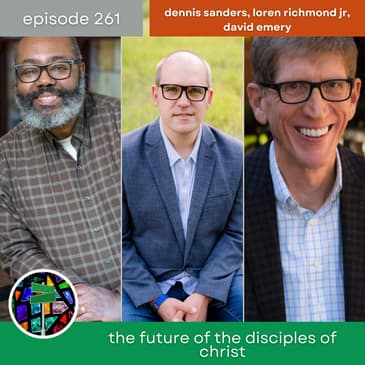
On the next-to-last episode of the year, Dennis joins Loren Richmond Jr. and David Emery to discuss the future of the Disciples of Christ. The trio examines the meaning of “no creed but Christ,” current generational and theological challenges, and the church’s evolving identity. They then emphasize the need for clear theology, a deeper sacramental life, collaboration among resilient local churches, and a practical, inclusive, and authentic expression of faith for the future.
Join the Church and Main Email List
Facebook | Instagram | Threads | Twitter | Website | YouTube
00:00:29 --> 00:00:33 Hello and welcome to Church and Maine, a podcast for people interested in the
00:00:33 --> 00:00:37 intersection of faith, politics, and culture. I'm Dennis Sanders, your host.
00:00:38 --> 00:00:45 So, for the penultimate episode for 2025, I'm going to share a crossover episode
00:00:45 --> 00:00:49 that I took part in with the Future Christian Podcast.
00:00:50 --> 00:00:52 This was recorded actually back in September.
00:00:53 --> 00:00:59 I took part in an interview with a future Christian co-host and colleague Lauren Richmond jr.
00:01:00 --> 00:01:06 And I did this along with David Emery. He is the senior pastor of Harvard Avenue
00:01:06 --> 00:01:08 Christian Church in Tulsa, Oklahoma.
00:01:08 --> 00:01:12 And the three of us talked about the future of our denomination,
00:01:12 --> 00:01:15 the Christian Church Disciples of Christ.
00:01:15 --> 00:01:22 It's a fascinating conversation about our denomination, which we all agree that
00:01:22 --> 00:01:25 has, I think, hit a bit of a rough patch.
00:01:25 --> 00:01:30 It's also inadvertently a generational conversation because the three of us
00:01:30 --> 00:01:32 actually represent three different generations.
00:01:32 --> 00:01:41 Lauren is a millennial, David is a late boomer, and then I'm a part of Generation X.
00:01:42 --> 00:01:47 How that factors in, I don't have any idea, but I found it interesting.
00:01:48 --> 00:01:52 I want to, before we get into this interview,
00:01:53 --> 00:01:59 want to say a special thanks to the other co-host the future Christian,
00:01:59 --> 00:02:06 Martha Tartarek, who actually was a guest on this podcast earlier this year
00:02:06 --> 00:02:13 for being the patient Anglican and Canadian to handle three unruly American
00:02:13 --> 00:02:15 disciples in this conversation.
00:02:17 --> 00:02:21 I'm not going to do my regular thing at the end of this episode,
00:02:21 --> 00:02:28 so don't forget to check out churchofmaine.org for past episodes.
00:02:28 --> 00:02:35 And don't forget to check out churchinmain.substack.com to read some of my latest articles.
00:02:35 --> 00:02:38 So with that, on to the conversation.
00:02:59 --> 00:03:04 Welcome to the Future Christian Podcast. I am your host today, Martha Tatarnik.
00:03:04 --> 00:03:12 And today I get to lead a roundtable with some Disciples of Christ pastors.
00:03:12 --> 00:03:15 I'm going to introduce them to you in a moment. And
00:03:15 --> 00:03:19 we are looking at the questions specifically in
00:03:19 --> 00:03:26 the Disciples of Christ denomination about creeds and sacraments and where the
00:03:26 --> 00:03:33 Disciples of Christ find their rootedness in today's world and whether the context
00:03:33 --> 00:03:38 in which the Disciples of Christ started is still working for them today.
00:03:38 --> 00:03:45 So, I'm really interested in this conversation as someone outside of the Disciples
00:03:45 --> 00:03:46 of Christ denomination.
00:03:47 --> 00:03:53 I hope that all of our listeners are going to find this bit of deep dive into
00:03:53 --> 00:04:00 this part of Christendom interesting and valuable for all of us,
00:04:00 --> 00:04:02 whatever denomination we're in.
00:04:02 --> 00:04:08 So today I'm joined by David Emery, Dana Sanders, and Lauren Richmond Jr.
00:04:08 --> 00:04:16 And maybe we could just go around the screen today and have you introduce yourselves
00:04:16 --> 00:04:21 and specifically your context where you're ministering right now to our listeners.
00:04:21 --> 00:04:22 David, do you mind starting us off?
00:04:33 --> 00:04:36 David, we're not getting audio from you. Yeah, I don't have any audio.
00:04:55 --> 00:04:59 Try again, David. Can you hear me now? There we go. Yes. All right.
00:04:59 --> 00:05:03 Answer that question again. Okay. Answer that question again.
00:05:03 --> 00:05:08 So my name is David Emery, and I'm a lead pastor at Harvard Avenue Christian
00:05:08 --> 00:05:10 Church in Tulsa, Oklahoma.
00:05:11 --> 00:05:16 In my sixth year, just finished sabbatical of the summer and heading into the fall.
00:05:18 --> 00:05:24 Okay. Thanks, David. Dennis, where are you and where do you minister?
00:05:25 --> 00:05:29 I'm Dennis Sanders. I'm the pastor of First Christian Church in St.
00:05:29 --> 00:05:36 Paul, Minnesota, and then also host of the Church in Maine podcast.
00:05:37 --> 00:05:42 Right. And we've had you a few times on this podcast, which we appreciate.
00:05:42 --> 00:05:48 How about you, Lauren? I do think that our listeners know who you are,
00:05:48 --> 00:05:54 but why don't you just refresh people's memory in case we have anybody new joining us today?
00:05:55 --> 00:06:01 Yes, thank you, Martha. Loren Richmond, I'm a chaplain and a regular host of
00:06:01 --> 00:06:03 this Future Christian Podcast.
00:06:03 --> 00:06:07 I shouldn't say regular, like always host, but one of the main hosts of the
00:06:07 --> 00:06:11 Future Christian Podcast with Martha Titarnik here, struggling to talk.
00:06:11 --> 00:06:16 I work as a chaplain currently in another ministry nonprofit context.
00:06:18 --> 00:06:21 Okay. Well, thank you all for being with us today.
00:06:23 --> 00:06:28 Lauren, I'm going to put you on the spot here because I understand that the
00:06:28 --> 00:06:36 disciples have long claimed no creed but Christ. So, can you just fill us in?
00:06:36 --> 00:06:43 If we have non-disciples, listeners who are with us, what is the context for
00:06:43 --> 00:06:48 that being the claim and how does that get lived out?
00:06:49 --> 00:06:53 Okay. I'm going to bring my credentials here in that I have in my hands the
00:06:53 --> 00:06:57 encyclopedia of the Stone Campbell movement I'm holding here.
00:06:57 --> 00:07:04 Although David and Dennis might take me to task or others on my accuracy of
00:07:04 --> 00:07:08 the Stone Campbell movement, but the Stone Campbell movement really comes out of,
00:07:08 --> 00:07:11 or excuse me, the disciples of Christ come out of the Stone Campbell movement,
00:07:11 --> 00:07:14 which began roughly 200 years ago in America.
00:07:14 --> 00:07:18 The disciples of Christ were at one point, as I understand, like the largest
00:07:18 --> 00:07:25 indigenous, meaning stemmed from the continental United States denomination in the United States.
00:07:25 --> 00:07:29 But I think one thing that I do want to say for our listeners,
00:07:29 --> 00:07:33 like, I think this is a conversation that has broader implications than just
00:07:33 --> 00:07:36 beyond David and Dennis's particular denomination.
00:07:36 --> 00:07:39 Like, I think within American Christian evangelicalism there,
00:07:39 --> 00:07:44 I really see this kind of like grasping for some more rootedness.
00:07:44 --> 00:07:49 And I think we're, I think I'm hoping that this conversation that we have can
00:07:49 --> 00:07:54 bring some more insights or context to that even broader conversation.
00:07:56 --> 00:07:59 Yeah, okay. I think that that's really helpful.
00:08:01 --> 00:08:07 Can you just, maybe one of you could unpack what that means to you, no creed but Christ.
00:08:09 --> 00:08:15 Yeah, Dennis, do you want to take a stab at that? Yeah, I think what it meant,
00:08:15 --> 00:08:17 at least to me and historically,
00:08:18 --> 00:08:25 was the Disciple of Christ along the wider Restoration movement came out of
00:08:25 --> 00:08:27 Presbyterianism. Presbyterianism.
00:08:27 --> 00:08:35 All of the founders came from, were Scotch-Irish, came out of Presbyterianism,
00:08:35 --> 00:08:41 which was incredibly at that time, around the 1700s, incredibly sectarian.
00:08:42 --> 00:08:51 And so they all kind of took parts of how they all kind of parsed the Westminster Confession.
00:08:51 --> 00:08:56 And if you believed it this way, then you were this certain Presbyterian.
00:08:56 --> 00:08:59 If you believed it this way, you were this certain Presbyterian.
00:08:59 --> 00:09:02 And if you believed it this way, then you could take communion.
00:09:02 --> 00:09:05 If you believed it that way, then you couldn't take communion.
00:09:05 --> 00:09:07 So it was just really a kind of a mess.
00:09:08 --> 00:09:12 And so you had this movement.
00:09:12 --> 00:09:17 And a lot of this kind of arose in, especially in Northern Ireland,
00:09:17 --> 00:09:21 and kind of got moved over to America.
00:09:22 --> 00:09:28 And as the restoration movement kind of came to fore.
00:09:30 --> 00:09:36 They kind of saw, at least the founders thought that the creeds in many ways
00:09:36 --> 00:09:40 were blocking people from coming together to worship.
00:09:41 --> 00:09:47 And so they saw creeds in that way as a problem of bringing people together.
00:09:48 --> 00:09:57 So for them, what was important was that the only creed that brought people together was Christ.
00:09:57 --> 00:10:06 And so it wasn't that they were anti-Creed, but that they were non-Creedal,
00:10:06 --> 00:10:08 that there wasn't a Creed.
00:10:08 --> 00:10:14 You didn't have to have a certain Creed to come forward to take part in communion
00:10:14 --> 00:10:23 or whatever, or to worship together, but that it was that you basically believed in Christ.
00:10:23 --> 00:10:31 That was the creed that was the only creed that mattered yeah okay so I want
00:10:31 --> 00:10:33 to get into the heart of the oh sorry go ahead.
00:10:35 --> 00:10:40 I was just going to say that no creed but Christ is kind of reflected in the
00:10:40 --> 00:10:41 way that many disciples'
00:10:41 --> 00:10:47 churches operate today in their congregations, in the sense that there's this
00:10:47 --> 00:10:51 idea and this belief that's very fundamental across most disciples' churches,
00:10:51 --> 00:10:56 this idea, this belief in diversity of opinion and thought and interpretation of Scripture.
00:10:56 --> 00:11:02 And so by the removing, this idea of no creed but Christ allows for a value
00:11:02 --> 00:11:05 that we really cherish at Harvard Avenue, which is theological humility,
00:11:06 --> 00:11:10 very, very important to us, to be an ecumenical church.
00:11:11 --> 00:11:18 And so the beauty of this early foundation of this church was like it wasn't so much anti-creed.
00:11:18 --> 00:11:22 However, it was taking down the barriers so that the community table became
00:11:22 --> 00:11:25 a place of unity rather than a place of division.
00:11:26 --> 00:11:30 So that's why communion really sits at the heart of our worship services.
00:11:30 --> 00:11:35 That's why it's not required for an ordained clergy person to oversee the table.
00:11:36 --> 00:11:41 The table is meant to be a place where barriers have been removed and have been taken down.
00:11:42 --> 00:11:46 However, I would add that part of the reason we're having this conversation
00:11:46 --> 00:11:51 today is even Alexander Campbell, one of the founders of the church itself, began to immediately,
00:11:51 --> 00:11:55 toward the end of his own life, recognize the difficulty of No Creed But Christ,
00:11:55 --> 00:12:00 because instead of creating a church, a unified church, it just caused more
00:12:00 --> 00:12:02 division within the church itself.
00:12:02 --> 00:12:07 Because this movement, this Christian church movement, said that we want to
00:12:07 --> 00:12:11 be a church that's at a communicable, that focuses on the unity of all Christians.
00:12:11 --> 00:12:15 But at the same time, how do you go about doing that? By returning to Christ
00:12:15 --> 00:12:19 as a center of our faith, and we're going to rely upon the New Testament for
00:12:19 --> 00:12:20 the governance of the church.
00:12:20 --> 00:12:23 As a result, you have people who can't agree on the governance,
00:12:23 --> 00:12:25 who can't agree on what the New Testament says.
00:12:26 --> 00:12:32 So instead of leading to a unity, it just created three more distinct denominations
00:12:32 --> 00:12:34 or three more distinct bodies of the church of Christ.
00:12:35 --> 00:12:41 The independent Christian church and the disciples of Christ. And so that is,
00:12:42 --> 00:12:46 That itself, it was a very naive thing. And so part of this conversation comes
00:12:46 --> 00:12:48 up because Lauren and Dennis and I have been talking,
00:12:48 --> 00:12:53 and I said to them recently that it feels like to me that we're living in an
00:12:53 --> 00:13:00 age and a time where we don't have a common set of language about sin, salvation,
00:13:01 --> 00:13:05 human suffering that allows us to navigate the times that we're living in.
00:13:05 --> 00:13:12 And that there are some beautiful parts of our faith and our tradition historically
00:13:12 --> 00:13:16 across all denominations that speak very meaningfully to those things.
00:13:16 --> 00:13:23 And can we hold on to that humility at the same time, lean into some of the creation of our church?
00:13:24 --> 00:13:30 So that's kind of what this conversation is. Yeah, you've all given me a lot
00:13:30 --> 00:13:32 of context for this conversation.
00:13:32 --> 00:13:38 And I love that word humility. I think that that's a really important word.
00:13:38 --> 00:13:43 I'm just going to speak for a moment from my Anglican perspective because we
00:13:43 --> 00:13:50 do, most Sundays in most of our churches, say either the Apostles' Creed or the Nicene Creed.
00:13:50 --> 00:13:57 And I would say that at various points in my ministry, I have found that a little
00:13:57 --> 00:14:00 strange because, you know,
00:14:00 --> 00:14:11 it seems to assume a lot that our churches are full of people who can all get up and say, we believe X,
00:14:11 --> 00:14:16 Y, and Z when we know that our churches are full of people who are at various
00:14:16 --> 00:14:25 points on their Christian journey and just like do hold a range of beliefs and
00:14:25 --> 00:14:28 a range of relationships to those core statements.
00:14:29 --> 00:14:35 But then at other times, I have found it very powerful as like.
00:14:37 --> 00:14:44 The faith that holds us together regardless of where any of us individually are on the journey,
00:14:44 --> 00:14:50 that there is this collective that we can be held by even if I,
00:14:50 --> 00:14:52 in that moment or in that season,
00:14:53 --> 00:14:59 am struggling with a particular part of the belief system, I can still feel
00:14:59 --> 00:15:02 held by that shared story.
00:15:03 --> 00:15:08 So yeah, I'm really interested to hear your reflections.
00:15:09 --> 00:15:18 David's kind of given us the sense that maybe it hasn't always led to unity
00:15:18 --> 00:15:26 and that maybe there is this floundering for lack of some shared language,
00:15:27 --> 00:15:35 as David said, around those key experiences of the human journey.
00:15:35 --> 00:15:43 So, yeah, Dennis, do you feel like the No Creed But Christ serves the denomination well for today? Yeah.
00:15:47 --> 00:15:54 No. I think that it still has some meaning,
00:15:54 --> 00:16:03 but it's also, I think in our day and age, it also has some, it falls short.
00:16:03 --> 00:16:09 Um, when I became a disciple, this was back about 30 years ago,
00:16:09 --> 00:16:13 we still had a lot of theologians.
00:16:13 --> 00:16:18 We had pastors, we had all these books that kind of explained and could kind
00:16:18 --> 00:16:25 of tell you what that whole phrase meant and could really explain to you the whole concept of,
00:16:25 --> 00:16:28 of what it meant to be a disciple.
00:16:29 --> 00:16:36 And we don't really have that as much today, and we don't have people there
00:16:36 --> 00:16:40 to explain what does this phrase mean?
00:16:42 --> 00:16:50 What does Christ mean? What does a creed mean? What does it mean to believe?
00:16:53 --> 00:16:59 We just don't have this way of how to explain this anymore. And so,
00:17:01 --> 00:17:07 That, I think, is kind of an issue. And it's not as much that the phrase of the problem,
00:17:07 --> 00:17:13 it's that it feels like we don't have people around that can explain what this
00:17:13 --> 00:17:17 means as much anymore. That's a problem.
00:17:18 --> 00:17:26 And maybe that's also a problem that it really does fall to us as pastors to do that now.
00:17:26 --> 00:17:32 It's just that there were a generation of people, other theologians that had
00:17:32 --> 00:17:37 written books that had all this, and those people have passed on.
00:17:37 --> 00:17:40 And we just don't have that much anymore.
00:17:41 --> 00:17:50 Well, I mean, even no creed but Christ, like, yeah, as you say, what does Christ mean?
00:17:50 --> 00:17:54 Like, Christ for what? Like to follow as the son of God,
00:17:54 --> 00:18:02 as the one who shows us what God is like, as like, what are we sort of signing
00:18:02 --> 00:18:06 on to to say even just Christ?
00:18:07 --> 00:18:18 So, yeah. Lauren, how do you feel like the shifting times have brought this into question?
00:18:18 --> 00:18:23 Well, I think it, I just wrote down a note, like, on thinking about what Dinoff
00:18:23 --> 00:18:28 was saying, like, I think it assumes a set of assumptions that aren't necessarily widely held.
00:18:28 --> 00:18:31 And I think this is a challenge that we're having, at least in America,
00:18:32 --> 00:18:36 you know, broadly speaking in our culture, that there's like this set of assumptions
00:18:36 --> 00:18:40 that we just assume everybody has that people don't have anymore.
00:18:40 --> 00:18:45 Like this assumptions on what what democracy is and what freedom is and what
00:18:45 --> 00:18:51 you know the so on and so forth and there's there's this shared set of assumptions
00:18:51 --> 00:18:56 perhaps rooted in a christendom that just don't exist anymore,
00:18:58 --> 00:18:59 Yeah.
00:19:03 --> 00:19:14 Do you feel like it is harder for people to feel like they have a common faith?
00:19:15 --> 00:19:20 And do any of you have an experience of how that stands in contrast maybe to other denominations?
00:19:20 --> 00:19:29 Because, again, like I see a lot of diversity across my congregation in belief
00:19:29 --> 00:19:31 despite the fact that we have creeds.
00:19:33 --> 00:19:39 Do you think in comparison that disciples of Christ find it harder to say,
00:19:40 --> 00:19:45 okay, well, we do have a shared faith story?
00:19:49 --> 00:19:52 I think that... David, maybe you want to take a stop there.
00:19:54 --> 00:20:00 Okay, Martha. What I wonder is if anybody really in our denomination really
00:20:00 --> 00:20:02 uses that phrase much anymore.
00:20:02 --> 00:20:05 I don't know. In recent gatherings, I've been with disciples.
00:20:06 --> 00:20:10 I don't hear us even using that language. It's kind of like we don't use it at all.
00:20:10 --> 00:20:17 We do talk about unity around an open table. We're very big on inclusion and welcome.
00:20:17 --> 00:20:25 And so um that that seems to be very important to us but i don't hear much of that language,
00:20:25 --> 00:20:33 around that around that anymore um the kind of the reason this has really become important to me,
00:20:33 --> 00:20:42 is um i i i was driving driving recently and an anglican church here in town
00:20:42 --> 00:20:45 had a sign up that It said, God loves you, and that means everyone,
00:20:45 --> 00:20:47 and everyone is welcome.
00:20:48 --> 00:20:51 I thought to myself, gosh, that's really beautiful. I believe that's true.
00:20:51 --> 00:20:54 It's a part of my faith. It's part of who we are as disciples,
00:20:54 --> 00:20:57 that we are a church of inclusion and a church of welcome.
00:20:59 --> 00:21:03 But as I was thinking about it, that very next day, two children were shot and
00:21:03 --> 00:21:08 murdered in a church in Minneapolis in another mass shooting.
00:21:09 --> 00:21:12 And I thought to myself, I said, it's just not enough.
00:21:13 --> 00:21:18 To be a church that primarily focuses its identity upon being a church of welcome
00:21:18 --> 00:21:22 and inclusion for all people isn't enough because it doesn't adequately address
00:21:22 --> 00:21:27 the sin and brokenness and the evil at work in our world that takes innocent human lives.
00:21:27 --> 00:21:33 And so one of the things that deeply concerns me about the disciples is that
00:21:33 --> 00:21:38 we tend to either take this very strong social activist role or that we tend
00:21:38 --> 00:21:41 to take a role of being a church for everyone,
00:21:41 --> 00:21:44 but a church that doesn't really stand for anything at all.
00:21:45 --> 00:21:52 And so, like, I'm thinking about the 25-year-old young man who was trying to
00:21:52 --> 00:21:54 find his way in the world.
00:21:56 --> 00:21:59 You know, a young white 25-year-old man is probably the most dangerous person
00:21:59 --> 00:22:02 in America today, probably, is my opinion.
00:22:03 --> 00:22:06 What do we have to say to a young man who feels isolated, alone,
00:22:07 --> 00:22:12 disconnected from the world, worried about the future, trapped in a world that
00:22:12 --> 00:22:14 feels unsafe and fearful to him,
00:22:15 --> 00:22:19 why do we really have to offer that person in a primarily activist congregation
00:22:19 --> 00:22:24 or in a congregation that says everybody's welcome but isn't able to adequately
00:22:24 --> 00:22:26 address the root issues of his alienation?
00:22:27 --> 00:22:31 And so just saying everybody's welcome is not enough. And by the way,
00:22:31 --> 00:22:35 I'll just point out, there is a revival of young people attending church,
00:22:35 --> 00:22:37 but they're not going to progressive congregations.
00:22:38 --> 00:22:46 It's not that I lean progressively theologically, where a church is welcoming
00:22:46 --> 00:22:49 in every way, but I don't know what our— here's the problem.
00:22:49 --> 00:22:52 This is the reason why I'm concerned about this matter.
00:22:52 --> 00:22:58 What does my church have to say? What do our disciples' churches have to say theologically,
00:22:59 --> 00:23:03 about what does it mean for a person to be a saved person, to experience the
00:23:03 --> 00:23:06 good news of Jesus and their salvation when they're walking into the door of
00:23:06 --> 00:23:09 our church broken by addiction and family dysfunction,
00:23:09 --> 00:23:15 and our message is primarily about race or gender or human sexuality.
00:23:16 --> 00:23:20 It doesn't address anything about their own social matters, and we don't have
00:23:20 --> 00:23:23 a shared language around how is a person saved?
00:23:23 --> 00:23:28 What does it mean to talk about the crucifixion, the resurrection of Jesus Christ?
00:23:28 --> 00:23:37 The table itself becomes a table of welcome without emphasis upon the crucifixion,
00:23:37 --> 00:23:41 live death of Jesus, which does, you know, at the center of our faith,
00:23:41 --> 00:23:43 does deal with the problem of human evil.
00:23:43 --> 00:23:48 We have a Savior who was crucified by state-sponsored and by religious people.
00:23:48 --> 00:23:55 So that's the kind of the—I am really—I have been really— this is a very—Mark,
00:23:55 --> 00:23:59 this is a very unformed thing in me. I spent all summer thinking about this.
00:24:00 --> 00:24:05 But how do we gather around,
00:24:05 --> 00:24:08 I'm not suggesting that we have a creed in our church, but how do we then gather
00:24:08 --> 00:24:12 some common language that's not just creating the disciples and another democratic
00:24:12 --> 00:24:17 progressive religion that isolates herself, that ignores half the world?
00:24:18 --> 00:24:27 Yeah, so I'm seeing Dennis and Lauren really nodding their heads a lot here.
00:24:27 --> 00:24:31 So, yeah, Dennis, what do you think? I was going to say that because this kind
00:24:31 --> 00:24:35 of leads into something about our identity as disciples.
00:24:35 --> 00:24:42 And I think right now it's really being tested. I think we're more formed and
00:24:42 --> 00:24:47 framed by ideology than theology.
00:24:50 --> 00:25:00 I think we are more identified by progressive politics than we are by any type of a theology.
00:25:00 --> 00:25:08 And I feel like a lot of times that's something that I am.
00:25:10 --> 00:25:18 Challenged by just in congregations but also in the larger church and and i
00:25:18 --> 00:25:27 do wonder what does that have to say to someone who doesn't fit that mold what
00:25:27 --> 00:25:29 if someone walks into the church that is,
00:25:30 --> 00:25:37 not interested or maybe doesn't have you know fit into the mold of issues on
00:25:37 --> 00:25:44 race or gender or sexuality, but is a 25-year-old white male.
00:25:46 --> 00:25:49 They need to hear that message of salvation just as much.
00:25:50 --> 00:25:54 And probably, if you look at the news these days, probably even more so.
00:25:55 --> 00:25:59 And do we have something to tell them, something to say to them?
00:25:59 --> 00:26:03 And right now, I don't think we do it. But yet, we kind of go on with this message
00:26:03 --> 00:26:06 that we're being inclusive and that we love everyone.
00:26:06 --> 00:26:16 But frankly we don't and i think to be honest if we were really honest we have
00:26:16 --> 00:26:24 really replaced our theology with an ideology and just one example i think,
00:26:26 --> 00:26:29 we i i used to years ago maybe 10
00:26:29 --> 00:26:34 15 years ago would sometimes read things about um there used to be this thing
00:26:34 --> 00:26:40 called the Stone-Campbell Dialogues where people from the three different streams
00:26:40 --> 00:26:45 of the Stone-Campbell movement would come and they would actually talk about
00:26:45 --> 00:26:48 various things and topics in the movement,
00:26:48 --> 00:26:54 on communion and on the role of the Trinity, all of these theological concepts.
00:26:56 --> 00:27:03 We don't really talk about that. And as you look around, we just don't even
00:27:03 --> 00:27:07 really talk about what it means to be a Christian anymore.
00:27:07 --> 00:27:10 What does this mean anymore?
00:27:10 --> 00:27:15 And so I don't know sometimes what we have to offer.
00:27:15 --> 00:27:19 It feels like what we have to offer is how to be a good progressive,
00:27:19 --> 00:27:24 but not necessarily what it means to be a Christian, to be a follower of Jesus.
00:27:24 --> 00:27:34 To offer grace, where people feel that they are being beaten up by the world
00:27:34 --> 00:27:37 and feel that they don't measure up.
00:27:37 --> 00:27:41 I just don't feel that we have that to offer. Yeah, so,
00:27:42 --> 00:27:49 I mean, I do want to say that a lot of what you're identifying here also gets
00:27:49 --> 00:27:51 discussed in our Anglican churches,
00:27:51 --> 00:27:56 despite the fact that we do have a creed and we're sacramental and there are
00:27:56 --> 00:28:04 lots of ways in which the common faith story does get expressed in our liturgy
00:28:04 --> 00:28:07 and in our shared language and our common prayer.
00:28:07 --> 00:28:12 And yet, all of the things that you're saying are things that we discuss in
00:28:12 --> 00:28:16 our church as well, because,
00:28:16 --> 00:28:25 yeah, you can get very caught up in the causes and sort of lose the distinguishing
00:28:25 --> 00:28:29 identity of being a disciple of Christ.
00:28:29 --> 00:28:34 And I'm using that not as a denomination, but like just what we're all supposed
00:28:34 --> 00:28:39 to be signed up for here. so yeah.
00:28:40 --> 00:28:47 I'm hearing a few issues that you're naming, all of you, about what has shifted
00:28:47 --> 00:28:52 that maybe requires some re-evaluation.
00:28:52 --> 00:29:02 So I hear a lot about that sense of younger people and particularly the younger
00:29:02 --> 00:29:07 male definitely finding something important.
00:29:08 --> 00:29:12 As a group in denominations other than the mainline.
00:29:12 --> 00:29:23 And I hear also that loss of just kind of the basic Christian fabric of society
00:29:23 --> 00:29:28 that I think we could assume to a much larger degree in both Canada and the
00:29:28 --> 00:29:31 US a couple of generations ago.
00:29:32 --> 00:29:38 That does make formation a lot trickier and you have to be a lot more intentional
00:29:38 --> 00:29:41 because it doesn't just happen by osmosis.
00:29:42 --> 00:29:52 So I do want to circle back to some of what you think could address what you're identifying here,
00:29:52 --> 00:29:58 but let's just delve a little bit more into another aspect specifically of your
00:29:58 --> 00:30:01 denomination that I've been hearing you name,
00:30:01 --> 00:30:06 which is those sacramental pieces.
00:30:06 --> 00:30:11 So the table and the font.
00:30:12 --> 00:30:17 What does that look like in your denomination that is sort of different from
00:30:17 --> 00:30:20 what I would expect as an Anglican?
00:30:20 --> 00:30:25 And is that also what you're feeling is part of the problem.
00:30:26 --> 00:30:29 Lauren, maybe you could unpack that a little bit for us.
00:30:30 --> 00:30:33 Yeah, David and Dennis can certainly add some more context here,
00:30:33 --> 00:30:38 but I'll get us started just by saying, certainly in the disciples of Christ
00:30:38 --> 00:30:40 tradition, there are no sacraments.
00:30:41 --> 00:30:44 We call them ordinances. And this is kind of what made it an easy transition
00:30:44 --> 00:30:48 for me when I was growing up Baptist to find my way into the disciples world
00:30:48 --> 00:30:56 was, it was a very similar kind of understanding of baptism and the Lord's Supper as a remembrance.
00:30:56 --> 00:30:59 It was remembrance and obedience.
00:31:00 --> 00:31:03 My thought is, and I'm curious for David and Dennis' perspectives here,
00:31:03 --> 00:31:06 is my thought is that it really puts,
00:31:06 --> 00:31:12 Baptism as remembrance and baptism as or communion as remembrance puts all the
00:31:12 --> 00:31:18 effort and work on me, which I think is kind of like the big fundamental problem I see.
00:31:18 --> 00:31:26 And I think others would agree that like the work of faith is become solely
00:31:26 --> 00:31:27 dependent on my efforts alone.
00:31:28 --> 00:31:33 Whereas having a sacramental understanding of baptism or Eucharist,
00:31:33 --> 00:31:35 it's God's grace coming upon me.
00:31:36 --> 00:31:41 Yeah. outward sign of an inner inward grace. Mm-hmm, yep. Mm-hmm.
00:31:43 --> 00:31:46 David, do you want to jump in here?
00:31:48 --> 00:31:54 I agree with Lauren.
00:31:54 --> 00:32:02 I do think that in my time as a pastor, I've seen the church elevate the understanding
00:32:02 --> 00:32:09 of communion to something greater than remembrance, approaching more what I would call a sacrament.
00:32:10 --> 00:32:16 And I do think that the way that we celebrate and share communion on a Sunday
00:32:16 --> 00:32:19 is something that's been an attractive feature for our church.
00:32:19 --> 00:32:25 You know, to have an open table in a world where a lot of tables are not open,
00:32:25 --> 00:32:26 where people can come together.
00:32:26 --> 00:32:33 It's a powerful symbol and a powerful metaphor, a powerful sacrament to call
00:32:33 --> 00:32:37 people together around a table where Christ is the head of the table and where
00:32:37 --> 00:32:40 Christ offers us food and life and community together.
00:32:40 --> 00:32:45 I think it is one of the richest, most meaningful parts of our tradition,
00:32:45 --> 00:32:50 and that part that is rooted in the early restoration movement is really the
00:32:50 --> 00:32:54 beautiful part of the movement.
00:32:54 --> 00:33:00 Where I think it gets weakened is, I remember a few years ago,
00:33:00 --> 00:33:07 we had an old disciples minister, retired minister, approached me after worship and said, you know,
00:33:08 --> 00:33:12 every Sunday you talk about the communion table being the table of inclusion.
00:33:13 --> 00:33:15 When are you going to talk about Christ?
00:33:16 --> 00:33:22 And I appreciated what he said because he meant that there's more to the table than inclusion.
00:33:23 --> 00:33:28 Inclusion, it's found in itself in the gospel of who Christ is and what Christ
00:33:28 --> 00:33:29 has done for us in the cross.
00:33:29 --> 00:33:35 It is life, sacrifice, the offering of his blood, body for us and for the world.
00:33:36 --> 00:33:40 And where I fear that we lose something in that tradition is where it becomes
00:33:40 --> 00:33:45 just a table of inclusion about how we gather people around us.
00:33:45 --> 00:33:49 It does not really take into account the brokenness of a world that Christ has
00:33:49 --> 00:33:51 broken with us and for us.
00:33:51 --> 00:33:54 And calling, I think there's an
00:33:54 --> 00:34:02 opportunity there to really enrich that sacrament to mean something very,
00:34:02 --> 00:34:06 very significant for the church. It's a place that we can lean in.
00:34:07 --> 00:34:09 I don't know that we need to adopt it free.
00:34:11 --> 00:34:16 But I do think that that's a place where we have something really to offer and
00:34:16 --> 00:34:20 something that we can lean into and something I think we get right a lot.
00:34:22 --> 00:34:29 Yeah, I like that. I like that both and that you appreciate the offering and
00:34:29 --> 00:34:34 the beauty, but also the leaning in.
00:34:34 --> 00:34:37 Is there an opportunity to lean in?
00:34:38 --> 00:34:45 It's great to be included, but included in what is sort of the follow-up question, right?
00:34:45 --> 00:34:48 So, yeah, Dennis, you're nodding
00:34:48 --> 00:34:54 here? How do you experience the lack of sacramentality in the disciples?
00:34:55 --> 00:35:01 Well, I think for me, it's been helpful because I went to a Lutheran seminary, and of course,
00:35:02 --> 00:35:11 living and pastoring as I do in Minnesota, I kind of have a hybrid version of looking at the,
00:35:12 --> 00:35:22 table of seeing it as a use and means of grace and kind of seeing Christ's presence at the table.
00:35:23 --> 00:35:27 So, yeah, I mean, I do see it, you know, that there is a sense of inclusion,
00:35:29 --> 00:35:32 but remembering that Christ is present at the table.
00:35:35 --> 00:35:43 Reminding and remembering Christ's sacrifice, Christ's love for us at the table.
00:35:44 --> 00:35:51 And I think trying to hopefully communicate that and hopefully trying to,
00:35:51 --> 00:35:57 I think, trying to better teach that to people.
00:35:59 --> 00:36:01 About the importance of that.
00:36:03 --> 00:36:08 So are there some, like, I guess I have two follow-up questions here.
00:36:08 --> 00:36:12 I'm wondering, in your own context of ministry,
00:36:12 --> 00:36:20 have you seen strategies that have worked in terms of giving people that leaning in experience,
00:36:20 --> 00:36:29 that opportunity to connect what you offer as a denomination to the most urgent
00:36:29 --> 00:36:32 questions on people's hearts today?
00:36:32 --> 00:36:37 Have you experienced strategies that help with that? That would be my first question.
00:36:37 --> 00:36:42 And then my follow-up question would be, do you feel like there are some things
00:36:42 --> 00:36:47 that do need to change as a denomination,
00:36:47 --> 00:36:53 like as a collective, to better respond to the moment that we're in?
00:36:53 --> 00:36:57 So let's maybe start with the more grassroots level.
00:36:58 --> 00:37:06 Like what have you seen that helps speak to the most urgent questions?
00:37:07 --> 00:37:10 Who wants to jump in here?
00:37:12 --> 00:37:15 I can start just so I guess we'll keep the same order, I suppose.
00:37:15 --> 00:37:21 Something I tried to do when I was leading a new Disciples Church was just talk about,
00:37:22 --> 00:37:26 so I did like a sermon series on, I can't remember the woman's name,
00:37:26 --> 00:37:33 but I lifted up Alexander Camel and his kind of passion to make communion accessible and inclusive.
00:37:33 --> 00:37:38 I lifted up William Barber as someone, you know, a person of faith whose activism
00:37:38 --> 00:37:39 was really much rooted in faith.
00:37:39 --> 00:37:44 And then I can't remember her name, but she was a disciples missionary in,
00:37:44 --> 00:37:49 I think it was, she was in China during the World War II crisis and really was
00:37:49 --> 00:37:54 like protective of, of women, disciple or Chinese women there.
00:37:55 --> 00:37:58 Dennis or David might be a speak to who I'm speaking of. But yeah,
00:37:58 --> 00:38:07 I think like talking about how our, how our story and has relevance for today, I think is important.
00:38:07 --> 00:38:13 I think that really, I think broadly speaking, like lifting up important voices
00:38:13 --> 00:38:17 who have done the right thing is not mentioned enough.
00:38:17 --> 00:38:22 Just quickly, at church this Sunday at the UMC church,
00:38:22 --> 00:38:26 the United Methodist Church, they were talking about the Sand Creek Massacre,
00:38:26 --> 00:38:32 which was a real tragic scenario in the Colorado 100, 150 years ago, where the U.S.
00:38:33 --> 00:38:37 Military just ambushed some innocent indigenous people who were there.
00:38:37 --> 00:38:40 And they just something i'd never heard before shared about uh
00:38:40 --> 00:38:44 an army officer i can't remember his name but who had had who
00:38:44 --> 00:38:47 had said like initially this was they they
00:38:47 --> 00:38:53 sold that the u.s army did as like this big military success and some uh military
00:38:53 --> 00:38:57 officer came back and said like hey we just what really happened is we ambushed
00:38:57 --> 00:39:03 a bunch of innocent people uh the man actually was was killed was lost his life
00:39:03 --> 00:39:05 but i think lifting up those stories of people who who
00:39:06 --> 00:39:08 did the right thing and how they have application today.
00:39:08 --> 00:39:11 I think in my mind is one important way we can do that.
00:39:12 --> 00:39:18 Yeah. Yeah. I think the more that you take it from abstract into actual lived
00:39:18 --> 00:39:20 experience, the better.
00:39:21 --> 00:39:28 David, how about you? What works? Well, so, yeah, I've been thinking about this.
00:39:28 --> 00:39:32 You know, so I've been here seven years and we have been really working about
00:39:32 --> 00:39:35 how it is that we form people in faith, root them in the community.
00:39:37 --> 00:39:43 And we spent a lot of time just really getting clarity about who we are and
00:39:43 --> 00:39:46 what we want to be in the community, what God's calling us to do in this community.
00:39:47 --> 00:39:51 And so we have a class now we offered. We spent a lot of time working on it.
00:39:51 --> 00:39:55 Ready for More, we offer it about three times a year.
00:39:55 --> 00:40:00 And Ready for More is where we take a group of newcomers to the church and talk
00:40:00 --> 00:40:03 with them about what does it mean to be a part of this church family?
00:40:04 --> 00:40:07 What are spiritual practices that help you grow and form in faith?
00:40:08 --> 00:40:11 How do you find your own place within the place of the community?
00:40:11 --> 00:40:17 What does communion mean to you, talking about disciples' history? It's three sessions.
00:40:17 --> 00:40:21 And so what we had before, people would come to kind of a new clumber welcoming
00:40:21 --> 00:40:28 thing, and then they would get asked to go to some sort of small group or class to get connected.
00:40:28 --> 00:40:31 What we try to do is put this thing in the middle, and we got very,
00:40:31 --> 00:40:37 very intentional. And we created a curriculum, wrote a, produced a,
00:40:38 --> 00:40:44 Three 15-minute films that go along with it where various people in our church are interviewed.
00:40:44 --> 00:40:46 And part of it is we actually have a baptism.
00:40:47 --> 00:40:52 I baptized—actually, the filmmaker became a member of our church,
00:40:52 --> 00:40:57 and I baptized him for the first time in a creek or actually a pond in a neighborhood
00:40:57 --> 00:41:01 as a part of the process. It was a beautiful thing.
00:41:02 --> 00:41:06 And so we do this thing called Ready for More where we pull people in.
00:41:06 --> 00:41:10 But I think there are three things. it's bigger than a creed i think if we want
00:41:10 --> 00:41:17 to impact the culture one is this is what i said we got to root ourselves as a church in christ,
00:41:18 --> 00:41:21 and that means the reading of scripture and wrestling with scripture,
00:41:22 --> 00:41:27 and allowing diversity and humility and interpretation and practice and teaching
00:41:27 --> 00:41:32 spiritual practices the second is helping people understand that faith is formed
00:41:32 --> 00:41:33 in the midst of community and.
00:41:34 --> 00:41:39 In spiritual formation happens in community. And then third is enabling our
00:41:39 --> 00:41:43 congregation to witness through compassion and mercy to our world,
00:41:43 --> 00:41:45 which is through speaking about our faith,
00:41:45 --> 00:41:50 but also through concrete action community on behalf of others in the least of these.
00:41:50 --> 00:41:57 And so I think that it's this process of bringing people in,
00:41:58 --> 00:42:01 immersing in the community, teaching them and giving
00:42:01 --> 00:42:04 them the tools and the skills to read and practice spiritual so
00:42:04 --> 00:42:07 that they root themselves in the life of christ it's not
00:42:07 --> 00:42:10 necessarily having a complete defined answer for everything as
00:42:10 --> 00:42:17 much as it is doing this together as a community uh you know a community itself
00:42:17 --> 00:42:22 um together and somehow we're forming people in faith so then we're asking somebody
00:42:22 --> 00:42:25 to join the church we're not just asking them or to be a part of the church
00:42:25 --> 00:42:29 we're asking to be a part of something that's bringing life to our community.
00:42:30 --> 00:42:34 So to be honest with you, I love the disciples. I've been in it my whole life.
00:42:35 --> 00:42:40 I was baptized. I want to create a role for a small church in the Fort Worth area.
00:42:40 --> 00:42:44 But I want the disciples to succeed and be successful in the future because
00:42:44 --> 00:42:48 I do believe in what we have to offer significant, but I'm not concerned about it.
00:42:49 --> 00:42:54 I'm more concerned, less concerned about saving the disciples from loss or growth
00:42:54 --> 00:42:58 than I am concerned about impacting our community and our world and sharing
00:42:58 --> 00:42:59 the work Christ is doing in the world.
00:42:59 --> 00:43:02 Because I think if you do that, the other takes care of itself.
00:43:02 --> 00:43:05 When you focus on the denomination, everything dies.
00:43:05 --> 00:43:10 Focus on people, the mission, the church grows and thrives. That's the way back.
00:43:11 --> 00:43:17 It's our mission, not our survival. And a lot of churches are in a survival
00:43:17 --> 00:43:19 mode, and that just leads to more death.
00:43:21 --> 00:43:26 Yeah, well, and what you're saying certainly transcends denomination because
00:43:26 --> 00:43:29 I would say the same thing for the Anglican Church.
00:43:30 --> 00:43:36 I think what I like about your answer is that you're not,
00:43:37 --> 00:43:45 I think you're being very clear about the offering that the disciples has for
00:43:45 --> 00:43:47 the well-being of the world.
00:43:48 --> 00:43:57 And at the same time being grounded in where that offering comes from and how
00:43:57 --> 00:44:00 that's communicated in a more fulsome way.
00:44:00 --> 00:44:05 So I think it's that both and. How about you, Dennis? What do you see working?
00:44:06 --> 00:44:11 I think it's been, for me, good effective preaching.
00:44:11 --> 00:44:14 Um it's been
00:44:14 --> 00:44:17 for me uh effective preaching of of
00:44:17 --> 00:44:21 the gospel preaching of grace um
00:44:21 --> 00:44:31 realizing that people are i think in the in the age that we live in people are
00:44:31 --> 00:44:35 being formed by a lot of different things on social media on cable news all
00:44:35 --> 00:44:38 of that stuff to tell they get other messages.
00:44:40 --> 00:44:48 And that you kind of need to preach about the fact of the love of God, of the grace of God.
00:44:48 --> 00:44:52 And so you try to preach that.
00:44:54 --> 00:45:02 Every Sunday, a little bit less and a lot less of kind of the quote-unquote
00:45:02 --> 00:45:05 lettuce sermons or honeydew sermons,
00:45:05 --> 00:45:14 and really just focus on the fact that God loves people and that they are,
00:45:15 --> 00:45:21 even as they mess up and fall short, that they're forgiven.
00:45:21 --> 00:45:27 And I think that that message needs to be heard because I think it's not a message
00:45:27 --> 00:45:30 that we hear a lot these days.
00:45:31 --> 00:45:40 What we hear are that either they are bad people or we're bad people or whatever.
00:45:40 --> 00:45:49 And so I think what needs to happen is to have some good, effective preaching.
00:45:49 --> 00:45:55 I think that there is some good and strong faith formation, that does need to happen.
00:45:56 --> 00:46:05 But for me, at least for a small congregation, you have to have some good preaching,
00:46:06 --> 00:46:09 and that has been what's been working for me.
00:46:09 --> 00:46:16 Yeah, that is the place of greatest impact I firmly believe that we have each and every week.
00:46:16 --> 00:46:21 And yeah, I've heard it said, like, make sure you're preaching the good news, not good advice.
00:46:22 --> 00:46:28 Like, we can get good advice anywhere, but make sure that you're proclaiming the gospel.
00:46:29 --> 00:46:34 Like, it's not just all, as Lauren said, on you to get this right and figure
00:46:34 --> 00:46:36 it out and work hard and do good.
00:46:36 --> 00:46:41 It's like, this is about the mercy and goodness and love of God.
00:46:42 --> 00:46:45 Okay, so let's look at that. It is my dog. Yeah.
00:46:48 --> 00:46:52 Sorry. I was going to say my dog likes what Dennis is saying.
00:46:52 --> 00:46:55 She keeps trying to jump in my lap while Dennis was talking.
00:46:55 --> 00:46:57 She affirms everything you said. She won't go away.
00:46:58 --> 00:47:02 Sorry. I'm sorry, Margie. That's validation for you, Dennis.
00:47:03 --> 00:47:07 So how about that, like, structural element?
00:47:07 --> 00:47:13 Do any of you feel that something needs to change more fundamentally across
00:47:13 --> 00:47:17 your denomination to better respond to this moment?
00:47:20 --> 00:47:23 David how about you jump in you
00:47:23 --> 00:47:26 nodded right away yeah i do i i do
00:47:26 --> 00:47:29 i want to say first of all i want to thank you martha and
00:47:29 --> 00:47:33 lauren and dennis uh church on
00:47:33 --> 00:47:38 maine and then future christians been very helpful i think you guys are y'all
00:47:38 --> 00:47:42 are bringing some stuff that needs you bring you're bringing diversity to voices
00:47:42 --> 00:47:47 and it's been very helpful and and you two are dennis and lauren able to offer
00:47:47 --> 00:47:50 something that I'm not gifted at offering.
00:47:50 --> 00:47:53 Their writing skills on Substack have been very helpful.
00:47:54 --> 00:47:59 In fact, I just copied down something Lauren wrote and put it in my file to
00:47:59 --> 00:48:05 share at some point with some other folks, actually quoting Dennis' Church on Main podcast.
00:48:05 --> 00:48:13 So I really appreciate both of those and their having that conversation. I think that.
00:48:15 --> 00:48:23 The overall general denomination itself, I'm not so sure, and I support the
00:48:23 --> 00:48:29 work they're doing to bring renewal and life to the church, and I'm fond of our leaders.
00:48:29 --> 00:48:33 We have a wonderful regional ministry here in Oklahoma, and we've got good people
00:48:33 --> 00:48:35 serving and giving their best to the church.
00:48:35 --> 00:48:44 I think the answer lies in local congregations that the life and vitality of
00:48:44 --> 00:48:46 the church is going to happen through a congregational renewal.
00:48:47 --> 00:48:53 It's going to require, it requires some of our larger church pastors buying
00:48:53 --> 00:48:59 in and being supportive of partnering with other churches that need help and
00:48:59 --> 00:49:02 direction and helping with the calling of leaders.
00:49:02 --> 00:49:05 We have a serious crisis of leadership.
00:49:06 --> 00:49:10 People step out of positions and we don't have, I'm sure it's true in the Anglican Church too.
00:49:10 --> 00:49:13 We don't have the leaders and the people that we need to be able to grow.
00:49:13 --> 00:49:18 Well, you want to change the church, change the leader. It all starts with leadership at a local level.
00:49:18 --> 00:49:25 And so my hope would be that we could get some of the pastors who have vital resources,
00:49:26 --> 00:49:31 large amounts of resources, and the ability to attract good staff to be able
00:49:31 --> 00:49:34 to partner with other churches to help them renew and revitalize themselves.
00:49:34 --> 00:49:36 I think that's the key to answer.
00:49:36 --> 00:49:40 But first of all, we've got to convince our larger church pastors and our pastors
00:49:40 --> 00:49:42 that it can be done and there's hope there.
00:49:42 --> 00:49:46 Because I think that there's a sense of people pulling away and losing hope
00:49:46 --> 00:49:47 in the denomination itself,
00:49:48 --> 00:49:54 and losing hope in us as disciples to be willing to lean back in and offer ourselves
00:49:54 --> 00:49:57 collegially to work with one another, to work with the region,
00:49:57 --> 00:49:59 to be able to help grow churches.
00:50:00 --> 00:50:05 And pulling together, pulling together, like Harvard, one of the things we're
00:50:05 --> 00:50:09 trying to do is we are partnered with a church in Broken Arrow and we've committed
00:50:09 --> 00:50:12 a large amount of financial resources,
00:50:13 --> 00:50:17 to help them find their new pastor and to partner with the church and the new
00:50:17 --> 00:50:18 pastor for their revitalization.
00:50:19 --> 00:50:22 So we're hoping that this will be the thing that we could do and that maybe
00:50:22 --> 00:50:24 others will want to do it in some fashion.
00:50:24 --> 00:50:29 So I do think it's down to the local level. It's about developing leaders.
00:50:29 --> 00:50:33 It's about our seminaries helping develop leaders that love the church,
00:50:33 --> 00:50:38 that don't want to just be nonprofit leaders, but who love the church and want
00:50:38 --> 00:50:41 to grow the church and develop the church. I think it's a local level issue.
00:50:42 --> 00:50:46 Yeah, I could not agree with you more. And, you know,
00:50:46 --> 00:50:51 I think it's certainly in our denomination, I would say that it's not just that
00:50:51 --> 00:50:58 we need large church pastors to buy into these conversations and support.
00:50:58 --> 00:51:04 I think just across our different ministry contexts, we need to be people really
00:51:04 --> 00:51:07 committed to learning from one another.
00:51:07 --> 00:51:11 I lead a large traditional downtown church,
00:51:11 --> 00:51:18 but I should be in intentional conversation with the person who's out there
00:51:18 --> 00:51:23 doing street ministry and the person who's starting a new church plant and the
00:51:23 --> 00:51:28 person who's in a rural small church setting.
00:51:28 --> 00:51:32 Because like each one of us have things
00:51:32 --> 00:51:35 that we can learn from one another about what
00:51:35 --> 00:51:38 we're seeing and experiencing and what works
00:51:38 --> 00:51:41 and what doesn't and I mean we're all kind of
00:51:41 --> 00:51:46 throwing some noodles at the wall to see what sticks but like wouldn't it be
00:51:46 --> 00:51:51 so much better if like we're telling each other about what noodles we're throwing
00:51:51 --> 00:51:56 at the wall and what doesn't doesn't stick and can be a lot more open about
00:51:56 --> 00:52:00 the things that don't work and the things that do and, you know,
00:52:01 --> 00:52:05 to have a lot of curiosity with one another about what is happening.
00:52:05 --> 00:52:13 I just could not agree more that it is the local level where people's lives are transformed.
00:52:14 --> 00:52:15 And so we need to be just...
00:52:17 --> 00:52:24 Throwing resources and energy and intentionality into what is happening there.
00:52:25 --> 00:52:28 Sorry, I just got really excited there for a moment. Jump in, Lauren.
00:52:28 --> 00:52:34 If I can just jump in there and say one structural thing that I think to backpack
00:52:34 --> 00:52:39 and piggyback off what David's saying, we need to be a more local networked.
00:52:40 --> 00:52:43 Whatever tradition we're talking about, whether it's our tradition,
00:52:43 --> 00:52:48 the disciples of Christ, or any kind of mainline or denominational grouping.
00:52:49 --> 00:52:56 I think it needs to be less focused on upholding the denomination and more focused
00:52:56 --> 00:53:02 on supporting local churches, whatever that looks like, making sure resources are going down, not up.
00:53:03 --> 00:53:06 Amen. Dennis, how about you? Hey, Ruth.
00:53:06 --> 00:53:14 Yeah, I was going to basically say the same thing. It's that for our denomination is that.
00:53:17 --> 00:53:20 This will sound sacrilegious to say, but I
00:53:20 --> 00:53:23 think it is that we need
00:53:23 --> 00:53:27 to focus less on the more
00:53:27 --> 00:53:30 regional and general church and more on
00:53:30 --> 00:53:39 the local church and to become more networked instead so that we can network
00:53:39 --> 00:53:46 with other churches and reach out and find ways to work together on churches
00:53:46 --> 00:53:50 and how can we work on certain things.
00:53:50 --> 00:53:53 So how do we work on helping
00:53:53 --> 00:53:58 each other with elders or deacons
00:53:58 --> 00:54:00 or how do we work on things with
00:54:00 --> 00:54:11 baptism or outreach or picking pastors or things to that extent is to create
00:54:11 --> 00:54:18 networks out there that can reach out and help each other.
00:54:18 --> 00:54:25 Because I think what we have done in the past is that we're all kind of waiting
00:54:25 --> 00:54:32 for something above to come down and do something.
00:54:32 --> 00:54:38 And that ain't working. And it hasn't been working probably for 20 years or so.
00:54:39 --> 00:54:48 And so we have to kind of figure this out and find ways of working that and
00:54:48 --> 00:54:51 work and kind of network.
00:54:51 --> 00:54:53 Because I think that's the way that things are working now.
00:54:54 --> 00:54:57 The ways of old don't work anymore.
00:54:57 --> 00:55:01 And this is the way that it has to work.
00:55:03 --> 00:55:05 Yeah, I think that...
00:55:11 --> 00:55:17 Martha, I was going to say that it's not that I believe that the whole church,
00:55:18 --> 00:55:20 all churches of all sizes matter and important.
00:55:21 --> 00:55:25 And the reason I speak to large churches, larger churches, is because I feel
00:55:25 --> 00:55:31 that because of the resources God has given us, that we have to be willing to
00:55:31 --> 00:55:35 step outside of our comfort zones to come alongside other churches that need our help and support.
00:55:35 --> 00:55:41 Because we've got congregations of 100 and 125 people and you've got a pastor
00:55:41 --> 00:55:45 in the church and you can't pay the insurance.
00:55:45 --> 00:55:48 My insurance right now is just outrageous.
00:55:51 --> 00:55:58 What I pay for insurance. And a smaller congregation, they just don't have the adequate resources.
00:55:58 --> 00:56:02 And then a pastor gets in a situation they feel so alone and without resource.
00:56:02 --> 00:56:04 And we've been given these opportunities.
00:56:04 --> 00:56:09 And I think the collegiality and working together and sharing I mean,
00:56:09 --> 00:56:12 I just think there's an obligation and a stewardship responsibility.
00:56:13 --> 00:56:16 And I'm not saying that our large groups are not doing it. I'm just calling
00:56:16 --> 00:56:20 us to it. And I'm willing to be responsible for that too.
00:56:21 --> 00:56:25 Yeah, I think obligation, stewardship, like those are great words.
00:56:26 --> 00:56:31 And I think too often we default to being competitors with each other, honestly.
00:56:32 --> 00:56:37 So I think the more that we can really intentionally, I think that can be a
00:56:37 --> 00:56:44 gift of our denominations is to clap back against that sense of competition
00:56:44 --> 00:56:45 and survival of the fittest.
00:56:45 --> 00:56:51 And instead to have that really strong foundation of network and relationship
00:56:51 --> 00:56:52 and shared responsibility.
00:56:53 --> 00:57:01 I think that's so important. So let's have a closing question here.
00:57:02 --> 00:57:09 And I appreciate all three of you for helping me understand your denomination
00:57:09 --> 00:57:15 better, but also to really drill into some pretty key questions that I think,
00:57:15 --> 00:57:17 as Lauren said at the very beginning,
00:57:17 --> 00:57:22 transcend your denomination and apply for all of us.
00:57:22 --> 00:57:29 Um, so thank you for your insight and your time and, uh, and all of the,
00:57:29 --> 00:57:30 the great work that you're doing.
00:57:31 --> 00:57:36 Where, where do you see hope? Where do you see hope in reclaiming,
00:57:36 --> 00:57:44 renewing that core story of, uh, who you are as disciples of Christ and who we all are as,
00:57:45 --> 00:57:47 uh, as followers of Christ?
00:57:49 --> 00:57:58 How do you see or feel hope in being able to really lay claim to that for a
00:57:58 --> 00:58:00 world that really needs to hear it?
00:58:03 --> 00:58:08 I'll say that I feel, yeah, I feel a lot of hope for David or from David and
00:58:08 --> 00:58:11 Dennis, two colleagues and other colleagues.
00:58:11 --> 00:58:15 I have a book sitting on my right, hopefully going to have him on the pod,
00:58:15 --> 00:58:20 Thriving Church with Aaron Cash and Corey Wilcoxon.
00:58:20 --> 00:58:25 I'm sorry, I'm butchering that. share some really encouraging stories about
00:58:25 --> 00:58:29 vitality and faithfulness within other disciples churches.
00:58:29 --> 00:58:36 And I just am encouraged by, I think there's an easy trend right now to become
00:58:36 --> 00:58:38 very nihilistic and give up.
00:58:38 --> 00:58:44 And even in whatever kind of part of society or North America we want to talk
00:58:44 --> 00:58:48 about, it's easy to kind of throw up our hands and think the world is ending.
00:58:48 --> 00:58:55 And I think Any kind of steps towards faithfulness and hopefulness is encouraging
00:58:55 --> 00:58:58 and, for me, signs of hope right now.
00:58:59 --> 00:59:00 I love that. Thank you.
00:59:02 --> 00:59:03 Dennis, how about you?
00:59:06 --> 00:59:13 I think that the hope—I'm seeing small places of hope happening,
00:59:13 --> 00:59:18 and I think it's in, like I said, small patches and small networks.
00:59:20 --> 00:59:27 And I think that's where it's happening. And it won't happen in big splashes.
00:59:27 --> 00:59:32 It's just going to be little kind of green shoots.
00:59:33 --> 00:59:37 But I think it's those green shoots that will kind of become a garden over time.
00:59:38 --> 00:59:40 And I think that's how it's going to happen.
00:59:43 --> 00:59:51 Okay. That's beautifully said. I'm hearing stories in different places, in different spots.
00:59:52 --> 00:59:55 People that I know who have been disciples for a long time and new disciples
00:59:55 --> 00:59:59 were exciting things that are happening for our church.
00:59:59 --> 01:00:04 There's a pastor named Josh Liu who's pastoring a church in Great Bend, Kansas.
01:00:06 --> 01:00:10 And his church is reaching lots of people in their community.
01:00:10 --> 01:00:14 The church has been growing significantly they
01:00:14 --> 01:00:17 just finished a new building in a place where
01:00:17 --> 01:00:20 you would not expect that maybe not to happen and uh
01:00:20 --> 01:00:24 he's a great leader and and uh um and
01:00:24 --> 01:00:28 they're discipling people and it's been very exciting to watch that and i see
01:00:28 --> 01:00:33 that in other places i see leaders leading and growing churches and other spots
01:00:33 --> 01:00:39 and here they're everywhere i also think that there are a lot of people who
01:00:39 --> 01:00:42 are serving in other particular faiths that are restrictive,
01:00:42 --> 01:00:47 where people have been going through a process of deconstruction,
01:00:47 --> 01:00:51 and who are serving in positions of leadership who would find a welcome home
01:00:51 --> 01:00:54 in the disciples to come and build and grow churches.
01:00:55 --> 01:00:59 We have a young woman preaching her first sermon Sunday,
01:00:59 --> 01:01:03 who graduated from Fuller Theological Center, came to us from another tradition
01:01:03 --> 01:01:09 and is on the ordination track with the disciples and preaching her first sermon
01:01:09 --> 01:01:10 Sunday, and it's going to be terrific.
01:01:10 --> 01:01:13 I can't wait for her to preach. That's amazing.
01:01:14 --> 01:01:18 She's a priest, and she came from another tradition to our tradition,
01:01:18 --> 01:01:20 and she's firmly rooted in scripture.
01:01:20 --> 01:01:24 She's teaching our youth every Wednesday night. She's our director of youth ministries.
01:01:24 --> 01:01:26 I don't want to say her name out loud because I'm afraid someone will try to
01:01:26 --> 01:01:31 recruit her, But she is awesome and is going to be, you know,
01:01:31 --> 01:01:35 in the future, going to be one of our great disciples, preachers and leaders.
01:01:37 --> 01:01:43 Also, let me say this. Phillips Theological Seminary has a new class this year,
01:01:43 --> 01:01:46 a new class this year of mostly MDiv students.
01:01:46 --> 01:01:49 They brought in 67 new students.
01:01:50 --> 01:01:53 Wow. And their new dean is being installed here next weekend.
01:01:55 --> 01:02:01 67 students. Most of them are MDivs. It's a free tuition, 100% tuition covered
01:02:01 --> 01:02:04 now because of an incredible endowment.
01:02:04 --> 01:02:11 And they have a new president who's doing a great job, who has a specialty in evangelism.
01:02:12 --> 01:02:13 So very excited about that.
01:02:14 --> 01:02:20 Doug Poe. Wow, that's awesome. And of course, Phillips is such a friend of Feature
01:02:20 --> 01:02:23 Christian as well. So great to have that share. Good point there, Martha.
01:02:24 --> 01:02:26 We're excited about Phillips. Yeah. Phillips.
01:02:27 --> 01:02:33 Yeah. Yay, Phillips. um okay lauren any wrap-up words that you want to say before
01:02:33 --> 01:02:40 we say goodbye no i'm just grateful for folks uh participating in the conversation
01:02:40 --> 01:02:44 and martha for your for your hosting it here for us,
01:02:45 --> 01:02:51 yeah thank you i feel hopeful about today's conversation and and glad for all
01:02:51 --> 01:02:57 of your insights and leadership so thank you everyone we always leave with the
01:02:57 --> 01:03:01 word of peace So may Christ's peace be with each of you.
01:03:02 --> 01:03:04 And also with you. And also with you.
01:03:06 --> 01:03:08 Amen. Amen.