
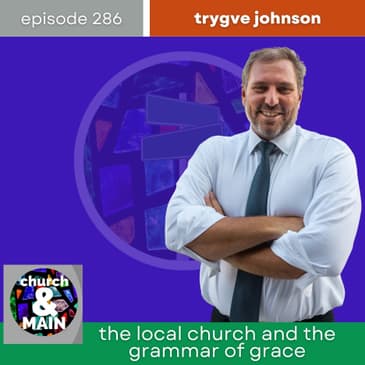

What happens when a local church closes? More than a building goes dark — something essential to the fabric of community disappears with it. Trygve Johnson, executive director of the Preach For Foundation, joins Dennis to talk about why the local church matters more than most people realize and what is lost when congregations vanish from our neighborhoods.
Drawing from his three-part Substack series When the Lights Go Out, Trygve introduces the idea of the "grammar of grace" — the underlying cadence of forgiveness, belonging, and second chances that the church offers to the broader culture. When that grammar goes silent, we are left with little more than meritocracy, isolation, and the exhausting pressure to perform our way into being loved.
The conversation moves from the social utility of the church to something deeper — the sacramental and theological vision of a community that does not need to earn its place at the table because, as Trig puts it, the church is the table. Along the way, Dennis and Trig talk about recruiting the next generation of pastors, the importance of Wednesday potlucks, why Jesus apparently refused to serve bad wine, and what it means to practice resurrection in a season of anxiety and decline.
Shownotes:
When the Lights Go Out Part One
When the Lights Go Out, Part Two
When the Lights Go Out, Part Three
Join the Church and Main Email List
Facebook | Instagram | Threads | Twitter | Website | YouTube
00:00:26 --> 00:00:30 Hello, everyone, and welcome to Church and Main, a podcast for people interested
00:00:30 --> 00:00:34 in the intersection of faith, politics, and culture.
00:00:35 --> 00:00:37 I'm Dennis Sanders, your host.
00:00:39 --> 00:00:40 So, there was a story in the New
00:00:40 --> 00:00:46 York Times last year, and it focused on a Lutheran pastor in Wisconsin.
00:00:46 --> 00:00:53 He was in charge or pastoring a small congregation in southeastern Wisconsin,
00:00:54 --> 00:00:58 And he was someone that took social justice very seriously. Now,
00:00:58 --> 00:01:01 there is nothing wrong with that. In fact, that's kind of important.
00:01:02 --> 00:01:07 He made himself known in public meetings like school boards and city councils.
00:01:08 --> 00:01:13 And he was someone that was always kind of wanting to do battle with the religious right.
00:01:14 --> 00:01:23 Now, in 2025, the IRS relaxed a kind of a something that had been called the
00:01:23 --> 00:01:27 Johnson Amendment, which kind of prohibited the.
00:01:30 --> 00:01:35 Religious bodies, pastors from publicly endorsing candidates.
00:01:36 --> 00:01:40 And since that was relaxed by the Trump administration, the pastor decided he
00:01:40 --> 00:01:47 was going to publicly endorse New York congresswoman Alexandria Ocasio-Cortez for president.
00:01:49 --> 00:01:53 Now, as he was planning on doing that from the pulpit on a Sunday,
00:01:56 --> 00:02:00 leaders in his denomination which is the evangelical lutheran church in america
00:02:00 --> 00:02:06 or elca basically said he could not do that even though there was an amendment
00:02:06 --> 00:02:08 now that said the amendment was basically dropped.
00:02:11 --> 00:02:17 They did not want him to do that so the pastor decided to not only leave the
00:02:17 --> 00:02:23 church but leave his pastoral ministry in order to give his endorsement and
00:02:23 --> 00:02:25 that sent the local church reeling.
00:02:26 --> 00:02:29 Now, as I said, it had been struggling for years.
00:02:30 --> 00:02:34 It was kind of just kind of hanging on. And now this.
00:02:35 --> 00:02:40 Now, the bishop, the local bishop and other church leaders did come and offer
00:02:40 --> 00:02:43 comfort for the church. But the thing that stuck with me was how the people
00:02:43 --> 00:02:46 wondered aloud, who was going to take care of them?
00:02:47 --> 00:02:50 Was their congregation going to survive?
00:02:52 --> 00:02:54 Now, I bring up this story not to necessarily.
00:02:57 --> 00:03:00 Say something critical about the pastor, though there is a lot,
00:03:00 --> 00:03:05 I think, that you could say critically about the pastor, but that's for another episode.
00:03:06 --> 00:03:09 But it did bring up a question about the local church.
00:03:10 --> 00:03:11 Does it matter?
00:03:12 --> 00:03:16 This church in Wisconsin was just struggling.
00:03:16 --> 00:03:22 It was a small little congregation, and they wondered, they wanted a pastor
00:03:22 --> 00:03:29 that was going to help them, help them into the next years in their ministry.
00:03:30 --> 00:03:36 And there are lots of churches like that, churches that are trying to hang on,
00:03:36 --> 00:03:39 not necessarily with those kinds of pastors, but are trying to hang on,
00:03:39 --> 00:03:41 and many of them end up closing.
00:03:42 --> 00:03:47 So, does that matter? Does it matter if there is a local church that seizes
00:03:47 --> 00:03:51 its ministry when there happen to be others down the street?
00:03:52 --> 00:03:59 And what impact does all of these kind of the vanishing of the local church have on our society?
00:04:01 --> 00:04:07 For Trigby Johnson, this is a problem. He recently wrote a three-part series
00:04:07 --> 00:04:13 on his sub stack, which is called the Kingfisher Study, that is called When the Lights Go Out.
00:04:13 --> 00:04:18 And in it, he talks about kind of what happens when communities lose congregations.
00:04:18 --> 00:04:21 And he talks about that on a social level, and that's important.
00:04:22 --> 00:04:28 But he also says that it loses something even more. Something that is really
00:04:28 --> 00:04:32 needed in our society today, the grammar of grace.
00:04:32 --> 00:04:37 So today, I'm going to talk about this with Trigby Johnson.
00:04:37 --> 00:04:42 But before we have that conversation, a little bit about Trigby. He served as the,
00:04:43 --> 00:04:48 Hinga Bozmer Dean of Chapel at Hope College in Holland, Michigan,
00:04:48 --> 00:04:55 where he oversaw Christian life and formation for a campus of over 3 students and 750 employees.
00:04:58 --> 00:05:05 Since that time, he now serves as the executive director of a nonprofit called
00:05:05 --> 00:05:07 the Preach Four Foundation.
00:05:08 --> 00:05:15 He is an ordained minister in the Reformed Church in America and is married to Dr.
00:05:15 --> 00:05:21 Kristen Dede Johnson, who is a writer, theologian, and currently principal of
00:05:21 --> 00:05:26 Wycliffe College in Toronto, Canada, and was previously the dean at Western
00:05:26 --> 00:05:29 Theological Seminary, which is also in Holland, Michigan.
00:05:30 --> 00:05:35 And together, they have two children, Trigvie Jr. and Ella.
00:05:35 --> 00:05:40 So, with all of that, here is my conversation on the need for the local church
00:05:40 --> 00:05:43 and the need for grace with Trigvie Johnson.
00:06:04 --> 00:06:07 Well, Trigby, thank you for being on the podcast.
00:06:08 --> 00:06:14 I always like to start this off by kind of knowing a little bit about you and
00:06:14 --> 00:06:16 who you are and what you do.
00:06:18 --> 00:06:23 Well, Dennis, thank you for the invitation. It's great to talk with you.
00:06:25 --> 00:06:30 My name is, as you said, it's Trigby Johnson. My friends call me Trig, so just call me Trig.
00:06:31 --> 00:06:35 I am the executive director of what's called the Preach For Foundation.
00:06:35 --> 00:06:42 It is an organization that's new, that is designed, built, commissioned to identify,
00:06:43 --> 00:06:46 nurture, and empower future exceptional leaders for the church.
00:06:47 --> 00:06:52 So part of what we do, think of Preach For as almost like Teach for America, but for the church.
00:06:53 --> 00:06:57 We want to place really gifted people who are natural-born leaders,
00:06:59 --> 00:07:03 have demonstrated that, and placing them in congregations where we help pay
00:07:03 --> 00:07:06 a living wage for two years,
00:07:07 --> 00:07:14 and help provide an opportunity for a master's in theology and ask the church
00:07:14 --> 00:07:16 to help provide a pastoral and lay mentor.
00:07:17 --> 00:07:20 What we're trying to do is engage the problem of why are some of our best and
00:07:20 --> 00:07:23 brightest not even considering ministry anymore?
00:07:24 --> 00:07:28 It's not even on the radar. I mean, these are like kids that go to college and
00:07:28 --> 00:07:33 they're involved in ministries and they care deeply about God and faith,
00:07:33 --> 00:07:35 but no one's actually encouraged them.
00:07:36 --> 00:07:41 Have you ever thought about being a pastor or depending upon your tradition, a priest?
00:07:41 --> 00:07:44 Have you ever thought about a life in service to the church?
00:07:46 --> 00:07:55 We don't do that right now. And so I'm really committed to trying to,
00:07:55 --> 00:08:01 A, raise the level of conversation that the church really matters for us right now.
00:08:02 --> 00:08:05 Also, Bird Dog, really gifted leaders.
00:08:06 --> 00:08:10 Um, you know, so here's my example. Like you want to, you're from Michigan.
00:08:10 --> 00:08:14 I don't know if you're a university of Michigan fan, maybe Michigan state,
00:08:15 --> 00:08:19 Michigan state. All right. Well, all right. We'll go to Michigan state. We'll go to Izzo.
00:08:19 --> 00:08:24 Izzo, Izzo wants to play for national championship, right? Hey, that's our stated goal.
00:08:25 --> 00:08:30 He does not wait until the first day of practice to see who shows up.
00:08:32 --> 00:08:35 But that's often how the church is doing talent acquisition right now.
00:08:37 --> 00:08:41 We just kind of wait to see who's generally called. And I think,
00:08:41 --> 00:08:43 no, no, no, no, no, no, no, no.
00:08:44 --> 00:08:51 We need to go out and we need to recruit people who are really gifted to do
00:08:51 --> 00:08:54 this work of leadership in the church because the church matters.
00:08:54 --> 00:08:58 It's the one thing Jesus promised to build in this world was his church.
00:08:59 --> 00:09:08 It is the body of jesus it really really matters and when a church is flourishing,
00:09:09 --> 00:09:15 it's not rocket science it often has really good wise intelligent gifted pastors,
00:09:15 --> 00:09:20 and it takes years years to form a pastor and so you got to get them early we
00:09:20 --> 00:09:24 got to go out and recruit we got to we got to celebrate i am banging the drum
00:09:24 --> 00:09:28 right now let's love our church again let's love our pastors again.
00:09:28 --> 00:09:32 Let's recruit some of the youngins and empower them and invest in them.
00:09:32 --> 00:09:36 Why? Because the church, Matt, when the church is healthy, it is leaven that
00:09:36 --> 00:09:41 brings up the water table for everyone in a community, whether you go to church or not.
00:09:43 --> 00:09:51 And I just believe that 100%. And I think the church is one of the most powerful,
00:09:52 --> 00:09:54 gifts of good that the world has ever seen.
00:09:56 --> 00:10:02 You know, you can uh you know the historian um uh.
00:10:05 --> 00:10:10 Tom Holland in his book, Dominion, who's not a Christian, basically talks about
00:10:10 --> 00:10:14 the Christian revolution of saying that the church has been the most in the church.
00:10:14 --> 00:10:20 And I say slash gospel, the church, the Christian movement has been a revolution that has,
00:10:21 --> 00:10:26 absolutely upended the basic assumptions in world history of what it means to
00:10:26 --> 00:10:31 be human, of what it means, what justice looks like, of what.
00:10:32 --> 00:10:34 Caring for people looks like.
00:10:34 --> 00:10:39 It is, it's, and he's arguing this as a secular historian, like saying this
00:10:39 --> 00:10:41 is just clear from the, from the history.
00:10:42 --> 00:10:46 Well, we're in a moment right now that is so cynical and everything we hear,
00:10:46 --> 00:10:51 and many times rightly, Dennis, is about what's wrong with the church,
00:10:51 --> 00:10:54 how abusive pastors are, how narcissistic they are.
00:10:55 --> 00:10:59 And to be true, when that is true, that has to be engaged. Absolutely.
00:11:00 --> 00:11:04 But it's also not the whole story. And it's not, I believe, the norm.
00:11:05 --> 00:11:10 My experience with pastors are incredibly cruciform leaders who are doing the
00:11:10 --> 00:11:16 hard, uncelebratory work of calling people and pouring into their lives and
00:11:16 --> 00:11:20 investing in them and making their corner of the world a better place.
00:11:21 --> 00:11:25 I think that's heroic. I think that needs to be celebrated.
00:11:25 --> 00:11:30 I think I want to call in a young generation to fall in love with the romance
00:11:30 --> 00:11:38 of ministry again Because I believe in it um, so Your original question What do I do?
00:11:38 --> 00:11:42 I'm trying to do all of that and then some and preach floor is an organization
00:11:42 --> 00:11:44 We're brand new. We're just getting started.
00:11:44 --> 00:11:49 We're about to launch our first cohorts first cohort of people um.
00:11:50 --> 00:11:57 And, you know, young, young, committed Christians who want to explore what life
00:11:57 --> 00:11:58 in the church looks like.
00:11:58 --> 00:12:02 And I couldn't be more excited, couldn't be more excited to walk alongside them,
00:12:03 --> 00:12:08 to kind of be a Sherpa for them into the high country of the Trinity where the
00:12:08 --> 00:12:12 air is thin and the glory is thick, brother. That's, that's where I want to live.
00:12:13 --> 00:12:17 So anyway, that's, sorry for the diatribe.
00:12:18 --> 00:12:23 Dad, you're not going to get a complaint from me.
00:12:25 --> 00:12:28 You know, one of the things that, the reason I wanted to talk to you,
00:12:28 --> 00:12:34 because you kind of wrote a three-part series on your sub stack called When the Lights Go Out.
00:12:34 --> 00:12:42 And, you know, the first one was really fascinating and talking about that from the social aspects.
00:12:42 --> 00:12:47 And I want to get to kind of the second one, because that's really kind of the
00:12:47 --> 00:12:49 heart of the matter. The grammar of grace, yeah. Yeah.
00:12:51 --> 00:12:55 But the first one is kind of interesting because you kind of talk about really
00:12:55 --> 00:13:01 the importance of the local church in a lot of different reasons,
00:13:02 --> 00:13:07 especially when it comes to social things that, you know, what happens when a church closes.
00:13:08 --> 00:13:15 And I think especially in my tradition, which is the Disciples of Christ,
00:13:16 --> 00:13:19 we're familiar with closing a lot of churches.
00:13:19 --> 00:13:23 And I think sometimes we don't really understand what happens when a church
00:13:23 --> 00:13:27 closes, or we think it's just kind of what happens.
00:13:27 --> 00:13:33 But you kind of explain something big does happen there, and would love to kind
00:13:33 --> 00:13:35 of hear you talk a little bit more about that.
00:13:36 --> 00:13:40 Yeah, I mean, we can get to the second one, but I intentionally put that first
00:13:40 --> 00:13:50 one first, is that the church is a human organization that does and gathers human activity.
00:13:52 --> 00:13:55 And, you know, I grew up in kind of the cinder block basement,
00:13:55 --> 00:14:00 you know, hand buns on weekend on the on, you know, Wednesday potlucks like,
00:14:00 --> 00:14:04 hey, I'm all for 100% bring back the potluck Wednesday potluck,
00:14:05 --> 00:14:07 you family, family potluck at the church.
00:14:08 --> 00:14:10 I'm that guy. I love the church. I love the big church, little church,
00:14:10 --> 00:14:13 small church, city church, rural church.
00:14:14 --> 00:14:18 Hanging a shingle outside the storefront church.
00:14:19 --> 00:14:23 I love it. I just love church. And one of the reasons why I love church is that,
00:14:24 --> 00:14:28 churches are like the tree described in Psalm 1.
00:14:29 --> 00:14:32 They shall be like trees planted by streams of water which yield their fruit
00:14:32 --> 00:14:35 in its season, whose leaf never withers, and in all that they do they prosper.
00:14:36 --> 00:14:39 A tree is a stabilizer to the soil.
00:14:40 --> 00:14:44 A tree provides a canopy of shade for those that are in need.
00:14:44 --> 00:14:48 It provides food for the hungry. It provides strong limbs for children to climb
00:14:48 --> 00:14:54 and play on it it changes with the seasons right and it's stable,
00:14:55 --> 00:15:02 that's what a church is it's like that tree it roots a community and when a church goes dark,
00:15:03 --> 00:15:10 when you it it hurts the whole community whether that community recognizes it
00:15:10 --> 00:15:13 or not you want to demolish a geography get rid of the trees.
00:15:15 --> 00:15:21 And all of a sudden you don't have that natural filter to take in all the poison
00:15:21 --> 00:15:27 gas of carbon dioxide and recycle it with fresh air that's what the church is supposed to be,
00:15:28 --> 00:15:34 on a social level on a civic level when a church is healthy it is it's helping
00:15:34 --> 00:15:36 school systems and hospitals and,
00:15:37 --> 00:15:40 legal systems and social services.
00:15:40 --> 00:15:46 A church is a stabilizer in a community that offers food pantries and places
00:15:46 --> 00:15:50 for people to talk about addictions in a safe place.
00:15:50 --> 00:15:53 It is the place where you can be safe, ideally.
00:15:54 --> 00:15:59 I know, I know, Dennis, not everyone has that experience or has had that experience of church.
00:15:59 --> 00:16:04 I want to own that and I don't want to, I am not I'm not a romantic Pollyanna,
00:16:04 --> 00:16:06 my head in the sand. I'm not that guy.
00:16:07 --> 00:16:11 And yet at the same time, I believe in Jesus Christ. I believe he was resurrected.
00:16:11 --> 00:16:14 I believe Jesus is at the right hand of the Father right now,
00:16:14 --> 00:16:16 interceding for it. I believe this.
00:16:17 --> 00:16:19 I think it's ontologically true.
00:16:20 --> 00:16:25 And that means that God shows up through people in his church.
00:16:25 --> 00:16:31 And that church is meant to love that place, that community, that neighborhood.
00:16:33 --> 00:16:37 We got to get over the addiction in America, that the only way you can be flourishing
00:16:37 --> 00:16:41 is to be big and powerful and play the empire game.
00:16:42 --> 00:16:45 That's not what the church is for ever.
00:16:47 --> 00:16:53 But it is, we are called to cruciform. We are called to submit our lives to
00:16:53 --> 00:16:57 this neighborhood, to this place, to these people, and show up for them.
00:16:57 --> 00:17:01 And when those churches go dark, those people in the neighborhood do not have
00:17:01 --> 00:17:04 somebody to provide that space.
00:17:06 --> 00:17:14 And then it's tooth and claw. You want to see how quickly culture is going to collapse?
00:17:15 --> 00:17:20 Watch as the churches go dark How quickly we start Of.
00:17:23 --> 00:17:27 Degenerate into our worst selves. You could argue we're already there.
00:17:27 --> 00:17:28 I don't quite think we're there.
00:17:29 --> 00:17:34 You know, there's a conversation around that. And again, I am not calling for
00:17:34 --> 00:17:40 a clarion retrieval to, you know, make the church great again.
00:17:40 --> 00:17:43 That's not what I'm talking about. I'm not talking about that there's some golden
00:17:43 --> 00:17:48 age where the church had it all figured out. That's never happened.
00:17:48 --> 00:17:54 I am talking about the Christians who are trying to follow Jesus to reclaim
00:17:54 --> 00:17:59 the church. It's a primary community that is a Paulos.
00:18:01 --> 00:18:06 The church is an ecclesia. It comes out of a tradition of the assembly.
00:18:07 --> 00:18:11 You can't be a Christian by yourself. You are a Christian in community.
00:18:12 --> 00:18:15 And so that is our i think our primary politic,
00:18:17 --> 00:18:22 you know i'm a i live in toronto right now dennis but i'm a proud citizen of
00:18:22 --> 00:18:26 the united states of america and i would describe myself as a patriot but not a nationalist,
00:18:27 --> 00:18:31 i don't i don't the only nationalism that matters for me is the kingdom of god,
00:18:32 --> 00:18:34 and my baptism is my passport,
00:18:37 --> 00:18:47 I want the church to be a place where young and old, women and men.
00:18:49 --> 00:18:54 Everything, they find their identity in the church, in Christ, in the baptism.
00:18:55 --> 00:19:02 And when that happens, it makes your whole community, the air is better to breathe.
00:19:04 --> 00:19:08 Because it's a place where it can recycle that poison gas going on in culture,
00:19:08 --> 00:19:18 and it can recycle it for forgiveness and second chances and healing and reconciliation.
00:19:19 --> 00:19:21 It's a place to say, yeah, I was wrong.
00:19:22 --> 00:19:27 It's a place you can be loved. It's a place where your name will be known and your story will be told.
00:19:28 --> 00:19:31 It's a place where your pastor will come alongside you when you're sick.
00:19:32 --> 00:19:34 And when you're first born.
00:19:37 --> 00:19:40 That church is going to love that kid, man. I grew up in an atmosphere.
00:19:40 --> 00:19:44 I don't know about you, Dennis, but I grew up in a church that was very humble.
00:19:45 --> 00:19:49 People I haven't spoke to in 20 years, if I picked up the phone today and said,
00:19:49 --> 00:19:56 hey, I'm in trouble, I know they would be on the first plane because I was part of the church.
00:19:57 --> 00:20:06 It's just the code. I love that. I need more of that So that's what's lost I
00:20:06 --> 00:20:08 think when the churches Go dark,
00:20:09 --> 00:20:13 I don't know if that's a helpful answer, but. It is.
00:20:13 --> 00:20:17 Do you think that there is a sense sometimes in our culture that we don't think
00:20:17 --> 00:20:19 that churches matter that much?
00:20:20 --> 00:20:23 Yes. That's exactly what I'm putting my finger on.
00:20:23 --> 00:20:30 I think we think they don't matter. I think that we think that the pastoral life is second tier.
00:20:31 --> 00:20:35 I think that we think that it's one of the reasons why we're not encouraging
00:20:35 --> 00:20:39 our best and brightest, really best leaders to think about the church.
00:20:39 --> 00:20:43 Investment banking, yes. Law school, yes. Medicine, yes.
00:20:44 --> 00:20:47 Education, yes. But the church?
00:20:48 --> 00:20:52 The church? Why would we go and invest in the church? We don't think the church matters.
00:20:53 --> 00:20:58 And that's part of what I'm trying to engage, is to say, no,
00:20:58 --> 00:21:02 no, no, that's a wrong mentality. The church matters. Again,
00:21:02 --> 00:21:04 it is the one thing Jesus promised to build.
00:21:06 --> 00:21:10 It is his body. we can have debates about what,
00:21:11 --> 00:21:17 ecclesially that looks like in different traditions that's a family conversation
00:21:17 --> 00:21:21 it's a fair conversation but can we all just agree as christians,
00:21:22 --> 00:21:29 catholic protestant orthodox can we all just agree that the church matters and
00:21:29 --> 00:21:33 live as if it does because i really believe, I really believe this.
00:21:33 --> 00:21:39 If we actually got that and engaged that with that kind of like imaginative
00:21:39 --> 00:21:46 and moral seriousness, so much would be engaged that would be better.
00:21:48 --> 00:21:51 Right now, people are isolated. And when they're in isolation,
00:21:51 --> 00:21:55 they go to their corners and they start fighting and they start, amen.
00:21:56 --> 00:22:01 The church, I believe, offers an alternative way of life that is a better way
00:22:01 --> 00:22:06 of life because the gospel calls us to something more human.
00:22:09 --> 00:22:13 And I mean, that leads to that second essay, which I think, as I said before,
00:22:13 --> 00:22:15 is the heart of the essay.
00:22:16 --> 00:22:20 And if it had another—well, it does have another title, and it's The Grammar of Grace, and that,
00:22:22 --> 00:22:28 without the church, or at least with the church not having a more major role,
00:22:29 --> 00:22:36 in your essay, and I think I would agree with it, is that we lose that sense of grace in our lives,
00:22:37 --> 00:22:43 and that the world becomes in a lot of ways a much colder place because that
00:22:43 --> 00:22:48 grace is just kind of not there or not not proclaimed i should say,
00:22:49 --> 00:22:55 yeah and i use that term the grammar of grace because grammar is like underneath the language,
00:22:56 --> 00:23:00 you don't really notice it but it's like what holds a sentence construction
00:23:00 --> 00:23:06 together and grace is one of those things for us in our human experience that, man,
00:23:07 --> 00:23:13 if there is no grace, all there is in pain is.
00:23:16 --> 00:23:21 Scapegoating, kicking people out, excommunication, canceling.
00:23:22 --> 00:23:25 There's no path for repentance.
00:23:26 --> 00:23:30 Justice just demands retribution without grace.
00:23:32 --> 00:23:37 It's what justice demands. And when a culture loses any sense of imaginative possibility,
00:23:38 --> 00:23:44 that there is a word outside of our experience that can speak into whatever
00:23:44 --> 00:23:48 failure, whatever pain, whatever moment, individually, corporately,
00:23:48 --> 00:23:52 that says there is another word over you than just failure.
00:23:53 --> 00:23:56 That there is a word called beloved.
00:23:57 --> 00:24:03 That's your name, if there is no word outside of the cul-de-sac of my experience,
00:24:04 --> 00:24:11 all you are left with at the end of the day is just self-help, self-improvement,
00:24:12 --> 00:24:17 pull yourself up by your bootstraps, and it's so fatiguing that it leads to
00:24:17 --> 00:24:22 either nihilism or despair if you're really, really honest with it.
00:24:23 --> 00:24:29 And the gospel is fundamentally not about moral performance.
00:24:30 --> 00:24:34 The gospel is not about just being a better you.
00:24:35 --> 00:24:41 The gospel is not about just activism. The gospel can encourage all of us.
00:24:41 --> 00:24:43 Those aren't bad things.
00:24:43 --> 00:24:48 But the gospel is God's word over you that speaks in from the outside into you,
00:24:48 --> 00:24:53 breaks through the kind of like the blockade of your cul-de-sac and says,
00:24:53 --> 00:24:57 no, there's another way out. I want to get you out of this cage, out of this cul-de-sac.
00:24:58 --> 00:25:02 And I want you to follow me into that, what I like to call that wide open country of salvation.
00:25:02 --> 00:25:09 I want you to find your feet on a narrow trail that leads into the topography that is expansive.
00:25:09 --> 00:25:14 And oh my God, the views there, the vistas, the valleys, the mountaintops,
00:25:14 --> 00:25:20 and the trees, my God, the trees and the rivers, they flow and it's beautiful,
00:25:21 --> 00:25:25 that is the world God created for us to be in and the only way to get out of
00:25:25 --> 00:25:27 that cul-de-sac the only key that can unlock it is grace.
00:25:29 --> 00:25:35 And when the churches go dark, the cadence of that grammar is lost.
00:25:37 --> 00:25:45 And we're just thrown back on ourselves. And that is terrifying. Because I am not enough.
00:25:47 --> 00:25:54 And it just leads to a kind of isolation, a loneliness that is worse than death.
00:25:55 --> 00:26:03 And grace is the invitation into a beloved community. Grace is the invitation to a new identity.
00:26:03 --> 00:26:06 Grace is the opportunity for belonging.
00:26:08 --> 00:26:15 Grace is the recipe for every human being to find their deep purpose.
00:26:16 --> 00:26:21 That maybe we were made for more than an algorithm More for just clocking hours
00:26:21 --> 00:26:24 Maybe we exist for something that God created,
00:26:26 --> 00:26:29 That would be knit together in justice, fulfillment, and delight What the old
00:26:29 --> 00:26:31 time was called Shalom, right?
00:26:31 --> 00:26:42 That's our purpose The church exists to keep that story alive for us And when
00:26:42 --> 00:26:46 the churches go dark when we lose the grammar of grace.
00:26:49 --> 00:26:55 The darkness wins and I'm a gospel of John Guy Dennis so I believe with all
00:26:55 --> 00:26:59 my heart that the light shines in the darkness and the darkness cannot overcome
00:26:59 --> 00:27:03 it and Jesus is the light from true light,
00:27:05 --> 00:27:15 he is a way for us to be more fully human and again not moral performance though the gospel is moral.
00:27:16 --> 00:27:21 But the point isn't that. The point is God enters in and does what we can't
00:27:21 --> 00:27:23 do for ourselves because God loves us.
00:27:25 --> 00:27:29 More of that, please. More love. More love.
00:27:32 --> 00:27:36 Do you think that the church has fumbled when it comes to,
00:27:38 --> 00:27:43 communicating, proclaiming grace, supporting communities?
00:27:44 --> 00:27:48 I can only say yes, because I have fumbled and I'm part of the church.
00:27:48 --> 00:27:51 Like, I don't want to paint the church as other.
00:27:53 --> 00:27:56 I am the church. I have failed every single day. I failed to live it.
00:27:56 --> 00:27:59 I failed to proclaim it. I fail.
00:28:02 --> 00:28:08 And yet that's not my story one of the reasons why I think the church is true
00:28:08 --> 00:28:12 is it's still here despite our best efforts to be so terrible,
00:28:13 --> 00:28:18 it's still here the only logical thing I can think about why the church still
00:28:18 --> 00:28:22 is here is that God continues to sustain it it's like the biggest proof of God's
00:28:22 --> 00:28:25 existence because we're so bad at it.
00:28:28 --> 00:28:33 And yet we're still at it And I find that hopeful. I think the church is clumsy.
00:28:33 --> 00:28:38 I think the church is, I think we're, and of course it is because it's filled with sinners.
00:28:39 --> 00:28:43 You know, like we don't, we don't join the church because we got to figure it
00:28:43 --> 00:28:45 out. We join the church because we don't.
00:28:45 --> 00:28:51 And we're all trying to figure out our own traumas and our own pains and our own stories.
00:28:52 --> 00:28:55 And my God, I just want it to be a place where we can do that with some like,
00:28:57 --> 00:28:58 extended mercy and grace.
00:28:59 --> 00:29:05 I want it to be a place where our best selves are experienced and found.
00:29:05 --> 00:29:09 And often I know that it isn't, and I say that it isn't because I haven't done
00:29:09 --> 00:29:13 that. You know, I have failed in the church. I have hurt people in the church.
00:29:14 --> 00:29:16 I had been hurt by the church.
00:29:17 --> 00:29:19 People in the church have hurt me.
00:29:20 --> 00:29:25 But my experience isn't the measure of its reality or consequence.
00:29:25 --> 00:29:32 And so again, my circumstances are not defined by, you know,
00:29:32 --> 00:29:38 my faith is not defined by my circumstances. My circumstances are defined by this faith and this God.
00:29:40 --> 00:29:45 And there's nothing in the Bible that says that church is going to be easy or clean or perfect.
00:29:45 --> 00:29:49 And so it's always going to be open to the charge of hypocrisy because it's
00:29:49 --> 00:29:54 full of hypocrites, because it's full of people, because that's what we are.
00:29:54 --> 00:29:57 We're all conflicted, you know.
00:29:59 --> 00:30:05 So the church is complex The church has done a really poor job I think of,
00:30:06 --> 00:30:13 It wants to often find its sense of meaning and power And that's when we are
00:30:13 --> 00:30:15 at our worst selves I think,
00:30:17 --> 00:30:21 And there's lots of temptations We all want to be powerful We all want to find
00:30:21 --> 00:30:24 meaning And we all want to feel important I get it,
00:30:26 --> 00:30:33 Yet, isn't that the temptation from the devil to Jesus, right?
00:30:34 --> 00:30:37 Take him up on the top. Hey, you could be really powerful. I'd give you all of this.
00:30:38 --> 00:30:42 And again and again, Jesus had to resist these temptations. I think the hard
00:30:42 --> 00:30:46 part where we've really failed is we have done a very poor job of resisting
00:30:46 --> 00:30:52 the temptations of what makes the world successful.
00:30:53 --> 00:30:58 Quote unquote we're not we're not very and i'm speaking more particularly of
00:30:58 --> 00:31:03 of american christianity and probably mostly,
00:31:04 --> 00:31:09 what i'm really speaking to is white american evangelical christianity and i
00:31:09 --> 00:31:12 would say white waspy high church uh.
00:31:13 --> 00:31:19 Mainline too right i'm speaking to that because that's out of where I'm from.
00:31:19 --> 00:31:26 And it's often we have lost the plot and we have lost confidence in a transcendent
00:31:26 --> 00:31:28 God that becomes imminent.
00:31:29 --> 00:31:33 And so then we try to problem solve on our own. And that's when we're bad.
00:31:34 --> 00:31:39 And then we, you know, we want the church to look and feel like the world so
00:31:39 --> 00:31:43 that we don't look out of place or awkward, which again is one of the reasons
00:31:43 --> 00:31:46 why we don't want our young adults to be pastors because, you know,
00:31:48 --> 00:31:53 Who wants to invite the pastor over for Thanksgiving? And if that pastor is
00:31:53 --> 00:31:59 your son or daughter, my God, it's all weird. There's three things you're never allowed to talk about.
00:32:00 --> 00:32:07 Religion, politics, and money. My dad's a banker. My sister's in politics,
00:32:07 --> 00:32:11 and I'm a preacher. So Thanksgiving's fun for us.
00:32:15 --> 00:32:20 Yeah, I'm wondering, when you talk about, in the first essay,
00:32:20 --> 00:32:26 about the recovering the romance of pastoral calling,
00:32:27 --> 00:32:34 is if there is a link there between our kind of modern sensibility where we lack,
00:32:35 --> 00:32:37 we don't trust a transcendent God.
00:32:38 --> 00:32:42 That we don't in some ways expect God to show up and that we feel like it's on us.
00:32:43 --> 00:32:47 And that maybe, I mean, is there a kind of a connection there?
00:32:47 --> 00:32:52 Because I sometimes see that in how people view the ministry.
00:32:53 --> 00:32:56 If you're, I don't know if you're familiar with the work of Charles Taylor,
00:32:56 --> 00:32:58 Taylor, the secular age, right?
00:32:58 --> 00:33:04 So he talks about the disenchanted age that, you know, once upon a time it would
00:33:04 --> 00:33:07 be impossible to grow up or live in,
00:33:08 --> 00:33:14 the civic world in any serious way without the idea that God existed.
00:33:16 --> 00:33:22 We have now constructed a world where that is not a normal, necessarily even
00:33:22 --> 00:33:25 necessary assumption, nor an easy one to embrace.
00:33:27 --> 00:33:32 And underneath of that then becomes, this is part of the loss of the grammar of grace.
00:33:32 --> 00:33:36 When there is no grammar of grace, you lose the capacity to believe that there
00:33:36 --> 00:33:43 is a transcendent that speaks in. And if there is no transcendence, where's the wonder?
00:33:44 --> 00:33:48 Again you're just throwing back on yourself so i'm very much pressing in on
00:33:48 --> 00:33:57 a cultural moment that assumes that the transcendent um isn't something to even look for,
00:33:58 --> 00:34:05 and yet and yet and yet again and again the human heart aches for that trend
00:34:05 --> 00:34:10 you feel it in the sunset you feel it walking into a cathedral.
00:34:10 --> 00:34:13 You feel it listening to Avopar.
00:34:14 --> 00:34:20 You feel it listening to Bach cellos.
00:34:20 --> 00:34:25 There is something that pulls at the human heart that says there is something
00:34:25 --> 00:34:27 outside of us that matters.
00:34:27 --> 00:34:30 If there is no transcendence, there is no real beauty.
00:34:31 --> 00:34:36 And this is, I'm echoing now C.S. Lewis, where he talks about those echoes of
00:34:36 --> 00:34:40 beauty are actually the signposts to the transcendent, reminding us that we
00:34:40 --> 00:34:41 were made for a different home.
00:34:43 --> 00:34:45 Not as an escape hatch from this home.
00:34:46 --> 00:34:51 He doesn't mean it that way, but as a way to say, no, no, this world is enchanted.
00:34:53 --> 00:34:57 I'm a Christian dentist, partly because I'm intoxicated with wonder.
00:35:00 --> 00:35:04 I think this whole damn world is just so beautiful.
00:35:08 --> 00:35:12 The small things, the quotidian mysteries,
00:35:15 --> 00:35:19 the little exchanges you have with a stranger, the shadows, the different colors
00:35:19 --> 00:35:21 of green. Take your pick.
00:35:23 --> 00:35:29 It's all just so enchanting. And I just think, what if that enchantment was
00:35:29 --> 00:35:33 a gift from the gift giver for us to just enjoy?
00:35:36 --> 00:35:41 There's a kind of rabbinic saying that says that God is not going to be upset
00:35:41 --> 00:35:46 at the things we did or didn't do. God's going to be upset at the things that we didn't enjoy.
00:35:49 --> 00:35:55 And I like that. And it goes to the idea that God just made the world,
00:35:55 --> 00:35:59 called it good, and that good was intrinsic in and of itself.
00:36:01 --> 00:36:08 And part of, I think, for the church is to reclaim an intrinsic wonder of this
00:36:08 --> 00:36:12 world and believe that it matters.
00:36:13 --> 00:36:16 You know, so, I mean, that can launch us into creation care.
00:36:16 --> 00:36:18 That can launch us into politics.
00:36:18 --> 00:36:21 That can launch us lots of different directions, obviously. But it begins with
00:36:21 --> 00:36:27 this idea that there is a God whose transcendent is also imminent.
00:36:27 --> 00:36:31 So I love like the opening scene of the Bible, right? You get these two creation narratives.
00:36:31 --> 00:36:37 Genesis 1 is this really transcendent God from outside speaking in.
00:36:37 --> 00:36:43 There's chaos, orders the chaos into the seven days that all build upon.
00:36:43 --> 00:36:49 You know, day two fulfills, you know, day four, day three fulfills day five,
00:36:49 --> 00:36:52 day six fulfills day six. All of it. It all builds together. Beautiful.
00:36:53 --> 00:36:57 And then in Genesis 2, you get the imminent God. You get the God who's like,
00:36:57 --> 00:37:00 his hands are in the dirt. He's breathing in.
00:37:00 --> 00:37:04 He's right there face to face that's the story.
00:37:05 --> 00:37:11 God is both transcendent and imminent it is that genesis one of two foreshadows jesus who is,
00:37:12 --> 00:37:17 word made flesh he is the eternal all eternal and all human at the same time
00:37:17 --> 00:37:24 this the the paradox that you can't explain um man i just think that's awesome that's so cool,
00:37:25 --> 00:37:28 this is beautiful um and that kind
00:37:28 --> 00:37:33 of wonder then takes me out into my neighborhood and helps me see people,
00:37:34 --> 00:37:39 and that person that i see man god made that person unique god made that individual
00:37:39 --> 00:37:41 the way they are that's beautiful,
00:37:43 --> 00:37:45 i don't need to be in competition i need To be in communion,
00:37:47 --> 00:37:57 I don't need to perform I need to participate That's That's what I think It's a war together And.
00:37:59 --> 00:38:03 That's part of what I worry is lost when churches go dark.
00:38:04 --> 00:38:08 We lose the romance. We lose the wonder.
00:38:09 --> 00:38:14 We lose the Wednesday potluck in the basement. Bring back the potluck, Dennis.
00:38:15 --> 00:38:20 Bring back the old ladies with the hand buns. Bring them back because there
00:38:20 --> 00:38:24 in that little, that's where we learn to participate.
00:38:24 --> 00:38:29 And we learn like, oh, I'm part of this intergenerational family.
00:38:30 --> 00:38:33 Of Christians. Man, that's so beautiful. What a gift to give a child.
00:38:34 --> 00:38:38 What a gift to give an elderly person that they're not forgotten,
00:38:38 --> 00:38:41 even though they're quote-unquote retired or in a nursing home,
00:38:41 --> 00:38:43 that their name still matters because they're part of the body,
00:38:43 --> 00:38:45 and I'm part of your body.
00:38:46 --> 00:38:48 That just seems like a good way to be alive.
00:38:49 --> 00:38:52 It just seems like a good way to be a human being to me.
00:38:55 --> 00:38:59 Um yeah anyway sorry you asked the preacher a question i just start i just start
00:38:59 --> 00:39:06 rolling no i i totally get it i mean one of the things that that um the church where i serve does,
00:39:08 --> 00:39:14 is and has done for a long time is every second sunday we have potluck and yeah
00:39:14 --> 00:39:18 there is something meaningful or right so it's right after worship and there
00:39:18 --> 00:39:21 is something meaningful about that and.
00:39:23 --> 00:39:30 And it is kind of where life is shared and where things, we actually know one another.
00:39:31 --> 00:39:41 And in some ways, it feels like the passage in the end of Acts 2 of the first believers.
00:39:42 --> 00:39:45 They devoted themselves to the apostles' teaching, to fellowship,
00:39:45 --> 00:39:48 to the breaking of bread and to prayer, right?
00:39:48 --> 00:39:52 That breaking of bread, God does really good things around food.
00:39:53 --> 00:39:57 I mean, if nothing else, if the church does nothing else but eat together,
00:39:57 --> 00:40:03 worship together, and eat together, man, I think you're on your way to flourishing.
00:40:05 --> 00:40:09 I really believe that. I come from a sacramental tradition. The table matters.
00:40:10 --> 00:40:12 Eating matters because Jesus is there.
00:40:14 --> 00:40:19 You know, not just as an idea, but it's like Jesus is here. I love that.
00:40:20 --> 00:40:24 And again, immediately there's transcendence in the imminent.
00:40:25 --> 00:40:27 There is the divine in the local.
00:40:28 --> 00:40:33 And I don't mean any harm by it. I just think that's cool.
00:40:35 --> 00:40:40 Yeah, because I think when you don't have that, you don't have that sense of
00:40:40 --> 00:40:44 transcendent, and I don't think you have the sense of grace either.
00:40:47 --> 00:40:51 And coming from a tradition where we have communion every Sunday,
00:40:52 --> 00:40:58 it seems to be a natural outgrowth to have that sacramental meal,
00:40:58 --> 00:41:00 but then actually another meal.
00:41:00 --> 00:41:05 And I don't know, Jesus seemed to do a lot of stuff around tables.
00:41:05 --> 00:41:08 Things seemed to happen when he was at a table.
00:41:09 --> 00:41:12 I love that story in John. You know, he's resurrected.
00:41:13 --> 00:41:18 And like he goes to the lake and he's like, hey, what are you guys cooking?
00:41:19 --> 00:41:22 What did you catch? He's concerned about the food.
00:41:24 --> 00:41:28 You know, and I just think as Christians, like one of the best things we could do is eat well.
00:41:29 --> 00:41:34 I don't mean eat a lot. I mean, eat well. um so one of my favorite shows is
00:41:34 --> 00:41:36 chef's table on netflix i don't,
00:41:37 --> 00:41:40 know if you've ever watched this but every episode is kind of a documentary
00:41:40 --> 00:41:47 of like a michelin star chef that explores the culture of the land the space
00:41:47 --> 00:41:49 of where this food comes from and how it's put together
00:41:50 --> 00:41:52 and it's like it makes me want to eat so well,
00:41:53 --> 00:41:57 and i think that's like oh because everything's a fruit of this creation that
00:41:57 --> 00:42:01 God has already made and putting these flavors and textures together.
00:42:02 --> 00:42:07 Like what if the church was a Michelin star place where people experience the
00:42:07 --> 00:42:11 best food and we eat well?
00:42:12 --> 00:42:16 I mean, I, you know, I've never given this sermon, but I've been close where,
00:42:17 --> 00:42:23 you know, Jesus first miracle in John is turning water to wine.
00:42:24 --> 00:42:26 The thing that no one ever talks about is that, you know.
00:42:28 --> 00:42:34 Yeah, it's a miracle there's water to wine, but then the declaration, this is the best wine.
00:42:35 --> 00:42:38 I'm convinced, Dennis, that Jesus just doesn't want to eat bad.
00:42:39 --> 00:42:43 He doesn't want to drink bad things. So when he makes wine, it's awesome.
00:42:44 --> 00:42:49 It's the best wine. I think we owe it to the world as a Christian community
00:42:49 --> 00:42:52 to eat well. Drink the best wine.
00:42:53 --> 00:42:57 Offer really good things to people. It's Babette's feast. Let's not hold back.
00:42:58 --> 00:42:59 Let's offer really good things.
00:43:02 --> 00:43:06 I just think that excellence matters in that way, not out of elitism,
00:43:06 --> 00:43:10 but out of a way to be human and invest in quality.
00:43:12 --> 00:43:14 Jesus does that around food.
00:43:16 --> 00:43:21 And I think the church at its best offers that in a cornucopia of different
00:43:21 --> 00:43:25 resources to people. And that's one of the reasons why I love the church.
00:43:26 --> 00:43:30 And one of the reasons why like my little organization preach for foundation
00:43:30 --> 00:43:35 exists to raise up people like you dennis that love the church who are pastors
00:43:35 --> 00:43:37 who are loving a people in a place,
00:43:37 --> 00:43:44 who open up the word the book that we love unleash its um its message where
00:43:44 --> 00:43:49 the grammar of grace can knit together sentences that become paragraphs that
00:43:49 --> 00:43:51 become chapters in people's lives.
00:43:54 --> 00:43:58 You know, you said something in that article on the Grammar of Grace,
00:43:58 --> 00:44:01 which was fascinating, and I wanted to read a little bit of it here.
00:44:02 --> 00:44:06 It says, we have argued for the church for its social utility,
00:44:06 --> 00:44:11 its community aspect, its role in the nonprofit ecosystem, its contribution to civic life.
00:44:12 --> 00:44:14 All of that is real and worth arguing for. But somewhere in the argument,
00:44:14 --> 00:44:19 we quietly accepted the premise that the church needs to justify itself by the
00:44:19 --> 00:44:21 institutions around it, that it
00:44:21 --> 00:44:25 needs to earn its place at the table by demonstrating measurable outcomes.
00:44:26 --> 00:44:29 And I think this is where I really want to talk about more.
00:44:29 --> 00:44:32 The church does not need to earn its place at the table.
00:44:32 --> 00:44:37 It is the table, the one around which the hungry are fed, the lost are found,
00:44:37 --> 00:44:41 and the dead are raised, and the broken are made whole, not metaphorically,
00:44:41 --> 00:44:45 not therapeutically, but actually really in the way that most people,
00:44:45 --> 00:44:47 most real things are real.
00:44:48 --> 00:44:55 I think that that is important for the church, because I do think there's something
00:44:55 --> 00:44:59 I remember one time someone saying that one of the things, especially now,
00:45:01 --> 00:45:04 that the church feels like it needs to prove that it's useful.
00:45:06 --> 00:45:09 And that's the wrong argument.
00:45:11 --> 00:45:16 I think that, as you've said here, we don't need to earn our place at the table.
00:45:16 --> 00:45:18 But we already are the table.
00:45:19 --> 00:45:25 I think that's what we were sent out to do. Um, and that I think we've lost
00:45:25 --> 00:45:26 that message in some ways.
00:45:26 --> 00:45:30 Um, we feel like we need to, we just have this utilitarian view of the church
00:45:30 --> 00:45:36 and not really the sacramental view of what church is.
00:45:37 --> 00:45:41 Right. And when you lose, when the church just becomes utilitarian,
00:45:41 --> 00:45:46 you lose that romance and it's worth is only what I can measure.
00:45:47 --> 00:45:55 It's only what it can do for me or for you the church again the metaphors matter is the body of jesus,
00:45:56 --> 00:46:00 it is it is god among us it can be,
00:46:01 --> 00:46:09 and it's not about us it's about god so when our focus just becomes anthropology
00:46:09 --> 00:46:13 when our focus is just trapped in our own experience again we're locked in that cul-de-sac.
00:46:15 --> 00:46:21 What grace does is get our attention off of ourselves and onto another, namely Jesus.
00:46:22 --> 00:46:27 And he leads us out into that, again, expansive geography.
00:46:30 --> 00:46:36 The church is the table. We don't have to justify ourselves by,
00:46:38 --> 00:46:45 whatever the politico debates and moments are we don't have to define ourselves
00:46:45 --> 00:46:52 by the other institutions we define ourselves by Jesus and that's enough,
00:46:55 --> 00:46:56 that is the assignment,
00:46:57 --> 00:47:04 that's enough. And what we, I believe as Christians, we have an opportunity
00:47:04 --> 00:47:06 to embrace that with confidence,
00:47:06 --> 00:47:12 rather than live in the insecurity that somehow that isn't enough,
00:47:12 --> 00:47:17 that we have to justify through our behavior, our performance.
00:47:17 --> 00:47:22 Again, because we live in a culture of meritocracy where the only way to be celebrated is to win.
00:47:22 --> 00:47:25 But in that kind of economy, only one person gets to win.
00:47:27 --> 00:47:32 In Jesus' economy, in the kingdom of God economy, the last shall be first and
00:47:32 --> 00:47:35 the first shall be last. In that economy, everyone can win.
00:47:37 --> 00:47:44 Because we're all focused not to try to beat each other. We're here to commune together.
00:47:45 --> 00:47:47 That's the prize.
00:47:50 --> 00:47:55 I love that story. Jesus is on the way to Jerusalem. The disciples are following him.
00:47:56 --> 00:48:00 They get into an argument about who's the greatest, who's the best, right?
00:48:00 --> 00:48:04 I don't know if you've ever been in those church discussions, ecclesial, you know,
00:48:04 --> 00:48:07 there's nothing worse than pastors all getting together, trying to figure out
00:48:07 --> 00:48:12 who has the best ministry, who's doing what, and who's the hot person,
00:48:12 --> 00:48:16 and who's the author everyone's reading, and all of those kind of—who's the
00:48:16 --> 00:48:17 best? Who does Jesus love the most?
00:48:19 --> 00:48:22 And so Jesus is on the way He's overhearing these guys talk And they're sitting
00:48:22 --> 00:48:27 around the fire Probably eating food And he says, hey, what were you guys arguing about?
00:48:29 --> 00:48:32 And they're like looking around, they're a little sheepish, I'm guessing.
00:48:32 --> 00:48:37 And they're like, well, we were arguing about, you know, who's the best.
00:48:38 --> 00:48:42 And that's what Jesus says. The first shall be last, the last shall be first.
00:48:42 --> 00:48:44 The greatest among you will be the least.
00:48:44 --> 00:48:47 Oh, man, that just flipped meritocracy on its head.
00:48:47 --> 00:48:52 So now success isn't defined by the strongest, the fastest, the smartest.
00:48:54 --> 00:48:57 It's defined by the one who's willing to give up in order to get.
00:48:59 --> 00:49:01 In that economy, everyone can be first.
00:49:03 --> 00:49:07 Everyone can be great. And I think the church is that place.
00:49:07 --> 00:49:13 That's what the grammar of grace teaches us, that by being who God made you
00:49:13 --> 00:49:16 to be, you don't have to compete with your neighbor. You have to love your neighbor.
00:49:17 --> 00:49:25 You don't have to be the fastest runner in order to receive the prize. You are beloved.
00:49:26 --> 00:49:31 We don't have to put our kids through the athletic industrial complex of travel
00:49:31 --> 00:49:38 sports in order for them to learn that what matters to be loved is you have to win.
00:49:39 --> 00:49:44 What they need is a church potluck on Wednesday where they are fed.
00:49:47 --> 00:49:54 Their story is honored, and they have an identity, and they have a belonging, and they have a purpose.
00:49:55 --> 00:49:59 That is what's lost to a generation that grows up without a church.
00:50:01 --> 00:50:05 And that's why I think there's an urgency.
00:50:07 --> 00:50:11 And the urgency is all based on the fact that the church matters.
00:50:13 --> 00:50:16 That's what, Dennis, I want to be about.
00:50:16 --> 00:50:25 I want to serve that uh not because it's useful not because it's going to justify
00:50:25 --> 00:50:29 us against other institutions but because it is,
00:50:30 --> 00:50:36 what we are i i just think it's the way for us to be free free from the meritocracy
00:50:36 --> 00:50:42 culture free from the performance anxiety free from the algorithms that tell
00:50:42 --> 00:50:43 us who we should be and what to buy,
00:50:44 --> 00:50:49 free so that we can love and be loved that you know that's the whole freedom
00:50:49 --> 00:50:51 poor freedom from right we,
00:50:52 --> 00:50:58 we in jesus we now are free uh for each other to love each other,
00:50:59 --> 00:51:02 rather than a vision of american freedom of like,
00:51:03 --> 00:51:07 i'm free from you i'm free to be an individual to jack kerouac hitting the open
00:51:07 --> 00:51:13 road all that does again is lead back to an isolated life where the best you
00:51:13 --> 00:51:15 can do is the best you can do.
00:51:17 --> 00:51:21 The best you can do is perform. And man, that's just exhausting.
00:51:23 --> 00:51:27 It's just tiring. And we see it all around us.
00:51:28 --> 00:51:32 I mean, you're a pastor. You see this in your people. You see it in the civic
00:51:32 --> 00:51:34 environment. You see it everywhere.
00:51:35 --> 00:51:42 Everyone's trying to be a thing so that I think they can hear that somebody loves them.
00:51:44 --> 00:51:45 What if they're already loved?
00:51:47 --> 00:51:53 Because that, again, is the ontological anchor. Because of God, you are loved.
00:51:54 --> 00:51:58 And that love is enough. We don't have to justify it.
00:51:59 --> 00:52:02 We just need to live into it with a little bit more creativity,
00:52:03 --> 00:52:09 a lot more courage, a great sense of humor, and some fun.
00:52:10 --> 00:52:15 And let's be at play in the fields of the Lord. And let's have a potluck.
00:52:21 --> 00:52:26 One thing I'm kind of curious about is, you know, the modern church,
00:52:26 --> 00:52:32 and I kind of come at this from the mainline traditions, is the sense,
00:52:33 --> 00:52:37 obviously, that you have a lot of churches that feel that they are struggling
00:52:37 --> 00:52:38 in a lot of different ways.
00:52:39 --> 00:52:45 Less members, lower budgets. I mean, you've talked about pastoral burnout.
00:52:48 --> 00:52:52 What is the word of hope for those churches?
00:52:52 --> 00:52:57 Because I think that there is still a mission out there, even if you don't have
00:52:57 --> 00:53:01 much, because obviously churches in the past didn't have much,
00:53:01 --> 00:53:04 and I also kind of grew up in the Black church, and,
00:53:06 --> 00:53:07 those traditions didn't have much.
00:53:07 --> 00:53:12 But what is the word of hope that you can give in this kind of anxious time,
00:53:12 --> 00:53:18 And especially in this culture where we feel that we do have to perform. Yeah.
00:53:22 --> 00:53:27 That's a great question. It's a really vulnerable question.
00:53:27 --> 00:53:34 And again, I'm hesitating because every context is so different.
00:53:34 --> 00:53:39 And I don't want to normalize somebody else's experience that is not my own.
00:53:39 --> 00:53:44 So I'm hesitant to give one answer. But the word that comes to mind,
00:53:44 --> 00:53:50 so if listener, if you listen to this and you hate this, just I'm sorry.
00:53:52 --> 00:53:55 But the word that comes to mind for me is practice resurrection.
00:53:57 --> 00:54:00 And the only way you can practice resurrection is to die.
00:54:02 --> 00:54:07 Um, it may be that death is required for what God needs to do next.
00:54:07 --> 00:54:11 That's not, I'm not, please do not hear that as your church needs to die so
00:54:11 --> 00:54:14 that God could do something new. That's not what I'm saying.
00:54:15 --> 00:54:22 I am saying that, um, death is also a natural part of life, but death is not the final word.
00:54:23 --> 00:54:29 If you're in a moment where there is deep anxiety about what your church used to be,
00:54:30 --> 00:54:36 Keep an open hand And know that that does not mean that God has left you Or
00:54:36 --> 00:54:42 left the building Or abandoned you It may mean that God's preparing for something new,
00:54:43 --> 00:54:49 Something new sometimes requires that Seed to fall into the soil And that seed
00:54:49 --> 00:54:53 has to die in order to germinate And become something,
00:54:55 --> 00:55:00 that will bear fruit again, bear, be like a tree planted by streams of water.
00:55:01 --> 00:55:07 So practice resurrection. That sense of resurrection requires deep abiding hope,
00:55:07 --> 00:55:14 childlike faith, a faith that says God's going to show up in this and do something new.
00:55:17 --> 00:55:20 You know, I've been in my own journey. We won't get into that because it's not
00:55:20 --> 00:55:24 important, but vocationally where, hey, some things happened And it's not what
00:55:24 --> 00:55:26 I anticipated. Man, there was death.
00:55:27 --> 00:55:29 It was pain. It was loss. It was grief.
00:55:31 --> 00:55:35 And I had to find a way to practice resurrection.
00:55:37 --> 00:55:40 And to embrace that the story of God is my story.
00:55:42 --> 00:55:45 My story, it gets to participate in God's story.
00:55:46 --> 00:55:52 And that primal story is God in Jesus who offers his life.
00:55:53 --> 00:55:57 He dies a death And yet comes back to life,
00:55:59 --> 00:56:04 The gospel, the grace is all about new life. So what I would say to you is,
00:56:04 --> 00:56:06 hey, there is new life ahead for you.
00:56:08 --> 00:56:10 Don't be afraid. Don't be afraid. Don't be afraid.
00:56:18 --> 00:56:23 If people want to know and need more about you, because you have a lot of good
00:56:23 --> 00:56:27 stuff out there. Where should they go? Man, Dennis, you're like my new BFF.
00:56:28 --> 00:56:32 Man, I'm going to call my mom and say, Mom, I made a friend today.
00:56:32 --> 00:56:35 His name's Dennis. He likes me. He likes me.
00:56:40 --> 00:56:44 Um yeah so you you you know hey i'm,
00:56:45 --> 00:56:50 you can uh i've got a little sub stack that is kind of my little sandbox called
00:56:50 --> 00:56:56 the kingfisher study it's my tip of the cap to eugene peterson who was a mentor of mine um,
00:56:57 --> 00:57:01 and it's also where i'm working out some ideas for the preach for Foundation.
00:57:02 --> 00:57:05 I would love for you to get on our website at the Preach 4 Foundation,
00:57:05 --> 00:57:13 follow along, sign up for our newsletter, just cheer us on. We're trying to cheer people on.
00:57:14 --> 00:57:18 Again, we're not trying to be a thing. We're just trying to love the church.
00:57:18 --> 00:57:19 We're trying to raise up leaders.
00:57:20 --> 00:57:24 We really believe that God's doing something new.
00:57:25 --> 00:57:32 And in the midst of a lot of anxiety We're taking to heart Paul's words Do not
00:57:32 --> 00:57:35 be anxious about anything But by prayer and supplication with thanksgiving,
00:57:36 --> 00:57:40 Man, make your request be made known to God And the peace of God will guard
00:57:40 --> 00:57:44 your heart and your mind Lord, we are bringing this anxious church to you And
00:57:44 --> 00:57:47 we know that you will send your spirit to bring peace,
00:57:48 --> 00:57:51 And it's such a good thing,
00:57:52 --> 00:57:57 So follow along at Preach4Foundation Join with me on the Substack Talk to me online,
00:57:58 --> 00:58:03 I've got a book, The Preacher is Liturgical Artist You can find it on Amazon
00:58:03 --> 00:58:08 You know, you and my mom will buy it So it'd be great Be great.
00:58:10 --> 00:58:14 Well, I saw that book, and that's going to be one of the next I'm reading,
00:58:14 --> 00:58:17 because I think it's fascinating.
00:58:17 --> 00:58:23 I think maybe it was you that talked about kind of where Bart was on some things
00:58:23 --> 00:58:25 and how some people look at others.
00:58:25 --> 00:58:30 Yeah, so the basic— Being around people who are artists, I understand that.
00:58:30 --> 00:58:33 Yeah, and part of like the preacher's liturgical artist, Jesus is the artist.
00:58:35 --> 00:58:39 So part of that whole conversation—this is probably another podcast, we'll cut it short.
00:58:39 --> 00:58:43 But this, but yeah, yeah, this is like, yeah,
00:58:43 --> 00:58:46 you're, you listen are going to care about this, but there's a long history
00:58:46 --> 00:58:52 about the imagination and why it's actually a category for truth bearing and
00:58:52 --> 00:58:55 Jesus redeems and unleashes our imagination in Jesus.
00:58:56 --> 00:59:00 We become artists and the word becomes unleashed in a new way.
00:59:01 --> 00:59:06 If we can embrace that identity, we perform our metaphors, right?
00:59:06 --> 00:59:11 What if on Sunday people came into church thinking you were an artist, Dennis?
00:59:12 --> 00:59:18 How might that impact how they hear you? How might that impact how you write off the word?
00:59:19 --> 00:59:22 Anyway, that's another time. So you got to invite me back, Dennis.
00:59:22 --> 00:59:23 You got to invite me back.
00:59:24 --> 00:59:30 Yep. Well, yeah, I will. That means you've already whetted my appetite for part
00:59:30 --> 00:59:31 two. Can we be friends, Dennis?
00:59:33 --> 00:59:38 So we can. We will. We are. Well, hey, again, check us out. Check out the Kingfisher
00:59:38 --> 00:59:42 study. Check out, most importantly, the Preach 4 Foundation.
00:59:43 --> 00:59:46 Love your local church. Love your pastor. Love your people.
00:59:49 --> 00:59:50 All right. All right.
01:00:19 --> 01:00:27 Links to those articles from Trigby in the show notes, and also a link to the
01:00:27 --> 01:00:29 website for the Preach For Foundation,
01:00:30 --> 01:00:34 which I think is a ministry that is worthwhile to learn more about.
01:00:35 --> 01:00:43 Also, if you want to learn more about this podcast, or make a donation,
01:00:44 --> 01:00:49 or listen to past episodes, check me out at churchandmain.org.
01:00:50 --> 01:00:57 You can also go to churchinmain.substack.com to read related articles.
01:00:57 --> 01:01:03 I'm actually working on one right now about artificial intelligence.
01:01:03 --> 01:01:07 It's probably a little bit different than what you're used to hearing.
01:01:07 --> 01:01:13 This is one that's not as much about how scary it is or that we shouldn't use
01:01:13 --> 01:01:17 it as much as it's here and how do we use it?
01:01:17 --> 01:01:22 How do we use it for the glory of God and for the dignity of humanity?
01:01:24 --> 01:01:29 And yes, it does include some quotes from Pope Leo's encyclical,
01:01:30 --> 01:01:33 Magnifica Humanitas. So, stay tuned.
01:01:34 --> 01:01:41 You can also be a subscriber on my sub stack, which is also called Church in Maine.
01:01:42 --> 01:01:49 You can also be a paid subscriber, which is for five bucks a month or $60 a year.
01:01:50 --> 01:01:56 I do also put episodes of the podcast on there. They usually follow a week after
01:01:56 --> 01:02:01 they appear on this feed, on the regular feed.
01:02:01 --> 01:02:07 So you can check all of that out at churchinmain.substack.com I also hope that
01:02:07 --> 01:02:11 you will consider subscribing to this podcast on your favorite podcast app and
01:02:11 --> 01:02:16 that you will leave a rating or review when you do that that does help others find the podcast.
01:02:17 --> 01:02:21 That is it for this episode of Church in Maine. As I always like to say,
01:02:21 --> 01:02:22 thank you so much for listening.
01:02:23 --> 01:02:27 Take care, everyone. Godspeed, and I will see you very soon.