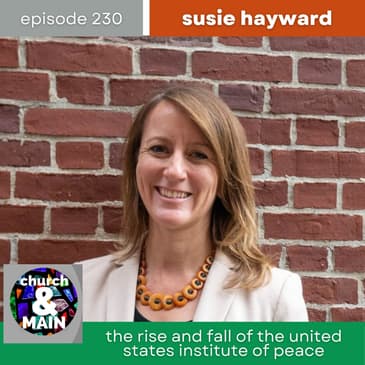
We explore the United States Institute of Peace (USIP) with Susie Hayward, a former senior advisor with extensive experience in religion and inclusive societies. Hayward shares insights into USIP's mission, history, and the recent challenges it faces following actions by the Department of Governmental Efficiency. We discuss her personal journey, emphasizing the intersection of faith, activism, and conflict resolution, and highlight USIP's significant contributions in conflict zones like Iraq, Afghanistan, Sri Lanka, and Colombia. As we examine the implications of potential disbandment due to government intervention, Hayward underscores the importance of USIP's work and calls for renewed commitment to peacebuilding. The conversation encourages listeners to engage in advocacy for essential institutions that support nonviolent conflict resolution and promote U.S. soft power on the global stage.
United States Institute of Peace (Wikipedia Page)
Washington Post Article on the Firing of USIP employees
Facebook | Instagram | Threads | Twitter | Website | YouTube
[0:09] Music.
[0:35] Hey, everyone. Welcome to Church in Maine, a podcast for people interested in the intersection of faith, politics, and culture. I'm Dennis Sanders, your host. So, we had actually two episodes on the United States Agency for International Development, or USAID, and how it was shut down by the Department of Governmental Efficiency, or DOGE, and how those actions affected religious agencies that contracted with USAID. In this episode, we're going to talk about another organization and about how DOGE came after the United States Institute of Peace. USIP is an independent nonprofit organization funded by Congress with the task of promoting conflict resolution and prevention around the world. It was started in 1984. And in late March, Doge tried to enter USIP offices in Washington, D.C., and on March 29th, employees received word that they had been fired. So.
[1:46] What is the United States Institute of Peace and what are the consequences of shutting this nonprofit down? In this episode, I talk with Susie Hayward. She worked at USIP from 2007 to 2021, a native of Adina, Minnesota. She was a senior advisor for religion and inclusive societies at the U.S. Institute of Peace.
[2:12] While she was there, she worked in active conflict zones around the world and strengthened the religious literacy of peace practitioners and diplomats. She is an ordained minister in the United Church of Christ and is currently the Transitional Associate Minister for Justice Organizing and Adult Faith Formation at Creekside United Church of Christ in Minneapolis. Now, this is a part of the federal government that a lot of people don't know about. So I hope that this will be a chance for people to learn about the work of the United States Institute of Peace, what it meant for the wider world, and actually the role of churches in making this organization come to life and make a difference in the world. So please join me in this conversation with Susie Hayward.
[3:02] Music.
[3:19] Well, Susie, thank you for taking the time to chat today. And I thought I wanted to start first by talking a little bit about your background, your faith background, before we kind of go into talking about the Institute of Peace. Okay. And thank you, Dennis, for inviting me. It's great to be here with you.
[3:37] My faith background, I'm ordained as a Christian minister in the United Church of Christ. I found my way to the UCC through a somewhat circuitous route. I grew up in Minneapolis in a nominally Protestant family, but not practicing. And I began going to a Presbyterian church kind of on my own volition when I was 11.
[4:02] Got myself baptized, got myself confirmed. And then I was becoming more and more involved in human rights activism and other forms of activism, protection of land and water in Minnesota and so on. And that church was trending a little bit more conservative than I was trending in some of my social and political positions. And so I stopped attending the church when I was about 15 and began exploring a lot of different religious and spiritual traditions. Eventually found my way to college where I became a student of religious studies. I was pursuing a comparative religion degree, so studying a lot of different religions. Ended up focusing quite a bit on Buddhism and did a study abroad program in Nepal with Tibetan Buddhist communities where I was living and practicing Buddhism on a daily basis, doing sitting meditation and participating in the ritual life of the community, I ended up taking refuge vows within Buddhism at that time.
[5:11] And so taking refuge vows means I became a Buddhist. I have a Buddhist name within the Tibetan Buddhist tradition. But when I came back to the US, I couldn't quite find my place within the Sangha, the Buddhist community in North America. And so I eventually found my way back into Christianity through the vestibule of Unitarian Universalism. And in the United Church of Christ, I found a home for sort of bringing together of my spiritual and my faith commitments and my ongoing work on human rights and global justice and advocacy. But I'm still a scholar of Buddhism. So I'm getting my PhD from Georgetown University. I focus a lot on political Buddhism and violence and peace. And I still draw a lot from Buddhist practice and ideas in how I practice my own Christianity.
[6:06] Okay. So, you worked for the United States Institute of Peace for a good long time there, from what I've noticed. Yeah, I was there for 14 years. Okay. For people who don't know about the Institute of Peace, how would you describe, what is their work? What did they do? Okay. Well, the Institute was created by an act of Congress in 1984.
[6:36] But there's a long story that precedes that of lobbying and advocacy on the part of a number of different constituencies, but central were those who were involved in some of the anti-war movements during the Vietnam War era. And they were saying to the U.S. Government, look, we have all of these military academies that we send our 18-year-olds to and they get a superb education and they learn the sort of strategy of warfare. And then in return for this education, they serve in the Defense Department or in the military. But the work of nonviolent, non-military means to resolve conflict through negotiations and peace processes and mediation and involvement within the international legal system and international organizations and so on, that takes just as much knowledge.
[7:39] It requires just as much development of skills and is just as critical to advancing U.S. National interests and security. And so what if we had a similar kind of peace academy, on par with a West Point or an Air Force Academy, where we sent our 18-year-olds and we invested in their education and formation, and then they served in State Department, or they served in the United Nations or other international organizations to advance peace. And there was a lot of faith-based organizations and movements that were also a part of that effort. So the Quakers, the Mennonites, the Church of the Brethren, what we often refer to as the Historic Peace Churches, as well as my own denomination, the United Church of Christ was involved, Rock Spring Congregational Church in Northern Virginia was a big actor in this advocacy campaign. Um, so what ended up being created, USIP, was not the, um... Was not precisely the vision of what these activists had hoped for. They'd wanted a peace academy on par with a West Point, but it had a similar mission and mandate.
[8:50] So it was meant to advance education, information, and understanding of the best practices of peace building, of non-military means to prevent violent conflict from breaking out, to resolve it once it has broken out to advance post-conflict reconciliation to ensure a sustainable peace. And in its early years when it was created, so in the mid-80s, it operated kind of like a think tank in Washington, D.C., putting out policy papers and research. It also did a lot of work to help develop peace and justice programs within universities across the US. So lived up to its sort of mandate and the vision that those activists had hoped for in the early years of creating a peace academy.
[9:46] And then since then, it has grown to have offices overseas and violent conflict zones, and to work with non-state actors and state actors across the globe who are involved in peace building to advise U.S. Foreign policymakers on means to resolve conflict non-violently, and so on and so forth. So it's funded, it was created by Congress, it's funded by Congress, but it was created as an independent federal institution, which means that it has its mandate and it must fulfill its mandate, but it doesn't have staff that are appointed by the executive branch. So that allows it to operate as a nonpartisan institution that can focus on its mandate and fulfilling its mandate across different administrations, even as, you know, the political winds blow and policy priorities shift and so on, it's meant to remain focused on its mandate to advance peacebuilding.
[10:56] And what, you kind of touched on this a little bit earlier, but what is kind of the, how does it interface with religious bodies?
[11:11] Yeah, this is one of the things that actually drew me to USIP and made me want to work for it.
[11:24] Actually, let me start that all over, Dennis, because I need a drink of water. Sorry, I'm being over a cold.
[11:33] That's a great question. And it's something that actually makes USIP distinct in the landscape of foreign policy organizations in Washington, D.C. And something that I noted when I was first in Washington, D.C. After college doing some work on immigration policy.
[11:50] USIP had this religion program. And it was a program that I learned had been created in 1987, So just a few years after the creation of the Institute itself. And so for, at this point now, 38 years, it's been doing this work of thinking in a really nuanced way about what is the role of religious ideas and actors and institutions in situations of violent conflict. That are intersecting with different issues related to economics, politics.
[12:27] Land, and so on and so forth that is driving both the conflict and driving peace, often simultaneously in the same setting. So it has had this consistent thematic program. It's the oldest thematic program at the Institute since 1987 that has been exploring the role of religious nationalism vis-a-vis violent conflict in different settings around the world, the roles of religious actors and organizations in zones of conflict, often in places where the state governments are either not operating or are operating in a predatory way in very rural areas, places where international organizations might not be able to get because they're very rural, and providing the first level of humanitarian care, food aid, security, and protection to local communities.
[13:22] So what are religious actors doing in order to attend to human security in the midst of violent conflict? How are religious actors mobilizing in response to peace processes.
[13:35] Either for or against them in some cases? How do they influence individual behavior, social behavior, political behavior, and so on and so forth. And what I appreciated about the religion program when I first encountered it was that it was, you know, it predated 9-11.
[13:55] And so it wasn't, Looking at the role of religion sort of myopically through a focus on either broadly, religion is bad, or Islam in particular, is a threat to security. It was really looking in a far more nuanced way at a range of religions that are operating across the world in conflict zones, and the contradictory and complex ways in which religious actors and institutions are operating in any given context that's not monolithic. And so it has, in large part, because of USIP's independent status, like I said, it doesn't have political appointees and shifting priorities and so on. It has had this kind of steady and consistent approach towards thinking about religion and engaging with religious actors in zones of conflicts over 38 years. And that makes it really distinct in the foreign policy landscape of Washington, D.C.
[15:04] One thing actually to note is, in doing some research about this, is that if I'm not mistaken, this has had, or at least at its creation, had bipartisan support. So this was not just one party kind of pushing it, but people from both parties were pushing its creation. Yeah, 100%. The senators and the representatives who created USIP, it came together as a bipartisan effort. It was signed into law by President Ronald Reagan.
[15:38] The president does have a role in appointing the board of directors of the Institute, but according to the act of Congress that created USIP, the board has to be half Democrat and half Republican. And so the board members feeding into, you know, the Institute's development over the years has always been bipartisan as well. And then the Institute itself is to operate in a nonpartisan manner. That's its directive from Congress. But that has meant often operating in a bipartisan manner. And that's been especially true and really critical of the religion work. Um sometimes in dc my experience was that um the questions related to religion they could be really fraught and there was um sometimes a push and pull like on many things in dc to partisanize it right to to say religious freedom for example is a cause that the republicans are far more concerned about and religious engagement is something that the democrats are far more involved in. But what I found was that USIP was often able, because of its nonpartisan or bipartisan issues.
[16:55] Position, it was able to be an incubator or a space for bringing together actors across the partisan divide who have a lot of common ground and wanting to take seriously the role of religion to ensure that nobody's being persecuted as a result of their religious identity or beliefs or lack of religious identity or beliefs. And to try to ensure that the best of what religion can offers in advancing human rights and advancing collective flourishing is being drawn on and taken seriously. And religious actors aren't being sidelined or marginalized in the work of peace building. So yeah, USIP status and its position as nonpartisan or bipartisan really gave it this distinctive, has given it this distinctive ability to convene conversations across the partisan divide, even in recent years when that's been really hard.
[18:00] And what are some examples, because we've talked a little bit about peace building, what are some examples of conflicts that the USIP has been involved in over the years and kind of their role in those? those conflicts? Well, USIP has done a lot of work in places like Iraq and Afghanistan. And what they've been able to do is support forms of negotiations between different tribal communities that were at odds with each other. We did a lot of work in northern Iraq in partnership with different ethnic and religious minorities in order to help ensure that they were able to do some, that they had input into policies that were affecting them.
[18:52] Policies coming out of Baghdad that were affecting them, sometimes in some very negative ways, and to ensure that their rights were being protected and advanced, helping to negotiate between them when there was tensions between different minority communities, which often happens, and helping to ensure things like reform of the educational curriculum to ensure Or that the historical experience of different religious and ethnic communities in the country were being taught in a constructive way and in a truthful way to children to try to mitigate some of the forms of prejudice or misinformation that existed and drove some of the exclusionary policies towards minorities. So that's an example in Iraq. In Afghanistan, some of the work that USIP writ large and the religion team specifically has been involved in is supporting the engagement of ulama or Muslim scholars in the peace process, including in addressing some of the Taliban's positions with respect to women's rights.
[20:01] With respect to the role of Islam in the governance in which interpretation of Islam is being used to shape and frame the governance. So ensuring that there's a diverse and critical discussion that's happening among religious scholars, Muslim scholars, and other religious minorities to try to shape a state that is going to be more inclusive. Um i did a lot of work in sri lanka in myanmar based on my background in buddhism um and there you have forms of um you have had forms of a sort of buddhist nationalist movement that's uh led by buddhist monks and in some cases buddhist nuns that have been very anti-muslim um anti-women have sometimes opposed uh peace processes and and so on and so i in those places I was working with Buddhist actors as well as Muslim, Christian, and Hindu actors in order to create sort of coalitions and networks of grassroots faith actor, peace-building movements that could push against some of those, some of the narratives and the actions of religious movements that were a threat to peace and to an inclusive national vision.
[21:27] I could go on and on. One of my favorites, let me just share one of my favorites. Yeah, yeah.
[21:32] In Colombia, I worked with a movement called the Ecumenical Women's Peacebuilding Network, which is this just incredible network of women across the country, Catholic sisters.
[21:46] Pentecostal women, pastors, Mennonite women, who have been doing this just fearless and fierce work of protecting local communities. When the war with the FARC was still ongoing, between the FARC and the government, they would negotiate for these zones of peace in local communities with government soldiers and guerrilla in order to ensure the protection of local communities. When the peace process was ongoing, this group, that in shorthand is known as Hempas, they were seeking to ensure that women were being included in the negotiations and to ensure that the priorities of women were being included in the negotiations for what the state would look like and how it would operate moving forward. And they continue to do this work of peacebuilding, of reintegration of former combatants into local communities.
[22:44] They're a really powerful and incredible network. And I've learned a lot from working with them, from working with, you know, these Buddhist monks and other activists in Myanmar and Sri Lanka and elsewhere about how to live out the deepest values and commitments of your faith and your religious communities in the midst of insecurity and violence. What that really looks like to put your body on the line and to walk the talk.
[23:20] So that kind of leads up to today and what we're seeing going on right now under the Trump administration and with Doge. And can you kind of walk through what you've kind of, and I know you're not there now, but what you've seen happen and maybe, and I don't know if you've been in communications with current workers of what's been going on in the last few weeks. I mean, one of the things I found interesting, again, in some of the setup for this is.
[23:56] Trying to check out the website, which is not there. Yep. So kind of explaining what's been going on recently. Yeah, it's really disheartening what's going on. So in February 19th, President Trump issued an executive order that was something like a warning shot, I think, to the U.S. Institute of Peace saying that he and the Department of government efficiency, we're going to be examining it and scrutinizing its place within the government system. And then this was followed. There was a couple meetings that happened between DOGE staff and USIP leadership.
[24:42] It escalated to on March, I believe it was March 14th of Friday, some doge staff came by the institute a couple times trying to gain entry into the building. Now, as I said earlier, USIP was created by Congress, but the act of Congress that created it stipulated that USIP is an independent institution. And so the building is a private building that is owned by the institute itself. And the institute is not part of the executive branch. It's not a formal part of the federal government. And so when the Doge staff came by and they wanted access to the building, they were informed by USIP council and leadership that it's a private building, this is trespassing, and we're going to ask you to leave. So the following Monday, Doge staff returned.
[25:40] And over the, I should say, that past Friday, Another act that the action that was taken was that the president fired the board of directors of USIP.
[25:55] The five Democrat and five Republican Senate confirmed board members of the Institute, leaving in place the ex officio members, which according to the act that created USIP is the president of the National Defense University, the secretary of state, and the secretary of defense, and then the president, president who is appointed by the board. So the acting president at USIP as of March 14th was George Moose, who's a longtime board member at USIP, knows the Institute very well. He's also a very well-regarded former US ambassador. Um the president president trump um summarily you know uh sacked george moose told him that he was no longer the president or or rather and let me correct that um the ex-officio members of the board of directors who were left upon the uh um forced resignation of the rest of the board of directors, the voting members of the board of directors, appointed a new president and fired the acting president, George Moose. And the new president they appointed was Kenneth Jackson.
[27:16] So Kenneth Jackson and some Doge staff showed up on Monday, March 17th to the Institute. And there was a bit of a showdown between George Moose and USIP Council and this group. They wanted access to the building. And again, they were told this is a private building. You're not allowed to enter.
[27:42] Over the weekend, USIP had a private security firm that it had contracted with to provide security. The building is down on the National Mall, and so it needs to have security given its place geographically across from the U.S. State Department. But the head of security had received word that this security company had been facing a lot of pressure from Doge to capitulate.
[28:17] And they became concerned that the private security firm might bend to this pressure. And so they ended the contract with this firm over the weekend. And so on Monday, members of the security firm accompanied Kenneth Jackson and some of the Doge officials to the building, and they tried to use their badges to get into the building, but the badges no longer worked. But one of those staff people still had a master key. So he was able to get into the building. At this point, the USIP leadership who were inside called the DC police to report that there was trespassing at the building. When the DC police arrived, they actually let in Kenneth Jackson and the Doge staff. And at that point, George Moose and other leadership at USIP who were there were forced to leave.
[29:14] And then there was some vandalization that was done at the Institute. Signs were taken down. um the usip staff were locked out of their email and their other internal microsoft systems they still cannot access their internal documents um and and so things have been on hold to see what's going to happen meanwhile george moose and um the the 10 members of the the board of directors members of the board of directors have issued a legal complaint against Doge and are suing to try to sort of recapture the Institute. The federal judge denied the initial temporary restraining order that was requested, but asked for more information. And so that lawsuit is continuing. But in the meantime, we're sort of in this purgatory state where some of the USIP leadership has been fired. Ken Jackson seems to be operating as the president of the presumed president of USIP, even though the way in which he was appointed doesn't abide by the statute of USIP.
[30:34] And the staff are not able to access their internal systems.
[30:45] I'm sorry, it's so convoluted. It's convoluted, but it's also shocking. Yeah, it is. I mean, why do you think that this is happening? Because this is, as you said, it's an independent group. It's basically, even though it's kind of set up by Congress, it's a private organization in some ways that, you know, does have kind of a charge given from the federal government. But, I mean, what is the point of all of this is, I guess, what I'm trying to get at. Yeah. I mean, the purported concern is about efficiency and bloated bureaucracy, right?
[31:29] Which is the rallying cry or the justification of a lot of what the Department of Government Efficiency, since title, is doing right now in Washington, D.C. There is, so the Heritage Foundation, which is a conservative think tank that's based in Washington, D.C. And is the sort of the mind behind Project 2025, they issued a report in 2024 attacking USIP, claiming that its staff was overwhelmingly, had overwhelmingly donated to Democratic party leaders and campaigns, and that the Institute itself had become bloated. And so they were calling for a dismantling or a reduction of USIP and a sort of an attack on its staff. I mean, my answer to that is first, it shouldn't matter how staff vote or donate if their work is nonpartisan and bipartisan. And Heritage didn't claim in that report anywhere that USIP's work itself was partisan, because I think they would be very hard-pressed to make that argument.
[32:44] USIP's events, if you go back and you look at its events and the convenings and the reports and so on that have come out of it, you'll see consistently either nonpartisan spokespeople or a mix of both Republican and Democratic elected officials and spokespeople who are speaking to the policy priorities of the U.S. Um, And, you know, I can attest for myself that when I was at USIP for 14 years, and I directed the religion program for six of those years, that I worked very closely with political appointees under both Republican and Democratic presidents. In the first Trump administration, I worked with Ambassador Sam Brownback, the ambassador for religious freedom in the International Religious Freedom Office. And then I worked with Ambassador Rashad Hussein under the Biden administration in that same role. I worked with Mark Brinkmoyler, who led the faith-based and community partnerships office in USAID under Obama. I worked with Kirsten Evans, who led that office under Trump in USAID. So this idea that the staff, as a result of their own personal political views.
[34:03] Are suspect somehow, I think that's illegal. First of all, there's no political test. But I also think that's separate from the work of the Institute itself. And then secondly, as for its mission and bureaucracy, I mean, the fact is the budget of USIP, its yearly budget is minuscule. Its annual budget wouldn't even cover the cost of one fighter jet. And it's because of its relatively small stature and status that it's able to work nimbly and in ways, frankly, that the State Department and the Defense Department and USAID can't because it's independent. And so it's not sort of hamstrung by different kinds of policy priorities and shifting political dynamics and so on as some of the more formal government agencies. And so it's far more cost efficient and effective to have USIP staff going in and supporting negotiations between the tribal leaders in Iraq or Afghanistan, like I spoke about, than to have the Defense Department going in and doing those kinds of things. So if we're concerned about cost efficiency, I also find that that argument suspect. I mean, personally, what I think is going on has far more to do with government capture and dismantlement.
[35:29] And the desire that I see within this administration to bend the various institutions, not just in D.C., but across the country, which we're seeing with universities and so on, to bend these institutions to serve the will and the agenda of the executive.
[35:47] And a deep concern I have about this attack on the Institute itself is that it might be not simply dismantled. I mean, I'm concerned that it might be dismantled, but I'm particularly concerned that it will be co-opted. That Trump has been talking about some of what he wants to do in Gaza, for example, in buying it and turning it into something of a real estate deal, the Riviera of the Middle East, as he said, he's presented that as being about peace. And so I'm concerned about USIP being co-opted to present these kinds of foreign policy priorities that frankly, I think are offensive to what true peace is about, just peace is about, sustainable peace is about, to present it as a foreign policy committed to peace. That would do just immeasurable damage to USIP's reputation and trust. And I think it especially would damage its longtime status as an independent, nonpartisan or bipartisan institution. I think it's something that...
[37:04] The writer Jonathan Rauch has said about Trump being personalist, which is kind of making the government basically about him or in his direction. Do you think that's kind of what you're kind of getting at, that this would turn the Institute into serving his purposes instead of a national purpose or even a purpose of the people involved in various conflicts?
[37:35] Yeah, I think it's that in part. I mean, frankly, I don't know if it's all about him. I think there's also other individuals and entities, especially those who profit from certain war. Um what uh eisenhower referred to as the military industrial complex um but we know there's there's a lot of different actors and institutions who who benefit from ongoing war and instability in different places or who benefit from um certain wars continuing um and so i i think it's It's also about driving the interest of trying to benefit economically from these kinds of capture of different institutions, including USIP within DC. Yeah.
[38:36] And, you know, what's happening right now is not just, I mean, there seems to be this effort in weakening or neutering or however you want to call it, of soft power, whether it's USIP or USAID. I know that National Endowment for Democracy is also kind of in that mix. Um what effect does that have if if soft power is either damaged or dismantled or co-opted yeah.
[39:15] I mean no doubt dennis it weakens the u.s the the fact that these the fact is that these these efforts that places like usip and ned the the actions the projects the programs the the people, the movements that they support worldwide, that builds tremendous goodwill and builds networks worldwide with incredible peace builders and democratic activists who are allies to the U.S. In our work to defend freedom and human rights worldwide. And this includes, I should note, a lot of faith-based organizations and religious actors worldwide whom USIP and others have built relationships of trust with over decades. I guess, you know, to answer your question, I could answer it as a former actor in the U.S. foreign policy space. And in doing that, I could cite all kinds of pragmatic reasons for... Advancing U.S. soft power interests in this way. It helps make the U.S. safer. It helps us to advance our national interests and economic prosperity. But I think I'd rather answer as a Christian minister, frankly.
[40:28] And as a Christian minister, I have deeper and far more foundational concerns about what it means to erode, if not uproot, these kinds of programs that we put under the umbrella of soft power? What does it mean for us to, for the U.S. To abandon entirely the call to feed the hungry or to heal the sick or to care for the oppressed and persecuted around the world? What does it mean for the U.S. to abandon any kind of commitment to acting with compassion for the suffering of others? Many of our current political leaders claim to be Christian, but these actions and their legitimation of them, to me personally, seems pretty antithetical to the teachings of Christ. And, you know, I don't want to be a U.S. foreign policy and assistance, historically, it's had a mixed track record.
[41:26] So there are certainly ways in which U.S. foreign policy and U.S. Foreign actions have gone against our professed foundational values. We've overthrown democratically elected leaders who opposed our economic interests as just one example. But we've also helped ensure that there have been fewer folks who've died from preventable diseases like Ebola or AIDS. You and I are both based here in Minneapolis, and our farmers here in Minnesota have provided crops that have fed the world's Hungary through USAID.
[42:04] The U.S. has provided support to democracy activists in the face of brutality. I know a lot of those democracy activists who've felt the support and benefited from the support of the U.S. in places like Myanmar, Burma. And we've been a place of refuge for those fleeing violence. And the principle of this matters. I believe that as an American citizen who believes in the professed foundational values of this country that we're constantly trying to live up to, but I believe that most importantly and foundationally as a follower of Jesus.
[42:44] So this kind of leads to another, the kind of obvious question is, what can people do? I mean, how can someone who's listening respond to this? Well, raise hell, I would say.
[43:00] I really do encourage people to be in touch with their federal representatives and senators.
[43:06] Like I said, USIP was created by Congress in 1984. Congress is baby. And Mama Bear needs to be responding in order to defend her baby right now as it's being attacked in this way. And I would love to see, even if folks were not aware that the United States had a national institution that was dedicated to the work of nonviolent, non-military peace building before, I hope they're learning about it now. And I hope they're proud of the fact that we had this institution and understand the importance of the continuation of this institution within the landscape of Washington, D.C. But my i think one one suggestion i would make to kind of nuance um the advocacy they do it's important to defend the institution yes i i think usip as an institution should continue for the reasons i mentioned but i would also encourage you to to frame this as about the principles of defending the rule of law because you know dennis as you said earlier this is an independent an institution. And so the executive branch here is operating way out of legal bounds in what it's done to the board of directors at USIP, to George Moose, the acting president of USIP.
[44:31] In how it's treating the staff of USIP right now and having kind of co-opted their internal systems.
[44:41] And firing a number of the leadership at USIP, this is against the law. And it's not only against principle, it's against the law. And so it's a little bit, I don't know if I would say it's the canary in the coal mine, because we've already had several canaries that have gone into that coal mine and come out really dusty. But this is another indication of the lack of respect for rule of law. And we need to be standing up and saying something to ensure, that this doesn't become another point at which there's continued permissiveness, for the dismantlement of democratic norms and the rule of law in this country. These checks and balances matter. And that's why we need to speak up on this as much as for the Institute itself.
[45:34] Yeah, I think that there is, and even in telling the story, just seems, as you said, this is Congress's baby, and the way that it's been handled, especially with Doge, is, to be honest, rather chilling. It is. It is. And particularly when, you know, the mandate of the U.S. Institute of Peace is nonviolent peacebuilding, is reconciliation between conflicting parties, is reducing suffering. And so to have this like dramatic showdown and this callous treatment of USIP leadership and staff, USIP leadership like George Moose, who, again, is somebody who served our country as an ambassador, has dedicated his life to this as, you know, somewhere around 80 years old. He's given much of his life to serving the cause of diplomacy and peace. And so to be treated this way is just chilling. It's awful.
[46:43] I probably should ask for clarification. Is the staff right now, are they being paid or are they just kind of in another world? They're not sure. They've been told they will continue to be paid. They haven't received, I'm not sure when the pay date is. I don't think there has been one yet since this all happened.
[47:12] Nice. They can't get into the system to see if the paycheck has come through. Yeah. Yeah, that's kind of callous. Yeah. So if people want to connect with you maybe to learn a little bit more about um usip, how do they do that uh you can find me on blue sky okay i'm also on linkedin so you can send me a note on either of those platforms and i'll i'll be happy to be in touch all right well suzy thank Thank you for taking the time to talk and for sharing a little bit about the story of USIP. And hopefully that this will help people to learn more about this and hopefully
[47:57] to make a difference in some way. Thank you so much, Dennis. It was great to be here.
[48:03] Music.
[48:31] So, what are your thoughts on the episode? Did you know about the United States Institute of Peace? And what do you think about its being shut down? What are your thoughts about what you can do? Susie did kind of talk about what steps could be done. What do you think can be done?
[48:52] Feel free to send me an email. You can do that by going to churchinmain at substack.com. And also, I will include links to an article from the Washington Post about the shutdown of USIP for you to know about. And unfortunately, I would love to say I could get you would like to see the website for the USIP, but that has been unfortunately shut down. Um, but I will try to put a link to the Wikipedia page so that people know more about what this agency did.
[49:29] Um, also just also a little bit of a, a programming note that, um, Holy week, which begins, uh, April 13th, uh, through the 20th. Um, I may or may not have an episode go up that week. Um, as many of you know, I'm also a pastor, um, uh, at a congregation. So like with a lot of pastors, that's a busy time, uh, for me. So, um, either we will put up a, uh, I will put up a, a repeat episode, or we may just not have an episode that weekend, then we'll resume the following week, um, with new episodes. But I just wanted you to be aware of that. If you're wondering why there isn't an episode for, if nothing comes up or it's an old episode, that's why. I decided it would be just really hard to try to put up an episode, which would go up on Good Friday, which also seems kind of weird to have a new episode on a very holy day.
[50:36] So instead of that, we will probably either, probably more likely than not, not have an episode go up that week. And then resume with new episodes the following week. So, just to let you know about that. Also, if you want to learn more about the podcast and to listen to past episodes or donate, don't forget to visit churchinmain.org. You can also go to this rsubstack at churchinmain.substack.com to read the latest articles. You can subscribe to the podcast on your favorite podcast app. And I do hope that you would consider leaving a review that does help others find this podcast. That is it for this episode of Church in Maine. I'm Dennis Sanders, your host. As I always like to say, thank you so much for listening. Take care, everyone. Godspeed, and I will see you very soon.
[51:31] Music.