
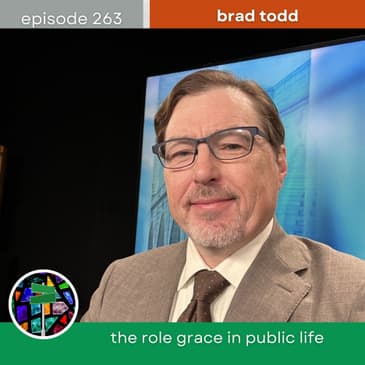

In this episode, I chat with Brad Todd, a political commentator for CNN, about the significance of grace in our polarized society. We discuss the challenges of maintaining grace in civil discourse, the impact of recent political scandals, and the disconnect between clergy and congregants. Brad advocates for local initiatives that promote kindness and emphasizes that recognizing our shared humanity is essential for meaningful dialogue in divisive times.
Suggested Reading and Listening:
Top Church and Main Episodes of 2025
Join the Church and Main Email List
Facebook | Instagram | Threads | Twitter | Website | YouTube
00:00:27 --> 00:00:31 And welcome to Church in Maine, a podcast for people interested in the intersection
00:00:31 --> 00:00:34 of faith, politics, and culture. I'm Dennis Sanders, your host.
00:00:34 --> 00:00:39 I really hope that you had a wonderful Christmas and welcome to 2026.
00:00:40 --> 00:00:43 So my first guest for the new year is Brad Todd.
00:00:44 --> 00:00:50 Brad's a commentator on CNN and one of the founding partners of On Message Inc.,
00:00:50 --> 00:00:52 a political consulting firm.
00:00:52 --> 00:00:55 In this podcast, we're going to talk about the role of grace.
00:00:55 --> 00:01:01 And actually the lack of it in public life and how we can find it in a time
00:01:01 --> 00:01:04 when there is so much political polarization.
00:01:05 --> 00:01:10 A little bit about Brad. He hails from East Tennessee. He grew up Southern Baptist,
00:01:10 --> 00:01:15 but now attends a United Methodist church in the suburbs of Washington,
00:01:15 --> 00:01:19 D.C., which is actually pastored by a former guest of the podcast.
00:01:20 --> 00:01:25 Being that Brad is engaged in political campaigns, we are going to talk about
00:01:25 --> 00:01:29 where grace, faith, and politics intersect.
00:01:30 --> 00:01:36 And this is an election year, so these are all important topics to talk about.
00:01:37 --> 00:01:45 Brad is the co-author of The Great Revolt, which was a Washington Post bestselling
00:01:45 --> 00:01:49 book about the current realignment underway in American politics.
00:01:50 --> 00:01:57 His opinion columns have appeared in Politico, CNN.com, Roll Call, and FoxNews.com.
00:01:57 --> 00:02:02 And he lives in Alexandria, Virginia with his wife, two kids,
00:02:02 --> 00:02:05 and as he describes, some ferocious Boston Terriers.
00:02:06 --> 00:02:10 So, here is my conversation with Brad Todd.
00:02:33 --> 00:02:36 All right brad i wanted to start by getting to
00:02:36 --> 00:02:39 know a little bit about you and kind of your
00:02:39 --> 00:02:44 background where you come from and your kind of religious history as well sure
00:02:44 --> 00:02:49 dennis thanks for having me appreciate the chance to be on the show um it's
00:02:49 --> 00:02:53 uh and i appreciate our interplay over the last several months on sub stack
00:02:53 --> 00:02:58 you know that's my midlife crisis my sub stack uh uh account you You know,
00:02:59 --> 00:03:04 it's so it's and what for I put a plug in for it. If anybody wants to read it, check it out.
00:03:04 --> 00:03:06 It's a commentary about a wide range of cultural things.
00:03:08 --> 00:03:11 You know, my religious background, I grew up Southern Baptist in East Tennessee.
00:03:12 --> 00:03:18 My family was very involved in the church. The church was our social life in many ways.
00:03:20 --> 00:03:26 My my mom came from a very large family that had been on this same piece of land since the 1840s.
00:03:26 --> 00:03:32 And the family, about two thirds of the family had split off in 1960 and formed
00:03:32 --> 00:03:35 their own church with another family or two as this common in rural communities.
00:03:36 --> 00:03:39 And so my mom was the charter member of that church. And she was the organist
00:03:39 --> 00:03:42 and she was very engaged. She married my dad.
00:03:42 --> 00:03:48 My dad also came from a very religious family. His father's kind of a missional family.
00:03:48 --> 00:03:54 Lay music leader. He would go up in the mountains and find a church that didn't
00:03:54 --> 00:03:58 have a music leader and lead the singing until they could find somebody.
00:03:58 --> 00:04:01 When he was a young man, he and his brother for church planters in the Kremlin
00:04:01 --> 00:04:04 Mountains. One of them preached, one of them did Sunday school,
00:04:04 --> 00:04:06 one of them led the singing.
00:04:07 --> 00:04:10 So that fit right in, in my mom's family's church.
00:04:10 --> 00:04:15 And dad became chairman of the deacons a couple of times and was very in the
00:04:15 --> 00:04:16 leadership role all the time.
00:04:16 --> 00:04:19 So my sister and I grew up in leadership roles in the church.
00:04:20 --> 00:04:23 You know, I'm a writer by training and by profession.
00:04:24 --> 00:04:27 And my first writing gig was the church newsletter.
00:04:28 --> 00:04:31 You know, I had been dormant for years. I took it over and started up when I
00:04:31 --> 00:04:34 was probably in junior high, middle school.
00:04:34 --> 00:04:38 So, you know, just grew up in the church and, you know, we're United Methodist
00:04:38 --> 00:04:40 now. My wife grew up in the United Methodist Church.
00:04:41 --> 00:04:46 I had already joined the United Methodist Church before we met and left the Baptist Church.
00:04:46 --> 00:04:50 And so, you know, it's just an ever-present part of our lives.
00:04:50 --> 00:04:55 I did a double major in college, and religious studies was my double for fun.
00:04:55 --> 00:04:59 You know, I didn't expect to use it or anything, but just for fun.
00:05:01 --> 00:05:07 Well, one of the reasons I wanted you on the podcast is because we know someone in common.
00:05:07 --> 00:05:16 That's Jason Michelli, who is your pastor, pastor of Annandale United Methodist in suburban D.C.
00:05:17 --> 00:05:21 And you were kind of saying as we were preparing for the podcast that D.C.
00:05:22 --> 00:05:27 Is a place that basically the business, it's a factory town, basically.
00:05:28 --> 00:05:34 And having growing up as I did in Michigan, where I was, everyone worked for GM.
00:05:35 --> 00:05:39 In Washington, everyone pretty much works for the government in some way.
00:05:40 --> 00:05:51 And the thing that's been interesting is how much in churches is things sometimes
00:05:51 --> 00:05:57 have become so kind of polarized in many ways.
00:05:57 --> 00:06:03 And what's been interesting in seeing, and I'm fascinated,
00:06:03 --> 00:06:09 is still seeing some churches where there are places where there still is diversity
00:06:09 --> 00:06:15 and not just diversity in the way that we like to think of it,
00:06:15 --> 00:06:21 which is still important where it's of African Americans and whites and of all
00:06:21 --> 00:06:22 kind of the ethnic diversity,
00:06:23 --> 00:06:25 but also political diversity.
00:06:25 --> 00:06:30 And I think that that's even very much important these days.
00:06:30 --> 00:06:36 And I'm just kind of curious of how do you see that showing up in your church
00:06:36 --> 00:06:43 and how is that happening and how do you see that still necessary in our day and age?
00:06:44 --> 00:06:48 Well, our church is diverse.
00:06:49 --> 00:06:54 I'm sure if you took a look at everybody on the voter file when Lee left,
00:06:54 --> 00:07:00 as most mainline suburban churches do, mainline denomination churches,
00:07:00 --> 00:07:03 but we absolutely have a lot of political diversity in Washington.
00:07:04 --> 00:07:06 You can't have a church in Washington without political people.
00:07:06 --> 00:07:09 In fact, everyone's political in some way, a lot of military,
00:07:09 --> 00:07:12 current military and ex-military and people who've worked
00:07:12 --> 00:07:15 in the in the administrative state in
00:07:15 --> 00:07:18 the in the bureaucracy and people who work on the outside as consultants
00:07:18 --> 00:07:24 or lobbyists or or contractors you know so it's a or lawyers who deal with government
00:07:24 --> 00:07:28 cases you know if you ask the one in dc are they a lawyer the chances are what
00:07:28 --> 00:07:32 they mean is they are a lawyer who sues the government or defends the government
00:07:32 --> 00:07:37 you know and so particularly the government uh it's even even that practice is about it.
00:07:37 --> 00:07:41 And if you're a dentist or a chiropractor, all your patients are involved in government, right?
00:07:41 --> 00:07:44 So it's inescapable connections to it.
00:07:45 --> 00:07:52 You know, I do think that church ought to be the place where melding people
00:07:52 --> 00:07:58 of different political ideologies is the easiest because the premise of being
00:07:58 --> 00:08:00 in church is that we're all equally sinful.
00:08:00 --> 00:08:05 We're all equally incapable of pulling ourselves out of that sin,
00:08:05 --> 00:08:10 and that we are all equally entitled to the grace that comes from Jesus,
00:08:10 --> 00:08:13 and no one gets any more or less of it.
00:08:14 --> 00:08:19 And by merely walking through the door, we're accepting that we all agree on that.
00:08:20 --> 00:08:23 So it ought to be the place where political differences get erased immediately,
00:08:24 --> 00:08:32 simply because we all, by showing up, accept that premise that we're all in the same boat. Hmm.
00:08:34 --> 00:08:39 Why do you think that that's not the case in so many places these days?
00:08:41 --> 00:08:48 Well, you know, religion is a great generator and enforcer of moral codes.
00:08:48 --> 00:08:53 And, you know, it's throughout all of human history, you know,
00:08:53 --> 00:08:57 people who were not religious at all have embraced religion as a means to help
00:08:57 --> 00:09:01 organize society and sort of compel order.
00:09:02 --> 00:09:07 And so I think that, therefore, it's only natural that people who are practicing
00:09:07 --> 00:09:13 in religion would conclude some kind of moral code emanates from their view of religion.
00:09:14 --> 00:09:19 And that puts up an immediate obstacle for, oh, well, if you don't rise to the
00:09:19 --> 00:09:26 same conclusions I do about that moral code, then perhaps you're not as sanctimonious or holy as I am.
00:09:26 --> 00:09:32 And so I think that's probably a natural outcropping because religion is such
00:09:32 --> 00:09:34 a handy generator of moral codes.
00:09:35 --> 00:09:40 But I think you just have to strip it down. Like it's it's you have to strip
00:09:40 --> 00:09:44 it all the way down and become get it back to what it exactly is.
00:09:44 --> 00:09:49 You know, I have some some secular liberal friends who I debate and argue with
00:09:49 --> 00:09:50 sometimes and they love to mock.
00:09:50 --> 00:09:54 Oh, so that's not very Christian of these right wing people. but
00:09:54 --> 00:09:56 they don't they don't understand what christianity is i was like we know
00:09:56 --> 00:09:59 christianity is not about your politics it is about
00:09:59 --> 00:10:02 whether you agree that you're in intractable sin and need
00:10:02 --> 00:10:05 the same in grace of jesus uh and then and that
00:10:05 --> 00:10:08 you need to tell that good news to other people said that's what christianity
00:10:08 --> 00:10:12 is um and the remark i get is oh that's who that's not what christianity really
00:10:12 --> 00:10:16 is it's really just a bunch of moral codes and rules and the fact that we let
00:10:16 --> 00:10:19 other people think that is on us that's a mistake on the church's part if we
00:10:19 --> 00:10:23 let outsiders not see that really what we're about is grace.
00:10:24 --> 00:10:28 And so, Washington, I think it's perhaps...
00:10:28 --> 00:10:35 A little easier to not have church become political because we're surrounded
00:10:35 --> 00:10:36 by politics and everything else we do.
00:10:36 --> 00:10:42 And so, you know, church is going to do a bad job of being our political organization.
00:10:43 --> 00:10:46 There are better political organizations, more efficient ones out there.
00:10:46 --> 00:10:51 And maybe in Washington, it's possible that we all know that those exist and
00:10:51 --> 00:10:52 are part of them in other phases of our life.
00:10:53 --> 00:10:56 And so we didn't have to be our church. Our church doesn't have to be political organ.
00:10:56 --> 00:10:59 Maybe that's part of it. I don't know.
00:11:00 --> 00:11:04 You know, you've said this a few times, and I think it's something I would agree
00:11:04 --> 00:11:12 with, is the role of the fact of it being about sinners in the need of grace.
00:11:14 --> 00:11:23 What is the role, and how important is it about the fact that grace is in the role of your faith?
00:11:23 --> 00:11:32 And what is that in the role of our public life? And how is that...
00:11:33 --> 00:11:40 What is the lack of that being, what does that mean in our public life today?
00:11:40 --> 00:11:43 Because I think there is something about that.
00:11:43 --> 00:11:49 I'm really worried about rising secularization in both parties in politics because
00:11:49 --> 00:11:54 it takes the commonality of a belief in grace away.
00:11:54 --> 00:12:02 Um and so i think when you decide that not everyone is in need of and entitled to and.
00:12:03 --> 00:12:08 Able to get grace it leads you to believe that it's okay to wish bad things
00:12:08 --> 00:12:13 on the other side um and hope things die people die you know one troubling thing
00:12:13 --> 00:12:18 it's but to me in our civic life today is you know every time someone a plenty
00:12:18 --> 00:12:22 political note dies the people on the other side stomp on their grave.
00:12:22 --> 00:12:25 You know, Dick Cheney passed away recently. And if you went online,
00:12:26 --> 00:12:31 the venom from people in the political left, while his family is grieving his
00:12:31 --> 00:12:34 death, I just find that completely tasteless and terrible.
00:12:34 --> 00:12:40 And this is not a malady that exists only on the left. I'm not saying that at all.
00:12:40 --> 00:12:46 But the fact that we've got to a place where we can't let people mourn and we
00:12:46 --> 00:12:54 can't acknowledge that passing is a thing to note and stand down for and sort
00:12:54 --> 00:12:56 of put our political swords in their sheets,
00:12:57 --> 00:12:59 that's a real bother to me.
00:12:59 --> 00:13:03 And I think it is indicative of a larger malady, and it is the fact that we
00:13:03 --> 00:13:08 all don't agree that everybody is in equal need of and is in need equally entitled to.
00:13:09 --> 00:13:13 And in grace, I think that's what's infecting us. And I think we can,
00:13:13 --> 00:13:16 you can trace it back to rising sanctuarism in most sites.
00:13:17 --> 00:13:23 Yeah, I mean, I think that there's also a sense of self-righteousness that we
00:13:23 --> 00:13:28 feel that we're under, well, to use a really worn phrase,
00:13:29 --> 00:13:34 the right side of history, that we are the ones that are correct.
00:13:34 --> 00:13:40 And if I'm right, and if I see the downfall of my enemy, well,
00:13:40 --> 00:13:41 then that's something to celebrate.
00:13:43 --> 00:13:50 And, you know, that's great. And why should I cry about, you know, someone who dies?
00:13:50 --> 00:13:54 They're both very Old Testament, you know? Exactly.
00:13:55 --> 00:13:58 I think you see, on the right, you see a lot of a martyrdom,
00:13:58 --> 00:14:02 sort of, we're righteous and we're we'll be martyred, we're way outnumbered.
00:14:02 --> 00:14:05 As a common sort of rubric of looking at things.
00:14:05 --> 00:14:08 And I think on the left, as you point out, there's a lot of,
00:14:08 --> 00:14:13 well, histories on our side where the arc of progress is bending toward exactly where we are.
00:14:13 --> 00:14:17 The term progressive itself means I am just more enlightened and more advanced
00:14:17 --> 00:14:19 and everything else will catch up to me eventually.
00:14:19 --> 00:14:24 That's the root of the term. And so, but those two maladies are the same malady right there.
00:14:25 --> 00:14:28 It is a self-righteousness, as you point out.
00:14:28 --> 00:14:34 And I think that reconciliation becomes difficult when you decide that.
00:14:35 --> 00:14:39 And it is an Old Testament view of things, right? It's my enemies are vanquished,
00:14:39 --> 00:14:41 and so therefore I must be blessed.
00:14:41 --> 00:14:45 And the new covenant that Jesus brought us is not that at all.
00:14:46 --> 00:14:53 And we don't live in that world where our enemies' deaths mean that we are righteous
00:14:53 --> 00:14:58 and that we are blessed. is not being sent signals from God based on our success.
00:14:58 --> 00:15:05 And so I do think that that is a part of the decline of a common understanding
00:15:05 --> 00:15:07 of the New Testament theology.
00:15:10 --> 00:15:16 Yeah, I mean, I think we don't see the—I mean,
00:15:16 --> 00:15:20 to really think about it, our common humanity
00:15:20 --> 00:15:23 or even our common sense that someone
00:15:23 --> 00:15:26 else is a child of God in the
00:15:26 --> 00:15:29 way that—I really
00:15:29 --> 00:15:33 think about some of the writings of Martin Luther King—that he
00:15:33 --> 00:15:36 would see even someone
00:15:36 --> 00:15:39 who was the most racist person still was a child
00:15:39 --> 00:15:42 of god and i don't i don't think we
00:15:42 --> 00:15:47 see that anymore even on the left or on the right that someone no matter who
00:15:47 --> 00:15:54 they are is still someone of value i think we just see them as incredibly evil
00:15:54 --> 00:15:59 um and there are lots of reasons why that is but i think we just don't.
00:16:00 --> 00:16:03 See that you know we have seen a
00:16:03 --> 00:16:06 few instances of it in our current culture and i
00:16:06 --> 00:16:09 when we see them they're startling you know when when they um
00:16:09 --> 00:16:12 that's after the mother of manual church killings in
00:16:12 --> 00:16:15 in charleston you were uh the families those
00:16:15 --> 00:16:18 victims said that they forgave this
00:16:18 --> 00:16:23 young man who came in there and eric charlie kirk's memorial service erica kirk
00:16:23 --> 00:16:28 uh stood up and said i forgive the man who did this you know and so when i i
00:16:28 --> 00:16:35 i think that we have a few shining examples of it And we probably ought to lift those up more.
00:16:36 --> 00:16:43 And we ought to probably all echo, you know, and it's more forgiveness in our
00:16:43 --> 00:16:46 discourse might help us get to reconciliation.
00:16:46 --> 00:16:52 Someone asked me yesterday in an interview, how do we bring about more reconciliation in politics?
00:16:52 --> 00:16:54 Well, I don't know that you structurally can.
00:16:54 --> 00:16:59 I think individually you can. You can lift up forgiveness. You can reach out
00:16:59 --> 00:17:02 to people and not question everyone's motive and assume everybody's motive is bad.
00:17:02 --> 00:17:09 You can disagree with their program and the steps they take to exact their motive.
00:17:09 --> 00:17:12 But I think presuming bad motive is part of our problem, too.
00:17:14 --> 00:17:23 I think that also part of it is how do we learn to not fear the other?
00:17:26 --> 00:17:29 And this is something that actually also Jason is related with.
00:17:29 --> 00:17:35 I was part of something called the Iowa Preachers Project, and it was a group
00:17:35 --> 00:17:42 of 10 pastors from across the country, And it was people from a wide spectrum,
00:17:43 --> 00:17:48 so from people who were theologically liberal to theologically conservative.
00:17:48 --> 00:17:55 And so, you had someone like myself and one other person who were gay to someone
00:17:55 --> 00:18:02 who were people from the Wisconsin Synod Lutherans who were pretty conservative.
00:18:02 --> 00:18:09 And we all were able to get together and to be together and to pray and care
00:18:09 --> 00:18:14 for one another and really actually be friends.
00:18:15 --> 00:18:26 And the thing was, is that none of us was trying to change each other or to try to best one another.
00:18:26 --> 00:18:33 It was really to just have a common meeting place. And I think for us,
00:18:33 --> 00:18:39 at least as Christians, were to understand that we were all sinners in need of grace.
00:18:39 --> 00:18:41 That was the common ground.
00:18:44 --> 00:18:49 And I think once that was the common ground, or at least to know that we weren't
00:18:49 --> 00:18:55 trying to change each other or trying to best one another, there wasn't any
00:18:55 --> 00:18:59 sense of you're my enemy or you're dangerous or something.
00:18:59 --> 00:19:06 There was just a sense you're a friend and we don't agree and we probably will
00:19:06 --> 00:19:10 never agree, but that's okay. That's fine.
00:19:11 --> 00:19:17 And I kind of wonder if, you know, is there a possibility that there are ways
00:19:17 --> 00:19:19 that we can get to that as a culture?
00:19:19 --> 00:19:25 Because I think there seems to always be this sense that we have to have this battle and win.
00:19:27 --> 00:19:30 And that's not, I don't
00:19:30 --> 00:19:34 think that we can that's to me that seems like that's not a path to anything
00:19:34 --> 00:19:42 except loss for everyone it the one problem with it is it is it ensures half
00:19:42 --> 00:19:43 the people are miserable at
00:19:43 --> 00:19:49 all the time you know uh we're in a zero-sum game um you know i think um,
00:19:50 --> 00:19:55 Part of what democracy means is being willing to lose and recalibrate when you
00:19:55 --> 00:20:01 lose and decide how do we change some things after we lose so that we don't lose next time.
00:20:02 --> 00:20:06 And we have lost that a little bit as the parties have become purer.
00:20:07 --> 00:20:11 And as we have social media has sort of allowed and the Internet has allowed
00:20:11 --> 00:20:14 us to silo ourselves with only people who agree with us.
00:20:15 --> 00:20:19 You know, it's 50 years ago, there were liberals and conservatives in both parties.
00:20:20 --> 00:20:25 And that doesn't exist now. You know, and there's a political scientist named
00:20:25 --> 00:20:31 Morris Fiorina who talks about how inter-party sorting is actually the driver of polarization.
00:20:31 --> 00:20:35 The fact that there's not a broad ideological difference in the side of the
00:20:35 --> 00:20:39 Democratic Party or the Republican Party is the reason that the two parties
00:20:39 --> 00:20:41 are so hostile and separated.
00:20:41 --> 00:20:46 When there was overlap, it was much easier to find common ground because there
00:20:46 --> 00:20:50 was a quarter of each party that agreed with a quarter of the other party. at all times.
00:20:51 --> 00:20:55 And there were disagreements within each party. We don't have a lot of inter-party
00:20:55 --> 00:20:58 disagreements anymore, at least on the scale of what we've had previously.
00:20:59 --> 00:21:04 And I think that translates into the rest of our lives. And there's a lot of
00:21:04 --> 00:21:06 self-storing that happens on the internet.
00:21:07 --> 00:21:11 That's what it exists for, right? The algorithms push you toward people who
00:21:11 --> 00:21:14 agree with the freakiest thing you think.
00:21:15 --> 00:21:19 The most niche idea you have, the algorithm will get you there because it It
00:21:19 --> 00:21:23 knows you have a yearning for that and you don't find it in other places.
00:21:23 --> 00:21:27 And if it provides it, then you're likely to stay on the app and look at some more ads.
00:21:28 --> 00:21:31 And we do that in our own physical lives, too.
00:21:32 --> 00:21:35 You know, it's a gerrymandering has been a hot topic this fall and redistricting.
00:21:36 --> 00:21:38 Well, you know, the thing is, it's pretty easy.
00:21:38 --> 00:21:42 Because people tend to move to places where people, they settle in places where
00:21:42 --> 00:21:43 everyone agrees with them.
00:21:44 --> 00:21:46 And then social pressure, if they don't agree with them, when everything social
00:21:46 --> 00:21:50 pressure pulls them to it, into a lockstep agreement on other things that they
00:21:50 --> 00:21:52 didn't have strong opinions on before.
00:21:52 --> 00:21:58 So we're fighting a lot of technology in human nature here now.
00:21:58 --> 00:22:03 And we're now in structures where societal structures are breaking down and
00:22:03 --> 00:22:06 there are fewer of them. And therefore, they become pure.
00:22:06 --> 00:22:11 You know, you probably couldn't come to a meeting of the Virginia Annual Conference
00:22:11 --> 00:22:14 of Methodists and find a lot of ideological disagreement.
00:22:15 --> 00:22:17 And that's not good for the Virginia Conference.
00:22:19 --> 00:22:25 No. And, you know, the thing is also that's kind of related to this is I don't
00:22:25 --> 00:22:29 know if you're familiar with sociologist Ryan Berge.
00:22:30 --> 00:22:32 He does a lot of things on religion.
00:22:34 --> 00:22:38 And, you know, you talk about the Virginia Annual Conference for the United
00:22:38 --> 00:22:44 Methodists, and I think a lot of pastors and a lot of religious leaders,
00:22:44 --> 00:22:45 especially in the mainline,
00:22:46 --> 00:22:51 might think that the people in their pews probably all vote the same way.
00:22:51 --> 00:22:58 But he's done a lot of research, and especially in the 2024 election,
00:22:58 --> 00:23:07 in a lot of the mainline denominations, the vote totals came pretty almost even,
00:23:08 --> 00:23:12 maybe just leaning slightly more towards Donald Trump.
00:23:14 --> 00:23:22 And so, you have people in the pews that are a lot more purple than what people
00:23:22 --> 00:23:24 want to think, than the clergy.
00:23:24 --> 00:23:27 And so, you have this disconnect.
00:23:28 --> 00:23:31 And so, how do you deal with that?
00:23:31 --> 00:23:36 And I don't know if the clergy sometimes are able or wanting to deal with that reality.
00:23:38 --> 00:23:40 There's no question. I've written about this a couple of times.
00:23:41 --> 00:23:46 Selena Zito and I did a piece in the spring of 2024 for Real Clear Politics about it.
00:23:47 --> 00:23:53 Almost every religious denomination inside Christianity, almost all of them lean right.
00:23:54 --> 00:23:58 If you survey the members. And even in an election with someone like Trump,
00:23:58 --> 00:24:02 who's polarizing, as you point out, Trump won, I mean, I think he might have
00:24:02 --> 00:24:08 lost the Episcopals narrowly, but in the United Church of Christ, he lost them narrowly.
00:24:08 --> 00:24:13 But even for everyone else, it's just, it's not really even tremendously close.
00:24:14 --> 00:24:16 But if you surveyed clergy in almost all those denominations,
00:24:17 --> 00:24:23 say maybe the Southern Baptists, it would have been decidedly the other way. Why is that?
00:24:24 --> 00:24:27 It has nothing to do with religion, and it goes to higher education.
00:24:28 --> 00:24:34 You know, if you have a master's or above degree, the chases that you lean left are really high.
00:24:34 --> 00:24:38 And if you have a bachelor's or lower degree, the chases that you lean right are pretty good.
00:24:39 --> 00:24:42 And if you only have an associate's degree or a technical degree,
00:24:43 --> 00:24:44 I almost guarantee you you lean right.
00:24:45 --> 00:24:52 And so that gap between clergy and parishioner is an educational gap.
00:24:52 --> 00:24:57 And however, I think it sometimes gets made manifest through their view of religion
00:24:57 --> 00:24:59 because it's we do what we know.
00:25:00 --> 00:25:04 Right. And we filter things through our priorities.
00:25:04 --> 00:25:08 And so I think perhaps a lot of Malan clergy are out of touch with the fact
00:25:08 --> 00:25:12 that their parishioners are not as liberal as their fellow clergy are because
00:25:12 --> 00:25:18 it's only human nature to filter your expressions through your professional prism.
00:25:22 --> 00:25:26 Well, I wanted to kind of in a time we have do something that was a little related
00:25:26 --> 00:25:31 to what we're talking about, and that's to some of the recent texting scandals.
00:25:31 --> 00:25:37 And you're kind of familiar with this, I guess, very intimately.
00:25:37 --> 00:25:44 And that is some of the texting scandals on both parties with Jay Jones,
00:25:44 --> 00:25:51 who now is the Attorney General-elect for Virginia, and then also with the Young
00:25:51 --> 00:25:54 Republicans texting scandal.
00:25:54 --> 00:25:57 And I think in both cases,
00:25:57 --> 00:26:06 you had some really just kind of horrible things that came out of those texts
00:26:06 --> 00:26:14 that just kind of were things that you would not expect to hear from people,
00:26:14 --> 00:26:15 want to hear from people.
00:26:17 --> 00:26:22 But also, it was just interesting how people responded to them.
00:26:24 --> 00:26:28 And I'm just curious, what do you think it says about.
00:26:30 --> 00:26:36 Are us as a society in that we have people in how people respond to the other
00:26:36 --> 00:26:44 party to people who are different from them in and just kind of what they're
00:26:44 --> 00:26:46 saying about each other and.
00:26:48 --> 00:26:52 Just kind of something about the moral state that's just kind of disturbing,
00:26:53 --> 00:26:57 yeah you know i have i worked on the attorney general's race in virginia the
00:26:57 --> 00:26:59 incumbent but Republican Jason Yars was my client.
00:26:59 --> 00:27:02 He's a long-term friend before he ever started running for office.
00:27:03 --> 00:27:06 And I've taken that loss pretty hard, to be honest with you.
00:27:06 --> 00:27:07 I'm not quite over it yet.
00:27:08 --> 00:27:12 Jay Jones, who is our opponent, it was revealed that he had sent text messages
00:27:12 --> 00:27:17 to another member of the Virginia legislature wishing for the Speaker of the
00:27:17 --> 00:27:19 House to get two bullets to the head.
00:27:19 --> 00:27:24 And then he said he means that sometimes it took violence and personal pain
00:27:24 --> 00:27:26 in order to make people change their opinion.
00:27:26 --> 00:27:30 And then he fantasized about the Speaker's children dying in the arms of their
00:27:30 --> 00:27:34 mother. And maybe that woman can change his political opinions. And it wasn't a joke.
00:27:35 --> 00:27:39 The recipient asked him to stop. He didn't stop. And basically said,
00:27:39 --> 00:27:42 you know, I hate it when you talk like this. And he doubled down and kept going.
00:27:43 --> 00:27:46 And then we learned later that he also said cops might need to die in order
00:27:46 --> 00:27:48 to change police practices. And that would be good.
00:27:49 --> 00:27:55 So it wasn't, it was, and inexplicably, he's been elected attorney general,
00:27:55 --> 00:27:57 the chief law enforcement officer of our state.
00:27:58 --> 00:28:03 So I've been very dismayed by the reaction to that and by the fact that more
00:28:03 --> 00:28:05 people didn't find it disqualifying.
00:28:06 --> 00:28:08 It was a close election, but not near enough.
00:28:10 --> 00:28:13 I got a lot of people who pushed back on me and said, well, you know,
00:28:13 --> 00:28:15 that's just a private tax.
00:28:15 --> 00:28:21 It's not like that's his public position. I think it's worse that it's his private view.
00:28:23 --> 00:28:27 Because his private views eventually are going to drive his public actions.
00:28:28 --> 00:28:34 And so that, and then the young Republican fiasco, you saw as well with the
00:28:34 --> 00:28:39 leaked checks changed, some of them glorifying Hitler and Nazis.
00:28:40 --> 00:28:46 And I think they were probably leaked by a rival faction of the young Republicans in New York.
00:28:47 --> 00:28:50 Also, you know, discounted by, oh, this was a private text chain.
00:28:51 --> 00:28:56 I don't know that our private thoughts should be, we should get a pass for that,
00:28:56 --> 00:29:02 you know, and that only the things we wash through the prism of what we think
00:29:02 --> 00:29:03 is socially acceptable should count.
00:29:05 --> 00:29:13 So it is, I get back to, it is, we no longer have this sort of common premise,
00:29:13 --> 00:29:14 or it's breaking down at least,
00:29:14 --> 00:29:19 that we're all in need of the same amount of grace and that we're all going
00:29:19 --> 00:29:21 to get the same amount of grace.
00:29:23 --> 00:29:28 And once we accept that status and we accept the fact that we're in need of
00:29:28 --> 00:29:33 it, I think it's humbling and perhaps it makes it easier to be on the same plane
00:29:33 --> 00:29:35 as other people who disagree with us.
00:29:39 --> 00:29:40 Where do you see hope?
00:29:44 --> 00:29:50 Well, you know, I think we still live in a great country where we have an ability
00:29:50 --> 00:29:54 to disagree with each other and not risk getting killed for it,
00:29:54 --> 00:29:57 you know, or in prison for it. There's the economic consequences for it.
00:29:57 --> 00:30:00 And that's unique even among the Western world.
00:30:00 --> 00:30:03 You know, the freedom of speech in Europe is not near what we have here in the
00:30:03 --> 00:30:05 United States right now.
00:30:05 --> 00:30:10 And I think we have a pretty resilient structure to our government that the
00:30:10 --> 00:30:15 founders gave us with a lot of checks and balances that can stop some of the excesses of our zeal.
00:30:16 --> 00:30:21 And so I think the fact that we have come through this fairly turbulent time
00:30:21 --> 00:30:26 and we are still speaking out, I think that that's optimistic to me.
00:30:26 --> 00:30:35 I think that we are, in fact, there are some negative trends in society that seem to be leveling off.
00:30:36 --> 00:30:41 For the moment, the de-churching of the country seems to be leveling off.
00:30:41 --> 00:30:43 I hope this is not a dead cat pounce.
00:30:44 --> 00:30:49 I hope that the leveling off is a permanent status.
00:30:50 --> 00:30:56 I still see hope in my neighbors. You know, we're getting ready to do a hypothermia
00:30:56 --> 00:30:58 overflow shelter in our church.
00:30:58 --> 00:31:04 And there's a couple in our church who put so many hours into this every year. We do it twice a year.
00:31:04 --> 00:31:07 It takes 80 volunteers to pull it off every time.
00:31:07 --> 00:31:09 And these people literally give...
00:31:10 --> 00:31:14 You know, weeks and weeks and weeks of their time so that, you know,
00:31:14 --> 00:31:18 people don't have to sleep in the cold for 10 days, twice a year,
00:31:18 --> 00:31:19 you know, eight days, twice a year.
00:31:19 --> 00:31:23 And you see stories like that all over the place still. And those are the things
00:31:23 --> 00:31:26 that inspire me and give me hope.
00:31:26 --> 00:31:30 You see people starting small businesses with, you know, and take their families
00:31:30 --> 00:31:34 from one economic level to another. We see that all around us.
00:31:34 --> 00:31:39 And, you know, it starts with a food truck and turns into a strip mall location,
00:31:39 --> 00:31:42 turns into something more prosperous than that with four or five people working for them.
00:31:43 --> 00:31:47 You know, so that kind of thing still gives me hope. I still see aspirations
00:31:47 --> 00:31:49 in people that do better and be better.
00:31:49 --> 00:31:56 And I guess those sort of individual uplifts drive me.
00:31:59 --> 00:32:03 Yeah, I think there is something to say about kind of what's happening at a
00:32:03 --> 00:32:07 local level that can still inspire some sense of hope.
00:32:07 --> 00:32:10 Um and as you go
00:32:10 --> 00:32:12 back all the way back to alexis de toqueville the
00:32:12 --> 00:32:15 french for visiting the united states in
00:32:15 --> 00:32:22 our infancy the thing he found most unique about us was these small associations
00:32:22 --> 00:32:27 these small units of how americans came together to achieve things in congregations
00:32:27 --> 00:32:33 and in civic societies and clubs um that's always been sort of the secret sauce of free countries,
00:32:34 --> 00:32:39 And so I think that that that means we should hearken back to it right now.
00:32:39 --> 00:32:43 And, you know, Edmund Burke called them little platoons.
00:32:44 --> 00:32:50 And, you know, in my sub stack, I try to write about one out of four.
00:32:50 --> 00:32:53 I try to write what I call a little little platoon column. Right.
00:32:53 --> 00:32:57 Something that sort of how tell me about the interactions between generations
00:32:57 --> 00:33:01 or between some things inside a family unit or, you know,
00:33:01 --> 00:33:05 teams, uh things that sort of bind people together try to make you know i don't
00:33:05 --> 00:33:09 always get one out of four columns as a little platoon but i try to make try
00:33:09 --> 00:33:13 to hit that uh and i think that's the right place to look for how things can
00:33:13 --> 00:33:19 work well if people want to know more about you where should they go.
00:33:22 --> 00:33:29 Well, again, I write on Substack the Lot 4, and I'm also on CNN as a commentator about four times a week.
00:33:29 --> 00:33:35 I'm on shows like AC 360 in the Arena, which airs at 4 p.m. Eastern.
00:33:36 --> 00:33:41 AC 360 airs at 8 p.m. Eastern. I'm on State of the Union on Sunday mornings
00:33:41 --> 00:33:44 before church sometimes. It airs three times on Sunday.
00:33:45 --> 00:33:48 Sometimes I'm on the Lord Coates show at 11 p.m. Eastern. So if you're on the
00:33:48 --> 00:33:51 West Coast, that's a show you can catch in your time zone. So,
00:33:51 --> 00:33:54 you know, most of that commentary is political.
00:33:54 --> 00:33:58 My Substack column is, you know, only sometimes political.
00:33:58 --> 00:34:05 So, but I hope that folks will join, give us some feedback. We'll take it in stride and adapt.
00:34:08 --> 00:34:13 Brad, thank you for this. This was a really good talk and hope to have you back on sometime soon.
00:34:14 --> 00:34:17 Sure does. Thanks for having me. All right. Have a good day.
00:34:49 --> 00:34:53 Usual, what are your thoughts about the episode? Do you think that grace can
00:34:53 --> 00:34:55 be found in our modern politics?
00:34:57 --> 00:35:03 As usual, feel free to send me an email. I actually love to hear from people,
00:35:03 --> 00:35:04 get their opinions on this.
00:35:05 --> 00:35:09 And you can do that by going to churchandmain at substack.com.
00:35:12 --> 00:35:17 And feel free. I would love to hear from you. Also, a few things just to let
00:35:17 --> 00:35:25 you know about I will put a link to Brad's sub stack, which is called the what for.
00:35:26 --> 00:35:32 And I'm also putting a link in to the top episodes of 2025.
00:35:33 --> 00:35:40 I didn't do a an episode kind of rehashing all of that, but I've decided to
00:35:40 --> 00:35:41 put that in a sub stack post.
00:35:42 --> 00:35:47 So I hope that you would look at that and find out what those top episodes were.
00:35:49 --> 00:35:54 They're quite varied. I think, um, really cool, um, episodes.
00:35:54 --> 00:36:01 I really, I enjoyed talking to everyone, but, um, these were some really good episodes that, um,
00:36:02 --> 00:36:08 we did in 2025. And, um, these are the top ones that I really want to share with folk.
00:36:08 --> 00:36:12 And I'm hoping maybe at some point I'll, I'll put out a list of some of the
00:36:12 --> 00:36:17 other ones that were interesting, um, that were good that I'd like to share as well.
00:36:17 --> 00:36:21 Um, but those two links are available. They'll be in the show notes.
00:36:22 --> 00:36:27 And also if you want to learn more about the podcast and listen to past episodes
00:36:27 --> 00:36:32 or donate, you can go to churchinmaine.org, uh, churchinmaine.
00:36:32 --> 00:36:33 Dot substack.com is where you
00:36:33 --> 00:36:38 can read related articles such as the said article I just talked about.
00:36:40 --> 00:36:44 I would also hope that you would consider subscribing to the podcast.
00:36:44 --> 00:36:50 You can do that by subscribing on your favorite podcast app and also would hope
00:36:50 --> 00:36:53 that you would consider leaving a review or a rating.
00:36:54 --> 00:36:58 When you do that, that actually helps others find a podcast.
00:36:58 --> 00:37:02 So I really do hope that you can consider doing that.
00:37:02 --> 00:37:06 Um, if you don't feel like typing out a long thing about how,
00:37:06 --> 00:37:12 you know, the podcast is just simply leave a rating, um, either way that really
00:37:12 --> 00:37:16 helps others find the podcast, which is something I really want to, um,
00:37:17 --> 00:37:19 have people do to find this podcast.
00:37:20 --> 00:37:25 Um, if you want to make a donation, there is a link in the show, uh, description.
00:37:25 --> 00:37:33 Um, And also, if you would like to get this episode basically in your email
00:37:33 --> 00:37:36 inbox, there's also a link for that as well.
00:37:38 --> 00:37:42 So, that is it for this episode of Church in Maine. It's the first one of 2026.
00:37:43 --> 00:37:47 I'm looking forward to a lot of good interviews in this coming year.
00:37:48 --> 00:37:56 Obviously, 2025 was a year, especially when it comes to the church and public
00:37:56 --> 00:37:58 life, that was not boring.
00:37:58 --> 00:38:03 And for obvious reasons, 2026 is not going to be boring either.
00:38:04 --> 00:38:11 So be on the lookout for some podcasts on some, I think, on some very important issues.
00:38:11 --> 00:38:17 So as I said, this is it for this episode of Church in Maine.
00:38:17 --> 00:38:21 Thank you so much for listening. That always means a lot to me.
00:38:22 --> 00:38:26 Take care, everyone. Godspeed. And I will see you next time.