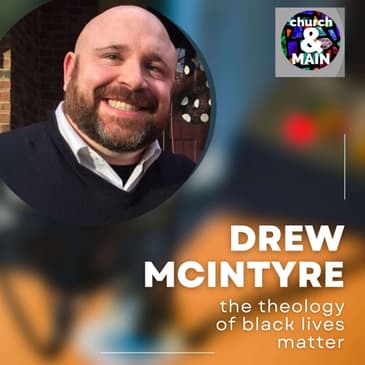
Note: This podcast originally aired on December 8, 2021. Black Lives Matter. Those three words have launched a million arguments over the last 8 years or so. What began as a hashtag in the wake of the killing of young black men by the police has become a phrase that has gone global and all the while it has been controversial. Some think it is exclusive and even racist because they think it only focuses on black people. Others like the phrase and take it on without asking questions.
Methodist Pastor Drew McIntrye wanted to look at black lives matter from a theological standpoint. What does it mean for followers of Jesus to say this phrase? Can followers of Jesus say this phrase? The answer is an emphatic yes. We will talk about what blacks live matters means theologically and what it means for African Americans to hear the church say black lives matter.
Show Notes:
The Scandal of Particularity, Black Lives, and Jesus by Drew McIntyre
The God & Whiskey Podcast- Drew and Evan Rohrs-Dodge
Make a Donation: https://donorbox.org/support-church-and-main
Twitter: https://twitter.com/churchandmain
Facebook: https://www.facebook.com/churchandmain Instagram: https://www.instagram.com/churchandmainpod/
Website: https://churchandmain.org/
YouTube: https://youtube.com/playlist?list=PL4CzMELfEV0oUYfbjdhdjqgrT3w8fHglj
Get full access to Church and Main at churchandmain.substack.com/subscribe
[00:00:00] Thanks for watching! People are scarce for interviews. And this one feels somewhat timely again. This is an interview I did in December 2021 with Drew McIntyre, who is a Methodist elder, Methodist pastor at a church in Greensboro, racial justice. But that doesn't mean that the phrase doesn't have some theological significance. I think sometimes some important theological significance. And so I wanted interviews I had in 2023 when I'm looking at coming forward in 2024. And so I'll talk about the year in the past. It's been kind of a big year in my life personally.
[00:04:22] There've also been some really good interviews. This is the podcast where we explore the who, where, what, why, and how of religion and the intersections with other aspects of life. Black lives matter. Those three words have launched a million arguments over the last eight years or so.
[00:06:47] to say this phrase. Can followers of Jesus say this phrase? The answer is an emphatic yes. And in this episode, we will talk about what Black Lives Matter means from a theological
[00:06:56] viewpoint and what it means for African Americans to hear the church say Black Lives Matter. is good to talk to you. You too, Dennis, thank you for having me. Well, for those people who are definitely kind of in the TLDR camp, would you be able to kind of give a summary of the article and kind of go from there?
[00:08:22] Sure, sure. As a preacher, I'm used to people telling me
[00:08:23] I ran too long, so I'm used to that.
[00:08:27] I guess if I was this was sort of hit me one day that the way people were reacting to Black Lives Matter was very much like what New Begin wrote about. We describe as scandal or particularity. New Begin, you're a New Begin fan of your enemy, New Begin stuff. I have read some of New Begin stuff. Yeah, I'm a big New Begin fan. I encountered
[00:09:42] him in seminary. One of my professors, Jeffrey W and of course all the other things we've seen in the last decade or so. And so it was making the connection anew, again, that's kind of how I started. And then I sort of built on to that some insights from the new perspective on Paul,
[00:11:00] which has really done important work, especially following EP Sanders just as a way of saying, in the biblical narrative, the biblical drama, God works oftentimes from the particular to the whole. We like to work from the whole to the particular, but God works from the particular to the whole. And that might give us some, I think, some scriptural warrants for the church right now to say,
[00:12:22] in a lot of this we've seen in sort of memes and social media posts, but just this idea that like,
[00:12:25] if I'm the fire department and there's a house on fire, way of looking at things is from a very universal standpoint. And I think that there are lots of things, especially in our particular faith that because it runs the other way. And I think we have a hard time dealing with things that aren't
[00:13:42] universal because we think, I tend to think that that's kind of how you would be at least look at Black lives
[00:15:03] that matter, especially from a Christian standpoint.
[00:16:07] where he talks, he really makes those connections about the origins of racism being in sort of the de-Judy eyes of Christianity.
[00:16:09] I drew on that pretty heavily.
[00:16:11] He also talks in there about sort of Christian's anxiety about not being the center of the
[00:16:18] story, right?
[00:16:19] That we de-Judy eyes Christianity because we want to be the center of the story.
[00:16:24] And so it's also worth naming, as I say in the piece, that's often kind of an obvious, I don't know, attempted platforming themselves. And I really don't want to be there. And so I was hesitant in some ways that out of this piece. It's not kind of racism, race matters is not something I've often written about.
[00:17:41] Not because I'm not interested.
[00:17:43] I try to read very widely and pay attention.
[00:17:45] But again, just because I feel kind of. And that can be, I think, disconcerting to a lot of people for a lot of reasons. If there are people who have, I think, immediately appropriated the word and just kind of
[00:20:04] there is this whole preferential option for the poor, in this sense that the marginalized
[00:20:07] are kind of important in God's eyes.
[00:20:12] Again, not saying that no one else is,
[00:20:15] but that these people hold some special value.
[00:20:19] And I think that that matters.
[00:20:22] And I think the whole point of,
[00:21:25] And at the risk of every internet conversation devolving
[00:21:29] and talking about Nazis, there is historically a connection
[00:21:32] to Christians forgetting about the Jewishness of Jesus
[00:21:36] and the Jewishness of Christianity,
[00:21:38] making possible the final solution.
[00:21:42] That's a real historical thing.
[00:21:43] That's not just hyperbole, that's not rhetoric.
[00:21:45] That's real history. referencing Isaiah and kind of referencing what a certain passage how you know we would interpret is usually referencing Christ and you know he was trying to say how they to kind of look at what this phrase meant in a theological focus? I think, you know, maybe it was just, I think there's just a richer case to be made. And that's what I wanted to try to do, to really think through this theologically. Racketing sort of the ideological stuff, because that's just noise. And I think most of the response to this
[00:25:40] is has been a lot of noise ways to de-judiize the story and to put Christians in the center And there is certainly the whole sort of Protestant background of readings of Paul in particular of the New Testament that were overly shaped by debates about medieval Catholicism, you know, coming out of where it comes from. Yeah, and combined with a sort of American, I don't know, populism or something, that everything is about the individual and the idea of anything having to do with community or it's something like Israel versus like no,
[00:29:42] Salvation is about my individual choices.
[00:29:45] I think the idea that we you know, the Bible, I think, is especially in the Old Testament. But I think in a New Testament, it's really rife and looking at things from a societal level in a way that I think is hard for us to, at least in
[00:31:03] the West, to understand. I think sometimes in that community is the church. It is communities that produce the documents that became our Bible, and they're largely written to be read and lived in community.
[00:32:24] And I think we missed that to our peril. Yes, it's important to have personal discipleship,
[00:32:27] but you have to have your own relationship with God. Jesus. I found that a fascinating statement. And what do you think he meant by that? And how did that? How did you take that when you first heard it? It definitely struck me how many things I remembered it. This is more than 10 years ago. This is over 13 years ago. beyond America, there are millions, it's not billions of Christians who did not connect their faith to how black people were treated. Right, he was even naming that sort of dissonance and saying, and I think what he was trying to say was,
[00:35:00] lots of people say they love Jesus
[00:35:02] and wanna know about their orthodoxy,
[00:35:04] but these people who are saying the nice thing
[00:35:07] created the apostles' freedom every week That was a very informative class for me. That was a fun class. He was an African-American Presbyterian pastor. He also did kind of taught in seminary on the side. And he was very, I mean, especially for me at that point, he was very radical compared to where my politics were at that point in my life. And you know, he would walk into class and say, I'm, look, I'm a socialist.
[00:36:21] I'm a, you know, all these things.
[00:36:22] I was like, whoa, whoa, whoa, whoa, whoa.
[00:36:24] But I learned a great deal from him.
[00:37:22] rear Seinfeld fan at all. The episode where Seinfeld doesn't want to wear the ribbon.
[00:37:25] I don't want to wear the ribbon.
[00:37:28] I'm one of those people.
[00:37:29] I don't want the sign.
[00:37:30] I don't want the slogan.
[00:37:32] That sense kind of my personality.
[00:37:34] I'm an integrand for.
[00:37:35] So I am an individualist in that sense.
[00:37:38] I do think for me what this should affect
[00:37:41] is kind of the posture of the church.
[00:38:47] What is it for me as a pastor and as a supervisor to walk with empathy through these things when these stories ring the news and all that.
[00:38:50] And I don't know that I've done any of that.
[00:38:53] I definitely have done it a bit perfectly.
[00:38:54] I hope I've stumbled and done it OK and tried to, without making it about my feelings and
[00:39:02] my need to be this and experience this. Maybe that's part of it. needs to be talked about. And I think there still are a lot of people that, you know, if we go back to looking at the phrase, Black Lives Matter don't really understand it from a theological standpoint. And I think need to hear another viewpoint. But I think the way that especially a lot of mainline clergy handle it, it's not doesn't work. And I think it doesn'm mainline, I think I'd say this. A lot of our clergy are educated institutions, but in some ways emphasize the ideological, the sociological, more than the theological. I mean, frankly, I a lot of the least Methodist seminaries, the theology is pretty weak.
[00:44:22] One way of understanding the mainline is you this was maybe back in the summer, that talked about racism and the importance of really coming to terms of things and he got just a lot of fear of that conversation. One of the things I say to this in sermons and in classes, one of the mythologies of the South, Stanley Hauer lost talks about
[00:45:40] this in some places. One of the mythologies both the left and the right, where if you veer from wherever the orthodox position is,
[00:47:02] you're gonna be vilified very, very openly.
[00:47:07] So I think in some ways, at least online, kind of like a mini bishop, right? Kind of my immediate boss and the bishop is over bosses in our policy. D.S. who's African American, describing the conversations that he had to have with his children when they were growing up by the New York police, right? And I remember that moment, like I never heard a black person describe
[00:48:20] that conversation before.
[00:48:22] That was new to me, right?
[00:48:24] And that was in my mid 20 Methodist pastor who's African American. And we began kind of our processes like this was a few years ago before the pandemic. We would get lunch once a month or so, you know, have a burger and just kind of talk and catch up. And most of what we did was not really talk about social stuff or even church stuff. We're both nerds and we talk about Marvel
[00:49:40] movies and comic books and that kind of stuff. But just sort of bonding on a human level.
[00:49:46] And we began to talk about, we should got our's stuff that we don't understand. We wanna, I'm just gonna build a relationship in Christ as brothers and sisters, but also try to learn, you know, from one another, what it's like to be you in this time and place and hear your stories. I wanna say for me, that's been most significant is those personal relationships.
[00:51:01] A good friend of mine who is African-American Baptist pastor,
[00:51:05] but I was a Duke with, you know, to be able to think and talk and write in these terms. And I think absent those kind of relationships, it's hard to, it's like telling people about Jesus, right? It's really hard to have that conversation over a tweet or Facebook page. No one gets converted, no one gets, it has a meaningful change in their perspective
[00:52:21] with that stuff.
[00:52:22] So it really has to be personal.
[00:52:25] And I know you're right,
[00:53:40] that's what's gonna change things.
[00:53:42] It's, yes, there are times where you have to have marches
[00:53:47] and sit-ins or desire or that sort of mass of angry and proffourished people to do that. And Methodism, Transform, Britain, not so much through at the level of legislation, the level of truth. Grand things, the Methodist movement, the engine of it was relational,
[00:55:01] small groups, three to five people, 10 not change people's hearts and minds. And I don't think that we're going to come to a better understanding of the history of racism and its implications today with legislation, even though there's some that may be helpful and needs to happen to one of those people. Yeah, I think, you know,
[00:57:24] that have been there for decades. And I think that that takes time.
[00:57:28] Yeah, yeah, for sure.
[00:57:32] I'll name a resource that I found helpful.
[00:57:34] It could be a mile from what we're describing.
[00:57:37] It was one that I listened to, I think last year,
[00:57:39] and the author's name is escaping me.
[00:57:41] It was called Be the Bridge.
[00:57:46] I thought it was the, of the slave trade, at least from Britain. What do you thinkslavery. Actually, I'm listening right now to this book is so long. It's Ron Chernow's new, I think it's new biography of Washington. It's very good. It's long. It's extensive. But one of the anecdotes
[01:00:20] in the book is when the two original American Methodist final question that I have is, what do you think is your objective with this essay?
[01:01:40] What do you think is you want someone to get
[01:01:45] from reading this essay? I've given them, hopefully, some good reasons to think maybe differently about it. Both about why it's something that we can and should affirm from a Christian perspective and why it what happens to us. And as the church, we should be able to to the first people to say for us, because we love Jesus, your life matters to us.