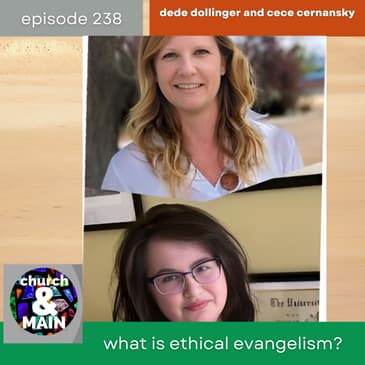
Can evangelism be done in a way that’s both ethical and inclusive? Denise Dollinger and Christina Cernansky, hosts of the podcast "Emissaries of Renewal," join me to discuss the nuances of ethical evangelism. DeDe and CeCe examine the concepts of radical hospitality and inclusivity in today’s religious context, advocating for a reimagined evangelism that prioritizes love and community over guilt and fear. Listen in as these two Episcopal seminarians challenge conventional practices of evangelism, encouraging Christians to envision a more inclusive and transformative approach to faith.
Emissaries of Renewal Facebook Page
Join the Church and Main Email List
Facebook | Instagram | Threads | Twitter | Website | YouTube
[0:09] Music.
[0:34] Hey, everyone. Welcome to Church in Maine, a podcast for people interested in the intersection of faith, politics, and culture. I'm Dennis Sanders, your host. Last summer, I became the producer for a podcast. The podcast is called Emissaries of Renewal. And over the last few months, as I have kind of helped the two hosts kind of get off the air, get themselves off the ground and into the air, I've got to know them.
[1:09] They are two Episcopal Seminarians, Denise Dullinger and Christina Cernansky. And I got to know more about their podcasts. And Emissaries of Renewal It is a podcast that explores ethical evangelism through radical hospitality and working behind the scenes to get their episodes off the ground. And I thought it might be a good thing to have them on this podcast to kind of help people learn more about them, about their podcast, and also about what ethical evangelism looks like. So that's what is going to happen on this episode. We're going to talk to both Denise and Christina, who go by Didi and Cece. And we'll talk a little bit about their faith journeys, and what led them to end up in seminary and then to talk about their approach to evangelism, especially within the Episcopal Church. I've kind of been on a streak where I've interviewed a lot of Episcopalians lately and one of the things that I think has been hopeful to see is this sense of...
[2:34] Interest in kind of in evangelism in a way. It's not in the way that I would think it was growing up, but this is kind of how it's being approached is evangelism. So this will be one way that we're going to talk about that. So I hope that you'll enjoy this talk. It might help you to see what it means
[2:54] to spread the good news in ways that are inclusive and especially inclusive of LGBTQ people. So please join me in this chat with Denise and Christina or Didi and Cece.
[3:12] Music.
[3:30] All right well dd and cc thank you for joining uh me today on the podcast i thought i wanted to start off, like I usually kind of do, is talking about your faith backgrounds. Where did you, how did you guys get to where you are? And so, whoever wants to start first.
[3:54] Well, do you want me to go first, Cece? Sure. Okay. Well, this is Dee Dee. And first of all, Dennis, thank you for asking us to be here. Our producer extraordinaire. We're so excited. I'm a huge fan of the podcast. So I am, as you know, just fangirling a little bit to be here. So my journey is just filled with a lot of, you know, twists and turns to where I got today. I was raised, I'm originally from the Appalachian Mountains of Kentucky. That's where my family is from, where I was born. And I was raised both there and in the Midwest. My parents moved here when I was very young. And I was baby, you know, I was, you know, barely a year old. And because they wanted to give us a better life. And um mommy didn't want daddy working in the coal mines so and that's pretty much all you can do there so we were brought here but the Appalachian culture is very ingrained in one another and so we spent time back home.
[5:18] Most, anytime we had free. So if we weren't in school, if we weren't, you know, all of our holidays, no vacay family, we had no family vacations, we went back home. So it was always a big part of our lives. And it was a big part of our spiritual life as well. When we found a church here, it was a Southern Baptist church, but we also practiced the faith that each one of my parents were raised in. My mom was a free will Baptist growing up, and my father was an old regular Baptist, and he did have access to that faith practice in Illinois. Once a month, he was able to go practice that.
[6:08] That's how old regular Baptists now are able to practice in this area, in the Midwest area where I am, because there's not a huge community. So they go around once a month, and they go to different churches as a community and practice. They'll travel. They travel to each other's churches. And so once a month, there was one in Illinois close enough that he could go and we would go with him. So I always like to say that I was raised three types of Baptist. And it was three levels of fundamental faith.
[6:52] You know, types and evangelical types of Baptists. The most liberal being the Southern Baptist one, which, you know, think about how liberal that is, right? So, that was my main formation, the one that I was in, that's the one I was baptized to, and the one that I had my calling in. I was about eight years old. I remember my calling very clearly. I didn't know what was happening. I didn't have the language for what was happening. It was during an altar call, which is a very common thing in fundamental and evangelical types of churches. I remember the song that was playing. I remember the smells. I remember the actual visions that I was having the Holy Spirit sent vision to me. I remember all of it, but I didn't know what it meant. So I went forward as if I was wanting to be baptized, but I didn't want to be baptized. I didn't understand that portion because it's a believer's baptism. I wasn't baptized as a baby.
[8:04] So luckily, you know, the deacon and the pastor at the time knew I didn't understand baptism, and they didn't know what the heck I was trying to explain to them because women didn't have a calling in a church. Women could teach, but they could not preach. My mother was a teacher.
[8:25] In the church. So she tried to understand what was happening. She asked me what it was that took me forward.
[8:34] And I tried to explain it to her. So for her, how she saw it through the lens was, oh, so you want to be a teacher like mommy is. That's how you want to serve. And I'm like, no, that's the last thing I want to do in that sense, because she actually taught young children. And even then, I knew that that probably wasn't what I wanted specifically to do. And so I spent many years trying to, you know, feeling very confused and not knowing what to do. A couple of years later, I actually was baptized in a believer's baptism. I was 10. And then when I was about 12, I realized another realization came to me was that I'm bisexual. And boy, did that not, that wasn't something that was going to go well. So I kept, you know, listening to people talk about what an abomination that was, not only in the Southern Baptist Church, but especially in the face of the communities of my family in Appalachia.
[9:55] Many of the sermons were about how... You know, you go straight to hell and all of those types of things. A lot of hellfire and brimstone is what I was raised with. A very, you know, that the type of it's very fundamental. You know, the old regular Baptist, you know, women don't even aren't even allowed to wear pants, you know, still no makeup, no pants. They can't cut their hair. There's no there's no instruments in the church for music. Only members can sing and only men preach. You know, there's no actual for educational formation or anything like that for, there's no theological formation. You preach from the Holy Spirit. So it's, that's, those are the types of, that's the type of formation I had. And it was filled with a lot of shame and guilt and believing that I was not worthy of salvation. And I was taught and that kind of salvation is theologically theological.
[11:09] Formation was what I believed until I was in college I was almost in graduate school and I was really always very conflicted I left Illinois and moved back to Kentucky to go to school. I went to the University of Kentucky for undergraduate and University of Louisville for my graduate degree. I had decided the way I was to serve was as a social worker. And that's what I was a clinical social worker. That was my first.
[11:45] My first form, you know, my first formal training that I've had. And so that's how I served. But I really struggled with my identity. I struggled with my faith. We didn't call it deconstruction then. I'm old. So this is like in the 90s. So I'm in college in the early 90s. So we called it a crisis of faith. And I like to call it my wanderings and ponderings. And I heard somebody say, I overheard it. They said, you can get the Bible right all you want to, but if you get loved wrong, you've messed it up. You've done it completely wrong. And that hit me harder than anything. And I realized that it was time to try to walk away. And so that's when I just took this big, huge.
[12:44] Theological dive into what religion is. And I tried every, you know, I tried everything on that I could. And in doing so, I always seemed to end up back into something that felt comfortable, but didn't fit my skin. So I usually ended up somewhere in between, like in a non-denominational megachurch and I'd try that out because it felt familiar or I'd find my way back to something that was Baptist because the songs were comfortable. But it wasn't until I tried out an Episcopal church in the early 2000s that I was like, I got this. This is it. This is where I want to be.
[13:32] I understand this. This makes sense. And this was before a lot of the things, You know, they were queer accepting, but not necessarily all the sacraments and those types of things. But I knew all along that the Anglican people were my people. You know, I could really get behind a lot of things. So I started a pretty deep dive into what Anglicanism is and their history and their polity just really in their dogma and canon made a lot of sense. And it continued to grow as they did, making even more and more sense. And then, of course, the creeds, you know, once you start affirming the creeds, you realize that you're really...
[14:21] You know, it's universally what you want to be. But what really struck me is, at first, what I liked about the Anglican faith is that they didn't evangelize. They didn't proselytize, you know, because, you know, I already came from the Lord's army and, you know, and selling fire insurance, and I didn't want to do that again. But then I realized that that's not what the gospel says that you're supposed to do.
[14:51] And there needs to be something, you know, the social gospel is what you should be about. And of course, you find that in the mainline denominations. But there has to be something in between that, right? And so as I continue to heal, I realize that there has to be, there needs to be, there's a need for something in the middle. You know, you have the theological right, which is that where they're not as concerned about what's happening here today, they're only concerned about what happens when you die. You know, Jesus is important to you to get washed in the blood. But after that, that sacrifice is all that seemed important. And then you get washed in the blood, you go to heaven, and that's the goal. That's the only thing that's important. And then you have the theological left and what's important is the social gospel and bringing heaven to earth, you know, the kingdom of God up here, but not yet, but we need to fix that. Well, sure, but what happens in between? You have to be able to deploy that. How do we deploy that? We need to deploy that.
[16:03] With evangelism, right? And we have to do that as ethically as possible. That's where, and I said, well, but you have to do that in a way that doesn't harm anybody. You have to do that in a way that is ethical for everybody and welcomes everybody. How do you do that? So how can we reclaim that, but also do it in a thoughtful, relational way and not a transactional way? And that I knew that that would be a ministry of mine when I was finally ready to join the Episcopal Church. And that took several more years before that could happen. I had still a lot of healing I had to do from years of shame, shame, shame, bitter, you know, the Game of Thrones, shame, shame, shame that happened. But once that, and I was able to join and continue my formation, which started out in seminary, which led to a bigger discernment. And I'm now in discernment toward actually following my call and hopefully ordination.
[17:11] But I always knew that it was going to be my ministry even before joining the Episcopal Church.
[17:19] And Cece, what is your journey? My journey has a couple of other different flavors to it than Denise's story.
[17:29] I was born in West Palm Beach, Florida, and my parents very much loved each other, but they came from different faith backgrounds. And I think that some of those things kind of sprung up, and my parents divorced at a very young age. My father is Catholic, Jesuit Catholic, and did pre-K through college Jesuit schools. And then my mother, a Lutheran, now the evangelical Lutheran ELCA flavor of Lutheranism. And I was raised by a single mother, and my grandmother was a single mother, and then her mother was a single mother. And so we come from a long line of females that were very active in the Lutheran faith. And I was always reminded of Martin Luther being the, Jesus being the original heretic, right? And Martin Luther right there with him. And at the same time, and I attended Lutheran school pre-K through mid-year fourth grade in Florida. and then I moved to Georgia. But my father, he was an airline pilot. And so I saw him when I could, and he was in the military reserves. And his reserve unit was always where I lived.
[18:55] And I would go with him to work sometimes, which this is the 80s.
[19:01] And if I couldn't go to work with him, I would then get shipped off to one of his siblings. And so I have a very close-knit family with my father's side, and they're all very devout Jesuit Catholics, still to this day. So I would grow up going to Lutheran, services, and then also Catholic services. And I was exposed from the very get-go of this very differing way on how to understand your faith. And it was always very confusing to me, but now, after I got my calling, I realize, ah, I see exactly what God was doing here, right? Because the Episcopal Church is almost as if you combine those two different practices. I was always curious about not having the saints in the Lutheran faith, and I was always confused why there was some certain linear practices within the Catholic faith, so to speak.
[20:06] And I left the church. I was confirmed in the Lutheran Church, And I left the church when I went to college, like most of us, right? We would go to, I would go to church with my family during high holidays or when I was visiting my family members. But I couldn't understand the reasons why all these things were happening. And I very much in the world, and I very much blame every single faith institution. And I left and I wanted to find my own way to God and find my own way to spirituality. And create my own religion, so to speak.
[20:46] After college, I went to college in South Florida. And after college, I moved to Washington, D.C. For 13 years and tried to pick up, tried to find a church. Nothing really fits, nothing. I didn't really feel, I wouldn't say welcome, but it just didn't feel right. And I worked for an organization and at the time that had a lot of they had partnerships with the National Cathedral and the National Cathedral is the National Cathedral of the Episcopal Church I had no idea what the Episcopal Church was I was clueless I just thought oh it's like the National Church and I went to a couple of talks and and events at the National Cathedral They hold a lot of forums, public forums. And so I would go quite often to the cathedral. And then towards the end of my stint in Washington, D.C., there were a lot of challenges that arose, mental health challenges. My best friend had died by suicide two years prior. My only cousin had died by a traumatic brain injury. And I was just kind of questioning the meaning of life. I was questioning what I was doing with my life. I spent my entire life working on social justice issues, and I was a lobbyist of some sorts, a good one, because I didn't make that much money.
[22:15] And then my calling started happening. And my grandmother, my dead grandmother, came to me in a dream, and she told me that I needed to shape up. I had a lot of work to do. And so I kind of woke up and thought, okay, well, what I'm doing right now is not what I'm supposed to be doing, according to my grandmother. So what should I be doing? And within a couple of weeks, someone asked me to dog sit in Sun Valley, Idaho. I had never thought of visiting the state of Idaho, never heard of this place called Sun Valley, but off I went for a month. At that time, I was doing some consulting work, so I had some free time.
[22:54] And I searched for a church. I went on, you know, the Googles and I searched for a church in that area that aligned with my values. And I walked into my first Episcopal church knowingly, sitting in the pews as an attendee. And I was, I had a spiritual experience. There's a church in Sun Valley, Idaho, St. Thomas, and it overlooks this beautiful mountain called Baldy Mountain, which is a big ski resort area. And it changed my life. And it was as if I was hearing the words of a Lutheran pastor, but then also the tradition of the Catholic faith. And I very much love that tradition of the Episcopal Church. And we have this saying that the Episcopal Church is a three-legged stool. So we very much lean on scripture as well as tradition and reason, and we're very much encouraged to build our own faith within faith, scripture, and reason. And I started rebuilding my life, started rebuilding my faith, and reconstructing my relationship with God. Because at that moment, I very much...
[24:12] Hated God. I was very angry at God. Very, very angry. There was a lot of things that I walked through and I couldn't understand. But that particular parish opened me, welcomed me with open arms. And it really helped that I was in the beauty of the most beautiful places on earth and really got rid of all my suits, tried to drop my hard exoskeleton that I had born in Washington, D.C., and started opening myself up to the sunlight of the Spirit. I was also there that I got sober, and I visited in August 2015 and moved September 2015, got sober January 2016.
[25:00] I was still Lutheran, and it just so happened that I was thinking about being confirmed in the Episcopal Church, being accepted and received in the Episcopal Church. And I was like, I don't think I need to sign a piece of paper. I'm here. But the bishop came in to bring in new, receive new members, and it was my birthday. So it was October 27th, 2019. So on my 39th birthday, I was received into the Episcopal Church. And from there, the following year, I moved to Boise, Idaho and started working on, at that time, I was working in mental health and suicide prevention. And I started working on this work in the military. And that's where I got my calling. And the rest is history.
[25:47] So how did this kind of become both of you coming from your background, obviously then going into seminary, which is also a question I am asking there too, but how did Emissaries of Renewal come about?
[26:11] Well, coming from very different backgrounds, and her living in Idaho and me living in Illinois, You know, I live in a suburb of Chicago. We met at orientation and matriculation at Bexley. I joined, I went to seminary because I didn't know what I wanted. But I had been told my entire life that women do not get ordained, nor do they go to school. I had wanted to get an MDiv for a long time. In fact, I wanted to do a dual social work and MDiv in the 90s when I was going to my when I decided to get a master's in social work. I would not nobody would accept me because I was a woman living in Kentucky.
[27:08] And I was wishy-washy about my idea of faith, right? So nobody would accept me. So I went a hard line and went to the University of Louisville's Master of Science in Social Work, which is a very clinical research type of like, okay, so I can't be, you know, I can't get an MDiv, but I'm going to get a science degree. Watch me as a woman kind of thing. So I went the opposite. So my entire life I wanted an MDiv. So I went in without knowing what if I was going to be a lay minister or if I was going to be or wanted to be ordained. Because in the Episcopal Church, everybody has a ministry.
[27:53] And we're very strict, you know, we're very certain about that. And a lay minister is just as important as an ordained minister because everybody has gifts of the Holy Spirit. it. And when those gifts are given, some of us need to be ordained to do them. And that's the difference kind of thing, right? So I was getting, nobody was going to tell me, especially a man that I couldn't get, you know, because my priest was like, are you sure you want it without knowing, without going through the discernment process? You're really doing this backwards. Do you sure want to do this. And I was like, you are not going to bogart my education. You're not doing this. I'm getting my MDF. And I really think it was a push from God, you know, in spirit telling me to do this because we met at orientation.
[28:47] And our entire cohort is extremely close. Like we happened to just be sitting together and I remember she was sitting behind me, but we just kept having a conversation. And then at matriculation, we, you know, we ended up sitting together in the pew and we just reached for each other, you know, when it, you know, became very overwhelming when you really felt spirit there. And from there, we did everything. But when we left orientation, our little cohort of eight to ten people, we already had our text threads. We were checking in on each other. We were solid already. But Cece and I were constantly in communication. So when the Episcopal Evangelism Society grant came up we immediately, I started looking at it because I'm like oh evangelism that's my thing that's a ministry I want to be involved in, I started looking at what that granting was and then I mentioned to her as I was working on a grant with them are you going to do this and it kind of snowballed, from there, I think.
[30:11] How would you say it, Cece? Yeah, I definitely gravitated towards Denise. I found out she was a social worker and I was in the mental health space. And I was like, yeah, I think it'd be great if I had a clinician friend going through this whole process with me. Because at that time, getting a master's in divinity, I was discerning on a couple of years prior, do I get a master's in social work or do I get a master's in theology. It wasn't like I should be a priest one day.
[30:40] It was more so how could I be in a helping field? And what is my calling? And she wore a really cool shirt too. And I was like, she seems really rad because she's got this shirt, which listed a bunch of the female leaders within the Bible. And I wanted to know more. And yeah, we were, she told me about the Episcopal Evangelism Society. And we were talking about, our school puts on a trip called Learning in London. And it's put on by our then Dean, Dr. Fout, who the Diocese of London has grown by 70% in 20 years. And the whole class is about 10 days. And you go and learn and you meet people and you visit three churches a day. I mean, it is definitely you're hitting the pavement. Quite intense. Yes, it's very intense. You read a lot of books. And so we went, we're going to go over and learn how to do this. And so we decided to do a joint venture. And we found out that some of the things weren't funded for the trip. And so we thought, well, let's just do a podcast and we'll talk about the trip.
[31:52] And then it just kind of spawned from there. And now we want to go into a second season. And I think that we're definitely growing into our voices. Denise had her voice quite all the time, you know, but me, I was kind of nervous and I was like, I don't know what I'm doing. This is because sometimes I have imposter syndrome of like, wow, this is really happening. This was, you know, five years ago, I just wanted to have babies and go skiing. And that is so not, right? I still ski, but I'm not having babies.
[32:23] And I'm just like spawning, you know, becoming a priest with my other seminarians. So, but it is what it is, right? When God calls, you step it on up, right?
[32:35] So I'm kind of curious, what led to the podcast? And what kind of made you want to kind of do this? Well, Denise had a framework that she will definitely be talking about in a few minutes, but we wanted to really, we wanted, but we want to talk, we really wanted to, for me, I want to take back the Bible. I want to take back our flag and I want to take back the word evangelism. I want to take back, and I think that we should, no one owns Jesus's words. No one owns the Bible. No one has dominion over these things, right? This is the word of God that has been shared with people for centuries. And the deeper I get into the word and the deeper I get into Jesus's teachings, it's the way of love. If it's not based in love, it is not the word of God. It is not Jesus's words. And so that's what evangelism is, is spreading the good word of the love and grace and mercy that God has been teaching us for thousands of years that has been written in the Torah, right? That now we include it in the Old Testament and so forth and so forth. And so that's been my desire to get this going. And Denise has a lot of the brains behind this.
[33:58] What I bring to the table is I come from a community organizing background and I.
[34:08] My ministry is to the nuns and duns, as well as to those that have left the church because of religious trauma, as well as those that feel as if the church isn't for them. I mean, think about all of the unwed mothers that are out there that don't feel loved by the church. Think about all of our LGBTQ plus population, children that don't feel loved by the church. Think about those that are divorced that don't be loved by the church. And it's not just the church. It's like, because I literally lived in that existence that I thought Christianity was one big blob, right? And everyone said the same thing. And everyone had this, this shame, guilt and fear thread to it. And that's not the case. And once I started reading the Bible, I was like, that is so not the case. So that's my passion behind the podcast and being able to talk about what evangelism means. And I hope that we can reach people that are sitting on the fence or just searching for a way of love and then knowing that there are places, atheists, agnostics, right? Like everyone, come on up in here, right? And it's not about making the tent bigger. It's focusing on the center of our tent, focusing on the most marginalized. And those are things that are not widely understood. Right.
[35:34] Yeah. Yeah. Amen. I, you know, you know, preach it, you know, almost mother CC.
[35:46] So she's right. I did, you know, when I started looking at writing the grant on my own, I ended up started working on this framework and model, but it, she came up with the podcast and I thought, well, we'll include it in it, but, you know, we need to be bigger than that. So, um, like she's saying, you know, our, our mission statement is, it's kind of a big, it's, you know, it's that we're a welcoming place where we can all explore, you know, our faith and, you know, through, you know, God's transformative love, you know, through Jesus and the use of ethical evangelism and radical hospitality, whether you're a seasoned believer or you're not, you know, whoever you are, you know, come on in. And I hope that that's something that is seen and, you know, and heard when we talk. You know, I think, you know, right now we spend a lot of time in season one educating about what we are because people hear the word evangelism and they're like, nope.
[37:02] You know, it's, they think of street preacher, you know, like, and I've, I've literally heard people say that, you know, and I'm going to date myself by saying that, but no, I'm not asking you to be Jerry, you know, Falwell. I'm not asking you to be Tammy Faye Baker on the screen. That's not what we're talking about. Um, but that's what people think. And I don't blame them. I mean, there have been, you know, somebody, you know, there were churches.
[37:32] I mean if you get into you know we could get into the history of it but you know that i think that's a whole other podcast if you want to talk about the history of you know the second awakening and talk about the pot you know talk about um the second great awakening that started the revival movement and then move into the fourth great awakening which mixed that you know in the 70s and the 80s with, you know, with religious, religion and politics. And that's where the growth of, you know, the street preachers and everything became, you know, televangelists and those types of things. And, you know, but what spawned from that was the Jesus movement. Right. And so the Jesus movement is where the church came from originally in the first century. But unfortunately, what the Jesus movement became from the 70s is, you know, the almost like the fundamental church of today.
[38:37] And because of that, there's been a lot of unfortunate events.
[38:47] Belief systems that come around what evangelism is being evangelistic. And it's not the original idea of what evangelism is supposed to be, which is simply just the good news. Literally, when it was used in a non-religious way, what was evangelism? It was, you know, you could use it militaristically to say something good was happening. It's just a good announcement. It's that excellent announcement. It was to herald something, right?
[39:16] That's being evangelistic. And it's been used, you know, over the millennia, over the centuries. You don't have to use it in a religious way, but it is just the gospel. We use it as the gospel. So how do we do it? How do we deploy it? Well, you need to do it through discipleship. And that just brings up, well, how do we make disciples? And I think that's where the breakdown happens. We don't sell fire insurance to do that. I think the way we do it is for us, we go back and we look at our baptismal covenant. And one of the questions that's asked is um simply we we are to evangelize not just with our actions but with our words because it's will you do you know will you practice the good news of jesus christ through words and deeds and it's i will with god's help well that's pretty simple and that's how we make this you know that's what discipleship is it's not simply just going out there and collecting collecting human beings collecting souls because they're scared of and making your own little you know we're in the lord's army now i know i keep saying that but that's what it was like to be baptist um and.
[40:46] You you know you make your own you know your little soldiers and you make your own little kind of.
[40:53] Insular kind of people and whoever's out there that's their problem and we get to go to heaven and that's the most important part instead of doing the work here.
[41:06] Because, as I said earlier, the kingdom of God is here, but not yet. When we just passed the fifth Sunday of Easter, and I loved the revelations, the proper revelations from the Revised Common Lectionary, which was, you know, Revelations 21, 1 through 6, which was talking about, I am the Alpha Omega, I'm the one that comes down. And I love being able to reclaim that, like CeCe talks about.
[41:39] You know, to reclaim that from, you know, revelation was something to be scared of, you know, in the evangelistic movement, in the fundamental movement. And now we can reclaim it and we can talk about what that actually means. It's, you know, talking about how it's breaking through here. And we can, you know, talk about what that means now. And I think that's exciting. And I think that's what's needed. But we can also talk about how that's including everyone. one. We can talk about John's verse of another clobber verse that's used, I am the way, the truth, and the life, and nobody can get to heaven but through me. What was Jesus actually talking about in that? Let's talk about it. Let's take that back. Let's reclaim that and say, he's talking about act like me. You don't have to, don't make a salvation prayer that everybody has to say. It's acting christ-like well there's plenty of people who act christ-like that aren't christians.
[42:54] You know let's include them in our community those are the types of things that i'm excited about um when we talk about um ethical evangelism when we talk about it being relational and not transactional, and taking that holistic approach to it instead.
[43:18] How do you think that you learned from both of you about evangelism not being more of a relationship than a transaction? Because I think I had a similar background where it was very much transactional. But at least for me, I think that that's not how you read the Gospels. It is actually more relational. So I'm kind of curious, when did you kind of learn that and how, and how did that kind of factor into your understanding of ethical evangelism?
[43:57] I started regaining and rebuilding my faith through 12-step recovery. And one of the prayers that we say in 12-step recovery is the St. Francis of Assisi prayer. And he became, at that time, my favorite saint. Now I know that there's lots more, like more than I can even fathom. So now I'm just in awe by all of the saints. But St. Francis, you know, he encouraged us to find God in nature, find God in our four and two-legged friends, to be quiet and find that, build that relationship with God and to not be told how to do it and to not be told when to do it, but to just go in and do it. I also read one of my favorite books as I was reconstructing was The Questions of Jesus. Jesus asked 307 questions, and he only answered three. So that further cemented the idea that it is up to us to build that relationship with God, and everyone's relationship with God is different. And sometimes that's scary, right? It's a big entity depending on where you're coming from or how you were raised.
[45:21] And I, Denise always laughs at this, like sometimes my idea of God or Jesus is, it differs depending on the day. And sometimes God or Jesus is a DJ. And I think of him like literally on turntables, like chicka, chicka, chicka, just trying to get us to love one another and be in unison and dancing with one another in joy and grace and love and mercy.
[45:48] And that's just not what we see right it's like some white dude on some mountain throwing a thunderbolt or something like that but you know that's like greek mythology almost uh but it's it's once i discovered all of this and and now in seminary we learned about the mystics and learned about mysticism which is the practice of having a deep relationship with god, and it's it's very like even as i talk about it it almost makes my heart flutter to the point of not nervousness but just joy right just pure joy of being able to explore that and it's not a and it's a journey it's not a destination right we constantly are building that relationship with that entity that created all of us.
[46:48] So over the last few months actually working with you is creating the the podcast i'm a series of renewal kind of what have you learned from that experience of putting the podcast together, and what made you want to start the podcast, well now we have an app where there's a teleprompter on my phone.
[47:15] Uh so it's it's technology right it's a big learning curve of technology and doing these things it's also constantly unfolding of the content right and we we talk about the content ongoing it's not like it's a outline and so i think that's the holy spirit moving within us right as well as we pray for guidance what what should we be talking today and when i when i started my relationship with god it was lord what would you like me to do today and help me to stay out of your way so let me be a vessel of thy peace let me be a vessel of thy message.
[47:56] It's ongoing. Yeah, I, well, I, you know, I totally agree with that, with that point, 100% is I can be very, I'm neurodivergent. So I'm somebody who is like, I plan, I plan, I plan, I plan, I plan, I need to know exactly what's happening when it's happening. And so I started, I do you know a lot of the writing for emissaries and so when we started I'm doing the writing I'm doing the writing ahead of time and what I learned is that doesn't work as having ideas having, maybe planning those things out makes sense maybe but even that needs to be fluid because I had almost all 12 scripts written, and half of them we haven't used and aren't going to use. I felt like everything had to be done before we even started taping, and that doesn't make any sense.
[49:09] Um and so i've learned that you really need to just allow spirit to unfold what's going to come next and be comfortable in that because that's how spirit works just like when you're preaching you sit and you contemplate with with spirit with the word and and let that happen you can't plan. You can't write it ahead of time and hope that that's exactly what was supposed to be said. And this is very much the same.
[49:48] Where do you see this ministry of Emissaries of Renewal going in the next few years? I know that you are trying to remember if you're wrapping up seminary or getting close to it. So what happens after that. How do you see this ministry continuing as you enter into professional ministry? I don't see it separating, but we'll see. We definitely have plans on doing a season two. We laid the foundation of what evangelism is to us and encouraging our listeners to, understand maybe some various concepts of it and to see what evangelism looks like to them, right? And start exploring that relationship. And if they're being called to join us in that journey. And so our second season, we are looking forward to interviewing people doing the work.
[50:49] Because this is not just me and Denise, right? Like, we are definitely, we feel like we are called to be able to have a conversation over what this looks like and all the possibilities that it could bring.
[51:05] Yeah, I, you know, I'm in this for the long haul. As long as people will have me, I'm here. Um, that's how I see it because this is part of my ministry, you know, evangelism will, you know, and I think evangelism is inherently a part of all of our ministries. But um when i look at exactly what i want to do um this is part of it and so as long as this serves god and as long as he says this is where you need to be i'm going to do it is it going to unfold into something different perhaps i'd love to see it grow i'd love to see you know others find, um
[51:59] Find it, you know, you know, life-giving in some way as well, that they find something from it, that they get something from it. You know, I'll keep doing the work as long as they keep wanting to see it. And I hope that it works, you know, that it works for them. I'm not doing it for me. So whatever comes from it. Yeah. Do you think it can have, or is having an effect, especially with people in the pews? So not just folks that are in seminary or are already in the priesthood, but people who are in the pews who may want to do more than just come to church, but are kind of living that life and want to find ways of having relationships with others and be able to kind of present Christ in a way that is ethical, non-threatening, and kind of contrary to what you, especially Denise, have talked about your growing up.
[53:20] I hope so i you know i i hope that you know from i've gotten some feedback back you know we don't have a huge fan base but you know um the feedback you know i get is that i never thought of it that way i thought that was a good example um those types of you know that feedback i know i i do, I have to be honest, a lot of my sermons say very similar things to what I write or what I say on the podcast, maybe not as specific, you know. I don't drop our names or anything. I'm not that shameless.
[54:04] But what I get back is a lot of people have never, they don't, in the Episcopal Church, they don't think about that. Evangelism in that way. So I do think that we are, people who spend time with us are rethinking what evangelism is. And that's my goal for now. As the seasons would go on, if they do, if that's what God wants, I hope that there's more that comes from that. I hope there's more that we can do. You know, we can give them that action and that's what the model and framework is for. But right now, I think the first step is definitely that moment of, I don't have to be scared of this work.
[55:00] Nobody's asking me to go door to door and leave the tracks. Right? Because then they've done that and nobody likes doing that. Have you heard the good news about our Lord Jesus Christ? Everybody's, nobody wants to do that. Nobody wants to do that. Nor is it effective. Every statistic, every statistic will tell you that that is not effective way to teach about Christ. And that is the goal, not saving somebody. That is the goal. And that is, you know, because through teaching about Christ and his life and his ministry and what discipleship is, that's how you change the world, which is what he wanted. That's the Jesus movement.
[56:01] I had the great privilege of watching Reverend Nadia Bowles Weber speak a couple of days ago. And I heard her give a talk. And by her sharing her story and how she became and listening and she reads her books, listening to her books and her story, it connected me to the Holy Spirit more than I ever could have imagined. She was not an older white dude that cast shame and guilt or judgment she was a human being that um covered in tattoos right she swore every now and then and that made the holy spirit more relatable and i think that that's what we need at this time right we don't need people that are untouchable. We need people that are doing the work that Jesus Christ did, the work that Jesus Christ encouraged us to do, and getting our hands dirty.
[57:13] It was so, I literally, I would sit in church and just everyone, it felt like I was being talked over. And that's not the word. That's not. Not to say that those that's good or bad are different, But I think that the world is calling and needing for folks to be able to step up to a call to identify with the population that feels as if they can't relate. And we see that in our mental health statistics.
[57:45] And it's not so much, have you joined us in church on Sunday? It's how are we sharing the good work of thoughts, words, and deeds, right? Thought, faith without works is debt, right? What is it? Faith without, I was getting confused with the 12-step recovery. Faith without action. Yeah. Yeah, you got it right.
[58:06] Faith without action is, yeah, and James. And so how are we working in our communities? How are we meeting the needs of the community? How are we meeting the community where they're at, rather than standing in the middle of four walls, wondering where people are?
[58:26] Well, if people want to know more about Emissaries of Renewal, where can they go? Well, we are on all social. We are religiously on social media. Um, poor Cece, I have her working so hard. We just got back from our retreat and I had our cohort working hard too. I was making them be guest speakers. Um, but we are on Facebook as Emissaries of Renewal and we are on Instagram as Emissaries of Renewal and, um, Emissaries of Renewal.com. We are there that is our website but you could also reach us by email each one of us, cc just c and c um at emissaries of renewal.com and denise at emissaries of renewal.com for me um but yeah and just go to facebook and follow us and that'll take you to the rest of everywhere that we are.
[59:34] We religiously are on there. We have videos. We have reflections. We try to do all of our updates or episodes. To follow us on our podcast, you know, to find our episodes of podcasts, we are on both on Spotify and Apple Podcasts, again, just by our name, Emissaries of Renewal. So we are everywhere and in great numbers we are we are out there and it's fun to look how we are growing into this or at least for me yeah yeah yeah but yeah no we um they were written reflections for a long time but we we have started to record them so they're just quick reflections, Every Friday and Sunday, you'll find a reflection. So there's always a reflection for the proppers on Sundays. And then Friday's just like a little...
[1:00:34] I don't know. What would you call them, Cece? There's always a theme to it. Like we have a Friday monthly theme that we do. Friday fun. I don't know. I don't know. Friday fun. Yeah. And then we'll throw pictures up there and what's new and what we're thinking and stuff. And there's some albums. Flat Denise is out there somewhere still. I'm not sure where she's at. But flat Denise is a picture of my face from London because I didn't get to go as planned. And somebody in our cohort has her right now and is traveling around somewhere. So she's being passed around. But yeah, so I couldn't go. So a huge, one of those huge things that, you know, that people, you know, get for like graduation or whatever their face. It was me. And I went everywhere in London. Instead, that way.
[1:01:33] Since I missed out on this. You have to find this flat, Denise. Yeah, there's pictures of me. I'm on the subway. I'm hanging out with a couple of bishops like Rick Thorpe. Just everywhere. Cece took me everywhere. I'm in the pub.
[1:01:53] Um so well thank you both for taking the time to chat with me today um i'd also want to say thank you for allowing me to be the producer of emissaries of renewal and the best producer ever ever thank you ever without you dennis i'm looking forward to season two and to see what y'all are going to be doing and um looking forward to being a part of it yes yes of course yeah we couldn't have done it without you you guys are amazing and so are you thank you for having us on so exciting yeah can't wait.
[1:02:36] Music.
[1:03:05] Well, I'm so thankful for Didi and Cece to take the time to chat with me. I'm kind of curious what your thoughts are about the episode. What are your thoughts about ethical evangelism? Do you think that that's something that your congregation would be willing to take on?
[1:03:25] I'd love to hear what you're thinking. Send me an email at churchinmain at substack.com, and I would love to hear from you. I will include links to Emissaries of Renewal's podcast and also to their Facebook page. I hope that you will give it a listen and also like their Facebook page. They have a lot of material, not just their latest episode that goes up. If you want to learn more about this podcast or listen to past episodes or donate, check us out at churchinmain.org. You can also visit churchinmain.substack.com to read related articles. I have a few articles up that are related to kind of some, especially some very recent happenings, so check it out. You can subscribe to the podcast on your favorite podcast app. And I hope that you would consider leaving a rating or a review that does help others find this podcast.
[1:04:35] If you are able to make a donation please consider doing so you can do it on the Substack page you can also go to Buy Me A Coffee, and the link is in the show notes it's buymeacoffee.com backslash Dennis L. Sanders that is it for this episode of Church in Maine thank you so much for listening I'm Dennis Sanders your host take care Godspeed and I will see you very soon.
[1:05:06] Music.