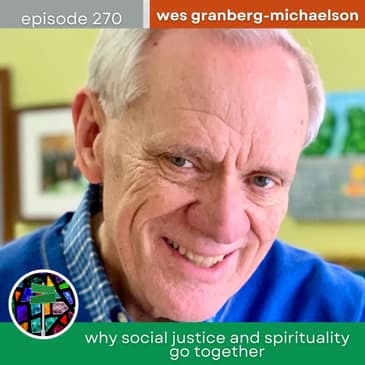
I speak with Wes Granberg-Michelson about the essential link between spirituality and social justice in today's political climate, looking at the urgency for faith communities to act while remaining grounded in spiritual practices. Drawing from his book, "The Soul Work of Justice", Wes advocates for integrating deep prayer and reflection into our pursuit of justice, ultimately calling for a renewed approach that prioritizes faith and love in addressing societal challenges.
Wes Granberg-Michaelson's website
Join the Church and Main Email List
Facebook | Instagram | Threads | Twitter | Website | YouTube
00:00:28 --> 00:00:32 Hello and welcome to Church and Main, a podcast for people interested in the
00:00:32 --> 00:00:36 intersection of faith, politics, and culture. I'm Dennis Sanders, your host.
00:00:36 --> 00:00:42 The rise of the second Trump administration has kind of meant the relaunch of protests.
00:00:43 --> 00:00:48 Not that protests went anywhere, but it seems to be much more prevalent right now.
00:00:49 --> 00:00:53 People are hitting the streets, they're signing statements, they're attending rallies.
00:00:54 --> 00:01:01 And for people, especially for mainline Protestants and progressive evangelicals,
00:01:01 --> 00:01:07 many of them can see the importance of social justice, especially right now.
00:01:07 --> 00:01:13 But at times they may forget that it's just as important to focus on the spiritual
00:01:13 --> 00:01:21 aspect of their faith as it is to focus on the justice aspect of their faith.
00:01:21 --> 00:01:28 My guest today is Wes Granberg-Michelson, and he says that if one sees justice
00:01:28 --> 00:01:33 as an important part of their faith, they also have to make spirituality a priority as well.
00:01:33 --> 00:01:37 Before we go into that conversation a little bit about Wes.
00:01:37 --> 00:01:43 He was a legislative assistant to Senator Mark Hatfield of Oregon,
00:01:44 --> 00:01:48 also a director of church and society for the World Council of Churches,
00:01:48 --> 00:01:53 and for 17 years, he was the general secretary of the Reformed Church in America.
00:01:55 --> 00:02:01 He has a new book out called The Soul Work of Justice that we will talk about in this discussion.
00:02:02 --> 00:02:07 So, without further ado, Here is my conversation with Wes Granberg-Michelson.
00:02:28 --> 00:02:36 Well, welcome to the podcast. And I wanted to start by kind of helping getting
00:02:36 --> 00:02:39 to know a little bit more about you, your kind of spiritual biography,
00:02:39 --> 00:02:42 and also a little bit about kind of,
00:02:44 --> 00:02:47 Well, your biography and then also some of your work background.
00:02:48 --> 00:02:53 Going back to when I was four years old with my wonderful mother,
00:02:53 --> 00:02:56 raised in a strong evangelical home.
00:02:57 --> 00:03:02 And I was asking her questions of faith as an inquisitive four-year-old.
00:03:02 --> 00:03:05 And she asked me if I wanted to accept Jesus into my heart.
00:03:06 --> 00:03:10 And I thought about it. And I knew I was going to a dentist appointment.
00:03:11 --> 00:03:15 And so I said to her, well, maybe, but why don't we do that after I go to the dentist, Mom?
00:03:16 --> 00:03:21 And she looked at me and she said, well, Jesus could come again while you're in the dentist chair.
00:03:23 --> 00:03:31 Well, that was both the sincerity and also the intensity of the kind of faith
00:03:31 --> 00:03:36 I grew up with, a strong evangelical home in the suburbs of Park Ridge,
00:03:36 --> 00:03:42 in Park Ridge, Illinois, I mean, suburbs of Chicago.
00:03:43 --> 00:03:49 Went to a high school of 4 kids in which there was not one single person of color.
00:03:50 --> 00:03:54 So I was in a very isolated kind of environment, a conservative,
00:03:55 --> 00:04:01 Republican, evangelical, white world.
00:04:03 --> 00:04:08 My parents wanted me to go to Wheaton College, which was their alma mater,
00:04:08 --> 00:04:11 well known as kind of the evangelical Harvard.
00:04:13 --> 00:04:16 I decided through the influence of my young life leader, I wanted to go to Hope
00:04:16 --> 00:04:18 College in Holland, Michigan.
00:04:19 --> 00:04:26 And that was really the beginning of broadening my faith to understand it wasn't just about Jesus and me.
00:04:27 --> 00:04:29 It was also about God and the world.
00:04:30 --> 00:04:34 And that we learned to put together both the word and the world.
00:04:35 --> 00:04:37 And this was happening right in
00:04:37 --> 00:04:40 the middle, Dennis, of the Civil Rights Movement and of the Vietnam War.
00:04:41 --> 00:04:48 And I went on to Princeton Seminary with a real desire to figure out how does
00:04:48 --> 00:04:56 this faith that I had learned in my childhood fit to what I see going on in the world.
00:04:58 --> 00:05:05 So I had the opportunity after I'd started seminary to work as an intern in
00:05:05 --> 00:05:08 D.C. in the office of Senator Mark Hatfield.
00:05:09 --> 00:05:15 He was an evangelical. Well, being an evangelical back then is different than what you say now.
00:05:16 --> 00:05:23 He was progressive. He was anti-war and one of the leading anti-war figures.
00:05:23 --> 00:05:29 And it was a real calling to work with him. That went on for 10 years in a very deep relationship.
00:05:29 --> 00:05:33 But when I started, I started looking for a church in D.C.
00:05:34 --> 00:05:37 I went to Fourth Presbyterian, which anyone from D.C. knows,
00:05:37 --> 00:05:40 really well-established evangelical church in Bethesda.
00:05:41 --> 00:05:46 Heard a lot of good things about Jesus, didn't hear anything about the war or civil rights.
00:05:47 --> 00:05:52 I went to the Episcopal Church on the Hill, heard a lot of good preaching about
00:05:52 --> 00:05:56 justice and peace and the war, and didn't hear very much about Jesus.
00:05:58 --> 00:06:04 And finally, I discovered Church of the Savior, which was an ecumenical church
00:06:04 --> 00:06:06 founded by Gordon Cosby.
00:06:06 --> 00:06:08 Elizabeth O'Connor wrote books about it.
00:06:08 --> 00:06:13 And that introduced me to the inward and outward journey together.
00:06:13 --> 00:06:20 It kind of brought those two aspects of faith together for me and really determined
00:06:20 --> 00:06:24 the future trajectory of my life.
00:06:25 --> 00:06:28 And vocationally, I eventually left D.C.
00:06:29 --> 00:06:33 I went into the ministry, worked at the World Council of Churches in Geneva,
00:06:33 --> 00:06:36 Switzerland on issues of integrity of creation.
00:06:37 --> 00:06:41 Was called to be what they call general secretary of my denomination,
00:06:41 --> 00:06:43 the Reformed Church of America.
00:06:44 --> 00:06:51 Which had me trying to figure out how you make a denomination work and its ecumenical commitments.
00:06:51 --> 00:06:56 I remained very engaged ecumenically, and for the last 10 years,
00:06:56 --> 00:07:03 my wife and I have been living in Santa Fe, New Mexico, and writing and also pastoring here.
00:07:04 --> 00:07:10 There are two things that are kind of D.C. related that I had in this conversation.
00:07:10 --> 00:07:20 The first is, I was in D.C. in the mid-1990s and had a lot of connection with Church's Savior.
00:07:20 --> 00:07:24 So, when you said that in our talking,
00:07:25 --> 00:07:29 that kind of picked that up that I went to a lot of their classes And I thought
00:07:29 --> 00:07:36 they were really helpful because I think they found a balance between both spirituality
00:07:36 --> 00:07:40 and social justice that is, even today,
00:07:40 --> 00:07:42 is not always found as much.
00:07:43 --> 00:07:48 And then the second thing is, is that I actually remember there was an event
00:07:48 --> 00:07:55 one time I was at in the Methodist building, which is across the street from the Capitol.
00:07:55 --> 00:07:59 And actually, one of the people who spoke there was Mark Hatfield,
00:07:59 --> 00:08:07 who is someone that I really found fascinating just because he was kind of an odd duck.
00:08:07 --> 00:08:13 And I mean that in a very good way, that he was just someone that was a different
00:08:13 --> 00:08:17 sort of politician that you just don't find these days.
00:08:18 --> 00:08:25 And so having him not around, I think, has made the world a little bit poorer for that.
00:08:26 --> 00:08:31 Well, if you thought he was an adult then, think of what a...
00:08:32 --> 00:08:35 Progressive evangelical and a
00:08:35 --> 00:08:38 liberal republican would feel like today oh it
00:08:38 --> 00:08:41 would yeah it would be a very very very odd
00:08:41 --> 00:08:45 yeah um yeah exactly his
00:08:45 --> 00:08:48 model his life um it was
00:08:48 --> 00:08:52 it was remarkable in fact randall balmer who's the noted religious
00:08:52 --> 00:08:55 historian um of american
00:08:55 --> 00:08:58 history uh he's writing a biography about
00:08:58 --> 00:09:01 him oh wow okay read the he sent
00:09:01 --> 00:09:04 me the the text that's going
00:09:04 --> 00:09:07 to be published by urban's probably probably won't be out to the end of the
00:09:07 --> 00:09:12 year but it's really going to make an important contribution to especially in
00:09:12 --> 00:09:16 today's political religious climate yeah i think that that will be something
00:09:16 --> 00:09:23 that will be very important to read and for people to hear um is about his his life because,
00:09:24 --> 00:09:30 I think it's influential, and I think, especially for evangelicals,
00:09:30 --> 00:09:34 it's important to have that voice, to hear that story.
00:09:36 --> 00:09:41 So, one of the reasons I have you on the podcast is because you,
00:09:41 --> 00:09:45 and you kind of hinted about it when you were looking for a church in D.C.,
00:09:45 --> 00:09:47 is your book, The Soul Work of Justice.
00:09:47 --> 00:09:54 And when you talk about the importance of spirituality, of faith—.
00:09:56 --> 00:10:02 As well as social justice, and how you kind of need one to feed the other.
00:10:03 --> 00:10:08 Can you kind of say, give a little bit of a synopsis of what led you to write
00:10:08 --> 00:10:09 the book, and what is the book about?
00:10:10 --> 00:10:17 Sure. Well, one of the things I learned at Church of the Savior was forms of
00:10:17 --> 00:10:22 spiritual life and development that were fresh and were deeper. Sure.
00:10:23 --> 00:10:26 And that included silent prayer,
00:10:27 --> 00:10:33 included forms of retreat, you know, that weren't just going out having a good
00:10:33 --> 00:10:39 time like I did in my church youth group, but actually spending time alone and
00:10:39 --> 00:10:41 in quiet and in contemplation.
00:10:41 --> 00:10:46 Also journaling, using journaling as a spiritual tool.
00:10:46 --> 00:10:53 And I began doing that. And for me and my personality, it really helped.
00:10:54 --> 00:10:59 Keeping a journal, as I learned it from people like Elizabeth O'Connor and many
00:10:59 --> 00:11:05 others, it's really a place to process the pain and the grace in your life.
00:11:06 --> 00:11:11 And to deal with it and to deal with God in that,
00:11:11 --> 00:11:16 to be in dialogue and to look at yourself and look at the questions you ask
00:11:16 --> 00:11:22 and look at your experiences of God or sometimes wondering where God was.
00:11:22 --> 00:11:27 But being able to write that out in ways that, at least for some people,
00:11:27 --> 00:11:33 certainly for me, really become therapeutic and really become spiritually grounding.
00:11:34 --> 00:11:40 And so I've done that for my life and my various ministries.
00:11:40 --> 00:11:45 And during COVID, I was sitting here in my home with my wife,
00:11:45 --> 00:11:51 Karn, and she looked up at this bookcase that has all the journals I've kept.
00:11:51 --> 00:11:56 She says, what are you ever going to do with those? And I said, I don't know.
00:11:56 --> 00:11:59 She said, well, why don't you, you know, it's COVID. Why don't you read them
00:11:59 --> 00:12:02 through and see if there's anything there that our two kids might want to read?
00:12:03 --> 00:12:06 So I decided to start that. I
00:12:06 --> 00:12:11 started reading through 50 years of these journals. So it took me a year.
00:12:12 --> 00:12:16 I started, you know, pulling out something that, oh, my gosh,
00:12:16 --> 00:12:20 now that's interesting. Now that's really useful and so forth.
00:12:21 --> 00:12:25 And by the end of the time, I know my spiritual director had said to me,
00:12:26 --> 00:12:30 If you do this, this isn't going to be an intellectual exercise.
00:12:30 --> 00:12:34 You're going to be drawn back into all those journey points,
00:12:34 --> 00:12:37 occurrences, pivotal points that, you
00:12:37 --> 00:12:42 know, you'll kind of relive them and internalize. That was really true.
00:12:43 --> 00:12:50 And I thought, well, I've got something here to share with, yeah, my two kids and others.
00:12:50 --> 00:12:54 But, you know, there's something deeper here, I think. So I talked to a friend
00:12:54 --> 00:12:58 who had been an agent with one of the previous books I've written,
00:12:58 --> 00:13:02 and she went through this stuff and she says, Wes, you have to write this.
00:13:03 --> 00:13:11 You've got stuff here that can be really helpful, especially when today…,
00:13:12 --> 00:13:20 The urgency of action and witness externally is so great because we're in such
00:13:20 --> 00:13:23 a mess, in my view, Dennis, such a dark time.
00:13:24 --> 00:13:32 But being able to undergird that with spiritual depth and integrity that allows
00:13:32 --> 00:13:37 for real truth speaking and doesn't have us just in continual reaction,
00:13:38 --> 00:13:43 and that gives us the ability to get in it for the long term.
00:13:44 --> 00:13:47 That's what I felt so urgently about.
00:13:47 --> 00:13:53 And so I wrote this whole work of justice really hoping it would be a help to
00:13:53 --> 00:13:58 any of us who are pastors or activists or leaders of organizations.
00:13:58 --> 00:14:03 I mean, it's particularly those who kind of know, yeah, we need to be out there.
00:14:03 --> 00:14:08 We need to be in the streets. We need to be clear about our witness to the gospel in this time,
00:14:08 --> 00:14:18 but we've got to do that from a depth of spiritual integrity and life that both
00:14:18 --> 00:14:22 sustains it, gives us resilience, and gives it real power and truth.
00:14:23 --> 00:14:29 And so that's really what the book is about and how I developed it and four
00:14:29 --> 00:14:32 different movements and the kind of stuff we have to deal with in the process.
00:14:36 --> 00:14:47 What led you to do journaling, and how did that help you and sustain you in your own activism?
00:14:48 --> 00:14:48 Yeah.
00:14:51 --> 00:14:57 What led me into journaling was a workshop at Church of the Soviet when I was
00:14:57 --> 00:14:59 kind of exploring membership there.
00:14:59 --> 00:15:06 And look, I was raised with an evangelical kind of piety, and I'm grateful for
00:15:06 --> 00:15:12 it, but it was have your quiet time every day,
00:15:12 --> 00:15:25 and then read some portions of the Bible and underline it with a pen, and then pray to God,
00:15:25 --> 00:15:28 making kind of a list of the things you'd like God to do.
00:15:28 --> 00:15:31 It's sort of, you know, the things we want to add to God's to-do list,
00:15:31 --> 00:15:33 which is already pretty long.
00:15:35 --> 00:15:38 And, okay, I, you know, I value those things.
00:15:38 --> 00:15:43 But, Dennis, I came to a point where I really needed something more,
00:15:44 --> 00:15:49 something to have more depth and, frankly, that looked more deeply into myself
00:15:49 --> 00:15:53 and looked more deeply into the questions we all have about God.
00:15:53 --> 00:16:00 And journaling was one of the tools that really allowed me to do that because
00:16:00 --> 00:16:05 I'd write about the things I was experiencing,
00:16:05 --> 00:16:08 about my struggles, my disappointments,
00:16:08 --> 00:16:15 my certain epiphany, certain times when I felt in some unexplicable way,
00:16:15 --> 00:16:20 God's presence and love has just broken through to me.
00:16:20 --> 00:16:26 You know, maybe for an instant Maybe in just one One encounter But suddenly
00:16:26 --> 00:16:30 all life becomes more vivid and real And what does that mean?
00:16:32 --> 00:16:37 And then I began going on retreats. I'd try to take one day a month,
00:16:37 --> 00:16:40 and then each year a more extended one.
00:16:40 --> 00:16:44 But every time I went on one of those retreats, I'd read what I had written
00:16:44 --> 00:16:47 in the journal since the last time I was on retreat.
00:16:47 --> 00:16:55 And what that would do is would just bring back into my awareness where my journey
00:16:55 --> 00:16:59 had been and where it was going and the things that I needed to be attentive to.
00:16:59 --> 00:17:06 So, you know, I mean, journaling is, for different people, according to your
00:17:06 --> 00:17:11 personality and gifts, you know, it may resonate more with some than others.
00:17:12 --> 00:17:12 For me, it really worked.
00:17:13 --> 00:17:19 The main thing is that all of us have to develop some kind of a spiritual infrastructure.
00:17:20 --> 00:17:27 I call that in the book a holding space. We've got to develop some discipline
00:17:27 --> 00:17:34 that allows us to take a step away from all the immediate pressures of our life
00:17:34 --> 00:17:38 and be at a point where we can be more deeply grounded,
00:17:39 --> 00:17:44 allowing for the real presence and love of God to break in anew.
00:17:45 --> 00:17:52 Because the way I experience it, when that love encounters you deeply.
00:17:53 --> 00:17:59 And you let it flow, it then connects you to all those places of the world's
00:17:59 --> 00:18:01 deepest pain and suffering.
00:18:01 --> 00:18:04 It breeds the deepest kind of solidarity.
00:18:05 --> 00:18:09 So it's not just a solidarity of ideology or solidarity of slogans,
00:18:09 --> 00:18:11 but it's a solidarity of love.
00:18:12 --> 00:18:18 And particularly in today's environment, that's the kind of solidarity we need.
00:18:22 --> 00:18:31 I'm reminded there is someone else that I follow on Substack and is Tony Robinson who is a UCC pastor.
00:18:31 --> 00:18:38 Oh, yeah. And he shares in a recent Substack about his experience also during
00:18:38 --> 00:18:39 the Civil Rights Movement.
00:18:40 --> 00:18:46 And I think it was in an African American church and how he was...
00:18:47 --> 00:18:54 He and his friends were just ready to go out there, and they were basically like, sit down.
00:18:54 --> 00:18:56 We need to worship right now. This is important.
00:18:57 --> 00:19:04 And he reflects on that years, decades later, and sees how important that is that you needed that,
00:19:04 --> 00:19:10 and how the civil rights movement was very much grounded in that,
00:19:10 --> 00:19:13 that it was grounded in worship.
00:19:15 --> 00:19:20 And before you went out into the streets, that that was where you started,
00:19:20 --> 00:19:24 was in prayer and in worship to God.
00:19:25 --> 00:19:31 And I think he talks about that because it can be so tempting to just think
00:19:31 --> 00:19:35 that worship doesn't have anything to do with what's going on in the world.
00:19:36 --> 00:19:40 And for him, it was, No, he learned, yeah, this matters.
00:19:41 --> 00:19:45 Yep, yep. And unfortunately, a lot of worship we experience doesn't have anything
00:19:45 --> 00:19:48 to do with what's going on. Unfortunately, yeah, yeah.
00:19:49 --> 00:19:52 But I think you're exactly right about the civil rights movement,
00:19:52 --> 00:19:54 and I think that's generally forgotten.
00:19:54 --> 00:20:00 I know even on Substack, on Church in Maine, you've written some very powerful
00:20:00 --> 00:20:05 things about the civil rights movement, Martin Luther King, and capturing the essence that was there.
00:20:06 --> 00:20:11 There's also kind of a related story that I mentioned in the book,
00:20:11 --> 00:20:12 but it's about Desmond Tutu.
00:20:13 --> 00:20:17 And so, it's during the anti-apartheid struggle. Desmond, of course,
00:20:17 --> 00:20:19 it's, you know, playing a key role.
00:20:20 --> 00:20:24 And Desmond learns, I don't know if he's on a trip or whatever,
00:20:24 --> 00:20:28 but that in California, there are a group of nuns.
00:20:29 --> 00:20:34 In a monastery who are getting up every morning early, as was their discipline,
00:20:34 --> 00:20:39 and they were praying for the end of apartheid. They were praying for the anti-apartheid.
00:20:40 --> 00:20:49 And so he's back in South Africa, and there's this really stressful moment where he's in the cathedral,
00:20:50 --> 00:20:55 and he's preaching, and those in the cathedral are ready to go out and march,
00:20:55 --> 00:20:59 but the cathedral is surrounded by South African police.
00:21:00 --> 00:21:05 And so Desmond goes out there in front of them, and he addresses the police, and he says,
00:21:06 --> 00:21:13 do you know that in California, a group of nuns are getting up every morning
00:21:13 --> 00:21:15 to pray for the end of apartheid?
00:21:16 --> 00:21:18 You don't stand a chance.
00:21:21 --> 00:21:31 I mean and that brings energy and conviction to those who are involved it does well and I think that is,
00:21:33 --> 00:21:38 That is the thing that we carry, I think, as Christians, is that we know that
00:21:38 --> 00:21:42 we have a power that's greater than the police.
00:21:46 --> 00:21:53 And prayer can be a powerful thing if we can see, because obviously apartheid
00:21:53 --> 00:21:58 did fall, and those prayers were answered. Yeah. Yeah.
00:22:00 --> 00:22:04 So, you know, what do you have to say?
00:22:04 --> 00:22:08 Because I think, as I said earlier, there are people who will think that,
00:22:08 --> 00:22:13 and it's not without reason that people will think, well,
00:22:14 --> 00:22:18 worship doesn't really have anything to say with what's going on in the world,
00:22:18 --> 00:22:22 or, you know, prayer has nothing to say with what's going on in the world.
00:22:22 --> 00:22:24 We need to be out doing action.
00:22:25 --> 00:22:30 How do you kind of counter that or help people to see that these two things
00:22:30 --> 00:22:36 are connected and that you can't really sustain one without the other?
00:22:37 --> 00:22:44 Well, in two ways. I'll first talk about prayer, and then I'll talk about what
00:22:44 --> 00:22:47 I think and hope can happen in worship.
00:22:48 --> 00:22:51 And partly that's based on experience
00:22:51 --> 00:22:56 that it so happens that right now my wife and I here in Santa Fe,
00:22:56 --> 00:23:00 New Mexico, We were asked, we've been living here about a decade,
00:23:00 --> 00:23:04 but we were asked recently to help this small ELCA congregation,
00:23:05 --> 00:23:09 Lutheran congregation, that's kind of struggling and their pastor had to retire.
00:23:10 --> 00:23:14 And so, suddenly we find ourselves in the pulpit and...
00:23:15 --> 00:23:21 Doing the sacraments, you know, every Sunday. And so that means when I answer
00:23:21 --> 00:23:23 these questions, it's pretty existential now.
00:23:24 --> 00:23:26 It's not some idea.
00:23:26 --> 00:23:35 But to start with prayer, I like to remind people of what prayer really can do.
00:23:36 --> 00:23:45 And I like to do that by reminding us of how distracted we always are.
00:23:45 --> 00:23:52 How there is so much information coming at us, so much that we can't possibly
00:23:52 --> 00:23:55 digest, but yet it's coming to us in social media.
00:23:56 --> 00:24:00 It's coming to us, you know, every day on our phones.
00:24:01 --> 00:24:10 And then when you get into it, you realize these are designed in order to rivet
00:24:10 --> 00:24:14 our attention because that's how money's made.
00:24:14 --> 00:24:22 And it does that, especially by emotions of fear and anger.
00:24:23 --> 00:24:28 And in fact, some people say it's really an economy of rage.
00:24:29 --> 00:24:33 You know, the more anger you get people, whether they're on the right or the
00:24:33 --> 00:24:34 left, the more engaged they're going to be.
00:24:38 --> 00:24:43 You know, we live in what some people call an attention economy.
00:24:44 --> 00:24:48 And the problem is that attention is a limited commodity There's only so much
00:24:48 --> 00:24:55 of it to go around So you have to pay attention to where you give attention Now here,
00:24:55 --> 00:25:01 where Henry Nowlin I think is the one who first told me this Prayer is attention.
00:25:02 --> 00:25:09 Prayer in attention. And so one can think about prayer in all the ways that we understand it,
00:25:09 --> 00:25:17 but as that practice that keeps us detached in a healthy way from the onslaught
00:25:17 --> 00:25:23 of what's happening in order that we can be attached more deeply to God's presence
00:25:23 --> 00:25:26 and God's love and God's desires.
00:25:27 --> 00:25:31 There's a similar way to think about it.
00:25:32 --> 00:25:38 You could also say prayer is detachment from the fruit of your actions.
00:25:39 --> 00:25:43 And you think about that. Prayer is detachment from the fruit of your actions,
00:25:43 --> 00:25:49 meaning you act with all the power and conviction that you can.
00:25:49 --> 00:25:53 But when you do that, you then have to let it go.
00:25:54 --> 00:26:00 You know, you have to feel, I've offered this up to God, but I'm not in charge of what happens.
00:26:01 --> 00:26:04 I'm not going to be able to manipulate and strategize.
00:26:05 --> 00:26:11 I've got to have that ability to stand back and let whatever God's spirit intends
00:26:11 --> 00:26:13 happen. And I think prayer also does that.
00:26:14 --> 00:26:20 Now, when it comes to worship, I talk with pastors and I, you know,
00:26:20 --> 00:26:22 I think every Sunday where I'm going to preach.
00:26:24 --> 00:26:27 How do you deal with
00:26:27 --> 00:26:33 the gospel with preaching in this time and especially you may have a purple
00:26:33 --> 00:26:38 congregation you know you may I know all kinds of pastors who half their congregation
00:26:38 --> 00:26:44 voted for Trump and half voted for Harris and there are all these divisions
00:26:44 --> 00:26:47 and so a pastor just wants to stay away from it,
00:26:48 --> 00:26:51 and then pastors struggle with I don't want to be political Cool.
00:26:53 --> 00:27:00 Look, all you have to do is preach the text, because it's all there.
00:27:00 --> 00:27:04 I mean, when you, you know, if you really, you go through Advent,
00:27:04 --> 00:27:07 you go through now, if you're following the lectionary, you know,
00:27:07 --> 00:27:13 we're in these passages about, well, this coming Sunday is the Beatitudes, for goodness sake.
00:27:13 --> 00:27:15 I mean, this is a manifesto.
00:27:15 --> 00:27:21 This is a manifesto of a changed society, of the Magnificat,
00:27:22 --> 00:27:29 and the fact that Jesus was living under the domination of a Roman Empire,
00:27:30 --> 00:27:39 and that when Jesus preaches about the kingdom of God, this isn't some magical spiritual thing.
00:27:39 --> 00:27:44 He's talking about a kingdom of God that is different than the kingdom that's
00:27:44 --> 00:27:51 there now and so and then if you're in a sacramental trudge.
00:27:53 --> 00:27:56 Or you celebrate like you celebrate communion on the Lord's Supper.
00:27:57 --> 00:28:07 I mean, my goodness, you're celebrating those moments when the material things
00:28:07 --> 00:28:14 of the world become transformed through the in-breaking power of God's presence.
00:28:15 --> 00:28:20 And those moments teach us that what happens then also happens when we're in the world.
00:28:21 --> 00:28:26 So, I think, Dennis, those are the ways I know for,
00:28:26 --> 00:28:32 you know, you really have to rethink what it is when we talk about prayer and
00:28:32 --> 00:28:36 rethink what happens when we're in worship and get to the heart of those things
00:28:36 --> 00:28:41 because then they will intersect directly with what's happening in the world. Mm-hmm.
00:28:43 --> 00:28:51 Yeah. And I think, you know, what you said reminds me of something about Karl
00:28:51 --> 00:28:58 Barth and how he preached and taught, especially during the rise of the Third Reich.
00:28:58 --> 00:29:06 And he didn't – I've heard somewhere that he very seldom really talked about Hitler.
00:29:06 --> 00:29:11 He basically preached the gospel. That was enough.
00:29:11 --> 00:29:15 And, in fact, that got him in trouble. Yeah. That sometimes,
00:29:16 --> 00:29:21 I mean, you don't have to basically talk necessarily directly about where things
00:29:21 --> 00:29:24 are going because it's in the Bible. It's there.
00:29:25 --> 00:29:29 Yeah, it is. Yeah, that will, that's enough.
00:29:31 --> 00:29:44 Yeah, I mean, I've been really struck by how much the message of the gospel itself.
00:29:45 --> 00:29:51 And, you know, of course, you could go back to the passages in the Hebrew scriptures
00:29:51 --> 00:29:53 where you have similar things.
00:29:53 --> 00:29:56 But these days, I'm really focusing on the life of Jesus.
00:29:57 --> 00:30:08 On how much what he says and does really can speak to our own context today.
00:30:10 --> 00:30:15 I think, and when the early Christians in the New Testament,
00:30:15 --> 00:30:23 when you say, Jesus is Lord, what is that in contrast to?
00:30:24 --> 00:30:26 Well, it's very simple. It's in contrast to Caesar as Lord.
00:30:27 --> 00:30:32 Yeah, yeah. Because that's what was going on. And I think it was Tertullian
00:30:32 --> 00:30:36 or someone said, if everything is Caesar's, nothing is God's.
00:30:38 --> 00:30:42 And those are the kinds of questions that, you know, you certainly don't have
00:30:42 --> 00:30:50 to be partisan to put those questions of the gospel in front of the congregation. Mm-hmm.
00:30:54 --> 00:30:57 So, I'm going to kind of get practical here for a moment, because,
00:30:57 --> 00:31:02 of course, where I'm recording this from is from Minneapolis.
00:31:02 --> 00:31:06 And, of course, that's kind of in the news lately.
00:31:08 --> 00:31:15 And so, my question would be for people, for Christians that are here,
00:31:15 --> 00:31:23 is what advice would you give them for them to be spiritually grounded? at this time?
00:31:23 --> 00:31:28 Uh-huh. Well, it's a great question, and before I answer it,
00:31:28 --> 00:31:34 I've also got to say, I mean, I have close friends who are pastors who are there,
00:31:34 --> 00:31:38 and I have utmost respect for them.
00:31:40 --> 00:31:45 I mean, one's not, yes, pastors who are like yourself, who are in Minneapolis, St.
00:31:45 --> 00:31:49 Paul, but others who have traveled there and whom I've heard from.
00:31:50 --> 00:31:55 And there's, I'll tell you, Dennis, there's a part you probably saw towards
00:31:55 --> 00:32:00 the end of my book where I kind of try to answer that.
00:32:00 --> 00:32:03 Now, not in the specific context, of course, of Minneapolis,
00:32:03 --> 00:32:09 but it's sort of like if you do the kinds of things that we're talking about
00:32:09 --> 00:32:12 here and putting together the kind of grounding infrastructure,
00:32:12 --> 00:32:19 what difference is it going to make when you are there outwardly in witness and in the world?
00:32:19 --> 00:32:22 As our friends are right now in Minneapolis-St. Paul.
00:32:24 --> 00:32:30 I came up with things like this. First of all, I would say to them,
00:32:30 --> 00:32:34 remember that this world belongs to God.
00:32:35 --> 00:32:38 That that's where everything is starting from.
00:32:39 --> 00:32:49 We are against a lot of immediate evil, but we are also there with the conviction
00:32:49 --> 00:32:52 that this world belongs to God.
00:32:52 --> 00:32:57 And that when, you know, even when you pray in the Lord's Prayer,
00:32:57 --> 00:33:02 like kingdom come, what you're really saying is we want this to be like God is in charge.
00:33:03 --> 00:33:07 And that's, you know, you start there.
00:33:07 --> 00:33:13 And then you have to realize that the work that you're doing,
00:33:13 --> 00:33:19 I mean, you're blowing whistles, You're standing in between people protecting
00:33:19 --> 00:33:23 victims against this angry,
00:33:24 --> 00:33:29 terrible face of police enforcement.
00:33:30 --> 00:33:36 You're trying to help people get groceries. You're doing all the things that people are doing.
00:33:36 --> 00:33:41 Well, to remember that at the heart of it, this is really a spiritual engagement.
00:33:43 --> 00:33:48 You're doing these practical things, but it's a spiritual engagement because
00:33:48 --> 00:33:53 those passages about how we wrestle not against flesh and blood,
00:33:53 --> 00:33:55 but against principalities and powers.
00:33:56 --> 00:34:00 Those kind of become real. I mean, that's not a slogan.
00:34:01 --> 00:34:07 The other thing I'd like to say is don't act just on the basis of urgency.
00:34:09 --> 00:34:14 Because, I mean, everything's urgent. You've got to act on the basis of call.
00:34:14 --> 00:34:21 You have to say, in the midst of all these things, where do I know God is really,
00:34:21 --> 00:34:23 as far as I can sense, that God is calling?
00:34:28 --> 00:34:33 And then, you know, all my friends who are in the same, you know,
00:34:33 --> 00:34:37 we have the same kind of concerns about the present shape of our country.
00:34:39 --> 00:34:45 And their first question is always, what can I do? What can I do?
00:34:45 --> 00:34:48 Well, okay, it's a good question. Should I go out in March? Should I sign a
00:34:48 --> 00:34:53 letter? Should I write to my congressman? Should I protest somewhere?
00:34:54 --> 00:34:58 Well, those are all really, really important questions.
00:34:58 --> 00:35:04 But I like to say maybe the first question to ask is, who am I called to be?
00:35:05 --> 00:35:11 Who am I called to be? Because I think we're in a time where we've got to develop
00:35:11 --> 00:35:23 the depths of character and spiritual courage and moral grounding that will last for the long term.
00:35:24 --> 00:35:27 That aren't going to just be temporary. However,
00:35:29 --> 00:35:38 we're going to need to have real depth of commitment that will breed resilience.
00:35:41 --> 00:35:48 And then two other important things that I list and that I would say to myself
00:35:48 --> 00:35:53 and say to my friends, you've got to work on being detached from your ego.
00:35:55 --> 00:36:02 You can't be in this because you want to see yourself as a hero or because you're
00:36:02 --> 00:36:04 wanting to draw attention to yourself.
00:36:07 --> 00:36:13 Because, you know, that's, I mean, unfortunately, that is the prime model of
00:36:13 --> 00:36:16 power in the president of the United States that we see.
00:36:16 --> 00:36:20 And we don't want to mimic that in our way. We want to act differently.
00:36:20 --> 00:36:28 And that's a spiritual matter. And with that, I think we have to learn how we
00:36:28 --> 00:36:30 don't demonize our opponents,
00:36:30 --> 00:36:35 and how we take that love that Jesus taught us, the final step,
00:36:36 --> 00:36:40 which is the hardest step, namely to love your enemies.
00:36:41 --> 00:36:46 And of course, this is what Dr. King lived out so well.
00:36:47 --> 00:36:57 And then I think at the end of the day, we all have to say, where do we root
00:36:57 --> 00:37:01 our lives? Are we rooting our lives in anger? Are we rooting our lives in fear?
00:37:01 --> 00:37:04 Or are we rooting our lives in love?
00:37:04 --> 00:37:11 And are we, in the words of Paul in Ephesians, are we rooted and grounded in love?
00:37:12 --> 00:37:19 Because that's a love that is so high and deep and vast, as the passage says,
00:37:20 --> 00:37:24 that we can't even grasp it intellectually, but we can know it deep within.
00:37:24 --> 00:37:29 And that's the love that finally will sustain us, that will eliminate fear,
00:37:30 --> 00:37:35 and that will bring us, as I said earlier, into solidarity with all the world's pain and suffering.
00:37:36 --> 00:37:42 When you're looking at kind of things that can ground you, and we've talked
00:37:42 --> 00:37:47 about journaling, what other things would people want to consider?
00:37:47 --> 00:37:53 If journaling isn't what they want to do, what else would they consider doing?
00:37:53 --> 00:37:57 I think you've got to find the things that work for you and for your personality.
00:37:59 --> 00:38:04 Certainly prayer. But there are so many ways now of praying.
00:38:04 --> 00:38:08 Yeah. You know, I mean, I think on the Protestant side,
00:38:08 --> 00:38:16 you know, we're recovering a lot of the ancient spiritual practices of prayer,
00:38:16 --> 00:38:21 a lot of the stuff that the Reformation threw out that we're now kind of grasping against.
00:38:21 --> 00:38:27 So, you know, you've got centering prayer, you've got Ignatian prayer,
00:38:27 --> 00:38:31 you've got desolation and consolation known as the examine.
00:38:32 --> 00:38:41 You've got silent prayer. You have, you know, in some traditions sort of walking prayer.
00:38:41 --> 00:38:49 I mean, you know, walking through a neighborhood with its needs as a prayer walk.
00:38:49 --> 00:38:59 You have so many tools that I think in many ways,
00:39:00 --> 00:39:06 At least for me, prayer gets focused much more on presence than it does get
00:39:06 --> 00:39:07 focused on what can I get.
00:39:08 --> 00:39:18 And so in whatever ways work for us, I think we have to deepen that capacity of prayer.
00:39:20 --> 00:39:32 And then I think we need to be enriched with words that can help penetrate deep
00:39:32 --> 00:39:37 within and of course that's going to be scripture but it may be other writings,
00:39:37 --> 00:39:40 maybe other readings I mean things that just bring
00:39:40 --> 00:39:43 other voices and then I think
00:39:43 --> 00:39:47 as we said earlier developing however
00:39:47 --> 00:39:50 one can the ability to
00:39:50 --> 00:39:53 have a proper kind
00:39:53 --> 00:39:56 of detachment from the
00:39:56 --> 00:40:00 ferocity and avalanche of all the
00:40:00 --> 00:40:13 present onslaught of demands and information and the kind of the kind of suffocating
00:40:13 --> 00:40:18 way in which news just absorbs our whole life.
00:40:18 --> 00:40:23 We've got to get some detachment from that in order to really speak with prophetic clarity.
00:40:23 --> 00:40:29 You know, one thing that helped me raised as a,
00:40:29 --> 00:40:36 you know, in an evangelical tradition was to become much more impacted by the
00:40:36 --> 00:40:39 Catholic contemplative tradition and the monastic tradition.
00:40:39 --> 00:40:47 At one point, I spent about 30 days living in a Trappist monastery.
00:40:50 --> 00:40:59 And I really, I was so struck by the discipline that they go through of prayer
00:40:59 --> 00:41:01 and of withdrawal and of reflection.
00:41:02 --> 00:41:06 And then I thought, you know, look, most of us are not going to be called to
00:41:06 --> 00:41:07 a monastery. We're not going to be called.
00:41:07 --> 00:41:12 We're in active life. But, you know, you have to find a way of kind of taking
00:41:12 --> 00:41:17 that little monastery with you that at any point you could kind of retreat back
00:41:17 --> 00:41:21 into it when you need to. and carry that with you.
00:41:24 --> 00:41:29 Yeah, I think, you know, obviously there are a lot of different ways of how
00:41:29 --> 00:41:31 we can do it, but I think it's,
00:41:32 --> 00:41:36 there is an importance of how this can,
00:41:37 --> 00:41:44 spiritual practices can help to detach you from kind of the,
00:41:44 --> 00:41:51 as you said, to the information overload that we are so accustomed to these
00:41:51 --> 00:41:59 days that I think we need because I think even more so now than maybe 20,
00:41:59 --> 00:42:06 30, 40 years ago is that we receive a lot of information, but it doesn't necessarily tell us anything.
00:42:07 --> 00:42:13 And it feels like sometimes what we need is that time to be spiritually grounded.
00:42:15 --> 00:42:18 To maybe to be able to listen.
00:42:18 --> 00:42:24 Because I think all of what we hear doesn't really help us to listen at all.
00:42:24 --> 00:42:29 And in fact, it's just as I think you said earlier that it's more reactive than
00:42:29 --> 00:42:32 it is coming from a more thoughtful place.
00:42:34 --> 00:42:43 I think you're right, Dennis. We have more information available to us than
00:42:43 --> 00:42:47 any other people in the lifetime of humanity.
00:42:48 --> 00:42:55 And with AI, we're able to gather more quickly and process more quickly all
00:42:55 --> 00:42:57 that vast amount of information.
00:42:57 --> 00:43:04 But information is not necessarily truth.
00:43:04 --> 00:43:12 And it's not, information itself doesn't breed insight.
00:43:13 --> 00:43:15 It just gives you information.
00:43:17 --> 00:43:20 And you need the ability to see
00:43:20 --> 00:43:26 through it to see deep within it and to not allow it to capture you but for
00:43:26 --> 00:43:32 you to be centered in the way in which you then learn how to how to filter and
00:43:32 --> 00:43:39 how to take that information i think that's harder in our lifetime than in any other time Mm-hmm.
00:43:42 --> 00:43:49 Well, before we wrap up, I wanted to kind of give you the chance to say something
00:43:49 --> 00:43:56 actually to maybe a younger generation that is maybe seeing what's going on in the news.
00:43:56 --> 00:44:02 They are people of faith, but they are really agitated by what's going on.
00:44:03 --> 00:44:09 What words would you want to say to them as they go out, as they consider what
00:44:09 --> 00:44:16 to do, that can help them to be grounded in their faith and not just kind of reacting?
00:44:18 --> 00:44:18 Yeah.
00:44:20 --> 00:44:21 Well...
00:44:23 --> 00:44:33 I think first, I think first I'd say, Dennis, I'd say to them, remember who you are.
00:44:34 --> 00:44:35 Remember who you are.
00:44:37 --> 00:44:41 Remember that you are beloved of God. Mm-hmm.
00:44:42 --> 00:44:47 And that that is your final source of security and identity.
00:44:48 --> 00:44:49 You are the beloved.
00:44:50 --> 00:45:01 And from that, from that, remember that each person whom you encounter in whatever
00:45:01 --> 00:45:04 form, whatever posture they're taking,
00:45:05 --> 00:45:14 that God is beside them and close to them and wanting to break into their lives as well.
00:45:16 --> 00:45:28 As improbable as that may seem, yet every person has within them that image, that image of God,
00:45:29 --> 00:45:37 and that God's presence is always there beckoning and calling them.
00:45:38 --> 00:45:44 And beyond all that we do, beyond, you know,
00:45:44 --> 00:45:51 beyond the slogans we shout and the prophetic calls we plead for,
00:45:52 --> 00:45:57 which have to be clearer than ever,
00:45:58 --> 00:46:07 but beyond that is the recognition that this world and each person is held in God's presence.
00:46:09 --> 00:46:15 And that means your interaction is simply going to be of a different nature.
00:46:15 --> 00:46:19 It's going to try to reflect what Jesus said in the Beatitudes.
00:46:21 --> 00:46:24 Because what finally can we give, Dennis?
00:46:25 --> 00:46:32 I mean, we can finally offer a different way of living, as imperfect as it is,
00:46:33 --> 00:46:41 but doing so saying we really believe the kingdom is breaking in which i like
00:46:41 --> 00:46:45 to say we really want to live as if god was in charge of this thing.
00:46:47 --> 00:46:50 Oh yeah so people
00:46:50 --> 00:46:53 want to uh read more learn more about you
00:46:53 --> 00:46:57 where should they go ah well um
00:46:57 --> 00:47:01 where should they go i've got a i've got
00:47:01 --> 00:47:08 a website that has a bunch of stuff on it uh uh it's uh it's west wgm you could
00:47:08 --> 00:47:19 find it um i i i think that the most uh i think frankly if I mean,
00:47:19 --> 00:47:22 if someone wants to pick up the book,
00:47:23 --> 00:47:28 it's all work of justice for movements of contemplative action,
00:47:28 --> 00:47:31 you'll discover in it, it's...
00:47:33 --> 00:47:39 It's about what I've shared, but as you read into it, you'll see a lot of stuff from my journals.
00:47:40 --> 00:47:44 There's a lot of stuff where I'm telling my story. In some ways,
00:47:44 --> 00:47:53 the book's about what we must do for a clear voice working for justice in our time.
00:47:53 --> 00:47:55 But it's also kind of my spiritual autobiography.
00:47:57 --> 00:48:01 I think myself comes through. So, you know, I'd say to someone,
00:48:01 --> 00:48:06 if you really kind of want to know at least what I am at this point in my life,
00:48:07 --> 00:48:11 you read that book and hopefully you'll get things that are going to help you.
00:48:11 --> 00:48:14 But you'll get some glimmers of what I'm all about.
00:48:16 --> 00:48:20 Okay. Well, Wes, thank you so much for taking the time to chat.
00:48:20 --> 00:48:24 This has been engaging, I think, and helpful.
00:48:24 --> 00:48:26 And I hope helpful to people who are listening.
00:48:27 --> 00:48:30 Thank you, Dennis. and thank you for your witness.
00:48:30 --> 00:48:36 Thank you for, yes, just the open example of your life and your following,
00:48:36 --> 00:48:41 the way you follow Jesus faithfully and the way you bring your whole life into
00:48:41 --> 00:48:44 the open to do so. I've got great respect for that.
00:48:45 --> 00:48:50 Well, thank you. That means a lot. Thank you. All right.
00:49:22 --> 00:49:27 So, as always, what are your thoughts about the episode? If you want to let
00:49:27 --> 00:49:31 me know, feel free to send me an email at churchinmain at subsac.com.
00:49:31 --> 00:49:38 I will include links to Wes's website, personal website, and also to his book,
00:49:39 --> 00:49:40 The Soul Work of Justice.
00:49:41 --> 00:49:46 Also, if you want to know more about this podcast, want to listen and check
00:49:46 --> 00:49:53 out past episodes, or make a donation, Visit me at churchinmain.org.
00:49:53 --> 00:50:00 Also, if you want to read some of my latest writings, check me out at churchinmain.substack.com.
00:50:01 --> 00:50:04 If you want to, please consider subscribing to the podcast on your favorite
00:50:04 --> 00:50:09 podcast app, and please consider leaving a rating or a review.
00:50:09 --> 00:50:11 That helps others find the podcast.
00:50:12 --> 00:50:18 If you want another way of making a donation, you can use the link for Buy Me
00:50:18 --> 00:50:22 a Coffee, which is in the description.
00:50:22 --> 00:50:30 And also there is a link available if you would like to receive the latest episode in your email inbox.
00:50:31 --> 00:50:34 That is it for this episode of Church and Main.
00:50:34 --> 00:50:40 Thank you so much for listening. I'm Dennis Sanders, your host. Take care, everyone.
00:50:40 --> 00:50:43 Godspeed. And I will see you very soon.