
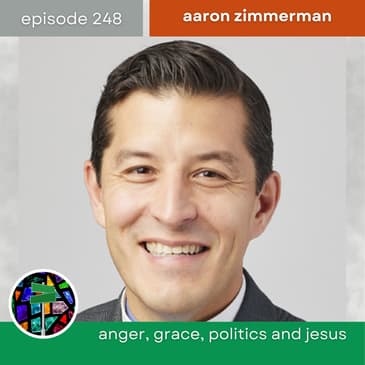

If there is one word that could describe our current politics, it would be anger. The anger in our politics doesn’t seem to move us forward towards solutions, but forces us to draw lines. And this anger seems to infect our relationships, especially our churches. How can we move past this anger and be faithful Christians who love each other regardless of our politics? Recently, I listened to an old sermon based on Luke 9:51-56 by Aaron Zimmerman, the Rector of St. Albans Episcopal Church in Waco, Texas. It was a great sermon tailored to the times and I wondered, did it still ring true today? So I invited Aaron to come on the podcast to talk about anger and what role the church can play in lowering the temperature.
Suggested Reading and Listening:
Anger, Politics and Jesus by Aaron Zimmerman
Same Old Song Podcast with Jacon Smith
Related Episodes:
An All Saints Theology in a Political Halloween World with Jacob Smith | Episode 237
[0:17] Music.
[0:43] Hello, and welcome to Church in Maine, a podcast for people interested in the intersection of faith, politics, and culture. I'm Dennis Sanders, your host, and welcome back to Your fall. If there is one word that could describe our current politics right now, it would be anger. I think you see it everywhere. You see it on our podcasts. You see it on social media. You definitely see it on the news. And yes, you see it in Washington. The anger in our politics doesn't move us anywhere forward towards solutions. All it does is that it forces us to dig in, to draw lines. And that anger really kind of infects everything in our lives. It infects our relationships. It infects our entertainment. And it also infects our churches. So, how do we deal with this? How do we deal with this anger, especially as Christians? And how do we love each other, regardless of our politics?
[1:58] Recently, I happened to listen to a sermon from 2022 based on Luke 9, 51 through 56, and it was by a pastor, an Episcopal priest, Aaron Zimmerman. He is the rector of St. Albans Episcopal Church in Waco, Texas. I thought it was a great sermon. And this is a passage where Jesus and disciples are rejected by a Samaritan village, and two of his disciples are very angry, and they want to take out some revenge, and Jesus rebukes them. It was a great sermon tailored to those times, but I wondered, since it was from 2022, I wanted to know, did it still ring true today? Because especially in the times that we live in, what made sense in 2022, I don't know, does it make sense in 2025? So I invited Aaron to come on to the podcast. And so a little bit more about who Aaron is. He is, as I said, the rector of St. Albans and Waco. He's also the co-host of the lectionary podcast, Same Old Song with Jacob Smith. Jacob was also on this podcast earlier this year.
[3:19] So I've had both of them on now. Before coming to St. Albans, Aaron served in churches in Pittsburgh and in Houston. He is also a contributor to the Mockingbird blog and magazine. He has also served on as president of Mockingbird's board of directors.
[3:41] So with all of that, please listen in to this really, I think, important conversation that I had with Aaron Zimmerman. Let's get started.
[3:51] Music.
[4:08] Well, Aaron, thanks for being able to chat with me this afternoon. I wanted to start off just to get a little bit to know about you, your spiritual journey, where'd you grow up, and then kind of go from there. Yeah, absolutely. I was born to a Catholic mother and a Protestant father, and so I was raised in the Episcopal Church. That seemed to fit. But yeah, and so we moved around a lot, but whenever we were in a place long enough to go to church, we always went to an Episcopal Church, but it wasn't that frequent. I'm one of those kids that caught the Jesus bug in high school, and they're a really good youth ministry at the church where I was at the time in North Carolina.
[4:48] Shout out to St. Paul's in Winston-Salem and then by the time I finished college the idea of ministry was still kind of rattling around in there and so I took some time to think and pray and do some ministry work overseas and in the U.S. And really came yeah really became very clear on the idea that this is something that I wanted to do and eventually went to seminary and I think just something about my background. When I got to seminary, I thought that I was there to learn how to use theology and scripture to motivate people, inspire people, scare people, berate people, somehow get them to make themselves better through trying harder, because I was up there in the pulpit cheering them on or lecturing them or something. But that was my job, and that's what I went to seminary to do. And I realized through some really important people when I was in seminary that actually the headline is the Jesus Christ is the friend of sinners, as the New Testament says, or that God loves human beings. And so that was a real big paradigm shift for me. Something I knew intellectually, but didn't really, I don't know, hadn't really applied it in how I thought about ministry. And so, but that's been the focus of my ministry for, I don't know, 15 years or so. I was ordained in 2008. My math is probably wrong, but I'm a preacher, not a mathematician.
[6:12] And I've served churches in Houston, in Pittsburgh, and been in Waco for the last 12 years where I'm the rector of St. Albans Episcopal Church.
[6:21] Is that what you want or you want more of a prayer life? What are you looking for? How many times I walk the labyrinth? I don't know. Okay. No, no, no. That is okay. I mean, you can tell me, but you don't need to. Yeah, let's move on. So one of the reasons I wanted to have you on the podcast was to talk to you a little bit about a sermon that you gave back in 2022 at St. Albans. And it was about, the story is basically about Jesus and a Samaritan village. And they're kind of going past this village and they're looking for a place to stay.
[7:06] And basically, the village doesn't want them. And James and John, as I think you said, wanted God to call down an airstrike on them. Yeah, that's right. Send in the drones. Yep. And Jesus said no. Yeah. And that became actually kind of an interesting take on the political situation, especially in 2022. Those were, especially we were going into midterms and all of that.
[7:40] And now, of course, it's three years later. It's a whole cycle of the lectionary cycle later. Yeah. And so, one of the reasons I wanted to bring you back is to talk about, does that, what you were talking about in that sermon still make sense today? But before we get to that question, kind of talk about maybe preaching about or talking about what you were trying to get at at that time in history, which seems like 100 years ago. Yeah, 30 years ago, 2022. Yeah, fresh out of the pandemic, all of that. I think, so yeah, that passage from Luke 9, what I was trying to get at was the fact that the anger that James and John displayed the Samaritans, which obviously that, you know, we tend to think of the first century, and especially when we read about Jesus and the disciples, everything has this hazy spiritual vibe to it. But the dispute between the Jewish residents of that part of the world and the Samaritan residents of that part of the world, it was a religious, but it was also a political fight. And it was also a political fight between two parties that were both being oppressed by a big Roman Empire.
[8:51] So there were political dimensions to all of it. And what struck me about it was the anger and this righteousness that I saw from James and John, these two disciples of Jesus, and the people on the opposing side, the wrong side, the Samaritans, in their rejection of Jesus, this triggered for James and John a desire for retribution, a desire to eliminate the enemy, and this really impulsive desire.
[9:17] I must crush you sort of energy. And by the way, they also think that Jesus is on a political mission because Jesus is on his way to Jerusalem, which would be the kind of center of the power, obviously, in that region. And they think he's going to kick out the Romans and reestablish his throne as a political and military ruler. And so they're just getting a foretaste of that. They want maybe an early win on the battlefield to begin to get Jesus's name more out there and get people really trembling when he goes to Jerusalem. So I think, so what I was trying to do was to address the fact that this is, there are political realities in the scriptures. I'm not, I don't tend to preach politically driven sermons, but I did see those elements in the passage and I was feeling those currents in the community, in the country, like all these, we are just at a really divisive time, as you know, and all your listeners know. And so what I was trying to do there is also get into the personal, the individual. I think a lot of sermons that do kind of tiptoe or maybe jump right into the political waters tend to make it about big issues out there.
[10:23] And I think a lot of it really starts in the human heart. And Jesus' teaching gets at this all the time when he says.
[10:34] Don't look at the log in your brother's sister's eye, look at the plank in your own, or look at, don't look at a speck in your brother's sister's eye, look at the log in your own eye. So as Michael Jackson said, if you want to make the change, you got to look at yourself, right? Start with the man or woman in the mirror. So I wanted to get kind of personal and look at James and John, like, where is this coming from for them? Where does this come from for us?
[10:56] And to look at this issue of anger. That's one of the things I really wanted to get at, which I think is, again, I mean, it's a reality at all times in politics, but certainly one we see around now and can be pretty toxic. Do you think especially in our current time when we are, well, let me rephrase that. Why are we not so good at looking at ourselves, looking at the log in our own eye? I mean, we are really good at pointing out everything that is wrong with them. We are terrible of actually focusing and saying, where have I messed up? Where have I fallen short? I think that is probably a pretty standard human default setting is to be much more aware of what other people are doing and judging and critiquing that. And it is uncomfortable to look at ourselves. You know, who likes to see the truth about themselves? Denial and numbing ourselves is much more comfortable. And I think the anger in our political cycles and our anger and our rhetoric is another one of those...
[12:04] Things that uh can be numbing and and just self-righteousness is a really it's a hell of a drug like it's really addictive it makes you feel good about yourself it makes you feel morally superior to other people and so uh i think if you can like and and having an enemy makes one feel powerful and there is um there's nobody out there i think that's really telling you to not do those things i mean the i i am when i go to my gym i can see like 15 different tv screens above the treadmills and they have the fox news the cnn the msnbc whatever and everybody's trying to make some group of people angry and uh paint some other folks as an enemy and so there's but there's nobody there's never like a psa that comes on these news channels it's like by the way have you looked at your own life have you done some examination of your own heart and maybe maybe you're so angry because of some stuff that's unresolved from your family of origin that never happens on any of the networks and so uh i think you have to one of the i think one of the reasons why people don't do this is one it's uncomfortable and two there's very few voices that are encouraging any sort of self-reflection um all the money all the outrage all the hype all the need to sell advertising spots and make money on these uh for-profit networks and but i you know it's not their fault like they're tapping into something that human beings already really really like.
[13:25] Which is, we like to feel angry, we like to feel morally superior, and we like to have enemies, and we like to demonize other people, which is exactly what James and John do. Like, just to say, let's call down fire from heaven on the Samaritans because they rebuke Jesus.
[13:36] You have to do some pretty serious dehumanization to feel like that's an appropriate response to people rejecting Jesus.
[13:45] Well, in thinking about that, especially about dehumanization, and again when you did the sermon was in 2022 it's three years later, I don't know if I can say three have gotten worse but I don't think they've improved and so, what are your thoughts about this sermon three years later does it still make sense and how you know.
[14:19] I guess how do we get ourselves out of this mess right yeah i mean absolutely it makes sense human beings uh sadly are still the same i guess my sermon didn't work uh so uh it seems like the the tendency for human beings to be angry and to dehumanize and to otherize uh and basically call out as enemies is is um so pretty apparent and i think what's you know one of the tragic elements of this is that jesus christ specifically tells us to love our enemies and so um he does so you know if we're in a political conversation we feel like some group of people are our enemies that doesn't get us off the hook either so we're supposed to love those people and yeah i don't think we've gotten too much better i think i do see glimmers of hope occasionally you see people trying to do some bipartisan work. The political chatter can be pretty corrosive and toxic and very black and white kind of thinking, polarized thinking.
[15:21] But in my spare time, my son has listened to podcasts where actual politicians, lawmakers, people in government administration talk about things. And you do hear stories about people actually trying to do the job of government, which is encouraging i think i do feel if anything's changed maybe it's this and of course everything waxes and wanes and ebbs and flows so we'll probably go through another cycle but i do feel a certain amount of fatigue i think the 2024 election was exhausting for a lot of people and i think their folks i mean i know people that were kind of biting their nails on the edge of their seat listening to five political podcasts a week and um and then after the election how you know, whether they were happy or whether they were upset, they've sort of just checked out. Like, and it's just, it's hard to maintain that level of being worked up, I guess. So.
[16:12] But yes, I think basically people are still the same, angry we tend to dehumanize and judge. And that's why I think the call in this passage still holds true. So I don't, yeah, I don't know if I would change anything here, but I think I would continue to invite myself and other people to, when we're thinking, and this is, I think, one of the things that I, if I had a mission in when I talk about things like this or when I preach about things like this, I want people to ask themselves, kind of why am I so angry about X, Y, or Z thing? Why does this matter so much to me? The world is full of injustices and really horrible things that people are doing to each other, governments that are doing awful things. And why do I care specifically about this one so much? Is it because it's the one I've heard the most about? Is it because it allows me to feel superior to somebody who lives down the street from me, who has a flag in the yard that I don't like? I think there's often just a personal psychological dimension that we're not aware of. And so this is not to say like differences of opinion don't matter and you shouldn't have them. And yeah, definitely have thoughts and have opinions and research and stuff. But I often, there's so much, I think, unexamined in one's inner life that drives a lot of the political conversation that I don't see a lot of people having those conversations out loud or in public very much. Now that gets to your question. Ask me another question.
[17:40] Reign me in, Dennis. Reign me in. Well, I was actually going to ask you, where do you think the church has fallen down on this? Because I'm going to be honest, I think the church has fallen down on this. I don't think we've done a good job of discipling people, of helping people to see that the person on the other side is not necessarily always has horns or something. Right. And there's a...
[18:09] Well, 30 years ago, when I was kind of involved in things, especially with kind of LGBTQ inclusion, and especially if churches had votes and really difficult votes on this issue, I almost always would hear someone say, well, now we're going to have to work on healing. There was always this sense that this was a group of people that were of different people but they had to work of ways of how to to re-knit themselves after this very stressy stressful time, i don't hear that phrase anymore in fact i don't think i've heard that phrase anymore for about 10 15 years and so that we don't anymore care about that other person that disagrees with us And I sometimes wonder, where has the church failed in helping to see that that other person that we may not agree with is a child of God? Yeah, that's a great question. I'm a big believer in that idea that it's kind of a cliche management phrase, but tone starts at the top. And so I think what church leaders model around this really matters. And I think, um, I know in my own denomination, which tends to skew left, although it's not exclusively that way, there has been, um, there can be among some leaders and some voices, uh, a very, um.
[19:36] Uh, a self-righteous tone, uh, that condemns the other side, the more conservative, uh, sisters and brothers, siblings among us. And, um, yeah. But you also see that on the right. I could name you any number of churches that have called out people on the left and dehumanize them. And I think, so if that's, if you get permission, even if it's sort of a subtle winking permission from your leaders, I think that's a problem. And that sort of gives a permission structure to the people in the pews or the stackable chairs to feel entitled to that. I think the other, and you can, I think people sadly use scripture, like kind of righteous anger, and we'll pull out passages to justify that. Or Jesus flipping the tables. Right, which is not a political thing at all. It's about making sure people can not be taken advantage of financially, and that all people can actually get into the place, get in the temple, and the court of the Gentiles specifically. But the, so tone starts at the top. So how leaders speak about politics and politicians and people, I think, does positive or negatively can impact how the, what is normal and what's acceptable. The other thing I think that the church could do a better job at is specifically naming the love of God for all people.
[21:05] And the previous presiding bishop of the Episcopal Church, Michael Curry, would always say things like, Jesus loves Republicans, Jesus loves Democrats. Cornel West does a great job of this whenever he's talking about political leaders. He'll say, in the last election, he would say Brother Joe or Brother Donald. Even using that kind of family, personal first name language, I think it does a lot. When you say Trump or Biden, you're not talking about a person as much. You're not talking about kind of an idea and an office and an image and a brand. So Brother Donald and Brother Joe is very different. It's very humanizing. So I think how you talk about it matters. I think being very specific about...
[21:45] Naming that we have different opinions on things, different views on things, and that's right and good as we should in the body of Christ. And that can be seen as not a bug, but as a feature. We do that a lot at St. Alvin's talking about theological diversity, and that's not something that we need to be threatened by or run from. The main things are the main things. Jesus is the reason for the season, but there's lots of things under that that we can and will disagree on. And I tell new members, I tell people we interview for staff, like if you're looking for a church where everybody agrees on everything. This probably will not be comfortable for you and good luck finding a church. But if you're at a place where we keep the main thing, the main thing, but we can and will have healthy conversations about other stuff we disagree about, then you'll be at home here.
[22:28] And so I think just verbalizing that is helpful. I think the church, and this is the last thing i'll say i think uh the church on i think i think it could do a better job at understanding jesus's uh rejection of politics as a way to fundamentally change human society.
[22:54] He is asked to be king he specifically chooses not to take that role i mean he is the king of kings and you know but even when pontius pilate is questioning him are you king he says you say that i am but when the when a crowd of people of his own um uh his own group they they love what he's saying they grab him they want to parade him on their shoulders into town and make him king and he slips through them because he has no interest in that and um jesus uh, seems to be very careful not to fall prey to the temptation of taking the political levers of power. This is one of the temptations that Satan offers Jesus. He says, bow down before me and I'll give you political power. You'll be the ruler of all the cities in the world. And I think Christians, whether they're on the left or the right, need to be really careful about how much they desire political power. And it's not to say to don't do it or don't run for office or don't serve on city council, but as I said, do that inner soul work of where am I and why am I approaching this way? Am I seeing people as my fellow image bearers of God?
[23:57] So I think that connecting, I think the church really needs to wrestle with the fact that Jesus doesn't seem to think that political means are the main way to change society. Now, there are times when Christians are called, and you can name any number of things, whether it's Dr. Martin Luther King and Jr. And his work across the American South for the Civil Rights Movement across the United States, or whether it's looking at William Wilberforce or looking at what Gandhi does. There are people whose religious and spiritual convictions drive them to work in politics, but I think those people, Wilberforce, King, Gandhi, these are all people who are deeply connected to their own humanity, to their faith tradition.
[24:39] These are people who I think are doing that soul work of what's going on in me internally, spiritually, so they can approach it. I think that's why somebody like King can pray for his enemies and can bless those who curse him, and I think that's the root of the power. Um and uh so anyways uh that's i think the church could do a lot more to to talk about that and to um that jesus wasn't someone who saw controlling like getting the levers of power as the way to make the to fix the world and christians when they do that i think get a little like get my team to be in the in the throne and then the world will be fixed and i think history is full of examples of that not working yeah i think you know martin luther king especially had a very strong belief in loving the enemy. And it seems like that is something that we've forgotten, that that was an important aspect of his work. It wasn't a side benefit. That was central to his work of justice. Yeah, I think it was the heart of it. And it's the heart of Christ's ministry. I mean, to Father forgive them for they don't know what they do. And I mean, he just, he, um.
[25:53] People come at him with all this hate and he responds with love. And I think that is kind of when Christians have made real change, I think in politics, that's often a part of it. And I think any person who is in politics publicly as a Christian person and uses language that dehumanizes or mocks people and their suffering and their pain and doesn't display that Christ-like love of enemy, I think they need to go back to Jesus' kindergarten and start over, because I think they're sort of missing the main thing. And I think, you know, finally, you know, do your question about where the church has gone wrong. I think a lot of times when it talks about politics, I think it misses, I think there's like a, I think like scripture is just lost. I think there's an assumption of kind of what is right and wrong politically without going back to the text. Like, what does it actually say in the text? So what is Jesus, what is his relationship with political power in his day? What does, what do the letters in the Testament say? Like, what do we learn from the Hebrew scriptures? Like the Israelites want a king and Samuel tells them, this is a really bad idea. And you like, you're going to regret this.
[27:06] So I think there's, I think that there are a lot of things in the scriptures that challenge the way we think politically. And I don't see a lot of preachers talking about that. I see preachers getting up in a pulpit, being angry on the left or the right and promoting a cause. And I may actually agree with that cause, but I'm like, would you please, like if you're gonna say something, like connect it to where you are in the scriptures with this. If you're against how people are being treated.
[27:31] Tell me tell me where you're drawing like i think we assume a level of theological education and scriptural literacy that is not always there that i think could be really helpful to people in texas we got this debate about the um the tank well not a debate it's now state law to put the ten commandments in all public schools and this is a move largely driven by christians and i think about jesus's statements in the sermon on the mount where he quotes the ten commandments he quotes moses and he says things like you have heard it said blah blah but i say to you something else, basically saying, I'm trying to move you to a different paradigm. And St. Paul, the letter killeth, but the spirit gives life. He's saying there's a new dynamic in how we interact with God. And yet Christians are trying to put the 10 commandments on the walls in schools. And I'm thinking, I mean, if you want to put scripture on the walls, I mean, there's a whole church state question, but if we're just going to say, we're going to throw that out, we're just going to put scripture in the walls. Why not put something from the Sermon on the Mount? Why not put love your neighbor as yourself? Why not put, you know, don't put the, don't worry about the speck and worry about the plank in your own eye. Like some, you know, because I think the scriptures are.
[28:46] Cautious, especially in the New Testament, about the power of the law to change a human heart, a demand, a lecture, a threat to really change somebody's heart. And so, like from a theological perspective as a Christian, that's where I kind of get off the bus and don't support the idea of the Ten Commandments in school. It's just my opinion, and you can disagree with me. But that's not because of a church-state constitutional thing, I mean, partly, but mostly it's because of how I understand the law from the Christian perspective in the New Testament. So, when I say like teach about Scripture... This is, yeah, this is not some like left-wing talking point that I just believe because I've listened to a lot of public radio or whatever. It's because of how I read the scriptures. So it's one thing I think the church has not always done a good job of teaching through the scriptures and how that should escape, should shape our policy. I taught through, I teach through a book of the Bible on a Wednesday Bible study. And there's a lot of stuff in Leviticus. And as the Jewish people come into the land and how they're supposed to live.
[29:48] Deuteronomy and Leviticus commandments about how harvest and agriculture should go so that immigrants can eat. Like they're supposed to come and like you're supposed to not be totally efficient in your harvest, leave some food kind of lying around so that other people, migrants, especially in foreigners and poor people can come and get food. And there's just a lot of instructions about that. And I remember telling the class at the time, and this was way before our current immigration debates, This was several years ago, but I said, whatever you think about your policy on immigration, if you as a Christian have not wrestled with these texts, this is where you've got to start. So I'm not telling you where you've got to come out at the end of this conversation, but at least be engaged in the text, the scriptural texts that actually do lay down some ways to think through this. So that's kind of where I am on that.
[30:35] You know, related to this is, where does the concept of grace fit in all of this? And, you know, you just mentioned the Ten Commandments and the law, and, well, I'm a disciple of Christ pastor, but I was trained by Lutherans, so law and gospel kind of just is always in my brain.
[30:58] And it seems like we live in an age where there's a lot of law, and it doesn't mean necessarily that you're going to be putting up the Ten Commandments somewhere, but... There isn't a whole lot of necessarily of grace in our politics. And I don't know if that's something you've observed or where does grace have a role in our modern politics? That is a great question. And I absolutely think it has a role to play. And you see it i think um when politicians are able to see each other as human beings and get to work together uh across their differences so i think one of the things in in that sort of law gospel paradigm uh luther says the law says what a thing is so you begin with what's actually true and so i think in politics one of the ways you get to grace is by acknowledging what is going on. So not trying to paper over or dismiss the differences that we have, the different viewpoints we have. And I think Grace often looks like a Republican trying to understand where a Democrat is coming from, a Democrat trying to understand where a Republican is coming from, even within these caucuses, whether you're maybe you're kind of a Susan Murkowski or.
[32:23] Lisa Murkowski or Susan Collins, more centrist Republican, and you've got your more right-wing Republicans. And just trying to see, like, where are you coming from? Where are you on this? What are your perspectives on it? And I think, so seeing the other as a real human being and trying to work together, I think there's some real grace in that. But it begins with acknowledging where you don't agree and then trying to find areas where you can. And I think there's a lot of this happening behind the scenes. I just listened to a Republican politician on the New York Times Daily podcast. You talked about going to town halls and a lot of his colleagues are not doing it anymore because they get booed and yelled at and all that. But he's like, no, it's really important to me that I go and hear what my constituents are saying and respond to those. I think there's a lot of grace in that. I mean, I'm not saying this guy is Jesus at all. Please don't hear me saying that. It's not a partisan endorsement or anything of his campaign. But being willing to go in front of a group of people who are just going to hurl insults at you and to hear and listen to them and to treat them respectfully, even if they don't respect or speak respectfully to you. I think it was great. There was a veteran who stood up and said, look, this big, beautiful bill is going to cut my benefits.
[33:34] And he and the, and the, political, the politician said, well, let me get back to you on that. And he said they addressed it. I don't know if that happened, but it was an example to me of someone showing some grace. James Tallarico is a Texas legislator here.
[33:50] He's a Democrat, but he's in seminary. He knows his scriptures backwards and forwards. And he just famously was on Joe Rogan's podcast. And one of the things he talked about is really is building friendships, building relationships with his Republican lawmaker colleagues and trying to work together for common sense good. So to me, that's where a lot of the grace is on those one-on-one or small group relationships. I think grace is, and it's another word for love, and you can't have love if you don't see the other person as a human being. So there is room for grace in that is seeing the other person as a human being. And I think in our interpersonal relationships, in our families, where we have these disagreements over politics, I think we can be honest.
[34:28] That's saying what a thing is. I believe this, you believe that like let's we can acknowledge that but then trying to listen to what the other person is saying and never lose sight of the humanity of the other and if they have some views that you find really really obnoxious or difficult there's probably some story in their psyche in their origin in their heart about why they are like that and i think this is something that a good theological perspective can add to the political debate which is that if you are a person who adopts what I would call the anthropology of the Bible, that is, the view of human beings that is in scriptures, which is to say, we are not people who are rational, make good decisions, and control our emotions. The scriptures show us, as people, as Jeremiah says, the human heart is deceptive of all things who can understand it. And so, if that's where we're starting from, the reason you get angry at somebody who disagrees with you is because you think that they have made a poor choice and you can convince them otherwise. You think it's a rational thing. And I think a theological perspective can sometimes remind you that the person you're talking to is not.
[35:37] There's a there's reason there, but they're not their political beliefs are not because they sat down with like, here's how to be a Republican and here's how to be a Democrat. They read both books, they made a decision and they came out on their side. And so like that's not how it happens. It happens because like maybe they're a staunch Republican because their grandma was a staunch Republican and then their dad was a staunch Republican and they feel like some sort of family loyalty. Again, it's not rational. It's like this is my tribe and I can't,
[36:01] you know, if I give this up, I lose my social circle. I lose my family network. I lose all kinds of things. and those aren't conscious front of mind thoughts but that's under there so when you're having a conversation or you know somebody has you know on the left side of things maybe they they have a you know they were really helped in a rough time by some social programs that they attributed democrats this is like again so the the non-rationality of it i think can help you have compassion for people when you're talking and it maybe can make you more of a listener like what's the story behind this for you where did this come from for you why do you hold that belief as opposed to you're wrong and i'm going to tell you why and i'm going to convince you because were rational beings, which were not. Close to be. I mean, except for you, Dennis, you are rational and you have a wonderful DJ voice. And I want to hear you. I'd like to make a request. Just kidding. Well, I could do that. It's been about 30 years, but I could do that. Okay. All right.
[36:58] So I think one of the things kind of getting closer to the end of this is we have a lot of people in congregations, pastors in congregations that are, maybe purple congregations, maybe they're more or different shades of blue or red. What advice would you give to them in preaching and how the, you know, you're not, obviously, you're not going to make every sermon about whatever the political issue is of the day, but how do you convey the sense of God's love and grace, especially in talking about politics? In having people when they discuss or politics in their daily life?
[37:47] One, I think in my tradition, but I think there's plenty of flexibility in other traditions to do this. I think the liturgy, the service order can do some of that work for you. We have this time called the prayers of the people. We follow a book of common prayer. One of the gifts of that tradition is that it has us pray in the form that we use Sunday after Sunday, has us pray by name for elected representatives so that we pray for the governor the president the governor and the mayor and the congress and the courts but we name our president joe our governor greg and our mayor jim uh and we we used to pray for our president joe our governor greg and before that we prayed for our president donald and before that you know so we we've prayed for everybody by their first names and i think so there's there's and people have told me time and again over the years how much they appreciate that and how it's a spirit like whether they're on the left or the right at some point about every four years they're praying for somebody that they like but then they're going to be praying for somebody they don't like and there's something there's teaching that comes from that but in terms of preaching i think realize that for the most part and this changes in context and culture and and and geography and i get that but i think for the most part people that are coming to church on sundays are not looking for a political sermon.
[39:03] Most people are looking for something that will give them some comfort in the face of the diagnosis they just received their marriage that's falling apart their estranged adult child that just reached out and they don't know how to respond or or or just their own inner sense of gosh the the secret lives of people that we have and wanting a word of comfort in that place and forgiveness so most people come looking for that they're not looking for a sermon to tell them how to necessarily interpret the headlines.
[39:32] So I think that's one thing I would say. The other thing I would like, gosh, can you imagine if somebody just had a child diagnosed with a glioblastoma and they come to church and they hear a sermon about Middle Eastern politics, like as important that is, but like they need a word of comfort. And so stick, I'd say stick to the scriptures. What do they say and how do they give a word of grace and hope and comfort and forgiveness to the actual individual human being, not the collective, but to the individual. And the thing, the key for preachers is to first know that need for themselves. selves. So if you're a preacher, what speaks to you about this passage? You can approach the text as something, how is this going to give me ammunition to then convince my congregation to agree with me politically? That's one way you can approach it, and I think that will probably not be as effective. And I think the other thing would be instead, though, to look at it as what does this say to me as a human being, and am I in touch with that, my own brokenness, and then how can I convey that to the congregation?
[40:31] Again, I think politically driven sermons, and as you can see in my sermon from 2022, I talked about anger, but I didn't say it's like bad that people out there are angry. I said, we're angry. I'm angry. And so what does this passage say to us? It invites us all to kind of a place of acknowledging that reality and receiving grace for that. And as I said, when James and John, if they had called down fire from heaven on the Samaritan village, it would have blown them up too, because they were standing right next to it. So it's, you know, The invitation is to look at yourself, look at your inner workings. But so stay rooted in text, stay personal and connected, know what it says to you, and try to speak to that place, knowing that political sermons tend not to persuade. I would, you should do a poll with your listeners. How many of them went into church one Sunday with some, you know, firmly held political or cultural belief, heard a preacher say the opposite from the pulpit and then change their mind.
[41:27] Oh, that would be no one. Yeah, nobody ever does. Yeah, because somebody says, you know, you should vote this way or think this way. Like, if you disagree with that, you're just going to get, you're going to dig in your heels more. You get defensive and like, how dare you? And you're never going to go back to the church. So I think for preachers, I would say, take care of yourself. See how the message of grace and the gospel connects to you and try to deliver that to the congregation. The one thing I would say is there are times when the political events of the wider culture become pastoral. So after, I remember after the loss of Hillary Clinton to Donald Trump in 2016, that Sunday, because of what I knew about my purple congregation, I knew that there were some people that would be really sad and just really kind of despondent. And I knew there'd be some other people that would be kind of gleefully surprised.
[42:23] And I felt that was, there was so, the emotions around that were so high, I felt like to not address it was to not address actually personal pastoral issues. So like sometimes when the political becomes personal pastoral, I think that's a place you can address it, but not necessarily to say, you know, these are the good guys, these are the bad guys, but just, and I remember what I said, I think in that sermon was, whatever you do as christians now the rest of the world that's another thing but as christians we're not allowed to dehumanize people and um uh and the the gospel is for everybody so i think those are some of my thoughts on on preaching for pastors and but now that i've just told them what to do they're probably not going to do it so i don't know you never know i think these days, with a lot of what we're getting they may want to hear it i want to hear that well i'll say one of the things that's interesting about grace, like a lot of people come to St. Albans, and I hear this from a lot of my clergy friends who are self-consciously choosing not to preach partisan political sermons.
[43:27] Lots of people from the left and the right have come to St. Albans and said that one of the things we really appreciate about this place is that you stick to the scriptures and you make it connecting and personal and real to us and you don't bring politics into the pulpit, is how they phrase it. But what's interesting is because of that reality, there are people in the pews and at the potluck suppers and at the communion rail who have wildly different perspectives on all the culture war topics and what party they vote for. And what's amazing over the years has been to see the relationships and the friendships that have grown out of that and serving together and ministering together and um i have seen people change their minds but it's not because somebody got up in the pulpit and told them to do so it's because of the relationships they developed and they felt loved and respected so they didn't change because they felt they were being pressured to they adjusted or softened their views out of a loving relationship with their fellow human being whom God loved and for whom God died. So that's, I think that's another place where the grace can come in.
[44:30] Yeah, I think I interviewed someone a few years ago, actually about a year and a half ago, Presbyterian pastor that said he was going to, I asked him what he was going to preach the day after or the Sunday after the election. And one of the things that he brought up was that if there was someone in his community and his church is a purple church who was going through a divorce, the last thing that they want to hear is a sermon about who won that election. And I think that that has stuck with me, especially stuck with me in how I was going to preach the Sunday after the election and from then onward. Because you don't know who walks into those doors.
[45:18] And in some ways, as a pastor, that isn't your role. Your role is really to preach the love and grace of God. There are times that you may need to talk a little bit more, clearly about spring issues, but not all the time.
[45:38] And probably not most of the time. Yeah. Yeah. I think that's right. I think the other thing, we have, like I mentioned, this Bible study that I teach on Wednesdays during the academic year, we have small groups that meet at homes, we have Sunday school, our adult formation classes. And those are places where if you're going to have conversations about political or cultural theological issues, where there can be some heat because there can be some controversy, I'm more comfortable having it in those areas. The pulpit, it's not, I mean, there is two-way conversation. It's nonverbal from the congregation. But it is, I mean, there's a reason they call it a bully pulpit. Because if you use it, you're being a bully because they don't have the opportunity to respond. And you don't really have the opportunity to listen to them.
[46:21] But if it's a Sunday school class and I can say, hey, we're going to talk about immigration from a Christian perspective. What do the scriptures say about this? And you can, you know, give a 20-minute overview. and then you can say, let's have questions or let's break down into small groups at our tables and you got some questions there, let's talk about that. There can be back and forth, there can be listening and I think those spaces are more conducive to those kinds of conversations and we do try to build those into our life here and I think those can be helpful. But yeah, I think you're right. Think about the person going through divorce, thinking about the person who just lost a child, thinking about the person who just lost a job, thinking about the person who just, whatever they have going on, like speak to that, speak to the heart And those big issues outside are, you know, I think ultimately they fade away. We have a, our citizenship is in heaven. You know, I think that that conversation between Pilate and Jesus is really, I think Christians could spend some time there about where real power is and where our citizenship is and what does Jesus' kingship, his lordship really mean.
[47:23] Well, if people want to know more and follow you, where should they go online? Uh, they can go to, so, you know, all of my preaching and, uh, and for the whole congregation is at St. Albans Waco, S-T-A-L-B-A-N-S-W-A-C-O, St. Albans Waco, uh, on all the places for the socials. Um, and I'm on, uh, I'm still on, I guess I have to say X now, uh, Zimmermania there. And I have a weekly preaching podcast with Jacob Smith, uh, priest in New York, who's also a previous and less effective podcast guest for you, Dennis, I would probably say. And so that's called Same Old Song, and you can find that wherever you get your podcasts. All right. Well, thank you so much, Aaron, for taking the time. This, I think, was helpful, and I hope it's been helpful for pastors out there as they're trying to figure out what to do and how to best preach. And I think it's been good. Yeah well i i appreciate it and grateful for you taking time out of your pastoral role to provide this resource for lots of people so thank you all right.
[48:32] Music.
[49:01] So let me know your thoughts about the conversation. I hope that that was helpful for you, especially if you are the pastor of a purple congregation or some lighter shade of blue or red. Love to know your thoughts. As always, please send them in. You can send me an email at churchandmain, all one word, at subsect.com. I do have links to Jacob Smith's episode from earlier this year, links to Aaron and Jacob's podcast, Same Old Song, which I do listen to on a weekly basis since I preach from the Revised Common Lectionary. It's a great podcast. I love it. And the banter between the two is great. So, but it's just a great podcast, especially just if you're someone that follows the revised Common Lectionary.
[50:03] So those two links are available. And I also have the link to Aaron's 2022 sermon, and I hope that you will listen to it. It's an important one. And I think it is actually still vital today, even though time has passed. I think actually we need it now more than ever. So please give it a listen. If you want to learn more about this podcast, listen to past episodes, or donate, visit churchinmain.org. You can also visit churchinmain.substack.com to read related articles. Subscribe to the podcast on your favorite podcast app and leave a review. That helps others find this podcast.
[50:52] Also, if you want to, you can sign up to get the podcast in your email inbox. There are links in the show notes. You can also leave a donation. There are links for that also in the show notes. That is it for this episode of Church in Maine. As I always say, thank you so much for listening. I'm Dennis Sanders, your host. Take care, everyone. Godspeed, and I will see you very soon.
[51:28] Music.