
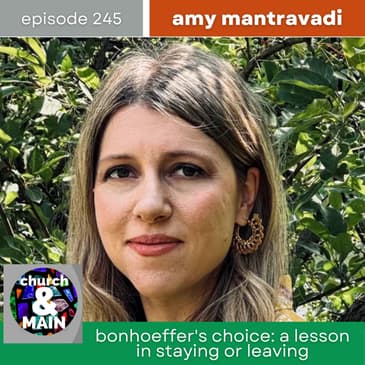

In this conversation, Amy Mantravadi discusses her article on 'the theology of staying,' where she reflects on the historical context of Christianity in Egypt and the challenges faced by Christians in the Middle East. The discussion also delves into Dietrich Bonhoeffer's experiences in Nazi Germany, exploring the complexities of staying or leaving in times of crisis and the church's role in society. We explore Bonhoeffer's commitment to training pastors, his views on military service, and the role of the church in times of crisis. Mantravadi emphasizes the importance of hope and prayer in navigating cultural challenges and the need for a theological foundation in political engagement.
The Theology of Staying by Amy Mantravadi
Resurrection Hope Amidst the Broken Politics of 2025 with Drew McIntyre | Episode 241
Join the Church and Main Email List
Facebook | Instagram | Threads | Twitter | Website | YouTube
[0:17] Music.
[0:43] Hello, and welcome to Church and Main, a podcast for people interested in the intersection of faith, politics, and culture. I'm Dennis Sanders, your host. So you may have heard me say in past episodes that my husband, Daniel, is a preacher's kid. His father's first call out of seminary, and he went to the same seminary I did, Luther Seminary, was to Lanigan, Saskatchewan. So for those who are not up on their geography, that's a Canada. So while Daniel's parents, who are both American citizens, were living in the Great White North, they had two of their three kids. Daniel and his older brother were born in Canada to their American parents.
[1:39] Now, Canada, like America, at least for the time being, has birthright citizenship. So Daniel could claim Canadian citizenship. And actually, to be honest, that would clear things up for him. Whenever we have traveled to Canada, and of course, living in Minnesota, Canada's not that far away, there was always some confusion, especially if he would ask, if someone would ask where he was born, you know, to share an American passport, but then to say he was born into another country. So it would kind of clear things up if he had could apply for Canadian citizenship and could, I mean, obviously keep his American citizenship, but you know, if he's going especially to Canada.
[2:29] You know, share his Canadian passport. As much as there's a pragmatic reason for him to do this, and he is in the process of doing this, there is also a not-so-pragmatic reason for doing this, and that I've kind of actually pushed him to do.
[2:49] If things ever got a little dicey here in the United States, we could bug out to Canada, and that would be easier if one of us is already a Canadian citizen. Now, even saying that personally sounds crazy. I'm not someone that's thinking that we are in the midst of some kind of American Reich. I don't think that American Auschwitz is just around the corner, but I would be foolish to say that I'm not concerned about that. And there are lots of people around who actually are leaving america especially in the wake of the election of donald trump to his second term uh the entertainer rosie o'donnell decided to leave the united states for ireland and then there is someone like timothy snyder uh he is an academic who specialized in Central and East European history, he left posting at Yale here in the United States for a new job at the University of Toronto not long after the election, basically because he feared a rise of fascism here in the States.
[4:11] So today I'm actually going to talk to a writer about the value of staying or leaving, when you feel that the times politically are challenging. She wrote something, our guest today wrote an article that in some ways chose the option of actually staying put. Back in May of this year, Amy Montravati wrote a piece on her substat called The Theology of Staying. And in it, she shares about her time working with the Egyptian press office during a tumultuous time in that nation's history and relates that to the struggle that German theologian Dietrich Bonhoeffer felt as he saw his native land descend into the Third Reich and going back and forth, literally, on staying or going.
[5:16] A little bit about Amy. She is an Ohio native that was also raised in my home state of Michigan. And as I said, she worked for the Egyptian press office from 2009 to 2013 in Washington, D.C. And if you know anything about recent history, especially about Egypt, those years between 2009 and 2013 were very chaotic years in Egyptian history. She is an author of fiction she also writes for such websites as mockingbird and 1517.org, i really hope that you uh will listen to this uh episode because even if you don't plan on leaving the united states anytime soon this is a good conversation to have on what it means to be faithful follower of Jesus during a time when
[6:09] it might be really hard to do just that. So, please join me in this talk with Amy Montravati.
[6:20] Music.
[6:38] Well, Amy, thank you so much for joining me today. And I think the way that I usually like to start things off is to hear a little bit about your background, especially your faith background, kind of your history of coming to the faith and growing in a faith, and then we can kind of go in and go from there.
[6:58] Well, my faith journey has taken a path similar to a lot of people who have grown up in church, which is that I came to a basic understanding of the gospel and the teachings of the Bible at a very young age. It was a Baptist church, so I wasn't baptized as an infant, but I was baptized at quite an early age. And I went to a Christian school, went to a Christian college. But as is usually the case with people who grow up in church, they'll tell you it's definitely been a process, right? It's not like, okay, you could say, I quote, unquote, I got saved at this date. And maybe, yes, you're justified before God forever, you know, at that point. But then, not only is there growing in sanctification, but there's throwing in understanding what you've confess. Because, you know, when I first confessed that Jesus Christ died on the cross for my sins, you know, there was a lot I did not understand about that. And, you know, it's sort of this log process. And for me, I think as is often the case, part of it came when I was a young adult and moved away from home for the first time and was struggling with some experiences of depression, which is when a lot of people have it sort of hit for the first time.
[8:24] And that really led me to start clinging to the scriptures as I hadn't before, to really fall in love with them. Not that I had hated them before. I mean, I memorized all kinds of scripture growing up. I knew a lot of it, but I started, you know, opening the Bible, feeling like I was coming to it for absolute sustenance, like in order to survive. And that sort of that put me on a different path. And I decided to do this second major in biblical literature, which got me to some of the basics of how to exegete text.
[9:02] But then I thought my career was going to go in another direction. So I was studying international relations. I went on and did my master's degree specifically in security studies. So basically how to keep people from trading around nuclear weapons and all these kinds of things. Things that are still very much in the news today. I mean, yeah. Kind of important. And as a result of that, I ended up, my first job was working for the press office of the Egyptian government in Washington, D.C., which a lot of times people ask me, do you have some Egyptian connection? I mean, have you been to Egypt? No, I've never been to Egypt. I never learned Arabic. But what they really wanted was someone who understood the political and media situation in the United States and who had a good general understanding of international relations in the Middle East. And I had spent time studying some time studying Islam and current, you know, especially postcolonial situation in the Middle East. So I was able to kind of bring those things together for them. But while I was there in D.C., I met my husband who was in the Air Force and they transferred us to Dayton, Ohio, where there really isn't a lot of international relations.
[10:18] So that necessitated a career change. And the Lord used that experience of me beginning to listen to some lectures about the history of the Reformation, which I didn't have a deep understanding of before. And I had this free time now, so I was doing that. And it just got me really interested in it. And ever since then, for about the past decade, I've just been going further and further down the rabbit hole. And as part of this, I realized that one of my vocations is to write for the church. So that's something I've been working on since then. But also the Lord helped lead me into this, better understanding of, you know, as I said, I knew Christ died on the cross for my sins, but I didn't understand everything that was entailed in my salvation. And the Lord helped me to understand at that time that my free will and me working up faith in myself were not playing any role in this process, at least not any instrumental major role. They were just, you know, Basically, all the power and everything was coming from God, and he was sovereign over this whole process.
[11:35] That, for me, has been a very freeing kind of thing. I had a lot of issues growing up with lacking assurance of my salvation. Even though the church I was raised in said that we did have eternal security, that we could know once we were saved we weren't going to lose it. But because I was so focused on my faith, which I saw as like an intellectual thing of believing, then if I was ever having doubts, then I thought that meant, well, do I really believe? You know, and if it's all coming down to me believing, then, you know, I can't really be sure.
[12:15] But I now got this, you know, this understanding that faith is a gift that God gives us, just like he gives us grace, he gives us faith, you know, all of those things are coming from God. They're all rooted in the work of Christ. So that has been very helpful for me on a personal level, even as I dealt with some difficult personal crises in my life over the past decade. You know, I mentioned before we started recording that our son is in special needs, and that's been a difficult thing to wrestle with, getting him the help and the resources that he needs and just being patient with him and making sure that we have a very grace-based form of parenting in this house. So, and it's something where I've really had to rely on God to deliver when I couldn't deliver myself. So, God is always using these things. And most recently, I've written a couple novels that take place during the Reformation and explore some of these issues of differentiating the law and the gospel and looking at how grace works in the context of people's lives. So, that's a little introduction to me. Okay.
[13:28] Well, you talked early on about working with the Egyptian government, and that brings us really to why you're on the podcast today. Because back in late May, you wrote an article called The Theology of Staying. And you begin that with your time working with the Egyptian government and some things that you encountered during that time. And you kind of linked it to what our present time is, especially….
[14:00] Now, I would say six months into the second Trump administration. And usually every time an election happens, someone is going to say, well, I'm leaving. And that has happened even more so. And actually, in some cases, people have actually done that. And so I guess I wanted to start off by talking a little bit about your time and what you learned, especially your time with the Egyptian government about the importance of staying. Because you learn something about especially the history of Christians in Egypt. And a lot of people don't always realize that Christianity actually was a very strong base of the Christian faith in Egypt for a long time. That's not the case now, but it was for many centuries. So, I guess maybe just to start off from there about what you learned about staying in a place even when it's dicey?
[15:06] Yes. So... When I was working in the Egyptian press office, my colleagues there were all Muslim. Now, varying degrees of observance, vast differences, but at least nominally Muslim. But also in the D.C. area, there's a large Egyptian expatriate community, even larger Ethiopian expatriate community. It's just, it's a wonderful, a wonderful place if you want Ethiopian food, but also just a great place if you want to connect with people from all over the world because of the diplomatic community and everything they have there, you get a lot of that.
[15:45] And most of the Egyptians, I would mean, I guess you could say in the wild, were people who were Coptic Christians. And they were either first or second generation immigrants, usually. And you mentioned the history of Christianity in Egypt. So once upon a time, Northern Africa was basically the heartland of Christianity. And this is something I see still being very important to see some of my African-American or African brothers and sisters in the church. The fact that Christianity is not the colonizer's religion in Africa. Like, I know there's that history in the past couple hundred years, but long before that, this was an African religion. And there are still Christians who are descended from that in Africa. And, you know, there's a lot of historical complexities there. But once upon a time, you know, this is where Augustine came from. And Athanasius was from Egypt. And Cyril of Alexandria was from Egypt. and the Christian monastic movement started in Egypt. And then there's Origen, who we're not always 100% sure of, but he's also very important to the church and he's from Egypt.
[17:03] And sometimes this gets forgotten because very early on, comparatively in Christian history, the Egyptian church splits away because of the disagreement over at the Council of Chalcedon or Calcadon, however you want to pronounce it, of the intricate nature of the hypostatic union in Christ's nature and differentiating the nature from the person. And but despite that, Egypt remained a Christian country until around 750, 800 AD, you get now the Islamic conquest coming in. And when that happens, it's not that they demand that everybody convert or they execute them. But basically, it becomes clear that if you want to be part of the ruling elite, you're going to need to convert. And also, some people are just convinced by what they're hearing of Islamic teaching. So over the centuries, there's this gradual shift towards more and more of the population being Muslim. Until you get down to the 20th century when we're down to only 10 or 20 percent of the population being christian but for an arab country that is still very high it's the highest percentage christian of any arab country unfortunately what happens in the 20th century partly.
[18:31] Through some responses to colonialism partly through the rise of arab nationalism and people like Gamal Abdel Nasser, you get sort of a redefinition of what it means to be Egyptian that is very closely tied to Islam. You get the rise of some more extremist movements like the Muslim Brotherhood.
[18:55] And you also get the creation of the State of Israel, which changes the political situation in the Middle East. Through lots of these things, and then with the United States opening up to more immigrants from different countries in the 1960s, you get more Egyptians leaving, and a lot of them come to the United States.
[19:16] And when i was living there in the dc area i remember and i wish i knew who it was that i could remember but someone mentioning this concept of the theology of staying which was that christians in the middle east who were experiencing persecution that there was an importance for them to remain there rather than seeking asylum elsewhere which on the one hand my reaction is Well, easy for you to say. You're not the one who's having to live for this. But on the other hand, if we really look at the numbers and think about it, the decline in Christianity in the Middle East has been caused partly because Muslims are having more children, partly because of persecution, but a lot of it just because of emigration. People are just leaving. And you can understand why they're leaving, because they're going to have a much better situation elsewhere. But what this has meant is that you have, you know, historic Christian communities in places like Syria and Lebanon and Iraq that are pretty much been howled out. And now, granted, even since I was working in D.C., we had the rise of ISIS and what they've done to anyone in the area who is Christian. I can understand why people would leave. But.
[20:41] On the other hand, how should we be thinking about that decision in terms of what will benefit us and our family most or what will benefit the church as a whole? Because what usually happens is that people who have the most resources and connections are able to get out, and the people who are poor and do not have the connections and do not have the language skills, they have to stay. And you'll see situations where pastors, you know, they'll feel like they shouldn't leave because they can't just abandon their flocks.
[21:16] It was interesting that I should be having these observations while I was working for Egypt because actually my job at the press office was causing me some ethical consternations because the government was asking us to essentially do public relations for them. And some of what I was seeing come across my desk for review I felt was not entirely truthful and was basically trying to put lipstick on a pig because I knew there were a lot of bad things happening in Egypt. Now a lot of times this was from the government's incompetence rather than deliberately being authoritarian, but it's still happening. And it really came to a head at one point when there was a sort of a blogger, I guess it was at that point.
[22:10] We didn't have really Twitter and TikTok and all this yet. But yeah, he was protesting what the government was doing.
[22:20] And then one day we got a report that you know he had died in police custody and of course they say you know he had a heart attack or something but i remember going into my boss's office and finding him just staring at his computer screen with this concerned look on his face i looked and he had somehow someone had gotten a picture of this guy and it was so obvious the physical abuse that had been done to him there was no question that this the police had killed him and seeing that image having to come face to face with the really horrific injuries the reality of what was happening in egypt.
[23:06] I felt like, I mean, I don't know if I can stay here anymore. Up to that point, I had felt like it actually was a benefit for the Egyptian people to have someone around who was going to be more ethical and was going to, in some small way, make a case for them.
[23:22] And because I challenged a lot of the stuff that was not very truthful, but it got to that point and I'm like, I just don't know if I can be involved in this anymore. And so I did tell my boss that I was going to look for another job. And then what happened was Egypt ended up having a revolution that the government was toppled. So at that point, I said, OK, I'll stay. I'll stick around to see what happens. But I had to question, you know, there's the should we stay in a particular location? But then there's also should we stay in a particular job? I know for a lot of people, the question is, should I stay in a particular marriage if I'm being mistreated by my spouse? And where are the levels there? I talked about all this in my article, and also with some relation to the case
[24:15] of Dietrich Bonhoeffer back in the 1930s. And um i know that right now a lot of people feel like our situation is in the united states is reminiscent of 1930s germany um i on the one hand i understand the concerns.
[24:38] I i share the concerns of a lot of people on the other hand i think that it, It's almost going to sound bad, but it kind of makes light of the situation that people were having in Germany in the 1930s to say, for instance, about this new alligator Alcatraz. Like, look, I think it's a ridiculous idea. The fact that they're selling T-shirts for it is ridiculous. I have all the same concerns as everybody else. But when people are calling it a concentration camp, I mean, I'm very interested in World War II history. I've read a lot, not only about what was happening in the concentration camps then, but I've read a lot about what's happening, you know, currently in prisons in North Korea or what's happening in Xinjiang province in China. And it's like, OK, we need to it's important that we still keep in mind the differences here, which is not to make light of our situation, but to give proper recognition to what people have gone through in those other situations.
[25:43] And, you know, like you, after every election, you see people saying, oh, I'm going to move to Canada. You always feel like no one ever really does end up moving to Canada. But this time, there does seem to be more than people actually moving. People who are trying to get passports to other countries, if they have some kind of a connection where there are some European countries, if you had a grandparent who's from there, you can technically get a passport from there.
[26:14] And probably, I mean, in my own personal life, the best case I have of this is some friends where they met in Japan, the wife is a Japanese citizen, husband is an American citizen. They've been living here and had their two children here. But the wife and the two children are Japanese citizens. And when I saw them recently he said you know not really so much because of the political situation exactly but also just because of the overall quality of life, he's wondering if they should move to Japan and raise their children there and if that would be a better life for their children. So I consider all these issues in the article and you know we can follow up on whichever aspects of you that you want but I will say there's no one-size-fits-all answer. Scripture doesn't give that to us. And we can talk about the permutations of why you might make one decision or another, but that was part of the conclusion I came to, is that like many issues that involve wisdom, you really have to evaluate each case in your own particular situation and limitations and responsibilities.
[27:34] You know, even before anything politically was happening, you know, I thought if I'm a single person, I'd love to go live in Europe because I'm so interested in European history.
[27:44] And there are some aspects of society in Europe that I kind of like, but my family's all here. And to me, you know, those ties are still important. And now at this point in my life, you know, I have a couple of vocations God has given me of being a wife and a mother. And I know that would be a major hardship on my family to move to a different country. So all these things have to be considered.
[28:14] Yeah, you know, I think one of the things I found in some ways, one of the reasons that this article moved me was that you didn't write it as, here is the one answer that you need. In that it's really a hard situation, that there is no simple answer to it, and that maybe the importance of it is that we're all going to come to those different conclusions based on where we're at, what we're feeling. That in some ways what you were saying is here are some of the benefits of actually staying, but not saying, this is what you must do, which I think is important because I think these are not easy decisions to be made. And like you, I don't want to compare our current situation to 1930s Germany because I don't think that they are the same.
[29:20] But we do face situations where we always wonder. And so, I think that having this is important just to kind of think through, what do we need to do? What is God calling me to do in this situation? And I think that that leads to that kind of situation to talk about Dietrich Bonhoeffer, because he faced this situation in 1930s Germany as Germany, the Weimar Republic ended, and kind of the rise of Nazism, where he at some point does actually leave to go to the United States. And so he has this—what's fascinating in the article you talk about this is his dialogue with Karl Barth, who was another theologian who actually was from Switzerland, but he was in Germany at the time that he was later kicked out.
[30:20] And having that dialogue, and then in some ways, Bonhoeffer's inner dialogue of what does it mean to stay and what does it mean to flee, which I would think is a dialogue that a lot of people in Germany at that time were having about what do you do in that type of a situation.
[30:46] Yeah, I talked about that. And first of all, my conclusion, if you were Jewish in Germany, you definitely needed to get out. Like there was no benefit to you staying. There's because society has considered you such a non-person that there's really, unless you're staying there just to be helping other people escape, there's, you're not going to be able to be a prophetic voice to that situation because of all the, you know, just that you've been completely disadvantaged. Started um whereas Dietrich Bonhoeffer as he was initially a professor at the University of Berlin he was very active in the uh ecumenical movement which is part of how he was able to move around even during uh World War II and get away with it but um he he had more of a platform he was a He came from a family that was very well respected. One of his brothers was actually part of the German nuclear research program all throughout World War II. Wow.
[31:54] Yeah, I mean, even though it was, you know, Nazi run, he was part of it for all of World War II. Their father had been one of the leading psychiatrists in the world. They were friends with I remember reading a book a while back by a gentleman I believe by the name of Fritz Stern who was in a German Jewish family at the time and they were friends with the Bonhoeffer family and the Bonhoeffers were accepting of Jewish intellectuals and there were a lot of them in the universities and they were also friends with another person in that group was the woman who founded the kindergarten movement I mean it was just like Yeah, the Montessori. I forget what her first name is, but Montessori, we still have Montessori schools. So they're just totally this nexus of German intellectual life.
[32:46] That puts Dietrich Bonhoeffer in a little different position than the average German. I think it does put more of a responsibility on him. But during the 1930s, as soon as the Nazi government comes to power and Adolf Hitler becomes chancellor, which was a big, like, that was sort of something that the ruling powers of Germany, the president of Germany, had tried to avoid that as long as possible. They finally feel like their arms twisted into it. And as soon as this happens, Bonhoeffer goes on the radio and starts making the, he gives this talk where he's being critical of the Nazis, and he's taken off the air. I mean, immediately, soon after they come in, this is how deep the censorship is going. And he is trying to work they're trying to pull together um a movement that the movement that become the confessing church because the evangelical churches in germany who were in this kind of weird confederation they had basically been sort of taken over by the nazis the nazis were dictating doctrine they were telling them to cut and cut out the parts of the bible that, talked said anything good about jews they're you know they're like jesus wasn't really descended from Jews, just take that part out. I mean, it's just totally unacceptable for any Christian.
[34:14] And a big thing in 1933, like immediately when they came out, they said, we will not have any Jewish pastors in the church. You got to, you have to get rid of them. And so... Bonhoeffer, he ends up taking this position to be pastor of a couple German-speaking congregations in London, and I think he figures that he is ministering to the German church this way, and he'll still be able to be in contact with his friends on the continent. it. He'll still be able to be helping the Confessing Church, but he'll maybe have actually more freedom to speak. But I think he knew that Karl Barth was not going to go for this, so he wrote a letter to him in October of 1933. And you can just tell reading it that he's like sensing that the hammer blow was going to come down. He doesn't even write to him until he's already in London. That's how much he knew that Barth was going to tell him not to go.
[35:17] And it's very interesting what he says, and I'll just quote here. He says, If one is going to discover quite definite reasons for such decisions after the event, in terms of his decision to leave, he says, One of the strongest, I believe, was that I simply did not any longer feel up to the questions and demands which came to me. I felt that I was incomprehensibly in radical opposition to all my friends, that my views of matters were taking me more and more into isolation, although I was and remained in the closest personal relationship with these men. And all that made me anxious, made me uncertain. I was afraid I would go wrong out of obstinacy, and I saw no reason why I should see these things more correctly, better than so many able and good pastors to whom I looked up. And so I thought it was probably time to go into the wilderness for a while and simply do pastoral work with as few demands as possible. And, you know, I kind of understand how he feels a little bit because who among us has not felt like at some point like we're seeing things that are concerning and we have all these people, oh, no, it's fine, you know, and they don't understand. They're like, you're just, oh, you're just, you know, I don't know, you're reading the wrong stuff.
[36:38] You're like, you almost feel like, is all society gaslighting me? Like, am I the only person seeing this? And I think Bonhoeffer's particular concern there is, you know, he calls that that letter saying he's in danger of making a gesture at the present moment that that might be like problematic. Like he'll he'll get so upset that he'll say something that compromises everything he's doing. And the Confessing Church itself was not completely sold on what its approach was going to be to the Nazi government, because, like, they were very clear that Jewish pastors should not be far from the pulpit. But on other aspects of the Nazi program, they, you know, they weren't really sure. Later on, Bonhoeffer is going to struggle with the fact that lots of German men were getting conscripted. And if you got conscripted into the German military, you had to swear a personal loyalty oath to Adolf Hitler.
[37:40] So not to the German nation, but to the Fuhrer. No, to Adolf Hitler himself. And he's going to remark that, you know, the Confessing Church was struggling with this. Because, I don't know, some people may have seen the film A Hidden Life about the Austrian Catholic farmer Franz Jägerstädter who got conscripted into the German army after they took over Austria. And he decided that he could not swear this oath. So they executed him. And i'm sure for i think it's very hard to say that no we all have to refuse to serve in the military because everybody's getting conscripted and this is a culture where only you know a couple decades before everyone had been conscripted for world war one it's just part you see it as your duty to the nation and are we going to say that all these people have to face execution uh That they're all complicit and evil because they're just serving in the military. So questions like that were very difficult. And I think, you know, Bonhoeffer's thinking in 1933, he's like, these are still early days. I don't want to... You know, basically, he doesn't want to die on the wrong hill too soon. But Karl Barth writes back to him about a month later.
[39:09] He says, reading your letter, I believe I can see that you, like the rest of us, yes, all of us, are suffering under the enormous difficulty of, quote, making straight paths for our feet through the present chaotic situation. But shouldn't it be clear to you that this is no reason to withdraw from the chaos, that perhaps we are called to man our position in and with our uncertainty, even if we stumble and go astray ten or a hundred times over, or however well or badly we then serve our cause? I am simply not happy with your putting your own private problem at center stage at this point in view of what is at stake for the German church today. Won't there be time enough afterward? when, God willing, we were beginning to come out on the other side of this mess to work off the various complexes and scruples from which you were suffering, as others are suffering as well? No, to all the reasons and apologies that you may still have to offer, I can only and shall always have the same answer. And what of the German church?
[40:12] Hmm. Like, wow, I mean, he wasn't wrong that Barth was going to flip his leg. It's like, it's so kind of flippant. Like your personal problems, your personal scruples, you know, these are really legitimately difficult issues that he's dealing with. But to part, the question is always not what is best for you or what is best for the nation, but what's best for the church. And you'll see this as he goes on. Bonhoeffer gets more of this laser focus on really it's not about trying to save and reform Germany. It's about trying to save and reform the German church, because the rot in the church is at the heart of so much, has allowed all this other rot to happen, essentially, because the church has not been faithful to the mission that Christ called it to. That is what has allowed this other force to take over. And if the church had been a proper prophetic voice at the time when it needed to be, then maybe they wouldn't have been in this situation. But even so, he figures even if Germany is destroyed, there's still going to be a church. And so we need to be putting, you know, that doesn't mean that you can't do anything to address the political situation.
[41:30] But if we don't get our own house in order, if we don't remain faithful and support each other to endure this situation and hope, then we're not going to have any basis for social action. If we're not doing what we're supposed to be doing in our own sphere.
[41:51] And how did Bonhoeffer take that, knowing, you know, obviously he was waiting for the hammer to fall, the hammer did fall. Yes, yes. How did he respond to that? What was going on with him at that time? Well, it's very interesting. He later, in 1936, he mentions in a letter that he describes this year in 1933 as a crisis for him that strengthened him and his call to serve the church. And specifically, he says that the revival of the church and of the ministry became my supreme concern. I suddenly saw as self-evident the Christian pacifism that I had recently passionately opposed.
[42:37] And so we know from what he says afterward that that was going on in his mind at the time, and he doesn't immediately you know bar literally tells him get on the first ship back you know he's like you need to leave right now and come back to germany he doesn't do that he sticks around for a couple years because it seems like he's like if i'm going to be going back what am i going back to do i need to have a plan in place and later on um he's writing in 1935 you know he's saying i i don't want to come back just to teach at the university because first of all he's going to get barred from doing that anyway but he's convinced that the kind of change that needs to happen is not going to take place in the universities and a letter to his brother.
[43:27] Carl Friedrich, the one in the nuclear program, in January 1935, he says, I believe I know that inwardly I shall be really clear and honest only when I have begun to take seriously the Sermon on the Mount. Here is set the only source of power capable of exploring the whole enchantment and specter, he's referring there to Hitler and his ideology, so that only a few burnt out fragments are left remaining from the fireworks. The restoration of the church will surely come from a sort of new monasticism, which has in common with the old, only the uncompromising attitude of life lived according to the Sermon on the Mount and the following of Christ. And those of us who are familiar with Bonhoeffer are now thinking, okay, this is going to become the cost of discipleship. So he comes back in 1935.
[44:20] To help teach pastors for the Confessing Church. And it's a somewhat undercover affair. After a couple years, in 1937, they get completely shut down. But I always found it was interesting that he doesn't come back just to lead protest marches or whatever. He would have been perfectly justified to do that. The thing he thinks he needs to do is to train pastors to shepherd the church through this difficult time. And so that's what he's devoting his time to. I mean, he's even helping people and helping young people in catechism classes. That's how he's eventually going to meet his fiancée when she started out as, I mean, she wasn't, it wasn't like he met her when she was 11, but she was basically getting ready to be confirmed. And that was, he was helping her with her confirmation process. And I just think, you know, you think Dietrich Bonhoeffer, he's one of the most important theologians of the world right now dealing with the situation. And he's training pastors and helping people to prepare for their confirmation, which just shows that he thinks actually the work that the church is always doing, the preaching of the word, distributing the sacraments, discipling people.
[45:37] This is, I mean, I'm not saying there's never a call for anything beyond that, but it always must at least be that. We don't just abandon that when everything starts going to pot. And so basically, he comes back with this goal in mind of training pastors. And he's also writing, well, become the cost of discipleship. And right after their seminary gets closed down, he publishes it.
[46:04] And you know that's kind of you can see his mindset shifting he has a very clear idea now of what he needs to do in terms of his prophetic voice but at the same time in 1939 uh as it's really looking like war is going to be kicking off soon he gets invited to give this lecture tour in the united states and he goes i don't think he was ever intending to stay in the united states forever but you know he he mentions uh right before he went he mentioned his friend bishop george bell the bishop of chichester in england he said i'm thinking of leaving germany sometime the main reason is the compulsory military service to which the men of my age year will be called up it seems to me conscientiously impossible to join in a war under the present circumstances and he clarifies perhaps the worst thing of all is the military oath, which I should have to swear. So I'm rather puzzled in this situation, and perhaps even more because I feel it is really only on Christian grounds that I find it difficult to do military service under the present conditions, and yet there are only very few friends who would approve of my attitude.
[47:18] Which is true, there were not many people who refused this oath. Most people just, you know, held their nose and did it, because yeah, if you don't do it, you're going to get executed. And most people figure they're better used to everyone alive than dead, which I get. I mean, I think that when you come into situations of extreme.
[47:38] Government persecution? That is something to keep in mind. Like, yes, I could be very upfront about my opposition and die a martyr's death. And that might be, you know, God can use that. He certainly has used many such deaths in the history of the church. But is it actually more important that I need to be alive to care for my neighbor? These are the kinds of difficult questions that come up. And, you know, the further he goes, he's having to ask things like this. I've often wondered, you know, is it easier to die once for Christ or live 10 days for Christ? Because it just depends. It depends on what you're doing for those 10 days.
[48:28] And, you know, he wants to make sure, particularly, you know, if he's going to die, that he dies in the right way. And so he does agree to take this lecture tour but almost as soon as he gets there he just senses it was a mistake he writes to his friend reinhold niebuhr professor at union seminary he says uh in july 1939 he says i've come to the conclusion that i made a mistake in coming to america this time i must live through this difficult period in our national history along with the people of Germany. I will have no right to participate in the reconstruction of Christian life in Germany after the war if I do not share the trials of this time with my people.
[49:10] I find that very interesting because how much are you really a part of your nation? If you've been opposing the evils that are being done in your nation, are you expected to reap the consequences of those evils along with your nation. And I think here it can be really instructive to look at the example of some of the Old Testament prophets like Jeremiah.
[49:36] Sometimes you'll see Jeremiah clearly differentiating himself from the people. You know, basically, I'm being persecuted for doing what you are telling me to do, Lord. But then, you know, there are other times in the book of Lamentations, for instance, where you see him identify himself with the people. I think of Isaiah when he was called to be a prophet, and he has this vision of the Lord in his temple. He says, I am a person of unclean lips among a people of unclean lips, identifying himself with the sin of the country. And.
[50:12] Of course, this is a very hotly debated issue. How much are we responsible for the sins of our ancestors or the sins of our country? I think the Bible is very clear that, you know, we're not individually, you know, for instance, Bonhoeffer was not individually personally responsible for the persecution of the Jews that Germany was doing. But he was still part of the German people. And if he was going to get to have any say or be able to have the German people listen to him, he was going to need to suffer alongside them. And he was going to need to go through that difficult hour with them. And when he gets to, when he's arrested in 1943, he writes to his friend Eberhard Bethke and says, I want to assure you that I haven't for a moment regretted calling back in 1939, nor any of the consequences either. I knew quite well what I was doing. I acted with a clear conscience. I have no wish to cross out in my life anything that has happened since, either to me personally or as regards events in general. And I regard my being kept here as being involved in Germany's fate as I was resolved to be.
[51:22] So, you know, that was what God led him to. But crucially, I think that wasn't what he necessarily led all German Christians to. And thinking about whether it's our situation here in the United States or other situations historically.
[51:42] The main thing that God calls us to is to love him with our whole heart, soul, mind, and strength, and to love our neighbor as ourself. And, you know, Martin Luther, for example, was very clear about this, that the freedom of a Christian is for the good of the neighbor. That's why we're living now. So we all have different vocations, and some of our vocations may require us to stay, and some of them may require us to go. But the thing we all have in common is that whatever we're doing we're doing for the good of god and our neighbor we're not just thinking about what will benefit us personally and we're proceeding in a spirit of faith hope and love because you know paul tells us in first corinthians 13 that no matter what else happens these three things are going to remain they are going to survive i think about that sometimes when i look out the world and think man there's not a lot of faith, hope, and love around these days.
[52:42] I think it's very important for our perseverance in difficult times to be centered in faith, hope, and love, which is why, for instance, 10 years ago, I would go on social media and warn people like, oh, this is, you need to be really careful not to vote for this person because X, Y, or Z will happen. And those were rightful warnings x y and z have happened in a lot of cases but i realized after a while it's like the only people who the people who already agree with me were responding positively everyone else was either ignoring me or just you know is like you know pushing against a brick wall and i realized much like bonhoeffer did that at the root we've got we've got a theological issue here because if we don't have a proper understanding of what it means to love our neighbor, then that will then work itself out in all this other stuff. If we are too much prioritizing the individual over the communal, or the communal over the individual, that's going to come out. And until you address those underlying theological issues, you can't expect people to be making good political decisions. I mean, I don't expect people to make good political decisions anyway. I wrote an article for Mockingbird on Election Day last year where I basically said.
[54:09] You know, we say that people don't have free will, so why are we expecting them to vote in a sensible manner? I mean, if people are bound to sin, this is exactly what you would expect from people. And I'm not just saying people who support Trump, but people who support all kinds of reasons why people vote. They're not thinking about the good of society. They're thinking about what's going to benefit them, you know, or they're not thinking about it at all. They're just showing up and, you know, flipping a coin or whatever. And, you know, as a very conscientious citizen myself, that kind of horrifies me to think that I can only cancel out one of those votes with my phone. But it's the way it's always been. People say now, you know, it's the end of democracy in America. And who knows, maybe it will be. But I'm like, at what point was our democracy totally healthy?
[55:00] Because if you go back, like even 50, 60 years in American history, um there were like vast numbers of people getting completely prevented from exercising their voting rights and there was like widespread vigilante violence in portions of this country and are you going to tell me that our democracy was healthy then are you going to tell me that you know it was healthy in the 19th century i mean when was this magical time and we were maybe i don't know maybe like five years in the 90s or something but even then i mean even then i lived through the 90s there was problems there were problems in the 90s so i do think we we've progressed in certain things and we maybe now are seeing some of those precedents sort of getting reversed but we we need to keep the historical perspective in mind you know i yeah i think it's interesting when you say about that because that's something that keeps in mind when i think about um what we're dealing with now and when people talk about the end of democracy or threatening of democracy, I think those are legitimate concerns. I don't want to belittle that. But then I also think, my late father grew up in Jim Crow, Louisiana.
[56:20] And it's like, I'm pretty sure my relatives growing up then were not thinking this was a wonderful, great democracy, that there were some things that were really bad back then that you know you couldn't vote you were under threat of vigil as you said earlier vigilante violence that that there were parts of the united states where it was not safe if you were an african-american um i remember as a kid doing, a report on the internment of japanese americans during world war ii i mean it's not to say that.
[56:56] We don't have a democracy or things aren't wonderful or things to that extent. But we've had really bad times before in very recent history that we have to kind of grapple with of what does that mean?
[57:12] And I think the other thing that your talk, especially the talk between both Bonhoeffer and with Barth, was really the importance for them wasn't necessarily as much.
[57:27] I mean, it was, but wasn't the German people. It wasn't the nation. It was the church. And what mattered was the church, and what mattered to Bonhoeffer, who was this professor, was doing things like teaching catechism. And I think there is a thought, especially I think from my own, coming from parts of mainline Christianity, where we think sometimes the things that are a part of everyday life in church don't matter, especially in these times. And I think that conversation between these two men is saying, yes, it does matter. And it does matter to what's going on right now. Because if you don't have this foundation, if you don't understand this foundation of theology of who Christ is and what does that mean, you don't have much going up against the likes of Hitler. I mean, that's kind of what I gather from that, that these things that might seem to not have much meaning that may seem like a slingshot against a Goliath actually do matter.
[58:48] Yeah, I mean, and this really comes down to trusting God, because God has given us these things. They said that this is the gospel, this is the power to change people's lives, to bring sinners back from the dead. I mean, and he's not, I'm not saying God doesn't care about our earthly kingdoms at all, but we're really focused on the kingdom. He's focused on building his kingdom, which is different from any kingdom on earth. And, you know, I think about the example of when the Jewish people were in exile in Babylon, and Jeremiah has that letter in Jeremiah chapter 29, where it basically says to the people, you know, build houses and seek the good of the place where you're in. Don't just be thinking about how you're going to topple the government or how you're going to make your escape. You know, and the interesting thing he says there is the good of this empire, which, of course, to them, in reality, was an evil empire. This is going to be your good. And that brings me to something that I always like to emphasize, which is the importance of contingencies in history. We tend to see the very big picture of what the political leaders are doing, and there are a lot of things they're doing that are objectively really awful.
[1:00:03] But every action has reactions, often that these people cannot fathom when they commit the actions. There's all kinds of stuff going on under the surface right now on planet earth like the gospel is spreading probably more than it ever has like by the end of this century the the most christians are going to be in africa like more than the entire western world maybe the rest of the world put together. We aren't hearing about that. I mean, I'm not usually. I'm not hearing about what's happening at the churches in China for understandable reasons. But I've often thought about this the past few years when people, you know, get very down about the state of the church and the United States and in Europe, you know, and this rise of the nuns and people are leaving church. Now, I guess the past year or two, we decided they're coming back. I don't know. But the point is, That's a very, like, that is a very isolated kind of perspective, like living inside a bubble perspective.
[1:01:18] And I had some, a little bit of communication with Tim Keller in the years before he died. The thing I loved about him, he always, he had like his sensors everywhere in the world. He knew what was happening everywhere in the global church. and he was always like the most hopeful person about the future of the church because he's not just looking at what's happening in the united states look we have the most money to put out books and media we but we we i mean we we have that positive role to play for the work the church globally but we're also doing a lot negative for the church globally in various ways and i i'm Actually, looking forward to seeing what's going to happen in the church in the coming century. I'm kind of excited about it because I think that as Christianity becomes a majority African Asian religion, which it kind of was when it started, I think we're going to see more different emphases coming to the fore.
[1:02:25] And we're going to see a church that is really dynamic. And we're going to see a church that is really dynamic. I think, you know, the church is a constantly growing thing. And if it stays in one rut too long, that's not really good. It needs to, and these different, sometimes disasters that happen, force the church to kind of not evolve necessarily in terms of basic doctrine, but evolve in its strategy, evolve in its emphases. And I think that's a very good thing for the church. I think about how the persecution, the very church in Jerusalem, led them to go witness to people all around in different regions, and that caused the church to grow.
[1:03:11] There are so many things happening right now on planet Earth that we just don't hear about that are probably as important, if not more important, than what we are hearing about.
[1:03:20] And, you know, if we think about just as recently as 2020, we had a major earth-shattering event in the COVID pandemic that, like, shut the entire planet down. I mean, this is absolutely unprecedented in human history. And it's probably going to be a long time before we realize the full ramifications of it and it changed things and you know by the end of the century we're going to have at least another event like that maybe multiple events that are completely unpredictable and they're going to change things so i think that's part of how i remain hopeful now you recently had um drew mcintyre that's the name right yeah he was on talking about the difference between hope and optimism like him i'm not encouraging us to be optimistic i'm never the most optimistic person when it comes to politics um i told you i spent four years working on the middle east that's enough to drive the optimism out of anyone so i'm not you know i i'm definitely not a believer in free will and good behavior anymore.
[1:04:28] But I'm a very hopeful person because, like he said, I believe in the resurrection of the dead. And resurrection is the complete game changer. The belief that not only will, it's not just about restoring life to our physical bodies, it's about the reconciliation of all things in Jesus Christ and the restoration of the earth itself.
[1:04:51] If you really believe that, man, it changes how you read the news. It really does. So for me, as for all of us, the challenge is to really believe it and let it sink down. And sometimes I find that it's best to, I mean, for the past decade, really, I've been having to curate what news I get because I found that having the constant updates on my phone, pinging me every time there was a news story was very bad for my mental health. So I'm not saying don't watch the news. I'm saying, watch what news you need to, to be able to serve your neighbor well. And I've said this with my husband sometimes because he is kind of more of a news junkie than me. And he'll be updating me on the latest court cases. The latest people have been arrested. I said, okay, it's not that I don't care about people being arrested, but I know such, I know this phenomenon exists. I know what's happening. I don't need to know about every individual case of it happening. And the reason for that is I don't want to live as an angry and fearful person. I can feel anger righteously. I can experience fear. But there's a difference between that and living and walking and just basting in fear and anger.
[1:06:13] That is, you can't have joy when you're doing that. And you become very ineffective if you're constantly like that. So I think that we've had a lot of people in our nation on both the right and left who have been basting in fear and loathing for a long time, are no longer able to move out toward each other in understanding and engagement. If we're going to, you know, heal this country, it's not going to be just healing the left or the right. It's going to be healing our entire culture of these insular tendencies, of these echo chambers we built for ourselves, being able to show grace to people who are not remotely like us.
[1:06:53] And so that's, like I said, you know, getting down to those theological issues that are behind the political disagreements rather than trying to treat the surface presenting issue. And that's how the church the church is getting at those theological issues and we believe you know in the old ways of preaching the gospel and you know the lord's supper and baptism and the i mean it's foolishness to the world that we would try to change the world in this way but we say you know the resurrection of sinners is is the most powerful thing that's going to allow us to really love our neighbor. And that's how we actually are going to change society. So we need to get that right first. Then we can march. Then we can write letters to our Congress people. Then we can do whatever else God might call us to. But if we don't have that foundation, if we don't have that basic hope and understanding of where our hope is coming from, we are just going to become more echo chamber builders.
[1:07:54] We're going to become part of the problem so yeah yeah you know there that reminds me of someone i hope to interview soon is um esau mccauley um the um anglican priest because he and he wrote an article recently that says something to the effect of um worship then protest and it's really that important and he hearkens back to the civil rights movement of that sense of, in some ways, almost creating another reality so that what we are seeing when we protest is not the end. That's not the end-all be-all, that there is something beyond that.
[1:08:43] There is a power beyond that power that we see that as oppressing. And I think that that is important. And it kind of leads to what you were saying about the news is that I've learned, and I am a news junkie, but I've had to learn to not listen to every or read every news article or listen to every news podcast. There are times I think I probably should start limiting the amount of social media I watch at times. Because if you kind of stew in that, as you said, stew into that anger, the other part of that is that I think it leads into a sense of hopelessness and helplessness, that the power, and I've seen this from some people, that the powers out there are so powerful that there's not much that we can do.
[1:09:32] And one, I don't want to believe that. Two, I don't believe that. And so it feels like I have to not always focus on that and that there is an importance in focusing on the basics of the fact of God loving us and the fact of us loving our neighbor, regardless of who that is, and to kind of have that balance. Because sometimes all of that information isn't always healthy to us physically, but also, I think, especially in this context spiritually. Yeah. And you know what I found really helpful to me lately in helping me make sense of this whole situation? Yeah. I start my day with the Book of Common Prayer, with the morning prayer. And you know the interesting thing about the Book of Common Prayer? If you go through the entire morning prayer at the beginning of your day, you are going to be reminded of the cosmic realities over top all this. You're going to be reminded that our God is a great God and a great king above all gods.
[1:10:49] You're going to be remembering the hope of the poor, and let the hope of the poor not be taken away. You're going to be praying for our leaders to be just. You're going to be praying for our ministers to be filled with zeal for the gospel.
[1:11:07] In those prayers, we have the words of Mary in the Magnificat talking about the rulers of this world being thrown down. You have you're reading the psalms you're getting that divine comfort you're seeing how other people responded in difficult situations and by the time i go through that and it takes me about 45 minutes to go through it all um on my own in the morning and i do it every morning i can um i just feel like i'm so much more hopeful i it's like i get this inoculation at the beginning of the day now Now, during the day, things are going to happen that will make my peace of mind a little less. But I'm starting out with this really good foundation at the beginning of the day. My schedule is too busy to do all the different prayers all throughout the day. But even if you can just do a little of it or whatever, you know, whatever system you want to use, if you have your own liturgy or if you just want to be reading scripture. But the thing I really love about that is just the different elements that are in the liturgy are calling you, I mean, first of all, to remember that you're part of the problem. You have to confess that you're a sinner first.
[1:12:20] And then you have to, you're forced to spend time praising God and giving thanks to him. It is creating, you know, the spirit of gratitude in you, which you can't have hope without gratitude. and it just I feel like it's forming me spiritually and the way I need to be formed to then deal with, what's on the news or the tantrums that we're having at our household or whatever the case may be.
[1:12:47] You know, my husband's been without a job for a couple of months, and that's a big, you know, that's a big test for us. And gosh, he's finding a hard time getting work in the defense contracting industry, given that so many people in the industry have been laid off by the federal government. And they're saying, oh, wow, we have so many people looking for jobs right now. You know, So there are economic changes happening, and it's going to put a lot of people in bad positions. And it's good for me to remember that actually God's promised in his word he's going to provide for me and for my family. And there's always this need to do something about the situation, to somehow try to control it in some way. And I feel like that just reminds me, you know, I can't control it, but I can trust in the one who does control things and just reorienting myself. And, you know, we all we all want to do something. God says, here's something to do. Go to church, do these things, pray, pray. And my tendency always in a crisis, I I'm getting a little better at having my first instinct be to pray. Usually I'm so you know I have to immediately start crossing everything off the list of how we respond to this crisis and then at the end I'm like oh maybe I should have prayed you know, so but really you know if we believe that prayer is powerful we ought to be doing a lot more of it probably.
[1:14:17] So if people want to kind of follow you or know more about you or read other articles that you've written, I know that you also have some books that have come out and that will be coming out. Where should they go? Well, you know, asking an author to talk about themselves and their own work is always a sure way to get them to talk an awful lot.
[1:14:40] I am pretty much on all the major social medias, not TikTok, but all the word-based ones. And you can look for my name, Amy Mantrovati. I'm the only Amy Mantrovati in the world. So literally if you Google my name, I'm the only person that comes up, which is nice because when you Googled me with my maiden name, it would tell you that I was murdered sometime in the 90s. So this is a positive development that when you google my name you get me so usually my username is just my name because of that but also i am on substack i have a substack called sub creations which is a little nod to tolkien and to the fact that it's on substack so um it's just amymontravati.substack.com, and i write for different organizations uh 1517 mockingbird sometimes for modern reformation and mere orthodoxy. So I do a lot of reviews of Christian books. This is something I feel like God is, I'm able to use this to encourage other Christian writers and, you know, help the church in that way. Because what I found.
[1:15:50] Uh and connecting with other christian writers is that a lot of them uh pretty much all of them are feeling you know imposter syndrome and they're feeling like.
[1:16:00] Man no one's engaging with what i'm doing am i what's the point of what i'm doing you know even beyond what normal writers would face you know they probably have the enemy telling them these things too so i you know that's like a positive thing i can do and i get to you know they give you books for free when you review them it's amazing yes you do yes so um so i'm doing that and i do have some of my own books which are all novels and specifically the two uh the one was out last november the other one coming out this november uh they're called broken bonds and face to face they're both novels about the characters mart well the real people who are characters in these books are martin luther philip melanchthon and desiderius erasmus in the years 1524 and 25 um society is falling apart uh people they've got people rebelling against the government it's complete chaos you know nothing we can relate to at all yeah nothing nothing like like our time which is so peaceful and and yeah held together when i was writing those books just and even since that i'm just like oh man this is exactly the parallels are just uncanny um so uh they even had a radical movement marching under.
[1:17:19] A rainbow flag which i mean if that's not you know now the the opinions of that group very different than the people who march with rainbow flags now but even i just i'm like oh man the irony it's it's all there it's all happening so um you know i and you can get those through 1517 Publishing.
[1:17:39] The new one is available for pre-order on Amazon right now. All right. Well, Amy, thank you so much for this conversation, I think, and hope that it will be one that is filled for hope for people, especially as we live through these times. And I do want to hopefully have you back on to chat a little bit more.
[1:17:59] Well, you must be a glutton for punishment, Dennis. Thank you and i do hope this is helpful and encouraging and i told you i used to try to warn people but now i mostly try to give hope to people because i think that there are a lot of people warning us and almost almost not i don't want to say to a fault because it's necessary but what we don't have a lot of is people giving us real legitimate grounded hope so amen to that yeah all right well thank you and we will we will talk again all right thanks dennis.
[1:18:40] Music.
[1:19:11] Well, I'm so thankful for Amy to take the time to chat with me about this important topic. If you have any thoughts that you'd like to share or just have questions that you'd like to pose to me, drop me a line. You can do that by sending me an email to churchandmain at substack.com. That's churchandmain at substack.com. That email address is in the show notes. So just to let you know about that. Also, I will include a link to Amy's article that she wrote back in May. I hope that you will read it. It's a good article. And I've also put a link to, she also mentioned listening to a recent episode that I had with frequent guest Drew McIntyre. And so I will put a link in the show notes to that episode that if you haven't listened to it, I hope you will listen to it soon. If you want to learn more about this podcast, listen to past episodes or donate, please visit churchandmain.org. And you can also go and visit churchandmain.substack.com to read related articles.
[1:20:31] Um i would hope that you would consider subscribing to the podcast which you can do on your favorite podcast app and also consider leaving a rating or review when you do that that does help other people find this podcast so i hope that you will take do that it only takes a few minutes to do it and um that would be very helpful also let you know that this is um next week's next week's episode is going to be related to this one, where I also talk to another returning guest, that is Chris Gehertz, who is a professor at Bethel University in St. Paul. And we talk about the rise of the dual state. I think you will want to listen to that episode when it becomes available next week, this time next week.
[1:21:21] And as I said, these two episodes are linked and basically asking the question what it means to follow Jesus in a time when it is very challenging. And I believe that these are very challenging times for all of us. So I do hope that you will listen to that episode. As I said before, remember to rate and to review this episode on your favorite podcast app, that you will pass it along to family and friends that might be interested. That will also be wonderful if you can do that.
[1:21:55] That's it for this episode of Church and Main. I'm Dennis Sanders, your host. Thank you so much for listening. Take care, everyone. Godspeed, and I will see you very soon.
[1:22:08] Music.